Research
Methodology
An Overview of a Research Process
1. Find a novel and potentially high-impact problem to solve based on the high-level criteria on
choosing a good problem.
2. Find a candidate solution. You then formulate a hypothesis as a (problem, solution) pair. Each
hypothesis states that the solution can indeed solve the problem.
3. Conduct theoretical or empirical analysis on the hypotheses to confirm or dispel them. You
also conduct significance tests to establish the validity of your conclusions on these
hypotheses.
4. If you are successful in your significance testing, then you are done. Otherwise, you return to
Step 2, find another candidate solution to the problem, and repeat the process.
Jim Gray’s Criteria
One of the best-known criteria for high-impact research was summarized by the
late great computer scientist and Turing Award winner Jim Gray, who was
credited with the invention of modern database technology and the fourth
paradigm in computer-science research.
In his 1999 Turing Award lecture, he stated that good research should:
•have clear benefit
•be simple to state
•have no obvious solution
•have a criterion where progress and solutions are testable, and
•where it is possible to break the larger problem down into smaller steps, so
that one can see intermediate progress after each step.
Jim Gray’s Criteria
We will refer to this set of rules as “Gray’s Criteria” hereafter.
One of the most important aspects of Gray’s Criteria is that the
progress should be testable.
Today, much research is done by means of system building and
empirical testing.
In this context, a testable criterion can be further refined to:
we must ensure that it is feasible to get credible and a sufficient
amount of data.
The Research Matrix Method
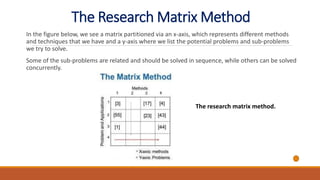
In the figure below, we see a matrix partitioned via an x-axis, which represents different methods
and techniques that we have and a y-axis where we list the potential problems and sub-problems
we try to solve.
Some of the sub-problems are related and should be solved in sequence, while others can be solved
concurrently.
The research matrix method.
The Research Matrix Method
Gray’s last rule says that research should be able to be broken down
into smaller steps, so that one can see intermediate progress.
This is important, since as we know well in history, new innovations are
possible by “standing on the shoulders of the giants.”
This applies to great inventions. It also applies to your own research
agenda, in which one of these giants may, in fact, be you.
One of the most effective methods is the research matrix method, in
which one can systematically plot a path to successful research.
Carrying Out Your Research
A first important step is to state your research objective in one understandable
sentence.
It is more advantageous to make your hypothesis more concrete.
Having more concrete hypothesis at the outset allows researchers to focus on a few
key elements in your work.
An important aspect of experimental design is to decide the free parameters or
independent variables that you must deal with, so that you can decide on their effect
on the dependent variable .
It is important that one of these variables is allowed to vary, while others (known as
control variables) are kept at constant values or randomized.
Carrying Out Your Research
Even after the experimental metric and comparison baselines are settled,
we still have to decide on how to obtain credible subjects on which we
obtain the results.
When dealing with models that can be constructed based on the data, it
is important that we do not mix the training data used for model building
with the data for testing and validating our models and hypothesis.
Finally, once we complete the experiments and produce the results, say in
the form of a number of data tables, we must follow up with
interpretations and analysis of the results.
Carrying Out Your Research
There are two aspects here:
•First, we must be able to tell the reader whether the experimental
results from competing methods showed significant differences via
statistical significance tests.
•Second, we must explain the significance of the results via what we
know from the domain knowledge.
What Do Researchers Do?
1. Explore and come up with new ideas.
2. Validate and implement the new ideas to see if they work, and make them
work well.
3. Write up the research outcome in Tasks.
4. Review papers and manuscripts from other researchers to see if they are novel
and significant enough to be accepted for publication.
5. Administrate academic journals and organize academic conferences, especially
when one becomes an established researcher.
6. Attend academic conferences to present papers, to learn the most recent
research results, and to exchange research ideas and knowledge with other
researchers.
What Do Researchers Do?
7. Apply for research grants from government and other organizations to
support research, including providing support to graduate Basics of Research
5 students.
8. Supervise graduate students, especially Ph.D. candidates, so they become
researchers in the near future.
9. Teach graduate and undergraduate courses in universities and colleges.
10. Perform administrative work for the organizations that researchers work in. In
the university this includes committee work in the department, faculty, or
college, writing reference letters, and so on.
11. Commercialize research outcome (also known as Conducting “Technology
Transfer”).
Carrying Out Your Research
Now we return to the topic of conducting statistical significance tests on your results.
The basic idea here is to ensure that the results are not due to random chance. This can be done by setting
a significance level at a low value, such as 5%.
Then, we can establish that the probability that result is by chance is lower than 5%, and subsequently, we
can say that our result is significant; in this case, we can reject the null hypothesis that there is no
difference.
The significance testing can be done via various significance tests. The student’s t-test, for example, tells if
the means of two sample groups show significant differences. It starts with a null hypothesis that there is
really no difference to be detected between the means of the two methods, and set out to show that the
null hypothesis can be rejected.
The student t-test is used to determine whether there is a difference between two independent sample
groups and when the sizes of the groups are reasonably small.
Carrying Out Your Research
Another often-used significance metric is p-value, which is the probability of
observing the test statistic value if we assume that the null hypothesis to be true.
We often reject the null hypothesis when the test statistic is less than the
significance level alpha.
Summarizing, the research process starts with the formulation of one or more
hypotheses (often a null hypothesis and alternative hypotheses), and goes
through a cycle in which an experimental design is completed together with data
selected and sampled, and then the statistical significance of the results
ascertained.
Finally, domain-related explanations are given so that others can fully appreciate
the impact of the findings. In the process, it is important that the experiments
are repeatable by others under the same experimental conditions.
BRANDING YOURSELF
Taking the view of the matrix, scientific research itself is not very different from
what commercial market researchers typically do when launching a product or a
company:
they have to find out where the market needs truly are.
On examination of the matrix again, a more important discovery from the matrix
is that an entire area can be “owned” by the young researcher, through which
the researcher can truly brand himself or herself as an expert in an area with a
significant impact.
BRANDING YOURSELF
Let us go horizontal first. This is when you have a good grasp on a significant and
high-impact sub problem, perhaps due to your fastidious experimentation and
examination of a particular problem at hand, or perhaps because you have
gained an important insight by reading many research papers and noticed a lack
of attention to a hidden gem.
Once you have a good understanding of the nature and complexity of the sub-
problem, you start asking the questions.
“Can method [x] be applied to this problem?” “What impact will be brought
forth if I succeed in applying method [x] to this problem?” and, “if method [x]
cannot be applied to this problem, what knowledge is gained in the field of
research?”
BRANDING YOURSELF
Likewise, we can also go vertically from top-down in this matrix (see the vertical
arrow), by considering applying the same method to a variety of related
problems in one focused area.
This is preferred if you have a very good grasp on the method’s inner strengths
and weaknesses.
Finally, a better solution is if you can identify both a hammer and a nail, by going
both horizontally and vertically.
If you can truly practice this “hybrid methodology,” you may already have a
research career at hand, and a tree of fruits will grow with the associated
publications.
Empirical vs. Theoretical Research
A popular question raised by many students:
should I do theoretical research or empirical research?
In engineering, the corresponding question is:
should I do fundamental research or application oriented research?
The researchers’ job is to uncover the causal relations between factors that
may be hidden in nature, and this job can be accomplished either
theoretically or experimentally.
Generally speaking, theoretical research fits better for areas where well-
founded assumptions can be formulated to allow inferences to be drawn
from, to verify one or more phenomena under observation.
Empirical vs. Theoretical Research
In contrast, empirical research is when such assumptions are difficult to come up
with, thus requiring experimental verification and data collection.
In traditional science such as physics, the boundary between theoretical and
empirical research was clearer. Nowadays, especially in engineering science and
practice, the line between theory and experimental research is less clear.
Add to this gray area the term “system oriented research,” which may indeed
confuse some beginners and even seasoned professors.
Building a system without subsequent analysis is not research, yet. But, if you have a
hypothesis, say “Method X is better than Method Y under conditions Z,” this
hypothesis can be verified by building systems to realize X, Y under Z and evaluate
the hypothesis with these systems. This way of proving or disproving a hypothesis is
research.
Empirical Research
Empirical research starts with a hypothesis, which is a prediction or
proclamation about the world.
As an example, the claim that “it is possible to fly faster than the speed of
sound” is a hypothesis. It can be proved, or disproved by building a plane that
can break the sound barrier, which provides evidence that is observable.
In science and engineering, hypotheses and empirical research are often tightly
coupled, but they may not be raised and verified by the same person or the
same group of researchers.
How do we get the initial ideas in empirical research? One often-practiced first
step is learning by repeating some other researcher’s work and rebuilding their
systems.
Theoretical research
•Theoretical research proposes models and hypotheses that can be
generalized and tested.
•They often state a fact that goes beyond the current set of
observations using methods of induction.
•Once the models are built, theories should have the ability to
deduce new facts about the future.
•Thus, good theories have the generalization ability.
Theoretical research
Empirical and theoretical research also often go hand in hand; in fact, in physics, the
theoretical and empirical research works are often done by theoretical physicists and
experimental physicists, respectively, who are often two separate groups of people.
To see whether you as a researcher should become a theorist or an experimental
scientist, consider that in science and engineering, the development of theories have
been serving two strikingly different purposes. The first purpose is for experiments to
confirm or disprove a preceding theory, and the second one is vice versa.
As a beginning researcher, you need to have a keen eye on the way the general field is
going, and able to see the theoretical underpinning in the trend. At the same time, you
need to cultivate a keen eye on how to unify different empirical research and various
theories with a simple and elegant theory of your own.
Team Work and Multi-Disciplinary
Research
A longtime ago, research used to be a one-person affair.
Leonardo da Vinci studied animal and human anatomy, architecture, and physics alone.
Galileo Galilei studied the motion of objects and planets, Newton published his three laws of physics, and they published their works
all by themselves.
Ibn Sina, also known as Abu Ali Sina, Pur Sina, and often known in the West as Avicenna, was a Persian polymath who is regarded as
one of the most significant physicians, astronomers, thinkers and writers of the Islamic Golden Age, and the father of early modern
medicine.
Muḥammad ibn Mūsā al-Khwārizmī, Arabized as al-Khwarizmi and formerly Latinized as Algorithmi, was a Persian polymath who
produced vastly influential works in mathematics, astronomy, and geography. Around 820 CE he was appointed as the astronomer and
head of the library of the House of Wisdom in Baghdad.
This situation has dramatically changed today: open any issue of Nature, and you will notice many co-authors for each paper;
sometimes the authorship takes up an entire page.
In milder cases, look up any author in engineering science, in Google scholar or DBLP, and you will find an active researcher who has
likely co-authored several, if not many, research papers with dozens of other people. In today’s science and engineering research,
teamwork and collaboration have become commonplace.
Team Work and Multi-Disciplinary
Research
For scientific research, however, collaboration often takes some
unique conditions.
We can summarize these conditions as:
common goals,
communication,
complimentary skill set,
and social cohesiveness.
Team Work and Multi-Disciplinary
Research
A most common team setting is a student-advisor combination. There can
be variations where an advisor is replaced by a committee member, and
the student by a student group.
In this setting, the student is often the main risk taker, taking the initiative in seeking out new research topics,
conducting surveys, inventing algorithms, and carrying out the experiments needed if the work involved is
empirical in nature. In this case, the advisor acts as a consultant, giving feedback to students from time to time
and making sure that the student is on the right track.
In this setting, the student is often the main risk taker, taking the initiative in seeking out new research topics,
conducting surveys, inventing algorithms, and carrying out the experiments needed if the work involved is
empirical in nature.
In this case, the advisor acts as a consultant, giving feedback to students from time to time and making sure that
the student is on the right track.
At the beginning, the advisor is often the generator of the initial ideas, defining an area where the advisor has
experience in, and listing out several potential broad topics for the student to choose from. Later, the student
becomes the main idea generator.
Team Work and Multi-Disciplinary
Research
When it is time for paper writing, the advisor often acts as an editor, especially for the first versions of
the research paper.
In fact, an effective advisor can help a student choose a better title, formulate a better abstract, and a
better introduction, which are often the most difficult tasks to do for a beginner.
These points are particularly important when dealing with multidisciplinary research, where team
members come from different disciplines. This is when your teammates are most likely your peers.
Bear in mind that multidisciplinary research is often the most rewarding, because it allows each
researcher to “think outside the box” of his or her own research field.
In multi-disciplinary research, many new challenges exist. . While it is fun to work with researchers
elsewhere, it does take time to learn each other’s objectives, tools, and terminologies.
This period of re-education might last one or more years, after which one can find many exciting new
horizons. Thus, we highly encourage Ph.D. students to be willing to drop in each other’s seminars and
conferences to learn something entirely new.
Writing and Publishing Papers
A research work and outcome can be very roughly categorized into top-notch (say top
5%), very good (top 5–25%), good (top 25–50%), and so so (bottom 50%), based on its
novelty and significance.
Experienced researchers, such as your supervisors, may have a better sense where your
research outcome fits in.
We can also roughly categorize journals and conferences into the same four classes
based on many factors (such as the Impact Factor, competitiveness, and so on). Then,
good writing is to ensure that a research outcome will be published in a publication
venue of the corresponding category.
As the late Turing Award winner and Nobel Laureate, Herb Simon was known to tell his
students: to write a good paper, “you decide on what you want to say, say it, and then
choose a good title!”
“Publish or Perish”
Publishing high-impact, top-quality papers in top, peer-reviewed venues in a
sustained manner is extremely important for researchers, especially faculty
members in universities and researchers in research labs.
It is the most important means to share with the research community your
contributions in research, and your papers will hopefully bring impact to the
field.
In addition, your academic promotion is also critically hinged on your high-
impact publications.
The same can be said about your research grants and projects.
“Publish or Perish”
Thus, in the research circle, there is a phrase: “publish or perish”!
Indeed, the pressure for publishing high-impact papers is very high in universities in
North America, and in many countries around the world.
This pressure tends to have some adverse effects, including producing “salami” papers
that are not highly impactful and overlooking the other important responsibilities (such
as teaching) of university professors.
We are certainly against publishing many unimportant papers just to pad your resume.
We emphasize that a researcher’s goal is to publish high-impact papers that others can
use to build their own research programs.
One indication of impact is citation numbers, which counts the number of references
others have made in their papers when referring to your work.
“Publish or Perish”
Today we have many ways to count citations.
Some count citations by journal articles only; for example, the Science Citation
Index, or SCI, is an often-used index on journals from the Institute for Scientific
Information (ISI), which is owned by Thomson Reuters.
Instead of just counting a limited number of journals, other citation services may
include most open-source publication venues, including conferences.
Examples include the Google Scholar and the CiteSeerX services, which are
increasingly being used to judge the impact of papers and researchers.
A particularly important measure is the h-index, which is a measure designed by
Jorge E. Hirsch on both the productivity and the citation numbers of a paper.
“Publish or Perish”
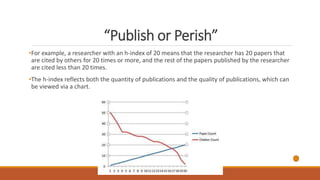
•For example, a researcher with an h-index of 20 means that the researcher has 20 papers that
are cited by others for 20 times or more, and the rest of the papers published by the researcher
are cited less than 20 times.
•The h-index reflects both the quantity of publications and the quality of publications, which can
be viewed via a chart.
Why Publishing Top-quality Papers Is Hard
There are usually two major avenues of publications: conferences and journals.
Most good conferences and journals want to maintain their reputation of only
publishing a limited number of top-quality papers.
At the same time, most researchers want to publish in those top conferences
and journals, because their papers will have a high visibility. Thus, the
competition is very stiff.
In computer science and some other disciplines, there are many top-rated
conferences that publish full-length papers (e.g., 6 to 12 pages of double-
column, condensed texts).
The acceptance rate can range from 10 to 30%.
Why Publishing Top-quality Papers Is Hard
Many top specialty journals in science and engineering also have an acceptance
rate of about 10–30%.
Some broad top-of-the-heap journals in science (such as Science and Nature)
have very low acceptance rates.
We usually give those students the following advice: first, do not submit “lousy”
papers to a good conference or journal just to try your luck, or just to get
reviewer comments about the paper.
Second, it is academic misconduct to simultaneously submit the same or very
similar papers to multiple places.
What Makes a Great Paper?
When reviewers evaluate papers, they take into account the overall quality of the conferences
and journals that you submit to.
First, you need to understand the review process. Almost all conferences and journals recruit a
pool of established researchers to review submitted papers. For each submission, 2–5 reviewers
(usually 3) in the same or closely related areas are selected to review your paper.
These reviewers often need to provide a set of “scores” for rating the quality of the paper, along
with a detailed justification of their scores.
Reviewers are always anonymous, thus, they often review papers with a critical eye.
Scores are usually integers between 1 to 5, or between 1 to 10. The following is a typical list of
questions that reviewers must answer with scores:
What Makes a Great Paper?
The following is a typical list of questions that reviewers must answer with scores:
Please use an integer from 1 to 5 to answer each question below (1 for definitely NO, 5
for definitely YES):
1. Are the research and results novel?
2. Are the results significant?
3. Is the paper technically sound?
4. Is the paper clearly written and well presented?
5. Should the paper be accepted?
6. Are you highly confident about your review?
What Makes a Great Paper?
Clearly, Questions 1 and 2 are about novelty and significance of the research we have been talking
about throughout this book.
Question 3 is about research methodologies. The research must be technically sound to support the
main claim of the paper.
If the idea is not novel, the result is not significant, or the research method is flawed, the scores on
Questions 1–3 would be low, and the chance for your paper to be accepted would be low, no matter
how well you write your paper.
However, too often we see young researchers, including Ph.D. candidates, who have conducted novel
and significant research, but have difficulty in writing their papers well. That is, their papers would
receive a low score for Question 4 above. This also means that it is difficult and frustrating for
reviewers to make an accurate judgment about Questions 1–3.
For a high-quality and competitive conference or journal, reviewers are usually critical and cautious—if
they are not sure about the novelty and significance of a paper, they tend to give low scores for
Questions 1–3.
A Few Untold Truths about Research
Paper
We would like to first lay down a few basic “ground truths” or postulates about research papers.
These postulates are so basic and well accepted in the research community that your supervisors (or
other researchers) may never explicitly spell them out for you. However, many early researchers learn
these postulates in the hard way.
The first and most important ground truth about a research paper is that it must be truthful,
honest, and accurate.
If researchers intentionally falsify the results or mislead the readers, serious questions may be raised
about the researchers’ credibility; in the worst case, academic fraud may be charged.
Another common form of research misconduct is plagiarism. This includes many forms. One of them
is called citation plagiarism. We understand that many authors may not wish to do this on purpose;
often they may not find certain previous publications to know that their work has actually been done
and published before.
As authors, you must study and cite other published papers, and discuss how your paper is different
from them.
A Few Untold Truths about Research
Paper
You should do a thorough literature search, as thorough as you can before you start your
research on a chosen topic or problem. This would help prevent you from wasting time and
effort in “reinventing the wheel.”
When you make a claim in your paper on novelty, you may also say “to the best of our
knowledge, our work is original . . .” to reflect your best effort.
Another form of plagiarism is multiple publications of the same or very similar content in
different conferences and journals.
Many conferences and journals explicitly ask authors to submit only original work, and forbid
simultaneous submissions even if the authors intend to withdraw others should one submission
be accepted.
Multiple submissions and publications can be discovered easily (especially with modern
electronic submission systems), and will easily damage authors’ reputations.
A Few Untold Truths about Research
Paper
When you include others’ writings as your own, you run the risk of violating copyright law.
Some graduate students copy many sentences or even several paragraphs from other papers,
often from previous work or a general introduction to a topic, in their own papers.
True, the description of previous work or a wellestablished topic is pretty much the same. But
still, you cannot copy sentences from other papers into yours as if you wrote them.
The “other papers” may actually include your own published papers. The publication agreement
of your previous papers may stipulate that anyone, including you, needs to get a written
permission if any part of the paper is reproduced.
If you need to quote the whole sentences or paragraph as fair use in your paper, put them in
quotation marks, and cite the sources.
A Few Untold Truths about Research
Paper
An easy way to avoid copyright infringement, when you write similar content as in other papers, is to wait for a
few hours (or days) after you read the other papers, and write the description in your own words. This way, your
content will be similar, but the wording will be quite different.
The last often-untold truth about research papers is that it must reveal the full details of your research so that
other researchers can replicate your results independently after reading your published paper.
It is your responsibility to reveal technical details of your work as fully and as clearly as possible in your paper.
If other researchers require additional details of your published paper, you are obliged to supply them.
Indeed, research in science is “self-regulating” and “self-correcting,” where published results and papers will be
analyzed, replicated, verified, and improved upon by other researchers.
It is an open (fully revealing), fair (relatively speaking), and free (i.e., academic freedom) community. If your work
contains trade secrets or methods with potential commercial gain, you can choose not to publish it, or you can
secure patents or other intellectual property protections before the paper is submitted.
The Roles of You, Your Supervisor, and
Proofreader
Quite a few graduate students are from abroad, where their native language is not English (such as Chinese, Persian,
Spanish), but they need to write papers in English. “Since my native language is not English, my supervisor should write
the papers, while I am doing the experiments,” some may say.
Or, students just write a first draft, give it to their supervisor or proofreader to revise and polish the paper to
“perfection.”
These viewpoints are certainly not correct. You must learn to write papers well by yourself by the end of your Ph.D.
study, regardless of whether your native language is English or not.
There are many language-independent misconceptions and flaws in writing research papers, and they are often harder
to overcome than grammatical errors. Your supervisor will play an important role in correcting them.
The Roles of You, Your Supervisor, and
Proofreader
Here is a list of roles that the supervisor may play in paper writing:
1. Help you to understand the goals, logic flow, organization, and arguments in writing research
papers.
2. Help you to identify specific misconceptions in writing research papers, and you must learn
to correct them quickly.
3. Make high-level suggestions on how to improve the presentation and argument of the
papers.
4. Make a final check of the paper before it is submitted.
The Roles of You, Your Supervisor, and
Proofreader
Your role in paper writing:
1. Work with your supervisor closely for the first 1–2 papers, and learn to write papers well
quickly (see Section 5.6 for advice for supervisors).
2. Become independent quickly, and be able to write the whole paper well by yourself.
The Roles of You, Your Supervisor, and
Proofreader
Proofreader’s role:
1. After a paper is largely finished (with excellent structure, flow, argument, organization, and
presentation) by you and your supervisor, a proofreader can be asked to further improve the
paper and correct minor English errors. Other graduate students in the group or in the
department would be good candidates.
We want to emphasize that the role of proofreaders, unless they are also researchers in the
similar area, is quite minimal.
You and your supervisor are most crucial for writing a high-quality research paper.
How to Improve Your Students’ Writing
Most Effectively
Many supervisors first ask their students to write paper drafts, and correct them on papers (e.g.,
with red ink). They pass the corrected drafts to students to “input” the corrections in the paper.
Unbeknownst to supervisors, their students often have a hard time reading their handwriting,
and do not know why these changes have been made.
The improvement in the students’ writing skill is often minimal in each such writing-revision
iteration.
The following method can very quickly improve students’ writing skill, to the point that they can
write well by themselves after writing only 1 to 2 papers. Progressive Improvement method.
How to Improve Your Students’ Writing
Most Effectively
The PI method works roughly as follows:
When it is time to write a research paper, you can ask your student to write a few sections first, or about half of the first
draft.
•These sections may include the Abstract, Introduction, and a section on your new theory or methods.
•Sit with your student, and work closely with him, word by word, for the first page (just one page) of the paper.
•Provide detailed explanations about why you revise the paper this way.
•Ask the student to write down each writing principle and each type of mistake your student made.
•Tell your student to learn and generalize from these principles and mistakes, and apply them to revising the rest of the
paper.
•Ask them to review the notes often, take time to revise the paper carefully, and try not to make the same mistakes again.
How to Improve Your Students’ Writing
Most Effectively
•Student may come back in a few days with the revised paper. Quickly review the previous page(s) you
have worked on, and offer further advice on improvements.
•Then work with him, word by word, on the next new page (still, just one page). You should notice that
the number of mistakes and needed improvements might be cut by half.
•Your student should write down new tips and mistakes, and then go away to revise the rest of the
paper.
•This process goes on progressively (thus called Progressive Improvement), until the whole paper is
improved once. By that time, the writing skill of your student should have improved tremendously.
•It is often necessary to go over this whole process two or more times. In the second and third rounds
you and your student may focus more on the overall structure and logic flow of the paper, adding
experiments to make the results more convincing, adding examples to make it easier to understand,
and so on. Again, you work closely with your student, but only on 1–2 issues, or only on 1–2 pages at
a time.
•Then, you may ask him to apply the ideas to improve the whole paper.
How to Improve Your Students’ Writing
Most Effectively
Several such iterations are often needed to produce a highly polished and satisfactory paper, to
be submitted to competitive conferences or journals. By the time the first paper is finished
(usually in several months), you student should improve his writing tremendously, and be ready
to write a reasonably good paper by himself.
Your student will also learn how you have tried to make their paper as perfect as possible.
Keep each version of the revisions so that your student can see how many changes have been
made, and learn from this process after the paper is submitted.
In Chinese there is a saying: it is better to teach people to fish, rather than giving them a fish.
Where to Submit: Conference or
Journals?
In some disciplines, such as biology and statistics, conference papers are usually very short and
in the form of an extended abstract, and the acceptance rates are usually high.
The purpose of the conferences in these disciplines is to let researchers meet and present their
most recent work, usually as posters.
Complete work is often published only in journals.
In other disciplines, such as Computer Science, conference papers are full-length with 6 to 12
pages of condensed text, often in double columns, reporting on novel contributions. The reviews
for such conferences are more rigorous, and thus, the acceptance rates are typically quite low.
If a paper is accepted, authors often have 20 to 30 minutes to present their work orally in a
conference session, sometimes as a poster as well.
Often, such conference papers are regarded as important as journal paper publications,
although different departments, schools, and universities may put them under different weights.
Where to Submit: Conference or
Journals?
Here are some other differences between full-length conference and journal papers:
1. Conference papers often have a shorter review time than journals, and their review processes are also. Thus, conference
papers are suitable for reporting the most current work with rapid progress. Going to conferences also allows you to meet
other researchers and build up your academic network.
2. Annual conferences have submission deadlines while journals do not. Thus, conference deadlines are often taken as drivers
and landmarks for making progress in research.
3. Conference papers, including the full-length ones, usually have page limits, while most journals do not. Thus, journal papers
are usually longer, extending full-length conference papers to report complete work, and thus are often regarded as
“archival.”
One way to enter a research field is to attend a top or main conference in that field. In computer science, for example, each
subfield such as artificial intelligence or machine learning has its own “top conference.”
Each discipline has a set of conferences and journals; usually some are considered top-tiered, while others so-so. Here are some
general guidelines in choosing conferences and journals to publish your work. If a conference is the main conference in the field
where most important researchers go, where “importance” can be measured by citation numbers, h-index, or leadership in an
area, then you may consider submiting a paper or poster even if the acceptance rate is high. Otherwise, choose the main
conferences in a field with an acceptance rate around or below 1/3.
Where to Submit: Conference or
Journals?
For journals, it is hard to specify an Impact Factor (IF) as a guide to determine where to submit
your papers, as IF varies a lot for different disciplines.
One general guideline is to choose the top tier, or the top 25%, of the journals in the field in
terms of IF.
You may also talk to your supervisor who should know well which conferences and journals
belong to top-tier.
How Are Full-length Conference Papers
Reviewed?
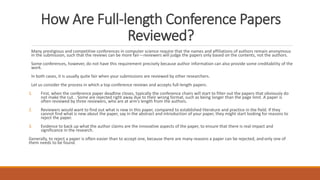
Many prestigious and competitive conferences in computer science require that the names and affiliations of authors remain anonymous
in the submission, such that the reviews can be more fair—reviewers will judge the papers only based on the contents, not the authors.
Some conferences, however, do not have this requirement precisely because author information can also provide some creditability of the
work.
In both cases, it is usually quite fair when your submissions are reviewed by other researchers.
Let us consider the process in which a top conference reviews and accepts full-length papers.
1. First, when the conference paper deadline closes, typically the conference chairs will start to filter out the papers that obviously do
not make the cut. . Some are rejected right away due to their wrong format, such as being longer than the page limit. A paper is
often reviewed by three reviewers, who are at arm’s length from the authors.
2. Reviewers would want to find out what is new in this paper, compared to established literature and practice in the field. If they
cannot find what is new about the paper, say in the abstract and introduction of your paper, they might start looking for reasons to
reject the paper.
3. Evidence to back up what the author claims are the innovative aspects of the paper, to ensure that there is real impact and
significance in the research.
Generally, to reject a paper is often easier than to accept one, because there are many reasons a paper can be rejected, andonly one of
them needs to be found.
How Are Full-length Conference Papers
Reviewed?
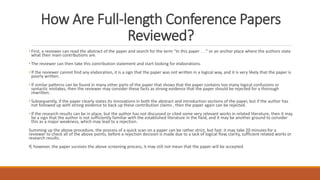
• First, a reviewer can read the abstract of the paper and search for the term “In this paper . . .” or an anchor place where the authors state
what their main contributions are.
• The reviewer can then take this contribution statement and start looking for elaborations.
• If the reviewer cannot find any elaboration, it is a sign that the paper was not written in a logical way, and it is very likely that the paper is
poorly written.
• If similar patterns can be found in many other parts of the paper that shows that the paper contains too many logical confusions or
syntactic mistakes, then the reviewer may consider these facts as strong evidence that the paper should be rejected for a thorough
rewritten.
• Subsequently, if the paper clearly states its innovations in both the abstract and introduction sections of the paper, but if the author has
not followed up with strong evidence to back up these contribution claims , then the paper again can be rejected.
• If the research results can be in place, but the author has not discussed or cited some very relevant works in related literature, then it may
be a sign that the author is not sufficiently familiar with the established literature in the field, and it may be another ground to consider
this as a major weakness, which may lead to a rejection.
Summing up the above procedure, the process of a quick scan on a paper can be rather strict, but fast: it may take 20 minutesfor a
reviewer to check all of the above points, before a rejection decision is made due to a lack of logical flow,clarity, sufficient related works or
research results.
If, however, the paper survives the above screening process, it may still not mean that the paper will be accepted.
How Are Full-length Conference Papers
Reviewed?
The reviewer might take another 30 minutes or longer to carefully read the technical parts of
the paper, go through the derivations, theorems, and results, check the relevant literature, and
perhaps even ask the opinion of another expert in the area, before giving a recommendation on
the paper.
Some conferences allow authors to view the reviews and input their feedback online before final
decisions are made. If such an opportunity is given, you should try your best to provide succinct,
clear, and strong statements about reviews, especially if you believe some aspects of the reviews
are not correct.
The final acceptance decision of each paper will be made by the senior program committee
member (SPC) and the program chairs. Once the decision is made in a conference, which is
usually just “Accept” or “Reject,” the decision is final, and usually cannot be appealed.
How Are Journal Papers Reviewed?
Journal papers are peer-reviewed by other researchers, in a similar way as a conference paper.
The EIC (Editors-in-Chief ) of the journal may assign each submission to one of the Associate Editors
(AE) of the journal.
The AE in charge of your paper will recruit reviewers and oversee the reviews of your submitted
paper.
The final decision is usually made by the EIC.
Compared to conference papers, major differences exist that make journal papers much “deeper.”
First, a journal usually does not have a very strict page limit, making it possible for authors to fully
express themselves. Thus, authors can go much deeper in a journal paper than in a conference paper
in describing their research results.
Second, the process of paper review for a journal paper is often longer than a conference paper,
going through several “rounds” of comments and response between the reviewers and authors. This
process makes it possible for authors to submit a revised paper to address all reviewers’ concerns.
How Are Journal Papers Reviewed?
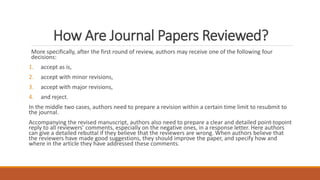
More specifically, after the first round of review, authors may receive one of the following four
decisions:
1. accept as is,
2. accept with minor revisions,
3. accept with major revisions,
4. and reject.
In the middle two cases, authors need to prepare a revision within a certain time limit to resubmit to
the journal.
Accompanying the revised manuscript, authors also need to prepare a clear and detailed point-topoint
reply to all reviewers’ comments, especially on the negative ones, in a response letter. Here authors
can give a detailed rebuttal if they believe that the reviewers are wrong. When authors believe that
the reviewers have made good suggestions, they should improve the paper, and specify how and
where in the article they have addressed these comments.
How Are Journal Papers Reviewed?
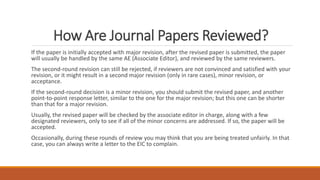
If the paper is initially accepted with major revision, after the revised paper is submitted, the paper
will usually be handled by the same AE (Associate Editor), and reviewed by the same reviewers.
The second-round revision can still be rejected, if reviewers are not convinced and satisfied with your
revision, or it might result in a second major revision (only in rare cases), minor revision, or
acceptance.
If the second-round decision is a minor revision, you should submit the revised paper, and another
point-to-point response letter, similar to the one for the major revision; but this one can be shorter
than that for a major revision.
Usually, the revised paper will be checked by the associate editor in charge, along with a few
designated reviewers, only to see if all of the minor concerns are addressed. If so, the paper will be
accepted.
Occasionally, during these rounds of review you may think that you are being treated unfairly. In that
case, you can always write a letter to the EIC to complain.
How Are Journal Papers Reviewed?
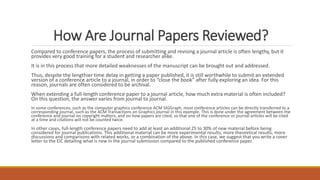
Compared to conference papers, the process of submitting and revising a journal article is often lengthy, but it
provides very good training for a student and researcher alike.
It is in this process that more detailed weaknesses of the manuscript can be brought out and addressed.
Thus, despite the lengthier time delay in getting a paper published, it is still worthwhile to submit an extended
version of a conference article to a journal, in order to “close the book” after fully exploring an idea. For this
reason, journals are often considered to be archival.
When extending a full-length conference paper to a journal article, how much extra material is often included?
On this question, the answer varies from journal to journal.
In some conferences, such as the computer graphics conference ACM SIGGraph, most conference articles can be directly transferred to a
corresponding journal, such as the ACM Transactions on Graphics journal in this example. This is done under the agreement between the
conference and journal on copyright matters, and on how papers are cited, so that one of the conference or journal articles will be cited
at a time and citations will not be counted twice.
In other cases, full-length conference papers need to add at least an additional 25 to 30% of new material before being
considered for journal publications. This additional material can be more experimental results, more theoretical results, more
discussions and comparisons with related works, or a combination of the above. In this case, we suggest that you write a cover
letter to the EIC detailing what is new in the journal submission compared to the published conference paper.
Misconceptions and Tips for Paper
Writing
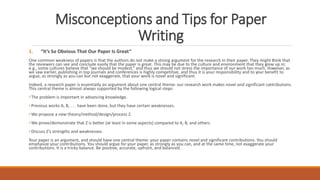
1. “It’s So Obvious That Our Paper Is Great”
One common weakness of papers is that the authors do not make a strong argument for the research in their paper. They might think that
the reviewers can see and conclude easily that the paper is great. This may be due to the culture and environment that they grew up in;
e.g., some cultures believe that “we should be modest,” and thus we should not stress the importance of our work too much. However, as
we saw earlier, publishing in top journals and conferences is highly competitive, and thus it is your responsibility and to your benefit to
argue, as strongly as you can but not exaggerate, that your work is novel and significant.
Indeed, a research paper is essentially an argument about one central theme: our research work makes novel and significant contributions.
This central theme is almost always supported by the following logical steps:
• The problem is important in advancing knowledge.
• Previous works A, B, . . . have been done, but they have certain weaknesses.
• We propose a new theory/method/design/process Z.
• We prove/demonstrate that Z is better (at least in some aspects) compared to A, B, and others.
• Discuss Z’s strengths and weaknesses.
Your paper is an argument, and should have one central theme: your paper contains novel and significant contributions. You should
emphasize your contributions. You should argue for your paper, as strongly as you can, and at the same time, not exaggerate your
contributions. It is a tricky balance. Be positive, accurate, upfront, and balanced.
Misconceptions and Tips for Paper
Writing
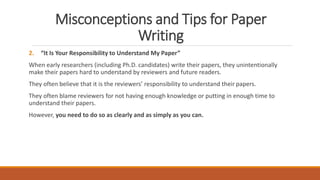
2. “It Is Your Responsibility to Understand My Paper”
When early researchers (including Ph.D. candidates) write their papers, they unintentionally
make their papers hard to understand by reviewers and future readers.
They often believe that it is the reviewers’ responsibility to understand their papers.
They often blame reviewers for not having enough knowledge or putting in enough time to
understand their papers.
However, you need to do so as clearly and as simply as you can.
The 10/30 Test
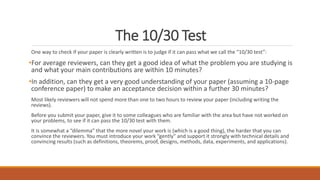
One way to check if your paper is clearly written is to judge if it can pass what we call the “10/30 test”:
•For average reviewers, can they get a good idea of what the problem you are studying is
and what your main contributions are within 10 minutes?
•In addition, can they get a very good understanding of your paper (assuming a 10-page
conference paper) to make an acceptance decision within a further 30 minutes?
Most likely reviewers will not spend more than one to two hours to review your paper (including writing the
reviews).
Before you submit your paper, give it to some colleagues who are familiar with the area but have not worked on
your problems, to see if it can pass the 10/30 test with them.
It is somewhat a “dilemma” that the more novel your work is (which is a good thing), the harder that you can
convince the reviewers. You must introduce your work “gently” and support it strongly with technical details and
convincing results (such as definitions, theorems, proof, designs, methods, data, experiments, and applications).
The 10/30 Test
3. The 10/30 Test
Whenever you are writing a research paper, or a report or thesis for that matter, you must
remember at all times that you are writing for your readers, such as reviewers, other researchers,
and thesis examiners.
You know your work so well after many years of research, but this is not true for your reviewers.
To write for reviewers, you must first gauge the knowledge level of average reviewers.
If you are submitting your paper to a general conference or journal, a gentle introduction to the
problem you study is needed. You should assume that the reviewers have little knowledge on the
specific research problems you work on.
You should certainly assume that reviewers have never attended your weekly research meetings,
nor have they heard your presentations on the work! All they have at hand is this paper that they
are reading.

Unit2-RM.pptx

  • 1.
  • 2.
    An Overview ofa Research Process 1. Find a novel and potentially high-impact problem to solve based on the high-level criteria on choosing a good problem. 2. Find a candidate solution. You then formulate a hypothesis as a (problem, solution) pair. Each hypothesis states that the solution can indeed solve the problem. 3. Conduct theoretical or empirical analysis on the hypotheses to confirm or dispel them. You also conduct significance tests to establish the validity of your conclusions on these hypotheses. 4. If you are successful in your significance testing, then you are done. Otherwise, you return to Step 2, find another candidate solution to the problem, and repeat the process.
  • 3.
    Jim Gray’s Criteria Oneof the best-known criteria for high-impact research was summarized by the late great computer scientist and Turing Award winner Jim Gray, who was credited with the invention of modern database technology and the fourth paradigm in computer-science research. In his 1999 Turing Award lecture, he stated that good research should: •have clear benefit •be simple to state •have no obvious solution •have a criterion where progress and solutions are testable, and •where it is possible to break the larger problem down into smaller steps, so that one can see intermediate progress after each step.
  • 4.
    Jim Gray’s Criteria Wewill refer to this set of rules as “Gray’s Criteria” hereafter. One of the most important aspects of Gray’s Criteria is that the progress should be testable. Today, much research is done by means of system building and empirical testing. In this context, a testable criterion can be further refined to: we must ensure that it is feasible to get credible and a sufficient amount of data.
  • 5.
    The Research MatrixMethod In the figure below, we see a matrix partitioned via an x-axis, which represents different methods and techniques that we have and a y-axis where we list the potential problems and sub-problems we try to solve. Some of the sub-problems are related and should be solved in sequence, while others can be solved concurrently. The research matrix method.
  • 6.
    The Research MatrixMethod Gray’s last rule says that research should be able to be broken down into smaller steps, so that one can see intermediate progress. This is important, since as we know well in history, new innovations are possible by “standing on the shoulders of the giants.” This applies to great inventions. It also applies to your own research agenda, in which one of these giants may, in fact, be you. One of the most effective methods is the research matrix method, in which one can systematically plot a path to successful research.
  • 7.
    Carrying Out YourResearch A first important step is to state your research objective in one understandable sentence. It is more advantageous to make your hypothesis more concrete. Having more concrete hypothesis at the outset allows researchers to focus on a few key elements in your work. An important aspect of experimental design is to decide the free parameters or independent variables that you must deal with, so that you can decide on their effect on the dependent variable . It is important that one of these variables is allowed to vary, while others (known as control variables) are kept at constant values or randomized.
  • 8.
    Carrying Out YourResearch Even after the experimental metric and comparison baselines are settled, we still have to decide on how to obtain credible subjects on which we obtain the results. When dealing with models that can be constructed based on the data, it is important that we do not mix the training data used for model building with the data for testing and validating our models and hypothesis. Finally, once we complete the experiments and produce the results, say in the form of a number of data tables, we must follow up with interpretations and analysis of the results.
  • 9.
    Carrying Out YourResearch There are two aspects here: •First, we must be able to tell the reader whether the experimental results from competing methods showed significant differences via statistical significance tests. •Second, we must explain the significance of the results via what we know from the domain knowledge.
  • 10.
    What Do ResearchersDo? 1. Explore and come up with new ideas. 2. Validate and implement the new ideas to see if they work, and make them work well. 3. Write up the research outcome in Tasks. 4. Review papers and manuscripts from other researchers to see if they are novel and significant enough to be accepted for publication. 5. Administrate academic journals and organize academic conferences, especially when one becomes an established researcher. 6. Attend academic conferences to present papers, to learn the most recent research results, and to exchange research ideas and knowledge with other researchers.
  • 11.
    What Do ResearchersDo? 7. Apply for research grants from government and other organizations to support research, including providing support to graduate Basics of Research 5 students. 8. Supervise graduate students, especially Ph.D. candidates, so they become researchers in the near future. 9. Teach graduate and undergraduate courses in universities and colleges. 10. Perform administrative work for the organizations that researchers work in. In the university this includes committee work in the department, faculty, or college, writing reference letters, and so on. 11. Commercialize research outcome (also known as Conducting “Technology Transfer”).
  • 12.
    Carrying Out YourResearch Now we return to the topic of conducting statistical significance tests on your results. The basic idea here is to ensure that the results are not due to random chance. This can be done by setting a significance level at a low value, such as 5%. Then, we can establish that the probability that result is by chance is lower than 5%, and subsequently, we can say that our result is significant; in this case, we can reject the null hypothesis that there is no difference. The significance testing can be done via various significance tests. The student’s t-test, for example, tells if the means of two sample groups show significant differences. It starts with a null hypothesis that there is really no difference to be detected between the means of the two methods, and set out to show that the null hypothesis can be rejected. The student t-test is used to determine whether there is a difference between two independent sample groups and when the sizes of the groups are reasonably small.
  • 13.
    Carrying Out YourResearch Another often-used significance metric is p-value, which is the probability of observing the test statistic value if we assume that the null hypothesis to be true. We often reject the null hypothesis when the test statistic is less than the significance level alpha. Summarizing, the research process starts with the formulation of one or more hypotheses (often a null hypothesis and alternative hypotheses), and goes through a cycle in which an experimental design is completed together with data selected and sampled, and then the statistical significance of the results ascertained. Finally, domain-related explanations are given so that others can fully appreciate the impact of the findings. In the process, it is important that the experiments are repeatable by others under the same experimental conditions.
  • 14.
    BRANDING YOURSELF Taking theview of the matrix, scientific research itself is not very different from what commercial market researchers typically do when launching a product or a company: they have to find out where the market needs truly are. On examination of the matrix again, a more important discovery from the matrix is that an entire area can be “owned” by the young researcher, through which the researcher can truly brand himself or herself as an expert in an area with a significant impact.
  • 15.
    BRANDING YOURSELF Let usgo horizontal first. This is when you have a good grasp on a significant and high-impact sub problem, perhaps due to your fastidious experimentation and examination of a particular problem at hand, or perhaps because you have gained an important insight by reading many research papers and noticed a lack of attention to a hidden gem. Once you have a good understanding of the nature and complexity of the sub- problem, you start asking the questions. “Can method [x] be applied to this problem?” “What impact will be brought forth if I succeed in applying method [x] to this problem?” and, “if method [x] cannot be applied to this problem, what knowledge is gained in the field of research?”
  • 16.
    BRANDING YOURSELF Likewise, wecan also go vertically from top-down in this matrix (see the vertical arrow), by considering applying the same method to a variety of related problems in one focused area. This is preferred if you have a very good grasp on the method’s inner strengths and weaknesses. Finally, a better solution is if you can identify both a hammer and a nail, by going both horizontally and vertically. If you can truly practice this “hybrid methodology,” you may already have a research career at hand, and a tree of fruits will grow with the associated publications.
  • 17.
    Empirical vs. TheoreticalResearch A popular question raised by many students: should I do theoretical research or empirical research? In engineering, the corresponding question is: should I do fundamental research or application oriented research? The researchers’ job is to uncover the causal relations between factors that may be hidden in nature, and this job can be accomplished either theoretically or experimentally. Generally speaking, theoretical research fits better for areas where well- founded assumptions can be formulated to allow inferences to be drawn from, to verify one or more phenomena under observation.
  • 18.
    Empirical vs. TheoreticalResearch In contrast, empirical research is when such assumptions are difficult to come up with, thus requiring experimental verification and data collection. In traditional science such as physics, the boundary between theoretical and empirical research was clearer. Nowadays, especially in engineering science and practice, the line between theory and experimental research is less clear. Add to this gray area the term “system oriented research,” which may indeed confuse some beginners and even seasoned professors. Building a system without subsequent analysis is not research, yet. But, if you have a hypothesis, say “Method X is better than Method Y under conditions Z,” this hypothesis can be verified by building systems to realize X, Y under Z and evaluate the hypothesis with these systems. This way of proving or disproving a hypothesis is research.
  • 19.
    Empirical Research Empirical researchstarts with a hypothesis, which is a prediction or proclamation about the world. As an example, the claim that “it is possible to fly faster than the speed of sound” is a hypothesis. It can be proved, or disproved by building a plane that can break the sound barrier, which provides evidence that is observable. In science and engineering, hypotheses and empirical research are often tightly coupled, but they may not be raised and verified by the same person or the same group of researchers. How do we get the initial ideas in empirical research? One often-practiced first step is learning by repeating some other researcher’s work and rebuilding their systems.
  • 20.
    Theoretical research •Theoretical researchproposes models and hypotheses that can be generalized and tested. •They often state a fact that goes beyond the current set of observations using methods of induction. •Once the models are built, theories should have the ability to deduce new facts about the future. •Thus, good theories have the generalization ability.
  • 21.
    Theoretical research Empirical andtheoretical research also often go hand in hand; in fact, in physics, the theoretical and empirical research works are often done by theoretical physicists and experimental physicists, respectively, who are often two separate groups of people. To see whether you as a researcher should become a theorist or an experimental scientist, consider that in science and engineering, the development of theories have been serving two strikingly different purposes. The first purpose is for experiments to confirm or disprove a preceding theory, and the second one is vice versa. As a beginning researcher, you need to have a keen eye on the way the general field is going, and able to see the theoretical underpinning in the trend. At the same time, you need to cultivate a keen eye on how to unify different empirical research and various theories with a simple and elegant theory of your own.
  • 22.
    Team Work andMulti-Disciplinary Research A longtime ago, research used to be a one-person affair. Leonardo da Vinci studied animal and human anatomy, architecture, and physics alone. Galileo Galilei studied the motion of objects and planets, Newton published his three laws of physics, and they published their works all by themselves. Ibn Sina, also known as Abu Ali Sina, Pur Sina, and often known in the West as Avicenna, was a Persian polymath who is regarded as one of the most significant physicians, astronomers, thinkers and writers of the Islamic Golden Age, and the father of early modern medicine. Muḥammad ibn Mūsā al-Khwārizmī, Arabized as al-Khwarizmi and formerly Latinized as Algorithmi, was a Persian polymath who produced vastly influential works in mathematics, astronomy, and geography. Around 820 CE he was appointed as the astronomer and head of the library of the House of Wisdom in Baghdad. This situation has dramatically changed today: open any issue of Nature, and you will notice many co-authors for each paper; sometimes the authorship takes up an entire page. In milder cases, look up any author in engineering science, in Google scholar or DBLP, and you will find an active researcher who has likely co-authored several, if not many, research papers with dozens of other people. In today’s science and engineering research, teamwork and collaboration have become commonplace.
  • 23.
    Team Work andMulti-Disciplinary Research For scientific research, however, collaboration often takes some unique conditions. We can summarize these conditions as: common goals, communication, complimentary skill set, and social cohesiveness.
  • 24.
    Team Work andMulti-Disciplinary Research A most common team setting is a student-advisor combination. There can be variations where an advisor is replaced by a committee member, and the student by a student group. In this setting, the student is often the main risk taker, taking the initiative in seeking out new research topics, conducting surveys, inventing algorithms, and carrying out the experiments needed if the work involved is empirical in nature. In this case, the advisor acts as a consultant, giving feedback to students from time to time and making sure that the student is on the right track. In this setting, the student is often the main risk taker, taking the initiative in seeking out new research topics, conducting surveys, inventing algorithms, and carrying out the experiments needed if the work involved is empirical in nature. In this case, the advisor acts as a consultant, giving feedback to students from time to time and making sure that the student is on the right track. At the beginning, the advisor is often the generator of the initial ideas, defining an area where the advisor has experience in, and listing out several potential broad topics for the student to choose from. Later, the student becomes the main idea generator.
  • 25.
    Team Work andMulti-Disciplinary Research When it is time for paper writing, the advisor often acts as an editor, especially for the first versions of the research paper. In fact, an effective advisor can help a student choose a better title, formulate a better abstract, and a better introduction, which are often the most difficult tasks to do for a beginner. These points are particularly important when dealing with multidisciplinary research, where team members come from different disciplines. This is when your teammates are most likely your peers. Bear in mind that multidisciplinary research is often the most rewarding, because it allows each researcher to “think outside the box” of his or her own research field. In multi-disciplinary research, many new challenges exist. . While it is fun to work with researchers elsewhere, it does take time to learn each other’s objectives, tools, and terminologies. This period of re-education might last one or more years, after which one can find many exciting new horizons. Thus, we highly encourage Ph.D. students to be willing to drop in each other’s seminars and conferences to learn something entirely new.
  • 26.
    Writing and PublishingPapers A research work and outcome can be very roughly categorized into top-notch (say top 5%), very good (top 5–25%), good (top 25–50%), and so so (bottom 50%), based on its novelty and significance. Experienced researchers, such as your supervisors, may have a better sense where your research outcome fits in. We can also roughly categorize journals and conferences into the same four classes based on many factors (such as the Impact Factor, competitiveness, and so on). Then, good writing is to ensure that a research outcome will be published in a publication venue of the corresponding category. As the late Turing Award winner and Nobel Laureate, Herb Simon was known to tell his students: to write a good paper, “you decide on what you want to say, say it, and then choose a good title!”
  • 27.
    “Publish or Perish” Publishinghigh-impact, top-quality papers in top, peer-reviewed venues in a sustained manner is extremely important for researchers, especially faculty members in universities and researchers in research labs. It is the most important means to share with the research community your contributions in research, and your papers will hopefully bring impact to the field. In addition, your academic promotion is also critically hinged on your high- impact publications. The same can be said about your research grants and projects.
  • 28.
    “Publish or Perish” Thus,in the research circle, there is a phrase: “publish or perish”! Indeed, the pressure for publishing high-impact papers is very high in universities in North America, and in many countries around the world. This pressure tends to have some adverse effects, including producing “salami” papers that are not highly impactful and overlooking the other important responsibilities (such as teaching) of university professors. We are certainly against publishing many unimportant papers just to pad your resume. We emphasize that a researcher’s goal is to publish high-impact papers that others can use to build their own research programs. One indication of impact is citation numbers, which counts the number of references others have made in their papers when referring to your work.
  • 29.
    “Publish or Perish” Todaywe have many ways to count citations. Some count citations by journal articles only; for example, the Science Citation Index, or SCI, is an often-used index on journals from the Institute for Scientific Information (ISI), which is owned by Thomson Reuters. Instead of just counting a limited number of journals, other citation services may include most open-source publication venues, including conferences. Examples include the Google Scholar and the CiteSeerX services, which are increasingly being used to judge the impact of papers and researchers. A particularly important measure is the h-index, which is a measure designed by Jorge E. Hirsch on both the productivity and the citation numbers of a paper.
  • 30.
    “Publish or Perish” •Forexample, a researcher with an h-index of 20 means that the researcher has 20 papers that are cited by others for 20 times or more, and the rest of the papers published by the researcher are cited less than 20 times. •The h-index reflects both the quantity of publications and the quality of publications, which can be viewed via a chart.
  • 31.
    Why Publishing Top-qualityPapers Is Hard There are usually two major avenues of publications: conferences and journals. Most good conferences and journals want to maintain their reputation of only publishing a limited number of top-quality papers. At the same time, most researchers want to publish in those top conferences and journals, because their papers will have a high visibility. Thus, the competition is very stiff. In computer science and some other disciplines, there are many top-rated conferences that publish full-length papers (e.g., 6 to 12 pages of double- column, condensed texts). The acceptance rate can range from 10 to 30%.
  • 32.
    Why Publishing Top-qualityPapers Is Hard Many top specialty journals in science and engineering also have an acceptance rate of about 10–30%. Some broad top-of-the-heap journals in science (such as Science and Nature) have very low acceptance rates. We usually give those students the following advice: first, do not submit “lousy” papers to a good conference or journal just to try your luck, or just to get reviewer comments about the paper. Second, it is academic misconduct to simultaneously submit the same or very similar papers to multiple places.
  • 33.
    What Makes aGreat Paper? When reviewers evaluate papers, they take into account the overall quality of the conferences and journals that you submit to. First, you need to understand the review process. Almost all conferences and journals recruit a pool of established researchers to review submitted papers. For each submission, 2–5 reviewers (usually 3) in the same or closely related areas are selected to review your paper. These reviewers often need to provide a set of “scores” for rating the quality of the paper, along with a detailed justification of their scores. Reviewers are always anonymous, thus, they often review papers with a critical eye. Scores are usually integers between 1 to 5, or between 1 to 10. The following is a typical list of questions that reviewers must answer with scores:
  • 34.
    What Makes aGreat Paper? The following is a typical list of questions that reviewers must answer with scores: Please use an integer from 1 to 5 to answer each question below (1 for definitely NO, 5 for definitely YES): 1. Are the research and results novel? 2. Are the results significant? 3. Is the paper technically sound? 4. Is the paper clearly written and well presented? 5. Should the paper be accepted? 6. Are you highly confident about your review?
  • 35.
    What Makes aGreat Paper? Clearly, Questions 1 and 2 are about novelty and significance of the research we have been talking about throughout this book. Question 3 is about research methodologies. The research must be technically sound to support the main claim of the paper. If the idea is not novel, the result is not significant, or the research method is flawed, the scores on Questions 1–3 would be low, and the chance for your paper to be accepted would be low, no matter how well you write your paper. However, too often we see young researchers, including Ph.D. candidates, who have conducted novel and significant research, but have difficulty in writing their papers well. That is, their papers would receive a low score for Question 4 above. This also means that it is difficult and frustrating for reviewers to make an accurate judgment about Questions 1–3. For a high-quality and competitive conference or journal, reviewers are usually critical and cautious—if they are not sure about the novelty and significance of a paper, they tend to give low scores for Questions 1–3.
  • 36.
    A Few UntoldTruths about Research Paper We would like to first lay down a few basic “ground truths” or postulates about research papers. These postulates are so basic and well accepted in the research community that your supervisors (or other researchers) may never explicitly spell them out for you. However, many early researchers learn these postulates in the hard way. The first and most important ground truth about a research paper is that it must be truthful, honest, and accurate. If researchers intentionally falsify the results or mislead the readers, serious questions may be raised about the researchers’ credibility; in the worst case, academic fraud may be charged. Another common form of research misconduct is plagiarism. This includes many forms. One of them is called citation plagiarism. We understand that many authors may not wish to do this on purpose; often they may not find certain previous publications to know that their work has actually been done and published before. As authors, you must study and cite other published papers, and discuss how your paper is different from them.
  • 37.
    A Few UntoldTruths about Research Paper You should do a thorough literature search, as thorough as you can before you start your research on a chosen topic or problem. This would help prevent you from wasting time and effort in “reinventing the wheel.” When you make a claim in your paper on novelty, you may also say “to the best of our knowledge, our work is original . . .” to reflect your best effort. Another form of plagiarism is multiple publications of the same or very similar content in different conferences and journals. Many conferences and journals explicitly ask authors to submit only original work, and forbid simultaneous submissions even if the authors intend to withdraw others should one submission be accepted. Multiple submissions and publications can be discovered easily (especially with modern electronic submission systems), and will easily damage authors’ reputations.
  • 38.
    A Few UntoldTruths about Research Paper When you include others’ writings as your own, you run the risk of violating copyright law. Some graduate students copy many sentences or even several paragraphs from other papers, often from previous work or a general introduction to a topic, in their own papers. True, the description of previous work or a wellestablished topic is pretty much the same. But still, you cannot copy sentences from other papers into yours as if you wrote them. The “other papers” may actually include your own published papers. The publication agreement of your previous papers may stipulate that anyone, including you, needs to get a written permission if any part of the paper is reproduced. If you need to quote the whole sentences or paragraph as fair use in your paper, put them in quotation marks, and cite the sources.
  • 39.
    A Few UntoldTruths about Research Paper An easy way to avoid copyright infringement, when you write similar content as in other papers, is to wait for a few hours (or days) after you read the other papers, and write the description in your own words. This way, your content will be similar, but the wording will be quite different. The last often-untold truth about research papers is that it must reveal the full details of your research so that other researchers can replicate your results independently after reading your published paper. It is your responsibility to reveal technical details of your work as fully and as clearly as possible in your paper. If other researchers require additional details of your published paper, you are obliged to supply them. Indeed, research in science is “self-regulating” and “self-correcting,” where published results and papers will be analyzed, replicated, verified, and improved upon by other researchers. It is an open (fully revealing), fair (relatively speaking), and free (i.e., academic freedom) community. If your work contains trade secrets or methods with potential commercial gain, you can choose not to publish it, or you can secure patents or other intellectual property protections before the paper is submitted.
  • 40.
    The Roles ofYou, Your Supervisor, and Proofreader Quite a few graduate students are from abroad, where their native language is not English (such as Chinese, Persian, Spanish), but they need to write papers in English. “Since my native language is not English, my supervisor should write the papers, while I am doing the experiments,” some may say. Or, students just write a first draft, give it to their supervisor or proofreader to revise and polish the paper to “perfection.” These viewpoints are certainly not correct. You must learn to write papers well by yourself by the end of your Ph.D. study, regardless of whether your native language is English or not. There are many language-independent misconceptions and flaws in writing research papers, and they are often harder to overcome than grammatical errors. Your supervisor will play an important role in correcting them.
  • 41.
    The Roles ofYou, Your Supervisor, and Proofreader Here is a list of roles that the supervisor may play in paper writing: 1. Help you to understand the goals, logic flow, organization, and arguments in writing research papers. 2. Help you to identify specific misconceptions in writing research papers, and you must learn to correct them quickly. 3. Make high-level suggestions on how to improve the presentation and argument of the papers. 4. Make a final check of the paper before it is submitted.
  • 42.
    The Roles ofYou, Your Supervisor, and Proofreader Your role in paper writing: 1. Work with your supervisor closely for the first 1–2 papers, and learn to write papers well quickly (see Section 5.6 for advice for supervisors). 2. Become independent quickly, and be able to write the whole paper well by yourself.
  • 43.
    The Roles ofYou, Your Supervisor, and Proofreader Proofreader’s role: 1. After a paper is largely finished (with excellent structure, flow, argument, organization, and presentation) by you and your supervisor, a proofreader can be asked to further improve the paper and correct minor English errors. Other graduate students in the group or in the department would be good candidates. We want to emphasize that the role of proofreaders, unless they are also researchers in the similar area, is quite minimal. You and your supervisor are most crucial for writing a high-quality research paper.
  • 44.
    How to ImproveYour Students’ Writing Most Effectively Many supervisors first ask their students to write paper drafts, and correct them on papers (e.g., with red ink). They pass the corrected drafts to students to “input” the corrections in the paper. Unbeknownst to supervisors, their students often have a hard time reading their handwriting, and do not know why these changes have been made. The improvement in the students’ writing skill is often minimal in each such writing-revision iteration. The following method can very quickly improve students’ writing skill, to the point that they can write well by themselves after writing only 1 to 2 papers. Progressive Improvement method.
  • 45.
    How to ImproveYour Students’ Writing Most Effectively The PI method works roughly as follows: When it is time to write a research paper, you can ask your student to write a few sections first, or about half of the first draft. •These sections may include the Abstract, Introduction, and a section on your new theory or methods. •Sit with your student, and work closely with him, word by word, for the first page (just one page) of the paper. •Provide detailed explanations about why you revise the paper this way. •Ask the student to write down each writing principle and each type of mistake your student made. •Tell your student to learn and generalize from these principles and mistakes, and apply them to revising the rest of the paper. •Ask them to review the notes often, take time to revise the paper carefully, and try not to make the same mistakes again.
  • 46.
    How to ImproveYour Students’ Writing Most Effectively •Student may come back in a few days with the revised paper. Quickly review the previous page(s) you have worked on, and offer further advice on improvements. •Then work with him, word by word, on the next new page (still, just one page). You should notice that the number of mistakes and needed improvements might be cut by half. •Your student should write down new tips and mistakes, and then go away to revise the rest of the paper. •This process goes on progressively (thus called Progressive Improvement), until the whole paper is improved once. By that time, the writing skill of your student should have improved tremendously. •It is often necessary to go over this whole process two or more times. In the second and third rounds you and your student may focus more on the overall structure and logic flow of the paper, adding experiments to make the results more convincing, adding examples to make it easier to understand, and so on. Again, you work closely with your student, but only on 1–2 issues, or only on 1–2 pages at a time. •Then, you may ask him to apply the ideas to improve the whole paper.
  • 47.
    How to ImproveYour Students’ Writing Most Effectively Several such iterations are often needed to produce a highly polished and satisfactory paper, to be submitted to competitive conferences or journals. By the time the first paper is finished (usually in several months), you student should improve his writing tremendously, and be ready to write a reasonably good paper by himself. Your student will also learn how you have tried to make their paper as perfect as possible. Keep each version of the revisions so that your student can see how many changes have been made, and learn from this process after the paper is submitted. In Chinese there is a saying: it is better to teach people to fish, rather than giving them a fish.
  • 48.
    Where to Submit:Conference or Journals? In some disciplines, such as biology and statistics, conference papers are usually very short and in the form of an extended abstract, and the acceptance rates are usually high. The purpose of the conferences in these disciplines is to let researchers meet and present their most recent work, usually as posters. Complete work is often published only in journals. In other disciplines, such as Computer Science, conference papers are full-length with 6 to 12 pages of condensed text, often in double columns, reporting on novel contributions. The reviews for such conferences are more rigorous, and thus, the acceptance rates are typically quite low. If a paper is accepted, authors often have 20 to 30 minutes to present their work orally in a conference session, sometimes as a poster as well. Often, such conference papers are regarded as important as journal paper publications, although different departments, schools, and universities may put them under different weights.
  • 49.
    Where to Submit:Conference or Journals? Here are some other differences between full-length conference and journal papers: 1. Conference papers often have a shorter review time than journals, and their review processes are also. Thus, conference papers are suitable for reporting the most current work with rapid progress. Going to conferences also allows you to meet other researchers and build up your academic network. 2. Annual conferences have submission deadlines while journals do not. Thus, conference deadlines are often taken as drivers and landmarks for making progress in research. 3. Conference papers, including the full-length ones, usually have page limits, while most journals do not. Thus, journal papers are usually longer, extending full-length conference papers to report complete work, and thus are often regarded as “archival.” One way to enter a research field is to attend a top or main conference in that field. In computer science, for example, each subfield such as artificial intelligence or machine learning has its own “top conference.” Each discipline has a set of conferences and journals; usually some are considered top-tiered, while others so-so. Here are some general guidelines in choosing conferences and journals to publish your work. If a conference is the main conference in the field where most important researchers go, where “importance” can be measured by citation numbers, h-index, or leadership in an area, then you may consider submiting a paper or poster even if the acceptance rate is high. Otherwise, choose the main conferences in a field with an acceptance rate around or below 1/3.
  • 50.
    Where to Submit:Conference or Journals? For journals, it is hard to specify an Impact Factor (IF) as a guide to determine where to submit your papers, as IF varies a lot for different disciplines. One general guideline is to choose the top tier, or the top 25%, of the journals in the field in terms of IF. You may also talk to your supervisor who should know well which conferences and journals belong to top-tier.
  • 51.
    How Are Full-lengthConference Papers Reviewed? Many prestigious and competitive conferences in computer science require that the names and affiliations of authors remain anonymous in the submission, such that the reviews can be more fair—reviewers will judge the papers only based on the contents, not the authors. Some conferences, however, do not have this requirement precisely because author information can also provide some creditability of the work. In both cases, it is usually quite fair when your submissions are reviewed by other researchers. Let us consider the process in which a top conference reviews and accepts full-length papers. 1. First, when the conference paper deadline closes, typically the conference chairs will start to filter out the papers that obviously do not make the cut. . Some are rejected right away due to their wrong format, such as being longer than the page limit. A paper is often reviewed by three reviewers, who are at arm’s length from the authors. 2. Reviewers would want to find out what is new in this paper, compared to established literature and practice in the field. If they cannot find what is new about the paper, say in the abstract and introduction of your paper, they might start looking for reasons to reject the paper. 3. Evidence to back up what the author claims are the innovative aspects of the paper, to ensure that there is real impact and significance in the research. Generally, to reject a paper is often easier than to accept one, because there are many reasons a paper can be rejected, andonly one of them needs to be found.
  • 52.
    How Are Full-lengthConference Papers Reviewed? • First, a reviewer can read the abstract of the paper and search for the term “In this paper . . .” or an anchor place where the authors state what their main contributions are. • The reviewer can then take this contribution statement and start looking for elaborations. • If the reviewer cannot find any elaboration, it is a sign that the paper was not written in a logical way, and it is very likely that the paper is poorly written. • If similar patterns can be found in many other parts of the paper that shows that the paper contains too many logical confusions or syntactic mistakes, then the reviewer may consider these facts as strong evidence that the paper should be rejected for a thorough rewritten. • Subsequently, if the paper clearly states its innovations in both the abstract and introduction sections of the paper, but if the author has not followed up with strong evidence to back up these contribution claims , then the paper again can be rejected. • If the research results can be in place, but the author has not discussed or cited some very relevant works in related literature, then it may be a sign that the author is not sufficiently familiar with the established literature in the field, and it may be another ground to consider this as a major weakness, which may lead to a rejection. Summing up the above procedure, the process of a quick scan on a paper can be rather strict, but fast: it may take 20 minutesfor a reviewer to check all of the above points, before a rejection decision is made due to a lack of logical flow,clarity, sufficient related works or research results. If, however, the paper survives the above screening process, it may still not mean that the paper will be accepted.
  • 53.
    How Are Full-lengthConference Papers Reviewed? The reviewer might take another 30 minutes or longer to carefully read the technical parts of the paper, go through the derivations, theorems, and results, check the relevant literature, and perhaps even ask the opinion of another expert in the area, before giving a recommendation on the paper. Some conferences allow authors to view the reviews and input their feedback online before final decisions are made. If such an opportunity is given, you should try your best to provide succinct, clear, and strong statements about reviews, especially if you believe some aspects of the reviews are not correct. The final acceptance decision of each paper will be made by the senior program committee member (SPC) and the program chairs. Once the decision is made in a conference, which is usually just “Accept” or “Reject,” the decision is final, and usually cannot be appealed.
  • 54.
    How Are JournalPapers Reviewed? Journal papers are peer-reviewed by other researchers, in a similar way as a conference paper. The EIC (Editors-in-Chief ) of the journal may assign each submission to one of the Associate Editors (AE) of the journal. The AE in charge of your paper will recruit reviewers and oversee the reviews of your submitted paper. The final decision is usually made by the EIC. Compared to conference papers, major differences exist that make journal papers much “deeper.” First, a journal usually does not have a very strict page limit, making it possible for authors to fully express themselves. Thus, authors can go much deeper in a journal paper than in a conference paper in describing their research results. Second, the process of paper review for a journal paper is often longer than a conference paper, going through several “rounds” of comments and response between the reviewers and authors. This process makes it possible for authors to submit a revised paper to address all reviewers’ concerns.
  • 55.
    How Are JournalPapers Reviewed? More specifically, after the first round of review, authors may receive one of the following four decisions: 1. accept as is, 2. accept with minor revisions, 3. accept with major revisions, 4. and reject. In the middle two cases, authors need to prepare a revision within a certain time limit to resubmit to the journal. Accompanying the revised manuscript, authors also need to prepare a clear and detailed point-topoint reply to all reviewers’ comments, especially on the negative ones, in a response letter. Here authors can give a detailed rebuttal if they believe that the reviewers are wrong. When authors believe that the reviewers have made good suggestions, they should improve the paper, and specify how and where in the article they have addressed these comments.
  • 56.
    How Are JournalPapers Reviewed? If the paper is initially accepted with major revision, after the revised paper is submitted, the paper will usually be handled by the same AE (Associate Editor), and reviewed by the same reviewers. The second-round revision can still be rejected, if reviewers are not convinced and satisfied with your revision, or it might result in a second major revision (only in rare cases), minor revision, or acceptance. If the second-round decision is a minor revision, you should submit the revised paper, and another point-to-point response letter, similar to the one for the major revision; but this one can be shorter than that for a major revision. Usually, the revised paper will be checked by the associate editor in charge, along with a few designated reviewers, only to see if all of the minor concerns are addressed. If so, the paper will be accepted. Occasionally, during these rounds of review you may think that you are being treated unfairly. In that case, you can always write a letter to the EIC to complain.
  • 57.
    How Are JournalPapers Reviewed? Compared to conference papers, the process of submitting and revising a journal article is often lengthy, but it provides very good training for a student and researcher alike. It is in this process that more detailed weaknesses of the manuscript can be brought out and addressed. Thus, despite the lengthier time delay in getting a paper published, it is still worthwhile to submit an extended version of a conference article to a journal, in order to “close the book” after fully exploring an idea. For this reason, journals are often considered to be archival. When extending a full-length conference paper to a journal article, how much extra material is often included? On this question, the answer varies from journal to journal. In some conferences, such as the computer graphics conference ACM SIGGraph, most conference articles can be directly transferred to a corresponding journal, such as the ACM Transactions on Graphics journal in this example. This is done under the agreement between the conference and journal on copyright matters, and on how papers are cited, so that one of the conference or journal articles will be cited at a time and citations will not be counted twice. In other cases, full-length conference papers need to add at least an additional 25 to 30% of new material before being considered for journal publications. This additional material can be more experimental results, more theoretical results, more discussions and comparisons with related works, or a combination of the above. In this case, we suggest that you write a cover letter to the EIC detailing what is new in the journal submission compared to the published conference paper.
  • 58.
    Misconceptions and Tipsfor Paper Writing 1. “It’s So Obvious That Our Paper Is Great” One common weakness of papers is that the authors do not make a strong argument for the research in their paper. They might think that the reviewers can see and conclude easily that the paper is great. This may be due to the culture and environment that they grew up in; e.g., some cultures believe that “we should be modest,” and thus we should not stress the importance of our work too much. However, as we saw earlier, publishing in top journals and conferences is highly competitive, and thus it is your responsibility and to your benefit to argue, as strongly as you can but not exaggerate, that your work is novel and significant. Indeed, a research paper is essentially an argument about one central theme: our research work makes novel and significant contributions. This central theme is almost always supported by the following logical steps: • The problem is important in advancing knowledge. • Previous works A, B, . . . have been done, but they have certain weaknesses. • We propose a new theory/method/design/process Z. • We prove/demonstrate that Z is better (at least in some aspects) compared to A, B, and others. • Discuss Z’s strengths and weaknesses. Your paper is an argument, and should have one central theme: your paper contains novel and significant contributions. You should emphasize your contributions. You should argue for your paper, as strongly as you can, and at the same time, not exaggerate your contributions. It is a tricky balance. Be positive, accurate, upfront, and balanced.
  • 59.
    Misconceptions and Tipsfor Paper Writing 2. “It Is Your Responsibility to Understand My Paper” When early researchers (including Ph.D. candidates) write their papers, they unintentionally make their papers hard to understand by reviewers and future readers. They often believe that it is the reviewers’ responsibility to understand their papers. They often blame reviewers for not having enough knowledge or putting in enough time to understand their papers. However, you need to do so as clearly and as simply as you can.
  • 60.
    The 10/30 Test Oneway to check if your paper is clearly written is to judge if it can pass what we call the “10/30 test”: •For average reviewers, can they get a good idea of what the problem you are studying is and what your main contributions are within 10 minutes? •In addition, can they get a very good understanding of your paper (assuming a 10-page conference paper) to make an acceptance decision within a further 30 minutes? Most likely reviewers will not spend more than one to two hours to review your paper (including writing the reviews). Before you submit your paper, give it to some colleagues who are familiar with the area but have not worked on your problems, to see if it can pass the 10/30 test with them. It is somewhat a “dilemma” that the more novel your work is (which is a good thing), the harder that you can convince the reviewers. You must introduce your work “gently” and support it strongly with technical details and convincing results (such as definitions, theorems, proof, designs, methods, data, experiments, and applications).
  • 61.
    The 10/30 Test 3.The 10/30 Test Whenever you are writing a research paper, or a report or thesis for that matter, you must remember at all times that you are writing for your readers, such as reviewers, other researchers, and thesis examiners. You know your work so well after many years of research, but this is not true for your reviewers. To write for reviewers, you must first gauge the knowledge level of average reviewers. If you are submitting your paper to a general conference or journal, a gentle introduction to the problem you study is needed. You should assume that the reviewers have little knowledge on the specific research problems you work on. You should certainly assume that reviewers have never attended your weekly research meetings, nor have they heard your presentations on the work! All they have at hand is this paper that they are reading.

Editor's Notes

  • #6 Cite examples of students A,B and C.
  • #7 Cite examples of students A,B and C.