Guest lecture on SQL Functions
presented by:
Aamir Maqsood(M tech. CSE)
Introduction to SQL functions
- What are SQL functions?
- Why are SQL functions important?
- Common types of SQL functions
- Scalar functions
- Aggregate functions
- String functions
- Date and time functions
- Mathematical functions
- Overview of popular SQL functions
- Examples of SQL functions in action
Conclusion and recap of key points
SQL And SQL Functions
 SQL, which stands for Structured Query Language, is a domain-specific
language used for managing and manipulating data in relational database
management systems (RDBMS).
 It is a standard language for communicating with and querying databases. SQL
allows you to perform various operations on data, including retrieving,
updating, inserting, and deleting records, as well as defining and modifying the
structure of a database.
 SQL functions are predefined or user-defined procedures that can be used
within SQL statements to perform various operations on data.
Common Types of SQL Functions
 Scalar Functions:
 Scalar functions are used to perform calculations on a single value and return a
single result. Some examples of scalar functions in SQL include −
 LENGTH() - Returns the number of characters in a string
 UPPER() - Converts a string to uppercase
 LOWER() - Converts a string to lowercase
 CONCAT() - Concatenates two or more strings together
 ROUND() - Rounds a number to a specified number of decimal places
Contd…
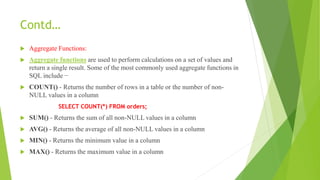
 Aggregate Functions:
 Aggregate functions are used to perform calculations on a set of values and
return a single result. Some of the most commonly used aggregate functions in
SQL include −
 COUNT() - Returns the number of rows in a table or the number of non-
NULL values in a column
SELECT COUNT(*) FROM orders;
 SUM() - Returns the sum of all non-NULL values in a column
 AVG() - Returns the average of all non-NULL values in a column
 MIN() - Returns the minimum value in a column
 MAX() - Returns the maximum value in a column
Contd..
 Date and Time Functions
 SQL also provides a number of functions for working with date and time
values. Some examples of date and time functions in SQL include −
 NOW() - Returns the current date and time
 CURRENT_DATE() - Returns the current date
 CURRENT_TIME() - Returns the current time
 YEAR() - Returns the year of a date
 MONTH() - Returns the month of a date
 DAY() - Returns the day of a date
Contd…
 String Functions:
 SQL also provides a number of string manipulation function. Some examples
of string functions in SQL include −
 LTRIM() - Removes the leading whitespace of the string
 RTRIM() - Removes the trailing whitespace of the string
 TRIM() - Removes both leading and trailing whitespace of the string
 SUBSTRING() - Extracts a specific portion of a string
 REPLACE() - Replaces all occurrences of a specified string with another
string
Contd…
 Conditional Functions
 SQL also provides a number of functions that perform different actions based
on certain conditions. Some examples of conditional functions in SQL include
−
 CASE - evaluates a list of conditions and returns a result for the first condition
that is met
 IF - return a specified value if the condition is met, otherwise return another
specified value
 COALESCE - return the first non-null expression among multiple
expressions.
Contd…
 Logical Functions
 SQL provides a set of logical functions that return a Boolean value, which can
be either true or false. Some examples of logical functions in SQL include −
 AND - Returns true if both the conditions are true
 OR - Returns true if at least one of the conditions is true
 NOT - Negates a boolean value
Contd…
 Conversion Functions
 SQL provides a number of functions that can be used to convert data from one
type to another. Some examples of conversion functions in SQL include −
 CAST() - Converts a value from one data type to another
 CONVERT() - Converts a value from one data type to another (This function
is specific for some database vendors like SQL Server)
 TO_DATE() - Converts a string to a date value
 TO_TIME() - Converts a string to a time value
 TO_TIMESTAMP() - Converts a string to a timestamp value
Contd…
 Window Functions
 SQL provides a set of functions that can be used to perform calculations across
a set of rows that are related to the current row. These functions are known as
window functions. Some examples of window functions in SQL include −
 RANK() - Assigns a unique rank to each row within a result set, based on the
values in one or more columns
 DENSE_RANK() - Assigns a unique rank to each row within a result set,
based on the values in one or more columns, but does not leave gaps in the
ranking sequence when there are ties
 ROW_NUMBER() - Assigns a unique number to each row within a result set,
based on the order specified in the ORDER BY clause of the function
Thankyou!

12th.pptx

  • 1.
    Guest lecture onSQL Functions presented by: Aamir Maqsood(M tech. CSE)
  • 2.
    Introduction to SQLfunctions - What are SQL functions? - Why are SQL functions important? - Common types of SQL functions - Scalar functions - Aggregate functions - String functions - Date and time functions - Mathematical functions - Overview of popular SQL functions - Examples of SQL functions in action Conclusion and recap of key points
  • 3.
    SQL And SQLFunctions  SQL, which stands for Structured Query Language, is a domain-specific language used for managing and manipulating data in relational database management systems (RDBMS).  It is a standard language for communicating with and querying databases. SQL allows you to perform various operations on data, including retrieving, updating, inserting, and deleting records, as well as defining and modifying the structure of a database.  SQL functions are predefined or user-defined procedures that can be used within SQL statements to perform various operations on data.
  • 4.
    Common Types ofSQL Functions  Scalar Functions:  Scalar functions are used to perform calculations on a single value and return a single result. Some examples of scalar functions in SQL include −  LENGTH() - Returns the number of characters in a string  UPPER() - Converts a string to uppercase  LOWER() - Converts a string to lowercase  CONCAT() - Concatenates two or more strings together  ROUND() - Rounds a number to a specified number of decimal places
  • 5.
    Contd…  Aggregate Functions: Aggregate functions are used to perform calculations on a set of values and return a single result. Some of the most commonly used aggregate functions in SQL include −  COUNT() - Returns the number of rows in a table or the number of non- NULL values in a column SELECT COUNT(*) FROM orders;  SUM() - Returns the sum of all non-NULL values in a column  AVG() - Returns the average of all non-NULL values in a column  MIN() - Returns the minimum value in a column  MAX() - Returns the maximum value in a column
  • 6.
    Contd..  Date andTime Functions  SQL also provides a number of functions for working with date and time values. Some examples of date and time functions in SQL include −  NOW() - Returns the current date and time  CURRENT_DATE() - Returns the current date  CURRENT_TIME() - Returns the current time  YEAR() - Returns the year of a date  MONTH() - Returns the month of a date  DAY() - Returns the day of a date
  • 7.
    Contd…  String Functions: SQL also provides a number of string manipulation function. Some examples of string functions in SQL include −  LTRIM() - Removes the leading whitespace of the string  RTRIM() - Removes the trailing whitespace of the string  TRIM() - Removes both leading and trailing whitespace of the string  SUBSTRING() - Extracts a specific portion of a string  REPLACE() - Replaces all occurrences of a specified string with another string
  • 8.
    Contd…  Conditional Functions SQL also provides a number of functions that perform different actions based on certain conditions. Some examples of conditional functions in SQL include −  CASE - evaluates a list of conditions and returns a result for the first condition that is met  IF - return a specified value if the condition is met, otherwise return another specified value  COALESCE - return the first non-null expression among multiple expressions.
  • 9.
    Contd…  Logical Functions SQL provides a set of logical functions that return a Boolean value, which can be either true or false. Some examples of logical functions in SQL include −  AND - Returns true if both the conditions are true  OR - Returns true if at least one of the conditions is true  NOT - Negates a boolean value
  • 10.
    Contd…  Conversion Functions SQL provides a number of functions that can be used to convert data from one type to another. Some examples of conversion functions in SQL include −  CAST() - Converts a value from one data type to another  CONVERT() - Converts a value from one data type to another (This function is specific for some database vendors like SQL Server)  TO_DATE() - Converts a string to a date value  TO_TIME() - Converts a string to a time value  TO_TIMESTAMP() - Converts a string to a timestamp value
  • 11.
    Contd…  Window Functions SQL provides a set of functions that can be used to perform calculations across a set of rows that are related to the current row. These functions are known as window functions. Some examples of window functions in SQL include −  RANK() - Assigns a unique rank to each row within a result set, based on the values in one or more columns  DENSE_RANK() - Assigns a unique rank to each row within a result set, based on the values in one or more columns, but does not leave gaps in the ranking sequence when there are ties  ROW_NUMBER() - Assigns a unique number to each row within a result set, based on the order specified in the ORDER BY clause of the function
  • 12.