PRACTICAL
RESEARCH 1
What is Research?
• Research is the process of gathering and
analyzing data to create new knowledge or
apply existing knowledge in a new way. It's
a systematic method of exploration that's
used in many disciplines.
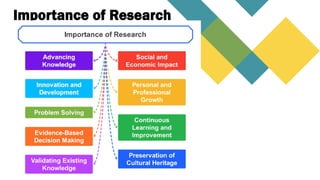
Importance of Research
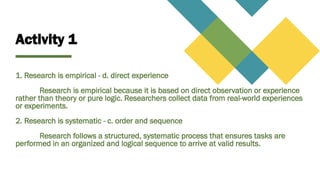
Activity 1
1. Research is empirical - d. direct experience
Research is empirical because it is based on direct observation or experience
rather than theory or pure logic. Researchers collect data from real-world experiences
or experiments.
2. Research is systematic - c. order and sequence
Research follows a structured, systematic process that ensures tasks are
performed in an organized and logical sequence to arrive at valid results.
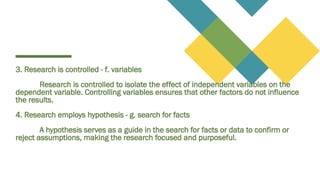
3. Research is controlled - f. variables
Research is controlled to isolate the effect of independent variables on the
dependent variable. Controlling variables ensures that other factors do not influence
the results.
4. Research employs hypothesis - g. search for facts
A hypothesis serves as a guide in the search for facts or data to confirm or
reject assumptions, making the research focused and purposeful.
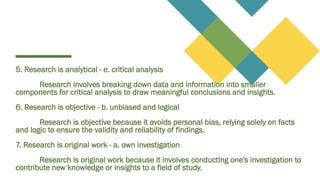
5. Research is analytical - e. critical analysis
Research involves breaking down data and information into smaller
components for critical analysis to draw meaningful conclusions and insights.
6. Research is objective - b. unbiased and logical
Research is objective because it avoids personal bias, relying solely on facts
and logic to ensure the validity and reliability of findings.
7. Research is original work - a. own investigation
Research is original work because it involves conducting one's investigation to
contribute new knowledge or insights to a field of study.
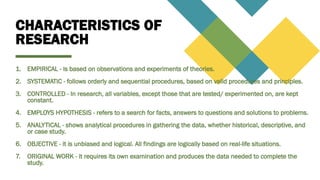
CHARACTERISTICS OF
RESEARCH
1. EMPIRICAL - is based on observations and experiments of theories.
2. SYSTEMATIC - follows orderly and sequential procedures, based on valid procedures and principles.
3. CONTROLLED - In research, all variables, except those that are tested/ experimented on, are kept
constant.
4. EMPLOYS HYPOTHESIS - refers to a search for facts, answers to questions and solutions to problems.
5. ANALYTICAL - shows analytical procedures in gathering the data, whether historical, descriptive, and
or case study.
6. OBJECTIVE - it is unbiased and logical. All findings are logically based on real-life situations.
7. ORIGINAL WORK - it requires its own examination and produces the data needed to complete the
study.
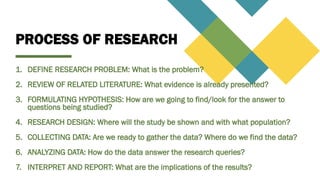
PROCESS OF RESEARCH
1. DEFINE RESEARCH PROBLEM: What is the problem?
2. REVIEW OF RELATED LITERATURE: What evidence is already presented?
3. FORMULATING HYPOTHESIS: How are we going to find/look for the answer to
questions being studied?
4. RESEARCH DESIGN: Where will the study be shown and with what population?
5. COLLECTING DATA: Are we ready to gather the data? Where do we find the data?
6. ANALYZING DATA: How do the data answer the research queries?
7. INTERPRET AND REPORT: What are the implications of the results?
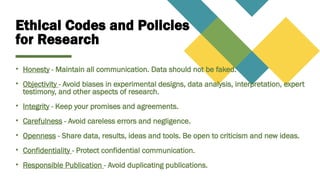
Ethical Codes and Policies
for Research
• Honesty - Maintain all communication. Data should not be faked.
• Objectivity - Avoid biases in experimental designs, data analysis, interpretation, expert
testimony, and other aspects of research.
• Integrity - Keep your promises and agreements.
• Carefulness - Avoid careless errors and negligence.
• Openness - Share data, results, ideas and tools. Be open to criticism and new ideas.
• Confidentiality - Protect confidential communication.
• Responsible Publication - Avoid duplicating publications.
• Responsible Mentoring - Help to educate, mentor, and advise others.
• Respect Colleagues - Treat all peers fairly.
• Social Responsibility - Strive to promote social good. Avoid social harm.
• Non- Discrimination avoid discrimination against colleagues or students on the basis of
sex, races, ethnicity, and or others.
• Legality - Be informed and obey relevant laws and institutional governmental policies.
• Respect of Intellectual Property - Give proper acknowledgment or credits to all
researchers.
• Human Subject - Minimize risks that involve human lives, dignity, and privacy.
IMPORTANCE OF ETHICS
IN RESEARCH
1. Protects Participants' Rights and Welfare
2. Ensures Integrity and Credibility
3. Builds Trust in Research
4. Promotes Fairness and Equity
5. Encourages Responsible Use of Resources
6. Prevents Harm to Society and the Environment
7. Upholds Scientific Integrity
8. Facilitates Collaboration
9. Ensures Compliance with Legal and Professional Standards
10.Advances Long-Term Progress


PRACTICAL RESEARCH 1 lesson guidelines.pptx

  • 1.
  • 2.
    What is Research? •Research is the process of gathering and analyzing data to create new knowledge or apply existing knowledge in a new way. It's a systematic method of exploration that's used in many disciplines.
  • 3.
  • 4.
    Activity 1 1. Researchis empirical - d. direct experience Research is empirical because it is based on direct observation or experience rather than theory or pure logic. Researchers collect data from real-world experiences or experiments. 2. Research is systematic - c. order and sequence Research follows a structured, systematic process that ensures tasks are performed in an organized and logical sequence to arrive at valid results.
  • 5.
    3. Research iscontrolled - f. variables Research is controlled to isolate the effect of independent variables on the dependent variable. Controlling variables ensures that other factors do not influence the results. 4. Research employs hypothesis - g. search for facts A hypothesis serves as a guide in the search for facts or data to confirm or reject assumptions, making the research focused and purposeful.
  • 6.
    5. Research isanalytical - e. critical analysis Research involves breaking down data and information into smaller components for critical analysis to draw meaningful conclusions and insights. 6. Research is objective - b. unbiased and logical Research is objective because it avoids personal bias, relying solely on facts and logic to ensure the validity and reliability of findings. 7. Research is original work - a. own investigation Research is original work because it involves conducting one's investigation to contribute new knowledge or insights to a field of study.
  • 7.
    CHARACTERISTICS OF RESEARCH 1. EMPIRICAL- is based on observations and experiments of theories. 2. SYSTEMATIC - follows orderly and sequential procedures, based on valid procedures and principles. 3. CONTROLLED - In research, all variables, except those that are tested/ experimented on, are kept constant. 4. EMPLOYS HYPOTHESIS - refers to a search for facts, answers to questions and solutions to problems. 5. ANALYTICAL - shows analytical procedures in gathering the data, whether historical, descriptive, and or case study. 6. OBJECTIVE - it is unbiased and logical. All findings are logically based on real-life situations. 7. ORIGINAL WORK - it requires its own examination and produces the data needed to complete the study.
  • 8.
    PROCESS OF RESEARCH 1.DEFINE RESEARCH PROBLEM: What is the problem? 2. REVIEW OF RELATED LITERATURE: What evidence is already presented? 3. FORMULATING HYPOTHESIS: How are we going to find/look for the answer to questions being studied? 4. RESEARCH DESIGN: Where will the study be shown and with what population? 5. COLLECTING DATA: Are we ready to gather the data? Where do we find the data? 6. ANALYZING DATA: How do the data answer the research queries? 7. INTERPRET AND REPORT: What are the implications of the results?
  • 9.
    Ethical Codes andPolicies for Research • Honesty - Maintain all communication. Data should not be faked. • Objectivity - Avoid biases in experimental designs, data analysis, interpretation, expert testimony, and other aspects of research. • Integrity - Keep your promises and agreements. • Carefulness - Avoid careless errors and negligence. • Openness - Share data, results, ideas and tools. Be open to criticism and new ideas. • Confidentiality - Protect confidential communication. • Responsible Publication - Avoid duplicating publications.
  • 10.
    • Responsible Mentoring- Help to educate, mentor, and advise others. • Respect Colleagues - Treat all peers fairly. • Social Responsibility - Strive to promote social good. Avoid social harm. • Non- Discrimination avoid discrimination against colleagues or students on the basis of sex, races, ethnicity, and or others. • Legality - Be informed and obey relevant laws and institutional governmental policies. • Respect of Intellectual Property - Give proper acknowledgment or credits to all researchers. • Human Subject - Minimize risks that involve human lives, dignity, and privacy.
  • 11.
    IMPORTANCE OF ETHICS INRESEARCH 1. Protects Participants' Rights and Welfare 2. Ensures Integrity and Credibility 3. Builds Trust in Research 4. Promotes Fairness and Equity 5. Encourages Responsible Use of Resources 6. Prevents Harm to Society and the Environment 7. Upholds Scientific Integrity 8. Facilitates Collaboration 9. Ensures Compliance with Legal and Professional Standards 10.Advances Long-Term Progress