Intangibility
Peopleas part of the product
Demands Patterns
Perishability
Channels of Distribution
3.
Products isexperienced
Products includes both goods and services
Guest are purchasing the performance
It is harder to evaluate quality of services
than products.
4.
Employees arepart of the products
Services are less standardized than products
Quality control is more challenging for
services than for products
Guest are directly involved in all service
transactions
5.
Demands levelshave peaks and valleys
Marketing mix is used to manage demands
6.
Unused capacityis wasted
There is no way to build an inventory
Capacity management is crucial
7.
Channels ofdistribution increase in
importance
Franchising is a form of distribution.
8.
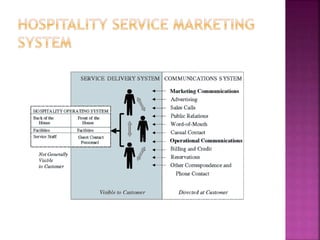
Three Overlappingservice Systems
The hospitality services, from guest’s
perspectives, comprises three overlapping
service systems (Lovelock 1996)
Only a small portion of these systems is under
the direct control of marketing; most are under
the supervision of operations
10.
The servicedelivery system is concerned
with where, when and how the service
products is delivered to guest.
The hospitality operating system is where
the works gets done for the guest.
The communication system includes planned
marketing communications, such as
advertising, promotion, and public relations
and operational communication such as
billing statements and reservation
confirmation.
11.
Quality, experts agree,“is whatever the
customer says it is , and the quality of the
particular products or service is whatever the
customer perceives it to be” (Buzzel and
Gale 1987)
12.
Technical dimension:Did things go right?
Was the hot food hot? The reservation in
order? The room cleaned?
Interpersonal dimension : Was the server
friendly? Did service staff go the extra mile
to be helpful? Did the guests feel welcome?
The technical dimension represents what the
customer receives; the interpersonal
dimension stands for how the customer
receives the services.
13.
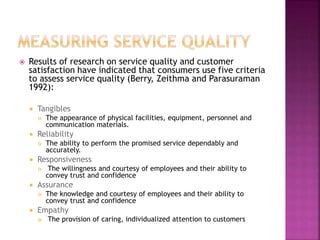
Results ofresearch on service quality and customer
satisfaction have indicated that consumers use five criteria
to assess service quality (Berry, Zeithma and Parasuraman
1992):
Tangibles
The appearance of physical facilities, equipment, personnel and
communication materials.
Reliability
The ability to perform the promised service dependably and
accurately.
Responsiveness
The willingness and courtesy of employees and their ability to
convey trust and confidence
Assurance
The knowledge and courtesy of employees and their ability to
convey trust and confidence
Empathy
The provision of caring, individualized attention to customers
14.
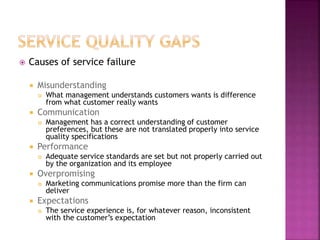
Causes ofservice failure
Misunderstanding
What management understands customers wants is difference
from what customer really wants
Communication
Management has a correct understanding of customer
preferences, but these are not translated properly into service
quality specifications
Performance
Adequate service standards are set but not properly carried out
by the organization and its employee
Overpromising
Marketing communications promise more than the firm can
deliver
Expectations
The service experience is, for whatever reason, inconsistent
with the customer’s expectation
15.
In hospitalityservices, there are no rejects, just
unhappy customers. Because a “defect” is an event
that happens to a guest, there is no way to do recall.
Under these circumstances, the argument for a zero
defect standard is compelling, but maybe unrealistic;
The facts is that in services, no matter how rigorous the
procedures and employee training or how advances the
technology, zero defects is an unattainable goal. Unlike
manufaturers that can adjust inputs and machinery until
products are uniformly perfects, service companies
cannot escape variations. Factors like the weather and
the customers themselves are beyond a company’s
control. (Labovitz and Chang 1987)
16.
The significantreduction of service defects
appears to be an expensive projects. Yet,
there are good reasons to believe that
improving quality will actually reduce costs.
Costs of quality can be divided into the good,
the bad and the ugly (Labovitz and Chang
1987)
17.
Cost involvedin problem prevention, such as
good hiring practices, quality-oriented
training and supervision and compensation
related to quality performance.
These costs represents a long-term
investment rather than short term,
temporary fix.
18.
Costs ofinspection and correction, including
supervisory personnel’s time, increased food
and beverages costs due to replacement,
decreased operational efficiency due to time
spent on corrective actions and additional
training and employee turnover costs.
19.
Costs ofservice defects.
The failure of preventive activities and
inspection and correction actions will allow
substandard performance to be delivered, which
results in unsatisfied guest.
When the guest complain, at least the operation
gets a second chance to correct its mistakes and
try to compensate the guest before his or her
departure.
If the guest leaves the property unsatisfied with
the problem unresolved, there are three very
expensive ugly costs of service defects: lost
customers, efforts to attract new customers and
bad word of mouth
20.
1. Guarantees
Itmakes the company ascertain its customers’ definition
of good services (reduces misunderstanding gap)
It sets clear performance standards (reduce
communication gap)
It generates reliable data through customer
compensation when performances poor. Such data can
be used for system redesign or training program
development
It forces a company o examine its service-delivery
systems for possible weak points in the corporation or in
individuals units in order to reduce the guarantee
program cost.
It builds customer loyalty, sales and market share.
The financial commitment from management makes a
strong statement about its emphasis on customer
satisfaction
2. Customer feedback
Customer complaints can also be solicited
through the use of toll-free telephone
numbers and Internet Web sites, which
encourage people to report problems by
making it easy to do so.
23.
Unoccupied waitsfeel longer than occupied
waits
Preprocess waits feel longer than in-process
waits
Anxiety makes waits seem longer
Uncertain waits seem longer than explained
waits
Unfair waits seem longer than equitable
waits
The more valuable the service, the longer
people will wait
Solo waits feel longer than group waits.
24.
Internal marketingis a philosophy for
managing personnel and a systematic way of
developing and enhancing a service culture.
The focus is on how to develop customer-
conscious employees.
The objectives are:
Attract and retain good employee
Ensure that the employee are motivated fro
customer-orientated and service-minded
performance and therefore successfully fulfill
their duties as “part-time marketer.”
25.
According toSouthwest Airlines CEO Kelleher
“If you don’t have a good attitude, we don’t
want you no matter how skilled you are. We can
change skills levels through training. We can’t
change attitudes” (Teasley and Robinson 1998)
Careful employee selection, therefore, is critical
to successful service oriented operations.
26.
A corporateculture can be sensed as an internal climate
within organization.
A corporate culture is a powerful communication tools for
“nurturing a service culture that will shape the employee
behavior more effectively than rules and regulations can.”
A service culture exist when there is an appreciation for
good service and when giving good service to internal and
external customers is considered a natural way of life and
one of the most important measurement in the
organization.
Management in a service culture usually take scare of its
internal customer – employees-first, which leads to higher
job satisfactions.
27.
What arethe characteristics of service? What impact
do they have on operations?
How can service quality be measured?
What common gaps occur in service? How can they be
avoided?
What are the limitations of a zero-defects goal? What
are its uses?
Is quality free? Why?
What are the uses of a guarantees program? What
makes a guarantee program successful?
What are the implications of managing demand
through queuing in service operations?
What is internal marketing?
What kind of corporate culture is appropriate to a
service organization?



![Chapter 2 Quality as competitive advantage [autosaved]](https://cdn.slidesharecdn.com/ss_thumbnails/chapter2qualityascompetitiveadvantageautosaved-190709034353-thumbnail.jpg?width=640&height=640&fit=bounds)


