Crossing OF A CHEQUE
(SECTION 123)
SUMMITED BY
PIYUSH JAIN
(MCOM - 2 SEMESTER)
SUMMITED TO
DR. NIDHI KHURANA
(DEPREMENT OF COMMERCE)
ST. ALOYSIUS’ COLLEGE
(AUTONOMOUS)
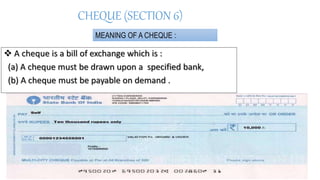
CHEQUE (SECTION 6)
 A cheque is a bill of exchange which is :
(a) A cheque must be drawn upon a specified bank,
(b) A cheque must be payable on demand .
MEANING OF A CHEQUE :
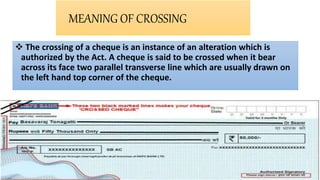
MEANING OF CROSSING
 The crossing of a cheque is an instance of an alteration which is
authorized by the Act. A cheque is said to be crossed when it bear
across its face two parallel transverse line which are usually drawn on
the left hand top corner of the cheque.
CHARACTERISTICS OF CROSSING
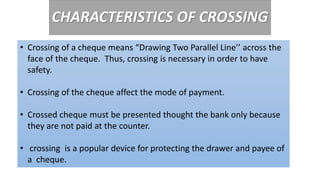
• Crossing of a cheque means “Drawing Two Parallel Line’’ across the
face of the cheque. Thus, crossing is necessary in order to have
safety.
• Crossing of the cheque affect the mode of payment.
• Crossed cheque must be presented thought the bank only because
they are not paid at the counter.
• crossing is a popular device for protecting the drawer and payee of
a cheque.
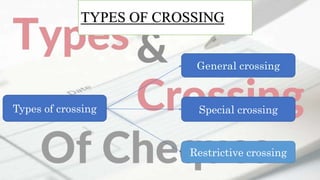
TYPES OF CROSSING
Types of crossing Special crossing
Restrictive crossing
Types of crossing
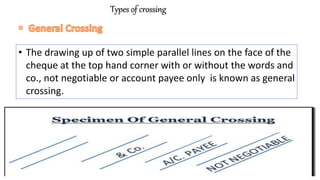
• The drawing up of two simple parallel lines on the face of the
cheque at the top hand corner with or without the words and
co., not negotiable or account payee only is known as general
crossing.
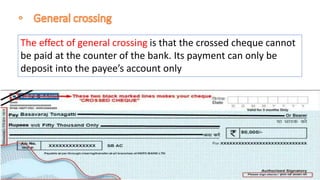
The effect of general crossing is that the crossed cheque cannot
be paid at the counter of the bank. Its payment can only be
deposit into the payee’s account only
Types of crossing
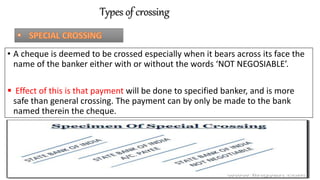
• A cheque is deemed to be crossed especially when it bears across its face the
name of the banker either with or without the words ‘NOT NEGOSIABLE’.
 Effect of this is that payment will be done to specified banker, and is more
safe than general crossing. The payment can by only be made to the bank
named therein the cheque.
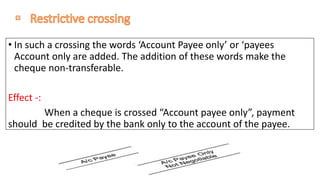
• In such a crossing the words ‘Account Payee only’ or ‘payees
Account only are added. The addition of these words make the
cheque non-transferable.
Effect -:
When a cheque is crossed “Account payee only”, payment
should be credited by the bank only to the account of the payee.
 THE DRAWER : While issuing a cheque the drawer can cross
the cheque generally or specially.
THE HOLDER : If the cheque is not crossed, the holder can
cross the cheque generally or specially.
THE BANKER : If the cheque is not crossed and send to the
bank for collection, banker can cross the cheque generally.
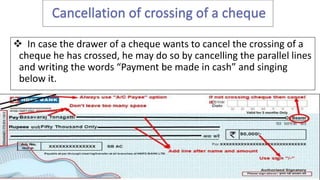
 In case the drawer of a cheque wants to cancel the crossing of a
cheque he has crossed, he may do so by cancelling the parallel lines
and writing the words “Payment be made in cash” and singing
below it.
Crossing OF A CHEQUE.pptx

Crossing OF A CHEQUE.pptx

  • 1.
    Crossing OF ACHEQUE (SECTION 123) SUMMITED BY PIYUSH JAIN (MCOM - 2 SEMESTER) SUMMITED TO DR. NIDHI KHURANA (DEPREMENT OF COMMERCE) ST. ALOYSIUS’ COLLEGE (AUTONOMOUS)
  • 2.
    CHEQUE (SECTION 6) A cheque is a bill of exchange which is : (a) A cheque must be drawn upon a specified bank, (b) A cheque must be payable on demand . MEANING OF A CHEQUE :
  • 3.
    MEANING OF CROSSING The crossing of a cheque is an instance of an alteration which is authorized by the Act. A cheque is said to be crossed when it bear across its face two parallel transverse line which are usually drawn on the left hand top corner of the cheque.
  • 4.
    CHARACTERISTICS OF CROSSING •Crossing of a cheque means “Drawing Two Parallel Line’’ across the face of the cheque. Thus, crossing is necessary in order to have safety. • Crossing of the cheque affect the mode of payment. • Crossed cheque must be presented thought the bank only because they are not paid at the counter. • crossing is a popular device for protecting the drawer and payee of a cheque.
  • 5.
    TYPES OF CROSSING Typesof crossing Special crossing Restrictive crossing
  • 6.
    Types of crossing •The drawing up of two simple parallel lines on the face of the cheque at the top hand corner with or without the words and co., not negotiable or account payee only is known as general crossing.
  • 7.
    The effect ofgeneral crossing is that the crossed cheque cannot be paid at the counter of the bank. Its payment can only be deposit into the payee’s account only
  • 8.
    Types of crossing •A cheque is deemed to be crossed especially when it bears across its face the name of the banker either with or without the words ‘NOT NEGOSIABLE’.  Effect of this is that payment will be done to specified banker, and is more safe than general crossing. The payment can by only be made to the bank named therein the cheque.
  • 9.
    • In sucha crossing the words ‘Account Payee only’ or ‘payees Account only are added. The addition of these words make the cheque non-transferable. Effect -: When a cheque is crossed “Account payee only”, payment should be credited by the bank only to the account of the payee.
  • 10.
     THE DRAWER: While issuing a cheque the drawer can cross the cheque generally or specially. THE HOLDER : If the cheque is not crossed, the holder can cross the cheque generally or specially. THE BANKER : If the cheque is not crossed and send to the bank for collection, banker can cross the cheque generally.
  • 11.
     In casethe drawer of a cheque wants to cancel the crossing of a cheque he has crossed, he may do so by cancelling the parallel lines and writing the words “Payment be made in cash” and singing below it.