Susan Muller
Environmental  ( ĕn-vī'rən-mĕn ' tl )—  Relating to or being concerned with the ecological impact of altering the environment. Policy  ( pŏl ' ĭ-sē )—  A plan or course of action, as of a government, political party, or business, intended to influence and determine decisions, actions, and other matters.
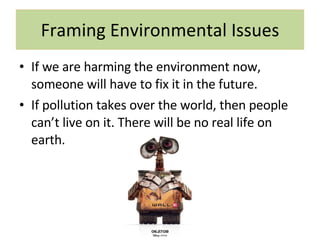
Framing Environmental Issues If we are harming the environment now, someone will have to fix it in the future. If pollution takes over the world, then people can’t live on it. There will be no real life on earth.
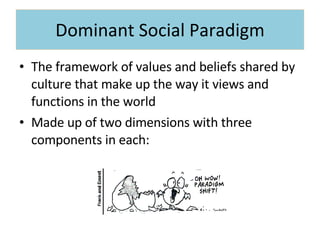
Dominant Social Paradigm The framework of values and beliefs shared by culture that make up the way it views and functions in the world Made up of two dimensions with three components in each:
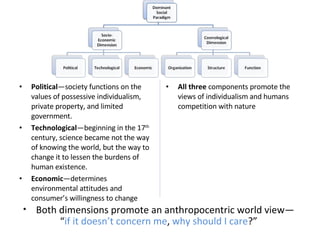
Political —society functions on the values of possessive individualism, private property, and limited government. Technological —beginning in the 17 th  century, science became not the way of knowing the world, but the way to change it to lessen the burdens of human existence. Economic —determines environmental attitudes and consumer’s willingness to change All three  components promote the views of individualism and humans competition with nature Both dimensions promote an anthropocentric world view— “ if it doesn’t concern me ,  why should I care ?”
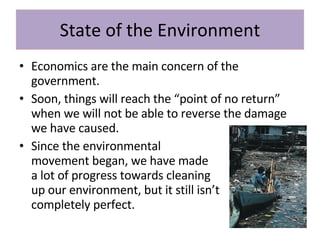
State of the Environment Economics are the main concern of the government. Soon, things will reach the “point of no return” when we will not be able to reverse the damage we have caused. Since the environmental  movement began, we have made  a lot of progress towards cleaning  up our environment, but it still isn’t  completely perfect.
 
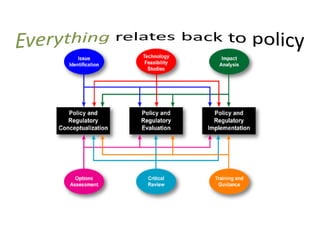
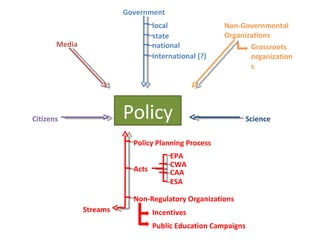
Policy Government Media Citizens Science Non-Governmental Organizations Grassroots organizations Streams Policy Planning Process Acts Non-Regulatory Organizations Incentives Public Education Campaigns local state national international (?) EPA CWA CAA ESA
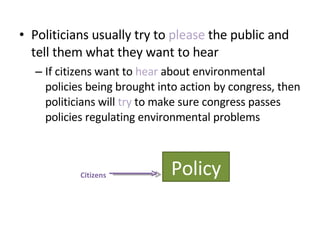
Politicians usually try to  please  the public and tell them what they want to hear If citizens want to  hear  about environmental policies being brought into action by congress, then politicians will  try  to make sure congress passes policies regulating environmental problems Policy Citizens
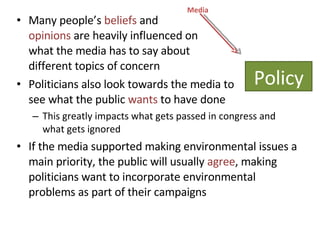
Many people’s  beliefs  and  opinions  are heavily influenced on  what the media has to say about  different topics of concern Politicians also look towards the media to  see what the public  wants  to have done This greatly impacts what gets passed in congress and what gets ignored If the media supported making environmental issues a main priority, the public will usually  agree , making politicians want to incorporate environmental problems as part of their campaigns Policy Media
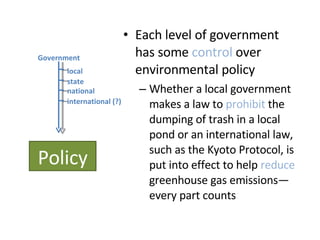
Each level of government has some  control  over environmental policy Whether a local government makes a law to  prohibit  the dumping of trash in a local pond or an international law, such as the Kyoto Protocol, is put into effect to help  reduce  greenhouse gas emissions—every part counts Policy Government local state national international (?)
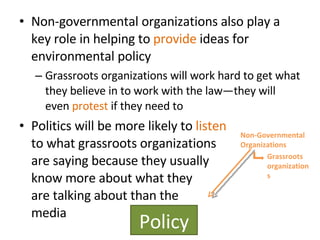
Non-governmental organizations also play a key role in helping to  provide  ideas for environmental policy Grassroots organizations will work hard to get what they believe in to work with the law—they will even  protest  if they need to Politics will be more likely to  listen to what grassroots organizations are saying because they usually know more about what they are talking about than the  media Policy Non-Governmental Organizations Grassroots organizations
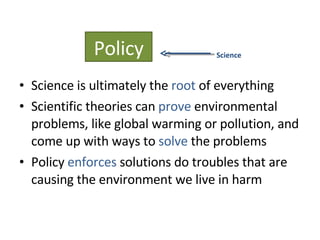
Science is ultimately the  root  of everything Scientific theories can  prove  environmental problems, like global warming or pollution, and come up with ways to  solve  the problems Policy  enforces  solutions do troubles that are causing the environment we live in harm Policy Science
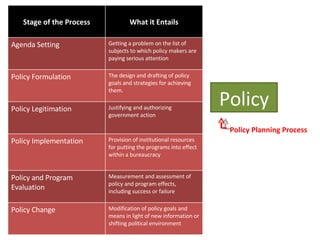
Policy Policy Planning Process Stage of the Process What it Entails Agenda Setting Getting a problem on the list of subjects to which policy makers are paying serious attention Policy Formulation The design and drafting of policy goals and strategies for achieving them. Policy Legitimation Justifying and authorizing government action Policy Implementation Provision of institutional resources for putting the programs into effect within a bureaucracy Policy and Program Evaluation Measurement and assessment of policy and program effects, including success or failure Policy Change Modification of policy goals and means in light of new information or shifting political environment
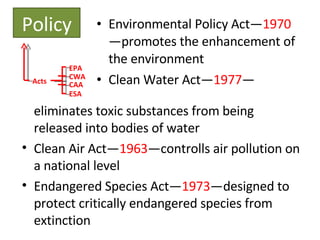
Environmental Policy Act— 1970 —promotes the enhancement of the environment Clean Water Act— 1977 — Policy Acts EPA CWA CAA ESA eliminates toxic substances from being released into bodies of water Clean Air Act— 1963 —controlls air pollution on a national level Endangered Species Act— 1973 —designed to protect critically endangered species from extinction
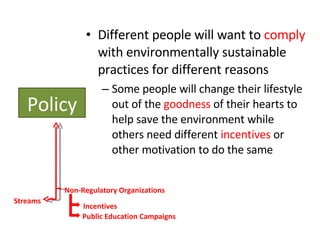
Different people will want to  comply  with environmentally sustainable practices for different reasons Some people will change their lifestyle out of the  goodness  of their hearts to help save the environment while others need different  incentives  or other motivation to do the same Policy Streams Non-Regulatory Organizations Incentives Public Education Campaigns
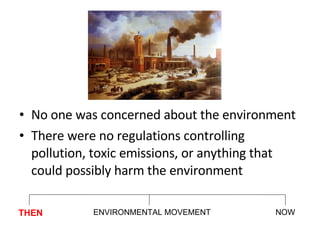
No one was concerned about the environment There were no regulations controlling pollution, toxic emissions, or anything that could possibly harm the environment THEN NOW ENVIRONMENTAL MOVEMENT
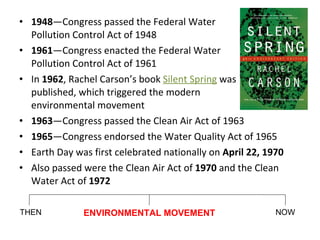
1948 —Congress passed the Federal Water  Pollution Control Act of 1948 1961 —Congress enacted the Federal Water  Pollution Control Act of 1961 In  1962 , Rachel Carson’s book  Silent Spring   was  published, which triggered the modern  environmental movement 1963 —Congress passed the Clean Air Act of 1963 1965 —Congress endorsed the Water Quality Act of 1965 Earth Day was first celebrated nationally on  April 22, 1970 Also passed were the Clean Air Act of  1970  and the Clean Water Act of  1972 THEN NOW ENVIRONMENTAL MOVEMENT
Many different countries all over the world have began working towards becoming “green” We are now looking at smaller aspects of what is causing environmental problems, when before we could only look at the bigger picture THEN NOW ENVIRONMENTAL MOVEMENT
YOU ? ? ? ? ? ? ? ? ? ? ? ? ? ? ? ? ?
Every individual can do something  small  to try to become more environmentally aware Whether its  picking up  a piece of trash while walking down the street or  recycling  water bottles instead of throwing them in the trash Small initiatives will catch on from person to person and eventually become spread to  massive  amounts of people, which will  have a great impact to  better  both  the environment and society

Test 1

  • 1.
  • 2.
    Environmental (ĕn-vī'rən-mĕn ' tl )— Relating to or being concerned with the ecological impact of altering the environment. Policy ( pŏl ' ĭ-sē )— A plan or course of action, as of a government, political party, or business, intended to influence and determine decisions, actions, and other matters.
  • 3.
    Framing Environmental IssuesIf we are harming the environment now, someone will have to fix it in the future. If pollution takes over the world, then people can’t live on it. There will be no real life on earth.
  • 4.
    Dominant Social ParadigmThe framework of values and beliefs shared by culture that make up the way it views and functions in the world Made up of two dimensions with three components in each:
  • 5.
    Political —society functionson the values of possessive individualism, private property, and limited government. Technological —beginning in the 17 th century, science became not the way of knowing the world, but the way to change it to lessen the burdens of human existence. Economic —determines environmental attitudes and consumer’s willingness to change All three components promote the views of individualism and humans competition with nature Both dimensions promote an anthropocentric world view— “ if it doesn’t concern me , why should I care ?”
  • 6.
    State of theEnvironment Economics are the main concern of the government. Soon, things will reach the “point of no return” when we will not be able to reverse the damage we have caused. Since the environmental movement began, we have made a lot of progress towards cleaning up our environment, but it still isn’t completely perfect.
  • 7.
  • 8.
    Policy Government MediaCitizens Science Non-Governmental Organizations Grassroots organizations Streams Policy Planning Process Acts Non-Regulatory Organizations Incentives Public Education Campaigns local state national international (?) EPA CWA CAA ESA
  • 9.
    Politicians usually tryto please the public and tell them what they want to hear If citizens want to hear about environmental policies being brought into action by congress, then politicians will try to make sure congress passes policies regulating environmental problems Policy Citizens
  • 10.
    Many people’s beliefs and opinions are heavily influenced on what the media has to say about different topics of concern Politicians also look towards the media to see what the public wants to have done This greatly impacts what gets passed in congress and what gets ignored If the media supported making environmental issues a main priority, the public will usually agree , making politicians want to incorporate environmental problems as part of their campaigns Policy Media
  • 11.
    Each level ofgovernment has some control over environmental policy Whether a local government makes a law to prohibit the dumping of trash in a local pond or an international law, such as the Kyoto Protocol, is put into effect to help reduce greenhouse gas emissions—every part counts Policy Government local state national international (?)
  • 12.
    Non-governmental organizations alsoplay a key role in helping to provide ideas for environmental policy Grassroots organizations will work hard to get what they believe in to work with the law—they will even protest if they need to Politics will be more likely to listen to what grassroots organizations are saying because they usually know more about what they are talking about than the media Policy Non-Governmental Organizations Grassroots organizations
  • 13.
    Science is ultimatelythe root of everything Scientific theories can prove environmental problems, like global warming or pollution, and come up with ways to solve the problems Policy enforces solutions do troubles that are causing the environment we live in harm Policy Science
  • 14.
    Policy Policy PlanningProcess Stage of the Process What it Entails Agenda Setting Getting a problem on the list of subjects to which policy makers are paying serious attention Policy Formulation The design and drafting of policy goals and strategies for achieving them. Policy Legitimation Justifying and authorizing government action Policy Implementation Provision of institutional resources for putting the programs into effect within a bureaucracy Policy and Program Evaluation Measurement and assessment of policy and program effects, including success or failure Policy Change Modification of policy goals and means in light of new information or shifting political environment
  • 15.
    Environmental Policy Act—1970 —promotes the enhancement of the environment Clean Water Act— 1977 — Policy Acts EPA CWA CAA ESA eliminates toxic substances from being released into bodies of water Clean Air Act— 1963 —controlls air pollution on a national level Endangered Species Act— 1973 —designed to protect critically endangered species from extinction
  • 16.
    Different people willwant to comply with environmentally sustainable practices for different reasons Some people will change their lifestyle out of the goodness of their hearts to help save the environment while others need different incentives or other motivation to do the same Policy Streams Non-Regulatory Organizations Incentives Public Education Campaigns
  • 17.
    No one wasconcerned about the environment There were no regulations controlling pollution, toxic emissions, or anything that could possibly harm the environment THEN NOW ENVIRONMENTAL MOVEMENT
  • 18.
    1948 —Congress passedthe Federal Water Pollution Control Act of 1948 1961 —Congress enacted the Federal Water Pollution Control Act of 1961 In 1962 , Rachel Carson’s book Silent Spring was published, which triggered the modern environmental movement 1963 —Congress passed the Clean Air Act of 1963 1965 —Congress endorsed the Water Quality Act of 1965 Earth Day was first celebrated nationally on April 22, 1970 Also passed were the Clean Air Act of 1970 and the Clean Water Act of 1972 THEN NOW ENVIRONMENTAL MOVEMENT
  • 19.
    Many different countriesall over the world have began working towards becoming “green” We are now looking at smaller aspects of what is causing environmental problems, when before we could only look at the bigger picture THEN NOW ENVIRONMENTAL MOVEMENT
  • 20.
    YOU ? ?? ? ? ? ? ? ? ? ? ? ? ? ? ? ?
  • 21.
    Every individual cando something small to try to become more environmentally aware Whether its picking up a piece of trash while walking down the street or recycling water bottles instead of throwing them in the trash Small initiatives will catch on from person to person and eventually become spread to massive amounts of people, which will have a great impact to better both the environment and society