Introduction
to
Phonetics
Gokhale Education Society’s
S.M.R.K. B.K. A.K Mahila Mahavidyalaya, Nasik-5.
CC English (LL)
F.Y.B.Com. Sem I
Unit 1
Ms.Geetanjali Gitay
Assistant Professor
Dept. of English
Introduction
• The word “phone” means sounds. e.g. telephone – “tele” means distant and “phone” means
“ sound”, so” telephone” means an instrument that helps us to listen to distant sounds.
• In English , there are 26 alphabets from A to Z. However, the pronunciation of these alphabets
is not uniform for all words. e.g. “c” – cook, cycle, check.
“s” – sell , sugar.
• So we can observe that a single alphabet is pronounced differently.
• The study and classifications of these speech sounds is called “ Phonetics”.
•Phonetics is part of linguistics, which is the scientific study of language.
• Phonetics helps us learn pronunciation, accent and intonation of sounds in English.
Speech Event
• Pronunciation of each sound requires a complex procedure to take place.
•First, a concept or idea is formulated in the speaker’ brain and then its linguistic codification
is transmitted by the nerves to speech organs, which are set in motion.
• The movement of these organs set up disturbance in the air, and these sound waves are
received by the listener’s ears.
• His nervous system carries the message to brain, where it is interpreted in linguistic terms.
• The speaker and the listener must share the same linguistic code in order to communicate
effectively. It means they both should know the language they are communicating in.
• The energy for the production of speech is generally provided by the air- stream coming out
of the lungs.
• The sounds are passed through air. So air acts as a medium to carry sounds.
• Thus pronouncing a sound involves a complex physical process.
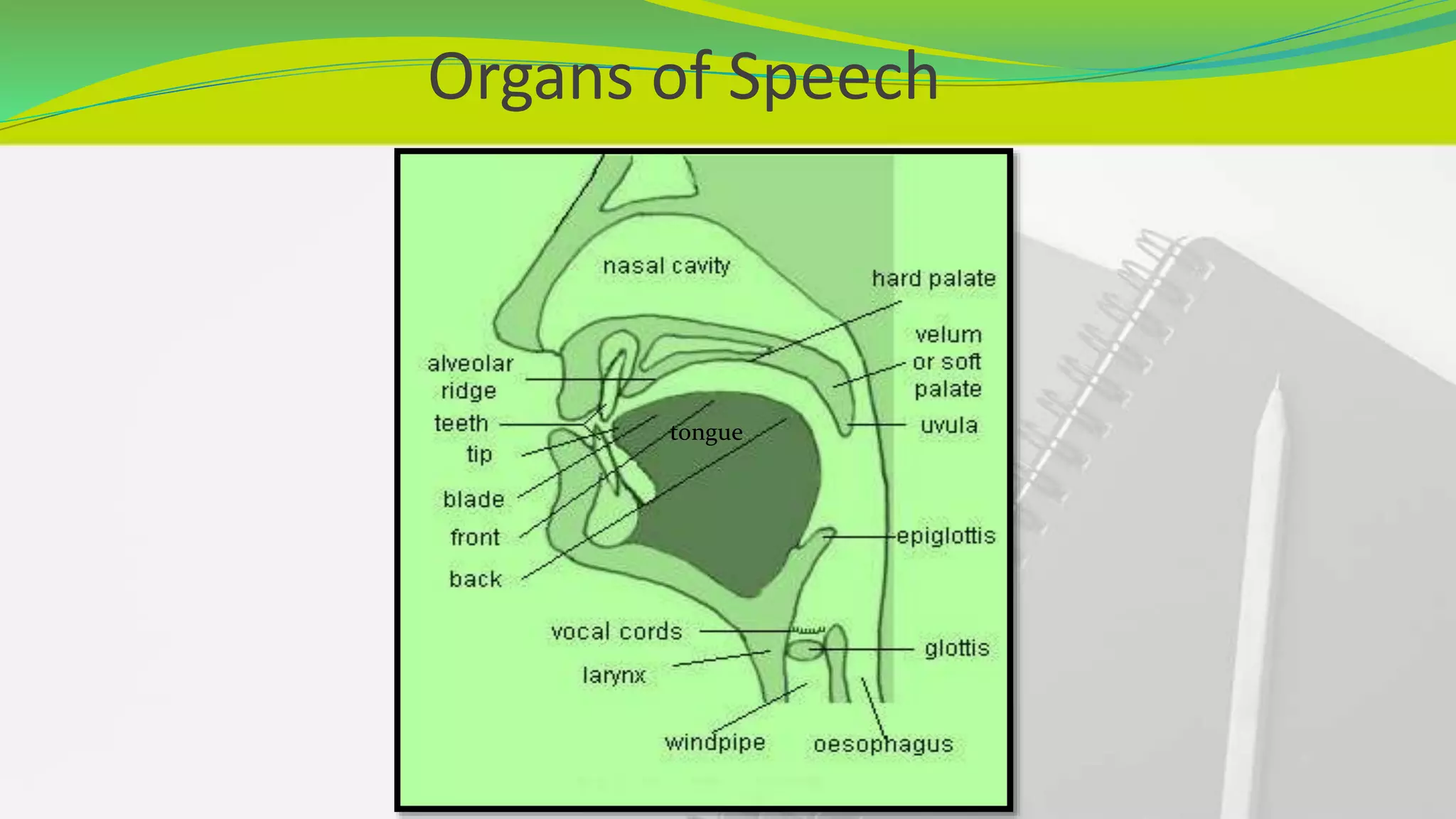
Organs of Speech
tongue
Phoneme
• Phoneme is the smallest unit of phonetics.
• Each individual sound is represented by a ‘phoneme’.
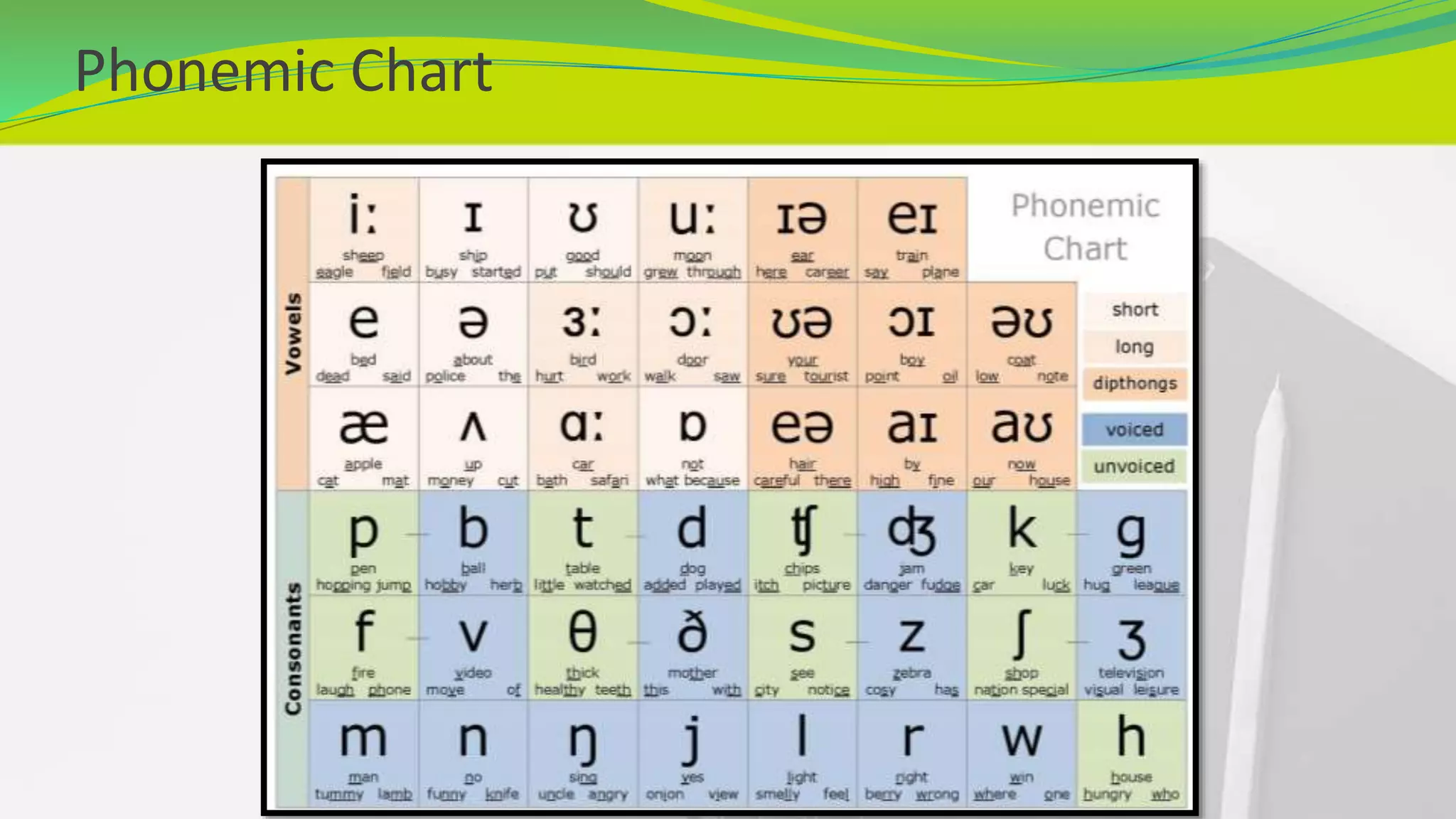
• There are 26 alphabets in English but 44 phonemes.
• These 44 phonemes are further divided into two categories : 1. Vowels and 2. Consonants
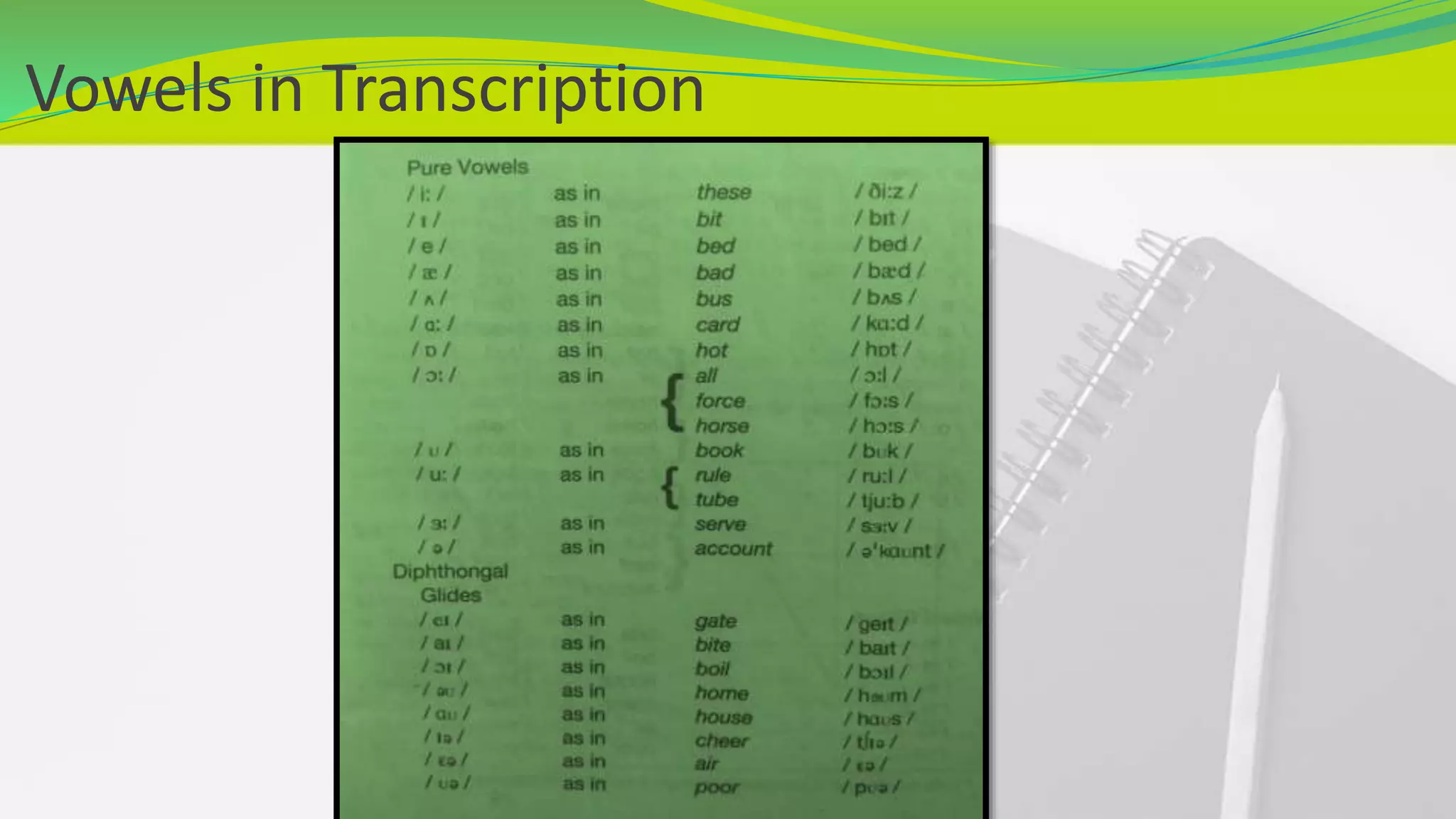
• There are 20 vowel sounds which are divided into Pure Vowels (12) and Diphthongs (08).
• There are 24 consonant sounds in English.
• Each of the phonemes is represented by a different symbol.
• We are going to study RP system that is British Received Pronunciation.
Phonemic Chart
Vowels
• Vowel are necessary to form words. A word cannot be formed without vowels.
• Vowel sound can be pronounced continually as there is no closure of speech organs while
pronouncing it.
• There are only 5 letters to represent vowel sounds (a, i, e, o, u) in English but 20 phonemes to
represent their pronunciation.
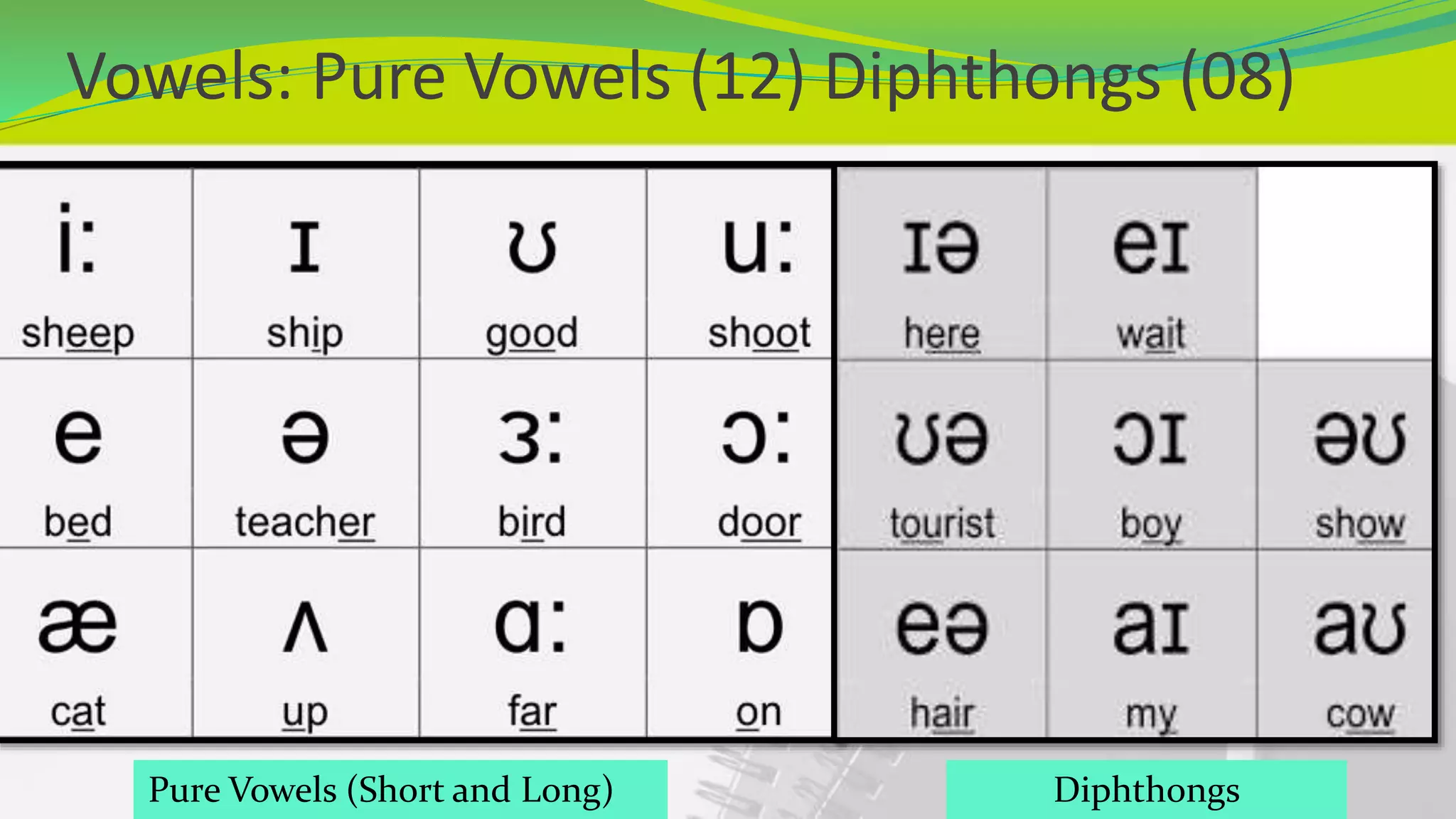
• They are further divided into Pure Vowels(12) and Diphthongs (08).
• Pure vowels are single vowel sounds and are classified into Short Vowels and Long Vowels.
•Diphthongs are sounds created by combining two vowel sounds.
Vowels: Pure Vowels (12) Diphthongs (08)
Pure Vowels (Short and Long) Diphthongs
Vowels in Transcription
Conclusion
In this presentation, we discussed :
1. What is Phonetics?
2. What are Phonemes?
3. Speech Event
4. Organs of Speech
5. Phonemes
6. Vowels (20): Pure Vowels(12) and Diphthongs (08)
7. Vowels in Transcription
Text Content Source :
1. Spoken English : A Manual of Speech and Phonetics, Bansal R.K. and Harrison J.B., Orient Longman , (Second
Edition)(1991)
Image Source :
1. www.google.com

Unit.1.1.introduction to phonetics.1

  • 1.
    Introduction to Phonetics Gokhale Education Society’s S.M.R.K.B.K. A.K Mahila Mahavidyalaya, Nasik-5. CC English (LL) F.Y.B.Com. Sem I Unit 1 Ms.Geetanjali Gitay Assistant Professor Dept. of English
  • 2.
    Introduction • The word“phone” means sounds. e.g. telephone – “tele” means distant and “phone” means “ sound”, so” telephone” means an instrument that helps us to listen to distant sounds. • In English , there are 26 alphabets from A to Z. However, the pronunciation of these alphabets is not uniform for all words. e.g. “c” – cook, cycle, check. “s” – sell , sugar. • So we can observe that a single alphabet is pronounced differently. • The study and classifications of these speech sounds is called “ Phonetics”. •Phonetics is part of linguistics, which is the scientific study of language. • Phonetics helps us learn pronunciation, accent and intonation of sounds in English.
  • 3.
    Speech Event • Pronunciationof each sound requires a complex procedure to take place. •First, a concept or idea is formulated in the speaker’ brain and then its linguistic codification is transmitted by the nerves to speech organs, which are set in motion. • The movement of these organs set up disturbance in the air, and these sound waves are received by the listener’s ears. • His nervous system carries the message to brain, where it is interpreted in linguistic terms. • The speaker and the listener must share the same linguistic code in order to communicate effectively. It means they both should know the language they are communicating in. • The energy for the production of speech is generally provided by the air- stream coming out of the lungs. • The sounds are passed through air. So air acts as a medium to carry sounds. • Thus pronouncing a sound involves a complex physical process.
  • 4.
  • 5.
    Phoneme • Phoneme isthe smallest unit of phonetics. • Each individual sound is represented by a ‘phoneme’. • There are 26 alphabets in English but 44 phonemes. • These 44 phonemes are further divided into two categories : 1. Vowels and 2. Consonants • There are 20 vowel sounds which are divided into Pure Vowels (12) and Diphthongs (08). • There are 24 consonant sounds in English. • Each of the phonemes is represented by a different symbol. • We are going to study RP system that is British Received Pronunciation.
  • 6.
  • 7.
    Vowels • Vowel arenecessary to form words. A word cannot be formed without vowels. • Vowel sound can be pronounced continually as there is no closure of speech organs while pronouncing it. • There are only 5 letters to represent vowel sounds (a, i, e, o, u) in English but 20 phonemes to represent their pronunciation. • They are further divided into Pure Vowels(12) and Diphthongs (08). • Pure vowels are single vowel sounds and are classified into Short Vowels and Long Vowels. •Diphthongs are sounds created by combining two vowel sounds.
  • 8.
    Vowels: Pure Vowels(12) Diphthongs (08) Pure Vowels (Short and Long) Diphthongs
  • 9.
  • 10.
    Conclusion In this presentation,we discussed : 1. What is Phonetics? 2. What are Phonemes? 3. Speech Event 4. Organs of Speech 5. Phonemes 6. Vowels (20): Pure Vowels(12) and Diphthongs (08) 7. Vowels in Transcription
  • 11.
    Text Content Source: 1. Spoken English : A Manual of Speech and Phonetics, Bansal R.K. and Harrison J.B., Orient Longman , (Second Edition)(1991) Image Source : 1. www.google.com