Paragraph Writing
Gokhale Education Society’s
S.M.R.K. B.K. A.K. Mahila Mahavidyalaya, Nasik-5.
Ms. Geetanjali Gitay
Assistant Professor
Dept. of English
CC English (LL)
F.Y.B.Com. Sem I
Unit 4
Introduction
• A paragraph is a basic unit of organisation in writing in which a group of related
sentences develop a single central idea.
• At first glance, a paragraph is only a visual thing, it is a unit of writing that begins with
an indentation – a series of sentences put together for the convenience of the reader.
However, this is a group of related sentences and that is the most important thing about
a paragraph.
• An effective paragraph has three major characteristics: 1. Unity
2. Coherence
3. Adequate Development
• A paragraph should have unity, that means all the sentences in a paragraph should
be related to a single controlling idea.
• Coherence means that the sentences within a paragraph are linked smoothly so as to
provide the reader with an evident progression from beginning to end. There should not
be any abrupt shift from one sentence to other even if they are related to a single idea.
• A good paragraph provides the reader with a sense of wholeness and completeness with
sufficient explanation and illustration for the central idea.
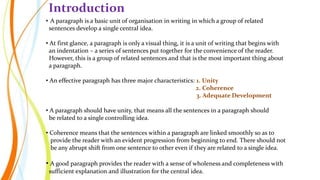
• A good paragraph follows the structure that includes 3 basic components:
1. Topic Sentence
2. Body
3. Concluding Sentence
• The topic sentence gives idea of the topic of the paragraph to which every other
sentence in a paragraph must relate. The topic sentence usually is the first
sentence in a paragraph.
• The body of the paragraph contains supporting
sentences that develop the central idea of the
paragraph.
• The concluding sentence restates or sums up the
main idea.
Structure of a Paragraph
(1) In their eating habits, goats are often very destructive. (2) The famous
Swiss scientist, Karl Vogt, says that goat does more harm in the forests than any
other animal. (3) Goat’s milk is highly valued in many places and is often used to
make cheese. (4) It is inadvisable, therefore, to let goats run at large where
valuable things are growing. (5) They will eat even the barks of trees.
M.M. Monipally
• The first sentence is the topic sentence and the rest of the paragraph explains
in what way the goat is ‘destructive’. However, note, how sentence (3) is not
related to the topic of the paragraph. Keep out sentences which do not
contribute to the topic that you have chosen , however attractive and informative
they may be. Order is another important aspect of writing a good paragraph.
The paragraph should follow a logical sequence.
Sample Paragraph
• There are basically three types of paragraphs:
1. Descriptive Paragraphs
2. Narrative Paragraphs
3. Expository Paragraphs : 1. Division and Classification
2. Illustration
3. Cause and Effect
4. Comparison
5. Contrast
6. Definition
Types of Paragraphs
1. Descriptive Paragraphs
A good description enables the readers to recreate in their minds and adequate
mental picture of the thing described. The description may be of something
physical like a person or a place, or it may be a description of a process. Abstract
things such as moods, state of mind can also be described as we generally find
in poetry and novels.
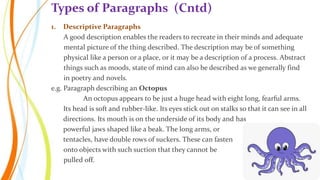
e.g. Paragraph describing an Octopus
An octopus appears to be just a huge head with eight long, fearful arms.
Its head is soft and rubber-like. Its eyes stick out on stalks so that it can see in all
directions. Its mouth is on the underside of its body and has
powerful jaws shaped like a beak. The long arms, or
tentacles, have double rows of suckers. These can fasten
onto objects with such suction that they cannot be
pulled off.
Types of Paragraphs (Cntd)
2. Narrative Paragraphs
The word narrative refers to an account of some personal experience. When you write a
narrative paragraph, you are telling your readers a story, giving an account of something
that happened. Sentences in a narrative paragraph follow a chronological sequence.
That is the order in which the events took place.
e.g. Just after the sunset, when all our work was over, I wanted to eat an apple. I went on deck,
I got into apple barrel, but all the apples had finished. I sat down therein the dark and the
motion of the Hispaola (name of the ship) made me feel sleepy. I was closing my eyes
when a heavy man sat down close by the apple barrel. I was about to jump when the man
began to speak. Before I heard a dozen words, I was trembling with fear.
Types of Paragraphs (Cntd)
3. Expository Paragraphs
Exposition means explaining or making something clear. In an expository
paragraph, ideas are arranged in a logical order. Textbooks generally contain
expository paragraphs.
There are six types of expository paragraphs.
a. Paragraph of Division and Classification
The paragraph of division and classification explains an idea by dividing or
classifying it into sub-groups, types or steps in a procedure.
e.g. a paragraph on types of pollution.
b. Paragraph of Illustration
To illustrate means to explain by giving examples. A paragraph of illustration
contains a topic sentence that generally states an opinion and the remaining
paragraph contains examples explaining that idea or opinion.
e.g. a paragraph on how traffic in India is problematic.
Types of Paragraphs (Cntd)
c. Paragraph of Cause and Effect
It can – state the effect and then explain its causes.
- state the effect and then list its causes.
- state the cause and then arrive at the effect.
e.g. A paragraph on effects of drinking salty water.
d. Paragraph of Comparison and Contrast
In this type of a paragraph, two concepts or things are compared with each
other. First the similarities are listed and then the contrasts or vice-versa.
e.g. A paragraph comparing town and a city.
e. Paragraph of Definition
A paragraph of definition begins by stating the definition. Some of the terms
in the definition are then explained in order to make the meaning of the
definition clear.
e.g. A paragraph defining a Computer.
Types of Paragraphs (Cntd)
Text Content Source :
1 . English for Practical Purposes. Patil Z.N. et al, Macmillan India Ltd., India .(Second Edition, 2004).

Unit.4.1.paragraph writing

  • 1.
    Paragraph Writing Gokhale EducationSociety’s S.M.R.K. B.K. A.K. Mahila Mahavidyalaya, Nasik-5. Ms. Geetanjali Gitay Assistant Professor Dept. of English CC English (LL) F.Y.B.Com. Sem I Unit 4
  • 2.
    Introduction • A paragraphis a basic unit of organisation in writing in which a group of related sentences develop a single central idea. • At first glance, a paragraph is only a visual thing, it is a unit of writing that begins with an indentation – a series of sentences put together for the convenience of the reader. However, this is a group of related sentences and that is the most important thing about a paragraph. • An effective paragraph has three major characteristics: 1. Unity 2. Coherence 3. Adequate Development • A paragraph should have unity, that means all the sentences in a paragraph should be related to a single controlling idea. • Coherence means that the sentences within a paragraph are linked smoothly so as to provide the reader with an evident progression from beginning to end. There should not be any abrupt shift from one sentence to other even if they are related to a single idea. • A good paragraph provides the reader with a sense of wholeness and completeness with sufficient explanation and illustration for the central idea.
  • 3.
    • A goodparagraph follows the structure that includes 3 basic components: 1. Topic Sentence 2. Body 3. Concluding Sentence • The topic sentence gives idea of the topic of the paragraph to which every other sentence in a paragraph must relate. The topic sentence usually is the first sentence in a paragraph. • The body of the paragraph contains supporting sentences that develop the central idea of the paragraph. • The concluding sentence restates or sums up the main idea. Structure of a Paragraph
  • 4.
    (1) In theireating habits, goats are often very destructive. (2) The famous Swiss scientist, Karl Vogt, says that goat does more harm in the forests than any other animal. (3) Goat’s milk is highly valued in many places and is often used to make cheese. (4) It is inadvisable, therefore, to let goats run at large where valuable things are growing. (5) They will eat even the barks of trees. M.M. Monipally • The first sentence is the topic sentence and the rest of the paragraph explains in what way the goat is ‘destructive’. However, note, how sentence (3) is not related to the topic of the paragraph. Keep out sentences which do not contribute to the topic that you have chosen , however attractive and informative they may be. Order is another important aspect of writing a good paragraph. The paragraph should follow a logical sequence. Sample Paragraph
  • 5.
    • There arebasically three types of paragraphs: 1. Descriptive Paragraphs 2. Narrative Paragraphs 3. Expository Paragraphs : 1. Division and Classification 2. Illustration 3. Cause and Effect 4. Comparison 5. Contrast 6. Definition Types of Paragraphs
  • 6.
    1. Descriptive Paragraphs Agood description enables the readers to recreate in their minds and adequate mental picture of the thing described. The description may be of something physical like a person or a place, or it may be a description of a process. Abstract things such as moods, state of mind can also be described as we generally find in poetry and novels. e.g. Paragraph describing an Octopus An octopus appears to be just a huge head with eight long, fearful arms. Its head is soft and rubber-like. Its eyes stick out on stalks so that it can see in all directions. Its mouth is on the underside of its body and has powerful jaws shaped like a beak. The long arms, or tentacles, have double rows of suckers. These can fasten onto objects with such suction that they cannot be pulled off. Types of Paragraphs (Cntd)
  • 7.
    2. Narrative Paragraphs Theword narrative refers to an account of some personal experience. When you write a narrative paragraph, you are telling your readers a story, giving an account of something that happened. Sentences in a narrative paragraph follow a chronological sequence. That is the order in which the events took place. e.g. Just after the sunset, when all our work was over, I wanted to eat an apple. I went on deck, I got into apple barrel, but all the apples had finished. I sat down therein the dark and the motion of the Hispaola (name of the ship) made me feel sleepy. I was closing my eyes when a heavy man sat down close by the apple barrel. I was about to jump when the man began to speak. Before I heard a dozen words, I was trembling with fear. Types of Paragraphs (Cntd)
  • 8.
    3. Expository Paragraphs Expositionmeans explaining or making something clear. In an expository paragraph, ideas are arranged in a logical order. Textbooks generally contain expository paragraphs. There are six types of expository paragraphs. a. Paragraph of Division and Classification The paragraph of division and classification explains an idea by dividing or classifying it into sub-groups, types or steps in a procedure. e.g. a paragraph on types of pollution. b. Paragraph of Illustration To illustrate means to explain by giving examples. A paragraph of illustration contains a topic sentence that generally states an opinion and the remaining paragraph contains examples explaining that idea or opinion. e.g. a paragraph on how traffic in India is problematic. Types of Paragraphs (Cntd)
  • 9.
    c. Paragraph ofCause and Effect It can – state the effect and then explain its causes. - state the effect and then list its causes. - state the cause and then arrive at the effect. e.g. A paragraph on effects of drinking salty water. d. Paragraph of Comparison and Contrast In this type of a paragraph, two concepts or things are compared with each other. First the similarities are listed and then the contrasts or vice-versa. e.g. A paragraph comparing town and a city. e. Paragraph of Definition A paragraph of definition begins by stating the definition. Some of the terms in the definition are then explained in order to make the meaning of the definition clear. e.g. A paragraph defining a Computer. Types of Paragraphs (Cntd)
  • 10.
    Text Content Source: 1 . English for Practical Purposes. Patil Z.N. et al, Macmillan India Ltd., India .(Second Edition, 2004).