Presented By :- Mo.Faizal A. Saiyed
Enrollment No :- 150511201809
MCA - Parul University
Guided By :- prof.Sneha Mam
What is Software ?
Software is a general term for the various kinds of Programs
used to operate Computers and related devices.
What is Testing ?
 Software testing is a process of executing a program or
application with the intent of finding the software bugs. It
can also be stated as the process of validating and verifying
that a software program or application or product: Meets the
business and technical requirements that guided it's design
and development.
Why Testing Tools Are Used
As the software industry grows, it becomes more and more
competitive and advanced for businesses to produce such good
quality software.
Testing plays a big part in the case of deadlines as testing can
take a long time on the software.
The production of the software and the quality together must
be increased for businesses to produce the Best possible
software.
With the aid of testing tools this can Increase efficiency and
get the deadlines met.
OBJECTIVES
Uncover as many as errors (or bugs) as possible in a given
product.
Demonstrate a given software product matching its
requirement specifications.
Validate the quality of a software testing using the minimum
cost and efforts.
Generate high quality test cases, perform effective tests, and
issue correct and helpful problem reports.
Error, Bug, Fault & Failure
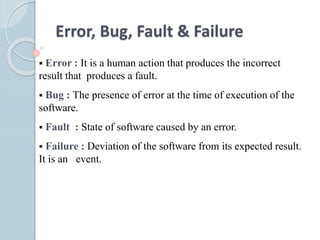
 Error : It is a human action that produces the incorrect
result that produces a fault.
 Bug : The presence of error at the time of execution of the
software.
 Fault : State of software caused by an error.
 Failure : Deviation of the software from its expected result.
It is an event.
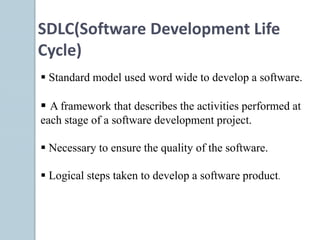
 Standard model used word wide to develop a software.
 A framework that describes the activities performed at
each stage of a software development project.
 Necessary to ensure the quality of the software.
 Logical steps taken to develop a software product.
SDLC(Software Development Life
Cycle)
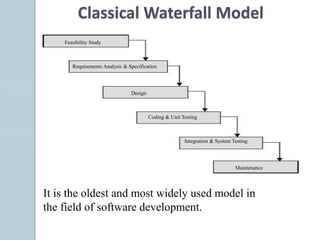
Feasibility Study
Requirements Analysis & Specification
Design
Coding & Unit Testing
Integration & System Testing
Maintenance
Classical Waterfall Model
It is the oldest and most widely used model in
the field of software development.
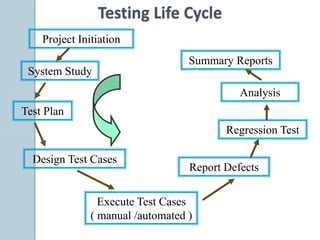
Project Initiation
System Study
Summary Reports
Analysis
Regression Test
Report Defects
Execute Test Cases
( manual /automated )
Design Test Cases
Test Plan
Testing Life Cycle
Test Plan
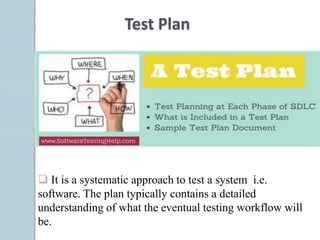
 It is a systematic approach to test a system i.e.
software. The plan typically contains a detailed
understanding of what the eventual testing workflow will
be.
Test Case
 It is a specific procedure of testing a particular
requirement.
It will include:
Identification of specific requirement tested
Test case success/failure criteria
Specific steps to execute test
Test data
• Verification: The software should confirm to its
specification (Are we building the product right?)
• Validation: The software should do what the user really
requires (Are we building the right product?)
Verification vs. Validation
Testing Methodologies
 Black box testing
 White box testing
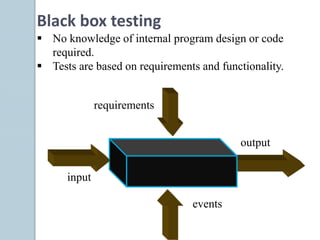
Black box testing
 No knowledge of internal program design or code
required.
 Tests are based on requirements and functionality.
requirements
input
events
output
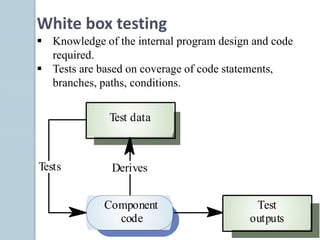
White box testing
 Knowledge of the internal program design and code
required.
 Tests are based on coverage of code statements,
branches, paths, conditions.
Component
code
Test
outputs
Test data
DerivesTests
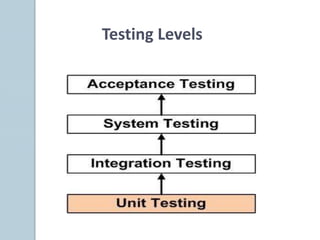
Testing Levels
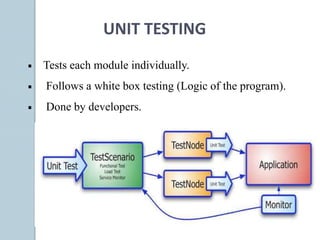
UNIT TESTING
Tests each module individually.
Follows a white box testing (Logic of the program).
Done by developers.
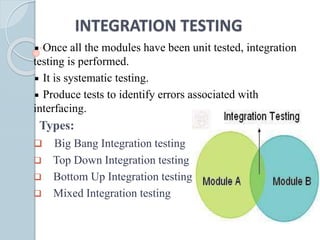
INTEGRATION TESTING
Once all the modules have been unit tested, integration
testing is performed.
It is systematic testing.
Produce tests to identify errors associated with
interfacing.
Types:
 Big Bang Integration testing
 Top Down Integration testing
 Bottom Up Integration testing
 Mixed Integration testing
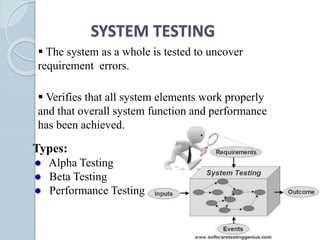
SYSTEM TESTING
 The system as a whole is tested to uncover
requirement errors.
 Verifies that all system elements work properly
and that overall system function and performance
has been achieved.
Types:
Alpha Testing
Beta Testing
Performance Testing
Alpha Testing
 It is carried out by the test team within the developing
organization .
Beta Testing
It is performed by a selected group of friendly customers.
Performance Testing
It is carried out to check whether the system meets the
nonfunctional requirements identified in the SRS document.
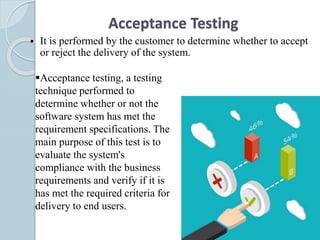
Acceptance Testing
 It is performed by the customer to determine whether to accept
or reject the delivery of the system.
Acceptance testing, a testing
technique performed to
determine whether or not the
software system has met the
requirement specifications. The
main purpose of this test is to
evaluate the system's
compliance with the business
requirements and verify if it is
has met the required criteria for
delivery to end users.
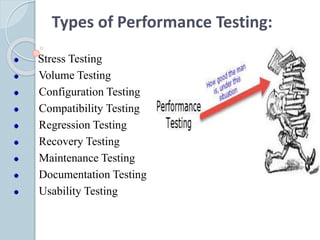
Types of Performance Testing:
Stress Testing
Volume Testing
Configuration Testing
Compatibility Testing
Regression Testing
Recovery Testing
Maintenance Testing
Documentation Testing
Usability Testing
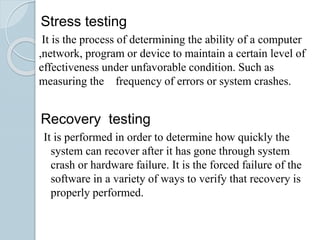
Stress testing
It is the process of determining the ability of a computer
,network, program or device to maintain a certain level of
effectiveness under unfavorable condition. Such as
measuring the frequency of errors or system crashes.
Recovery testing
It is performed in order to determine how quickly the
system can recover after it has gone through system
crash or hardware failure. It is the forced failure of the
software in a variety of ways to verify that recovery is
properly performed.
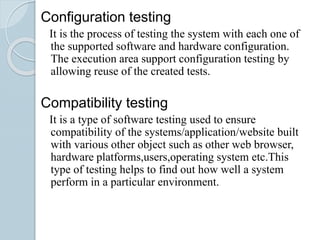
Configuration testing
It is the process of testing the system with each one of
the supported software and hardware configuration.
The execution area support configuration testing by
allowing reuse of the created tests.
Compatibility testing
It is a type of software testing used to ensure
compatibility of the systems/application/website built
with various other object such as other web browser,
hardware platforms,users,operating system etc.This
type of testing helps to find out how well a system
perform in a particular environment.
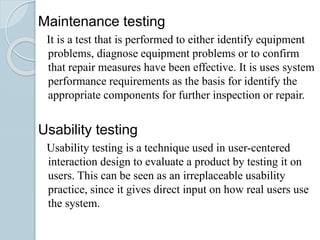
Maintenance testing
It is a test that is performed to either identify equipment
problems, diagnose equipment problems or to confirm
that repair measures have been effective. It is uses system
performance requirements as the basis for identify the
appropriate components for further inspection or repair.
Usability testing
Usability testing is a technique used in user-centered
interaction design to evaluate a product by testing it on
users. This can be seen as an irreplaceable usability
practice, since it gives direct input on how real users use
the system.
REFERENCES
 Http://www.slideshare.net/
 https://www.wikipedia.org/
 http://www.testingbrain.com/
softwaretestingppt-FINAL-PPT-1

softwaretestingppt-FINAL-PPT-1

  • 2.
    Presented By :-Mo.Faizal A. Saiyed Enrollment No :- 150511201809 MCA - Parul University Guided By :- prof.Sneha Mam
  • 3.
    What is Software? Software is a general term for the various kinds of Programs used to operate Computers and related devices. What is Testing ?  Software testing is a process of executing a program or application with the intent of finding the software bugs. It can also be stated as the process of validating and verifying that a software program or application or product: Meets the business and technical requirements that guided it's design and development.
  • 4.
    Why Testing ToolsAre Used As the software industry grows, it becomes more and more competitive and advanced for businesses to produce such good quality software. Testing plays a big part in the case of deadlines as testing can take a long time on the software. The production of the software and the quality together must be increased for businesses to produce the Best possible software. With the aid of testing tools this can Increase efficiency and get the deadlines met.
  • 5.
    OBJECTIVES Uncover as manyas errors (or bugs) as possible in a given product. Demonstrate a given software product matching its requirement specifications. Validate the quality of a software testing using the minimum cost and efforts. Generate high quality test cases, perform effective tests, and issue correct and helpful problem reports.
  • 6.
    Error, Bug, Fault& Failure  Error : It is a human action that produces the incorrect result that produces a fault.  Bug : The presence of error at the time of execution of the software.  Fault : State of software caused by an error.  Failure : Deviation of the software from its expected result. It is an event.
  • 7.
     Standard modelused word wide to develop a software.  A framework that describes the activities performed at each stage of a software development project.  Necessary to ensure the quality of the software.  Logical steps taken to develop a software product. SDLC(Software Development Life Cycle)
  • 8.
    Feasibility Study Requirements Analysis& Specification Design Coding & Unit Testing Integration & System Testing Maintenance Classical Waterfall Model It is the oldest and most widely used model in the field of software development.
  • 9.
    Project Initiation System Study SummaryReports Analysis Regression Test Report Defects Execute Test Cases ( manual /automated ) Design Test Cases Test Plan Testing Life Cycle
  • 10.
    Test Plan  Itis a systematic approach to test a system i.e. software. The plan typically contains a detailed understanding of what the eventual testing workflow will be.
  • 11.
    Test Case  Itis a specific procedure of testing a particular requirement. It will include: Identification of specific requirement tested Test case success/failure criteria Specific steps to execute test Test data
  • 12.
    • Verification: Thesoftware should confirm to its specification (Are we building the product right?) • Validation: The software should do what the user really requires (Are we building the right product?) Verification vs. Validation
  • 13.
    Testing Methodologies  Blackbox testing  White box testing
  • 14.
    Black box testing No knowledge of internal program design or code required.  Tests are based on requirements and functionality. requirements input events output
  • 15.
    White box testing Knowledge of the internal program design and code required.  Tests are based on coverage of code statements, branches, paths, conditions. Component code Test outputs Test data DerivesTests
  • 16.
  • 17.
    UNIT TESTING Tests eachmodule individually. Follows a white box testing (Logic of the program). Done by developers.
  • 18.
    INTEGRATION TESTING Once allthe modules have been unit tested, integration testing is performed. It is systematic testing. Produce tests to identify errors associated with interfacing. Types:  Big Bang Integration testing  Top Down Integration testing  Bottom Up Integration testing  Mixed Integration testing
  • 19.
    SYSTEM TESTING  Thesystem as a whole is tested to uncover requirement errors.  Verifies that all system elements work properly and that overall system function and performance has been achieved. Types: Alpha Testing Beta Testing Performance Testing
  • 20.
    Alpha Testing  Itis carried out by the test team within the developing organization . Beta Testing It is performed by a selected group of friendly customers. Performance Testing It is carried out to check whether the system meets the nonfunctional requirements identified in the SRS document.
  • 21.
    Acceptance Testing  Itis performed by the customer to determine whether to accept or reject the delivery of the system. Acceptance testing, a testing technique performed to determine whether or not the software system has met the requirement specifications. The main purpose of this test is to evaluate the system's compliance with the business requirements and verify if it is has met the required criteria for delivery to end users.
  • 22.
    Types of PerformanceTesting: Stress Testing Volume Testing Configuration Testing Compatibility Testing Regression Testing Recovery Testing Maintenance Testing Documentation Testing Usability Testing
  • 23.
    Stress testing It isthe process of determining the ability of a computer ,network, program or device to maintain a certain level of effectiveness under unfavorable condition. Such as measuring the frequency of errors or system crashes. Recovery testing It is performed in order to determine how quickly the system can recover after it has gone through system crash or hardware failure. It is the forced failure of the software in a variety of ways to verify that recovery is properly performed.
  • 24.
    Configuration testing It isthe process of testing the system with each one of the supported software and hardware configuration. The execution area support configuration testing by allowing reuse of the created tests. Compatibility testing It is a type of software testing used to ensure compatibility of the systems/application/website built with various other object such as other web browser, hardware platforms,users,operating system etc.This type of testing helps to find out how well a system perform in a particular environment.
  • 25.
    Maintenance testing It isa test that is performed to either identify equipment problems, diagnose equipment problems or to confirm that repair measures have been effective. It is uses system performance requirements as the basis for identify the appropriate components for further inspection or repair. Usability testing Usability testing is a technique used in user-centered interaction design to evaluate a product by testing it on users. This can be seen as an irreplaceable usability practice, since it gives direct input on how real users use the system.
  • 26.