8086 Architecture
Dr Vikas Mahor
Architecture
8086 Microprocessor
2
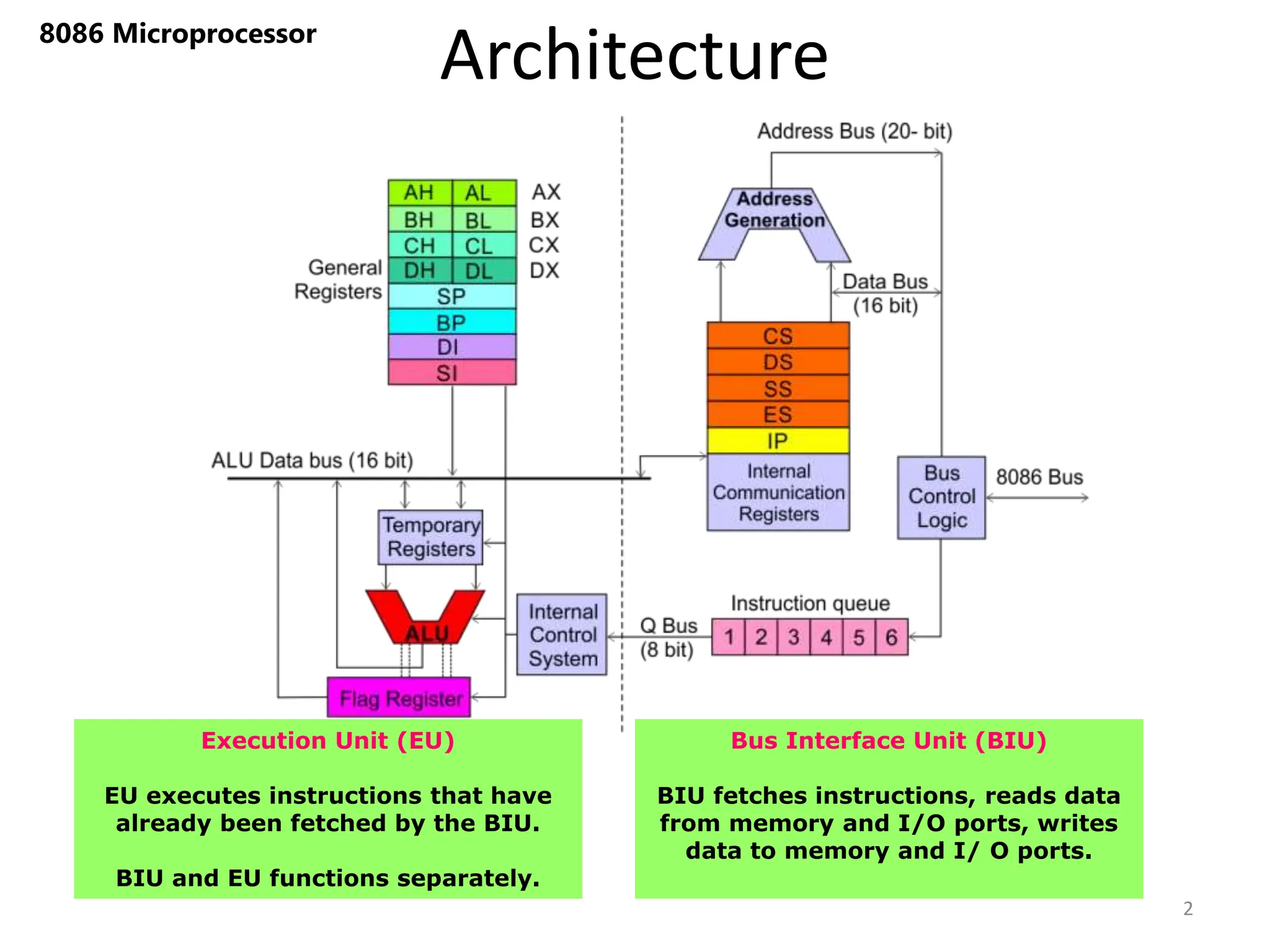
Execution Unit (EU)
EU executes instructions that have
already been fetched by the BIU.
BIU and EU functions separately.
Bus Interface Unit (BIU)
BIU fetches instructions, reads data
from memory and I/O ports, writes
data to memory and I/ O ports.
Architecture
8086 Microprocessor
3
Bus Interface Unit (BIU)
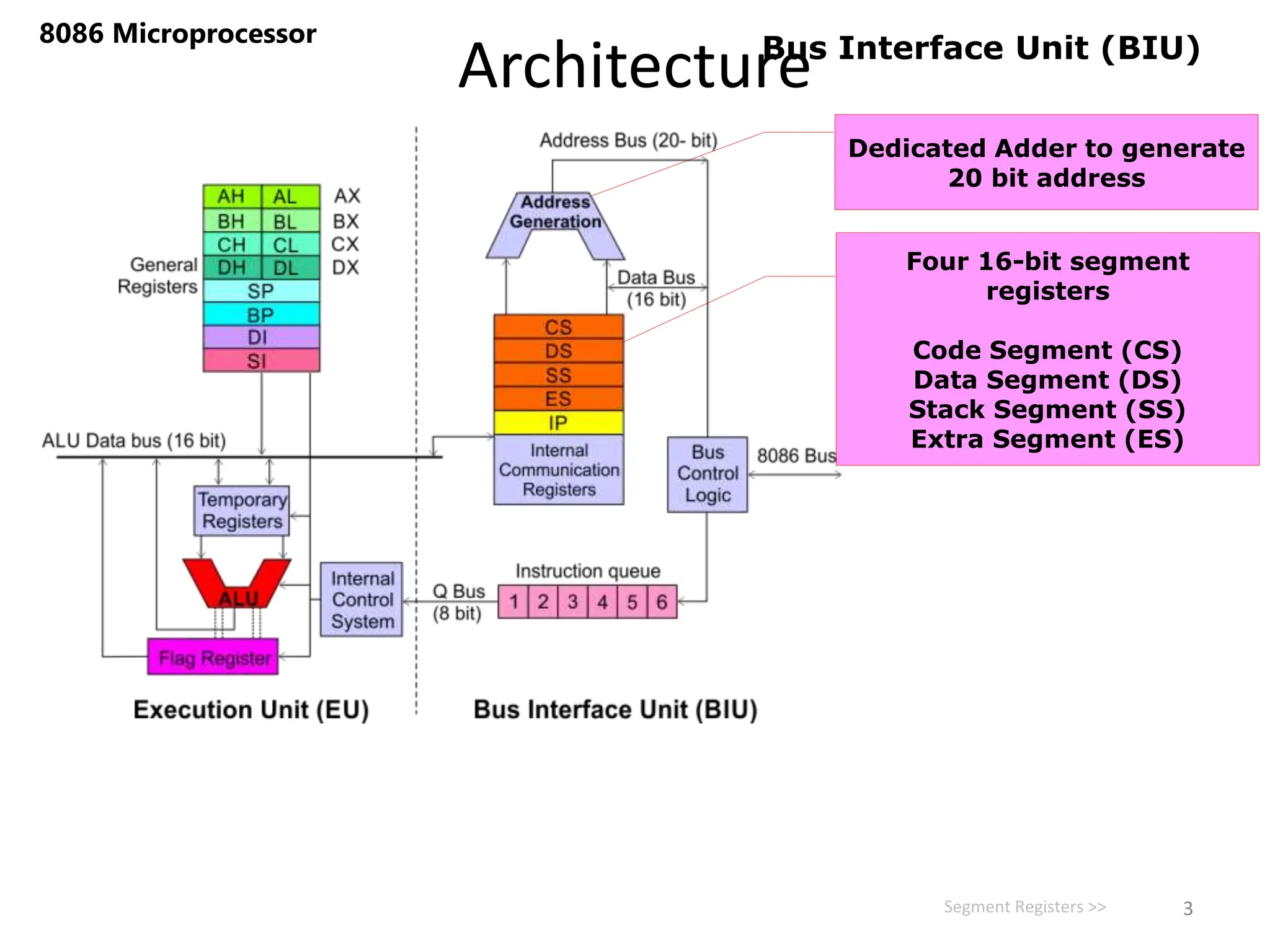
Dedicated Adder to generate
20 bit address
Four 16-bit segment
registers
Code Segment (CS)
Data Segment (DS)
Stack Segment (SS)
Extra Segment (ES)
Segment Registers >>
Architecture
8086 Microprocessor
4
Bus Interface Unit (BIU)
Segment
Registers
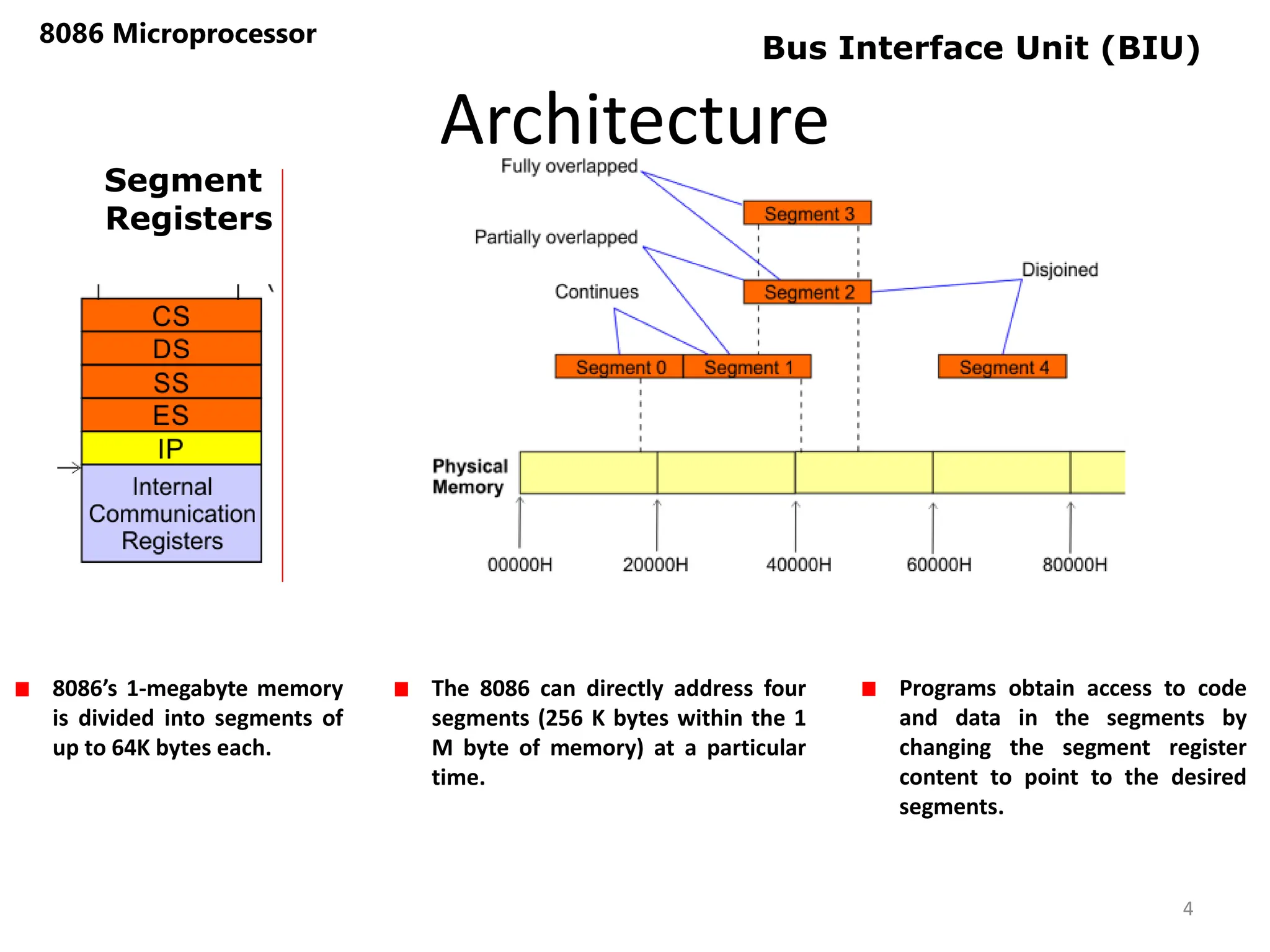
8086’s 1-megabyte memory
is divided into segments of
up to 64K bytes each.
Programs obtain access to code
and data in the segments by
changing the segment register
content to point to the desired
segments.
The 8086 can directly address four
segments (256 K bytes within the 1
M byte of memory) at a particular
time.
Architecture
8086 Microprocessor
5
Bus Interface Unit (BIU)
Segment
Registers
Code Segment Register
16-bit
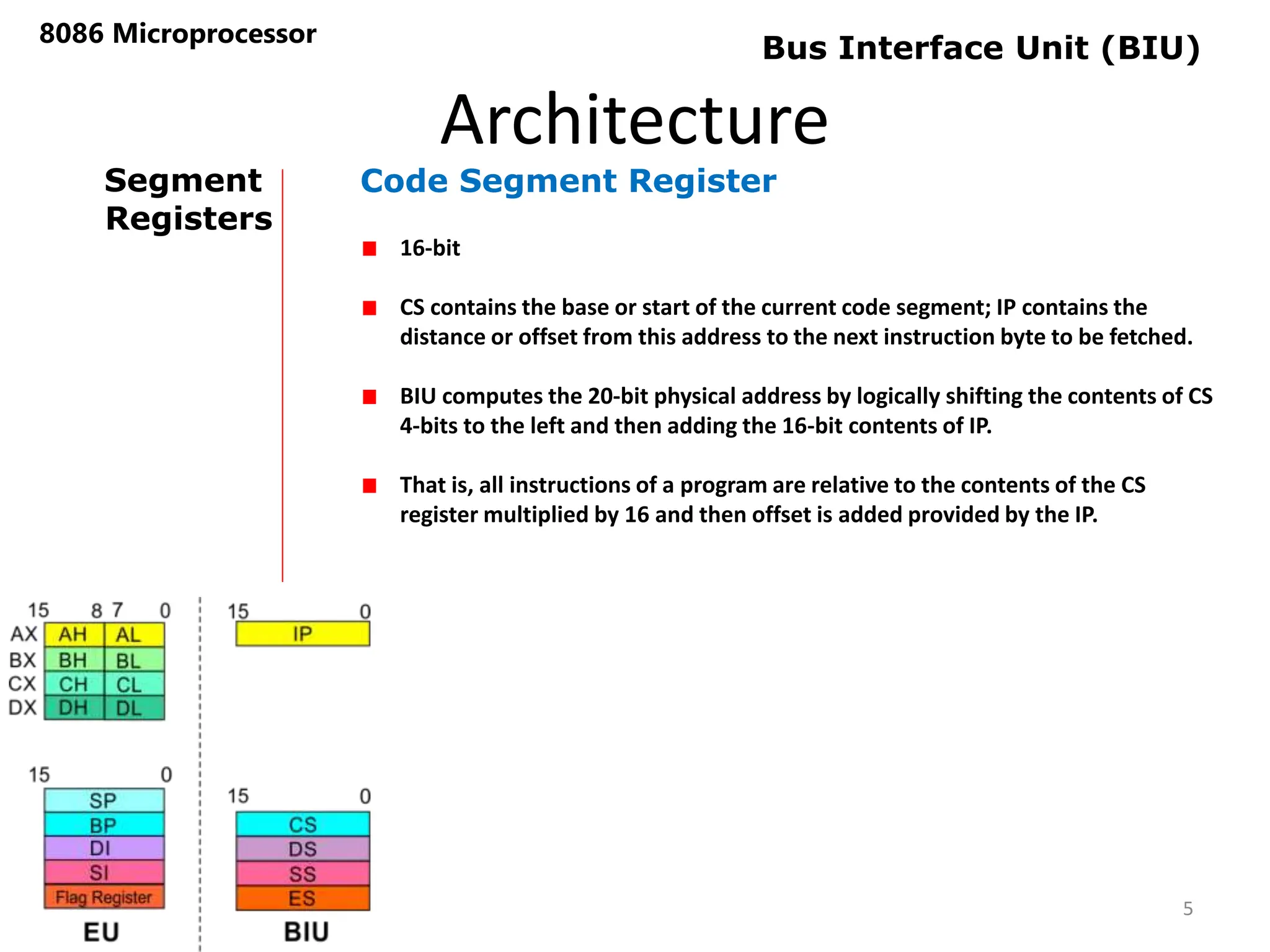
CS contains the base or start of the current code segment; IP contains the
distance or offset from this address to the next instruction byte to be fetched.
BIU computes the 20-bit physical address by logically shifting the contents of CS
4-bits to the left and then adding the 16-bit contents of IP.
That is, all instructions of a program are relative to the contents of the CS
register multiplied by 16 and then offset is added provided by the IP.
Architecture
8086 Microprocessor
6
Bus Interface Unit (BIU)
Segment
Registers
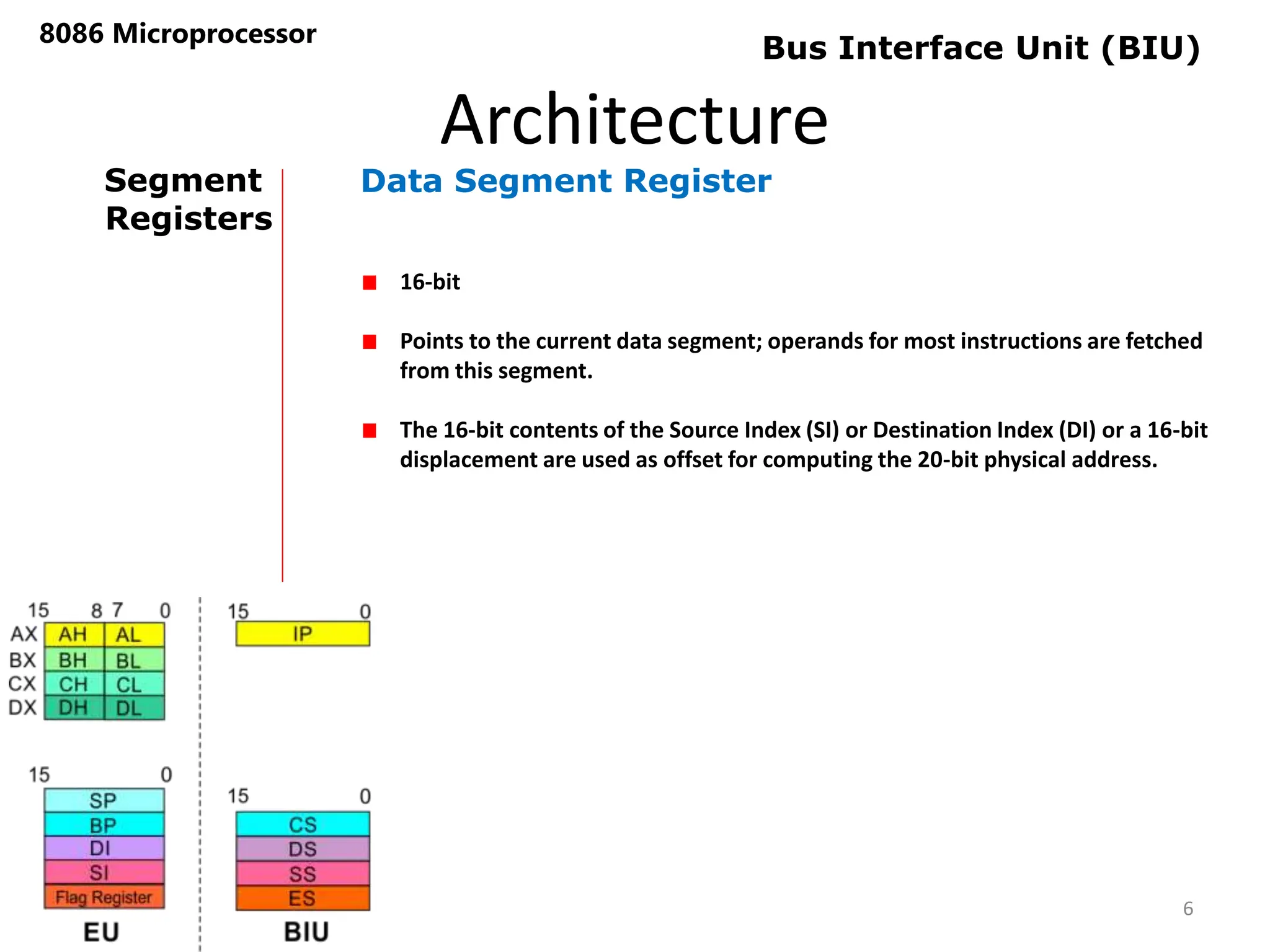
Data Segment Register
16-bit
Points to the current data segment; operands for most instructions are fetched
from this segment.
The 16-bit contents of the Source Index (SI) or Destination Index (DI) or a 16-bit
displacement are used as offset for computing the 20-bit physical address.
Architecture
8086 Microprocessor
7
Bus Interface Unit (BIU)
Segment
Registers
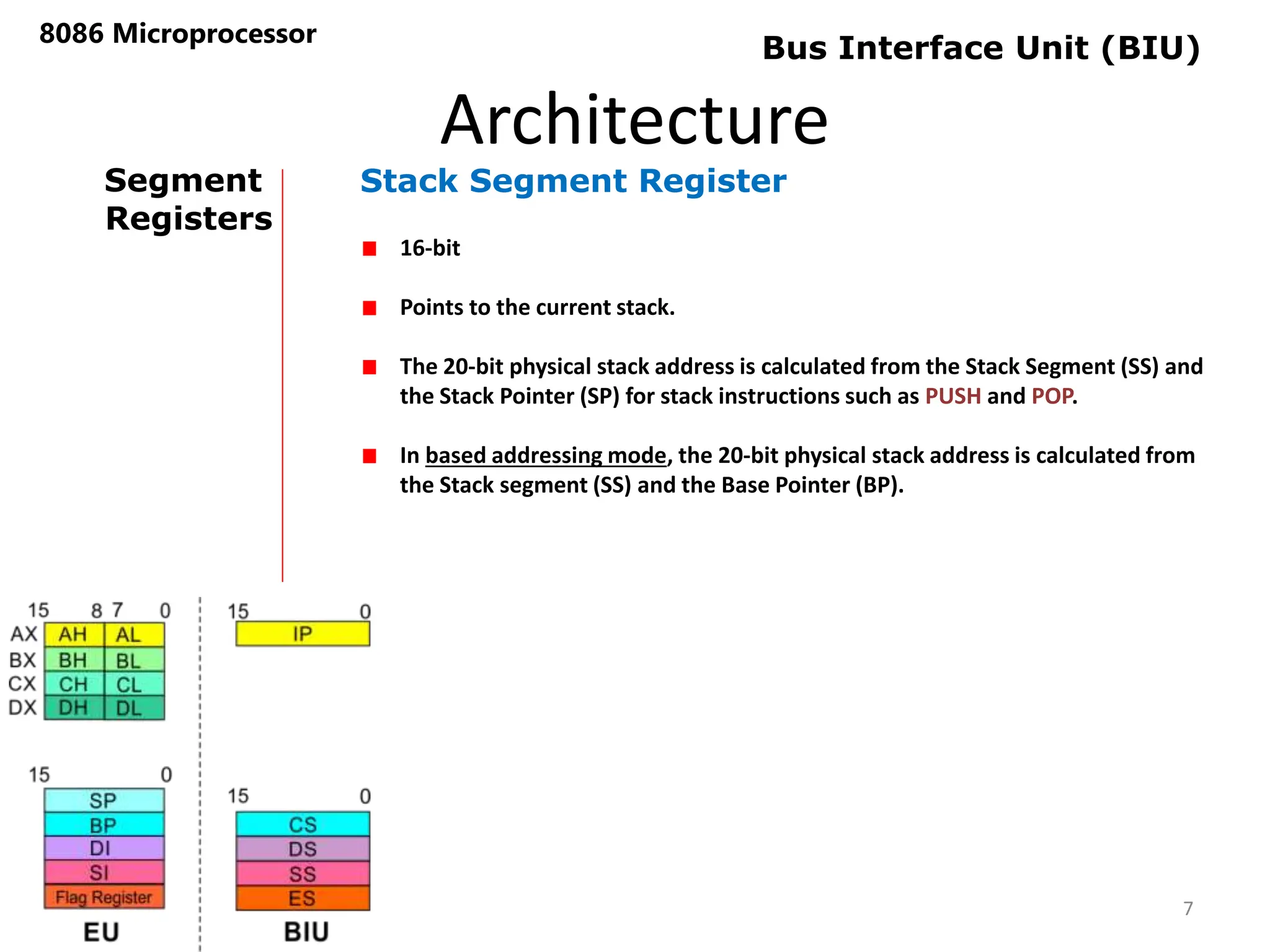
Stack Segment Register
16-bit
Points to the current stack.
The 20-bit physical stack address is calculated from the Stack Segment (SS) and
the Stack Pointer (SP) for stack instructions such as PUSH and POP.
In based addressing mode, the 20-bit physical stack address is calculated from
the Stack segment (SS) and the Base Pointer (BP).
Architecture
8086 Microprocessor
8
Bus Interface Unit (BIU)
Segment
Registers
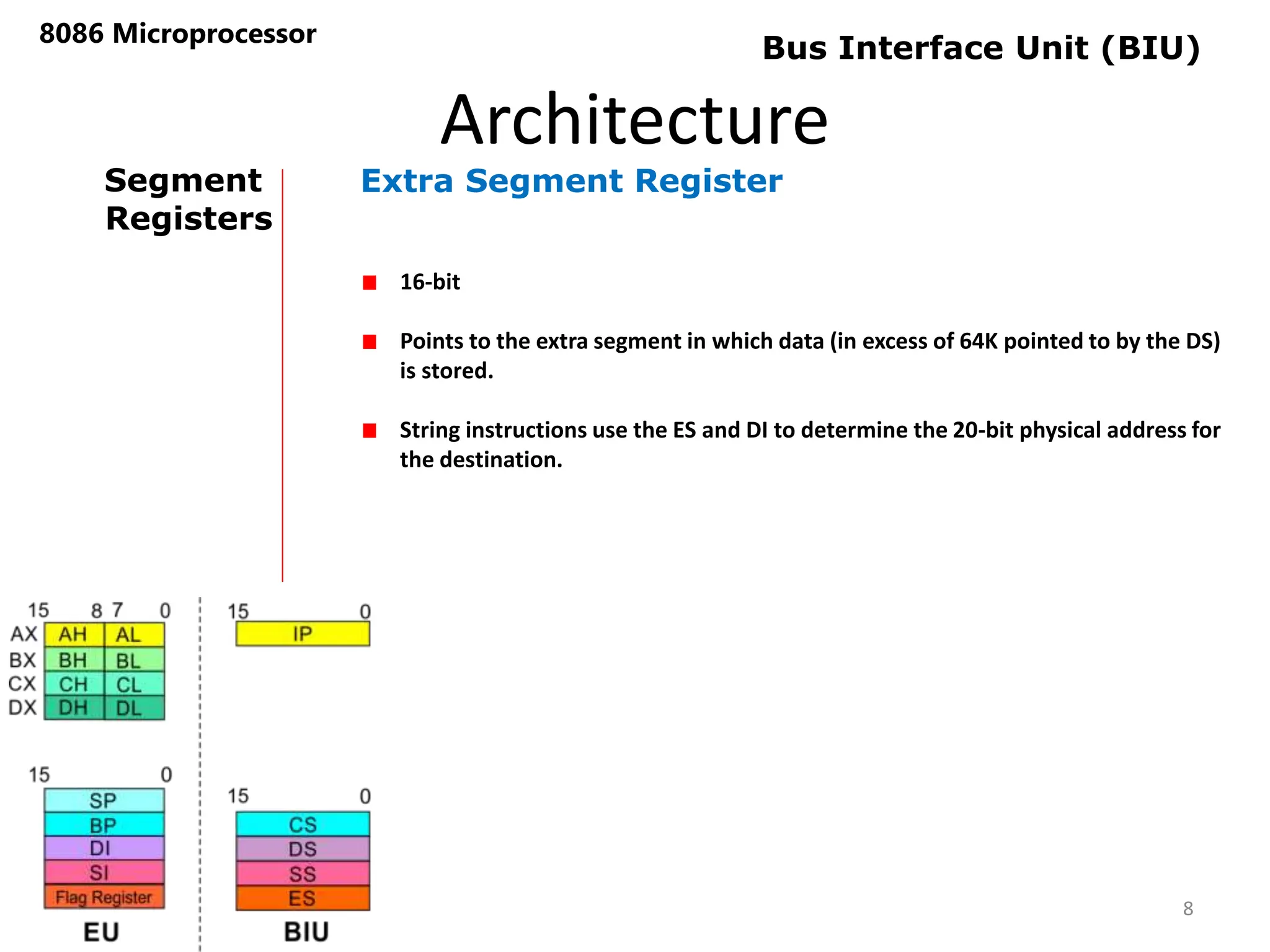
Extra Segment Register
16-bit
Points to the extra segment in which data (in excess of 64K pointed to by the DS)
is stored.
String instructions use the ES and DI to determine the 20-bit physical address for
the destination.
Architecture
8086 Microprocessor
9
Bus Interface Unit (BIU)
Segment
Registers
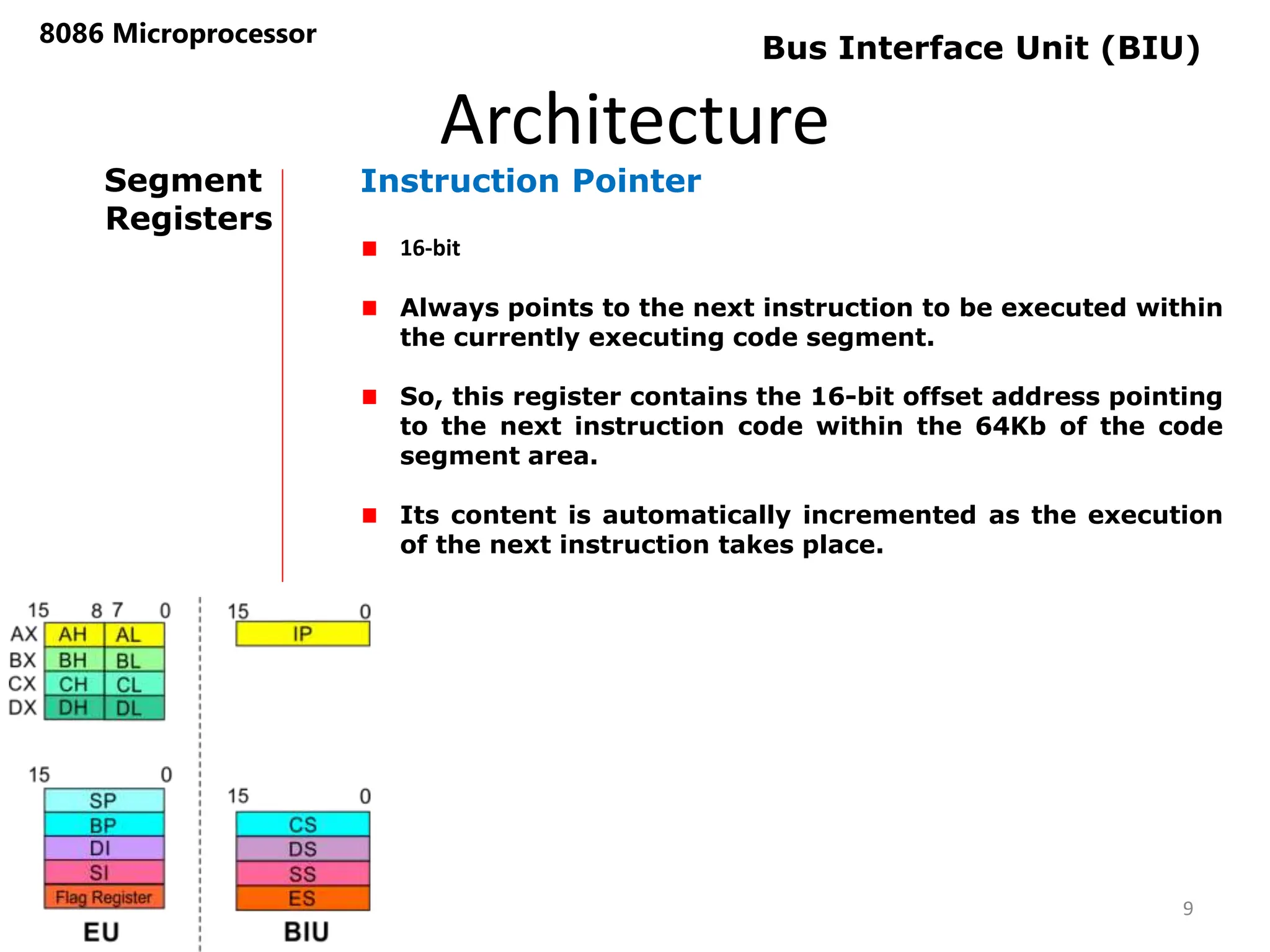
Instruction Pointer
16-bit
Always points to the next instruction to be executed within
the currently executing code segment.
So, this register contains the 16-bit offset address pointing
to the next instruction code within the 64Kb of the code
segment area.
Its content is automatically incremented as the execution
of the next instruction takes place.
Architecture
8086 Microprocessor
10
Bus Interface Unit (BIU)
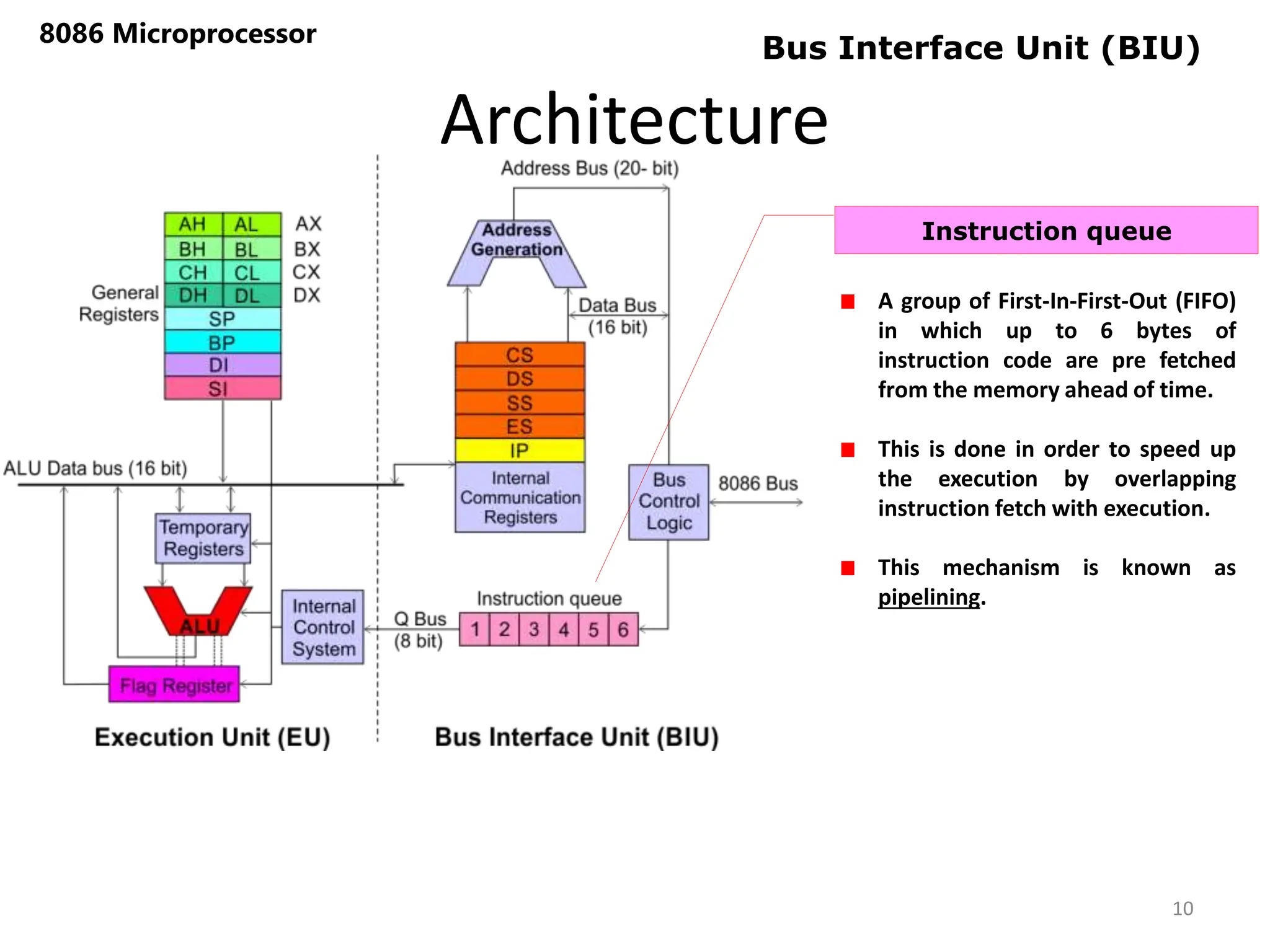
A group of First-In-First-Out (FIFO)
in which up to 6 bytes of
instruction code are pre fetched
from the memory ahead of time.
This is done in order to speed up
the execution by overlapping
instruction fetch with execution.
This mechanism is known as
pipelining.
Instruction queue
Architecture
8086 Microprocessor
11
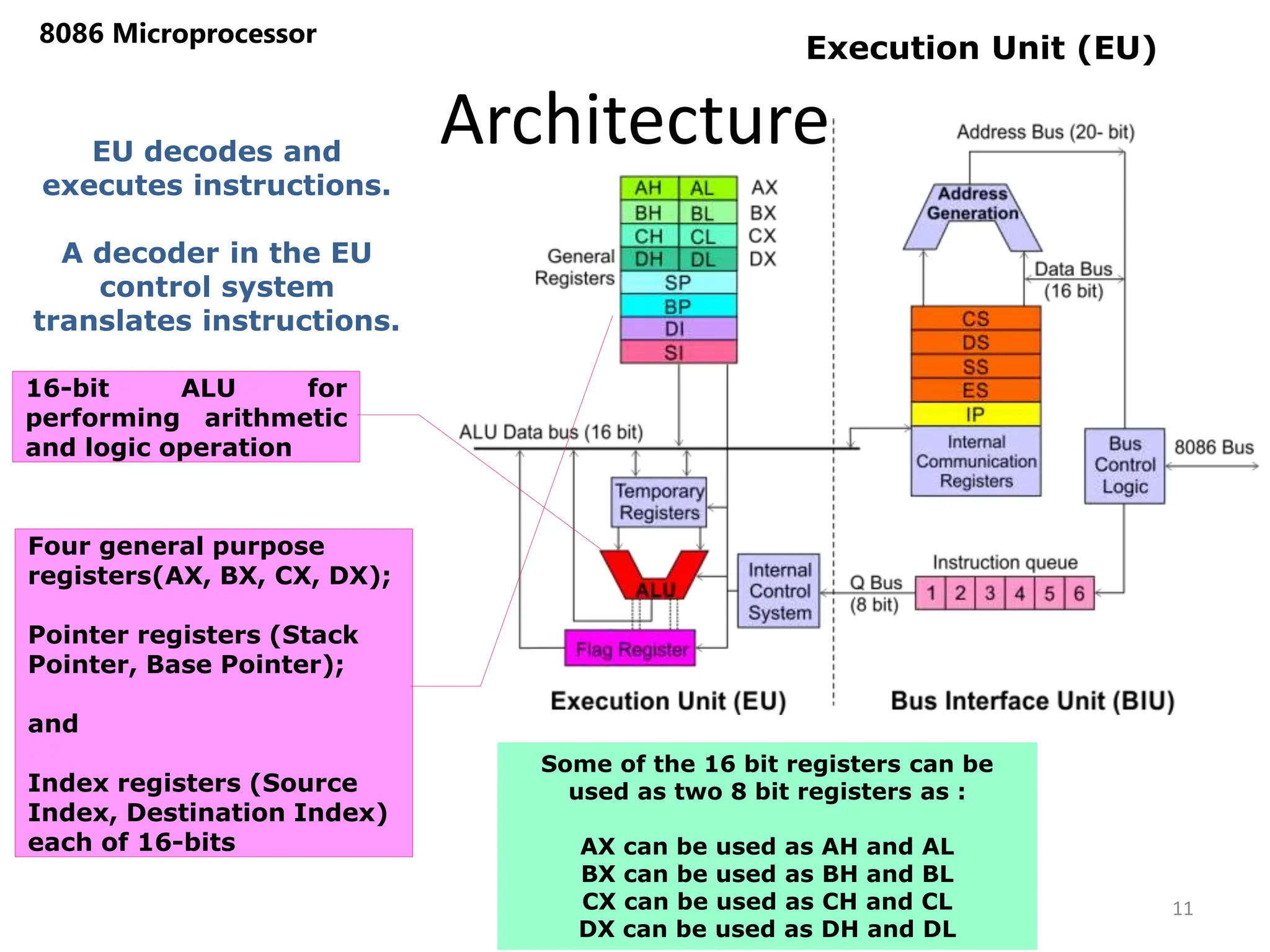
Some of the 16 bit registers can be
used as two 8 bit registers as :
AX can be used as AH and AL
BX can be used as BH and BL
CX can be used as CH and CL
DX can be used as DH and DL
Execution Unit (EU)
EU decodes and
executes instructions.
A decoder in the EU
control system
translates instructions.
16-bit ALU for
performing arithmetic
and logic operation
Four general purpose
registers(AX, BX, CX, DX);
Pointer registers (Stack
Pointer, Base Pointer);
and
Index registers (Source
Index, Destination Index)
each of 16-bits
Architecture
8086 Microprocessor
12
EU
Registers
Accumulator Register (AX)
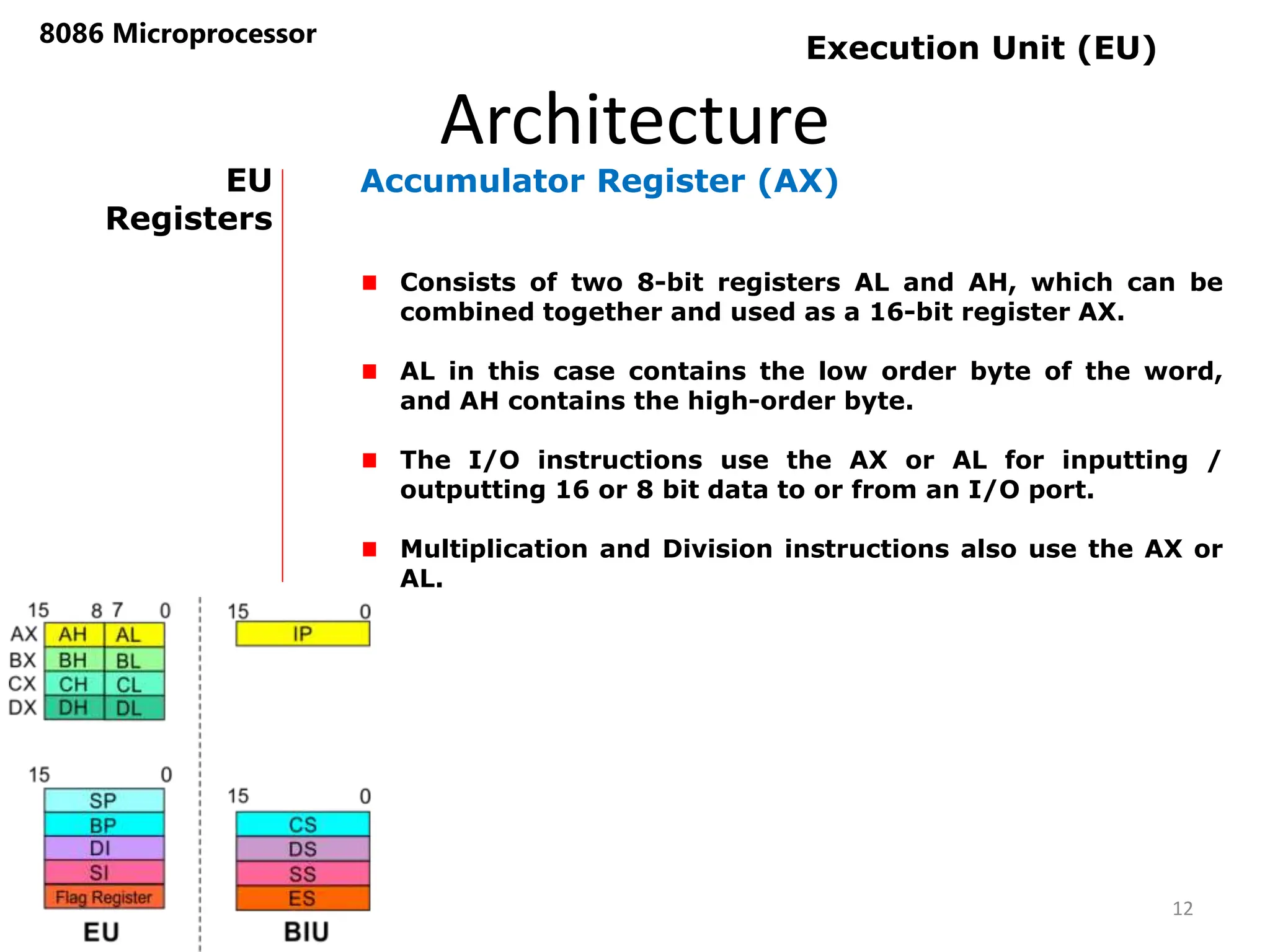
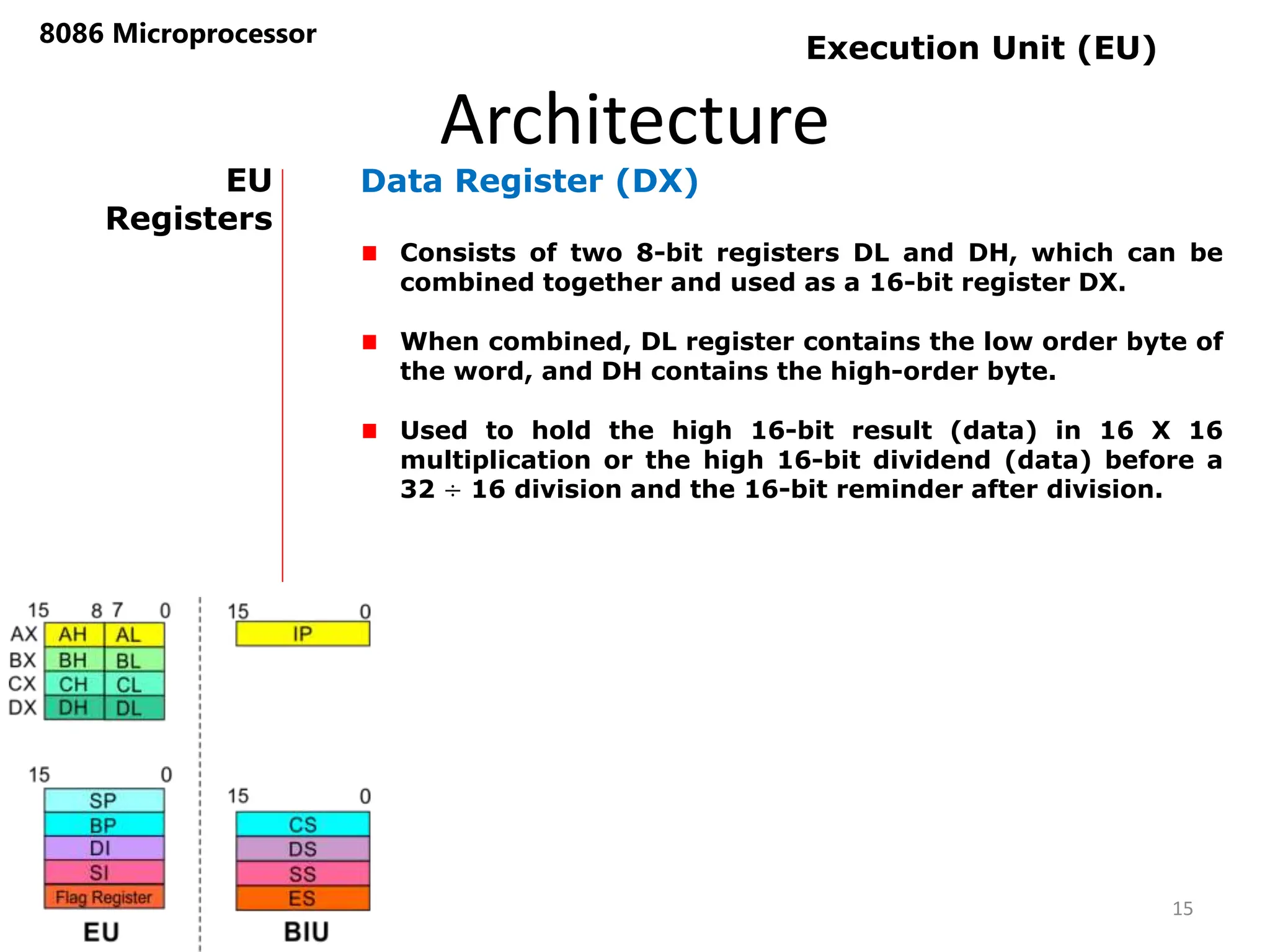
Consists of two 8-bit registers AL and AH, which can be
combined together and used as a 16-bit register AX.
AL in this case contains the low order byte of the word,
and AH contains the high-order byte.
The I/O instructions use the AX or AL for inputting /
outputting 16 or 8 bit data to or from an I/O port.
Multiplication and Division instructions also use the AX or
AL.
Execution Unit (EU)
Architecture
8086 Microprocessor
13
EU
Registers
Base Register (BX)
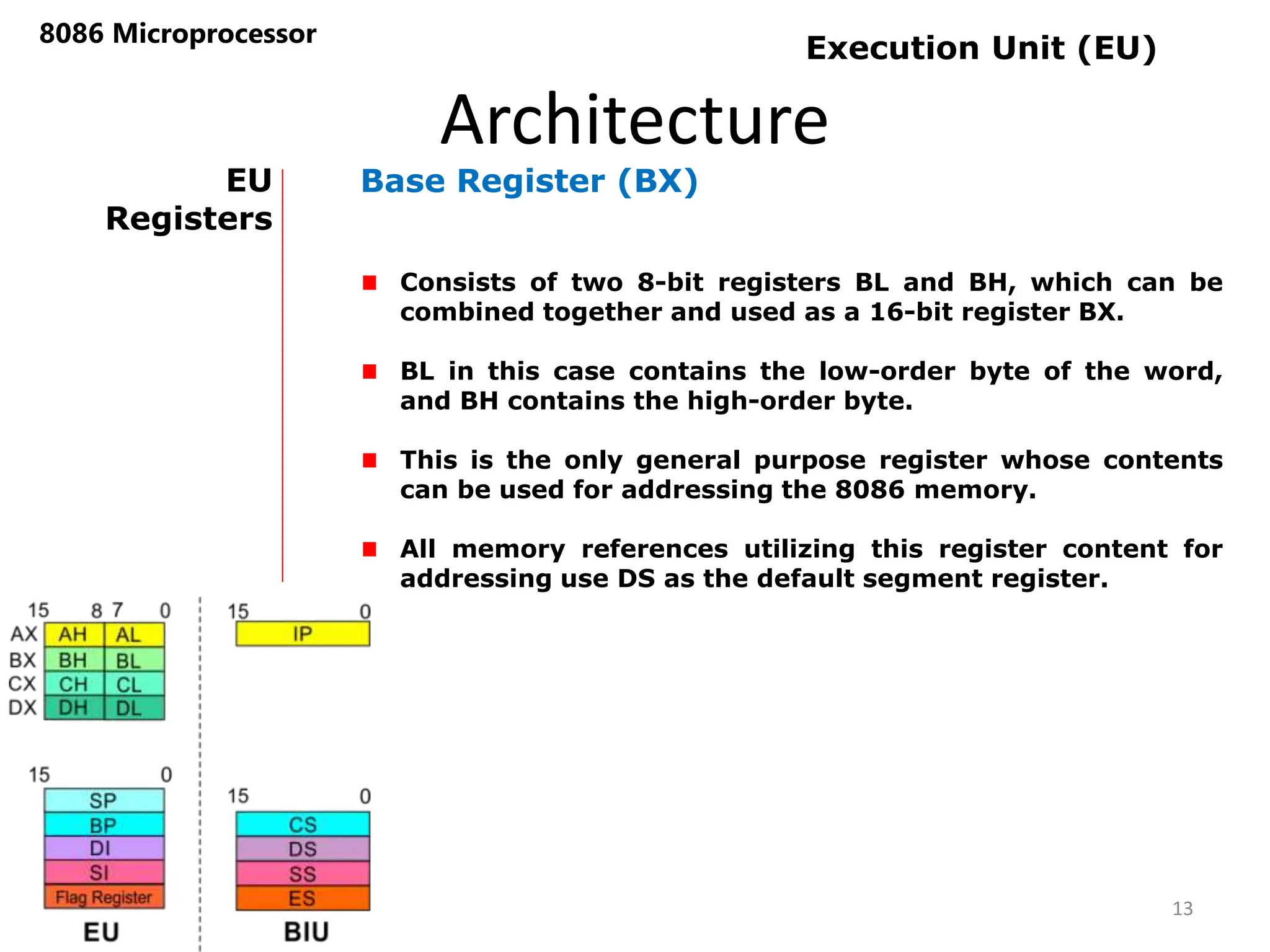
Consists of two 8-bit registers BL and BH, which can be
combined together and used as a 16-bit register BX.
BL in this case contains the low-order byte of the word,
and BH contains the high-order byte.
This is the only general purpose register whose contents
can be used for addressing the 8086 memory.
All memory references utilizing this register content for
addressing use DS as the default segment register.
Execution Unit (EU)
Architecture
8086 Microprocessor
14
EU
Registers
Counter Register (CX)
Consists of two 8-bit registers CL and CH, which can be
combined together and used as a 16-bit register CX.
When combined, CL register contains the low order byte of
the word, and CH contains the high-order byte.
Instructions such as SHIFT, ROTATE and LOOP use the
contents of CX as a counter.
Execution Unit (EU)
Example:
The instruction LOOP START automatically decrements
CX by 1 without affecting flags and will check if [CX] =
0.
If it is zero, 8086 executes the next instruction;
otherwise the 8086 branches to the label START.
Architecture
8086 Microprocessor
15
EU
Registers
Data Register (DX)
Consists of two 8-bit registers DL and DH, which can be
combined together and used as a 16-bit register DX.
When combined, DL register contains the low order byte of
the word, and DH contains the high-order byte.
Used to hold the high 16-bit result (data) in 16 X 16
multiplication or the high 16-bit dividend (data) before a
32 ÷ 16 division and the 16-bit reminder after division.
Execution Unit (EU)
Architecture
8086 Microprocessor
16
EU
Registers
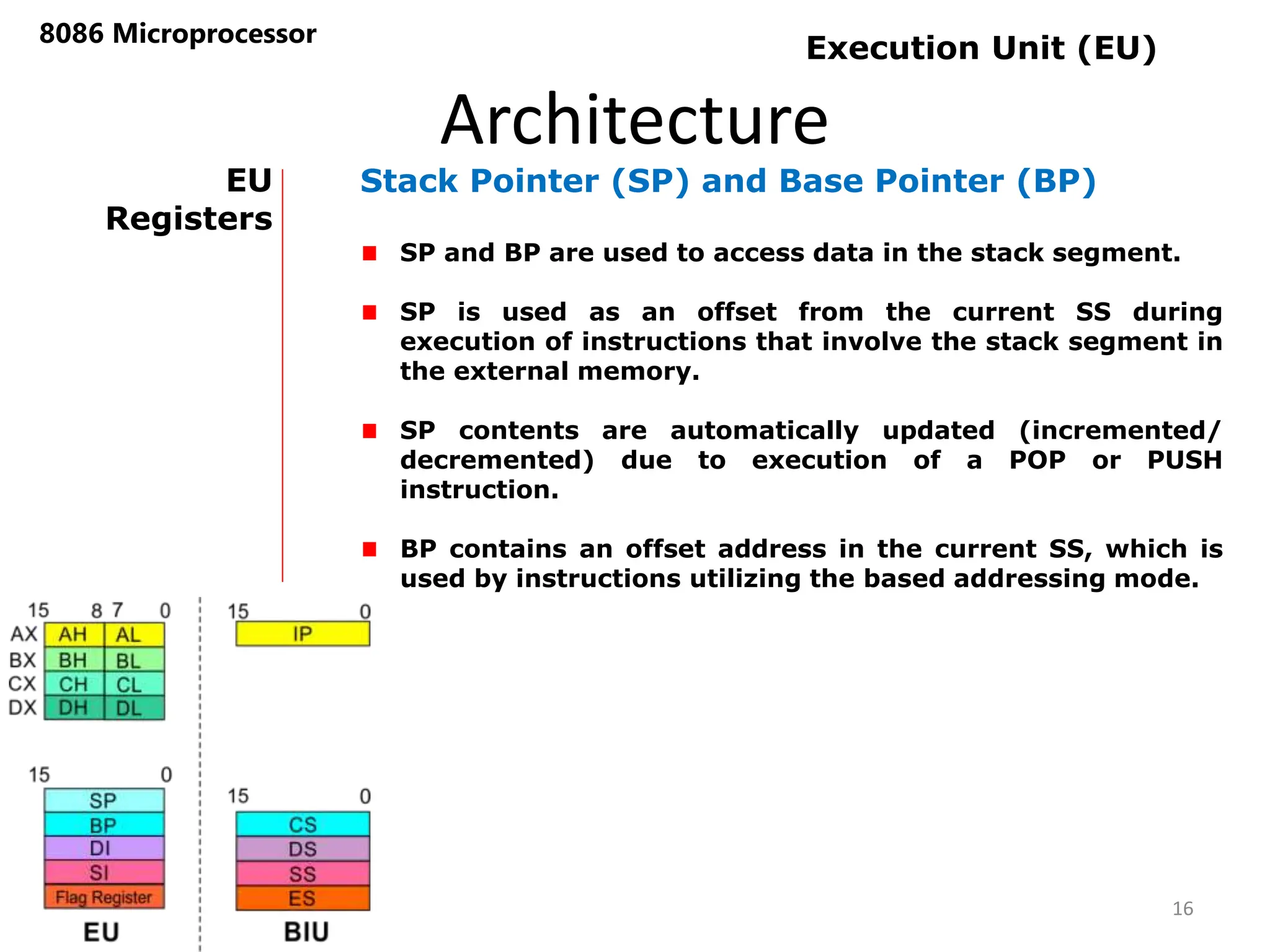
Stack Pointer (SP) and Base Pointer (BP)
SP and BP are used to access data in the stack segment.
SP is used as an offset from the current SS during
execution of instructions that involve the stack segment in
the external memory.
SP contents are automatically updated (incremented/
decremented) due to execution of a POP or PUSH
instruction.
BP contains an offset address in the current SS, which is
used by instructions utilizing the based addressing mode.
Execution Unit (EU)
Architecture
8086 Microprocessor
17
EU
Registers
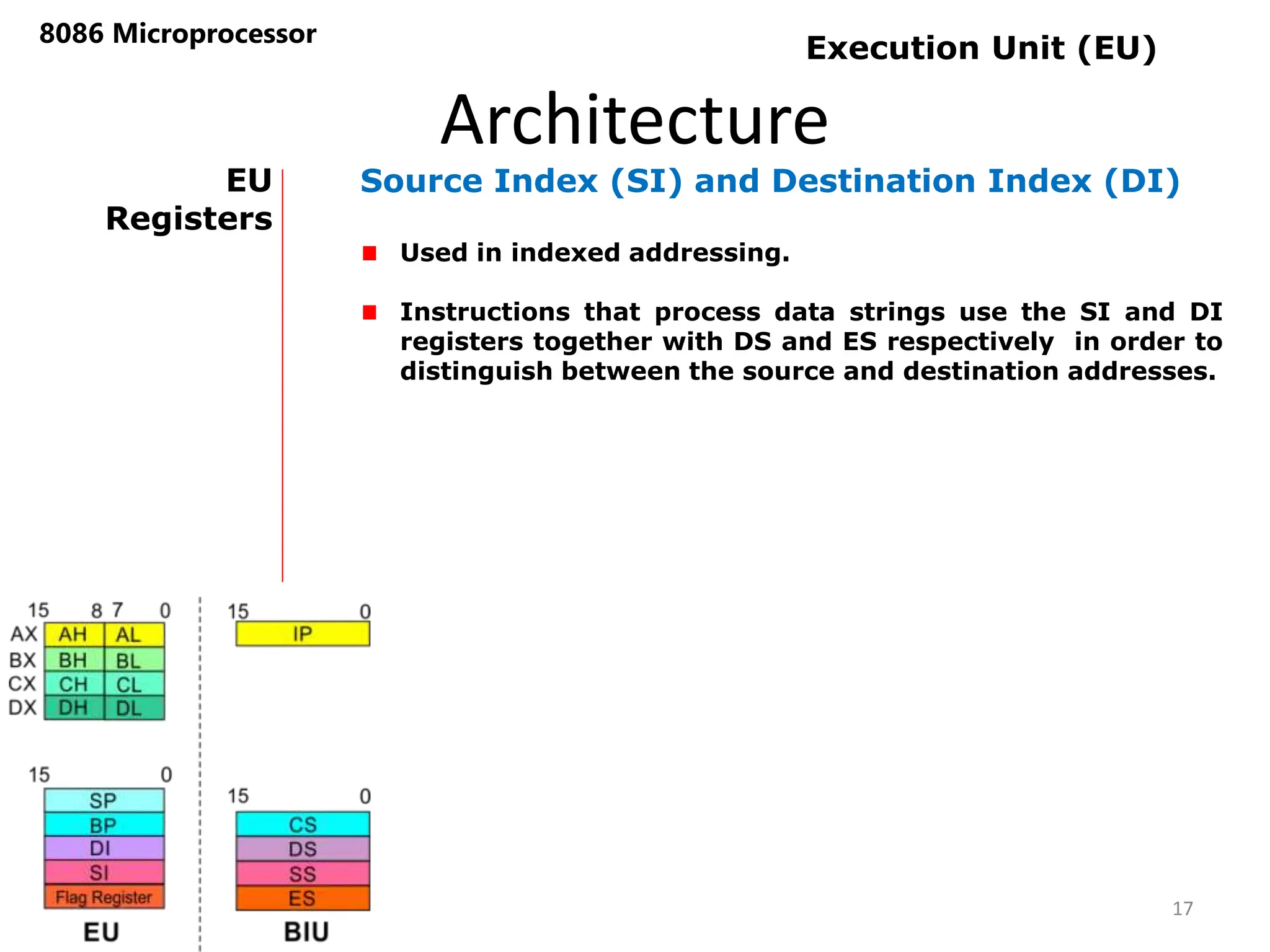
Source Index (SI) and Destination Index (DI)
Used in indexed addressing.
Instructions that process data strings use the SI and DI
registers together with DS and ES respectively in order to
distinguish between the source and destination addresses.
Execution Unit (EU)
Architecture
8086 Microprocessor
18
EU
Registers
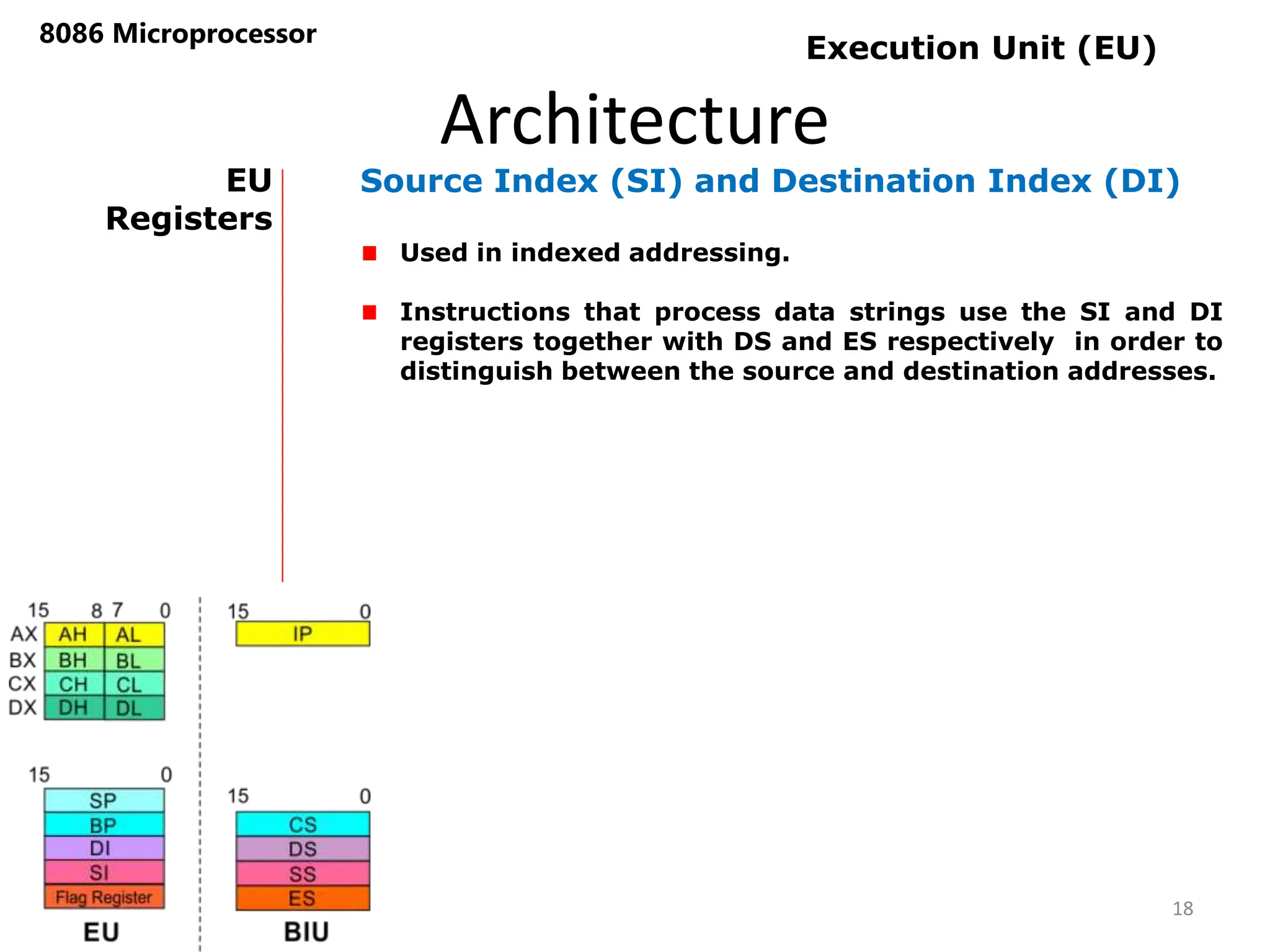
Source Index (SI) and Destination Index (DI)
Used in indexed addressing.
Instructions that process data strings use the SI and DI
registers together with DS and ES respectively in order to
distinguish between the source and destination addresses.
Execution Unit (EU)
Architecture
8086 Microprocessor
19
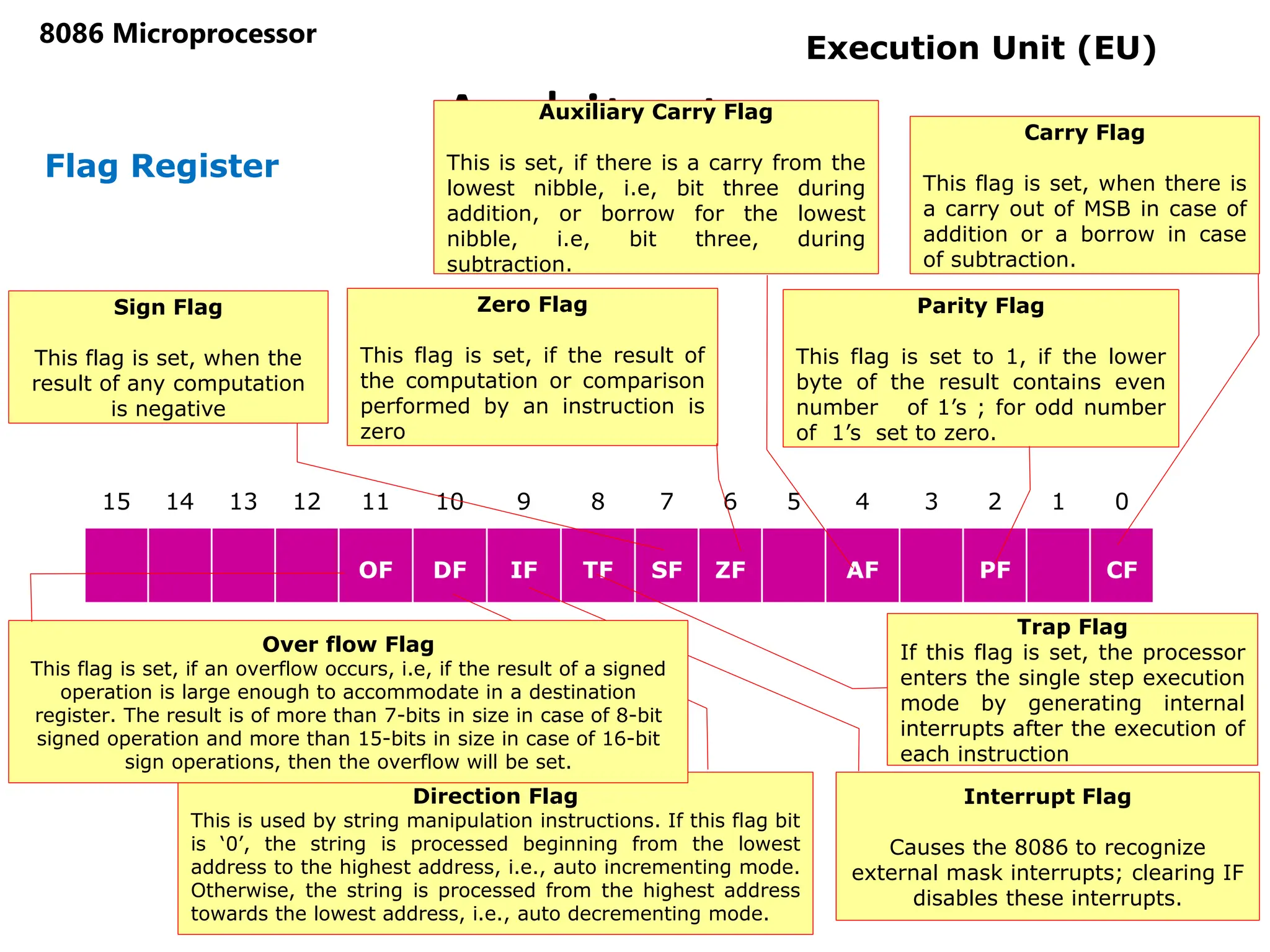
Flag Register
15 14 13 12 11 10 9 8 7 6 5 4 3 2 1 0
OF DF IF TF SF ZF AF PF CF
Carry Flag
This flag is set, when there is
a carry out of MSB in case of
addition or a borrow in case
of subtraction.
Parity Flag
This flag is set to 1, if the lower
byte of the result contains even
number of 1’s ; for odd number
of 1’s set to zero.
Auxiliary Carry Flag
This is set, if there is a carry from the
lowest nibble, i.e, bit three during
addition, or borrow for the lowest
nibble, i.e, bit three, during
subtraction.
Zero Flag
This flag is set, if the result of
the computation or comparison
performed by an instruction is
zero
Sign Flag
This flag is set, when the
result of any computation
is negative
Trap Flag
If this flag is set, the processor
enters the single step execution
mode by generating internal
interrupts after the execution of
each instruction
Interrupt Flag
Causes the 8086 to recognize
external mask interrupts; clearing IF
disables these interrupts.
Direction Flag
This is used by string manipulation instructions. If this flag bit
is ‘0’, the string is processed beginning from the lowest
address to the highest address, i.e., auto incrementing mode.
Otherwise, the string is processed from the highest address
towards the lowest address, i.e., auto decrementing mode.
Over flow Flag
This flag is set, if an overflow occurs, i.e, if the result of a signed
operation is large enough to accommodate in a destination
register. The result is of more than 7-bits in size in case of 8-bit
signed operation and more than 15-bits in size in case of 16-bit
sign operations, then the overflow will be set.
Execution Unit (EU)
20
Architecture
8086 Microprocessor
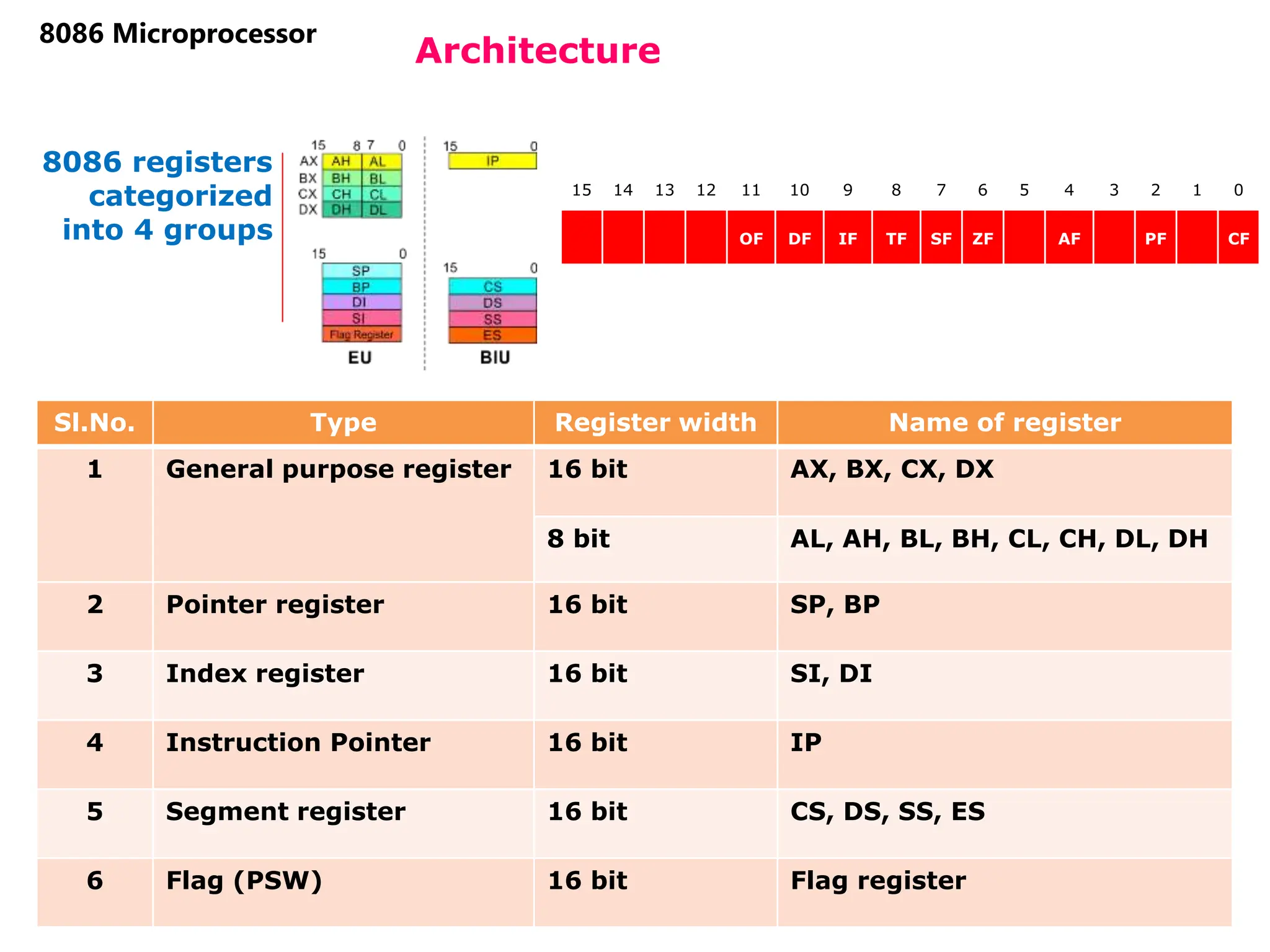
Sl.No. Type Register width Name of register
1 General purpose register 16 bit AX, BX, CX, DX
8 bit AL, AH, BL, BH, CL, CH, DL, DH
2 Pointer register 16 bit SP, BP
3 Index register 16 bit SI, DI
4 Instruction Pointer 16 bit IP
5 Segment register 16 bit CS, DS, SS, ES
6 Flag (PSW) 16 bit Flag register
8086 registers
categorized
into 4 groups
15 14 13 12 11 10 9 8 7 6 5 4 3 2 1 0
OF DF IF TF SF ZF AF PF CF
21
Architecture
8086 Microprocessor
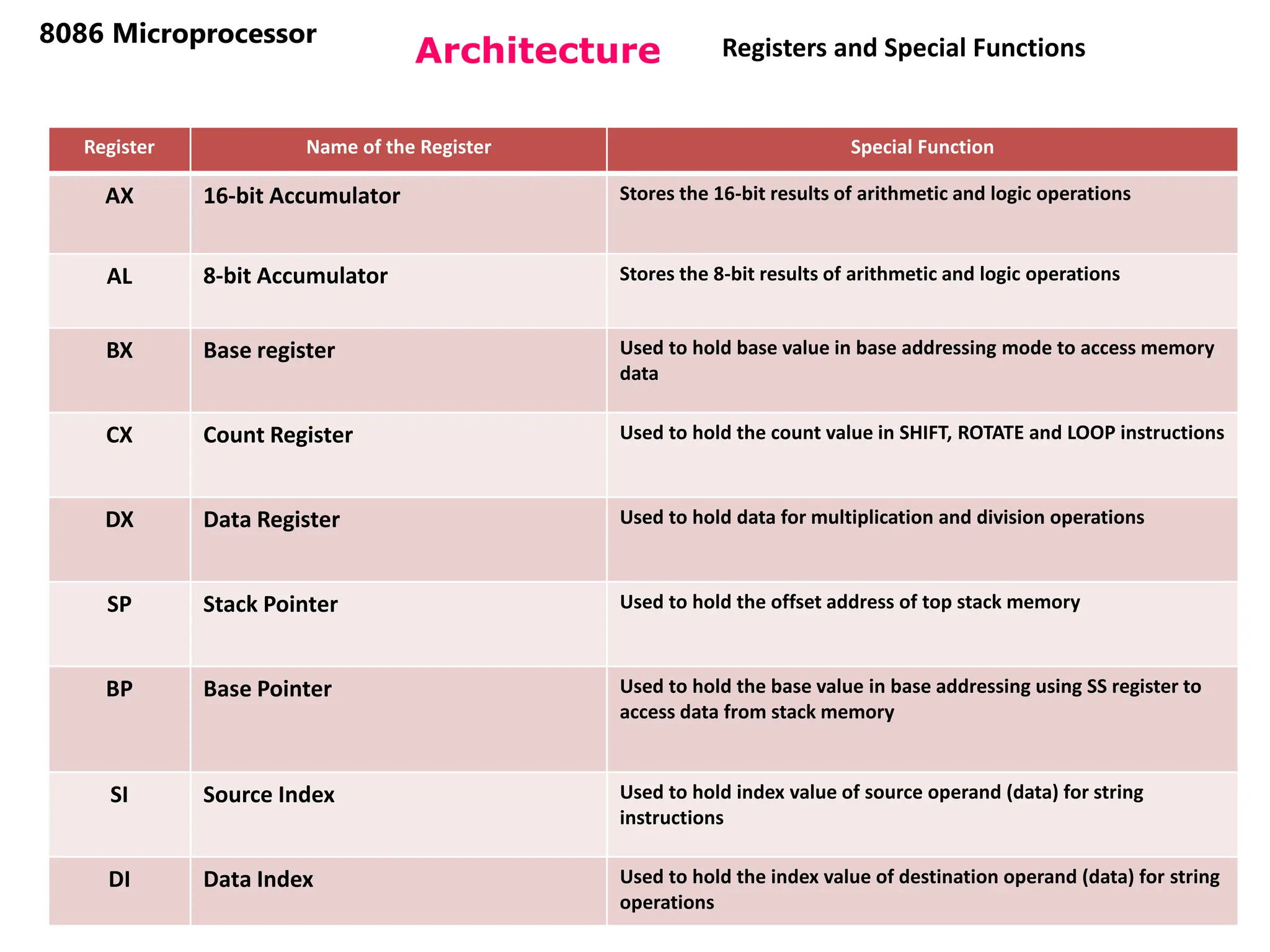
Register Name of the Register Special Function
AX 16-bit Accumulator Stores the 16-bit results of arithmetic and logic operations
AL 8-bit Accumulator Stores the 8-bit results of arithmetic and logic operations
BX Base register Used to hold base value in base addressing mode to access memory
data
CX Count Register Used to hold the count value in SHIFT, ROTATE and LOOP instructions
DX Data Register Used to hold data for multiplication and division operations
SP Stack Pointer Used to hold the offset address of top stack memory
BP Base Pointer Used to hold the base value in base addressing using SS register to
access data from stack memory
SI Source Index Used to hold index value of source operand (data) for string
instructions
DI Data Index Used to hold the index value of destination operand (data) for string
operations
Registers and Special Functions
Pins and signals
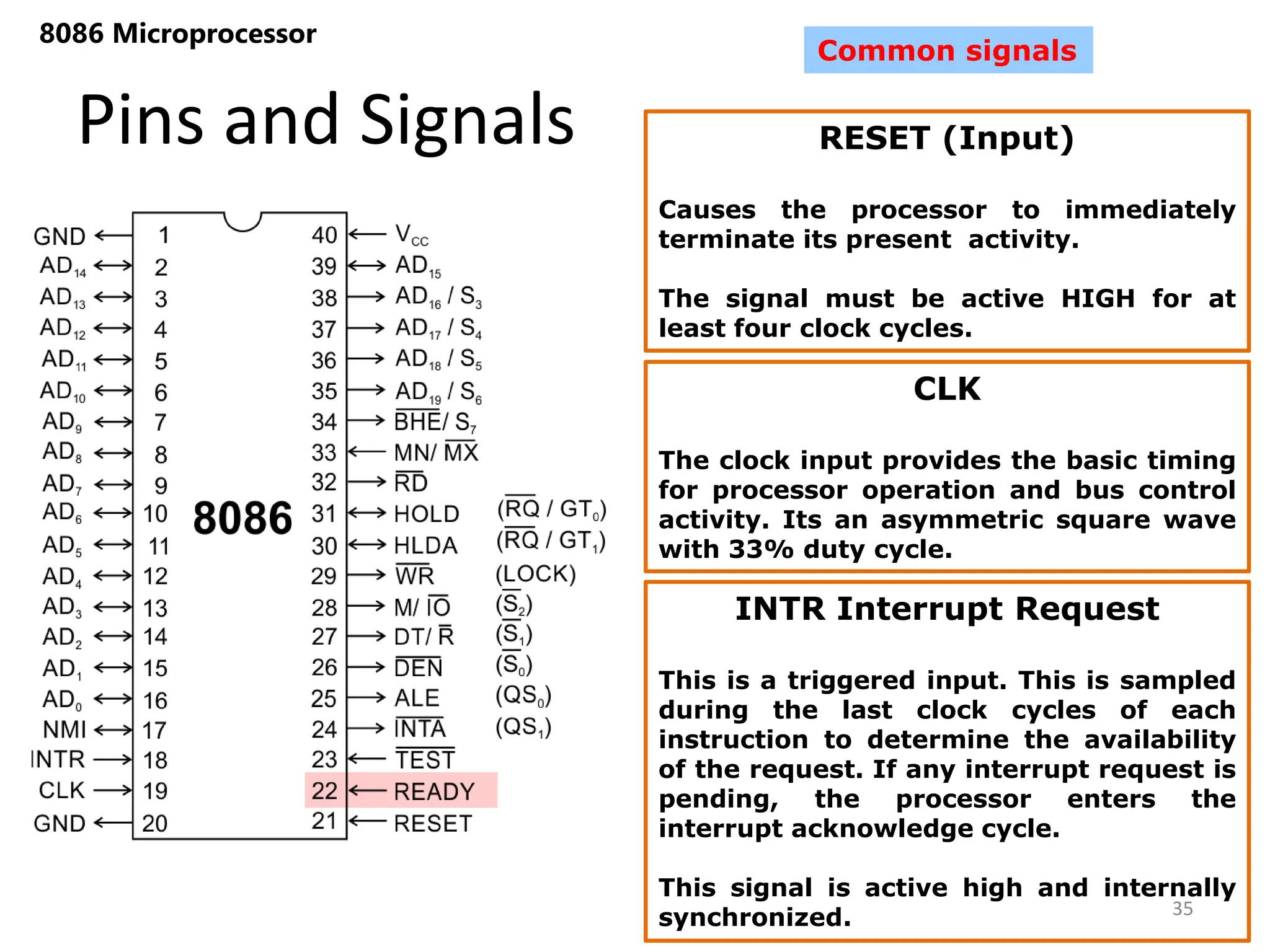
Pins and Signals
8086 Microprocessor
23
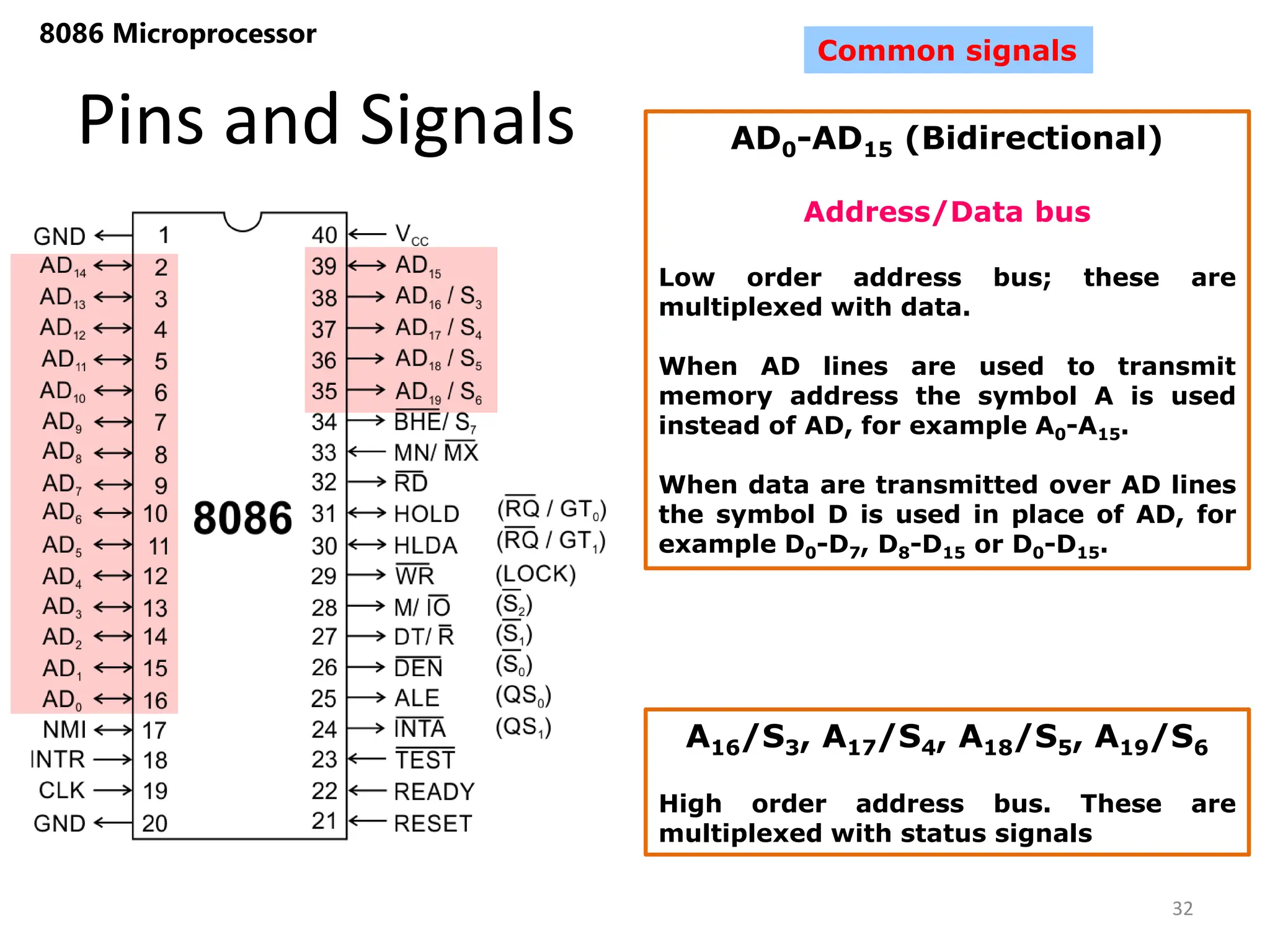
Common signals
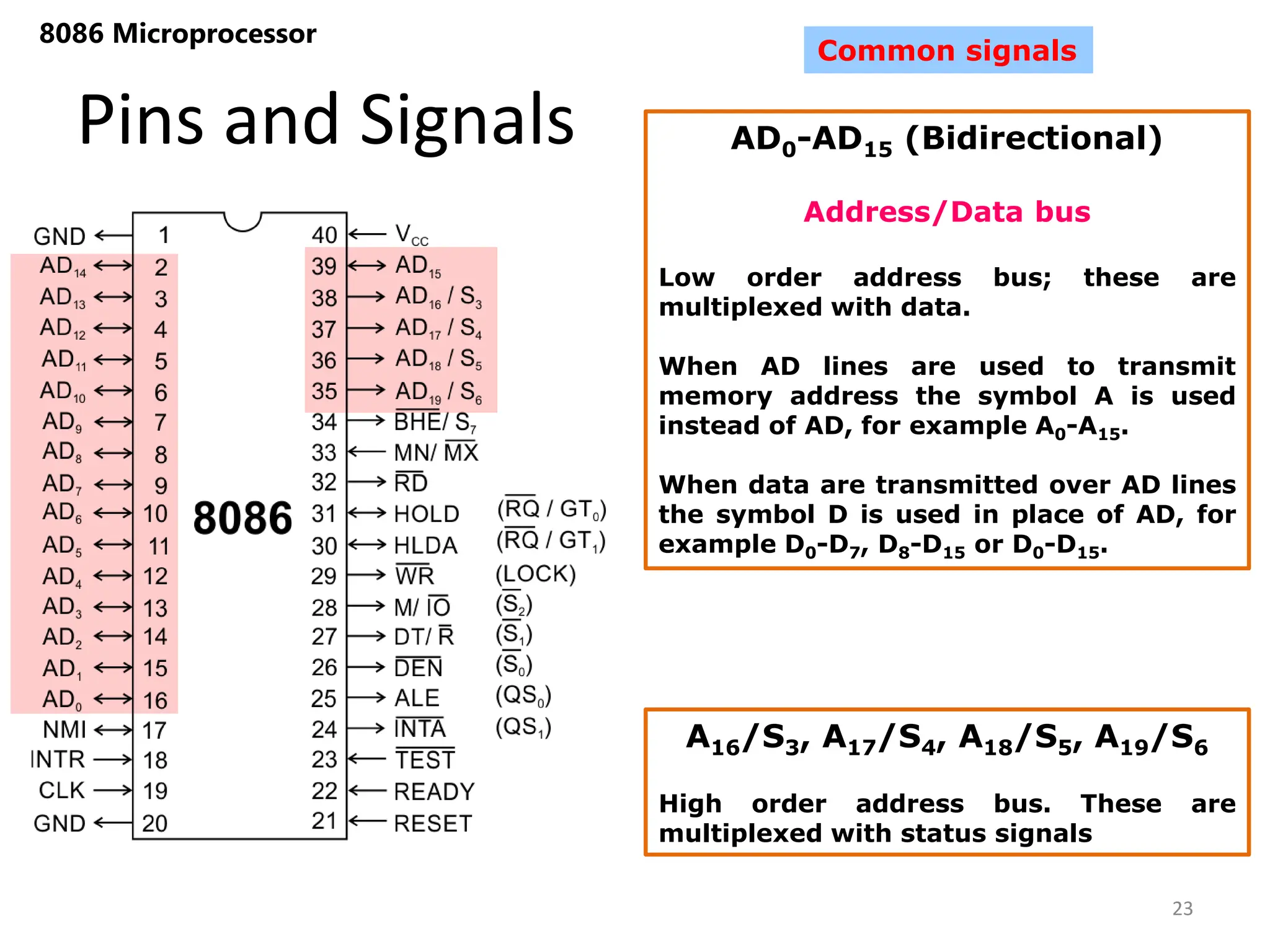
AD0-AD15 (Bidirectional)
Address/Data bus
Low order address bus; these are
multiplexed with data.
When AD lines are used to transmit
memory address the symbol A is used
instead of AD, for example A0-A15.
When data are transmitted over AD lines
the symbol D is used in place of AD, for
example D0-D7, D8-D15 or D0-D15.
A16/S3, A17/S4, A18/S5, A19/S6
High order address bus. These are
multiplexed with status signals
Pins and Signals
8086 Microprocessor
24
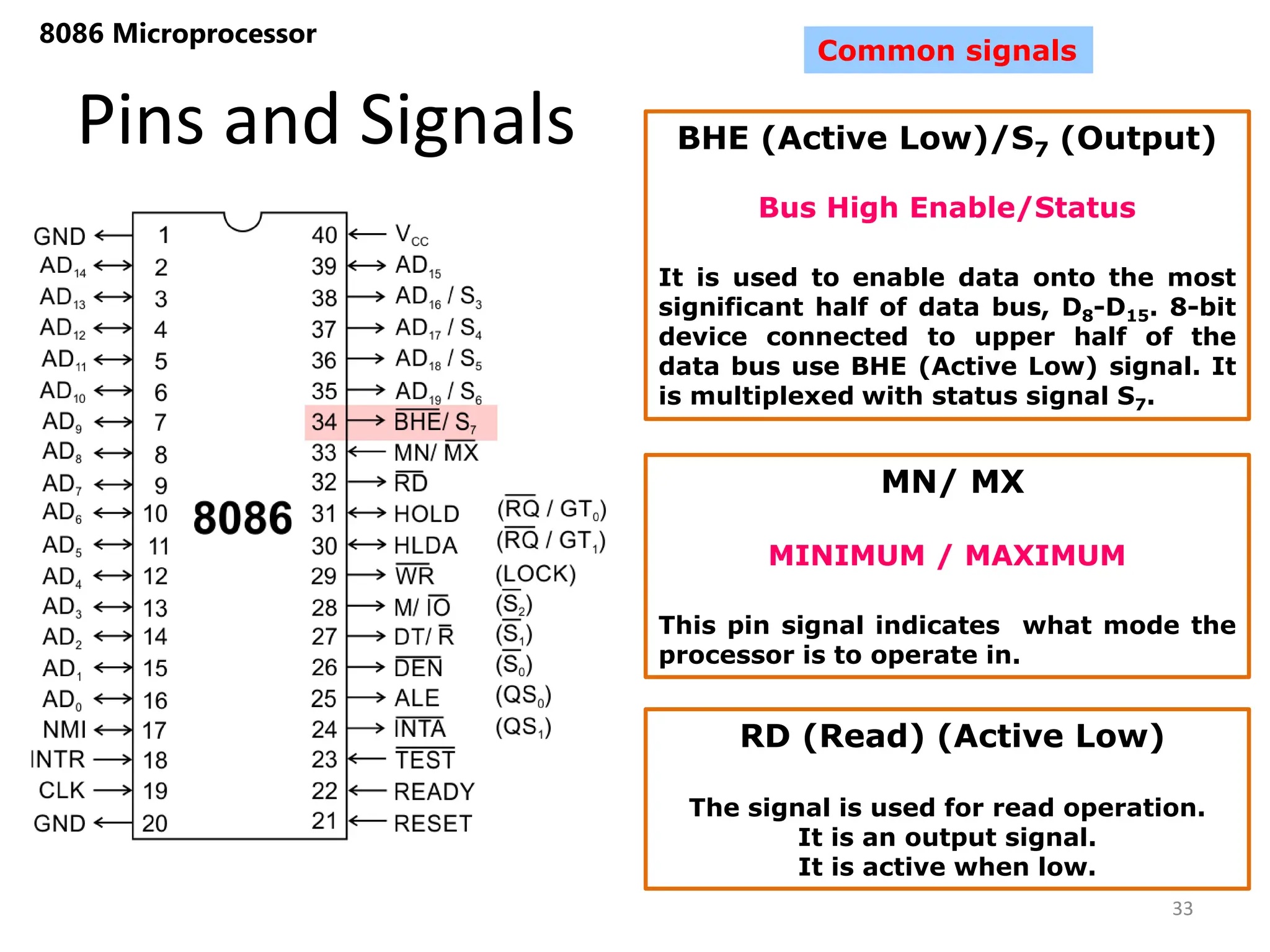
Common signals
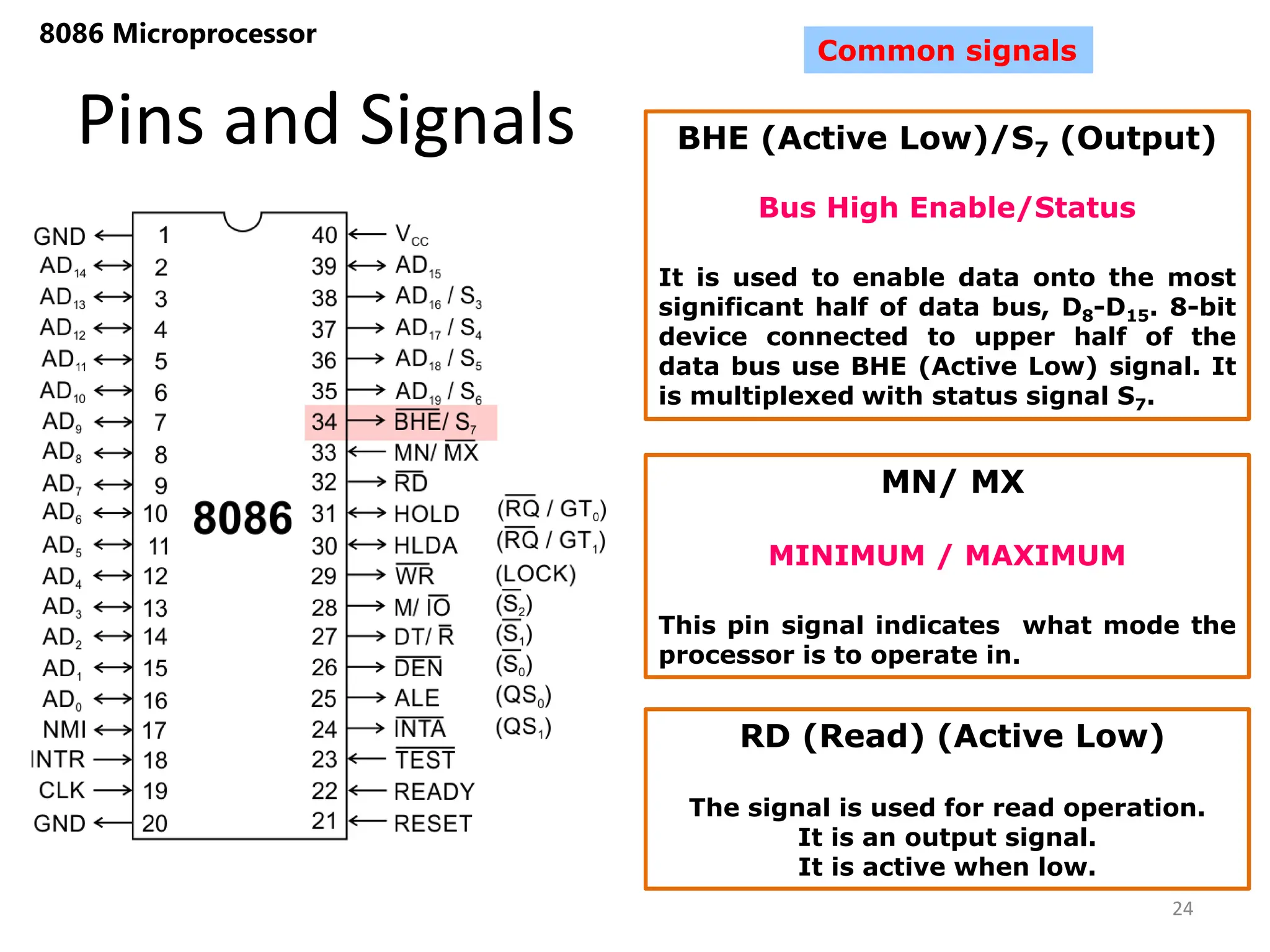
BHE (Active Low)/S7 (Output)
Bus High Enable/Status
It is used to enable data onto the most
significant half of data bus, D8-D15. 8-bit
device connected to upper half of the
data bus use BHE (Active Low) signal. It
is multiplexed with status signal S7.
MN/ MX
MINIMUM / MAXIMUM
This pin signal indicates what mode the
processor is to operate in.
RD (Read) (Active Low)
The signal is used for read operation.
It is an output signal.
It is active when low.
Pins and Signals
8086 Microprocessor
25
Common signals
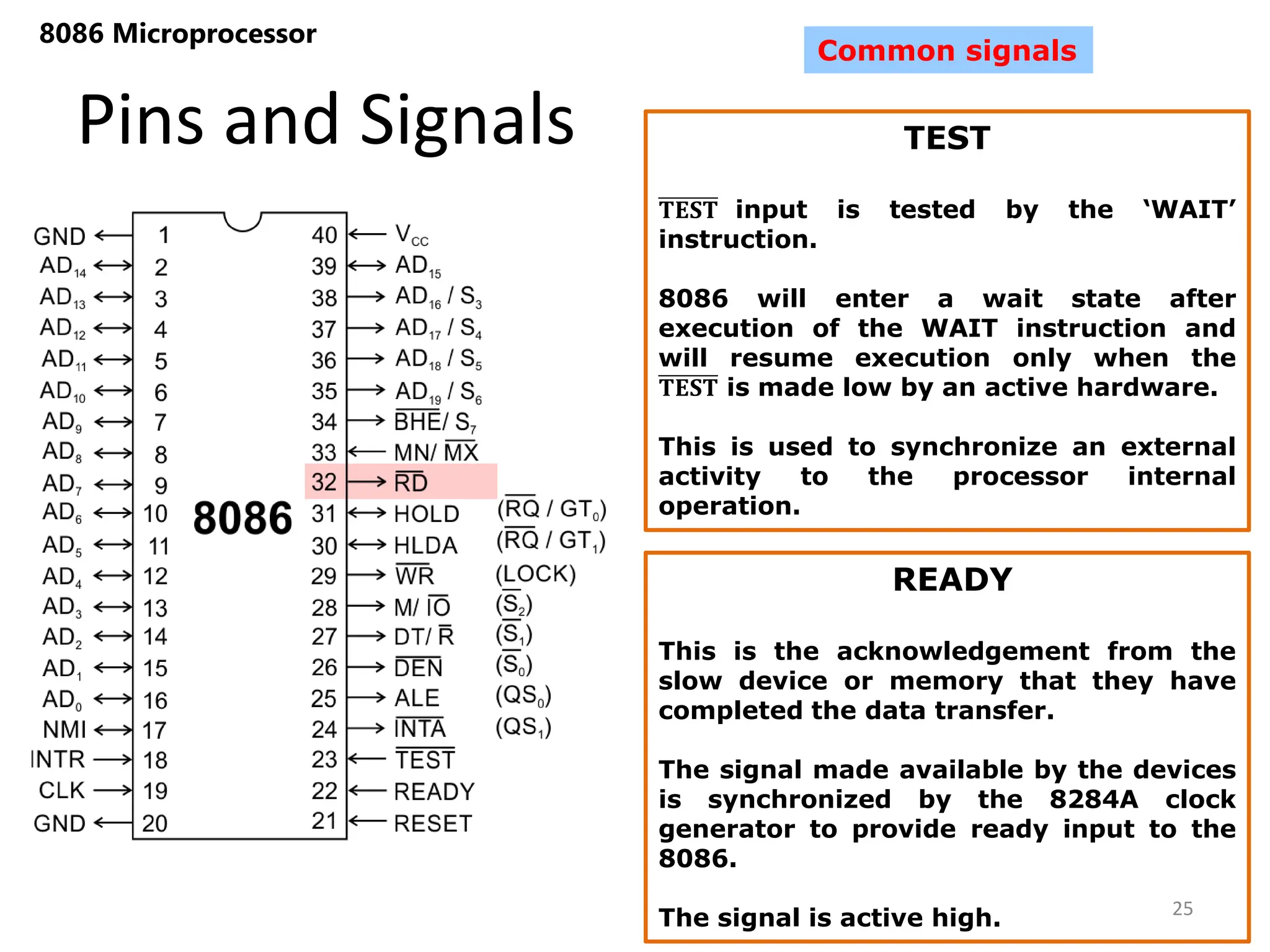
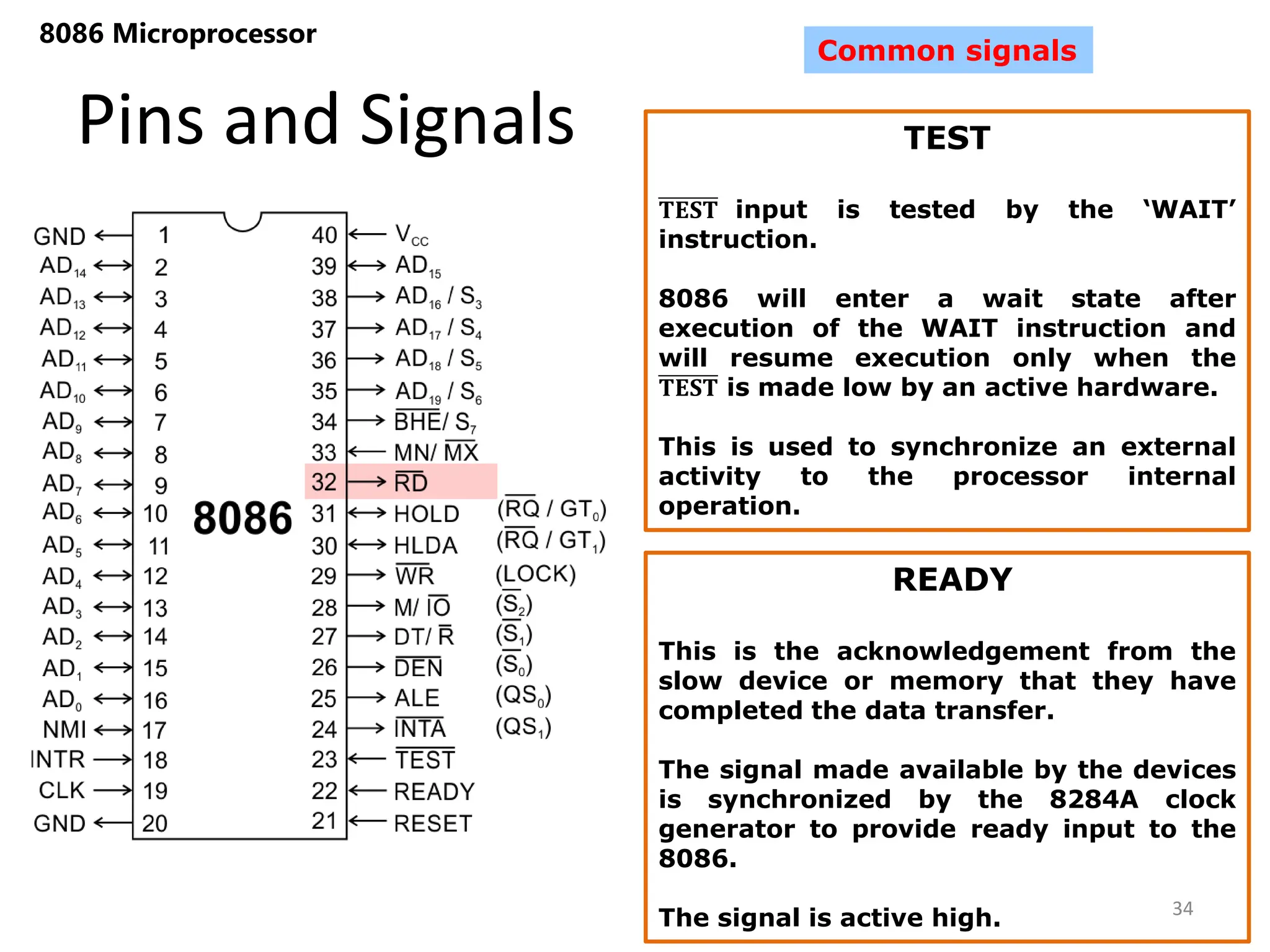
TEST
𝐓𝐄𝐒𝐓 input is tested by the ‘WAIT’
instruction.
8086 will enter a wait state after
execution of the WAIT instruction and
will resume execution only when the
𝐓𝐄𝐒𝐓 is made low by an active hardware.
This is used to synchronize an external
activity to the processor internal
operation.
READY
This is the acknowledgement from the
slow device or memory that they have
completed the data transfer.
The signal made available by the devices
is synchronized by the 8284A clock
generator to provide ready input to the
8086.
The signal is active high.
Pins and Signals
8086 Microprocessor
26
Common signals
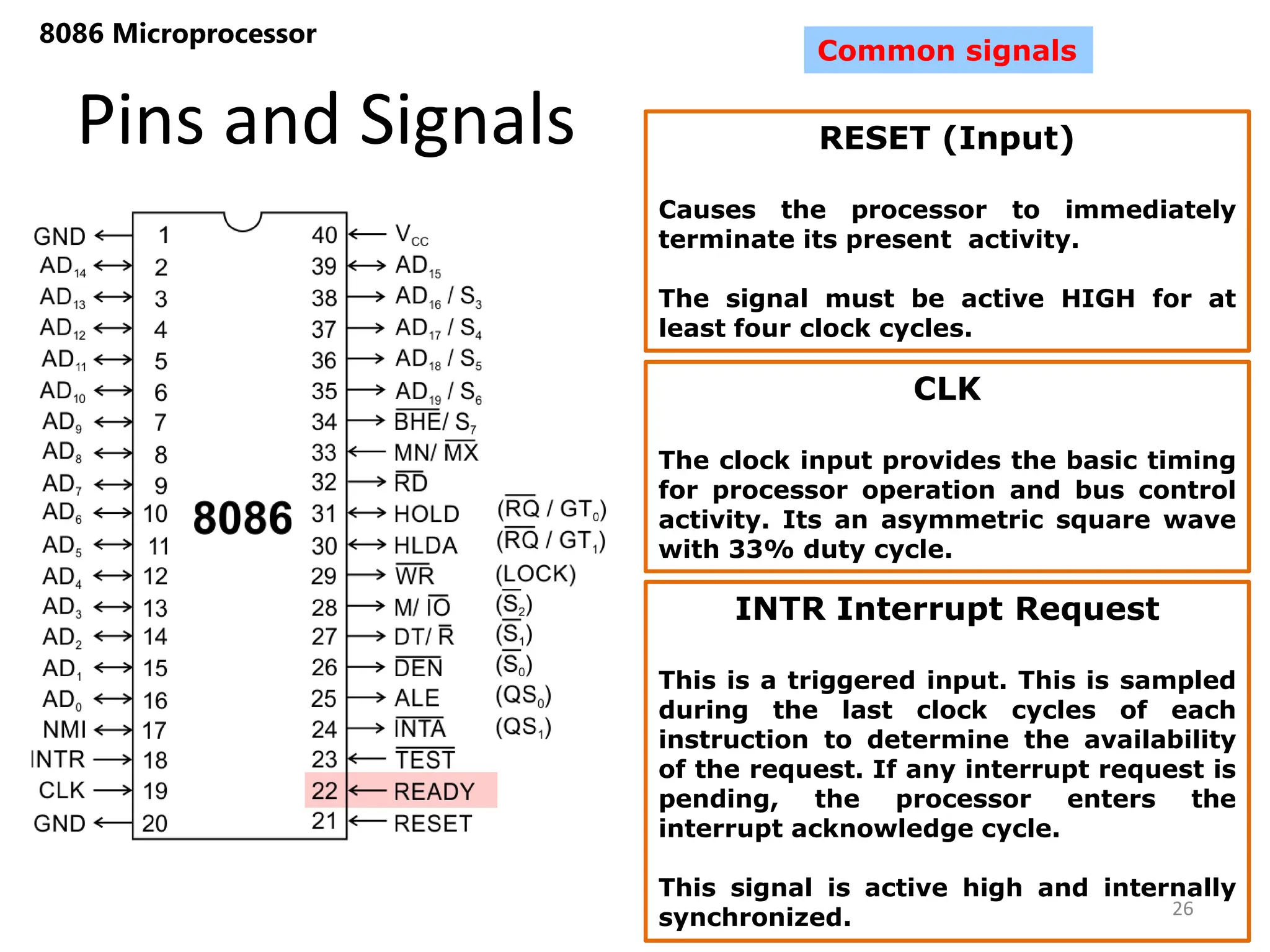
RESET (Input)
Causes the processor to immediately
terminate its present activity.
The signal must be active HIGH for at
least four clock cycles.
CLK
The clock input provides the basic timing
for processor operation and bus control
activity. Its an asymmetric square wave
with 33% duty cycle.
INTR Interrupt Request
This is a triggered input. This is sampled
during the last clock cycles of each
instruction to determine the availability
of the request. If any interrupt request is
pending, the processor enters the
interrupt acknowledge cycle.
This signal is active high and internally
synchronized.
Pins and Signals
8086 Microprocessor
27
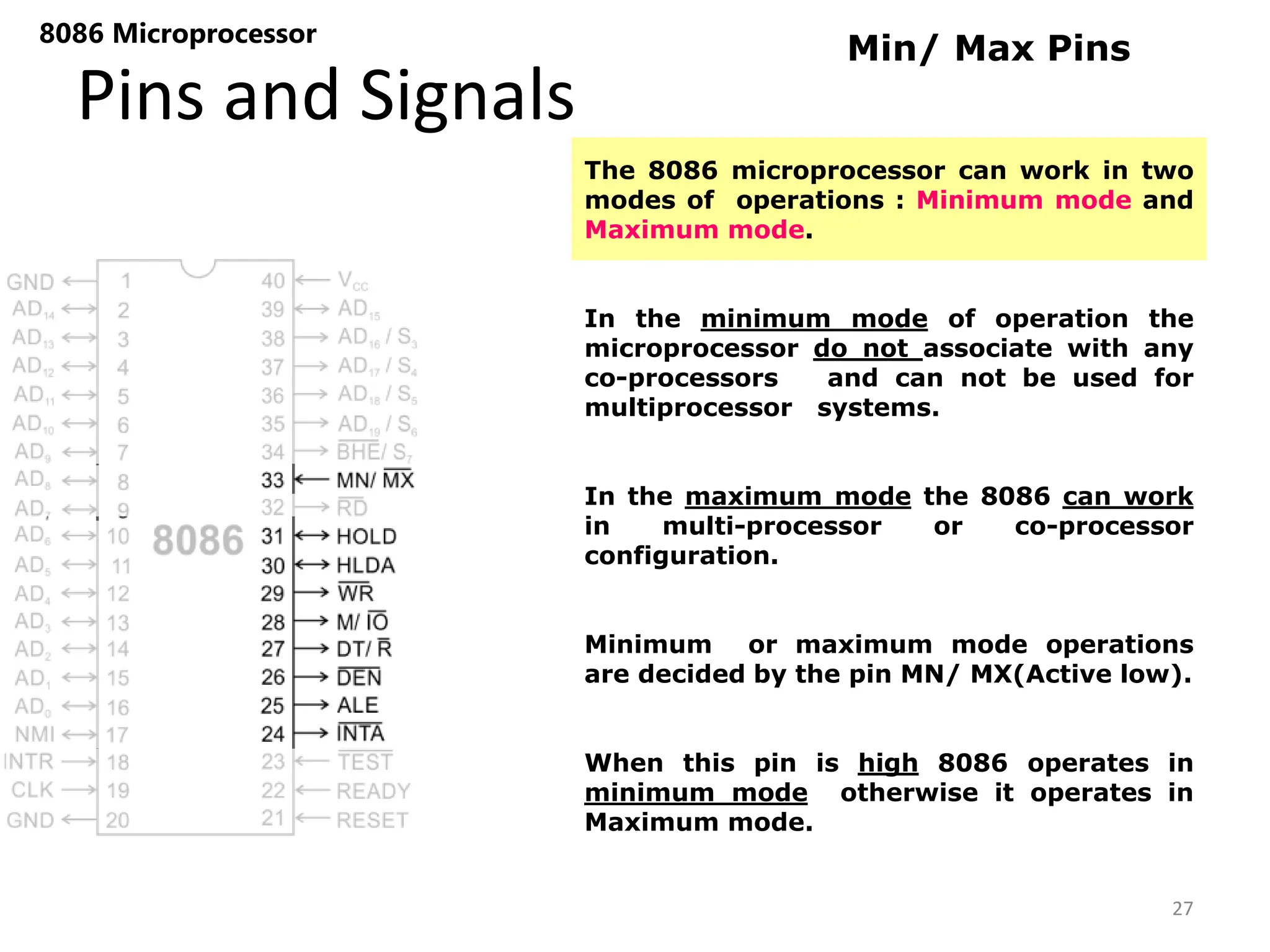
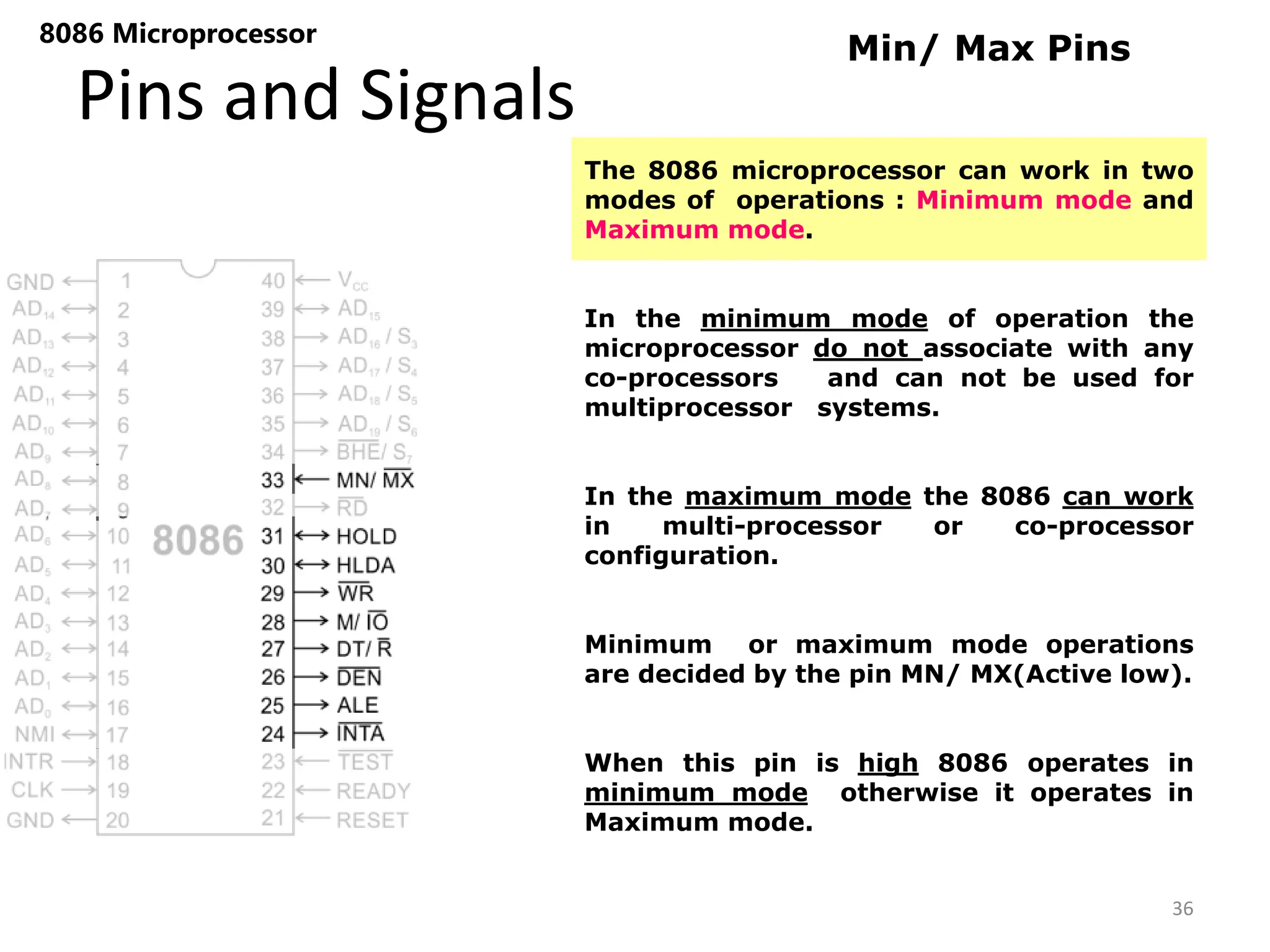
Min/ Max Pins
The 8086 microprocessor can work in two
modes of operations : Minimum mode and
Maximum mode.
In the minimum mode of operation the
microprocessor do not associate with any
co-processors and can not be used for
multiprocessor systems.
In the maximum mode the 8086 can work
in multi-processor or co-processor
configuration.
Minimum or maximum mode operations
are decided by the pin MN/ MX(Active low).
When this pin is high 8086 operates in
minimum mode otherwise it operates in
Maximum mode.
Pins and Signals
8086 Microprocessor
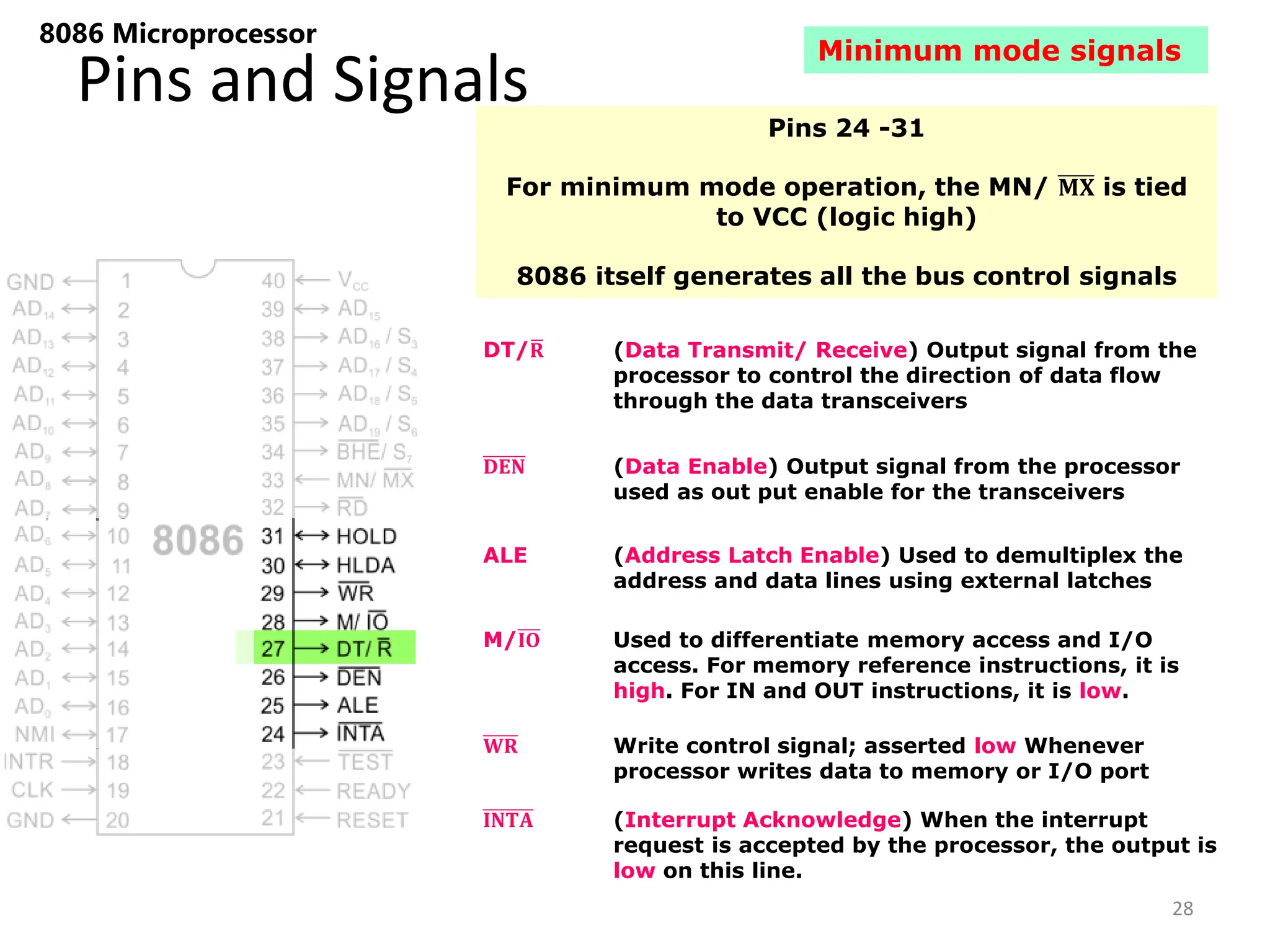
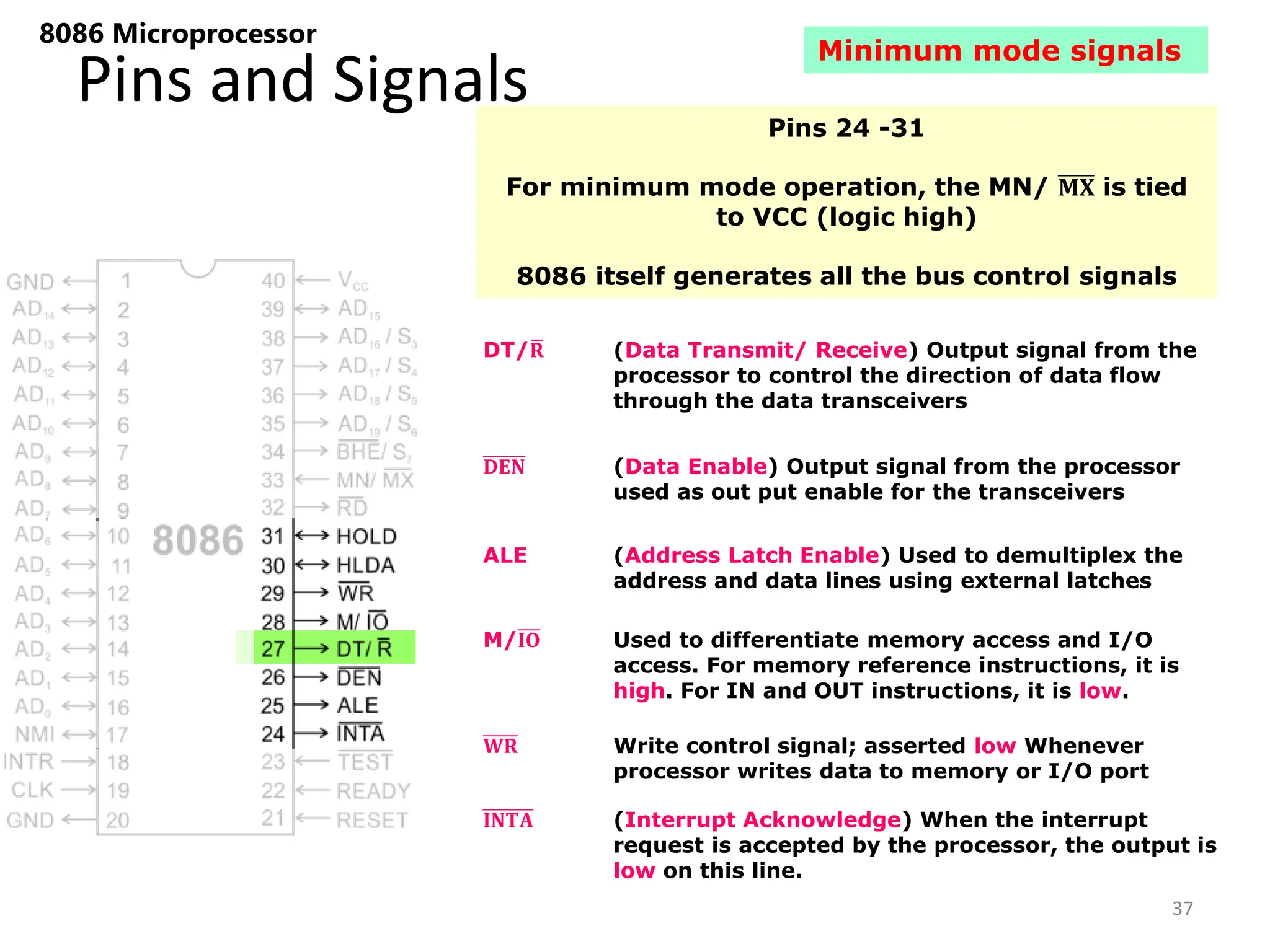
Pins 24 -31
For minimum mode operation, the MN/ 𝐌𝐗 is tied
to VCC (logic high)
8086 itself generates all the bus control signals
DT/𝐑 (Data Transmit/ Receive) Output signal from the
processor to control the direction of data flow
through the data transceivers
𝐃𝐄𝐍 (Data Enable) Output signal from the processor
used as out put enable for the transceivers
ALE (Address Latch Enable) Used to demultiplex the
address and data lines using external latches
M/𝐈𝐎 Used to differentiate memory access and I/O
access. For memory reference instructions, it is
high. For IN and OUT instructions, it is low.
𝐖𝐑 Write control signal; asserted low Whenever
processor writes data to memory or I/O port
𝐈𝐍𝐓𝐀 (Interrupt Acknowledge) When the interrupt
request is accepted by the processor, the output is
low on this line.
28
Minimum mode signals
Pins and Signals
8086 Microprocessor
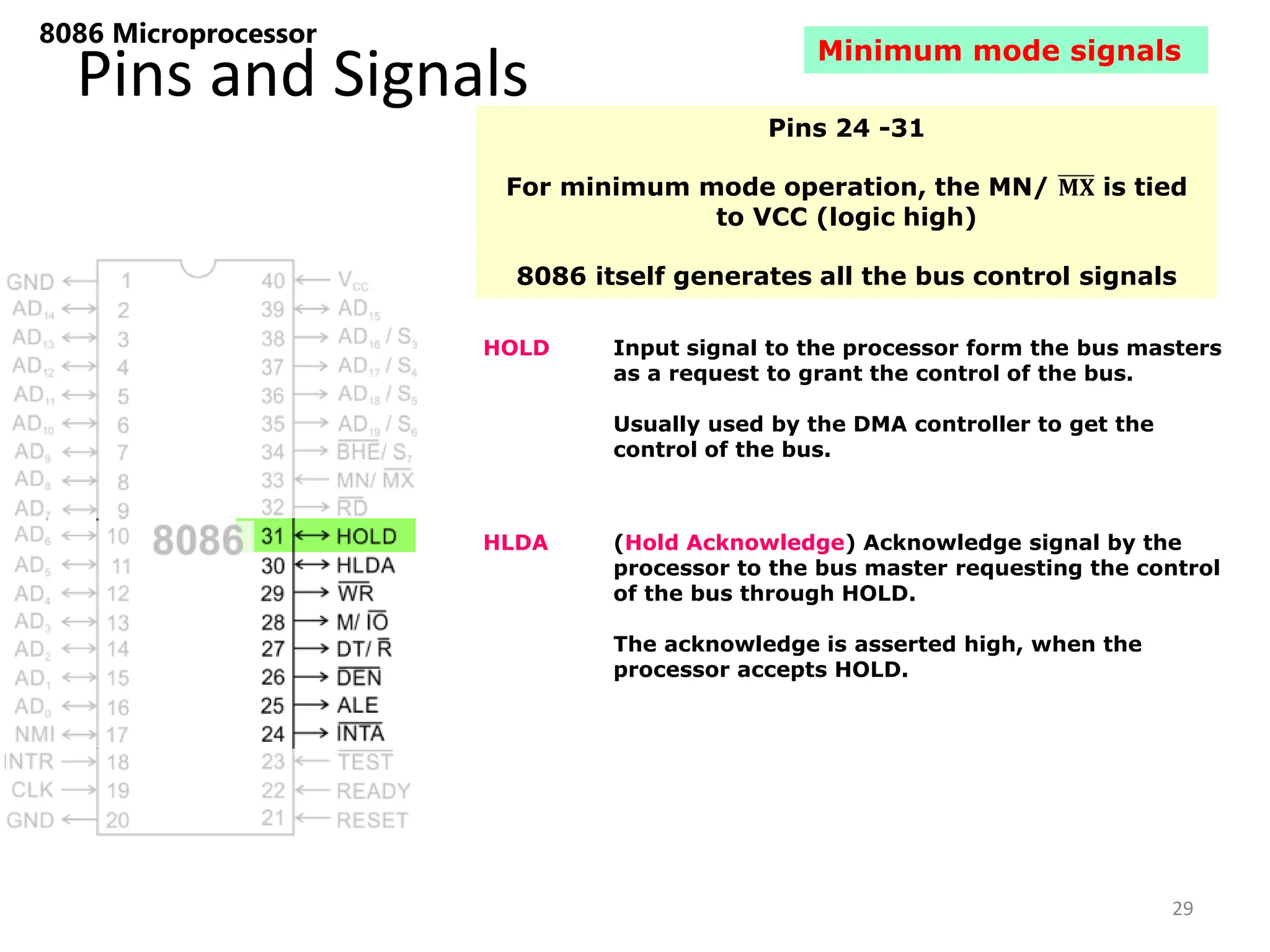
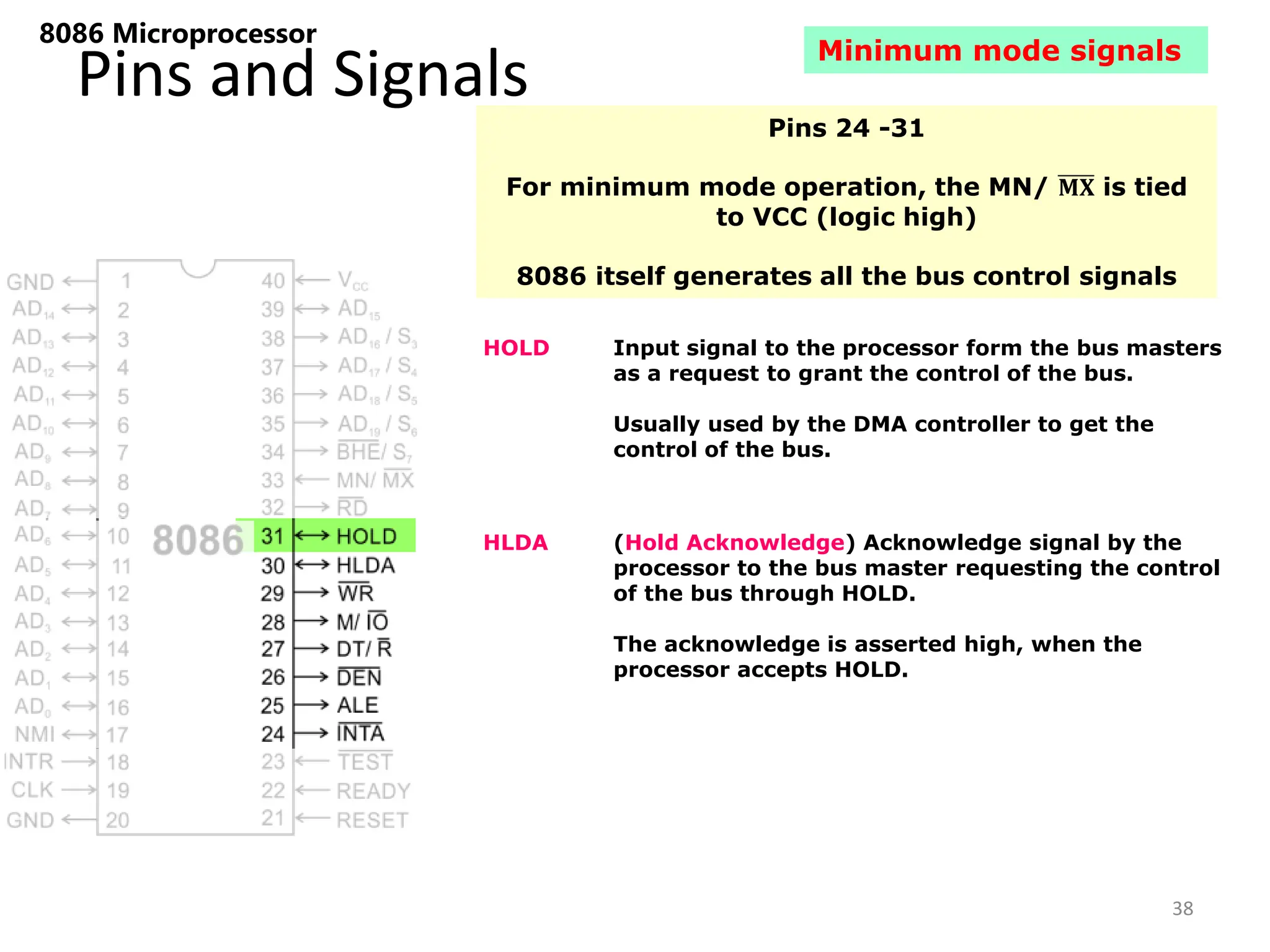
HOLD Input signal to the processor form the bus masters
as a request to grant the control of the bus.
Usually used by the DMA controller to get the
control of the bus.
HLDA (Hold Acknowledge) Acknowledge signal by the
processor to the bus master requesting the control
of the bus through HOLD.
The acknowledge is asserted high, when the
processor accepts HOLD.
29
Minimum mode signals
Pins 24 -31
For minimum mode operation, the MN/ 𝐌𝐗 is tied
to VCC (logic high)
8086 itself generates all the bus control signals
Pins and Signals
8086 Microprocessor
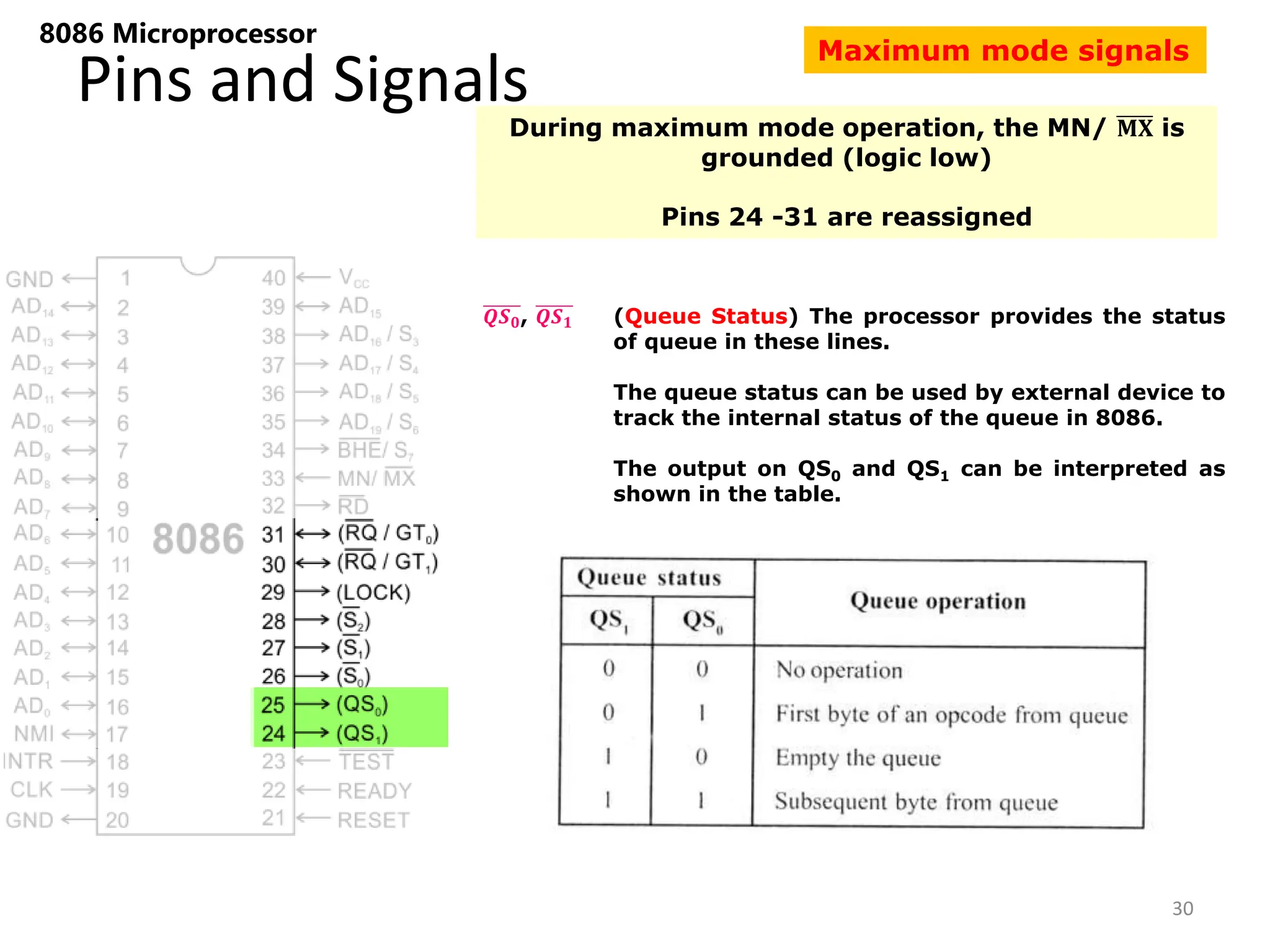
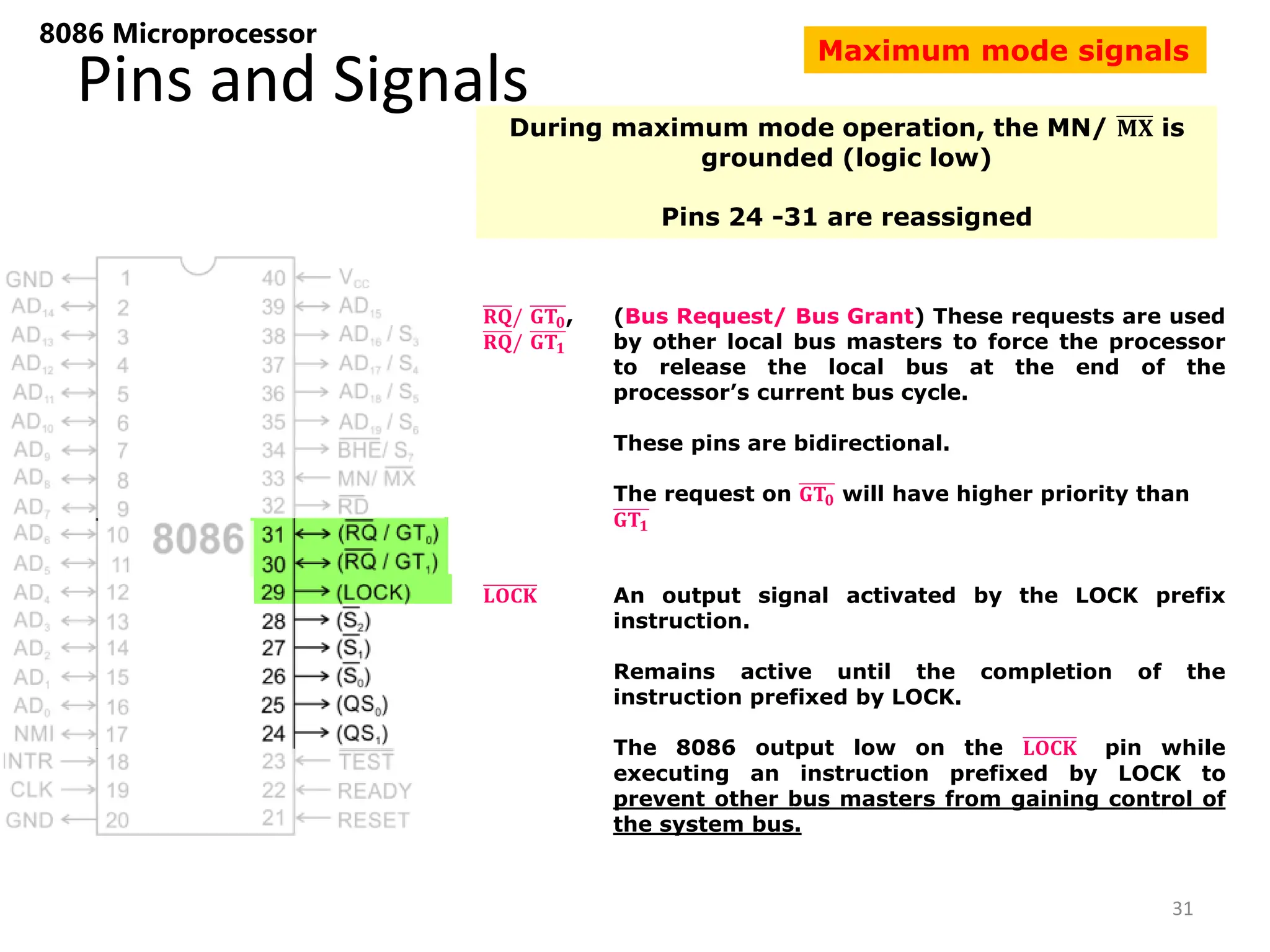
During maximum mode operation, the MN/ 𝐌𝐗 is
grounded (logic low)
Pins 24 -31 are reassigned
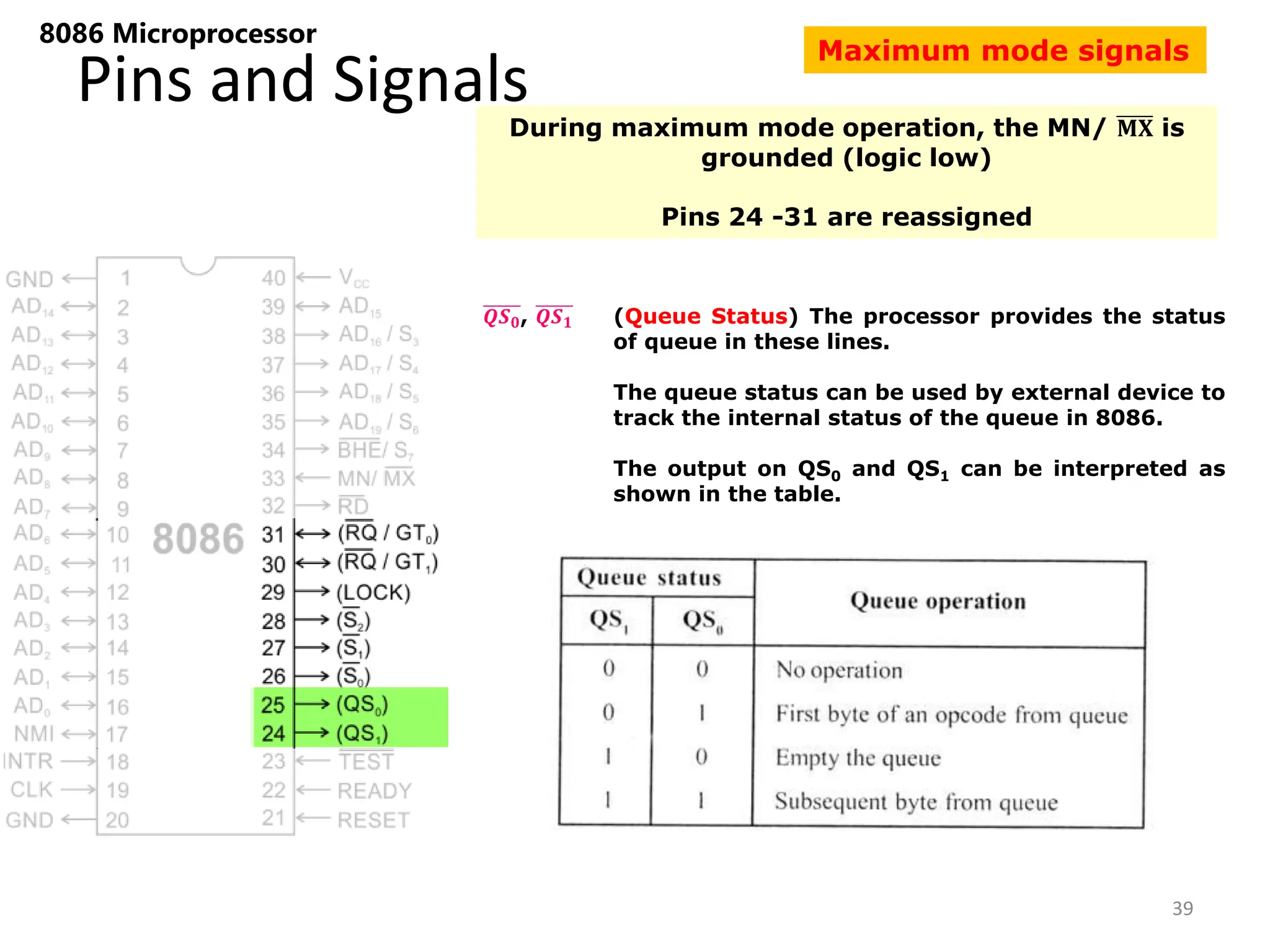
𝑸𝑺𝟎, 𝑸𝑺𝟏 (Queue Status) The processor provides the status
of queue in these lines.
The queue status can be used by external device to
track the internal status of the queue in 8086.
The output on QS0 and QS1 can be interpreted as
shown in the table.
30
Maximum mode signals
Pins and Signals
8086 Microprocessor
During maximum mode operation, the MN/ 𝐌𝐗 is
grounded (logic low)
Pins 24 -31 are reassigned
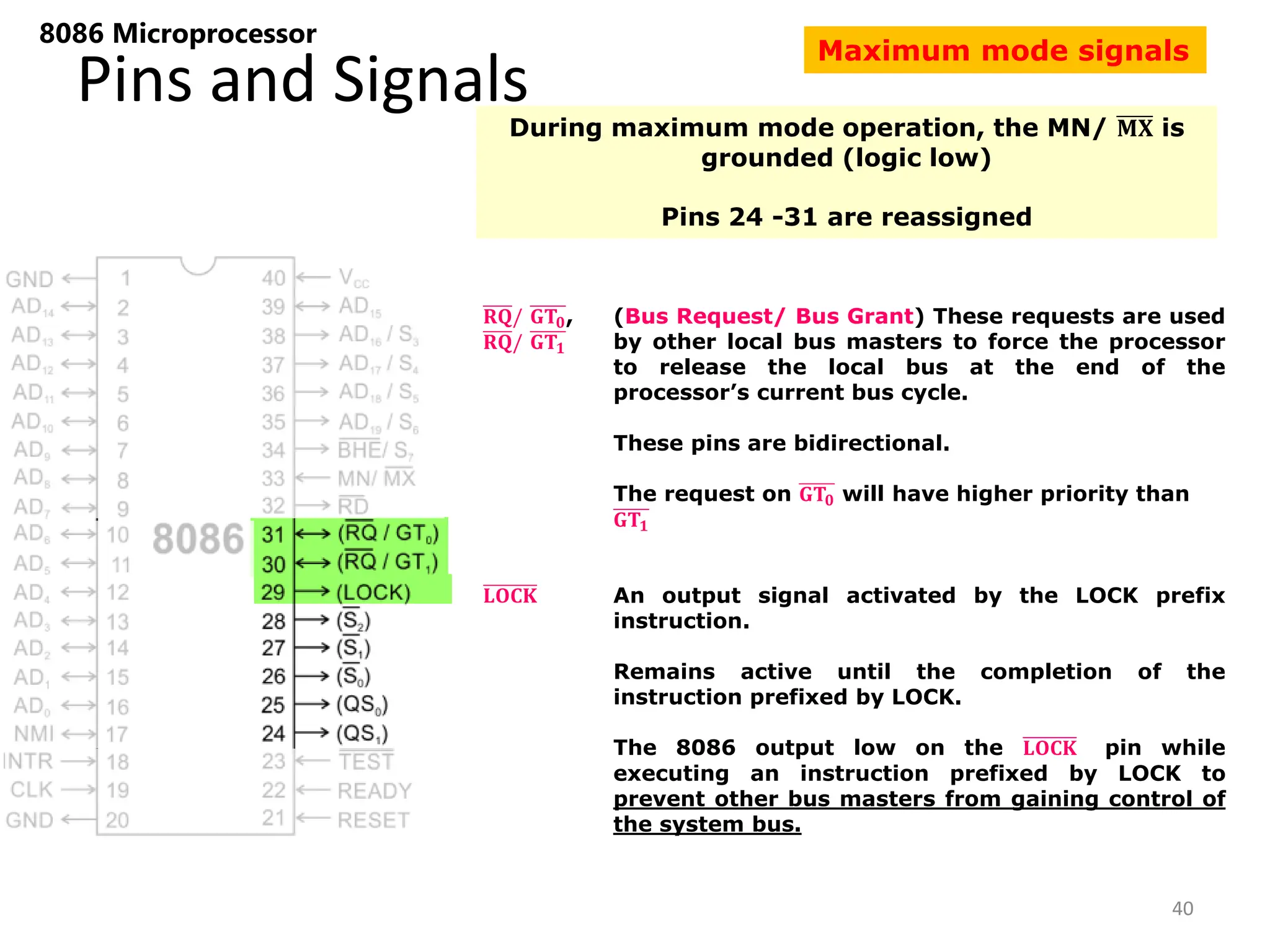
𝐑𝐐/ 𝐆𝐓𝟎,
𝐑𝐐/ 𝐆𝐓𝟏
(Bus Request/ Bus Grant) These requests are used
by other local bus masters to force the processor
to release the local bus at the end of the
processor’s current bus cycle.
These pins are bidirectional.
The request on 𝐆𝐓𝟎 will have higher priority than
𝐆𝐓𝟏
31
𝐋𝐎𝐂𝐊 An output signal activated by the LOCK prefix
instruction.
Remains active until the completion of the
instruction prefixed by LOCK.
The 8086 output low on the 𝐋𝐎𝐂𝐊 pin while
executing an instruction prefixed by LOCK to
prevent other bus masters from gaining control of
the system bus.
Maximum mode signals
Pins and Signals
8086 Microprocessor
32
Common signals
AD0-AD15 (Bidirectional)
Address/Data bus
Low order address bus; these are
multiplexed with data.
When AD lines are used to transmit
memory address the symbol A is used
instead of AD, for example A0-A15.
When data are transmitted over AD lines
the symbol D is used in place of AD, for
example D0-D7, D8-D15 or D0-D15.
A16/S3, A17/S4, A18/S5, A19/S6
High order address bus. These are
multiplexed with status signals
Pins and Signals
8086 Microprocessor
33
Common signals
BHE (Active Low)/S7 (Output)
Bus High Enable/Status
It is used to enable data onto the most
significant half of data bus, D8-D15. 8-bit
device connected to upper half of the
data bus use BHE (Active Low) signal. It
is multiplexed with status signal S7.
MN/ MX
MINIMUM / MAXIMUM
This pin signal indicates what mode the
processor is to operate in.
RD (Read) (Active Low)
The signal is used for read operation.
It is an output signal.
It is active when low.
Pins and Signals
8086 Microprocessor
34
Common signals
TEST
𝐓𝐄𝐒𝐓 input is tested by the ‘WAIT’
instruction.
8086 will enter a wait state after
execution of the WAIT instruction and
will resume execution only when the
𝐓𝐄𝐒𝐓 is made low by an active hardware.
This is used to synchronize an external
activity to the processor internal
operation.
READY
This is the acknowledgement from the
slow device or memory that they have
completed the data transfer.
The signal made available by the devices
is synchronized by the 8284A clock
generator to provide ready input to the
8086.
The signal is active high.
Pins and Signals
8086 Microprocessor
35
Common signals
RESET (Input)
Causes the processor to immediately
terminate its present activity.
The signal must be active HIGH for at
least four clock cycles.
CLK
The clock input provides the basic timing
for processor operation and bus control
activity. Its an asymmetric square wave
with 33% duty cycle.
INTR Interrupt Request
This is a triggered input. This is sampled
during the last clock cycles of each
instruction to determine the availability
of the request. If any interrupt request is
pending, the processor enters the
interrupt acknowledge cycle.
This signal is active high and internally
synchronized.
Pins and Signals
8086 Microprocessor
36
Min/ Max Pins
The 8086 microprocessor can work in two
modes of operations : Minimum mode and
Maximum mode.
In the minimum mode of operation the
microprocessor do not associate with any
co-processors and can not be used for
multiprocessor systems.
In the maximum mode the 8086 can work
in multi-processor or co-processor
configuration.
Minimum or maximum mode operations
are decided by the pin MN/ MX(Active low).
When this pin is high 8086 operates in
minimum mode otherwise it operates in
Maximum mode.
Pins and Signals
8086 Microprocessor
Pins 24 -31
For minimum mode operation, the MN/ 𝐌𝐗 is tied
to VCC (logic high)
8086 itself generates all the bus control signals
DT/𝐑 (Data Transmit/ Receive) Output signal from the
processor to control the direction of data flow
through the data transceivers
𝐃𝐄𝐍 (Data Enable) Output signal from the processor
used as out put enable for the transceivers
ALE (Address Latch Enable) Used to demultiplex the
address and data lines using external latches
M/𝐈𝐎 Used to differentiate memory access and I/O
access. For memory reference instructions, it is
high. For IN and OUT instructions, it is low.
𝐖𝐑 Write control signal; asserted low Whenever
processor writes data to memory or I/O port
𝐈𝐍𝐓𝐀 (Interrupt Acknowledge) When the interrupt
request is accepted by the processor, the output is
low on this line.
37
Minimum mode signals
Pins and Signals
8086 Microprocessor
HOLD Input signal to the processor form the bus masters
as a request to grant the control of the bus.
Usually used by the DMA controller to get the
control of the bus.
HLDA (Hold Acknowledge) Acknowledge signal by the
processor to the bus master requesting the control
of the bus through HOLD.
The acknowledge is asserted high, when the
processor accepts HOLD.
38
Minimum mode signals
Pins 24 -31
For minimum mode operation, the MN/ 𝐌𝐗 is tied
to VCC (logic high)
8086 itself generates all the bus control signals
Pins and Signals
8086 Microprocessor
During maximum mode operation, the MN/ 𝐌𝐗 is
grounded (logic low)
Pins 24 -31 are reassigned
𝑸𝑺𝟎, 𝑸𝑺𝟏 (Queue Status) The processor provides the status
of queue in these lines.
The queue status can be used by external device to
track the internal status of the queue in 8086.
The output on QS0 and QS1 can be interpreted as
shown in the table.
39
Maximum mode signals
Pins and Signals
8086 Microprocessor
During maximum mode operation, the MN/ 𝐌𝐗 is
grounded (logic low)
Pins 24 -31 are reassigned
𝐑𝐐/ 𝐆𝐓𝟎,
𝐑𝐐/ 𝐆𝐓𝟏
(Bus Request/ Bus Grant) These requests are used
by other local bus masters to force the processor
to release the local bus at the end of the
processor’s current bus cycle.
These pins are bidirectional.
The request on 𝐆𝐓𝟎 will have higher priority than
𝐆𝐓𝟏
40
𝐋𝐎𝐂𝐊 An output signal activated by the LOCK prefix
instruction.
Remains active until the completion of the
instruction prefixed by LOCK.
The 8086 output low on the 𝐋𝐎𝐂𝐊 pin while
executing an instruction prefixed by LOCK to
prevent other bus masters from gaining control of
the system bus.
Maximum mode signals

Unit IV 8086 complete ppt, architecture and instruction set.pptx

  • 1.
  • 2.
    Architecture 8086 Microprocessor 2 Execution Unit(EU) EU executes instructions that have already been fetched by the BIU. BIU and EU functions separately. Bus Interface Unit (BIU) BIU fetches instructions, reads data from memory and I/O ports, writes data to memory and I/ O ports.
  • 3.
    Architecture 8086 Microprocessor 3 Bus InterfaceUnit (BIU) Dedicated Adder to generate 20 bit address Four 16-bit segment registers Code Segment (CS) Data Segment (DS) Stack Segment (SS) Extra Segment (ES) Segment Registers >>
  • 4.
    Architecture 8086 Microprocessor 4 Bus InterfaceUnit (BIU) Segment Registers 8086’s 1-megabyte memory is divided into segments of up to 64K bytes each. Programs obtain access to code and data in the segments by changing the segment register content to point to the desired segments. The 8086 can directly address four segments (256 K bytes within the 1 M byte of memory) at a particular time.
  • 5.
    Architecture 8086 Microprocessor 5 Bus InterfaceUnit (BIU) Segment Registers Code Segment Register 16-bit CS contains the base or start of the current code segment; IP contains the distance or offset from this address to the next instruction byte to be fetched. BIU computes the 20-bit physical address by logically shifting the contents of CS 4-bits to the left and then adding the 16-bit contents of IP. That is, all instructions of a program are relative to the contents of the CS register multiplied by 16 and then offset is added provided by the IP.
  • 6.
    Architecture 8086 Microprocessor 6 Bus InterfaceUnit (BIU) Segment Registers Data Segment Register 16-bit Points to the current data segment; operands for most instructions are fetched from this segment. The 16-bit contents of the Source Index (SI) or Destination Index (DI) or a 16-bit displacement are used as offset for computing the 20-bit physical address.
  • 7.
    Architecture 8086 Microprocessor 7 Bus InterfaceUnit (BIU) Segment Registers Stack Segment Register 16-bit Points to the current stack. The 20-bit physical stack address is calculated from the Stack Segment (SS) and the Stack Pointer (SP) for stack instructions such as PUSH and POP. In based addressing mode, the 20-bit physical stack address is calculated from the Stack segment (SS) and the Base Pointer (BP).
  • 8.
    Architecture 8086 Microprocessor 8 Bus InterfaceUnit (BIU) Segment Registers Extra Segment Register 16-bit Points to the extra segment in which data (in excess of 64K pointed to by the DS) is stored. String instructions use the ES and DI to determine the 20-bit physical address for the destination.
  • 9.
    Architecture 8086 Microprocessor 9 Bus InterfaceUnit (BIU) Segment Registers Instruction Pointer 16-bit Always points to the next instruction to be executed within the currently executing code segment. So, this register contains the 16-bit offset address pointing to the next instruction code within the 64Kb of the code segment area. Its content is automatically incremented as the execution of the next instruction takes place.
  • 10.
    Architecture 8086 Microprocessor 10 Bus InterfaceUnit (BIU) A group of First-In-First-Out (FIFO) in which up to 6 bytes of instruction code are pre fetched from the memory ahead of time. This is done in order to speed up the execution by overlapping instruction fetch with execution. This mechanism is known as pipelining. Instruction queue
  • 11.
    Architecture 8086 Microprocessor 11 Some ofthe 16 bit registers can be used as two 8 bit registers as : AX can be used as AH and AL BX can be used as BH and BL CX can be used as CH and CL DX can be used as DH and DL Execution Unit (EU) EU decodes and executes instructions. A decoder in the EU control system translates instructions. 16-bit ALU for performing arithmetic and logic operation Four general purpose registers(AX, BX, CX, DX); Pointer registers (Stack Pointer, Base Pointer); and Index registers (Source Index, Destination Index) each of 16-bits
  • 12.
    Architecture 8086 Microprocessor 12 EU Registers Accumulator Register(AX) Consists of two 8-bit registers AL and AH, which can be combined together and used as a 16-bit register AX. AL in this case contains the low order byte of the word, and AH contains the high-order byte. The I/O instructions use the AX or AL for inputting / outputting 16 or 8 bit data to or from an I/O port. Multiplication and Division instructions also use the AX or AL. Execution Unit (EU)
  • 13.
    Architecture 8086 Microprocessor 13 EU Registers Base Register(BX) Consists of two 8-bit registers BL and BH, which can be combined together and used as a 16-bit register BX. BL in this case contains the low-order byte of the word, and BH contains the high-order byte. This is the only general purpose register whose contents can be used for addressing the 8086 memory. All memory references utilizing this register content for addressing use DS as the default segment register. Execution Unit (EU)
  • 14.
    Architecture 8086 Microprocessor 14 EU Registers Counter Register(CX) Consists of two 8-bit registers CL and CH, which can be combined together and used as a 16-bit register CX. When combined, CL register contains the low order byte of the word, and CH contains the high-order byte. Instructions such as SHIFT, ROTATE and LOOP use the contents of CX as a counter. Execution Unit (EU) Example: The instruction LOOP START automatically decrements CX by 1 without affecting flags and will check if [CX] = 0. If it is zero, 8086 executes the next instruction; otherwise the 8086 branches to the label START.
  • 15.
    Architecture 8086 Microprocessor 15 EU Registers Data Register(DX) Consists of two 8-bit registers DL and DH, which can be combined together and used as a 16-bit register DX. When combined, DL register contains the low order byte of the word, and DH contains the high-order byte. Used to hold the high 16-bit result (data) in 16 X 16 multiplication or the high 16-bit dividend (data) before a 32 ÷ 16 division and the 16-bit reminder after division. Execution Unit (EU)
  • 16.
    Architecture 8086 Microprocessor 16 EU Registers Stack Pointer(SP) and Base Pointer (BP) SP and BP are used to access data in the stack segment. SP is used as an offset from the current SS during execution of instructions that involve the stack segment in the external memory. SP contents are automatically updated (incremented/ decremented) due to execution of a POP or PUSH instruction. BP contains an offset address in the current SS, which is used by instructions utilizing the based addressing mode. Execution Unit (EU)
  • 17.
    Architecture 8086 Microprocessor 17 EU Registers Source Index(SI) and Destination Index (DI) Used in indexed addressing. Instructions that process data strings use the SI and DI registers together with DS and ES respectively in order to distinguish between the source and destination addresses. Execution Unit (EU)
  • 18.
    Architecture 8086 Microprocessor 18 EU Registers Source Index(SI) and Destination Index (DI) Used in indexed addressing. Instructions that process data strings use the SI and DI registers together with DS and ES respectively in order to distinguish between the source and destination addresses. Execution Unit (EU)
  • 19.
    Architecture 8086 Microprocessor 19 Flag Register 1514 13 12 11 10 9 8 7 6 5 4 3 2 1 0 OF DF IF TF SF ZF AF PF CF Carry Flag This flag is set, when there is a carry out of MSB in case of addition or a borrow in case of subtraction. Parity Flag This flag is set to 1, if the lower byte of the result contains even number of 1’s ; for odd number of 1’s set to zero. Auxiliary Carry Flag This is set, if there is a carry from the lowest nibble, i.e, bit three during addition, or borrow for the lowest nibble, i.e, bit three, during subtraction. Zero Flag This flag is set, if the result of the computation or comparison performed by an instruction is zero Sign Flag This flag is set, when the result of any computation is negative Trap Flag If this flag is set, the processor enters the single step execution mode by generating internal interrupts after the execution of each instruction Interrupt Flag Causes the 8086 to recognize external mask interrupts; clearing IF disables these interrupts. Direction Flag This is used by string manipulation instructions. If this flag bit is ‘0’, the string is processed beginning from the lowest address to the highest address, i.e., auto incrementing mode. Otherwise, the string is processed from the highest address towards the lowest address, i.e., auto decrementing mode. Over flow Flag This flag is set, if an overflow occurs, i.e, if the result of a signed operation is large enough to accommodate in a destination register. The result is of more than 7-bits in size in case of 8-bit signed operation and more than 15-bits in size in case of 16-bit sign operations, then the overflow will be set. Execution Unit (EU)
  • 20.
    20 Architecture 8086 Microprocessor Sl.No. TypeRegister width Name of register 1 General purpose register 16 bit AX, BX, CX, DX 8 bit AL, AH, BL, BH, CL, CH, DL, DH 2 Pointer register 16 bit SP, BP 3 Index register 16 bit SI, DI 4 Instruction Pointer 16 bit IP 5 Segment register 16 bit CS, DS, SS, ES 6 Flag (PSW) 16 bit Flag register 8086 registers categorized into 4 groups 15 14 13 12 11 10 9 8 7 6 5 4 3 2 1 0 OF DF IF TF SF ZF AF PF CF
  • 21.
    21 Architecture 8086 Microprocessor Register Nameof the Register Special Function AX 16-bit Accumulator Stores the 16-bit results of arithmetic and logic operations AL 8-bit Accumulator Stores the 8-bit results of arithmetic and logic operations BX Base register Used to hold base value in base addressing mode to access memory data CX Count Register Used to hold the count value in SHIFT, ROTATE and LOOP instructions DX Data Register Used to hold data for multiplication and division operations SP Stack Pointer Used to hold the offset address of top stack memory BP Base Pointer Used to hold the base value in base addressing using SS register to access data from stack memory SI Source Index Used to hold index value of source operand (data) for string instructions DI Data Index Used to hold the index value of destination operand (data) for string operations Registers and Special Functions
  • 22.
  • 23.
    Pins and Signals 8086Microprocessor 23 Common signals AD0-AD15 (Bidirectional) Address/Data bus Low order address bus; these are multiplexed with data. When AD lines are used to transmit memory address the symbol A is used instead of AD, for example A0-A15. When data are transmitted over AD lines the symbol D is used in place of AD, for example D0-D7, D8-D15 or D0-D15. A16/S3, A17/S4, A18/S5, A19/S6 High order address bus. These are multiplexed with status signals
  • 24.
    Pins and Signals 8086Microprocessor 24 Common signals BHE (Active Low)/S7 (Output) Bus High Enable/Status It is used to enable data onto the most significant half of data bus, D8-D15. 8-bit device connected to upper half of the data bus use BHE (Active Low) signal. It is multiplexed with status signal S7. MN/ MX MINIMUM / MAXIMUM This pin signal indicates what mode the processor is to operate in. RD (Read) (Active Low) The signal is used for read operation. It is an output signal. It is active when low.
  • 25.
    Pins and Signals 8086Microprocessor 25 Common signals TEST 𝐓𝐄𝐒𝐓 input is tested by the ‘WAIT’ instruction. 8086 will enter a wait state after execution of the WAIT instruction and will resume execution only when the 𝐓𝐄𝐒𝐓 is made low by an active hardware. This is used to synchronize an external activity to the processor internal operation. READY This is the acknowledgement from the slow device or memory that they have completed the data transfer. The signal made available by the devices is synchronized by the 8284A clock generator to provide ready input to the 8086. The signal is active high.
  • 26.
    Pins and Signals 8086Microprocessor 26 Common signals RESET (Input) Causes the processor to immediately terminate its present activity. The signal must be active HIGH for at least four clock cycles. CLK The clock input provides the basic timing for processor operation and bus control activity. Its an asymmetric square wave with 33% duty cycle. INTR Interrupt Request This is a triggered input. This is sampled during the last clock cycles of each instruction to determine the availability of the request. If any interrupt request is pending, the processor enters the interrupt acknowledge cycle. This signal is active high and internally synchronized.
  • 27.
    Pins and Signals 8086Microprocessor 27 Min/ Max Pins The 8086 microprocessor can work in two modes of operations : Minimum mode and Maximum mode. In the minimum mode of operation the microprocessor do not associate with any co-processors and can not be used for multiprocessor systems. In the maximum mode the 8086 can work in multi-processor or co-processor configuration. Minimum or maximum mode operations are decided by the pin MN/ MX(Active low). When this pin is high 8086 operates in minimum mode otherwise it operates in Maximum mode.
  • 28.
    Pins and Signals 8086Microprocessor Pins 24 -31 For minimum mode operation, the MN/ 𝐌𝐗 is tied to VCC (logic high) 8086 itself generates all the bus control signals DT/𝐑 (Data Transmit/ Receive) Output signal from the processor to control the direction of data flow through the data transceivers 𝐃𝐄𝐍 (Data Enable) Output signal from the processor used as out put enable for the transceivers ALE (Address Latch Enable) Used to demultiplex the address and data lines using external latches M/𝐈𝐎 Used to differentiate memory access and I/O access. For memory reference instructions, it is high. For IN and OUT instructions, it is low. 𝐖𝐑 Write control signal; asserted low Whenever processor writes data to memory or I/O port 𝐈𝐍𝐓𝐀 (Interrupt Acknowledge) When the interrupt request is accepted by the processor, the output is low on this line. 28 Minimum mode signals
  • 29.
    Pins and Signals 8086Microprocessor HOLD Input signal to the processor form the bus masters as a request to grant the control of the bus. Usually used by the DMA controller to get the control of the bus. HLDA (Hold Acknowledge) Acknowledge signal by the processor to the bus master requesting the control of the bus through HOLD. The acknowledge is asserted high, when the processor accepts HOLD. 29 Minimum mode signals Pins 24 -31 For minimum mode operation, the MN/ 𝐌𝐗 is tied to VCC (logic high) 8086 itself generates all the bus control signals
  • 30.
    Pins and Signals 8086Microprocessor During maximum mode operation, the MN/ 𝐌𝐗 is grounded (logic low) Pins 24 -31 are reassigned 𝑸𝑺𝟎, 𝑸𝑺𝟏 (Queue Status) The processor provides the status of queue in these lines. The queue status can be used by external device to track the internal status of the queue in 8086. The output on QS0 and QS1 can be interpreted as shown in the table. 30 Maximum mode signals
  • 31.
    Pins and Signals 8086Microprocessor During maximum mode operation, the MN/ 𝐌𝐗 is grounded (logic low) Pins 24 -31 are reassigned 𝐑𝐐/ 𝐆𝐓𝟎, 𝐑𝐐/ 𝐆𝐓𝟏 (Bus Request/ Bus Grant) These requests are used by other local bus masters to force the processor to release the local bus at the end of the processor’s current bus cycle. These pins are bidirectional. The request on 𝐆𝐓𝟎 will have higher priority than 𝐆𝐓𝟏 31 𝐋𝐎𝐂𝐊 An output signal activated by the LOCK prefix instruction. Remains active until the completion of the instruction prefixed by LOCK. The 8086 output low on the 𝐋𝐎𝐂𝐊 pin while executing an instruction prefixed by LOCK to prevent other bus masters from gaining control of the system bus. Maximum mode signals
  • 32.
    Pins and Signals 8086Microprocessor 32 Common signals AD0-AD15 (Bidirectional) Address/Data bus Low order address bus; these are multiplexed with data. When AD lines are used to transmit memory address the symbol A is used instead of AD, for example A0-A15. When data are transmitted over AD lines the symbol D is used in place of AD, for example D0-D7, D8-D15 or D0-D15. A16/S3, A17/S4, A18/S5, A19/S6 High order address bus. These are multiplexed with status signals
  • 33.
    Pins and Signals 8086Microprocessor 33 Common signals BHE (Active Low)/S7 (Output) Bus High Enable/Status It is used to enable data onto the most significant half of data bus, D8-D15. 8-bit device connected to upper half of the data bus use BHE (Active Low) signal. It is multiplexed with status signal S7. MN/ MX MINIMUM / MAXIMUM This pin signal indicates what mode the processor is to operate in. RD (Read) (Active Low) The signal is used for read operation. It is an output signal. It is active when low.
  • 34.
    Pins and Signals 8086Microprocessor 34 Common signals TEST 𝐓𝐄𝐒𝐓 input is tested by the ‘WAIT’ instruction. 8086 will enter a wait state after execution of the WAIT instruction and will resume execution only when the 𝐓𝐄𝐒𝐓 is made low by an active hardware. This is used to synchronize an external activity to the processor internal operation. READY This is the acknowledgement from the slow device or memory that they have completed the data transfer. The signal made available by the devices is synchronized by the 8284A clock generator to provide ready input to the 8086. The signal is active high.
  • 35.
    Pins and Signals 8086Microprocessor 35 Common signals RESET (Input) Causes the processor to immediately terminate its present activity. The signal must be active HIGH for at least four clock cycles. CLK The clock input provides the basic timing for processor operation and bus control activity. Its an asymmetric square wave with 33% duty cycle. INTR Interrupt Request This is a triggered input. This is sampled during the last clock cycles of each instruction to determine the availability of the request. If any interrupt request is pending, the processor enters the interrupt acknowledge cycle. This signal is active high and internally synchronized.
  • 36.
    Pins and Signals 8086Microprocessor 36 Min/ Max Pins The 8086 microprocessor can work in two modes of operations : Minimum mode and Maximum mode. In the minimum mode of operation the microprocessor do not associate with any co-processors and can not be used for multiprocessor systems. In the maximum mode the 8086 can work in multi-processor or co-processor configuration. Minimum or maximum mode operations are decided by the pin MN/ MX(Active low). When this pin is high 8086 operates in minimum mode otherwise it operates in Maximum mode.
  • 37.
    Pins and Signals 8086Microprocessor Pins 24 -31 For minimum mode operation, the MN/ 𝐌𝐗 is tied to VCC (logic high) 8086 itself generates all the bus control signals DT/𝐑 (Data Transmit/ Receive) Output signal from the processor to control the direction of data flow through the data transceivers 𝐃𝐄𝐍 (Data Enable) Output signal from the processor used as out put enable for the transceivers ALE (Address Latch Enable) Used to demultiplex the address and data lines using external latches M/𝐈𝐎 Used to differentiate memory access and I/O access. For memory reference instructions, it is high. For IN and OUT instructions, it is low. 𝐖𝐑 Write control signal; asserted low Whenever processor writes data to memory or I/O port 𝐈𝐍𝐓𝐀 (Interrupt Acknowledge) When the interrupt request is accepted by the processor, the output is low on this line. 37 Minimum mode signals
  • 38.
    Pins and Signals 8086Microprocessor HOLD Input signal to the processor form the bus masters as a request to grant the control of the bus. Usually used by the DMA controller to get the control of the bus. HLDA (Hold Acknowledge) Acknowledge signal by the processor to the bus master requesting the control of the bus through HOLD. The acknowledge is asserted high, when the processor accepts HOLD. 38 Minimum mode signals Pins 24 -31 For minimum mode operation, the MN/ 𝐌𝐗 is tied to VCC (logic high) 8086 itself generates all the bus control signals
  • 39.
    Pins and Signals 8086Microprocessor During maximum mode operation, the MN/ 𝐌𝐗 is grounded (logic low) Pins 24 -31 are reassigned 𝑸𝑺𝟎, 𝑸𝑺𝟏 (Queue Status) The processor provides the status of queue in these lines. The queue status can be used by external device to track the internal status of the queue in 8086. The output on QS0 and QS1 can be interpreted as shown in the table. 39 Maximum mode signals
  • 40.
    Pins and Signals 8086Microprocessor During maximum mode operation, the MN/ 𝐌𝐗 is grounded (logic low) Pins 24 -31 are reassigned 𝐑𝐐/ 𝐆𝐓𝟎, 𝐑𝐐/ 𝐆𝐓𝟏 (Bus Request/ Bus Grant) These requests are used by other local bus masters to force the processor to release the local bus at the end of the processor’s current bus cycle. These pins are bidirectional. The request on 𝐆𝐓𝟎 will have higher priority than 𝐆𝐓𝟏 40 𝐋𝐎𝐂𝐊 An output signal activated by the LOCK prefix instruction. Remains active until the completion of the instruction prefixed by LOCK. The 8086 output low on the 𝐋𝐎𝐂𝐊 pin while executing an instruction prefixed by LOCK to prevent other bus masters from gaining control of the system bus. Maximum mode signals