What Are Derivatives?
Derivativesare financial instruments whose value is derived from an
underlying asset. A derivative is a contract between two parties. Its
value depends on the underlying asset's price.
2.
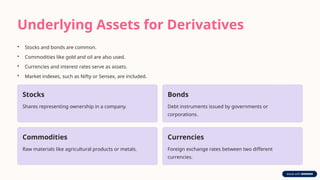
Underlying Assets forDerivatives
• Stocks and bonds are common.
• Commodities like gold and oil are also used.
• Currencies and interest rates serve as assets.
• Market indexes, such as Nifty or Sensex, are included.
Stocks
Shares representing ownership in a company.
Bonds
Debt instruments issued by governments or
corporations.
Commodities
Raw materials like agricultural products or metals.
Currencies
Foreign exchange rates between two different
currencies.
3.
Purpose of DerivativesMarket
Risk Management
Hedge against adverse price movements.
Price Discovery
Reflect market supply and demand.
Liquidity Enhancement
Increase trading volume and ease of transactions.
Capital Efficiency
Gain exposure with less upfront capital.
Risk Transfer
Shift risk from one party to another.
Speculation & Investment
Opportunities for profit from price changes.
4.
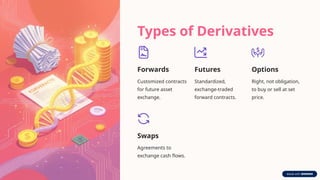
Types of Derivatives
Forwards
Customizedcontracts
for future asset
exchange.
Futures
Standardized,
exchange-traded
forward contracts.
Options
Right, not obligation,
to buy or sell at set
price.
Swaps
Agreements to
exchange cash flows.
5.
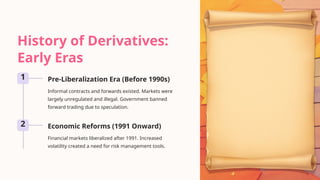
History of Derivatives:
EarlyEras
1 Pre-Liberalization Era (Before 1990s)
Informal contracts and forwards existed. Markets were
largely unregulated and illegal. Government banned
forward trading due to speculation.
2 Economic Reforms (1991 Onward)
Financial markets liberalized after 1991. Increased
volatility created a need for risk management tools.
6.
Formal Introduction of
Derivativesin India
SEBI Act & Regulatory Framework
(1992–1995)
SEBI became the primary regulator. Steps taken to legalize
derivatives trading.
Formal Introduction (2000)
June 2000: NSE and BSE launched index futures. Index
options, stock options, and stock futures followed. Nifty 50
and Sensex-based trading began.
7.
Expansion and Growth
(2001–2010)
RapidGrowth
Volume and variety of instruments expanded quickly.
Currency Derivatives
USD-INR futures introduced in 2008.
Global Leader
India became one of the largest derivatives markets by
volume.
8.
Innovation and ProductDiversification
(2010–Present)
Interest Rate Derivatives
New products launched for interest
rate management.
1
Commodity Options
SEBI's merger with FMC boosted
commodity derivatives.
2
Volatility Index (India VIX)
Introduced for market volatility
measurement.
3
New Offerings
Weekly options and cross-currency
derivatives debuted.
4
9.
Technological Advancements andCurrent
Status
1
Current Status
Market is mature and well-regulated. NSE is a top global exchange.
2
Technological Advancements
Electronic trading improved access. Mobile and
algorithmic trading increased participation.
10.
Commodity Exchanges
A commoditymarket trades goods derived from the earth. These
include cattle, gold, oil, and agricultural products. Commodities are
transformed into consumer products. They are then bought and sold by
businesses and consumers. This market facilitates trade in raw
materials.