Introduction
• Intellectual propertylaw is the area of law that
deals with legal rights to creative works and
inventions.
• It controls who gets to use creations including
new products, artistic works and designs.
• The purpose of intellectual property law is to
allow the people who create and invent things to
profit from their work. Lawmakers believe that
it’s fair for creators to profit from their own work
product.
3.
Evolutionary past
Historical Background:Ancient Times
• Signatures on Paintings & Creations
• Substantial and Identifiable Patterns & particularity
in Architectures, Painting’s, Jewellery, Dresses etc.
• Rewards and monopolies granted by Emperors
• Stamping of Jewelers’ Initials on Jewellery made by
them (Still followed by local Jewelers)
• Concept of Copyright came only after invention of
Printing Press.
4.
Historical Background: ModernTimes
• Modern patents originated in Europe where European sovereigns commonly
awarded "letters patent" to favored inventors.
• The first U.S. patent laws were enacted by Congress in 1790 as part of the
Constitution.
• The first patent was granted by the Massachusetts General Court to Samuel
Winslow in 1641 for a novel method of making salt.
• George Washington signed the First United States Patent Grant on July 31,
1790.
• Patent system in India was first introduced by British Government in 1856.
• The Indian Patents and Designs Act, 1911, (2 of 1911) first enacted under the
management of Controller of Patents with a patent term of 14 years.
• The Patents Act (39 of 1970) came into force on 20th April 1972 .
• Initially, the Patent Act, 1970, provided a term of 7 years for pharmaceutical,
agro chemical and food products and 16 years for other categories.
5.
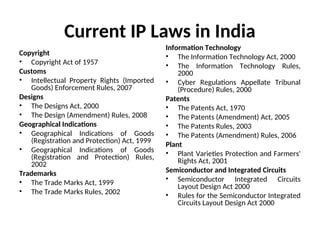
Current IP Lawsin India
Copyright
• Copyright Act of 1957
Customs
• Intellectual Property Rights (Imported
Goods) Enforcement Rules, 2007
Designs
• The Designs Act, 2000
• The Design (Amendment) Rules, 2008
Geographical Indications
• Geographical Indications of Goods
(Registration and Protection) Act, 1999
• Geographical Indications of Goods
(Registration and Protection) Rules,
2002
Trademarks
• The Trade Marks Act, 1999
• The Trade Marks Rules, 2002
Information Technology
• The Information Technology Act, 2000
• The Information Technology Rules,
2000
• Cyber Regulations Appellate Tribunal
(Procedure) Rules, 2000
Patents
• The Patents Act, 1970
• The Patents (Amendment) Act, 2005
• The Patents Rules, 2003
• The Patents (Amendment) Rules, 2006
Plant
• Plant Varieties Protection and Farmers'
Rights Act, 2001
Semiconductor and Integrated Circuits
• Semiconductor Integrated Circuits
Layout Design Act 2000
• Rules for the Semiconductor Integrated
Circuits Layout Design Act 2000
6.
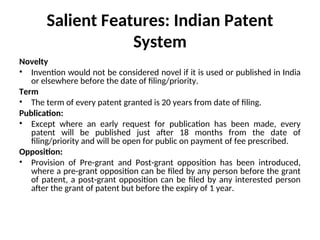
Salient Features: IndianPatent
System
Novelty
• Invention would not be considered novel if it is used or published in India
or elsewhere before the date of filing/priority.
Term
• The term of every patent granted is 20 years from date of filing.
Publication:
• Except where an early request for publication has been made, every
patent will be published just after 18 months from the date of
filing/priority and will be open for public on payment of fee prescribed.
Opposition:
• Provision of Pre-grant and Post-grant opposition has been introduced,
where a pre-grant opposition can be filed by any person before the grant
of patent, a post-grant opposition can be filed by any interested person
after the grant of patent but before the expiry of 1 year.
7.
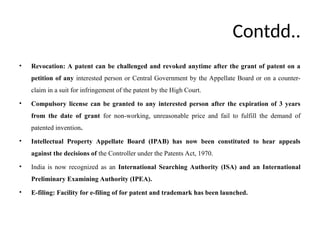
Contdd..
• Revocation: Apatent can be challenged and revoked anytime after the grant of patent on a
petition of any interested person or Central Government by the Appellate Board or on a counter-
claim in a suit for infringement of the patent by the High Court.
• Compulsory license can be granted to any interested person after the expiration of 3 years
from the date of grant for non-working, unreasonable price and fail to fulfill the demand of
patented invention.
• Intellectual Property Appellate Board (IPAB) has now been constituted to hear appeals
against the decisions of the Controller under the Patents Act, 1970.
• India is now recognized as an International Searching Authority (ISA) and an International
Preliminary Examining Authority (IPEA).
• E-filing: Facility for e-filing of for patent and trademark has been launched.
Patent Law
• Thehistory of Patent law in India starts from 1911 when the Indian Patents
and Designs Act, 1911 was enacted.
• The present Patents Act, 1970 came into force in the year 1972, amending
and consolidating the existing law relating to Patents in India.
• The Patents Act, 1970 was again amended by the Patents (Amendment)
Act, 2005, wherein product patent was extended to all fields of technology
including food, drugs, chemicals and micro-organisms.
• After the amendment, the provisions relating to Exclusive Marketing
Rights (EMRs) have been repealed, and a provision for enabling grant of
compulsory license has been introduced.
• The provisions relating to pre-grant and post-grant opposition have been
also introduced.
• An invention relating to a product or a process that is new, involving
inventive step and capable of industrial application can be patented in
India.
• However, it must not fall into the category of inventions that are non-
patentable as provided under sections 3 and 4 of the (Indian) Patents Act,
1970.
• In India, a patent application can be filed, either alone or jointly, by true
and first inventor or his assignee.
10.
Copyright Law
• Indiancopyright law is at parity with the international
standards as contained in TRIPS.
• The (Indian) Copyright Act, 1957, pursuant to the
amendments in 1999, 2002 and 2012, fully reflects the
Berne Convention for Protection of Literary and Artistic
Works, 1886 and the Universal Copyrights Convention,
to which India is a party.
• India is also a party to the Geneva Convention for the
Protection of Rights of Producers of Phonograms and is
an active member of the World Intellectual Property
Organization(WIPO)
11.
Trademark Law
• Priorto statutory enactment of regulations governing trademark law and
practice in India, the proprietary rights vested in a trademark were
protected through common law principles and principles of equity.
• Majority of Indian Laws owe their origin to English Laws which were
substantially subsumed while formulating Laws for the Indian
subcontinent prior to Independence.
• The passing of the English Act, 1875, which provided for the protection of
trademarks in England prompted passing of a similar Bill in India.
• Subsequently, requests were made to the Bombay Government by the
Bombay Chamber of Commerce and Mill Owners’ Association for
introducing a Bill in the Bombay Legislative Council on the lines of the
English Act.
• The Central Government took up the matter and circulated the Trademark
Bill for public opinion in 1879.
• However, the Bill met heavy opposition from vested interests and
commercial public and was not proceeded with further
12.
Contdd..
• The needfor a law exclusively addressing trademark
practice and procedure in India was again sought for in the
19th
century which eventually materialized into
the Trademark Act, 1940.
• The Trademark Act, 1940 predominantly reflected the
provisions incorporated in the UK Trademark Act, 1938.
• Subsequently, in the wake of ensuing trade and commerce
development, the Trademark Act, 1958 was passed to
address the lacunae being witnessed in the Trademark Act,
1940.
• The Trademark Act, 1958 also consolidated the provisions
associated with trademarks in the Indian Penal Code,
Criminal Procedure Code and Sea Customs.
13.
Contdd..
• The TrademarkAct, 1958 was thereafter
repealed by the Trademark Act, 1999 which at
present governs trademark law and practice in
India.
• The Trademark Act, 1999 was enacted with
the intent to revise the Act in congruity with
latest developments witnessed in trading and
commercial practices, rapid globalization and
for harmonization with International trade
laws.
14.
Some of theepoch- making inclusions in
the Trademark Act, 1999 inter alia include:
• Provision was made for trademark registration in
respect of services in addition to goods;
• Statutory protection was extended to well-known
trademarks;
• Widened the scope and purview of ‘trademark’ in
India;
• Provision for registration of ‘collective marks’;
• Incorporated provision to prevent use of
trademark as a corporate or trade name by third
party.
15.
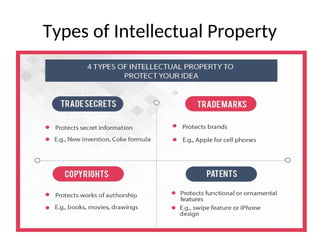
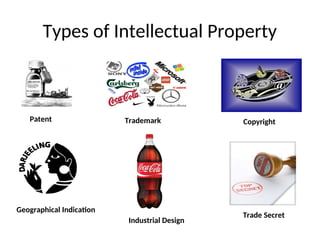
Types of IntellectualProperty
The four types of intellectual property include:
• Trade Secrets
• Trademarks
• Copyrights, and
• Patents.
Patent
• A patentis an exclusive right granted for an
invention, which is a product or a process that
provides, in general, a new way of doing
something, or offers a new technical solution
to a problem.
• To get a patent, technical information about
the invention must be disclosed to the public
in a patent application.
19.
Patent
• A Patentis a grant issued by the government through
the Intellectual Property Office of the India.
• It is an exclusive right granted for a product, process or
an improvement of a product or process which is new,
inventive and useful.
• This exclusive right gives the inventor the right to
exclude others from making, using, or selling the
product of his invention during the life of the patent.
• A patent has a term of protection of twenty (20) years
providing an inventor significant commercial gain.
• In return, the patent owner must share the full
description of the invention.
20.
NON-PATENTABLE INVENTIONS
• Discovery
•Scientific theory
• Mathematical methods
• Scheme, rule and method of performing mental act
• Playing games
• Doing business
• Program for computer
• Method for treatment – human or animal body by surgery or
therapy & diagnostic method
• Plant variety or animal breed or essentially biological
• processes for the production of plants and animals
• Aesthetic creation
• Contrary to public order or morality
REQUIREMENTS FOR FILINGA
PATENT
• Request for the Grant of Patent
• Description of the Invention (Specification and
Claim/s)
• Drawings necessary for the Invention (if any)
• Filing Fee
23.
Copyright
• "a person'sexclusive right to reproduce,
publish, or sell his or her original work of
authorship (as a literary, musical, dramatic,
artistic, or architectural work).“
• It's important to understand that copyright
law covers the "form of material expression,"
not the actual concepts, ideas, techniques, or
facts in a particular work
24.
WORKS COVERED BYCOPYRIGHT
PROTECTION
• Books, pamphlets, articles and other writings
• Periodicals and newspapers
• Lectures, sermons, addresses, dissertations
prepared for oral delivery, whether or not
reduced in writing or other material form
• Letters
• Dramatic or dramatic-musical compositions;
choreographic works or entertainment in dumb
shows
• Musical compositions, with or without words
25.
Contdd.
• Works ofdrawing, painting, architecture, sculpture,
engraving, lithography or other work of art; models or
designs for works of art
• Original ornamental designs or models for articles of
manufacture, whether or not registrable as an
industrial design, and other works of applied art
• Illustrations, maps, plans, sketches, charts and three
dimensional works relative to geography, topography,
architecture or science
• Drawings or plastic works of a scientific or technical
character
26.
Contd..
• Photographic worksincluding works produced by
a process analogous to photography; lantern slides
• Audiovisual works and cinematographic works
and works produced by a process analogous to
cinematography or any process for making audio-
visual recordings
• Pictorial illustrations and advertisements
• Computer programs
• Other literary, scholarly, scientific and artistic
works.
27.
Trademarks
• The TradeMarks Registry was established in India in 1940
and presently it administers the Trade Marks Act, 1999 and
the rules there under.
• It acts as a resource and information centre and is a facilitator
in matters relating to trade marks in the country.
• The objective of the Trade Marks Act, 1999 is to register trade
marks applied for in the country and to provide for better
protection of trade mark for goods and services and also to
prevent fraudulent use of the mark.
• The main function of the Registry is to register trade marks
which qualifies for registration under the Act and Rules.
28.
TRADEMARKS
• "Mark" meansany visible sign capable of distinguishing
the goods (trademark) or services (service mark) of an
enterprise and shall include a stamped or marked container
of goods.
• A trademark is a tool used that differentiates goods and
services from each other. It is a very important marketing
tool that makes the public identify goods and services.
• A trademark can be one word, a group of words, sign,
symbol, logo, or a combination of any of these.
• Generally, a trademark refers to both trademark and
service mark, although a service mark is used to identify
those marks used for services only.
29.
TRADEMARK PROTECTION
• Atrademark can be protected through registration.
Registration gives the trademark owner the exclusive
right to use the mark and to prevent others from using
the same or similar marks on identical or related goods
and services.
• Before applying for trademark registration, it would
help if you conduct a search in the trademarks
database to determine if there are identical or similar
marks that would prevent the registration of your
mark.
• This is to prevent future conflicts with marks that are
already registered or with earlier filing dates.
30.
Trade Secret
• Broadlyspeaking, any confidential business information which
provides an enterprise a competitive edge may be considered a
trade secret.
• Trade secrets encompass manufacturing or industrial secrets and
commercial secrets.
• The unauthorized use of such information by persons other than
the holder is regarded as an unfair practice and a violation of the
trade secret.
• Depending on the legal system, the protection of trade secrets
forms part of the general concept of protection against unfair
competition or is based on specific provisions or case law on the
protection of confidential information
Innovations and Inventionsof Trade
related Intellectual Property Rights
• Innovation is not the same as invention.
Innovation is a process, which begins from the
conception of an idea to the launching of a
new product/process in the market place
• Inventions are the bedrock of innovation. An
invention is a new solution to a technical
problem and can be protected
through patents.
33.
Innovation
• Generally put,an ‘innovation’ is developing a new
idea and putting it into practice.
• The term ‘innovation’ is used here to refer to the process of
bringing valuable new products (goods and services) to
market i.e., from the idea/concept formulation stage to the
successful launching of a new or improved product in the
marketplace, or the result of that process, so as to meet
the explicit or implied needs of current or potential
customers.
• In other words, through innovation an enterprise seeks to
deliver unique new value to its customers. In this context,
‘marketing’ is the understanding of that unique new value
and communicating it to the current and potential
customers of a business so that the product sells itself.
34.
Contdd..
• Technological innovationmay be classified in several ways:
– Product vs. Process,
– Radical (basic or fundamental) vs. Incremental (improvement),
and
– Disruptive vs. Sustaining (sequential and/or complementary).
• Other important types of (non-technological) innovations
that do not result from scientific and/or technological R&D,
but are often crucial for profitably marketing the products
and services resulting from the investment made in R&D
are:
– Marketing Innovation,
– Institutional Innovation,
– Complementary Innovation.
35.
Role of IPin Innovation
• As there are many players involved in facilitating the market success of an
innovation, the effective use of the tools of IP will play an important role in
reducing risk for the players involved, who may then be able to reap
acceptable returns for their participation in the process.
• IP plays an important role in facilitating the process of taking innovative
technology to the market place.
• At the same time, IP plays a major role in enhancing competitiveness of
technology-based enterprises, whether such enterprises are commercializing
new or improved products or providing service on the basis of a new or
improved technology.
• For most technology-based enterprises, a successful invention results in a
more efficient way of doing things or in a new commercially viable product.
• The improved profitability of the enterprise is the outcome of added value
that underpins a bigger stream of revenue or higher productivity.
36.
Agencies
The agency ofthe government in charge of the
implementation of the Intellectual Property Code is the
Intellectual Property Office which replaced the Bureau of
Patents, Trademarks and Technology Transfer. It is divided
into six [6] Bureaus, namely:
• Bureau of Patents
• Bureau of Trademarks
• Bureau of Legal Affairs
• Documentation, Information and Technology Transfer
Bureau
• Management Information System and EDP Bureau
• Administrative, Financial and Personnel Services Bureau.
37.
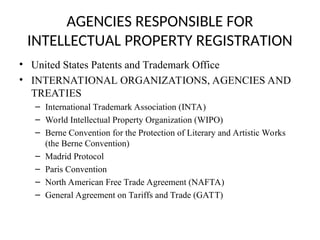
AGENCIES RESPONSIBLE FOR
INTELLECTUALPROPERTY REGISTRATION
• United States Patents and Trademark Office
• INTERNATIONAL ORGANIZATIONS, AGENCIES AND
TREATIES
– International Trademark Association (INTA)
– World Intellectual Property Organization (WIPO)
– Berne Convention for the Protection of Literary and Artistic Works
(the Berne Convention)
– Madrid Protocol
– Paris Convention
– North American Free Trade Agreement (NAFTA)
– General Agreement on Tariffs and Trade (GATT)
38.
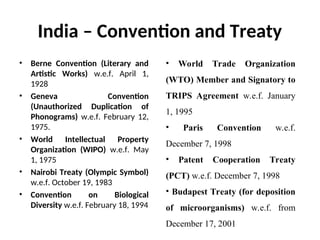
India – Conventionand Treaty
• Berne Convention (Literary and
Artistic Works) w.e.f. April 1,
1928
• Geneva Convention
(Unauthorized Duplication of
Phonograms) w.e.f. February 12,
1975.
• World Intellectual Property
Organization (WIPO) w.e.f. May
1, 1975
• Nairobi Treaty (Olympic Symbol)
w.e.f. October 19, 1983
• Convention on Biological
Diversity w.e.f. February 18, 1994
• World Trade Organization
(WTO) Member and Signatory to
TRIPS Agreement w.e.f. January
1, 1995
• Paris Convention w.e.f.
December 7, 1998
• Patent Cooperation Treaty
(PCT) w.e.f. December 7, 1998
• Budapest Treaty (for deposition
of microorganisms) w.e.f. from
December 17, 2001
39.
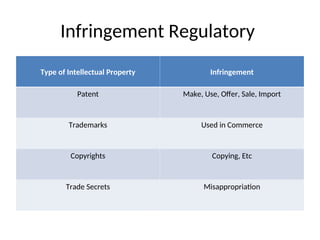
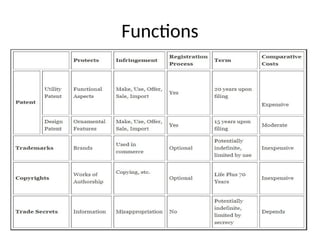
Infringement Regulatory
Type ofIntellectual Property Infringement
Patent Make, Use, Offer, Sale, Import
Trademarks Used in Commerce
Copyrights Copying, Etc
Trade Secrets Misappropriation
40.
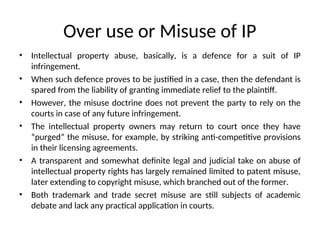
Over use orMisuse of IP
• Intellectual property abuse, basically, is a defence for a suit of IP
infringement.
• When such defence proves to be justified in a case, then the defendant is
spared from the liability of granting immediate relief to the plaintiff.
• However, the misuse doctrine does not prevent the party to rely on the
courts in case of any future infringement.
• The intellectual property owners may return to court once they have
“purged” the misuse, for example, by striking anti-competitive provisions
in their licensing agreements.
• A transparent and somewhat definite legal and judicial take on abuse of
intellectual property rights has largely remained limited to patent misuse,
later extending to copyright misuse, which branched out of the former.
• Both trademark and trade secret misuse are still subjects of academic
debate and lack any practical application in courts.
41.
Different forms ofIntellectual Property Rights abuse
have been elaborated under the following heads:
• Patent misuse
• Copyright misuse
• Patent trolls
• Tax Avoidance
• Harmonization of IPR and Competition Laws:
TRIPS
• Compulsory Licensing
42.
Patent Misuse
• Attimes, patent owner wrongfully uses the patent surpassing its legitimate
scope. Patent misuse is the unjustified use of the acquired patent rights.
• Examples of patent misuse include illegal tying of products and services to
the patented invention, price fixing, fraudulently making the customers
pay royalties on items the patent of which has expired, and the like.
• The concept of patent misuse first surfaced in the case of Adams v Burke,
decided by the US Supreme Court in 1873.
• The court held that after the first authorized sale of a patent product by
the patentee, the product becomes the complete property of the
purchaser, rendering the patentee devoid of his monopoly rights over the
product.
• Subsequent purchasers acquire the same rights over the product as the
seller had, and may use it in the same way the owner could have used. This
came to be known as the exhaustion doctrine.
43.
Contd…
• However, inthe 19th century, not many facets of patent
misuse were acknowledged by the judges.
• In the famous case of Henry v. A.B. Dick Co, the United States
Supreme Court upheld the validity of licensing the use of tied
or other related products along with the originally patented
product.
• Usually known as the Inherency doctrine, this theory states
that it was the inherent right of a patent owner, in lieu of his
having exclusive rights over his product, to exercise the right
to license the product on any terms and conditions he chose.
44.
Contdd.
• In 1917,the United States Supreme Court overruled the A.B.
Dick case in Motion Picture Patents Co. v. Universal Film Mfg.
Co.
• In this case the Supreme Court held that ‘the scope of every
patent is limited to the invention described in the claims.
• The patentee can claim nothing beyond them.’ It condemned
the licensing of materials which formed no part of the patented
invention and were merely necessary for its operation.
• In Brulotte v. Thys Co. (1964), the United States Supreme Court
held that a patent holder’s attempt to collect royalties beyond
the term of the patent constitutes misuse of the patent.
45.
Contd..
• An essentialcondition for using patent misuse
defence is that it must hamper the competition in
the market.
• When a company accuses a patent owner of misuse,
then the allegation must fulfill 2 conditions:
– The valid patent was used as a way to change business
outcomes
– The anti-competitive effects extended outside of the
patent’s scope
46.
Contd..
• The patentmisuse doctrine requires that the alleged infringer
show that the patentee has impermissibly broadened the
‘physical or temporal scope’ of the patent grant with
anticompetitive effect.
• Patent misuse does not affect a patent’s validity.
• Since the 20th century, there have been significant
developments through various legislations and judicial
decisions that have further broadened the scope and
understanding of the patent systems so as to eliminate the
loopholes and make it more user- friendly.
47.
Copyright misuse
• Copyrightmisuse occurs when a company or an individual makes
unjustified use of a copyright which is beyond its legal capacity and
in violation of the Copyright Act of the concerned country.
• A copyright owner could commit misuse by violating any public
policy choices embodied in the Copyright Act, such as by using a
license agreement to extend the length of its copyright monopoly.
• Copyright misuse can also occur when the assertion of copyright is
aimed at suppressing speech.
• It is believed that Copyright misuse derives its basis from patent
misuse as, while patent abuse finds mention in various cases since
the 19th century, copyright misuse found recognition in the legal
fraternity only a few decades ago.
48.
Contd.
• Morton SaltCo. v. GS. Suppiger (1942) case, decided
by the United States Supreme Court, laid the
foundation of the concept of copyright misuse. While
the reasoning given by the court refers to patent
misuse, the commentary and the dicta address the
issue of copyright misuse.
• In the case Tekla Corporation v. Survo Ghosh,
decided by the Delhi High Court on 16th May 2014,
Justice Endlaw of the Delhi High Court held that
“copyright misuse does not constitute a legitimate
defense for copyright infringement in India.”
49.
Contd…
• In AlcatelU.S.A., Inc. v. DGI Technologies (1999), it was held that the
defense of copyright misuse has its historical roots in the unclean hands
doctrine, i.e, which means that the suit of infringement filed by the plaintiff,
who himself has abused the privilege conferred upon him by the copyright,
is not itself justified.
• In the instant case, the Court found copyright misuse where the holder of a
copyright in software licensed its use on the condition that the licensee also
use it only in conjunction with the copyright holder’s hardware.
• It prescribed the use of the copyright to secure an exclusive right or
monopoly, which is not granted by the Copyright Office of a country and
which is contrary to public policy to grant.
• Upon the improper use of a copyrighted work, the work will provide no
copyright rights to its owner.
• In order to retain the rights, it is important that the activity constituting the
misuse must be ceased.
50.
Patent trolls
• PatentTrolls, formally known as ‘Non-Practicing Entities (NPEs) or Patent
Assertion Entities (PAEs)’, are companies which tend to earn a fortune
from frivolous patent infringement lawsuits.
• While normal companies use their patents to protect their product from
being counterfeited and sold in the market, patent trolls often acquire
patents cheaply from bankrupt companies and, instead of using such
patents in operations, these companies charge hefty licensing fees on
other persons or businesses which appear to infringe any of their acquired
patents.
• Fees can range from ten to hundred thousand dollars, whereas patent
lawsuits can cost the individuals or companies in millions.
• Hence, when such are the costs, many companies prefer to concede and
settle, even if they believe there to be no patent infringement.
51.
Contd.
• This practiceis a lucrative option for making money with
minimal risks.
• Small mobile and software companies, mostly startups, are
most vulnerable in this case and an easy target of patent
trolls.
• According to the RPX Corporation (RPXC) “NPE Litigation
Report,” around 4,500 patent infringement lawsuits were
filed in 2014.
• Out of those, patent trolls were responsible for 2,791 cases,
i.e. 63% of the total, whereas actual operating companies
filed only 1,667.
52.
Contd..
• A landmarkcase that came as a relief for companies in the United States,
as it would mitigate the threat of phoney patent suits, was decided by the
United States Supreme Court recently.
• The Court, in TC Heartland v. Kraft Foods (2017), unanimously ruled that
patent cases should be tried where the defending company is based,
rather than in a court of the plaintiff’s choosing.
• Until now, patent cases could be heard anywhere throughout the country,
causing the companies to find the courts where the odds would be in their
favour, often resulting in biased results and over burdening of certain
courts.
53.
Tax Avoidance
• Accordingto Prof. Andrew Blair-Stanek of University of California,
Multinational Corporations use Intellectual Property (IP) to avoid taxes on
a massive scale, by transferring their IP to tax havens for artificially low
prices.
• He states that there are two main reasons which make acquired
intellectual property rights ideal for tax evasion.
– First, unlike workers or physical assets like factories or stores, IP can easily be moved to
tax havens via mere paperwork.
– Second, the uniqueness of every piece of IP makes a precise fair market value nearly
impossible to establish, allowing multinationals to justify low valuations that result in
the least tax. Virtually all IP-based tax-avoidance schemes involve assigning an
artificially low price to a piece of IP at some point in time.
54.
Harmonization of IPRand
Competition Laws: TRIPS
• While the negotiations over the TRIPS Agreement
were going on, many countries expressed their
serious concern over the regulation of unfair
competition and abusive monopoly powers of the IP
rights holder.
• Subsequently, after much deliberations, Article 40 of
the TRIPS agreement was inserted to address the
issue of IPR misuse and combat it through necessary
government intervention:
55.
Article 40
• Membersagree that some licensing practices or conditions pertaining to
intellectual property rights which restrain competition may have adverse effects on
trade and may impede the transfer and dissemination of technology.
• Nothing in this Agreement shall prevent Members from specifying in their
legislation licensing practices or conditions that may in particular cases constitute
an abuse of intellectual property rights having an adverse effect on competition in
the relevant market.
• As provided above, a Member may adopt, consistently with the other provisions of
this Agreement, appropriate measures to prevent or control such practices, which
may include for example exclusive grant back conditions, conditions preventing
challenges to validity and coercive package licensing, in the light of the relevant
laws and regulations of that Member.
• Article 40 of the Agreement empowers the member countries to specify any
exploitation of monopoly rights and adopt such laws that may be necessary to
curb the abuse of IPR.
56.
Compulsory Licensing
• Accordingto World Trade Organisation,
• Compulsory licensing is when a government allows someone else to produce a
patented product or process without the consent of the patent owner or plans to
use the patent-protected invention itself.
• It is one of the flexibilities in the field of patent protection included in the WTO’s
agreement on intellectual property — the TRIPS (Trade-Related Aspects of
Intellectual Property Rights) Agreement.
• The right over the product still rests with the owner, who is entitled to royalty by
the users. This is an effective statutory measure to deter complete control of the
owner over the unfettered use (or misuse) of the product.
• Article 31 of the TRIPS agreement provides for the grant of compulsory licensing
under certain exceptional situations such as national emergency or other
circumstances of extreme urgency or inadequate exploitation of the patent in the
country.
![Agencies
The agency of the government in charge of the
implementation of the Intellectual Property Code is the
Intellectual Property Office which replaced the Bureau of
Patents, Trademarks and Technology Transfer. It is divided
into six [6] Bureaus, namely:
• Bureau of Patents
• Bureau of Trademarks
• Bureau of Legal Affairs
• Documentation, Information and Technology Transfer
Bureau
• Management Information System and EDP Bureau
• Administrative, Financial and Personnel Services Bureau.](https://image.slidesharecdn.com/unit1intellectualpropetylaw-250807074444-bd4d8898/85/Intellectual-Property-Law-Introduction-for-B-Tech-36-320.jpg)