Dr.A.DINESH KARTHIK
HEAD, P G & RESEARCH DEPT. OF CHEMISTRY
SHANMUGA INDUSTRIES ARTS & SCIENCE COLLEGE,
TIRUVANNAMALAI-606603.
dineshkarthik2008@gmail.com.
Cell: 9486887461/9500260601
UNIT-I: primary and secondary
sources - citation index for scientific
papers and journals - patents.
2017 -2018 / 2020 – 2021
REGULATION
PCH 34 A / MCH 34 A / DCH 34A
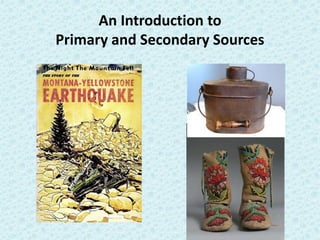
An Introduction to
Primary and Secondary Sources
Primary vs Secondary data
Primary data: Data originated by a researcher
for the specific purpose of addressing the
problem at hand
Secondary data: Data collected for some purpose
other than the problem at hand
Dr.A.DINESH KARTHIK
Original Documents (excerpts or translations
acceptable): diaries, speeches, manuscripts, letters,
interviews, news film footage, autobiographies,
official records
Creative Works: poetry, drama, novels, music, art
Relics or Artifacts: pottery, furniture, clothing,
buildings
Examples
Dr.A.DINESH KARTHIK
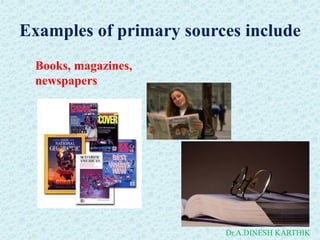
Examples of primary sources include
Books, magazines,
newspapers
Dr.A.DINESH KARTHIK
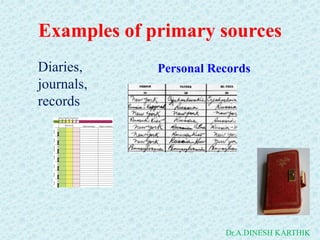
Examples of primary sources
Personal Records
Diaries,
journals,
records
Dr.A.DINESH KARTHIK
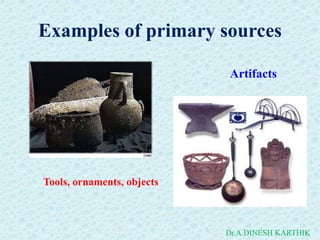
Examples of primary sources
Artifacts
Tools, ornaments, objects
Dr.A.DINESH KARTHIK
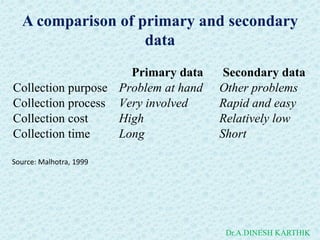
A comparison of primary and secondary
data
Primary data Secondary data
Collection purpose Problem at hand Other problems
Collection process Very involved Rapid and easy
Collection cost High Relatively low
Collection time Long Short
Source: Malhotra, 1999
Dr.A.DINESH KARTHIK
Qualitative research methods
• Qualitative research is a form of exploratory
research which
– Provides an understanding of the problem and
its underlying factors
• Is unstructured and flexible
• Based on small samples
Dr.A.DINESH KARTHIK
What are secondary sources?
• A secondary source interprets and
analyzes primary sources. These
sources are one or more steps
removed from the event. Secondary
sources may have pictures, quotes or
graphics of primary sources in them.
Dr.A.DINESH KARTHIK
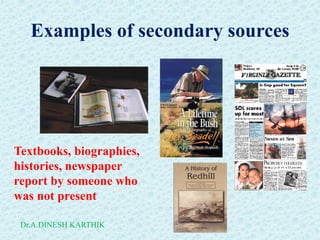
Examples of secondary sources
Textbooks, biographies,
histories, newspaper
report by someone who
was not present
Dr.A.DINESH KARTHIK
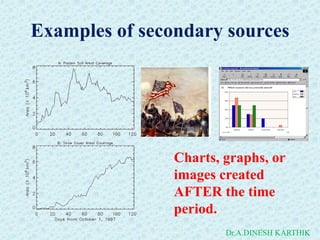
Examples of secondary sources
Charts, graphs, or
images created
AFTER the time
period.
Dr.A.DINESH KARTHIK
Against…
QUALITATIVE RESEARCH
• Results cannot be uses as conclusive
• Results cannot be generalised to any
population
QUANTITATIVE RESEARCH
“Then thousand times nothing is still nothing”
Dr.A.DINESH KARTHIK
Situations where Qualitative R. is
useful
• Impossible to use quantitative research (e.g.
Developing Countries)
• People unable/unwilling to answer questions
• Need for “emotional” or “affective”
information
Dr.A.DINESH KARTHIK
The research process
(with primary data)
1. Formulate a research problem
2. Determine the research design
3. Design data-collection method and forms
4. Design sample and collect data
5. Analyse and interpret the data
6. Prepare the research report
Dr.A.DINESH KARTHIK
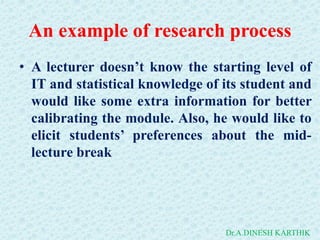
An example of research process
• A lecturer doesn’t know the starting level of
IT and statistical knowledge of its student and
would like some extra information for better
calibrating the module. Also, he would like to
elicit students’ preferences about the mid-
lecture break
Dr.A.DINESH KARTHIK
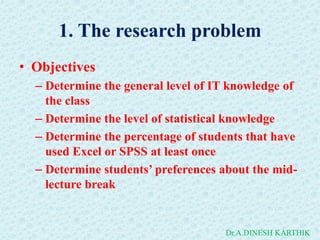
1. The research problem
• Objectives
– Determine the general level of IT knowledge of
the class
– Determine the level of statistical knowledge
– Determine the percentage of students that have
used Excel or SPSS at least once
– Determine students’ preferences about the mid-
lecture break
Dr.A.DINESH KARTHIK
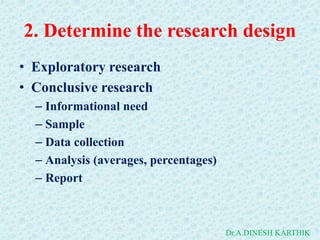
2. Determine the research design
• Exploratory research
• Conclusive research
– Informational need
– Sample
– Data collection
– Analysis (averages, percentages)
– Report
Dr.A.DINESH KARTHIK
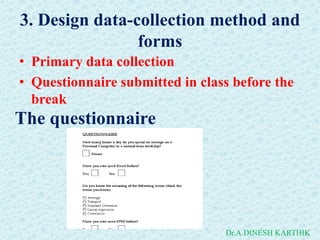
3. Design data-collection method and
forms
• Primary data collection
• Questionnaire submitted in class before the
break
Dr.A.DINESH KARTHIK
The questionnaire
5. Analyse and interpret the Data
• Data tabulation
• Summarised statistics
• Correlations allows to show the link
between knowing statistics and having used
SPSS… or the link between knowing
statistics and wanting no lecture at all.
Dr.A.DINESH KARTHIK
6. The research report
• Finally, a research report is provided. Results are
summarised and conclusions are drawn.
• E.g. Student showed a good knowledge of IT tools,
but SPSS needs to be explained from the
foundations. Lectures should start at 11 and end at
12.40, with a ten minutes break
• The demand about “having heard of statistical
terms” was not appropriate to infer the knowledge
of statistics (as it emerged from preliminary
qualitative research)
Dr.A.DINESH KARTHIK
Some research problems related to
food marketing
• Packaging of a food product (e.g. plastic or
glass bottle for milk) - Product
• Communication to be given to consumers
(e.g. beef after BSE scare) - Promotion
• Pricing for organic food - Price
• Development of on-line retailing… - Place
Dr.A.DINESH KARTHIK
Preparing a Research Proposal
• The Research Problem
• Purpose of the research project
• Data sources and methodology
• Time, personnel and costs
Dr.A.DINESH KARTHIK
The Research Problem
• It is crucial to give a clear definition
• It is useful to identify its specific
components
• How to define the problem
– Discussion with the decision maker (final user)
– Interview with experts in the topic
– Secondary analysis
– Qualitative research (e.g. Focus Groups)
Dr.A.DINESH KARTHIK
Objectives : the research questions
• They are detailed statements of the specific
components of the problem
• Research questions depend on:
– Problem definition
– Theoretical framework
– Analytical model adopted
• For conclusive research, it is very helpful to reach a
further detail and formulate hypotheses, i.e.
unproven statements about a factor or a
phenomenon of interest
Dr.A.DINESH KARTHIK
Data sources
• Explore available secondary data sources
• Primary data collection
– Exploratory research
– Qualitative research
– Survey plan
1. Identification of the reference population
2. Definition of the research questions
3. Choice of sampling criteria
4. Definition of the estimation methodology for
making inference on the surveyed parameters
5. Choice of sample size
6. Choice of the data-collection method (method of
administration)
7. Questionnaire design
8. Costs evaluation
Dr.A.DINESH KARTHIK
Methodology of analysis
• Data preparation & coding
• Cleaning and consistency checks
• Select a data analysis strategy
– Statistical techniques
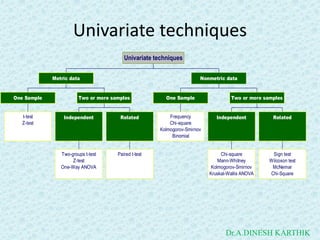
• Univariate techniques
• Multivariate techniques
Dr.A.DINESH KARTHIK
Univariate techniques
t-test
Z-test
One Sample
Two-groups t-test
Z-test
One-Way ANOVA
Independent
Paired t-test
Related
Two or more samples
Metric data
Frequency
Chi-square
Kolmogorov-Smirnov
Binomial
One Sample
Chi-square
Mann-Whitney
Kolmogorov-Smirnov
Kruskal-Wallis ANOVA
Independent
Sign test
Wilcoxon test
McNemar
Chi-Square
Related
Two or more samples
Nonmetric data
Univariate techniques
Dr.A.DINESH KARTHIK
Science Citation Index
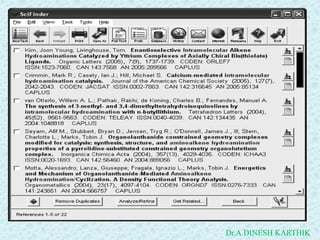
• As seen in the SciFinder search tutorials, it
is possible to track papers that have cited a
particular article or author. A publication
that can greatly facilitate literature
searching is Science Citation Index (SCI),
begun in 1961. This publication, which is
quite different from any other mentioned in
this chapter, gives a list of all papers in a
given year that have cited a given paper,
patent or book.
Dr.A.DINESH KARTHIK
Science Citation Index
• Its utility lies in the fact that it enables the user
to search forward from a given paper or
patent, rather than backward, as is usually the
case. For example, suppose a chemist Is
familiar with a paper by Jencks and Gilchrist
(J. Am. Chem. Soc., 1968, 90, 2622) entitled
‘‘Nonlinear Structure–Reactivity Correlations.
Dr.A.DINESH KARTHIK
Science Citation Index
• The chemist is easily able to begin a search for
earlier papers by using references supplied in
this paper, and can then go further backward
with the aid of references in those papers, and
so on. But for obvious reasons, the paper itself
supplies no way to locate later papers.
Dr.A.DINESH KARTHIK
Dr.A.DINESH KARTHIK
Science Citation Index
• The publishers of SCI also produce another
publication, called Index to Scientific Reviews, that
appears semiannually. This publication, which began in
1974, is very similar to SCI, but confines itself to listing
citations to review articles. The citations come from
2500 journals in the same general areas as are covered
by SCI. The review articles cited appeared in 215
review journals and books, as well as in those journals
that publish occasional review articles. Like SCI, the
Index to Scientific Reviews contains citation, source,
corporate, and Permuterm indexes. It also contains a
‘‘Research Front Specialty Index,’’ which classifies
reviews by subject.
Dr.A.DINESH KARTHIK
JOURNALS
• The primary literature has grown so much in
recent years that attempts have
• been made to reduce the volume. One such
attempt is the Journal of Chemical
• Research, begun in 1977. The main section of
this journal, called the ‘‘Synopses,’’
• publishes synopses, which are essentially long
abstracts, with references. The full
• texts of most of the papers are published only
in microfiche and miniprint versions.
Dr.A.DINESH KARTHIK
JOURNALS
• 1 Angewandte Chemie (1887)
• 2 Angewandte Chemie International Edition (1962)6
• 3 Australian Journal of Chemistry (1948)
• 4 Bioorganic Chemistry (1971)
• 5 Bioorganic & Medicinal Chemistry Letters (1991)
• 6 Bulletin of the Chemical Society of Japan (1926)
• 7 Canadian Journal of Chemistry (1929)
• 8 Carbohydrate Research (1965)
• 9 Chemistry, a European Journal (1995)
• 10 Chemistry, an Asian Journal (2006)
• 11 Chemistry and Industry (London) (1923)
• 12 Chemistry Letters (1972)
• 13 Chimia (1947)
• 14 Collection of Czechoslovak Chemical Communications (1929)
• 15 Doklady Chemistry (1922) Dr.A.DINESH KARTHIK
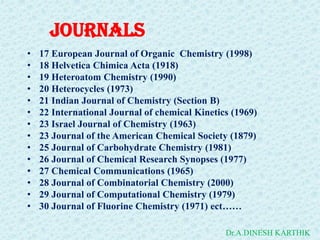
JOURNALS
• 17 European Journal of Organic Chemistry (1998)
• 18 Helvetica Chimica Acta (1918)
• 19 Heteroatom Chemistry (1990)
• 20 Heterocycles (1973)
• 21 Indian Journal of Chemistry (Section B)
• 22 International Journal of chemical Kinetics (1969)
• 23 Israel Journal of Chemistry (1963)
• 23 Journal of the American Chemical Society (1879)
• 25 Journal of Carbohydrate Chemistry (1981)
• 26 Journal of Chemical Research Synopses (1977)
• 27 Chemical Communications (1965)
• 28 Journal of Combinatorial Chemistry (2000)
• 29 Journal of Computational Chemistry (1979)
• 30 Journal of Fluorine Chemistry (1971) ect……
Dr.A.DINESH KARTHIK
Patents
• In many countries, including the United States,
it is possible to patent a new compound or a
new method for making a known compound
(either laboratory or industrial procedures), as
long as the compounds are useful.
• It comes as a surprise to many to learn that a
substantial proportion of the patents granted
(perhaps 20–30%) have been chemical patents.
• Chemical patents are part of the chemical
literature, and both U.S. and foreign patents
are regularly abstracted by Chemical
AbstractsTM.
Dr.A.DINESH KARTHIK
In addition to learning about the
contents of patents from this source,
chemists may consult the Official
Gazette of the U.S. Patent Office,
which, published weekly and
available in many libraries, lists titles
of all patents issued that week.
Dr.A.DINESH KARTHIK
Patents are also available via
SciFinder
Although patents are often very
useful to the laboratory chemist,
and no literature search is
complete that neglects relevant
patents, as a rule they are not as
reliable as papers. There are two
reasons for this:
Dr.A.DINESH KARTHIK
1. It is in the interest of the inventor
to claim as much as possible.
Therefore, they may, for example,
actually have carried out a reaction
with ethanol and with 1-propanol,
but will claim all primary alcohols,
and perhaps even secondary and
tertiary alcohols, glycols, and
phenols.
Dr.A.DINESH KARTHIK
An investigator repeating the
reaction on an alcohol that the
inventor did not use may find
that the reaction gives no yield at all.
In general, it is safest to duplicate
the actual examples given, of which
most chemical patents contain one
or more.
Dr.A.DINESH KARTHIK
2. Although legally a patent gives an
inventor a monopoly, any alleged
infringements must be protected in
court, and this may cost a good deal
of money. Therefore some patents
are written so that certain essential
details are concealed or entirely
omitted.
Dr.A.DINESH KARTHIK
This practice is not exactly
cricket, because a patent is
supposed to be a full disclosure, but
patent attorneys are generally
APPENDIX A PRIMARY
SOURCES 1875 skilled in the art
of writing patents, and procedures
given are not always sufficient to
duplicate the results.
Dr.A.DINESH KARTHIK
Dr.A.DINESH KARTHIK
dineshkarthik2008@gmail.com

Unit I B Research Methodolgy II MSc

  • 2.
    Dr.A.DINESH KARTHIK HEAD, PG & RESEARCH DEPT. OF CHEMISTRY SHANMUGA INDUSTRIES ARTS & SCIENCE COLLEGE, TIRUVANNAMALAI-606603. dineshkarthik2008@gmail.com. Cell: 9486887461/9500260601 UNIT-I: primary and secondary sources - citation index for scientific papers and journals - patents. 2017 -2018 / 2020 – 2021 REGULATION PCH 34 A / MCH 34 A / DCH 34A
  • 3.
    An Introduction to Primaryand Secondary Sources
  • 4.
    Primary vs Secondarydata Primary data: Data originated by a researcher for the specific purpose of addressing the problem at hand Secondary data: Data collected for some purpose other than the problem at hand Dr.A.DINESH KARTHIK
  • 5.
    Original Documents (excerptsor translations acceptable): diaries, speeches, manuscripts, letters, interviews, news film footage, autobiographies, official records Creative Works: poetry, drama, novels, music, art Relics or Artifacts: pottery, furniture, clothing, buildings Examples Dr.A.DINESH KARTHIK
  • 6.
    Examples of primarysources include Books, magazines, newspapers Dr.A.DINESH KARTHIK
  • 7.
    Examples of primarysources Personal Records Diaries, journals, records Dr.A.DINESH KARTHIK
  • 8.
    Examples of primarysources Artifacts Tools, ornaments, objects Dr.A.DINESH KARTHIK
  • 9.
    A comparison ofprimary and secondary data Primary data Secondary data Collection purpose Problem at hand Other problems Collection process Very involved Rapid and easy Collection cost High Relatively low Collection time Long Short Source: Malhotra, 1999 Dr.A.DINESH KARTHIK
  • 10.
    Qualitative research methods •Qualitative research is a form of exploratory research which – Provides an understanding of the problem and its underlying factors • Is unstructured and flexible • Based on small samples Dr.A.DINESH KARTHIK
  • 11.
    What are secondarysources? • A secondary source interprets and analyzes primary sources. These sources are one or more steps removed from the event. Secondary sources may have pictures, quotes or graphics of primary sources in them. Dr.A.DINESH KARTHIK
  • 12.
    Examples of secondarysources Textbooks, biographies, histories, newspaper report by someone who was not present Dr.A.DINESH KARTHIK
  • 13.
    Examples of secondarysources Charts, graphs, or images created AFTER the time period. Dr.A.DINESH KARTHIK
  • 14.
    Against… QUALITATIVE RESEARCH • Resultscannot be uses as conclusive • Results cannot be generalised to any population QUANTITATIVE RESEARCH “Then thousand times nothing is still nothing” Dr.A.DINESH KARTHIK
  • 15.
    Situations where QualitativeR. is useful • Impossible to use quantitative research (e.g. Developing Countries) • People unable/unwilling to answer questions • Need for “emotional” or “affective” information Dr.A.DINESH KARTHIK
  • 16.
    The research process (withprimary data) 1. Formulate a research problem 2. Determine the research design 3. Design data-collection method and forms 4. Design sample and collect data 5. Analyse and interpret the data 6. Prepare the research report Dr.A.DINESH KARTHIK
  • 17.
    An example ofresearch process • A lecturer doesn’t know the starting level of IT and statistical knowledge of its student and would like some extra information for better calibrating the module. Also, he would like to elicit students’ preferences about the mid- lecture break Dr.A.DINESH KARTHIK
  • 18.
    1. The researchproblem • Objectives – Determine the general level of IT knowledge of the class – Determine the level of statistical knowledge – Determine the percentage of students that have used Excel or SPSS at least once – Determine students’ preferences about the mid- lecture break Dr.A.DINESH KARTHIK
  • 19.
    2. Determine theresearch design • Exploratory research • Conclusive research – Informational need – Sample – Data collection – Analysis (averages, percentages) – Report Dr.A.DINESH KARTHIK
  • 20.
    3. Design data-collectionmethod and forms • Primary data collection • Questionnaire submitted in class before the break Dr.A.DINESH KARTHIK The questionnaire
  • 21.
    5. Analyse andinterpret the Data • Data tabulation • Summarised statistics • Correlations allows to show the link between knowing statistics and having used SPSS… or the link between knowing statistics and wanting no lecture at all. Dr.A.DINESH KARTHIK
  • 22.
    6. The researchreport • Finally, a research report is provided. Results are summarised and conclusions are drawn. • E.g. Student showed a good knowledge of IT tools, but SPSS needs to be explained from the foundations. Lectures should start at 11 and end at 12.40, with a ten minutes break • The demand about “having heard of statistical terms” was not appropriate to infer the knowledge of statistics (as it emerged from preliminary qualitative research) Dr.A.DINESH KARTHIK
  • 23.
    Some research problemsrelated to food marketing • Packaging of a food product (e.g. plastic or glass bottle for milk) - Product • Communication to be given to consumers (e.g. beef after BSE scare) - Promotion • Pricing for organic food - Price • Development of on-line retailing… - Place Dr.A.DINESH KARTHIK
  • 24.
    Preparing a ResearchProposal • The Research Problem • Purpose of the research project • Data sources and methodology • Time, personnel and costs Dr.A.DINESH KARTHIK
  • 25.
    The Research Problem •It is crucial to give a clear definition • It is useful to identify its specific components • How to define the problem – Discussion with the decision maker (final user) – Interview with experts in the topic – Secondary analysis – Qualitative research (e.g. Focus Groups) Dr.A.DINESH KARTHIK
  • 26.
    Objectives : theresearch questions • They are detailed statements of the specific components of the problem • Research questions depend on: – Problem definition – Theoretical framework – Analytical model adopted • For conclusive research, it is very helpful to reach a further detail and formulate hypotheses, i.e. unproven statements about a factor or a phenomenon of interest Dr.A.DINESH KARTHIK
  • 27.
    Data sources • Exploreavailable secondary data sources • Primary data collection – Exploratory research – Qualitative research – Survey plan 1. Identification of the reference population 2. Definition of the research questions 3. Choice of sampling criteria 4. Definition of the estimation methodology for making inference on the surveyed parameters 5. Choice of sample size 6. Choice of the data-collection method (method of administration) 7. Questionnaire design 8. Costs evaluation Dr.A.DINESH KARTHIK
  • 28.
    Methodology of analysis •Data preparation & coding • Cleaning and consistency checks • Select a data analysis strategy – Statistical techniques • Univariate techniques • Multivariate techniques Dr.A.DINESH KARTHIK
  • 29.
    Univariate techniques t-test Z-test One Sample Two-groupst-test Z-test One-Way ANOVA Independent Paired t-test Related Two or more samples Metric data Frequency Chi-square Kolmogorov-Smirnov Binomial One Sample Chi-square Mann-Whitney Kolmogorov-Smirnov Kruskal-Wallis ANOVA Independent Sign test Wilcoxon test McNemar Chi-Square Related Two or more samples Nonmetric data Univariate techniques Dr.A.DINESH KARTHIK
  • 30.
    Science Citation Index •As seen in the SciFinder search tutorials, it is possible to track papers that have cited a particular article or author. A publication that can greatly facilitate literature searching is Science Citation Index (SCI), begun in 1961. This publication, which is quite different from any other mentioned in this chapter, gives a list of all papers in a given year that have cited a given paper, patent or book. Dr.A.DINESH KARTHIK
  • 31.
    Science Citation Index •Its utility lies in the fact that it enables the user to search forward from a given paper or patent, rather than backward, as is usually the case. For example, suppose a chemist Is familiar with a paper by Jencks and Gilchrist (J. Am. Chem. Soc., 1968, 90, 2622) entitled ‘‘Nonlinear Structure–Reactivity Correlations. Dr.A.DINESH KARTHIK
  • 32.
    Science Citation Index •The chemist is easily able to begin a search for earlier papers by using references supplied in this paper, and can then go further backward with the aid of references in those papers, and so on. But for obvious reasons, the paper itself supplies no way to locate later papers. Dr.A.DINESH KARTHIK
  • 33.
  • 34.
    Science Citation Index •The publishers of SCI also produce another publication, called Index to Scientific Reviews, that appears semiannually. This publication, which began in 1974, is very similar to SCI, but confines itself to listing citations to review articles. The citations come from 2500 journals in the same general areas as are covered by SCI. The review articles cited appeared in 215 review journals and books, as well as in those journals that publish occasional review articles. Like SCI, the Index to Scientific Reviews contains citation, source, corporate, and Permuterm indexes. It also contains a ‘‘Research Front Specialty Index,’’ which classifies reviews by subject. Dr.A.DINESH KARTHIK
  • 35.
    JOURNALS • The primaryliterature has grown so much in recent years that attempts have • been made to reduce the volume. One such attempt is the Journal of Chemical • Research, begun in 1977. The main section of this journal, called the ‘‘Synopses,’’ • publishes synopses, which are essentially long abstracts, with references. The full • texts of most of the papers are published only in microfiche and miniprint versions. Dr.A.DINESH KARTHIK
  • 36.
    JOURNALS • 1 AngewandteChemie (1887) • 2 Angewandte Chemie International Edition (1962)6 • 3 Australian Journal of Chemistry (1948) • 4 Bioorganic Chemistry (1971) • 5 Bioorganic & Medicinal Chemistry Letters (1991) • 6 Bulletin of the Chemical Society of Japan (1926) • 7 Canadian Journal of Chemistry (1929) • 8 Carbohydrate Research (1965) • 9 Chemistry, a European Journal (1995) • 10 Chemistry, an Asian Journal (2006) • 11 Chemistry and Industry (London) (1923) • 12 Chemistry Letters (1972) • 13 Chimia (1947) • 14 Collection of Czechoslovak Chemical Communications (1929) • 15 Doklady Chemistry (1922) Dr.A.DINESH KARTHIK
  • 37.
    JOURNALS • 17 EuropeanJournal of Organic Chemistry (1998) • 18 Helvetica Chimica Acta (1918) • 19 Heteroatom Chemistry (1990) • 20 Heterocycles (1973) • 21 Indian Journal of Chemistry (Section B) • 22 International Journal of chemical Kinetics (1969) • 23 Israel Journal of Chemistry (1963) • 23 Journal of the American Chemical Society (1879) • 25 Journal of Carbohydrate Chemistry (1981) • 26 Journal of Chemical Research Synopses (1977) • 27 Chemical Communications (1965) • 28 Journal of Combinatorial Chemistry (2000) • 29 Journal of Computational Chemistry (1979) • 30 Journal of Fluorine Chemistry (1971) ect…… Dr.A.DINESH KARTHIK
  • 38.
    Patents • In manycountries, including the United States, it is possible to patent a new compound or a new method for making a known compound (either laboratory or industrial procedures), as long as the compounds are useful. • It comes as a surprise to many to learn that a substantial proportion of the patents granted (perhaps 20–30%) have been chemical patents. • Chemical patents are part of the chemical literature, and both U.S. and foreign patents are regularly abstracted by Chemical AbstractsTM. Dr.A.DINESH KARTHIK
  • 39.
    In addition tolearning about the contents of patents from this source, chemists may consult the Official Gazette of the U.S. Patent Office, which, published weekly and available in many libraries, lists titles of all patents issued that week. Dr.A.DINESH KARTHIK
  • 40.
    Patents are alsoavailable via SciFinder Although patents are often very useful to the laboratory chemist, and no literature search is complete that neglects relevant patents, as a rule they are not as reliable as papers. There are two reasons for this: Dr.A.DINESH KARTHIK
  • 41.
    1. It isin the interest of the inventor to claim as much as possible. Therefore, they may, for example, actually have carried out a reaction with ethanol and with 1-propanol, but will claim all primary alcohols, and perhaps even secondary and tertiary alcohols, glycols, and phenols. Dr.A.DINESH KARTHIK
  • 42.
    An investigator repeatingthe reaction on an alcohol that the inventor did not use may find that the reaction gives no yield at all. In general, it is safest to duplicate the actual examples given, of which most chemical patents contain one or more. Dr.A.DINESH KARTHIK
  • 43.
    2. Although legallya patent gives an inventor a monopoly, any alleged infringements must be protected in court, and this may cost a good deal of money. Therefore some patents are written so that certain essential details are concealed or entirely omitted. Dr.A.DINESH KARTHIK
  • 44.
    This practice isnot exactly cricket, because a patent is supposed to be a full disclosure, but patent attorneys are generally APPENDIX A PRIMARY SOURCES 1875 skilled in the art of writing patents, and procedures given are not always sufficient to duplicate the results. Dr.A.DINESH KARTHIK
  • 46.