Location of Places
Locating Places
• How do you find a city or other location on a
world map or globe?
• All places on Earth have a specific address.
This address makes it easy to find a place.
• The addresses of places on the Earth are
given in latitude and longitude.
2
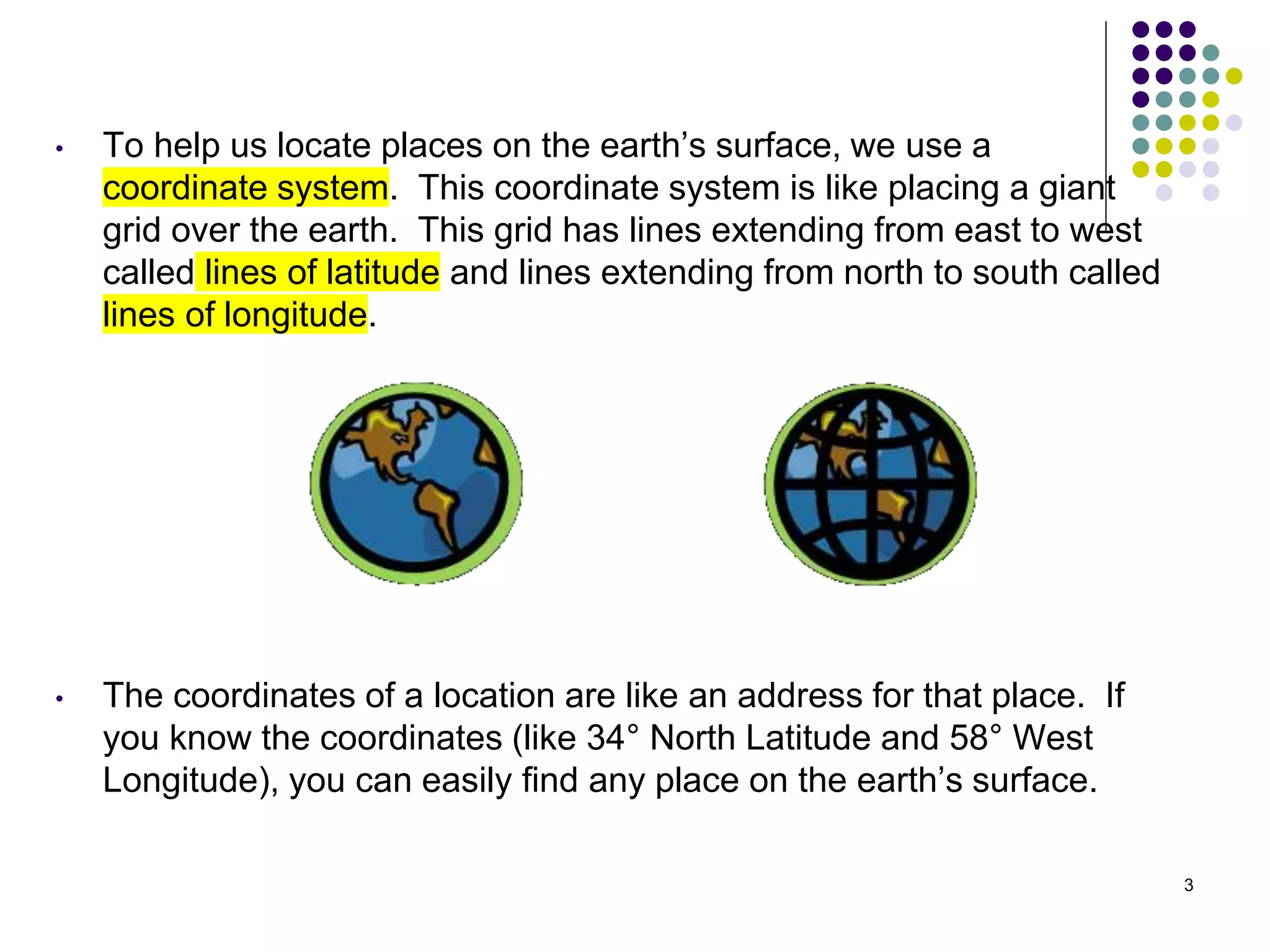
• To help us locate places on the earth’s surface, we use a
coordinate system. This coordinate system is like placing a giant
grid over the earth. This grid has lines extending from east to west
called lines of latitude and lines extending from north to south called
lines of longitude.
• The coordinates of a location are like an address for that place. If
you know the coordinates (like 34° North Latitude and 58° West
Longitude), you can easily find any place on the earth’s surface.
3
Latitude
South Pole
North Pole
Equator
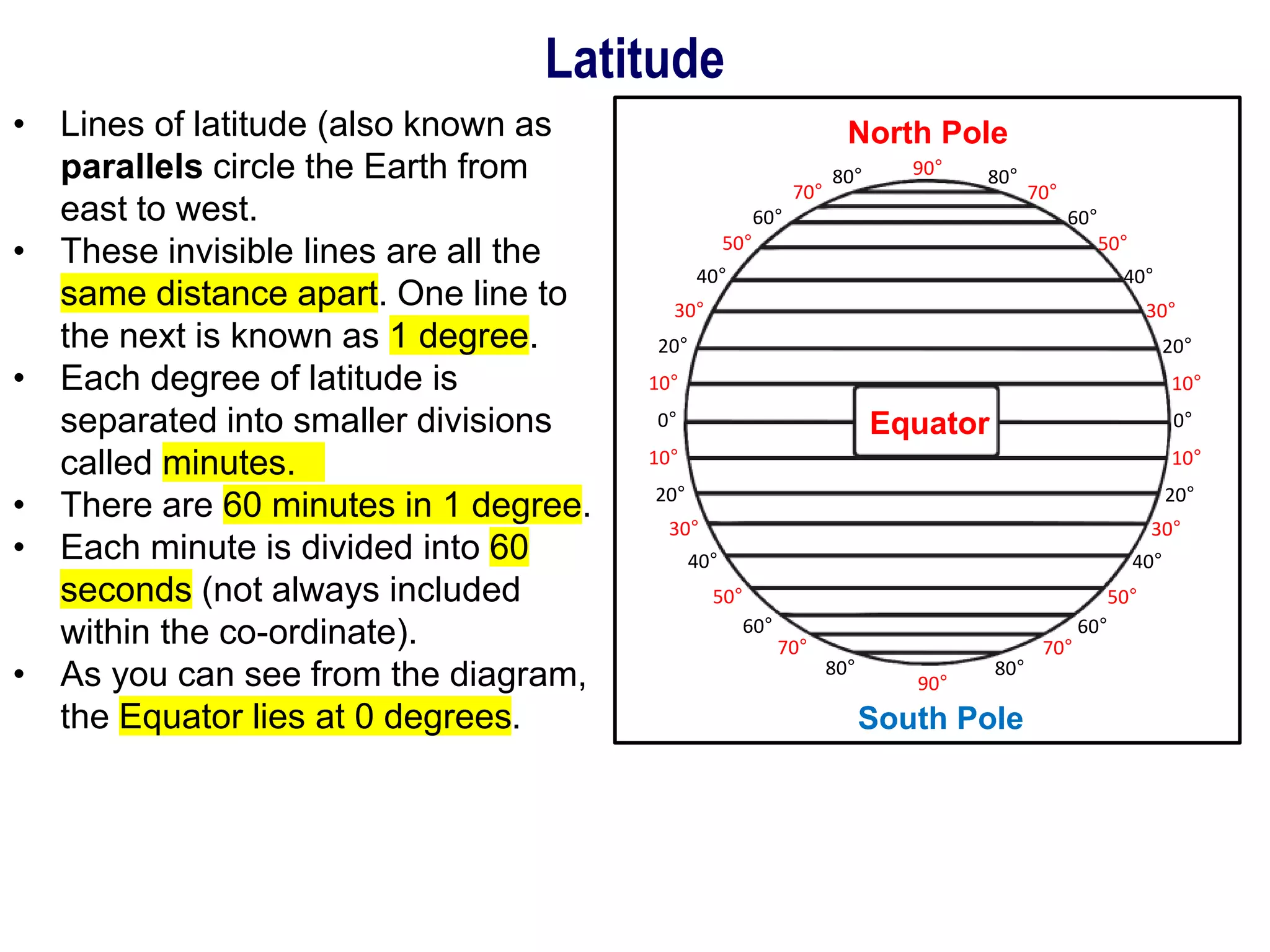
• Lines of latitude (also known as
parallels circle the Earth from
east to west.
• These invisible lines are all the
same distance apart. One line to
the next is known as 1 degree.
• Each degree of latitude is
separated into smaller divisions
called minutes.
• There are 60 minutes in 1 degree.
• Each minute is divided into 60
seconds (not always included
within the co-ordinate).
• As you can see from the diagram,
the Equator lies at 0 degrees.
90°
70°
60°
50°
40°
30°
20°
10°
0°
80°
10°
20°
30°
40°
50°
60°
70°
80°
90°
70°
60°
50°
40°
30°
20°
10°
0°
80°
10°
20°
30°
40°
50°
60°
70°
80°
Imagine the
Earth cut in
half...
The Northern
Hemisphere is
anywhere north of
the Equator whilst
the Southern
Hemisphere is
anywhere south of
the Equator.
Northern
Hemisphere
North Pole
North
America
Equator
Antarctic Circle
Southern
Hemisphere South Pole
South
America
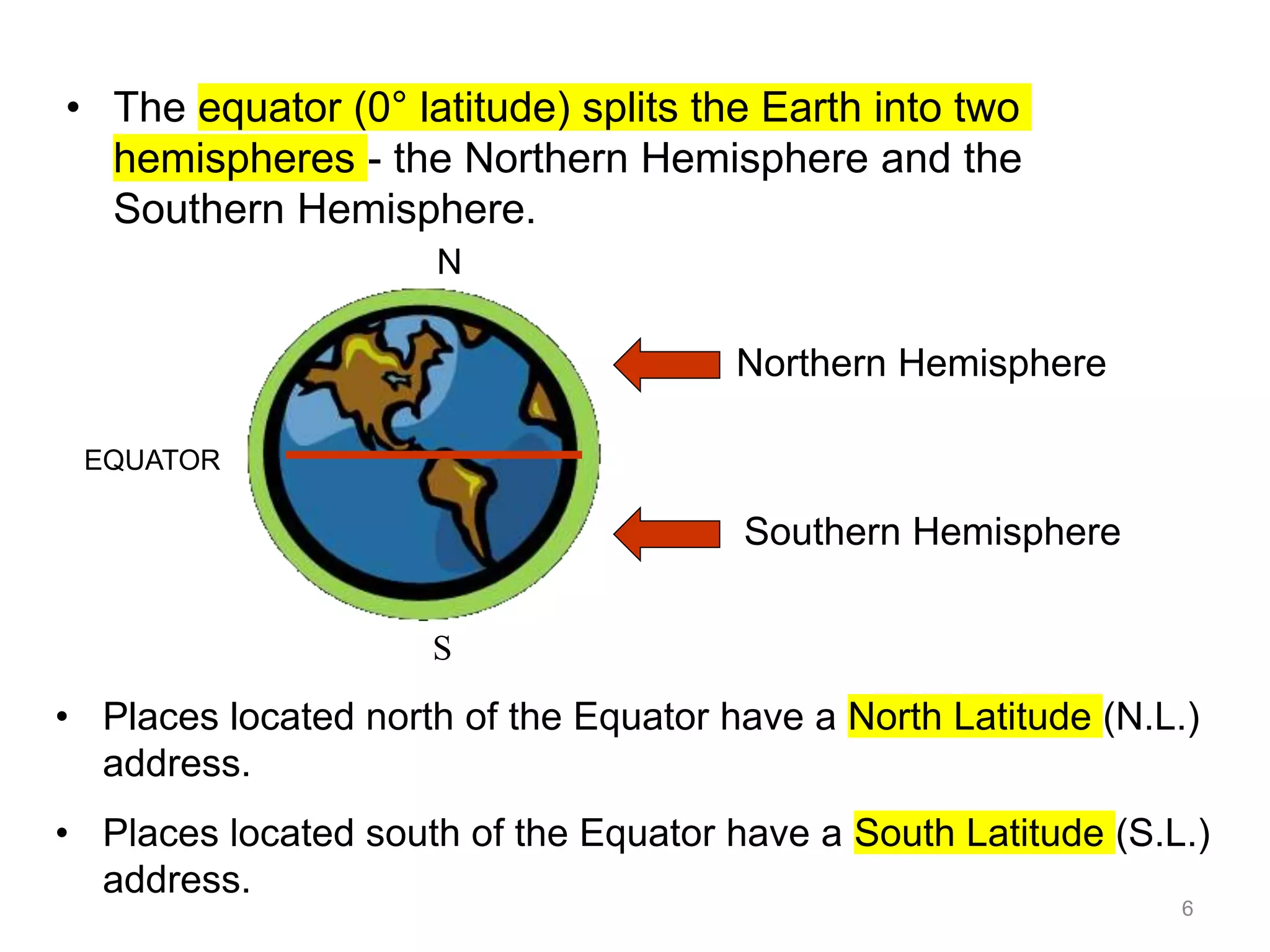
• The equator (0° latitude) splits the Earth into two
hemispheres - the Northern Hemisphere and the
Southern Hemisphere.
N
EQUATOR
S
• Places located north of the Equator have a North Latitude (N.L.)
address.
• Places located south of the Equator have a South Latitude (S.L.)
address.
Northern Hemisphere
Southern Hemisphere
6
Longitude
South Pole
North Pole
Equator
• These are the lines which run
north and south and are
known as lines of longitude or
meridians of longitude. These
lines are measured in the
same way as the lines of
latitude.
• Lines of longitude are not
equal distances (equidistant)
from each other.
• The Prime Meridian or
Greenwich Meridian line is a
line of longitude at 0 degrees.
• It passes right through
Greenwich in London.
105°
75°
60°
45° 30° 15° 0°
15°
30°
90°
Western
Hemisphere
Eastern
Hemisphere
Prime Meridian
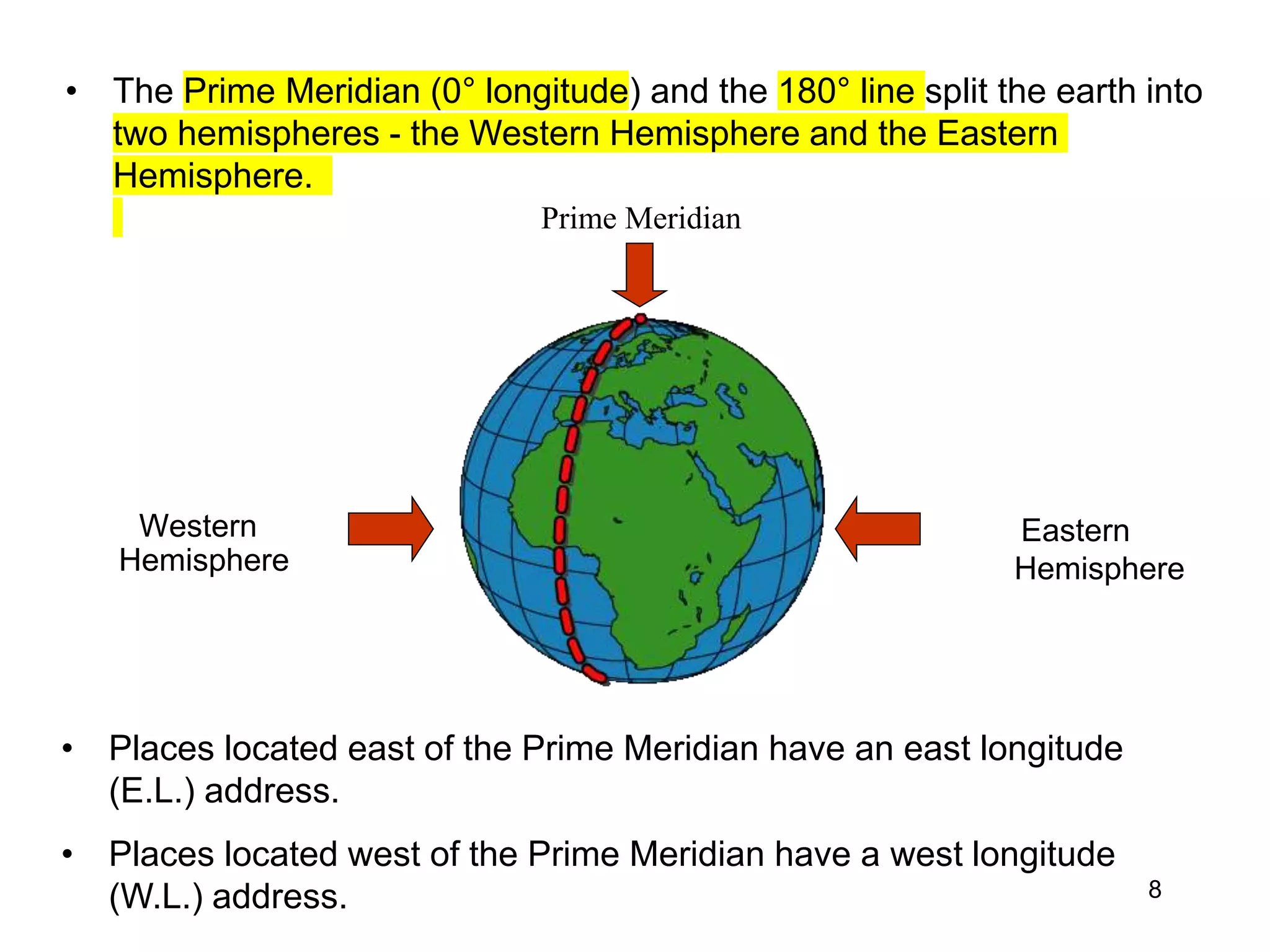
• The Prime Meridian (0° longitude) and the 180° line split the earth into
two hemispheres - the Western Hemisphere and the Eastern
Hemisphere.
• Places located east of the Prime Meridian have an east longitude
(E.L.) address.
• Places located west of the Prime Meridian have a west longitude
(W.L.) address. 8
Latitude and Longitude lines together in
a grid are called Coordinates
9
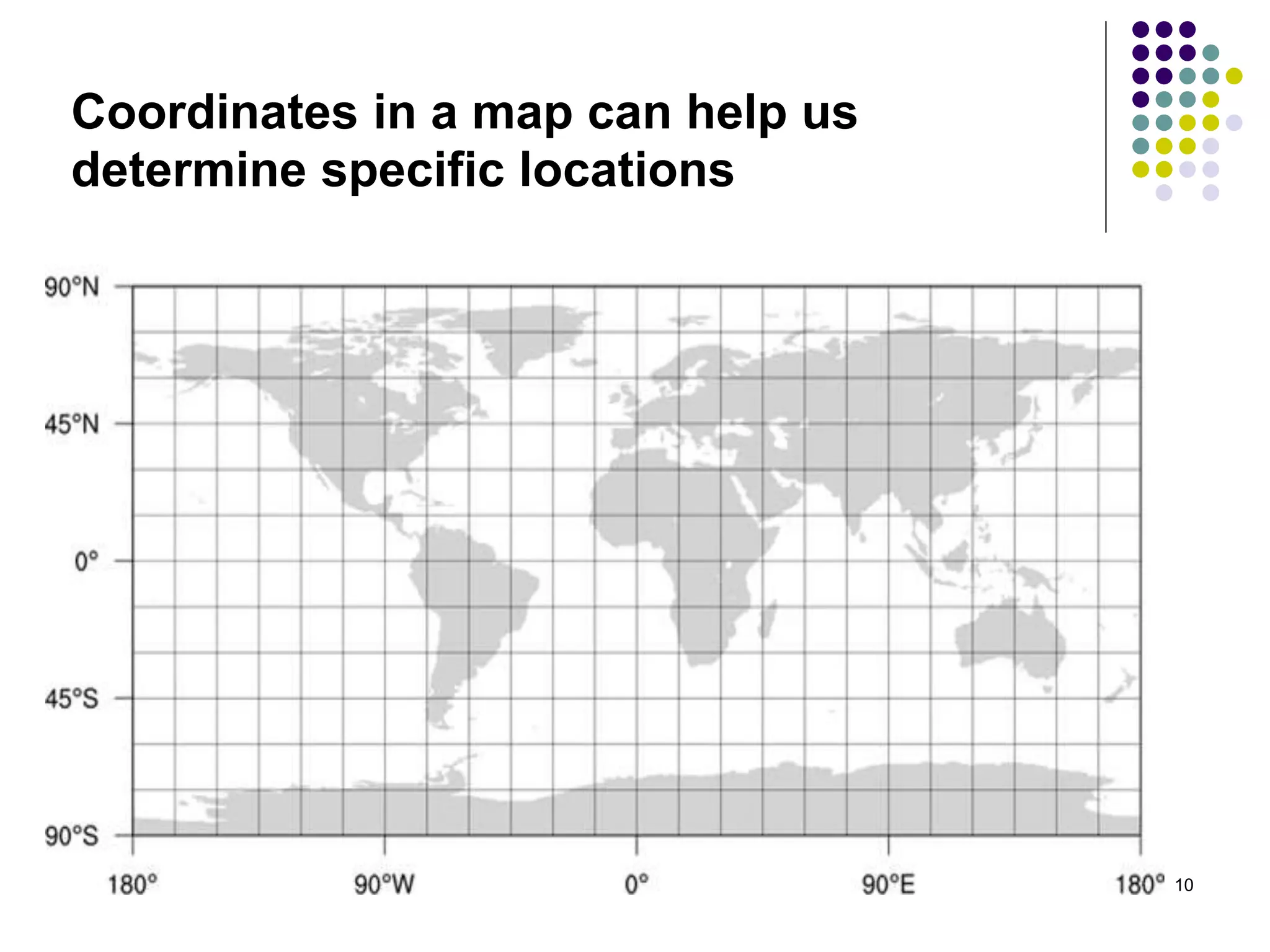
Coordinates in a map can help us
determine specific locations
10
The World
0° 20°60°E 100°140° 180°
20°
60°W
100°
140°
180°
80°
60°
40N°
20°
0°
20°
40S°
60°
80°
0° 20°60°E 100°140° 180°
20°
60°W
100°
140°
180°
80°
60°
40N°
20°
0°
20°
40S°
60°
80°
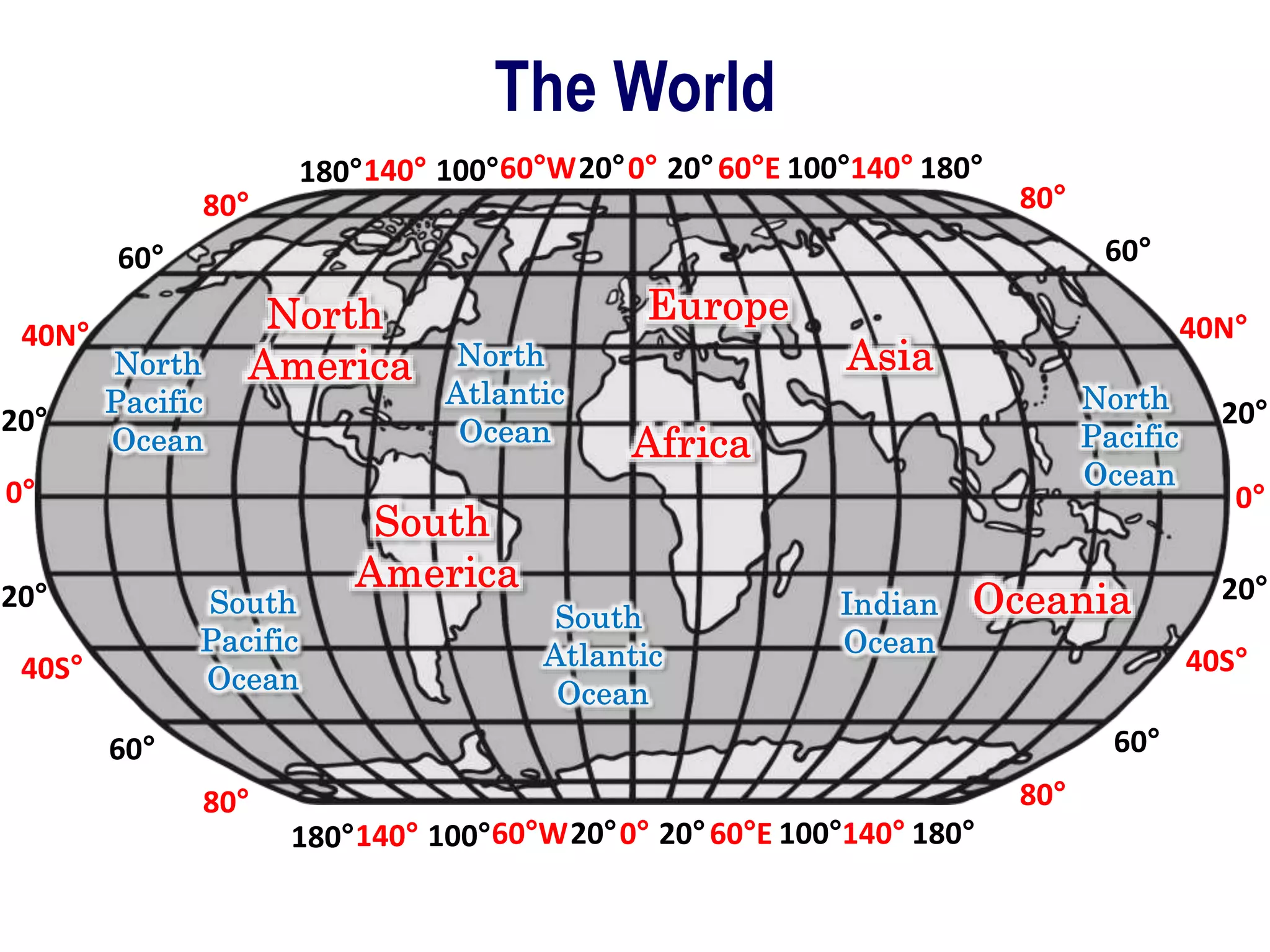
How do we use this information to locate a place?
• We use numbers and letters to create a co-ordinate.
• Within the co-ordinate, the ° stands for degrees and the ‘
stands for minutes.
• The letters relate to north, south, east or west and are
shown as capitals.
• The latitude is always given first.
• To locate Florida, USA using this principle we would say it
has the following
co-ordinates: 28°00'N 82°00'W.
Other cities:
• Edinburgh - 55° 57 ' N 03° 17' W
• Canberra - 35° 15' S 149° 8' E
• Yamoussoukro - 6° 49' N 5° 17' W
• Madrid - 40°25'N 03°45'W

location of places.pptx

  • 1.
  • 2.
    Locating Places • Howdo you find a city or other location on a world map or globe? • All places on Earth have a specific address. This address makes it easy to find a place. • The addresses of places on the Earth are given in latitude and longitude. 2
  • 3.
    • To helpus locate places on the earth’s surface, we use a coordinate system. This coordinate system is like placing a giant grid over the earth. This grid has lines extending from east to west called lines of latitude and lines extending from north to south called lines of longitude. • The coordinates of a location are like an address for that place. If you know the coordinates (like 34° North Latitude and 58° West Longitude), you can easily find any place on the earth’s surface. 3
  • 4.
    Latitude South Pole North Pole Equator •Lines of latitude (also known as parallels circle the Earth from east to west. • These invisible lines are all the same distance apart. One line to the next is known as 1 degree. • Each degree of latitude is separated into smaller divisions called minutes. • There are 60 minutes in 1 degree. • Each minute is divided into 60 seconds (not always included within the co-ordinate). • As you can see from the diagram, the Equator lies at 0 degrees. 90° 70° 60° 50° 40° 30° 20° 10° 0° 80° 10° 20° 30° 40° 50° 60° 70° 80° 90° 70° 60° 50° 40° 30° 20° 10° 0° 80° 10° 20° 30° 40° 50° 60° 70° 80°
  • 5.
    Imagine the Earth cutin half... The Northern Hemisphere is anywhere north of the Equator whilst the Southern Hemisphere is anywhere south of the Equator. Northern Hemisphere North Pole North America Equator Antarctic Circle Southern Hemisphere South Pole South America
  • 6.
    • The equator(0° latitude) splits the Earth into two hemispheres - the Northern Hemisphere and the Southern Hemisphere. N EQUATOR S • Places located north of the Equator have a North Latitude (N.L.) address. • Places located south of the Equator have a South Latitude (S.L.) address. Northern Hemisphere Southern Hemisphere 6
  • 7.
    Longitude South Pole North Pole Equator •These are the lines which run north and south and are known as lines of longitude or meridians of longitude. These lines are measured in the same way as the lines of latitude. • Lines of longitude are not equal distances (equidistant) from each other. • The Prime Meridian or Greenwich Meridian line is a line of longitude at 0 degrees. • It passes right through Greenwich in London. 105° 75° 60° 45° 30° 15° 0° 15° 30° 90°
  • 8.
    Western Hemisphere Eastern Hemisphere Prime Meridian • ThePrime Meridian (0° longitude) and the 180° line split the earth into two hemispheres - the Western Hemisphere and the Eastern Hemisphere. • Places located east of the Prime Meridian have an east longitude (E.L.) address. • Places located west of the Prime Meridian have a west longitude (W.L.) address. 8
  • 9.
    Latitude and Longitudelines together in a grid are called Coordinates 9
  • 10.
    Coordinates in amap can help us determine specific locations 10
  • 11.
    The World 0° 20°60°E100°140° 180° 20° 60°W 100° 140° 180° 80° 60° 40N° 20° 0° 20° 40S° 60° 80° 0° 20°60°E 100°140° 180° 20° 60°W 100° 140° 180° 80° 60° 40N° 20° 0° 20° 40S° 60° 80°
  • 12.
    How do weuse this information to locate a place? • We use numbers and letters to create a co-ordinate. • Within the co-ordinate, the ° stands for degrees and the ‘ stands for minutes. • The letters relate to north, south, east or west and are shown as capitals. • The latitude is always given first. • To locate Florida, USA using this principle we would say it has the following co-ordinates: 28°00'N 82°00'W. Other cities: • Edinburgh - 55° 57 ' N 03° 17' W • Canberra - 35° 15' S 149° 8' E • Yamoussoukro - 6° 49' N 5° 17' W • Madrid - 40°25'N 03°45'W