Council of Education’s
D. R. K. College of Commerce, Kolhapur.
Session Presented By,
Dr. Tahir S. Zari
Asst. Prof.
D.R.K.College of Commerce, Kolhapur
Marketing
Planning
Process
Planning is deciding in advance what to do,
how to do it, when to do it and who is to do it.
Planning is simply a rational approach to
accomplish an objective. It bridges the gap from
where we are and where we want to go.
A Marketing Plan is a comprehensive
document that outlines a company's overall
marketing effort. It is a blueprint that outlines how
a company will implement its marketing strategy,
and use a combination of resources to achieve
business objectives including sales targets or
customer acquisition.
Marketing Planning is the process
of developing marketing plan
incorporating overall marketing
objectives, strategies, and programs of
actions designed to achieve these
objectives.
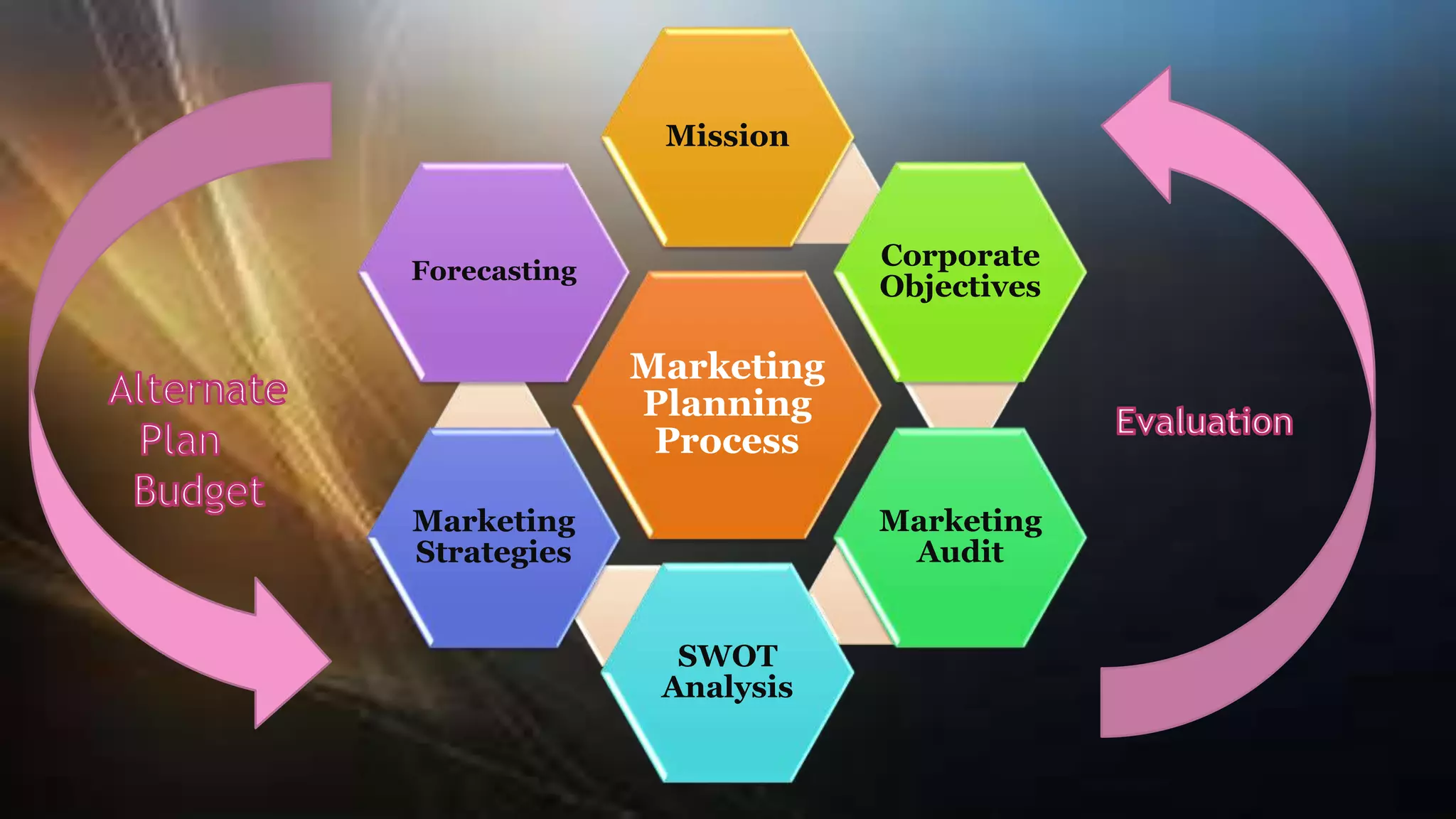
Marketing planning process is a
series of stages that are usually followed
in a sequence. Following are the steps
involved in Marketing Planning Process-
Marketing
Planning
Process
Mission
Corporate
Objectives
Marketing
Audit
SWOT
Analysis
Marketing
Strategies
Forecasting
1. Mission
It is the reason for which an
organization exists. Mission statement is a
straightforward statement that shows why
an organization is in business, provides
basic guidelines for further planning, and
establishes broad parameters for the future.
Organizations can adapt their
marketing plan to suit the mission,
circumstances and their requirements.
2.Corporate Objectives
Corporate objectives are most
important goals the organization as a
whole wish to achieve within a specified
period of time, say one or five years.
Marketing department must
appreciate the corporate objectives and
ensure its actions and decisions support
the overall objectives of the organization.
3.Marketing Audit
Marketing audit helps in analyzing
and evaluating the marketing strategies,
activities, problems, goals, and results. The
marketing audit clarifies opportunities and
threats, so that required alterations can be
done to the plan if necessary.
4. SWOT Analysis
It is a look at organization's
marketing efforts, and its strengths,
weaknesses, opportunities, and threats
related to marketing functions. Strengths
and Weaknesses are factors of organization
that can be controlled by the organization.
Opportunities and Threats are
factors outside the organization which are
beyond the direct control of an
organization.
5.Marketing Assumptions
A good marketing plan is based on
deep customer understanding and
knowledge, but it is not possible to know
everything about the customer, so lot of
different things are assumed about
customer.
Strategic planning is a stream of
decisions and actions which lead to effective
strategies and which in term help the firm to
achieve its objectives.
6.Marketing Objectives and Strategies
Marketing objective reflects what an
organization can accomplish through
marketing in the coming years. Objective
identify the end point to achieve. Marketing
strategies are formed to achieve the
marketing objectives.
7.Forecast the Expected Results
Marketing managers have to forecast the
response that the average customers will
have to marketing efforts. To accurately
forecast the market, marketing managers
have to gain an intimate understanding of
customers, their buying behavior, and
tendencies.
8.Create Alternative Plan
An alternate marketing plan is
created and kept ready to be implement at
the place of primary marketing plan if the
whole or some part of the primary
marketing plan is dropped.
Alternate marketing plan
incorporating overall marketing objectives,
strategies, and programs of actions designed
to achieve these objectives."
9.Marketing Budget
The marketing budget is the process of
documenting the expected costs of the
proposed marketing plan. Marketing budget
allows the organization for optimum use of
available financial resources.
10.Implementation and Evaluation
At this stage the marketing team is
ready to actually start putting their plans
into action. This may involve spending
money on advertising, launching new
products, interacting with potential new
customers, opening new retail outlets etc.
The marketing planning process is
required to be evaluated and updated
regular. Regular evaluation of marketing
efforts helps in achieving marketing goals.
Marketing Planning Process

Marketing Planning Process

  • 1.
    Council of Education’s D.R. K. College of Commerce, Kolhapur. Session Presented By, Dr. Tahir S. Zari Asst. Prof. D.R.K.College of Commerce, Kolhapur
  • 2.
  • 3.
    Planning is decidingin advance what to do, how to do it, when to do it and who is to do it. Planning is simply a rational approach to accomplish an objective. It bridges the gap from where we are and where we want to go. A Marketing Plan is a comprehensive document that outlines a company's overall marketing effort. It is a blueprint that outlines how a company will implement its marketing strategy, and use a combination of resources to achieve business objectives including sales targets or customer acquisition.
  • 4.
    Marketing Planning isthe process of developing marketing plan incorporating overall marketing objectives, strategies, and programs of actions designed to achieve these objectives. Marketing planning process is a series of stages that are usually followed in a sequence. Following are the steps involved in Marketing Planning Process-
  • 5.
  • 6.
    1. Mission It isthe reason for which an organization exists. Mission statement is a straightforward statement that shows why an organization is in business, provides basic guidelines for further planning, and establishes broad parameters for the future. Organizations can adapt their marketing plan to suit the mission, circumstances and their requirements.
  • 7.
    2.Corporate Objectives Corporate objectivesare most important goals the organization as a whole wish to achieve within a specified period of time, say one or five years. Marketing department must appreciate the corporate objectives and ensure its actions and decisions support the overall objectives of the organization.
  • 8.
    3.Marketing Audit Marketing audithelps in analyzing and evaluating the marketing strategies, activities, problems, goals, and results. The marketing audit clarifies opportunities and threats, so that required alterations can be done to the plan if necessary.
  • 9.
    4. SWOT Analysis Itis a look at organization's marketing efforts, and its strengths, weaknesses, opportunities, and threats related to marketing functions. Strengths and Weaknesses are factors of organization that can be controlled by the organization. Opportunities and Threats are factors outside the organization which are beyond the direct control of an organization.
  • 10.
    5.Marketing Assumptions A goodmarketing plan is based on deep customer understanding and knowledge, but it is not possible to know everything about the customer, so lot of different things are assumed about customer. Strategic planning is a stream of decisions and actions which lead to effective strategies and which in term help the firm to achieve its objectives.
  • 11.
    6.Marketing Objectives andStrategies Marketing objective reflects what an organization can accomplish through marketing in the coming years. Objective identify the end point to achieve. Marketing strategies are formed to achieve the marketing objectives.
  • 12.
    7.Forecast the ExpectedResults Marketing managers have to forecast the response that the average customers will have to marketing efforts. To accurately forecast the market, marketing managers have to gain an intimate understanding of customers, their buying behavior, and tendencies.
  • 13.
    8.Create Alternative Plan Analternate marketing plan is created and kept ready to be implement at the place of primary marketing plan if the whole or some part of the primary marketing plan is dropped. Alternate marketing plan incorporating overall marketing objectives, strategies, and programs of actions designed to achieve these objectives."
  • 14.
    9.Marketing Budget The marketingbudget is the process of documenting the expected costs of the proposed marketing plan. Marketing budget allows the organization for optimum use of available financial resources.
  • 15.
    10.Implementation and Evaluation Atthis stage the marketing team is ready to actually start putting their plans into action. This may involve spending money on advertising, launching new products, interacting with potential new customers, opening new retail outlets etc. The marketing planning process is required to be evaluated and updated regular. Regular evaluation of marketing efforts helps in achieving marketing goals.