THERMAL COMFORT AND HEAT FLOW
PRESENTED BY,
AGILANDEESWARI. R
SUSTAINABLE ARCHITECT
THERMAL COMFORT
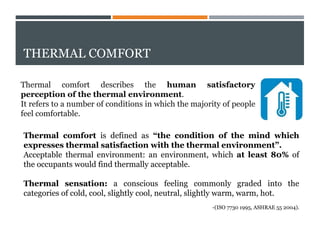
Thermal comfort describes the human satisfactory
perception of the thermal environment.
It refers to a number of conditions in which the majority of people
feel comfortable.
Thermal comfort is defined as “the condition of the mind which
expresses thermal satisfaction with the thermal environment”.
Acceptable thermal environment: an environment, which at least 80% of
the occupants would find thermally acceptable.
Thermal sensation: a conscious feeling commonly graded into the
categories of cold, cool, slightly cool, neutral, slightly warm, warm, hot.
-(ISO 7730 1995, ASHRAE 55 2004).
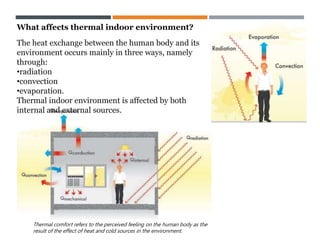
The heat exchange between the human body and its
environment occurs mainly in three ways, namely
through:
•radiation
•convection
•evaporation.
Thermal indoor environment is affected by both
internal and external sources.
What affects thermal indoor environment?
Thermal comfort refers to the perceived feeling on the human body as the
result of the effect of heat and cold sources in the environment.
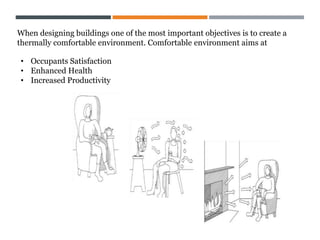
When designing buildings one of the most important objectives is to create a
thermally comfortable environment. Comfortable environment aims at
• Occupants Satisfaction
• Enhanced Health
• Increased Productivity
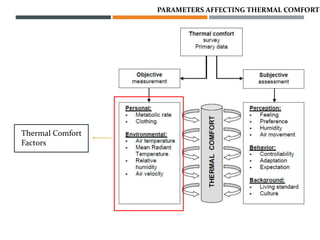
PARAMETERS AFFECTING THERMAL COMFORT
Thermal Comfort
Factors
The variables that affect heat dissipation from the body (thus also thermal
comfort) can be grouped into Following sets:
Environmental: air temperature, air movement, humidity, radiation
Personal: metabolic rate (activity), clothing.
Contributing factors: food and drink, acclimatization, body shape,
subcutaneous fat, age and gender, state of health
BODY HEAT BALANCE
• Heat is Continuously Produced in the body. Most biological process involved in
tissue building, energy conversion, and muscular work are exotherm.
• The energy needed is obtained from consumption and digestion of food and the
process by which the food is converted into energy is called metabolism.
Metabolism Heat Production
Basal Metabolism: Heat production of vegetative, automatic process.
Muscular Metabolism: Heat Production due to consciously controlled work.
Of all the energy produced in the body, only about 20% is utilised, the
remaining 80 % is surplus heat and must be dissipated to the environment
Metabolism measures in watts (watt; W) which is a unit for power or
energy flow.
When in movement, our metabolism naturally increases and
therefore more heat is emitted. Trained people in intense physical
• The metabolic rate is the amount of energy consumed minus the amount
of energy expended by the body.
• The basal metabolic rate (BMR) describes the amount of daily energy
expended by humans at rest, in a neutrally temperate environment, while in
the postabsorptive state. It measures how much energy the body needs for
normal, basic, daily activity.
• About 70 percent of all daily energy expenditure comes from the basic
functions of the organs in the body. Another 20 percent comes from physical
activity, and the remaining 10 percent is necessary for body
thermoregulation or temperature control.
BASAL METABOLIC RATE
Metabolism is a process in which energy is emitted. This energy is needed
for our bodies to even operate. Its by-product is an energy rush which
raises our body temperature. We usually measure metabolism in watts
(watt; W) which is a unit for power or energy flow. When stationary, we
produce about 100 W with our metabolism which is almost the same
amount of energy needed to power an average light bulb.
When in movement, our metabolism naturally increases and therefore
more heat is emitted. Trained people in intense physical activity can
produce energy flow equal to the one, needed to power fifteen light bulbs
(1.5 kW). If we were not able to get rid of the metabolically made heat, the
body temperature would grow rapidly and we would find ourselves in
serious trouble. Oppositely, if in winter with conduction, convection,
thermal radiation, or thermal evaporation into the environment we emit
more heat than we produce, our body begins to cool down. Instead of
standing still in the cold, we sooner or later start to shift weight from one
foot to another. Why? This increases muscle work, accelerates metabolism
and thus we release more heat which reduces the cooling, raises our body
THERMAL BALANCE OF HUMAN BODY
• Thermal comfort is a state of mind that express
satisfaction with the thermal environment.
• Thermal Comfort occurs when body
temperature are held within narrow ranges and
the physiological effort of regulation is
minimized.
• Judgement of comfort is a cognitive process
involving many inputs influenced by physical,
physiological, psychological, and the other
processes.
• The human sensation of warmth depends on
the thermal balance of the body as a whole.
• This balance is defined by amount of physical
activity (met), the value of thermal insulation
by clothing (clo), and by parameters of the
thermal comfort.
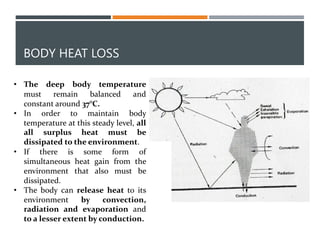
BODY HEAT LOSS
• The deep body temperature
must remain balanced and
constant around 37°C.
• In order to maintain body
temperature at this steady level, all
all surplus heat must be
dissipated to the environment.
• If there is some form of
simultaneous heat gain from the
environment that also must be
dissipated.
• The body can release heat to its
environment by convection,
radiation and evaporation and
to a lesser extent by conduction.
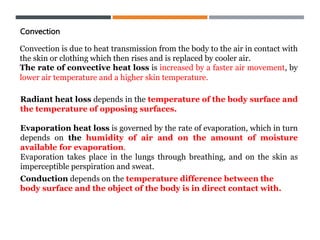
Convection
Convection is due to heat transmission from the body to the air in contact with
the skin or clothing which then rises and is replaced by cooler air.
The rate of convective heat loss is increased by a faster air movement, by
lower air temperature and a higher skin temperature.
Radiant heat loss depends in the temperature of the body surface and
the temperature of opposing surfaces.
Evaporation heat loss is governed by the rate of evaporation, which in turn
depends on the humidity of air and on the amount of moisture
available for evaporation.
Evaporation takes place in the lungs through breathing, and on the skin as
imperceptible perspiration and sweat.
Conduction depends on the temperature difference between the
body surface and the object of the body is in direct contact with.
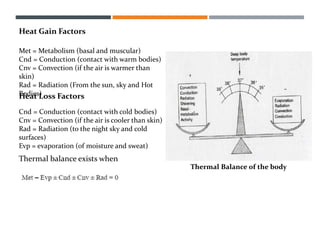
Heat Gain Factors
Met = Metabolism (basal and muscular)
Cnd = Conduction (contact with warm bodies)
Cnv = Convection (if the air is warmer than
skin)
Rad = Radiation (From the sun, sky and Hot
Bodies)
Thermal Balance of the body
Heat Loss Factors
Cnd = Conduction (contact with cold bodies)
Cnv = Convection (if the air is cooler than skin)
Rad = Radiation (to the night sky and cold
surfaces)
Evp = evaporation (of moisture and sweat)
Thermal balance exists when
PRINCIPLES OF HEAT TRANSFER
Heat is the transfer of energy between two systems. It is a form of energy
presented as molecular motion or as electromagnetic radiation in space. The
The unit of energy is Joules J (kg m2/s2).
Temperature is the indicator of the presence of heat in an object, and is
changed or affected by the adding or removing of heat from the object. Units
Units of Temperature are Kelvin (°K) and Degree Celsius (°C).
The Specific Heat Capacity is the amount of heat needed to raise the
temperature of 1kg of a mass by 1°C. It is the relationship between heat and
temperature.
Heat is divided into two forms
Sensible Heat = change of temperature
Latent Heat = Change of state (solid-liquid-gas)
Work is also a form of energy and is measured in Joules (J). It is important to
note that work can be converted entirely into heat but heat cannot be
converted entirely into work without any heat loss.
Power is the work done in unit time known as watt (W) or (Joules/second).
The laws of thermodynamics describe the transport of heat and work. Many
Many systems are controlled by these laws. The following are the first two laws of
laws of thermodynamics:
First law of Thermodynamics: Energy cannot be created or destroyed; it can
only be changed from one form to another.
Second law of Thermodynamics: Heat transfer will always occur between
two systems with a temperature difference. The heat transfer will always be
from the hotter system to the cooler system. Work can be used to transfer heat
heat from a cold body to a hot body.
TYPES OF HEAT TRANSFER
There are three types of heat transfer that are to be considered:
• Conduction
• Convection
• Radiation
Conductivity (k) is defined as the rate of heat flow through unit area of
unit thickness of the material when there is unit temperature difference
between the two sides.
The unit of measurement is W/m-k.
Conductivity varies between 0.03 W/m-k for insulating materials to 400
W/m-k for metals. The lower the conductivity of the material, the insulation
ability is better
Resistivity is the reciprocal of conductivity (1/k) measured in units of m-k/W.
AIT TO AIR TRANSMITTANCE (U-VALUE)
Resistance of a body is the product of its thickness and the resistivity of its
material
R = b x 1/k = b/k (m2k/W)
where ‘b’ is the thickness in meters.
Rb = Resistance of the body = R1 + R2 + R3 + ................ + Rb
The overall air-to-air resistance (Ra) is the sum of the body's resistance and
and the surface resistances.
Ra = 1/fi + Rb + 1/fo
where 1/fi = internal surface resistance
resistance Rb = Resistance of
of the body
1/fo = external surface resistance
Surface Conductance or Air-to Air Transmittance (U-Value):
The reciprocal of this air-to-air resistance is the air-to-air transmittance or
Uvalue
U = 1 / Ra. (W/m2k)
The rate of heat flow through material can be calculated from the following
equation:
Q = U x A x ΔT
Where Q is rate of heat flow (W)
U is the air-to-air transmittance in W/m2k
ΔT is temperature difference between indoor and outdoor
(K / 0C) A is the area of the opaque surface (m2)
When designing a building, the building fabric is considered first and
materials of a low U-Value are favoured in order to reduce the amount of
transfer into the building.
Sol-air temperature:
In the design of buildings, for surfaces exposed to solar radiation, to calculate
heat gain,
sol-air temperature concept needs to be used.
Ts= To + [(l x a) / fo]
Where Ts = Sol-air temperature in k
To = Outside temperature in k
2
CONDUCTION HEAT FLOW RATE IN
BUILDINGS
Convection:
The transfer of heat by bodily movement of a carrying medium (usually a gas
gas or a liquid). This movement may be due to thermal forces alone (Passive
(Passive means) or may be propelled by an applied force (mechanical means).
CONVECTION HEAT TRANSFER
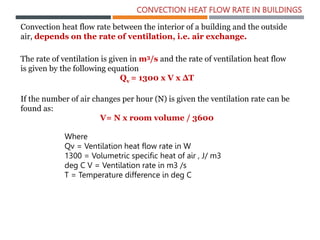
CONVECTION HEAT FLOW RATE IN BUILDINGS
Convection heat flow rate between the interior of a building and the outside
air, depends on the rate of ventilation, i.e. air exchange.
The rate of ventilation is given in m3/s and the rate of ventilation heat flow
is given by the following equation
Qv = 1300 x V x ΔT
If the number of air changes per hour (N) is given the ventilation rate can be
found as:
V= N x room volume / 3600
Where
Qv = Ventilation heat flow rate in W
1300 = Volumetric specific heat of air , J/ m3
deg C V = Ventilation rate in m3 /s
T = Temperature difference in deg C
UNIT - 3.pptx
UNIT - 3.pptx

UNIT - 3.pptx

  • 1.
    THERMAL COMFORT ANDHEAT FLOW PRESENTED BY, AGILANDEESWARI. R SUSTAINABLE ARCHITECT
  • 2.
    THERMAL COMFORT Thermal comfortdescribes the human satisfactory perception of the thermal environment. It refers to a number of conditions in which the majority of people feel comfortable. Thermal comfort is defined as “the condition of the mind which expresses thermal satisfaction with the thermal environment”. Acceptable thermal environment: an environment, which at least 80% of the occupants would find thermally acceptable. Thermal sensation: a conscious feeling commonly graded into the categories of cold, cool, slightly cool, neutral, slightly warm, warm, hot. -(ISO 7730 1995, ASHRAE 55 2004).
  • 3.
    The heat exchangebetween the human body and its environment occurs mainly in three ways, namely through: •radiation •convection •evaporation. Thermal indoor environment is affected by both internal and external sources. What affects thermal indoor environment? Thermal comfort refers to the perceived feeling on the human body as the result of the effect of heat and cold sources in the environment.
  • 4.
    When designing buildingsone of the most important objectives is to create a thermally comfortable environment. Comfortable environment aims at • Occupants Satisfaction • Enhanced Health • Increased Productivity
  • 5.
    PARAMETERS AFFECTING THERMALCOMFORT Thermal Comfort Factors
  • 6.
    The variables thataffect heat dissipation from the body (thus also thermal comfort) can be grouped into Following sets: Environmental: air temperature, air movement, humidity, radiation Personal: metabolic rate (activity), clothing. Contributing factors: food and drink, acclimatization, body shape, subcutaneous fat, age and gender, state of health
  • 7.
    BODY HEAT BALANCE •Heat is Continuously Produced in the body. Most biological process involved in tissue building, energy conversion, and muscular work are exotherm. • The energy needed is obtained from consumption and digestion of food and the process by which the food is converted into energy is called metabolism. Metabolism Heat Production Basal Metabolism: Heat production of vegetative, automatic process. Muscular Metabolism: Heat Production due to consciously controlled work. Of all the energy produced in the body, only about 20% is utilised, the remaining 80 % is surplus heat and must be dissipated to the environment Metabolism measures in watts (watt; W) which is a unit for power or energy flow. When in movement, our metabolism naturally increases and therefore more heat is emitted. Trained people in intense physical
  • 8.
    • The metabolicrate is the amount of energy consumed minus the amount of energy expended by the body. • The basal metabolic rate (BMR) describes the amount of daily energy expended by humans at rest, in a neutrally temperate environment, while in the postabsorptive state. It measures how much energy the body needs for normal, basic, daily activity. • About 70 percent of all daily energy expenditure comes from the basic functions of the organs in the body. Another 20 percent comes from physical activity, and the remaining 10 percent is necessary for body thermoregulation or temperature control. BASAL METABOLIC RATE
  • 9.
    Metabolism is aprocess in which energy is emitted. This energy is needed for our bodies to even operate. Its by-product is an energy rush which raises our body temperature. We usually measure metabolism in watts (watt; W) which is a unit for power or energy flow. When stationary, we produce about 100 W with our metabolism which is almost the same amount of energy needed to power an average light bulb. When in movement, our metabolism naturally increases and therefore more heat is emitted. Trained people in intense physical activity can produce energy flow equal to the one, needed to power fifteen light bulbs (1.5 kW). If we were not able to get rid of the metabolically made heat, the body temperature would grow rapidly and we would find ourselves in serious trouble. Oppositely, if in winter with conduction, convection, thermal radiation, or thermal evaporation into the environment we emit more heat than we produce, our body begins to cool down. Instead of standing still in the cold, we sooner or later start to shift weight from one foot to another. Why? This increases muscle work, accelerates metabolism and thus we release more heat which reduces the cooling, raises our body
  • 10.
    THERMAL BALANCE OFHUMAN BODY • Thermal comfort is a state of mind that express satisfaction with the thermal environment. • Thermal Comfort occurs when body temperature are held within narrow ranges and the physiological effort of regulation is minimized. • Judgement of comfort is a cognitive process involving many inputs influenced by physical, physiological, psychological, and the other processes. • The human sensation of warmth depends on the thermal balance of the body as a whole. • This balance is defined by amount of physical activity (met), the value of thermal insulation by clothing (clo), and by parameters of the thermal comfort.
  • 11.
    BODY HEAT LOSS •The deep body temperature must remain balanced and constant around 37°C. • In order to maintain body temperature at this steady level, all all surplus heat must be dissipated to the environment. • If there is some form of simultaneous heat gain from the environment that also must be dissipated. • The body can release heat to its environment by convection, radiation and evaporation and to a lesser extent by conduction.
  • 12.
    Convection Convection is dueto heat transmission from the body to the air in contact with the skin or clothing which then rises and is replaced by cooler air. The rate of convective heat loss is increased by a faster air movement, by lower air temperature and a higher skin temperature. Radiant heat loss depends in the temperature of the body surface and the temperature of opposing surfaces. Evaporation heat loss is governed by the rate of evaporation, which in turn depends on the humidity of air and on the amount of moisture available for evaporation. Evaporation takes place in the lungs through breathing, and on the skin as imperceptible perspiration and sweat. Conduction depends on the temperature difference between the body surface and the object of the body is in direct contact with.
  • 13.
    Heat Gain Factors Met= Metabolism (basal and muscular) Cnd = Conduction (contact with warm bodies) Cnv = Convection (if the air is warmer than skin) Rad = Radiation (From the sun, sky and Hot Bodies) Thermal Balance of the body Heat Loss Factors Cnd = Conduction (contact with cold bodies) Cnv = Convection (if the air is cooler than skin) Rad = Radiation (to the night sky and cold surfaces) Evp = evaporation (of moisture and sweat) Thermal balance exists when
  • 14.
    PRINCIPLES OF HEATTRANSFER Heat is the transfer of energy between two systems. It is a form of energy presented as molecular motion or as electromagnetic radiation in space. The The unit of energy is Joules J (kg m2/s2). Temperature is the indicator of the presence of heat in an object, and is changed or affected by the adding or removing of heat from the object. Units Units of Temperature are Kelvin (°K) and Degree Celsius (°C). The Specific Heat Capacity is the amount of heat needed to raise the temperature of 1kg of a mass by 1°C. It is the relationship between heat and temperature. Heat is divided into two forms Sensible Heat = change of temperature Latent Heat = Change of state (solid-liquid-gas)
  • 15.
    Work is alsoa form of energy and is measured in Joules (J). It is important to note that work can be converted entirely into heat but heat cannot be converted entirely into work without any heat loss. Power is the work done in unit time known as watt (W) or (Joules/second). The laws of thermodynamics describe the transport of heat and work. Many Many systems are controlled by these laws. The following are the first two laws of laws of thermodynamics: First law of Thermodynamics: Energy cannot be created or destroyed; it can only be changed from one form to another. Second law of Thermodynamics: Heat transfer will always occur between two systems with a temperature difference. The heat transfer will always be from the hotter system to the cooler system. Work can be used to transfer heat heat from a cold body to a hot body.
  • 16.
    TYPES OF HEATTRANSFER There are three types of heat transfer that are to be considered: • Conduction • Convection • Radiation Conductivity (k) is defined as the rate of heat flow through unit area of unit thickness of the material when there is unit temperature difference between the two sides. The unit of measurement is W/m-k. Conductivity varies between 0.03 W/m-k for insulating materials to 400 W/m-k for metals. The lower the conductivity of the material, the insulation ability is better Resistivity is the reciprocal of conductivity (1/k) measured in units of m-k/W.
  • 17.
    AIT TO AIRTRANSMITTANCE (U-VALUE) Resistance of a body is the product of its thickness and the resistivity of its material R = b x 1/k = b/k (m2k/W) where ‘b’ is the thickness in meters. Rb = Resistance of the body = R1 + R2 + R3 + ................ + Rb The overall air-to-air resistance (Ra) is the sum of the body's resistance and and the surface resistances. Ra = 1/fi + Rb + 1/fo where 1/fi = internal surface resistance resistance Rb = Resistance of of the body 1/fo = external surface resistance Surface Conductance or Air-to Air Transmittance (U-Value): The reciprocal of this air-to-air resistance is the air-to-air transmittance or Uvalue U = 1 / Ra. (W/m2k)
  • 18.
    The rate ofheat flow through material can be calculated from the following equation: Q = U x A x ΔT Where Q is rate of heat flow (W) U is the air-to-air transmittance in W/m2k ΔT is temperature difference between indoor and outdoor (K / 0C) A is the area of the opaque surface (m2) When designing a building, the building fabric is considered first and materials of a low U-Value are favoured in order to reduce the amount of transfer into the building. Sol-air temperature: In the design of buildings, for surfaces exposed to solar radiation, to calculate heat gain, sol-air temperature concept needs to be used. Ts= To + [(l x a) / fo] Where Ts = Sol-air temperature in k To = Outside temperature in k 2 CONDUCTION HEAT FLOW RATE IN BUILDINGS
  • 19.
    Convection: The transfer ofheat by bodily movement of a carrying medium (usually a gas gas or a liquid). This movement may be due to thermal forces alone (Passive (Passive means) or may be propelled by an applied force (mechanical means). CONVECTION HEAT TRANSFER
  • 20.
    CONVECTION HEAT FLOWRATE IN BUILDINGS Convection heat flow rate between the interior of a building and the outside air, depends on the rate of ventilation, i.e. air exchange. The rate of ventilation is given in m3/s and the rate of ventilation heat flow is given by the following equation Qv = 1300 x V x ΔT If the number of air changes per hour (N) is given the ventilation rate can be found as: V= N x room volume / 3600 Where Qv = Ventilation heat flow rate in W 1300 = Volumetric specific heat of air , J/ m3 deg C V = Ventilation rate in m3 /s T = Temperature difference in deg C