UNIT 3.
Pages 20-27 on Students´s book.
Pages 84-89 on workbook.
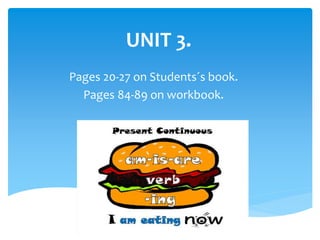
 We use this tense with normal verbs to express the idea
that something is happening NOW , at this very moment.
 It´s the present tense of the verb be and the present
participle (-ing) of a verb.
 We can also call it,
PRESENT IN USE.
What is the present continous?
Pronoun Affirmative Negative Question
I I am
studying.
I am not
studying.
Am I studying?
HE, SHE & IT He is
studying .
She is not
studying
Is she
studying?
YOU, WE &
THEY
You are
studying.
We are
studying.
Are they
studying?
How to form the present continous?
 AFFIRMATIVE SENTENCES.
Pronoun + the verb to be + Verb (+ -ing ending)
Ex.
I am going to a concert tonight.
She is playing guitar right now in her school.
How to form the present continous?
 NEGATIVE SENTENCES.
Pronoun + To be + NOT + verb (+ -ing ending)
Ex.
She is not coming to class today.
Oliver is not picking up his room this afternoon.
How to form the present continous?
 FOR QUESTIONS.
To be + pronoun + verb (+ -ing ending)
DON´T FORGET!
In English we use the ? For questions.
Ex.
Is she talking a lot?
Are you running tonight?
How to form the present continous?
 REMEMBER!!!
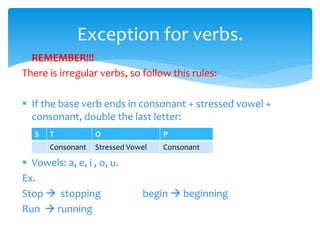
There is irregular verbs, so follow this rules:
 If the base verb ends in consonant + stressed vowel +
consonant, double the last letter:
 Vowels: a, e, i , o, u.
Ex.
Stop  stopping begin  beginning
Run  running
Exception for verbs.
S T O P
Consonant Stressed Vowel Consonant
 REMEMBER!!!
There is irregular verbs, so follow this rules:
 If the base verb ends in ie, change the ie to y :
Ex.
Lie  lying
Die- dying
Exception for verbs.
 REMEMBER!!!
There is irregular verbs, so follow this rules:
 If the verb ends in vowel + consonant + e, omit the e:
 Ex.
Come  coming shake- shaking
mistake-  mistaking hide hiding
lose  losing dance- dancing
ride  riding
Exception for verbs.
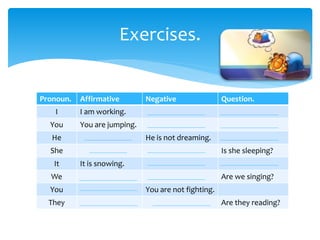
Pronoun. Affirmative Negative Question.
I I am working.
You You are jumping.
He He is not dreaming.
She Is she sleeping?
It It is snowing.
We Are we singing?
You You are not fighting.
They Are they reading?
Exercises.
 Do you remember how to use the present
simple?
Let´s look back at UNIT 2.
Simple present vs present continous.
 It´s only using the normal verb.
 Ex. He swims every morning.
I sing to my mom on her birthday.
 It´s used to express an action that is repeated,
a fact or short actios like: a hobby, a habit, a
daily event or a scheduled event.
Remeber the simple presnt!
 1st and 2nd person on singular form + infinitive verb.
 The same formula goes for the plural forms.
 Ex. We run to school on Mondays.
Karla plays soccer every Saturday.
Remember how to make it!
 When using 3rd person singular. (HE, SHE & IT) we add an S at
the end of the verb.
 3rd person singular + infinitive verb+ S (at the end os the verb)
 Ex. Carol likes chocolates.
He eats burgers almost every weekend.
Remember how to make it!
 Now that you remembered, answer the following exercises:
Look! He (leave) is leaving the house.
Quiet please! I (write) a test.
She usually (walk) to school.
But look! Today she by bike.
He often (go) to the cinema.
We (play) Monopoly at the moment.
I (not/do) anything at the moment.
(watch/he) the news regularly?
Exercises.
Work book pages 84-86
Home work!!
 Look at the picture on the right and complete the
sentences (Simple Present or Present Progressive).
 1. This (be) Patrick Star.
 2. He (wear) underpants today.
 3. He (eat) a hamburger at the moment.
 4. Patrick (like) junk food.
 5. He (play) with his best friend everyday.
 6. Patrick (love) his best friend Sponge Bob.
Quiz!!!

Unit 3.1

  • 1.
    UNIT 3. Pages 20-27on Students´s book. Pages 84-89 on workbook.
  • 2.
     We usethis tense with normal verbs to express the idea that something is happening NOW , at this very moment.  It´s the present tense of the verb be and the present participle (-ing) of a verb.  We can also call it, PRESENT IN USE. What is the present continous?
  • 3.
    Pronoun Affirmative NegativeQuestion I I am studying. I am not studying. Am I studying? HE, SHE & IT He is studying . She is not studying Is she studying? YOU, WE & THEY You are studying. We are studying. Are they studying? How to form the present continous?
  • 4.
     AFFIRMATIVE SENTENCES. Pronoun+ the verb to be + Verb (+ -ing ending) Ex. I am going to a concert tonight. She is playing guitar right now in her school. How to form the present continous?
  • 5.
     NEGATIVE SENTENCES. Pronoun+ To be + NOT + verb (+ -ing ending) Ex. She is not coming to class today. Oliver is not picking up his room this afternoon. How to form the present continous?
  • 6.
     FOR QUESTIONS. Tobe + pronoun + verb (+ -ing ending) DON´T FORGET! In English we use the ? For questions. Ex. Is she talking a lot? Are you running tonight? How to form the present continous?
  • 7.
     REMEMBER!!! There isirregular verbs, so follow this rules:  If the base verb ends in consonant + stressed vowel + consonant, double the last letter:  Vowels: a, e, i , o, u. Ex. Stop  stopping begin  beginning Run  running Exception for verbs. S T O P Consonant Stressed Vowel Consonant
  • 8.
     REMEMBER!!! There isirregular verbs, so follow this rules:  If the base verb ends in ie, change the ie to y : Ex. Lie  lying Die- dying Exception for verbs.
  • 9.
     REMEMBER!!! There isirregular verbs, so follow this rules:  If the verb ends in vowel + consonant + e, omit the e:  Ex. Come  coming shake- shaking mistake-  mistaking hide hiding lose  losing dance- dancing ride  riding Exception for verbs.
  • 10.
    Pronoun. Affirmative NegativeQuestion. I I am working. You You are jumping. He He is not dreaming. She Is she sleeping? It It is snowing. We Are we singing? You You are not fighting. They Are they reading? Exercises.
  • 11.
     Do youremember how to use the present simple? Let´s look back at UNIT 2. Simple present vs present continous.
  • 12.
     It´s onlyusing the normal verb.  Ex. He swims every morning. I sing to my mom on her birthday.  It´s used to express an action that is repeated, a fact or short actios like: a hobby, a habit, a daily event or a scheduled event. Remeber the simple presnt!
  • 13.
     1st and2nd person on singular form + infinitive verb.  The same formula goes for the plural forms.  Ex. We run to school on Mondays. Karla plays soccer every Saturday. Remember how to make it!
  • 14.
     When using3rd person singular. (HE, SHE & IT) we add an S at the end of the verb.  3rd person singular + infinitive verb+ S (at the end os the verb)  Ex. Carol likes chocolates. He eats burgers almost every weekend. Remember how to make it!
  • 15.
     Now thatyou remembered, answer the following exercises: Look! He (leave) is leaving the house. Quiet please! I (write) a test. She usually (walk) to school. But look! Today she by bike. He often (go) to the cinema. We (play) Monopoly at the moment. I (not/do) anything at the moment. (watch/he) the news regularly? Exercises.
  • 16.
    Work book pages84-86 Home work!!
  • 17.
     Look atthe picture on the right and complete the sentences (Simple Present or Present Progressive).  1. This (be) Patrick Star.  2. He (wear) underpants today.  3. He (eat) a hamburger at the moment.  4. Patrick (like) junk food.  5. He (play) with his best friend everyday.  6. Patrick (love) his best friend Sponge Bob. Quiz!!!