THE PRESENT
CONTINUOUS AND THE
SIMPLE FUTURE TENSE
República Bolivariana de Venezuela
Ministerio del Poder Popular Para la Educación Superior Ciencia y Tecnología
Instituto Universitario Politécnico Santiago Mariño Ampliación Maracaibo
Name: Ana Isabel Martínez 25.186.271 (49)
PRESENT CONTINUOUS
The present continuous is made from the present tense of the
verb be and the –ing form of a verb:
 I am working -You are working -He is working
 She is working -It is working -We are working
 You are working -They are working
We use the present continuous to talk about:
Activities at the moment of speaking:
I’m just leaving work. I’ll be home in an hour.
SIMPLE PRESENT
The simple present is a verb tense with two main uses. We use the
simple present tense when an action is happening right now, or when
it happens regularly (or unceasingly, which is why it’s sometimes called
present indefinite). Depending on the person, the simple present
tense is formed by using the root form or by adding -s or -es to the
end.
-Examples:
I feel great!
Paul loves pie.
I’m sorry to hear that you’re sick.
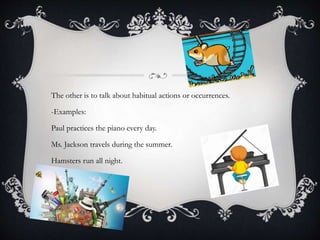
The other is to talk about habitual actions or occurrences.
-Examples:
Paul practices the piano every day.
Ms. Jackson travels during the summer.
Hamsters run all night.
-Typically, when we want to describe a temporary action that is
currently in progress, we use the present continuous.
Example:
Paul can’t come to the phone right now because she is brushing her
teeth.
-How to Form the Simple Present
In the simple present, most regular verbs use the root form, except in the third-person
singular (which ends in -s).
First-person singular: I write
Second-person singular: You write
Third-person singular: He/she/it writes (note the -s)
First-person plural: We write
Second-person plural: You write
Third-person plural: They write
-For a few verbs, the third-person singular ends with -es instead of -s. Typically,
these are verbs whose root form ends in o, ch, sh, th, ss, gh, or z.
First-person singular: I go
Second-person singular: You go
Third-person singular: He/she/it goes (note the -es)
First-person plural: We go
Second-person plural: You go
Third-person plural: They go
-For most regular verbs, you put the negation of the verb before the verb, e.g. “She won’t
go” or “I don’t smell anything.”
The verb to be is irregular:
First-person singular: I am
Second-person singular: You are
Third-person singular: He/she/it is
First-person plural: We are
Second-person plural: You are
Third-person plural: They are
-How to Make the Simple Present Negative
The formula for making a simple present verb negative is do/does + not + [root
form of verb]. You can also use the contraction don’t or doesn’t instead of do
not or does not.
Paul does not want to share the pie. She doesn’t think there is enough to go around.
Her friends do not agree. I don’t want pie anyway.
To make the verb to be negative, the formula is [to be] + not.
I am not a pie lover, but Paul sure is. You aren’t ready for such delicious pie.
-How to Ask a Question
The formula for asking a question in the simple present is do/does +
[subject] + [root form of verb].
Example:
Do you know how to bake a pie? How much does Paul love pie?
Ana Isabel

Ana Isabel

  • 1.
    THE PRESENT CONTINUOUS ANDTHE SIMPLE FUTURE TENSE República Bolivariana de Venezuela Ministerio del Poder Popular Para la Educación Superior Ciencia y Tecnología Instituto Universitario Politécnico Santiago Mariño Ampliación Maracaibo Name: Ana Isabel Martínez 25.186.271 (49)
  • 2.
    PRESENT CONTINUOUS The presentcontinuous is made from the present tense of the verb be and the –ing form of a verb:  I am working -You are working -He is working  She is working -It is working -We are working  You are working -They are working
  • 3.
    We use thepresent continuous to talk about: Activities at the moment of speaking: I’m just leaving work. I’ll be home in an hour.
  • 4.
    SIMPLE PRESENT The simplepresent is a verb tense with two main uses. We use the simple present tense when an action is happening right now, or when it happens regularly (or unceasingly, which is why it’s sometimes called present indefinite). Depending on the person, the simple present tense is formed by using the root form or by adding -s or -es to the end.
  • 5.
    -Examples: I feel great! Paulloves pie. I’m sorry to hear that you’re sick.
  • 6.
    The other isto talk about habitual actions or occurrences. -Examples: Paul practices the piano every day. Ms. Jackson travels during the summer. Hamsters run all night.
  • 7.
    -Typically, when wewant to describe a temporary action that is currently in progress, we use the present continuous. Example: Paul can’t come to the phone right now because she is brushing her teeth.
  • 8.
    -How to Formthe Simple Present In the simple present, most regular verbs use the root form, except in the third-person singular (which ends in -s). First-person singular: I write Second-person singular: You write Third-person singular: He/she/it writes (note the -s) First-person plural: We write Second-person plural: You write Third-person plural: They write
  • 9.
    -For a fewverbs, the third-person singular ends with -es instead of -s. Typically, these are verbs whose root form ends in o, ch, sh, th, ss, gh, or z. First-person singular: I go Second-person singular: You go Third-person singular: He/she/it goes (note the -es) First-person plural: We go Second-person plural: You go Third-person plural: They go
  • 10.
    -For most regularverbs, you put the negation of the verb before the verb, e.g. “She won’t go” or “I don’t smell anything.” The verb to be is irregular: First-person singular: I am Second-person singular: You are Third-person singular: He/she/it is First-person plural: We are Second-person plural: You are Third-person plural: They are
  • 11.
    -How to Makethe Simple Present Negative The formula for making a simple present verb negative is do/does + not + [root form of verb]. You can also use the contraction don’t or doesn’t instead of do not or does not. Paul does not want to share the pie. She doesn’t think there is enough to go around. Her friends do not agree. I don’t want pie anyway. To make the verb to be negative, the formula is [to be] + not. I am not a pie lover, but Paul sure is. You aren’t ready for such delicious pie.
  • 12.
    -How to Aska Question The formula for asking a question in the simple present is do/does + [subject] + [root form of verb]. Example: Do you know how to bake a pie? How much does Paul love pie?