PHYSICAL EDUCATION DEPARTMENT
I.E.S. PEÑALBA
CONTENTS REVIEW PHYSICAL CAPACITIES
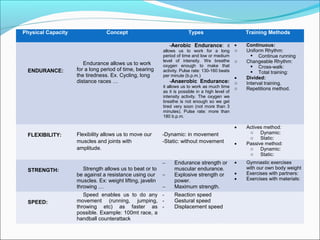
Physical Capacity Concept Types Training Methods
ENDURANCE:
Endurance allows us to work
for a long period of time, bearing
the tiredness. Ex. Cycling, long
distance races …
-Aerobic Endurance: it
allows us to work for a long
period of time and low or medium
level of intensity. We breathe
oxygen enough to make that
activity. Pulse rate: 130-160 beats
per minute (b.p.m.)
-Anaerobic Endurance:
it allows us to work as much time
as it is possible in a high level of
intensity activity. The oxygen we
breathe is not enough so we get
tired very soon (not more than 3
minutes). Pulse rate: more than
180 b.p.m.
• Continuous:
o Uniform Rhythm:
 Continue running
o Changeable Rhythm:
 Cross-walk:
 Total training:
• Divided:
o Interval training.
o Repetitions method.
FLEXIBILITY: Flexibility allows us to move our
muscles and joints with
amplitude.
-Dynamic: in movement
-Static: without movement
• Actives method:
o Dynamic:
o Static:
• Passive method:
o Dynamic:
o Static:
STRENGTH: Strength allows us to beat or to
be against a resistance using our
muscles. Ex: weight lifting, javelin
throwing …
− Endurance strength or
muscular endurance.
− Explosive strength or
power.
− Maximum strength.
• Gymnastic exercises
with our own body weight
• Exercises with partners:
• Exercises with materials:
SPEED:
Speed enables us to do any
movement (running, jumping,
throwing etc) as faster as
possible. Example: 100mt race, a
handball counterattack
- Reaction speed
- Gestural speed
- Displacement speed
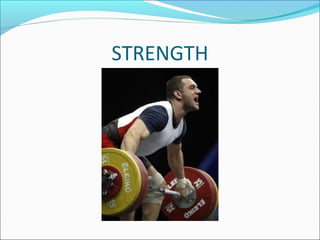
STRENGTH
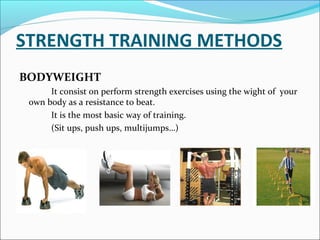
STRENGTH TRAINING METHODS
BODYWEIGHT
It consist on perform strength exercises using the wight of your
own body as a resistance to beat.
It is the most basic way of training.
(Sit ups, push ups, multijumps…)
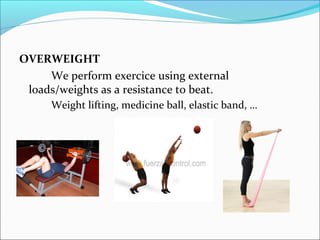
OVERWEIGHT
We perform exercice using external
loads/weights as a resistance to beat.
Weight lifting, medicine ball, elastic band, …
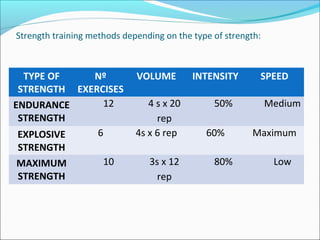
Strength training methods depending on the type of strength:
TYPE OF
STRENGTH
Nº
EXERCISES
VOLUME INTENSITY SPEED
ENDURANCE
STRENGTH
12 4 s x 20
rep
50% Medium
EXPLOSIVE
STRENGTH
6 4s x 6 rep 60% Maximum
MAXIMUM
STRENGTH
10 3s x 12
rep
80% Low
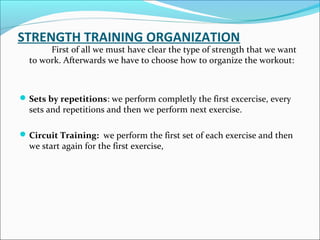
STRENGTH TRAINING ORGANIZATION
First of all we must have clear the type of strength that we want
to work. Afterwards we have to choose how to organize the workout:
Sets by repetitions: we perform completly the first excercise, every
sets and repetitions and then we perform next exercise.
Circuit Training: we perform the first set of each exercise and then
we start again for the first exercise,
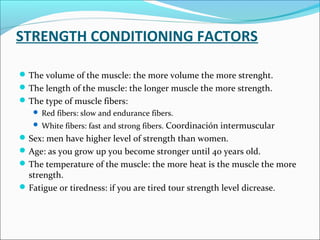
STRENGTH CONDITIONING FACTORS
The volume of the muscle: the more volume the more strenght.
The length of the muscle: the longer muscle the more strength.
The type of muscle fibers:
 Red fibers: slow and endurance fibers.
 White fibers: fast and strong fibers. Coordinación intermuscular
Sex: men have higher level of strength than women.
Age: as you grow up you become stronger until 40 years old.
The temperature of the muscle: the more heat is the muscle the more
strength.
Fatigue or tiredness: if you are tired tour strength level dicrease.
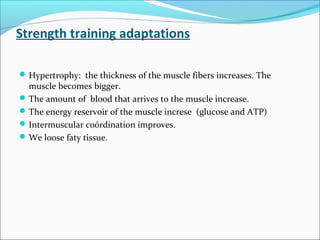
Strength training adaptations
Hypertrophy: the thickness of the muscle fibers increases. The
muscle becomes bigger.
The amount of blood that arrives to the muscle increase.
The energy reservoir of the muscle increse (glucose and ATP)
Intermuscular coórdination improves.
We loose faty tissue.
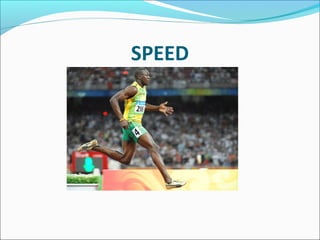
SPEED
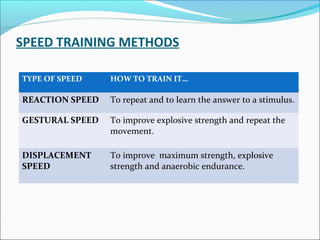
SPEED TRAINING METHODS
TYPE OF SPEED HOW TO TRAIN IT…
REACTION SPEED To repeat and to learn the answer to a stimulus.
GESTURAL SPEED To improve explosive strength and repeat the
movement.
DISPLACEMENT
SPEED
To improve maximum strength, explosive
strength and anaerobic endurance.
Conditioning factors
The speed of the ttansmission of the nervous impulse.
The type of muscle fiber.
Red fibers are slow contraction fibers.
White fibers are fast contaction fibers. La fuerza de los
músculos.
The technique level.
Speed training adaptations:
The co-ordination of movements improve.
Strength and power improve.
The technique of movements improve.
The effectiveness of the movements improve so i will
be a better athlete.
Unit 2 physical fitness

Unit 2 physical fitness

  • 1.
  • 2.
    CONTENTS REVIEW PHYSICALCAPACITIES Physical Capacity Concept Types Training Methods ENDURANCE: Endurance allows us to work for a long period of time, bearing the tiredness. Ex. Cycling, long distance races … -Aerobic Endurance: it allows us to work for a long period of time and low or medium level of intensity. We breathe oxygen enough to make that activity. Pulse rate: 130-160 beats per minute (b.p.m.) -Anaerobic Endurance: it allows us to work as much time as it is possible in a high level of intensity activity. The oxygen we breathe is not enough so we get tired very soon (not more than 3 minutes). Pulse rate: more than 180 b.p.m. • Continuous: o Uniform Rhythm:  Continue running o Changeable Rhythm:  Cross-walk:  Total training: • Divided: o Interval training. o Repetitions method. FLEXIBILITY: Flexibility allows us to move our muscles and joints with amplitude. -Dynamic: in movement -Static: without movement • Actives method: o Dynamic: o Static: • Passive method: o Dynamic: o Static: STRENGTH: Strength allows us to beat or to be against a resistance using our muscles. Ex: weight lifting, javelin throwing … − Endurance strength or muscular endurance. − Explosive strength or power. − Maximum strength. • Gymnastic exercises with our own body weight • Exercises with partners: • Exercises with materials: SPEED: Speed enables us to do any movement (running, jumping, throwing etc) as faster as possible. Example: 100mt race, a handball counterattack - Reaction speed - Gestural speed - Displacement speed
  • 3.
  • 4.
    STRENGTH TRAINING METHODS BODYWEIGHT Itconsist on perform strength exercises using the wight of your own body as a resistance to beat. It is the most basic way of training. (Sit ups, push ups, multijumps…)
  • 5.
    OVERWEIGHT We perform exerciceusing external loads/weights as a resistance to beat. Weight lifting, medicine ball, elastic band, …
  • 6.
    Strength training methodsdepending on the type of strength: TYPE OF STRENGTH Nº EXERCISES VOLUME INTENSITY SPEED ENDURANCE STRENGTH 12 4 s x 20 rep 50% Medium EXPLOSIVE STRENGTH 6 4s x 6 rep 60% Maximum MAXIMUM STRENGTH 10 3s x 12 rep 80% Low
  • 7.
    STRENGTH TRAINING ORGANIZATION Firstof all we must have clear the type of strength that we want to work. Afterwards we have to choose how to organize the workout: Sets by repetitions: we perform completly the first excercise, every sets and repetitions and then we perform next exercise. Circuit Training: we perform the first set of each exercise and then we start again for the first exercise,
  • 8.
    STRENGTH CONDITIONING FACTORS Thevolume of the muscle: the more volume the more strenght. The length of the muscle: the longer muscle the more strength. The type of muscle fibers:  Red fibers: slow and endurance fibers.  White fibers: fast and strong fibers. Coordinación intermuscular Sex: men have higher level of strength than women. Age: as you grow up you become stronger until 40 years old. The temperature of the muscle: the more heat is the muscle the more strength. Fatigue or tiredness: if you are tired tour strength level dicrease.
  • 9.
    Strength training adaptations Hypertrophy:the thickness of the muscle fibers increases. The muscle becomes bigger. The amount of blood that arrives to the muscle increase. The energy reservoir of the muscle increse (glucose and ATP) Intermuscular coórdination improves. We loose faty tissue.
  • 10.
  • 11.
    SPEED TRAINING METHODS TYPEOF SPEED HOW TO TRAIN IT… REACTION SPEED To repeat and to learn the answer to a stimulus. GESTURAL SPEED To improve explosive strength and repeat the movement. DISPLACEMENT SPEED To improve maximum strength, explosive strength and anaerobic endurance.
  • 12.
    Conditioning factors The speedof the ttansmission of the nervous impulse. The type of muscle fiber. Red fibers are slow contraction fibers. White fibers are fast contaction fibers. La fuerza de los músculos. The technique level.
  • 13.
    Speed training adaptations: Theco-ordination of movements improve. Strength and power improve. The technique of movements improve. The effectiveness of the movements improve so i will be a better athlete.