Inventory
Management
Fundamentals
Inventory
Management
Inventory refers to the goods and
materials that a business holds for
the purpose of resale or use in
production. It includes raw materials,
work-in-progress (unfinished goods),
and finished products ready for sale.
Inventory plays a crucial role in
business operations for several
reasons:
Inventory
Management
1. Meeting Customer Demand: Maintaining
appropriate inventory levels ensures that
businesses can fulfill customer orders promptly.
This availability enhances customer satisfaction
and helps retain clients.
2. Smooth Production and Operations: For
manufacturing companies, having sufficient raw
materials and components on hand ensures
uninterrupted production. This helps in meeting
production schedules and avoiding delays.
3. Buffer Against Uncertainty: Inventory serves as a
buffer against fluctuations in demand or supply
chain disruptions. It allows businesses to manage
unexpected increases in demand or delays in
receiving raw materials.
4. Economies of Scale: Holding inventory allows
businesses to take advantage of economies of
scale by ordering materials and products in larger
quantities. This can lead to lower per-unit costs
and increased profitability.
Inventory
Management
5. Supports Sales and Marketing Strategies:
Businesses can leverage inventory to support
sales and marketing strategies, such as offering
promotions or discounts on excess inventory to
increase sales.
6. Asset for Financial Purposes: Inventory is
considered an asset on the balance sheet, which
can be used as collateral for securing loans or
financing for business expansion.
7. Strategic Planning and Decision Making: Accurate
inventory data helps businesses make informed
decisions about production, purchasing, pricing,
and resource allocation. It supports strategic
planning by providing insights into market trends
and consumer behavior.
8. Optimizing Inventory Management: Effective
inventory management practices, such as just-in-
time (JIT) inventory systems or inventory turnover
ratios, help businesses minimize holding costs
while maximizing operational efficiency.
Inventory
Management
In summary, inventory is essential for businesses as it
ensures operational continuity, supports sales and
production activities, enhances financial stability, and
enables strategic decision-making. Effective
management of inventory levels is crucial for balancing
supply and demand dynamics and maintaining
competitive advantage in the marketplace.
Inventory
Management
Effective inventory management is crucial for businesses across
various aspects of their operations. Here are several key reasons why:
1. Cost Reduction: Efficient inventory management helps minimize
holding costs associated with storing excess inventory, such as
storage space, insurance, and obsolescence. By optimizing
inventory levels through methods like just-in-time (JIT) inventory
systems or economic order quantity (EOQ), businesses can
reduce carrying costs and improve overall profitability.
2. Meeting Customer Demand: Maintaining the right amount of
inventory ensures that businesses can fulfill customer orders
promptly. Stockouts (when demand exceeds supply) can lead to
lost sales and dissatisfied customers, while excess inventory ties
up capital unnecessarily. Effective inventory management helps
strike a balance where customer demand can be consistently met
without overstocking.
3. Optimizing Production Efficiency: For manufacturing companies,
having the right amount of raw materials and components on hand
is crucial for uninterrupted production. This prevents delays and
ensures that production schedules are met efficiently, which in
turn supports overall operational efficiency and reduces production
costs.
4. Improved Cash Flow: Inventory ties up capital that could be used
elsewhere in the business. Effective inventory management
practices help minimize the amount of capital tied up in inventory,
thus improving cash flow. This freed-up capital can be reinvested
in other areas of the business or used for strategic initiatives.
Inventory
Management
Effective inventory management is crucial for businesses across
various aspects of their operations. Here are several key reasons
why:
5. Strategic Decision Making: Accurate inventory data and
insights provided by effective inventory management systems
enable businesses to make informed decisions. This includes
decisions related to purchasing, production planning, pricing
strategies, and resource allocation. Such strategic decisions
are essential for maintaining competitiveness and adapting to
changes in the market environment.
6. Reduced Risk of Obsolescence: Poor inventory management
can lead to obsolete or expired inventory, which results in
financial losses for the business. By monitoring inventory levels
and implementing inventory turnover strategies, businesses
can reduce the risk of holding obsolete stock and minimize
write-offs.
7. Enhanced Customer Satisfaction: Consistently meeting
customer demand through effective inventory management
contributes to improved customer satisfaction. Customers
receive their orders on time and in full, leading to positive
experiences and potentially repeat business.
8. Compliance and Risk Management: In industries with
regulatory requirements or volatile supply chains, effective
inventory management helps businesses comply with
regulations and manage risks associated with supply
disruptions, quality issues, or changes in market conditions.
Inventory
Management
In conclusion, effective inventory
management is crucial because it directly
impacts cost reduction, customer
satisfaction, production efficiency, cash
flow, strategic decision-making, and risk
management. Businesses that prioritize
and optimize their inventory management
practices are better positioned to achieve
operational excellence and maintain a
competitive edge in their respective
markets.
Types of
Inventory
Raw materials, work-in-progress (WIP), and
finished goods are three primary categories of
inventory that businesses typically manage.
Here’s a brief explanation of each:
1. Raw Materials:
• Definition: Raw materials are the basic
materials and components used in the
production process to manufacture finished
goods.
• Examples: For a furniture manufacturer,
raw materials could include wood, screws,
nails, upholstery fabric, and other materials
used in the construction of furniture.
• Importance: Raw materials are essential for
production. Ensuring an adequate supply of
raw materials is crucial to maintain
uninterrupted production schedules and
meet customer demand.
Types of
Inventory
• Examples: Wood, metal, fabric, chemicals,
etc.
• Management Challenges:
1. Procurement and Sourcing: Challenges
may include finding reliable suppliers,
managing supplier relationships, and
ensuring a stable supply of high-quality
materials.
2. Inventory Optimization: Balancing between
maintaining sufficient inventory to support
production needs without overstocking to
avoid tying up capital or storage space.
3. Price Fluctuations: Raw material prices can
be volatile due to factors like market
demand, geopolitical issues, and weather
conditions, posing challenges in cost
management and pricing strategies.
Types of
Inventory
Raw materials, work-in-progress (WIP), and finished
goods are three primary categories of inventory that
businesses typically manage. Here’s a brief
explanation of each:
2. Work-in-Progress (WIP):
• Definition: Work-in-progress refers to goods that
are in the process of being manufactured but
are not yet completed.
• Examples: In a manufacturing plant, WIP
includes partially assembled products or
products undergoing various stages of
production. For example, an automobile on an
assembly line with the chassis and engine
installed but awaiting paint and final assembly is
considered WIP.
• Importance: Managing WIP is critical to
optimizing production efficiency and reducing
lead times. It ensures that production processes
flow smoothly and that resources are utilized
effectively to complete goods according to
schedule.
Types of
Inventory
• Examples: Partially assembled products
or products in various stages of
production.
• Management Challenges:
1. Production Planning: Ensuring smooth
flow and synchronization of production
processes to avoid bottlenecks and
delays in completing WIP.
2. Quality Control: Monitoring and ensuring
the quality of goods at each stage of
production to minimize defects and
rework.
3. Inventory Visibility: Maintaining visibility
and tracking of WIP inventory across
different production stages to optimize
resource allocation and scheduling.
Types of
Inventory
Raw materials, work-in-progress (WIP), and finished
goods are three primary categories of inventory that
businesses typically manage. Here’s a brief
explanation of each:
3. Finished Goods:
• Definition: Finished goods are products that
have completed the production process and are
ready for sale or distribution to customers.
• Examples: Finished goods include fully
assembled and packaged products ready for
shipment to retailers or directly to consumers.
Examples include packaged food items,
electronics, clothing, and vehicles.
• Importance: Finished goods inventory
represents the end goal of production and is
crucial for fulfilling customer orders promptly.
Proper management of finished goods inventory
ensures that products are available in the right
quantities and locations to meet customer
demand and maintain high service levels.
Types of
Inventory
• Examples: Packaged goods ready for
shipment to customers.
• Management Challenges:
1. Demand Forecasting: Accurately
predicting customer demand to avoid
stockouts or overstock situations.
2. Inventory Distribution: Managing
distribution channels and logistics to
ensure timely delivery of finished
goods to customers or retailers.
3. Seasonal Demand: Handling
fluctuations in demand due to
seasonal trends or promotional
activities, which can impact inventory
levels and storage requirements.
Types of
Inventory
Role in Inventory Management:
• Balancing Act: Effective inventory management
involves balancing the levels of raw materials,
WIP, and finished goods to ensure efficient
production and meet customer demand without
overstocking or running out of key items.
• Cost Management: Each category of inventory
carries its own costs (e.g., storage, handling,
obsolescence). Optimizing inventory levels
across raw materials, WIP, and finished goods
helps minimize these costs and improve overall
profitability.
• Supply Chain Coordination: Proper coordination
of raw materials, WIP, and finished goods
inventory is essential for optimizing the entire
supply chain. It ensures smooth transitions
between production stages, reduces lead times,
and enhances overall supply chain efficiency.
Types of
Inventory
Common Challenges Across All Types:
• Inventory Holding Costs: Each type of inventory
incurs costs such as storage, insurance, and
handling, which need to be managed to optimize
overall operational expenses.
• Inventory Accuracy: Ensuring accurate tracking
and visibility of inventory levels to prevent
discrepancies and improve decision-making.
• Supply Chain Coordination: Coordinating with
suppliers, production teams, and distribution
channels to maintain a seamless flow of
materials and products.
• Obsolete Inventory: Minimizing the risk of holding
obsolete or expired inventory through effective
inventory turnover strategies and product
lifecycle management.
Types of
Inventory
In summary, raw materials, work-in-
progress, and finished goods are integral
components of inventory management,
each playing a vital role in ensuring
smooth production processes, meeting
customer demand, and ultimately
contributing to the profitability and
competitiveness of businesses. Effective
management of raw materials, work-in-
progress, and finished goods involves
addressing specific challenges unique to
each type while also implementing
strategies to optimize overall inventory
performance and support business
objectives such as cost reduction,
customer satisfaction, and operational
efficiency.
Inventory
Management
Techniques
ABC Analysis is a technique used in
inventory management to categorize
items based on their value and
importance to the business. It classifies
inventory into three categories (A, B, and
C) to prioritize management efforts and
resources effectively. Here’s how each
category is typically defined:
Inventory
Management
Techniques
1. Category A (High-Value Items):
• These are items that contribute the most value to
the business in terms of monetary value or
criticality.
• Characteristics:
o High unit cost per item.
o High annual consumption value (typically accounts
for a significant portion of total inventory value).
o Critical for production, sales, or customer service.
• Management Focus:
o Tight inventory control and monitoring.
o Rigorous forecasting and demand planning.
o Regular review and optimization of ordering
quantities and lead times.
o Emphasis on minimizing stockouts and ensuring
availability.
Inventory
Management
Techniques
2) Category B (Medium-Value Items):
• These items are of moderate importance and
value compared to Category A.
• Characteristics:
o Moderate unit cost.
o Moderate annual consumption value.
o Necessary for regular operations but not as critical
as Category A items.
• Management Focus:
o Periodic review and monitoring.
o Balanced approach to inventory management.
o Optimization of ordering and replenishment
processes to maintain adequate stock levels.
o Attention to cost-effective storage and handling.
Inventory
Management
Techniques
3. Category C (Low-Value Items):
• These are items of relatively low value and
importance to the business.
• Characteristics:
o Low unit cost.
o Low annual consumption value.
o Generally, large quantities are stocked to meet
occasional or sporadic demands.
• Management Focus:
o Minimal monitoring and control efforts.
o Bulk ordering or just-in-time replenishment
strategies.
o Streamlined inventory management processes to
reduce handling and storage costs.
o Periodic review to adjust inventory levels based on
actual usage patterns.
Inventory
Management
Techniques
Purpose and Benefits of ABC Analysis:
• Resource Allocation: By categorizing inventory into
ABC groups, businesses can allocate resources,
time, and attention more effectively. This ensures
that critical items (Category A) receive the most
stringent management practices and focus.
• Cost Efficiency: It helps in optimizing inventory
holding costs by identifying where to concentrate
efforts (e.g., reducing excess inventory for low-value
items in Category C).
• Risk Management: Focus on Category A items
reduces the risk of stockouts for high-value products,
thereby minimizing potential revenue loss and
customer dissatisfaction.
• Strategic Planning: Provides insights for strategic
decision-making, such as supplier negotiations,
inventory policies, and operational improvements
based on the criticality and value of inventory items.
Inventory
Management
Techniques
ABC Analysis is a powerful tool that
aids in maintaining the balance
between inventory availability and
cost-effectiveness, ultimately
supporting businesses in improving
efficiency, profitability, and customer
satisfaction through better inventory
management practices.
Inventory
Management
Techniques
Just-in-Time (JIT) inventory is a
management strategy aimed at
reducing inventory carrying costs
and improving efficiency by receiving
goods only as they are needed in the
production process, thereby
minimizing inventory levels.
Inventory
Management
Techniques
Principles of JIT Inventory:
1. Demand-Driven: JIT relies on accurate demand
forecasting and inventory planning to ensure that
materials and goods arrive just in time for
production or sale.
2. Continuous Improvement: JIT emphasizes
continuous improvement in processes, quality, and
efficiency to reduce waste and enhance
productivity.
3. Smooth Workflow: It aims to maintain a smooth
and uninterrupted flow of materials and products
throughout the production process, reducing
bottlenecks and delays.
4. Supplier Relationships: Strong partnerships with
suppliers are crucial in JIT, as timely delivery and
quality are critical to its success.
5. Flexibility: JIT requires flexibility to respond quickly
to changes in customer demand and production
requirements.
Inventory
Management
Techniques
Benefits of JIT Inventory:
1. Reduced Inventory Costs: By minimizing inventory levels,
businesses can reduce holding costs such as storage,
insurance, and obsolescence.
2. Improved Cash Flow: Less capital is tied up in inventory,
freeing up funds for other business operations or
investments.
3. Lower Lead Times: JIT reduces lead times for materials
and products, allowing for quicker response to customer
orders and market changes.
4. Quality Improvement: With a focus on continuous
improvement, JIT often leads to higher quality products as
defects and issues are identified and addressed promptly.
5. Increased Efficiency: Streamlined processes and reduced
waste lead to improved operational efficiency and
productivity.
6. Enhanced Customer Satisfaction: Faster response times
and consistent product availability contribute to better
customer service and satisfaction.
7. Space Optimization: Reduced inventory levels require less
storage space, allowing businesses to utilize their facilities
more efficiently.
Inventory
Management
Techniques
Considerations and Challenges:
• Dependency on Suppliers: JIT requires
reliable suppliers capable of delivering
materials and goods on time and in the
desired quantities.
• Risk of Disruptions: Any disruptions in the
supply chain can quickly impact production
schedules and customer fulfillment.
• Implementation Costs: Initial setup and
integration of JIT practices may require
investments in technology, training, and
process changes.
• Demand Variability: Fluctuations in demand
can challenge JIT systems, requiring robust
forecasting and agile responses.
Inventory
Management
Techniques
Overall, JIT inventory management
offers significant advantages for
businesses aiming to minimize
waste, optimize resources, and
improve responsiveness to customer
needs. It aligns well with lean
manufacturing principles and
continues to be adopted across
various industries seeking
operational excellence and
competitive advantage.
Inventory
Management
Techniques
EOQ, or Economic Order Quantity, is
a formula used in inventory
management to determine the
optimal order quantity that minimizes
total inventory costs. It balances the
costs of holding inventory (holding
costs) against the costs of ordering
or setting up for production (ordering
costs). Here’s how EOQ is
calculated and applied:
Inventory
Management
Techniques
Calculation of EOQ:
The EOQ formula is derived based
on the following assumptions:
• Demand Rate (D): The annual
demand for the product in units.
• Ordering Cost (S): The cost
incurred each time an order is
placed (setup cost).
• Holding Cost per Unit per Year
(H): The cost to hold one unit of
inventory for one year (includes
storage, insurance, obsolescence,
etc.).
Inventory
Management
Techniques
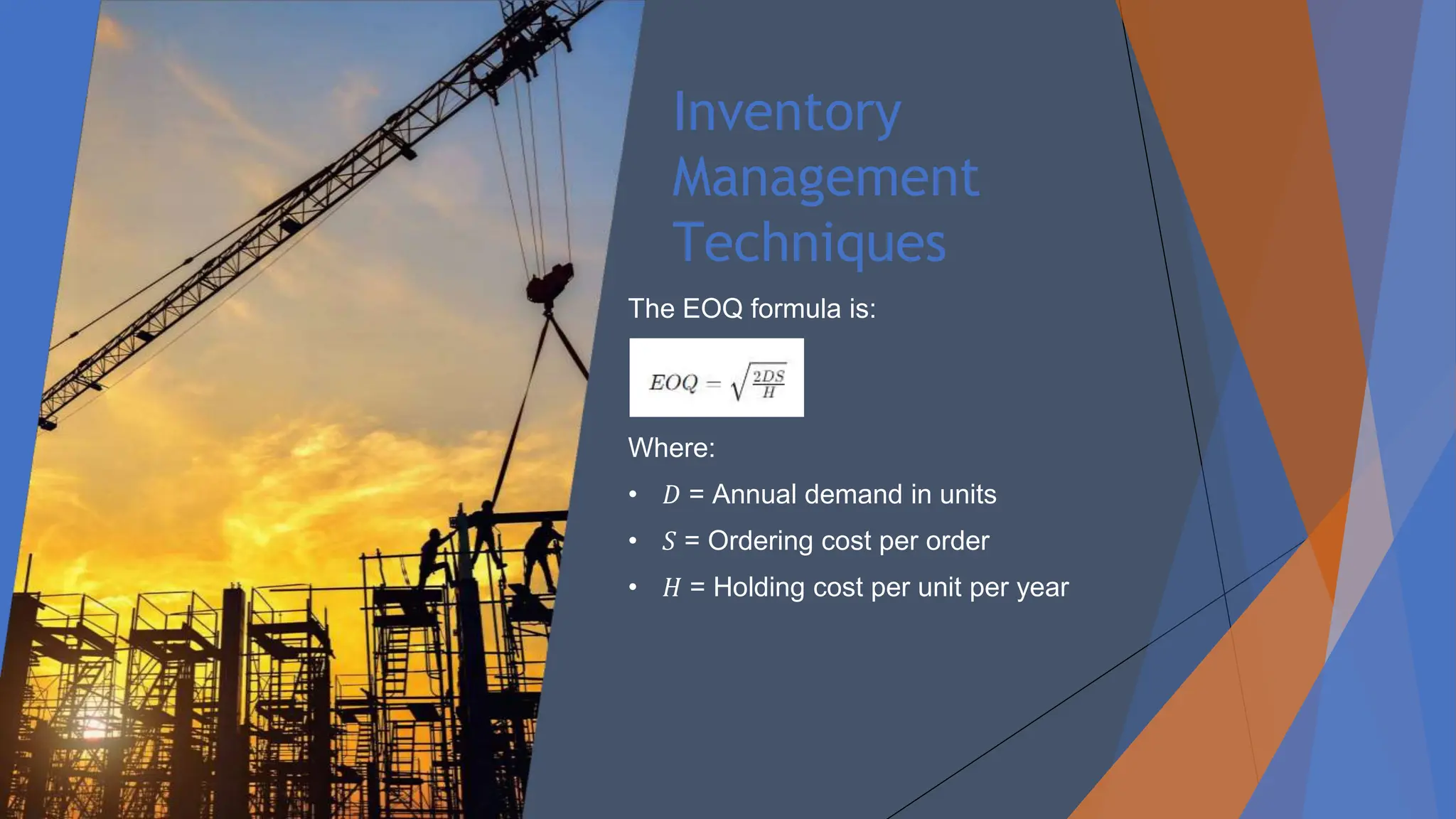
The EOQ formula is:
Where:
• 𝐷 = Annual demand in units
• 𝑆 = Ordering cost per order
• 𝐻 = Holding cost per unit per year
Inventory
Management
Techniques
Application of EOQ:
1. Minimizing Total Inventory Costs: The
primary objective of EOQ is to find the
order quantity that minimizes the total
inventory costs, which include holding
costs and ordering costs.
2. Inventory Planning: EOQ helps in
determining how much to order each time
to maintain optimal inventory levels,
thereby preventing stockouts (which
could lead to lost sales) and excess
inventory (which ties up capital).
3. Order Frequency: EOQ calculation
provides insights into how frequently
orders should be placed based on the
optimal order quantity.
Inventory
Management
Techniques
Application of EOQ:
4. Cost-Benefit Analysis: EOQ facilitates
a cost-benefit analysis of ordering
and holding costs. By comparing
different order quantities, businesses
can make informed decisions to
balance costs and benefits.
5. Inventory Control: EOQ serves as a
benchmark for inventory control
policies and helps in setting reorder
points (when to place an order) and
safety stock levels (buffer stock to
account for demand variability).
Inventory
Management
Techniques
Considerations and Assumptions:
• Static Demand and Costs: EOQ assumes
that demand, ordering costs, and holding
costs remain constant over time. In reality,
these factors can fluctuate, requiring
periodic review and adjustment of EOQ
calculations.
• Sensitivity to Parameters: EOQ results can
be sensitive to changes in demand, ordering
costs, and holding costs. Sensitivity analysis
may be necessary to understand the impact
of these changes on EOQ.
• Practical Implementation: Implementing
EOQ requires accurate data on demand
patterns, costs, and lead times. It also
requires coordination with suppliers and
production teams to ensure timely and cost-
effective inventory management.
Inventory
Management
Techniques
In conclusion, EOQ is a valuable tool
in inventory management that helps
businesses optimize their ordering
policies to achieve cost efficiencies
while maintaining adequate inventory
levels to meet customer demand. It
is widely used across industries to
support strategic decision-making
and operational effectiveness in
managing inventory.
Inventory
Management
Techniques
Safety stock is additional inventory
held by a company to mitigate the
risk of stockouts due to variability in
demand or supply lead times. Its
purpose is to ensure that there is
enough inventory on hand to meet
unexpected increases in demand or
delays in supply without impacting
customer service levels. Here’s an
overview of the purpose of safety
stock and common calculation
methods:
Inventory
Management
Techniques
Purpose of Safety Stock:
1. Buffer Against Variability: Safety stock acts as
a buffer to absorb fluctuations in demand that
exceed forecasted levels or variations in lead
times from suppliers.
2. Customer Service Levels: It helps maintain
high service levels by reducing the risk of
stockouts, which can lead to lost sales and
dissatisfied customers.
3. Production Stability: For manufacturing
businesses, safety stock ensures that
production can continue smoothly even if there
are disruptions in the supply chain or
unexpected spikes in demand.
4. Insurance Against Uncertainty: It serves as
insurance against uncertainties in demand
forecasting, supplier reliability, transportation
delays, and other unforeseen events.
Inventory
Management
Techniques
Calculation Methods for Safety Stock:
There are several methods to calculate safety
stock, depending on the level of complexity and
available data:
1. Fixed Quantity Method:
• Formula: 𝑆𝑆=𝑧×𝜎SS=z×σ
• Description: In this method, safety stock 𝑆𝑆SS
is calculated based on a multiple (z) of the
standard deviation (𝜎σ) of demand or lead
time variability. The value of z corresponds to
a desired service level (probability of not
having a stockout).
• Example: If a company wants a 95% service
level (z = 1.645 for 95% service level), and the
standard deviation of daily demand is 20 units,
then 𝑆𝑆=1.645×20=32.9SS=1.645×20=32.9
units. This means approximately 33 units
should be kept as safety stock.
Inventory
Management
Techniques
2. Percentage of Demand Method:
• Formula: 𝑆𝑆=Lead Time Demand ×
Safety Stock Percentage
• Description: Safety stock is calculated
as a percentage of the average
demand during the lead time. This
method is simpler but may not account
for demand variability or lead time
variability explicitly.
• Example: If average daily demand
during lead time is 100 units, and the
safety stock percentage is 50%, then
𝑆𝑆=100×0.5=50SS=100×0.5=50 units.
Inventory
Management
Techniques
3. Service Level Approach:
• Description: This method involves
setting a target service level (e.g.,
95%, 99%) and calculating safety
stock based on the probability
distribution of demand or lead time.
• Formula: It typically involves using
statistical techniques such as the
normal distribution or empirical data
to determine the safety stock that
achieves the desired service level..
Inventory
Management
Techniques
Considerations for Safety Stock Calculation:
• Demand Variability: Understanding the
variability of demand patterns and lead times
is crucial for accurate safety stock
calculations.
• Service Level Goals: The desired service
level (probability of not having a stockout)
should be clearly defined to determine the
appropriate level of safety stock.
• Costs: Balancing the costs of holding safety
stock (storage, obsolescence) against the
costs of stockouts is essential in determining
the optimal amount of safety stock.
• Continuous Review: Safety stock levels
should be periodically reviewed and adjusted
based on changes in demand patterns, lead
times, and business objectives.
Inventory
Management
Techniques
In conclusion, safety stock plays a
critical role in inventory management
by providing a cushion against
uncertainties in demand and supply.
Choosing the right method for
calculating safety stock ensures that
businesses can maintain high
service levels while managing
inventory costs effectively.
Inventory
Management
Systems
Inventory Management Software
(IMS) is a specialized application or
system that helps businesses
efficiently manage their inventory
levels, orders, sales, and other
related operations. It provides a
centralized platform for businesses
to track, control, and optimize their
inventory throughout the supply
chain. Here’s an introduction to IMS
and its key features:
Inventory
Management
Systems
Key Features of Inventory Management Software:
1. Inventory Tracking and Visibility:
• IMS enables real-time tracking of inventory levels
across multiple locations or warehouses. It
provides visibility into stock levels, including
quantities on hand, on order, and in transit.
• Barcode scanning and RFID technology
integration facilitate accurate and efficient
inventory management.
2. Order Management:
• It streamlines order processing by automating
workflows from order creation to fulfillment. IMS
can generate purchase orders, sales orders, and
transfer orders based on inventory levels and
demand forecasts.
• Integration with sales channels (e.g., e-commerce
platforms) ensures synchronization of inventory
and orders across different channels.
Inventory
Management
Systems
Key Features of Inventory Management Software:
3. Forecasting and Demand Planning:
• Advanced IMS platforms offer demand forecasting
and planning tools based on historical data,
trends, and seasonality. This helps businesses
optimize inventory levels and minimize stockouts
or overstock situations.
• Forecast accuracy improves with the ability to
analyze sales patterns and adjust inventory
strategies accordingly.
4. Inventory Optimization:
• IMS employs algorithms and optimization
techniques (like Economic Order Quantity,
discussed earlier) to determine optimal reorder
points, safety stock levels, and replenishment
quantities.
• This ensures that inventory is maintained at levels
that balance between meeting customer demand
and minimizing carrying costs.
Inventory
Management
Systems
Key Features of Inventory Management Software:
5. Warehouse Management:
• IMS includes features for warehouse management, such as
bin/location tracking, picking and packing management, and
inventory rotation (FIFO, LIFO).
• It optimizes warehouse layout and workflows to improve
efficiency in receiving, storing, and shipping goods.
6. Reporting and Analytics:
• IMS provides customizable reports and analytics dashboards
that offer insights into inventory performance, turnover rates,
stock movement, and financial metrics.
• These insights help businesses make data-driven decisions
to optimize inventory management strategies and improve
overall operational efficiency.
7. Integration and Scalability:
• Modern IMS solutions integrate with other business systems
such as ERP (Enterprise Resource Planning), CRM
(Customer Relationship Management), and accounting
software.
• Scalable IMS platforms can accommodate business growth
by supporting additional users, locations, and functionalities
as needed.
Inventory
Management
Systems
Benefits of Inventory Management Software:
• Improved Efficiency: Streamlined
processes and automation reduce manual
errors and save time in managing
inventory-related tasks.
• Cost Reduction: Optimized inventory
levels and reduced stockouts minimize
holding costs and improve cash flow.
• Enhanced Customer Service: Accurate
inventory tracking ensures timely order
fulfillment and better customer
satisfaction.
• Data-driven Insights: Analytics and
reporting tools provide actionable insights
for strategic decision-making and
continuous improvement.
Inventory
Management
Systems
Considerations for Choosing IMS:
• Business Needs: Assess specific
requirements such as multi-location
management, batch tracking, or
integration capabilities.
• Usability and Support: Evaluate user
interface, ease of implementation, and
availability of customer support.
• Scalability: Ensure the IMS can grow
with the business and adapt to future
needs.
Inventory
Management
Systems
In summary, Inventory Management
Software plays a crucial role in
modern supply chain management
by optimizing inventory levels,
improving operational efficiency, and
enhancing overall business
performance. It is an essential tool
for businesses looking to maintain
competitive advantage and meet
customer expectations in today's
dynamic marketplace.
Inventory
Management
Systems
Inventory Management Software (IMS) offers
numerous benefits to modern businesses across
various industries. Here are some key advantages:
1. Improved Inventory Control and Accuracy:
• IMS provides real-time visibility into inventory
levels across multiple locations or
warehouses. This helps businesses track
stock levels accurately, reduce instances of
stockouts or overstocking, and ensure optimal
inventory levels based on demand forecasts.
2. Enhanced Efficiency and Productivity:
• Automation of inventory processes, such as
order management, replenishment, and
tracking, reduces manual effort and eliminates
errors associated with manual data entry. This
improves operational efficiency and allows
employees to focus on higher-value tasks.
Inventory
Management
Systems
Inventory Management Software (IMS) offers
numerous benefits to modern businesses across
various industries. Here are some key advantages:
3. Cost Savings:
• By optimizing inventory levels and reducing
carrying costs (storage, insurance,
obsolescence), IMS helps businesses save
money. Accurate demand forecasting and
inventory optimization minimize excess
inventory and stockouts, leading to better cash
flow management.
4. Better Customer Service:
• IMS enables businesses to fulfill customer
orders accurately and on time by maintaining
adequate stock levels and optimizing order
fulfillment processes. This results in improved
customer satisfaction and retention.
Inventory
Management
Systems
Inventory Management Software (IMS) offers
numerous benefits to modern businesses across
various industries. Here are some key advantages:
5. Data-Driven Decision Making:
• IMS provides robust reporting and analytics
capabilities that offer actionable insights into
inventory performance, trends, and financial
metrics. Businesses can make informed
decisions based on data, improving strategic
planning and operational efficiency.
6. Streamlined Supply Chain Management:
• Integration capabilities of IMS with other
business systems such as ERP, CRM, and e-
commerce platforms streamline supply chain
processes. This includes seamless data
exchange, automated order processing, and
synchronized inventory management across
the supply chain.
Inventory
Management
Systems
Inventory Management Software (IMS) offers
numerous benefits to modern businesses across
various industries. Here are some key advantages:
7. Compliance and Traceability:
• IMS facilitates compliance with regulatory
requirements by enabling accurate tracking
and documentation of inventory movements,
batch/lot tracking, and expiration dates. This
enhances product traceability and ensures
adherence to industry standards.
8. Scalability and Adaptability:
• Modern IMS solutions are scalable and
adaptable to accommodate business growth
and changing needs. They support additional
users, locations, and functionalities, making
them suitable for businesses of all sizes and
industries.
Inventory
Management
Systems
Inventory Management Software (IMS) offers
numerous benefits to modern businesses across
various industries. Here are some key advantages:
9. Inventory Optimization and Control:
• With features like ABC analysis, Economic
Order Quantity (EOQ) calculations, and safety
stock management, IMS helps businesses
optimize inventory levels and maintain control
over stock movements. This ensures efficient
use of resources and minimizes waste.
10. Competitive Advantage:
• Utilizing IMS allows businesses to operate
more efficiently, respond quickly to market
demands, and adapt to changes in the
competitive landscape. This strengthens their
competitive position and supports sustainable
growth.
Inventory
Management
Systems
There are several popular Inventory Management Software
(IMS) tools available in the market, each offering a range of
features tailored to different business needs and industries.
Here are some well-known IMS tools widely used by
businesses:
1. Fishbowl Inventory:
• Fishbowl Inventory is a popular IMS solution designed for
small to midsize businesses. It integrates with QuickBooks
and provides features such as inventory tracking, order
management, manufacturing, and reporting.
2. NetSuite ERP:
• NetSuite ERP includes robust inventory management
capabilities as part of its comprehensive enterprise
resource planning (ERP) suite. It offers real-time visibility
into inventory levels, demand forecasting, procurement
management, and integration with other business functions.
3. SAP ERP:
• SAP offers various ERP solutions that include advanced
inventory management modules. SAP ERP provides
features for inventory optimization, warehouse
management, batch tracking, and integration with SAP’s
extensive enterprise solutions.
Inventory
Management
Systems
There are several popular Inventory Management Software (IMS)
tools available in the market, each offering a range of features
tailored to different business needs and industries. Here are some
well-known IMS tools widely used by businesses:
4. Oracle NetSuite:
• Oracle NetSuite is a cloud-based ERP system that includes
sophisticated inventory management functionalities. It supports
multi-location inventory tracking, demand planning, order
management, and integration with e-commerce platforms.
5. InFlow Inventory:
• InFlow Inventory is a user-friendly IMS tool suitable for small
businesses and startups. It offers features such as inventory
tracking, order management, barcode scanning, and reporting,
all accessible through a desktop application.
6. TradeGecko:
• TradeGecko is a cloud-based inventory management and
order fulfillment platform designed for e-commerce businesses.
It includes features like inventory tracking across multiple
channels, automated reordering, sales analytics, and
integration with popular e-commerce platforms.
Inventory
Management
Systems
There are several popular Inventory Management
Software (IMS) tools available in the market, each
offering a range of features tailored to different
business needs and industries. Here are some well-
known IMS tools widely used by businesses:
7. Zoho Inventory:
• Zoho Inventory is part of the Zoho suite of business
applications and offers inventory management
capabilities for small to midsize businesses. It
includes features for tracking inventory levels, order
management, warehouse operations, and
integration with Zoho CRM and other Zoho
applications.
8. QuickBooks Enterprise:
• QuickBooks Enterprise includes advanced inventory
management features for businesses that use
QuickBooks as their accounting software. It
supports inventory tracking, order fulfillment,
barcode scanning, and integration with other
QuickBooks modules.
Inventory
Management
Systems
9. WMS by Logiwa:
• Logiwa offers a Warehouse Management System
(WMS) that includes robust inventory management
features suitable for e-commerce and retail
businesses. It supports multi-warehouse
management, order picking, packing, shipping, and
real-time inventory tracking.
10.DEAR Inventory:
• DEAR Inventory is a cloud-based IMS solution that
caters to small and medium-sized businesses. It
offers features such as inventory tracking,
purchasing, sales order management,
manufacturing, and integrations with various e-
commerce platforms and accounting software.
These IMS tools vary in terms of features, scalability,
integration capabilities, and pricing, allowing businesses
to choose the solution that best fits their specific
inventory management needs and operational
requirements.
Inventory
Management
Systems
Poor inventory management can significantly impact
businesses in various ways, leading to operational
inefficiencies, financial losses, and even damage to
reputation. Here are a few real-world scenarios and
case studies that highlight the consequences of
inadequate inventory management:
1. Chipotle Mexican Grill (2015 E. coli outbreak):
• In 2015, Chipotle experienced an E. coli outbreak
linked to contaminated ingredients. This incident
forced the company to close several stores
temporarily and led to a significant drop in sales and
stock prices.
• Impact of Poor Inventory Management: The
outbreak was partly attributed to supply chain issues
and inadequate inventory tracking of fresh
ingredients. Chipotle's failure to manage inventory
effectively in terms of sourcing, monitoring supplier
quality, and maintaining safety standards had a
severe impact on its brand reputation and financial
performance.
Inventory
Management
Systems
Poor inventory management can significantly impact
businesses in various ways, leading to operational
inefficiencies, financial losses, and even damage to
reputation. Here are a few real-world scenarios and
case studies that highlight the consequences of
inadequate inventory management:
2. Toys "R" Us Bankruptcy (2017):
• Toys "R" Us, once a leading toy retailer, filed for
bankruptcy in 2017 and eventually liquidated its U.S.
operations. The company struggled with mounting
debt and failed to adapt to changing consumer
preferences and the rise of e-commerce.
• Impact of Poor Inventory Management: Toys "R" Us
faced challenges with excessive inventory levels
and outdated product assortments. Poor inventory
management practices, such as overstocking on
less popular items and underestimating demand for
trending products, contributed to financial losses
and inability to compete effectively.
Inventory
Management
Systems
Poor inventory management can significantly impact
businesses in various ways, leading to operational
inefficiencies, financial losses, and even damage to
reputation. Here are a few real-world scenarios and
case studies that highlight the consequences of
inadequate inventory management:
3. H&M Inventory Overstock (2018):
• In 2018, H&M, a global fashion retailer, reported a
$4 billion inventory backlog due to excessive
stockpiling of unsold clothes. The company faced
declining sales and profitability despite aggressive
discounting.
• Impact of Poor Inventory Management: H&M's over-
reliance on seasonal forecasting and failure to
adjust inventory levels led to a surplus of outdated
fashion items. This resulted in heavy markdowns,
eroded profit margins, and strained cash flow,
highlighting the pitfalls of mismanaged inventory
planning and forecasting.
Inventory
Management
Systems
Poor inventory management can significantly impact
businesses in various ways, leading to operational
inefficiencies, financial losses, and even damage to
reputation. Here are a few real-world scenarios and
case studies that highlight the consequences of
inadequate inventory management:
4. Nike's Supply Chain Disruption (2020):
• During the COVID-19 pandemic in 2020, Nike
experienced supply chain disruptions that affected
its ability to fulfill customer orders and meet demand
for popular products.
• Impact of Poor Inventory Management: Nike's
reliance on global suppliers and just-in-time
inventory strategies left the company vulnerable to
disruptions in manufacturing and logistics. This led
to delays in product launches, missed sales
opportunities, and dissatisfied customers unable to
purchase desired items.
Inventory
Management
Systems
Poor inventory management can significantly impact
businesses in various ways, leading to operational
inefficiencies, financial losses, and even damage to
reputation. Here are a few real-world scenarios and
case studies that highlight the consequences of
inadequate inventory management:
5. General Motors Ignition Switch Recall (2014):
• General Motors (GM) faced a major crisis in 2014
when it recalled millions of vehicles due to defective
ignition switches linked to fatalities and injuries.
• Impact of Poor Inventory Management: The recall
process was hindered by poor inventory
management practices within GM's supply chain
and distribution network. Issues included inadequate
tracking of faulty parts, delays in identifying affected
vehicles, and challenges in coordinating
replacements, resulting in significant reputational
damage and financial liabilities.
Inventory
Management
Systems
These real-world examples
underscore the critical importance of
effective inventory management in
mitigating risks, optimizing
operational performance, and
safeguarding business continuity.
Businesses that neglect to
implement robust inventory
management practices risk facing
costly disruptions, reduced
profitability, and diminished customer
trust in the long term.
Best Practices for Demand Forecasting &
Inventory Planning
Inventory
Management
Having inventory allows for a
smoother operation in most cases
since it alleviates the need to create
product from scratch for each
individual demand. Inventory is the
result of a push system where the
forecast determines how much
inventory of each item is required.
Excess Inventory
There is, however, a problem with
having too much inventory. Excess
inventory can lead to spoilage,
obsolescence, and damage. Also,
spending too much on inventory
limits the resources available for
other activities and investments.
Inventory analysis is essentially the
determination of the right amount of
product in the right location in the
right form.
Excess Inventory
▶ Strategic decisions cover the inventory
implications of product and network
design.
▶ Tactical decisions cover deployment
and determine what items to carry, in
what form (raw materials, work-in-
process, finished goods, etc.), and where.
▶ Finally, Operational decisions
determine the replenishment policies
(when and how much) of these
inventories. This course mainly covers
the operational decisions on
replenishment.
Inventory
Classification
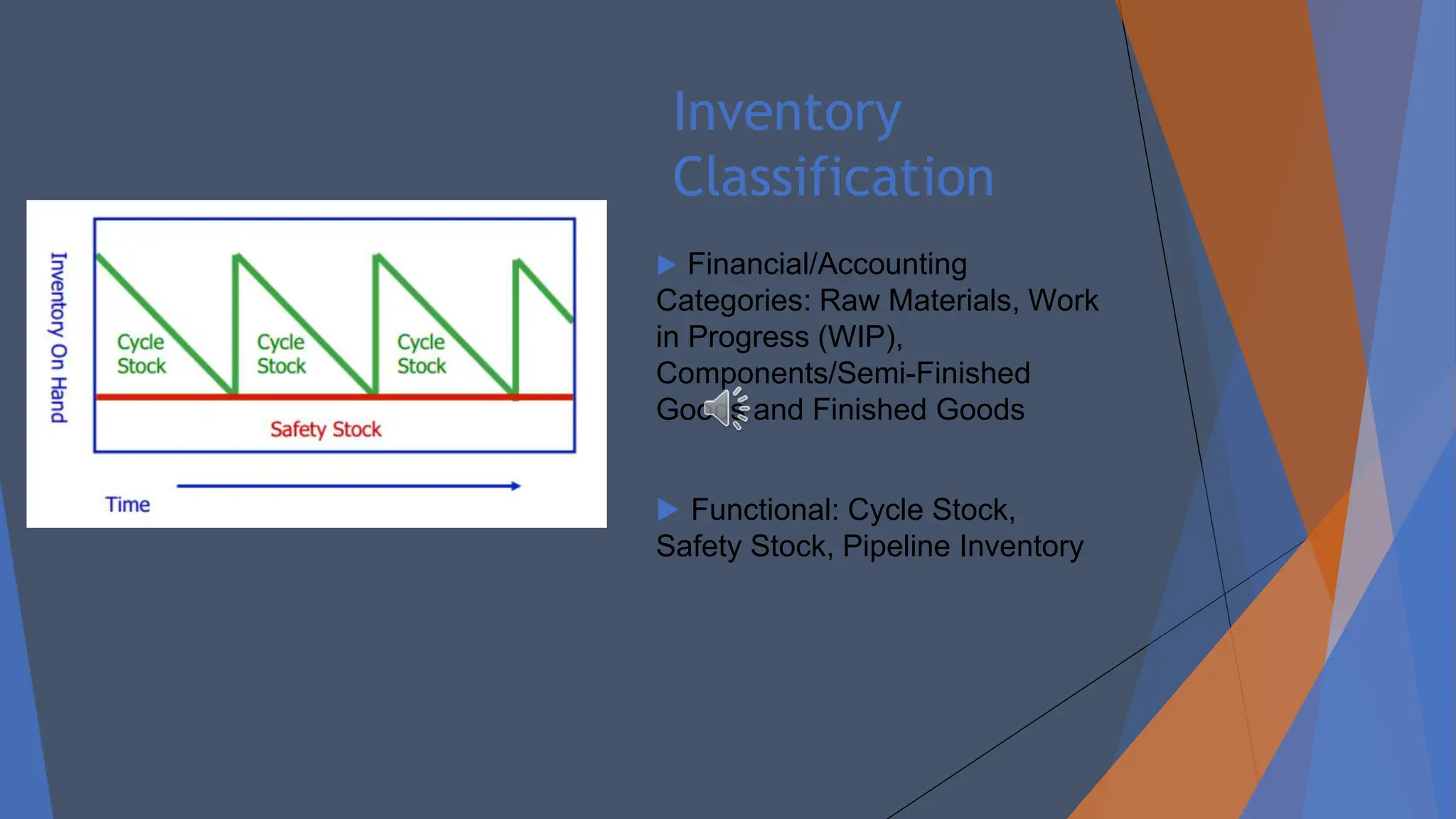
▶ We can classify inventory in
two main ways:
Financial/Accounting or
Functional. The financial
classifications include raw
materials, work in process (WIP),
components, and finished goods.
These are the forms that
recognize the added value to a
product and are needed for
accounting purposes. The
functional classifications, on the
other hand, are based on how
the items are used.
Functional
Classification
▶ The two main functional
classifications are Cycle Stock (the
inventory that you will need during a
replenishment cycle, that is, the time
between order deliveries) and Safety
or Buffer Stock (the inventory
needed to cover any uncertainties in
demand, supply, production, etc).
There are others, but these are the
two primary functional forms. Note
that unlike the financial categories,
you cannot identify specific items as
belonging to either safety or cycle
stock by looking just at it. The
distinction is important, though,
because we will manage cycle and
safety stock very differently.
Cost Equation
▶ The Total Cost equation
is typically used to make
the decisions of how much
inventory to hold and how
to replenish. It is the sum of
the Purchasing, Ordering,
Holding, and Shortage
costs.
Cost Equation
▶ The Purchasing costs are usually
variable or per-item costs and cover the
total landed cost for acquiring that product
– whether from internal manufacturing or
purchasing it from outside.
▶ The Ordering costs are fixed costs that
accrue when placing an order for products.
It is often also called the set-up cost and it
covers the activities required to place,
receive, and process a batch of products in
a single order.
▶ The Holding or Carrying costs are
simply those costs that are required to
keep inventory and include such things as
storage costs, insurance, loss/shrinkage,
damage, obsolescence, and capital costs.
The units are typically in terms of cost per
unit of time.
Cost Equation
▶ Finally, the Shortage or Stock-Out
Costs are those costs associated
with not having an item available
when demanded. This is the most
nebulous of the four costs as it really
depends on the assumptions of the
buyer’s behavior. It covers situations
such as; the cost of a backorder
where the customer is willing to wait,
lost sales where the customer goes
elsewhere for that purchase,
complete lost sales where the
customer never purchases the
products again, as well as
disruptions in manufacturing lines
that occur due to missing parts.
Cost Component
▶ We seek the Order
Replenishment Policy that
minimizes these total costs and
specifically the Relevant Total
Costs. A cost component is
considered relevant if it impacts
the decision at hand and we can
control it by some action. A
Replenishment Policy essentially
states two things: the quantity to
be ordered, and when it should
be ordered.
Cost Component
▶ The exact form of the Total
Cost Equation used depends on
the assumptions we make in
terms of the situation. There are
many different assumptions
inherent in any of the models we
will use, but the primary
assumptions are made
concerning the form of the
demand for the product (whether
it is constant or variable, random
or deterministic, continuous or
discrete, etc.).
Reasons to Hold Inventory
Reasons to hold inventory include:
▶ Cover process time
▶ Allow for uncoupling of
processes
▶ Anticipation/Speculation
▶ Minimize control costs
▶ Buffer against uncertainties such
as demand, supply, delivery
and manufacturing.
Inventory Decisions
▶ Strategic decision about the supply chain such as
potential alternatives to holding inventory and product design
▶ Tactical deployment decisions such as what items to
carry as inventory, in what form to carry items and how much
of each item to hold and where
▶ Operational replenishment decisions such as how often to
review inventory status, how often to make replenishment
decisions and how large replenishment should be
Inventory
Classification
▶ Financial/Accounting
Categories: Raw Materials, Work
in Progress (WIP),
Components/Semi-Finished
Goods and Finished Goods
▶ Functional: Cycle Stock,
Safety Stock, Pipeline Inventory
Relevant Costs
▶ Purchase: Total landed cost for acquiring product
▶ Ordering: Cost to place, receive and process a batch of
good including processing invoicing, auditing, labor, etc. In
manufacturing this is the set-up cost for a run.
▶ Holding: Costs required to hold inventory such as storage,
service casts, risk costs and capital costs
▶ Shortage: Costs of not having an item in stock including
backorder, lost sales, lost customers and disruption costs
▶ A cost is relevant if it is controllable, and it applies to the
specific decision being made.
Learning Block 1:
Demand Planning
Supply chain management is about
balancing supply with demand.
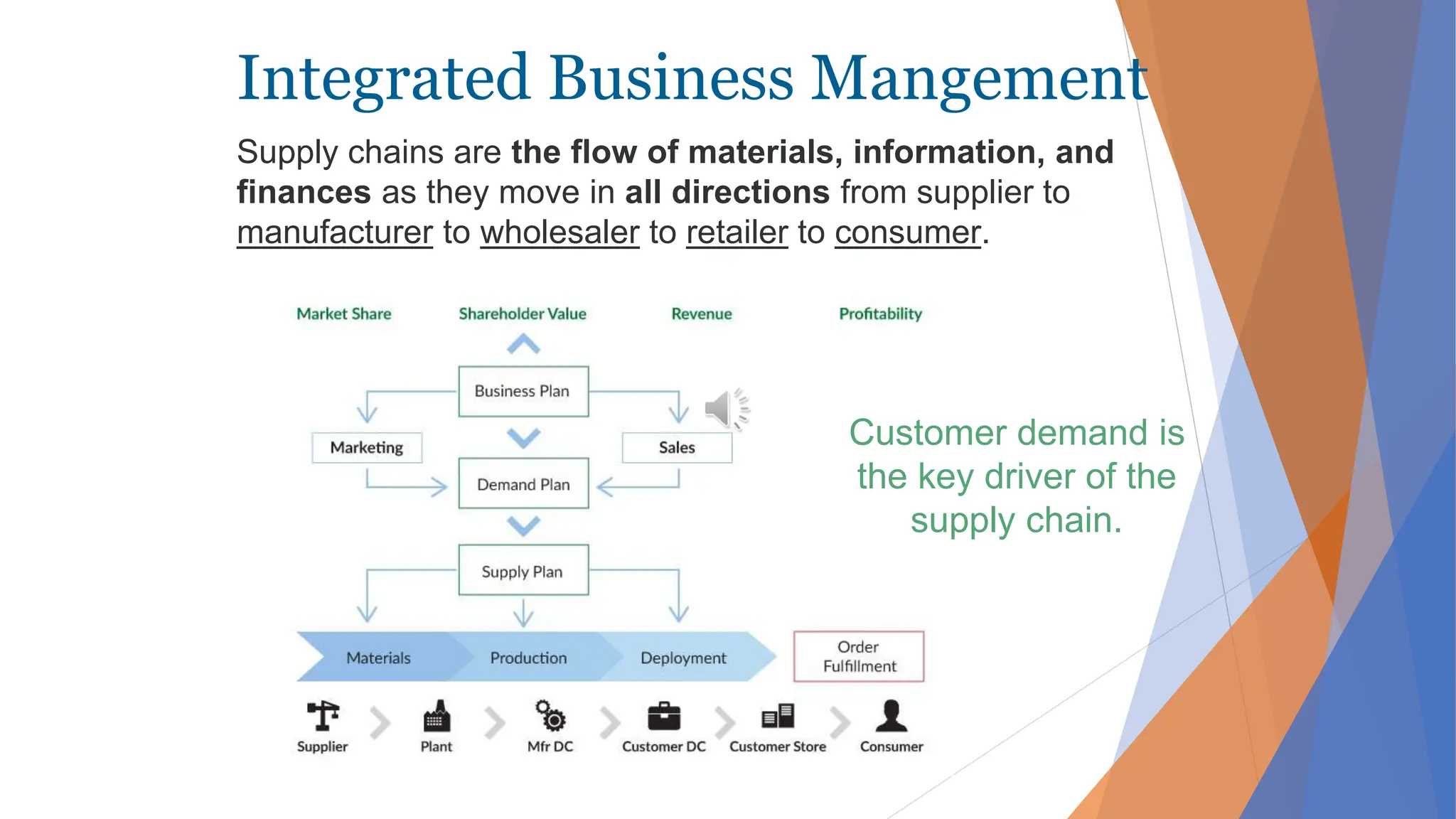
Integrated Business Mangement
Supply chains are the flow of materials, information, and
finances as they move in all directions from supplier to
manufacturer to wholesaler to retailer to consumer.
Customer demand is
the key driver of the
supply chain.
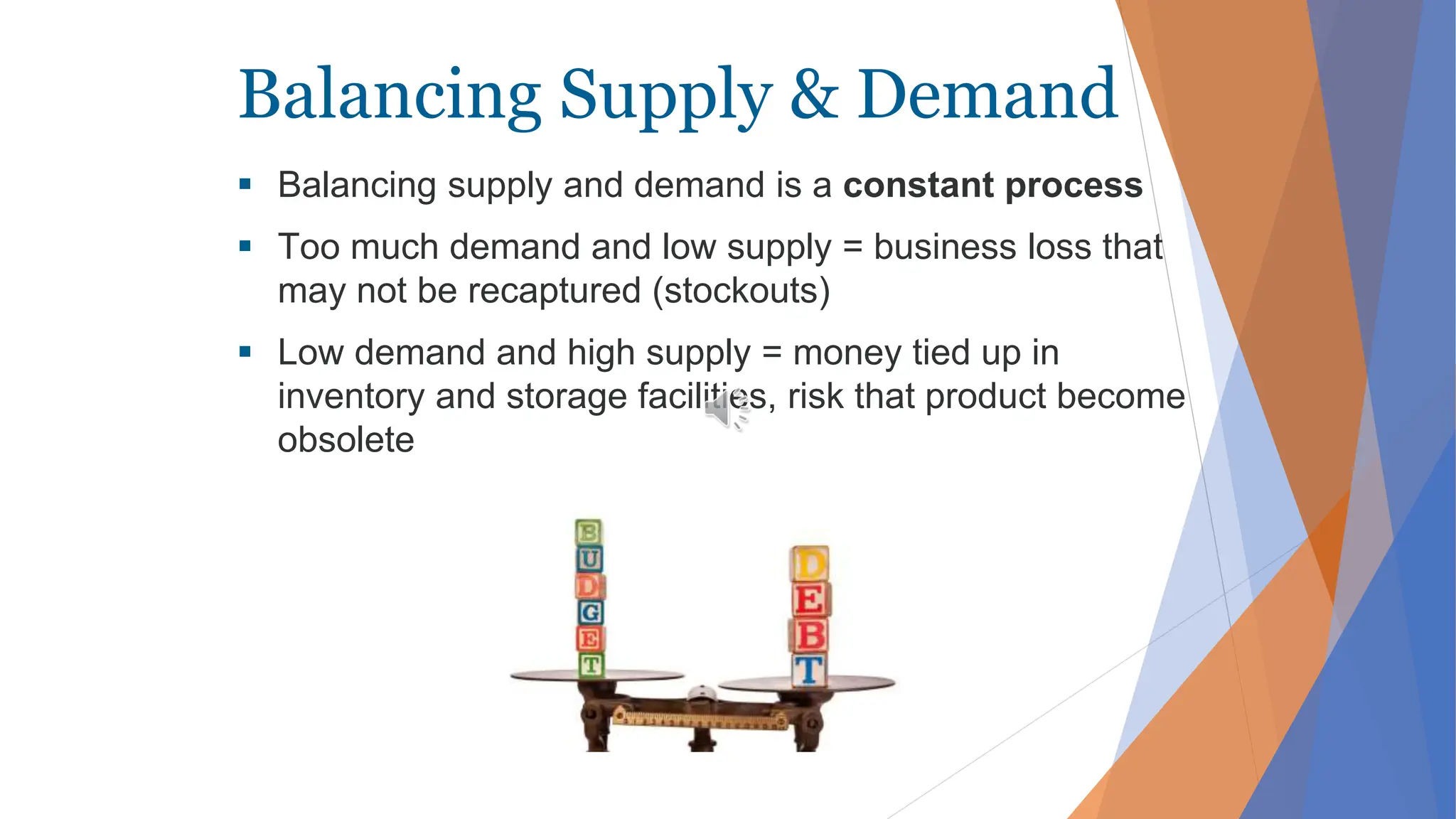
Balancing Supply & Demand
 Balancing supply and demand is a constant process
 Too much demand and low supply = business loss that
may not be recaptured (stockouts)
 Low demand and high supply = money tied up in
inventory and storage facilities, risk that product become
obsolete
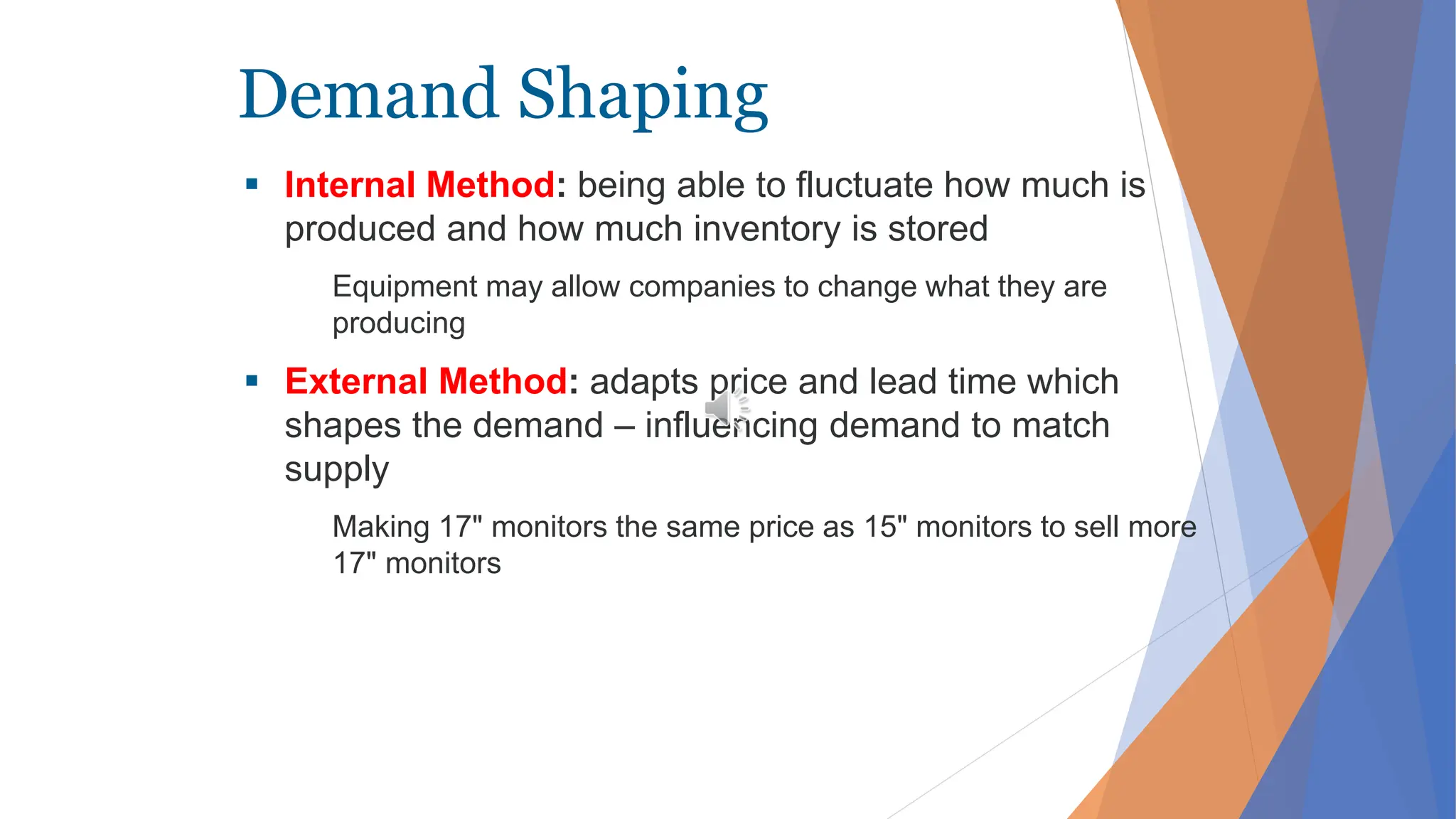
Demand Shaping
 Internal Method: being able to fluctuate how much is
produced and how much inventory is stored
Equipment may allow companies to change what they are
producing
 External Method: adapts price and lead time which
shapes the demand – influencing demand to match
supply
Making 17" monitors the same price as 15" monitors to sell more
17" monitors
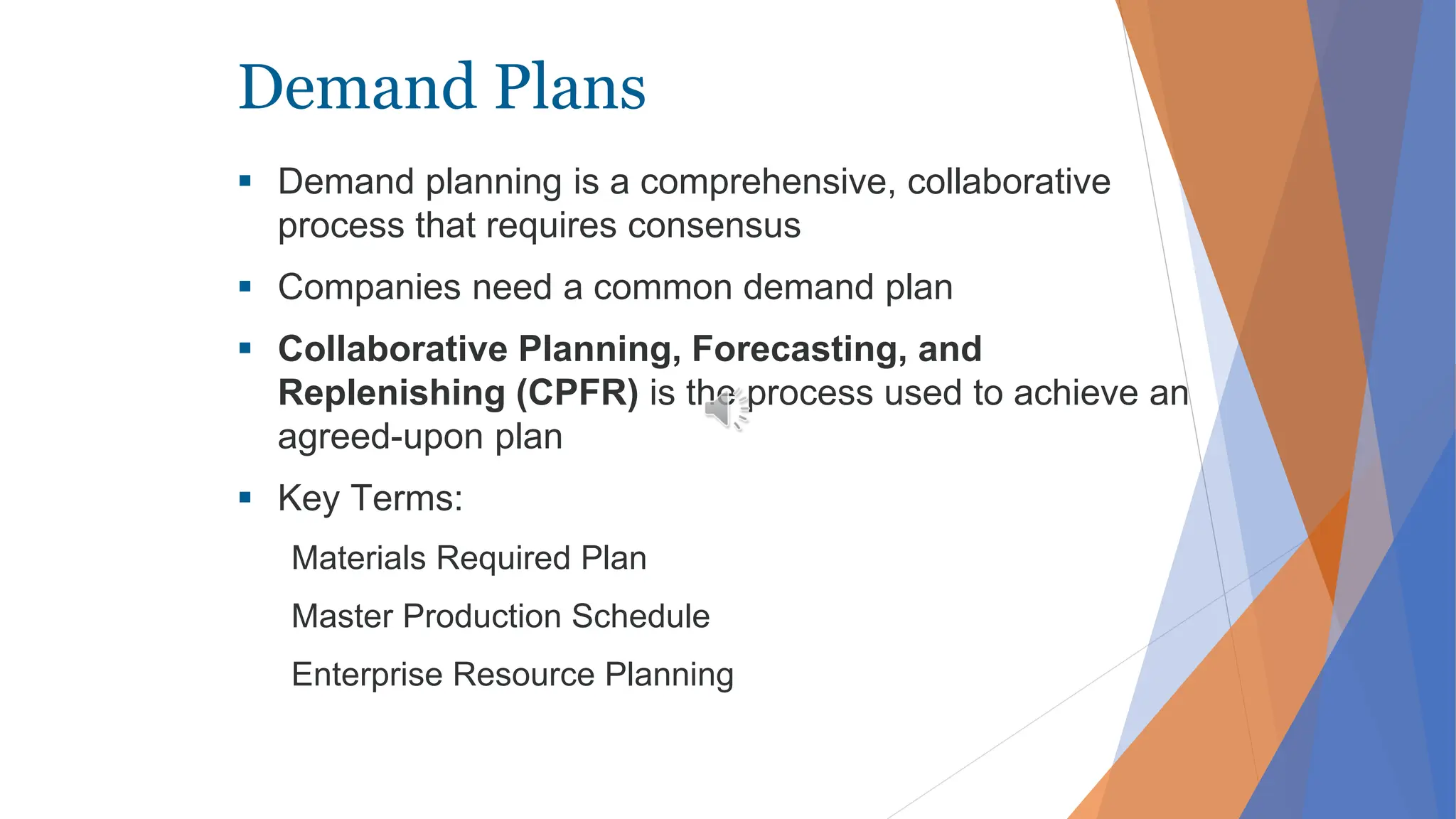
Demand Plans
 Demand planning is a comprehensive, collaborative
process that requires consensus
 Companies need a common demand plan
 Collaborative Planning, Forecasting, and
Replenishing (CPFR) is the process used to achieve an
agreed-upon plan
 Key Terms:
Materials Required Plan
Master Production Schedule
Enterprise Resource Planning
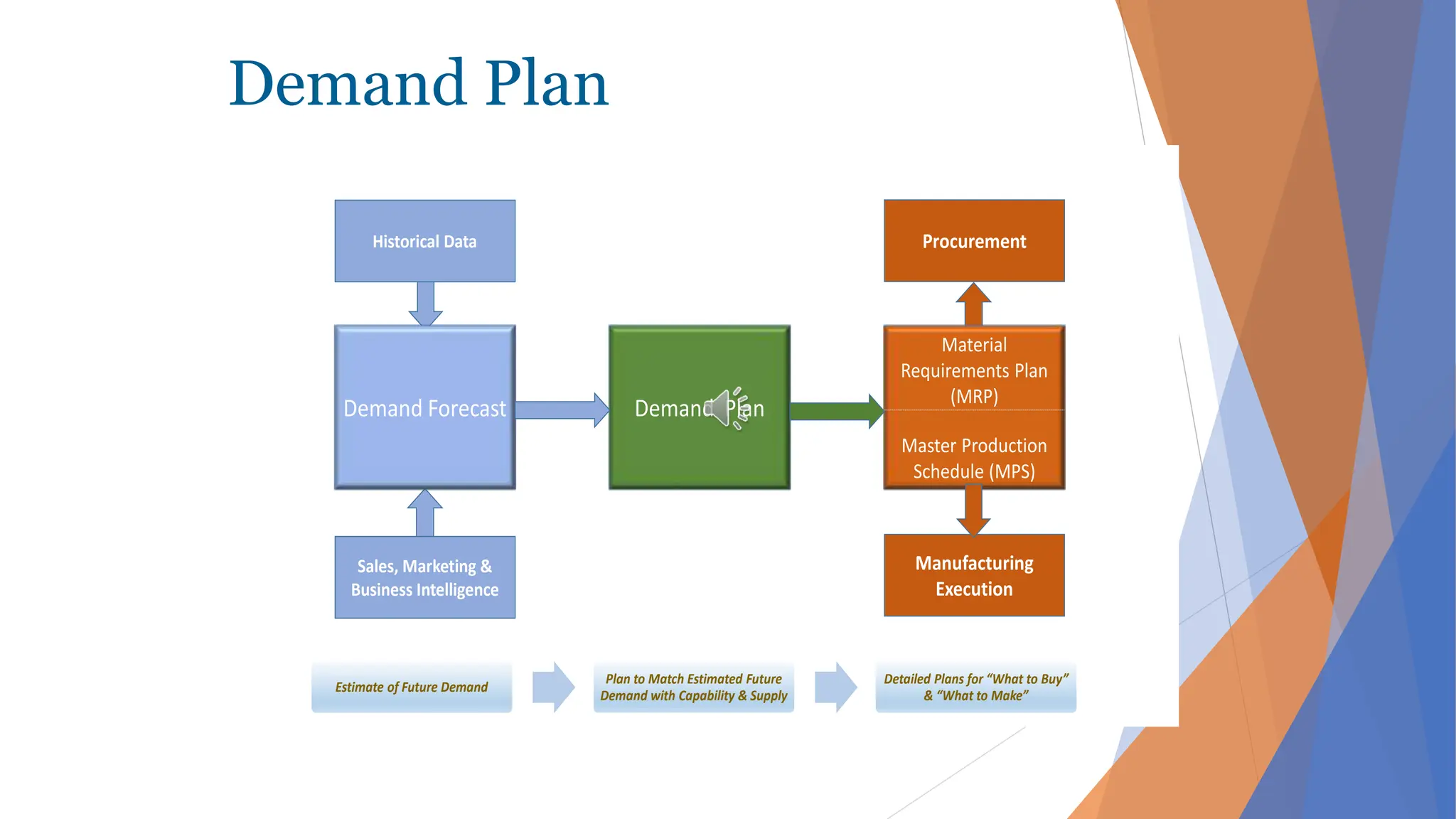
Demand Plan
Demand Forecast Demand Plan
Material
Requirements Plan
(MRP)
Master Production
Schedule (MPS)
Historical Data
Sales, Marketing &
Business Intelligence
Procurement
Manufacturing
Execution
Estimate of Future Demand
Plan to Match Estimated Future
Demand with Capability & Supply
Detailed Plans for “What to Buy”
& “What to Make”
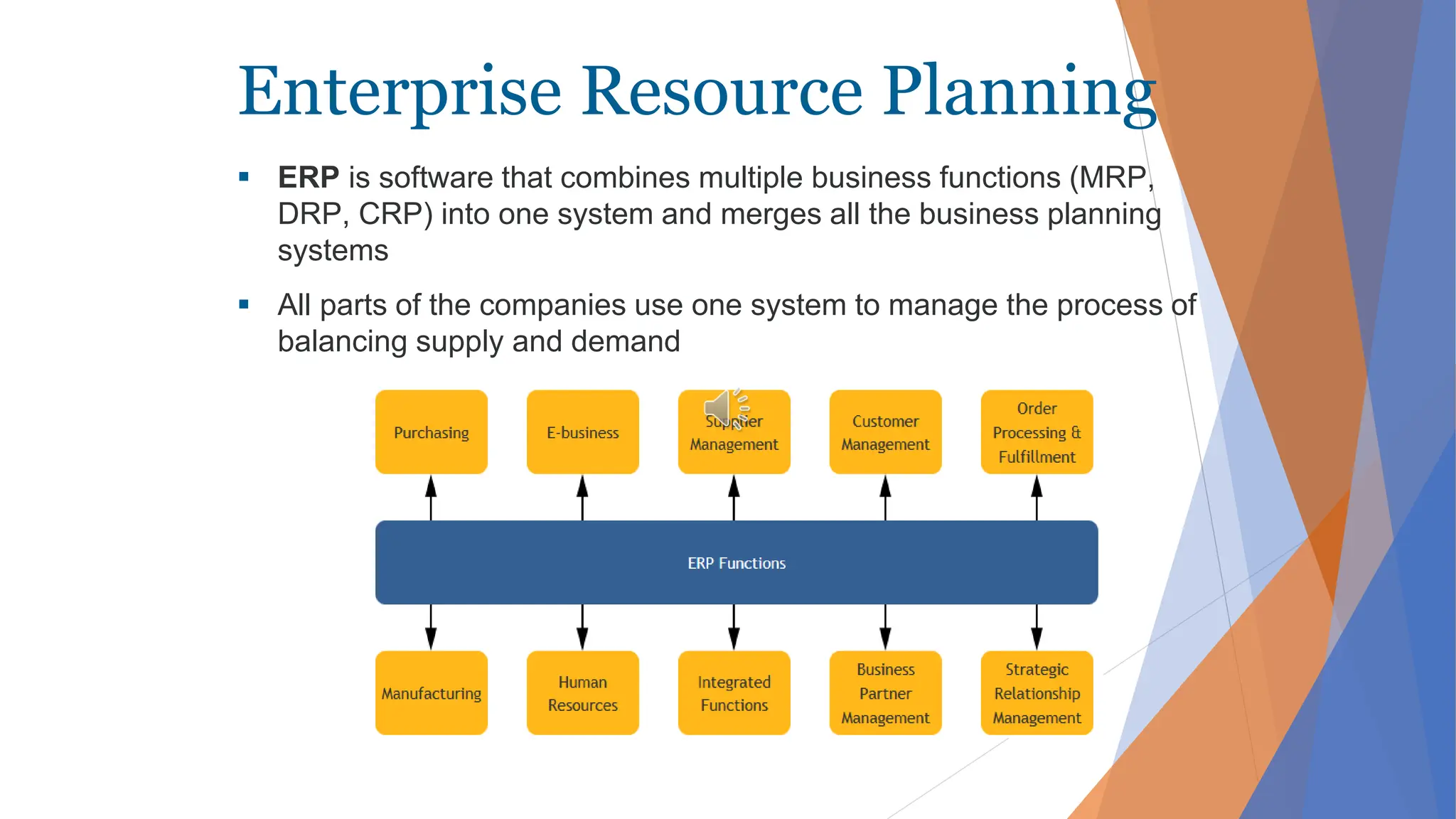
Enterprise Resource Planning
 ERP is software that combines multiple business functions (MRP,
DRP, CRP) into one system and merges all the business planning
systems
 All parts of the companies use one system to manage the process of
balancing supply and demand
Demand Forecasting
 Quantitative Forecasting: when historical data exists
and is helpful in calculating future demand or forecasting
based on numbers
 Qualitative Forecasting: when there is little past data
to rely on and intuition or expert judgment is used
 Both methods include the need to understand events
and conditions that modify demand
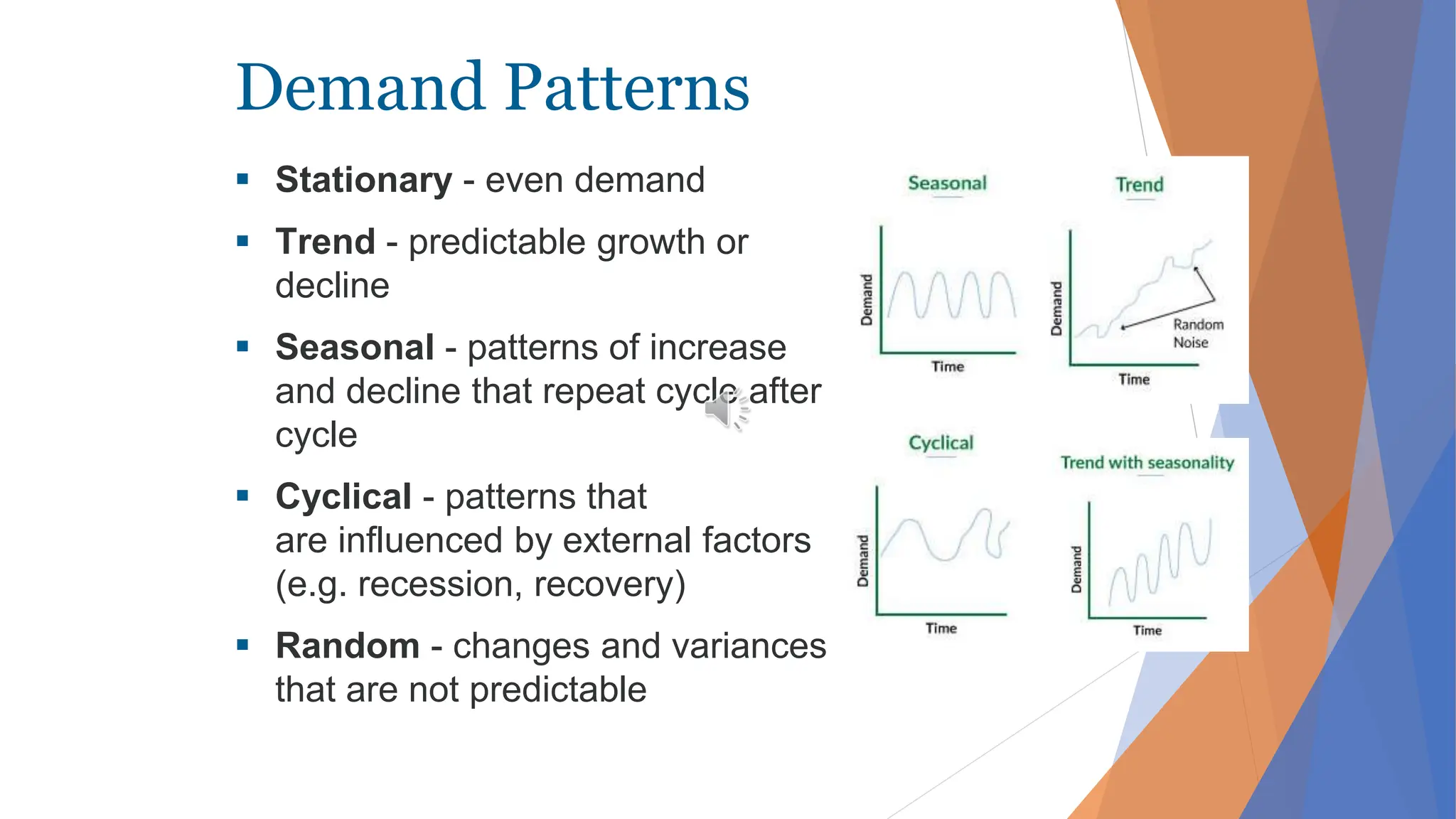
Demand Patterns
 Stationary - even demand
 Trend - predictable growth or
decline
 Seasonal - patterns of increase
and decline that repeat cycle after
cycle
 Cyclical - patterns that
are influenced by external factors
(e.g. recession, recovery)
 Random - changes and variances
that are not predictable
Demand Planning Inaccuracies
 Forecasting is almost never perfect
 May lack customer demand data early enough
 New products also present more challenges due higher
levels of coordination and no previous data
 Plans should consider and allow for inaccuracies
 Long-range forecasts tend to have a greater degree
of error than short-term forecasts
Bullwhip Effect
 Bullwhip Effect: inaccurate forecasts create disruption
and expense within the organization and has a ripple
effect of customers and supplier
 Ultimately it reduces profit and inflates the end cost for
customers
 Variations of demand are amplified at each of the
following:
Inaccurate forecasting and planning
Lack of communication
Lack of visibility
Excess lead time
Late deliveries
Types of Demand
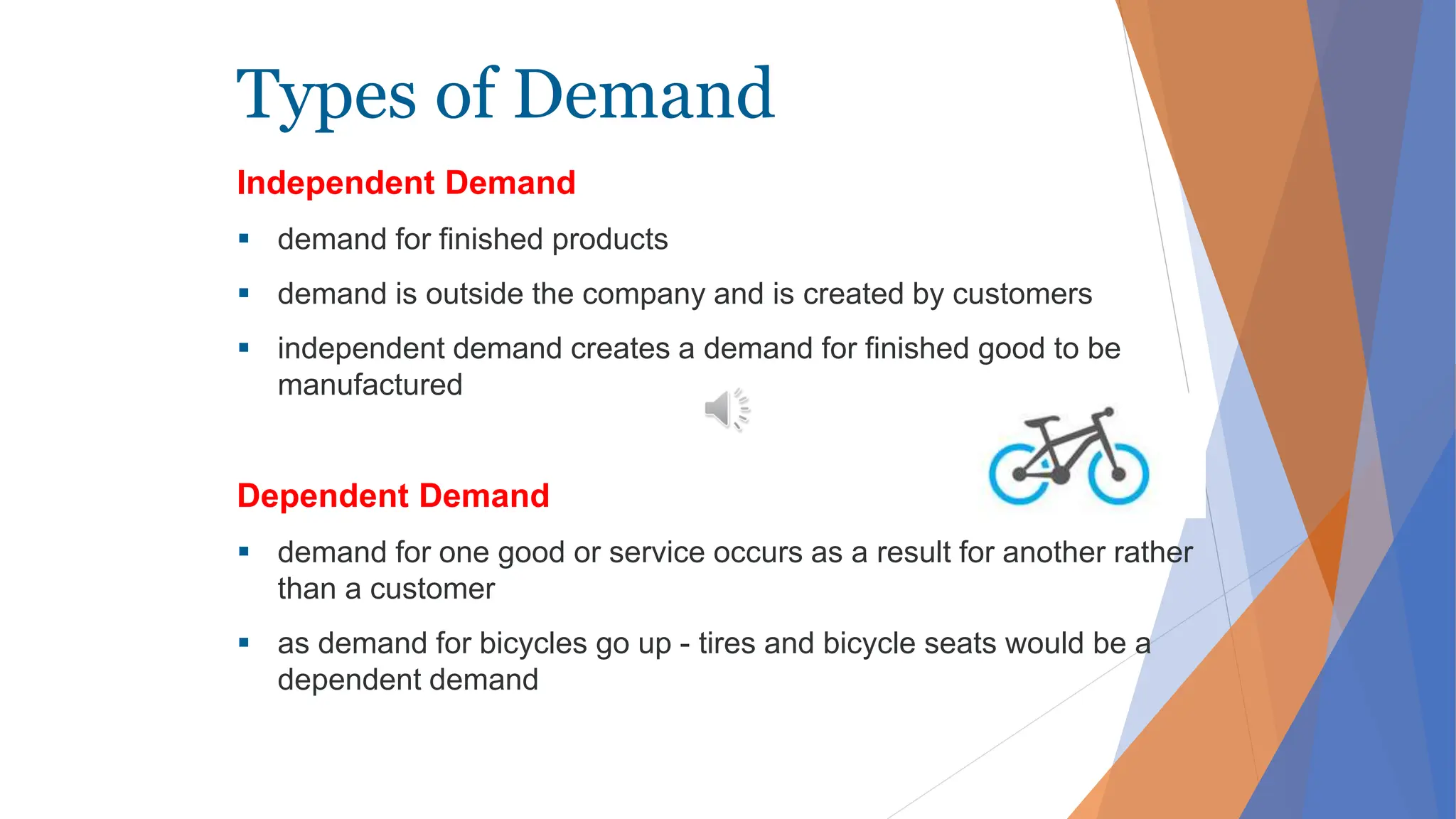
Independent Demand
 demand for finished products
 demand is outside the company and is created by customers
 independent demand creates a demand for finished good to be
manufactured
Dependent Demand
 demand for one good or service occurs as a result for another rather
than a customer
 as demand for bicycles go up - tires and bicycle seats would be a
dependent demand
Learning Block 2:
Supply Management &
Procurement
The goal of procurement in the supply chain
is to balance supply with demand while
creating value.
Procurement
 Procurement: the key function in the supply chain that is
responsible for buying, or procuring, good and services
 Purchasing is the act of buying
 Procurement process involves planning, negotiation, and
administration associated with the eventual placement of
purchase orders with suppliers
 The right materials need to be purchased - based upon
definition of requirements and formal specifications
Procurement includes…
 Receiving requirements from MRP via purchase
requisitions
 Sourcing, or finding, suitable suppliers
 Obtaining pricing and delivery data via requests for
quotes (RFQs) and requests for price (RFPs)
 Conduction negotiations with suppliers
 Creating weighted scorecards to justify awards
 Placing purchase orders (POs)
 Tracking and expediting POs
 Processing supplier invoices (payments)
Procurement Adds Value
 Procurement is viewed as a strategic business function
 Procurement is linked closely with other chain functions
 Awards are made based upon the best value verses
lowest price
 Best value may include
Price
Delivery
Quality
Supplier reputation
Environmental factors
Relationship Management &
Strategic Sourcing
 Relationships with suppliers are more important
 Relationship Management: the focus on building,
maintaining, and developing relationships for the future
of both organizations
 Buying no longer focuses only of the lowest price, but
takes in to account a variety of factors
 Strategic sourcing describes the concept of a win-win
relationship
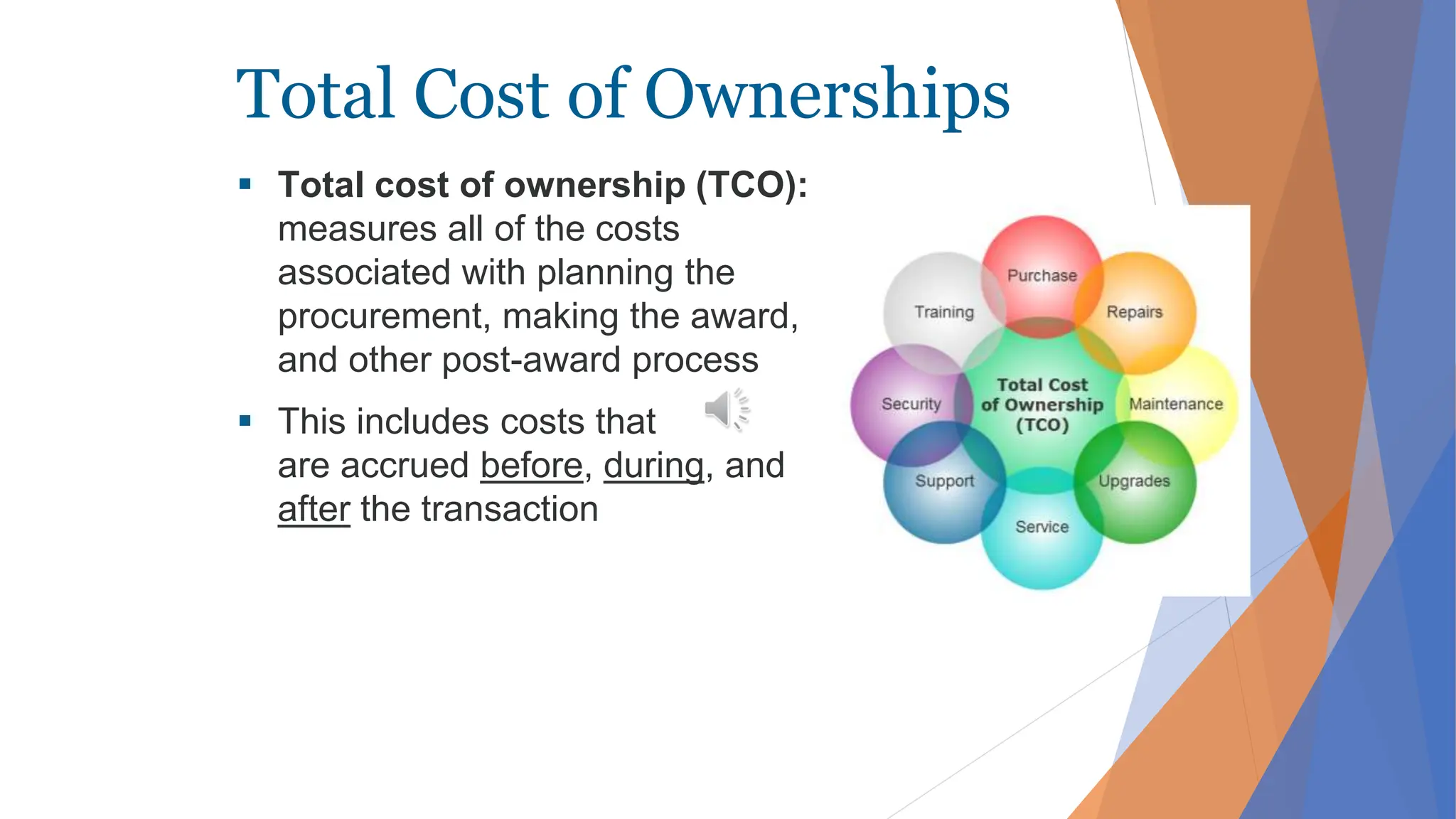
Total Cost of Ownerships
 Total cost of ownership (TCO):
measures all of the costs
associated with planning the
procurement, making the award,
and other post-award process
 This includes costs that
are accrued before, during, and
after the transaction
Decision: Make or Buy
 Companies usually like to make products they
consider their core competencies
 Core competencies or competitive advantage are what
companies invest in, have expertise in, and strategically
fit with the overall mission and visions
 Benefits of buying include:
funds to invest elsewhere
product may be of better quality
supplier can make it cheaper due to economies of scale
Weighted Scorecard
 A tool that identifies attributes of a requirement and
generates a proportionate value based on a score
multiplied by the value assigned to the attribute to
achieve a total score of 100%.
 Each attribute is then rated based on a consistent scale.
 Example: a requirement may be a new supplier for
product A.
Scored attributes: price, quality, and flexibility.
Learning Block 3:
Warehousing Operations
 Warehouse: a place in which inventory is held for vary
periods of time
 Primary Objective: to provide excellent and efficient
customer service at the lowest cost possible
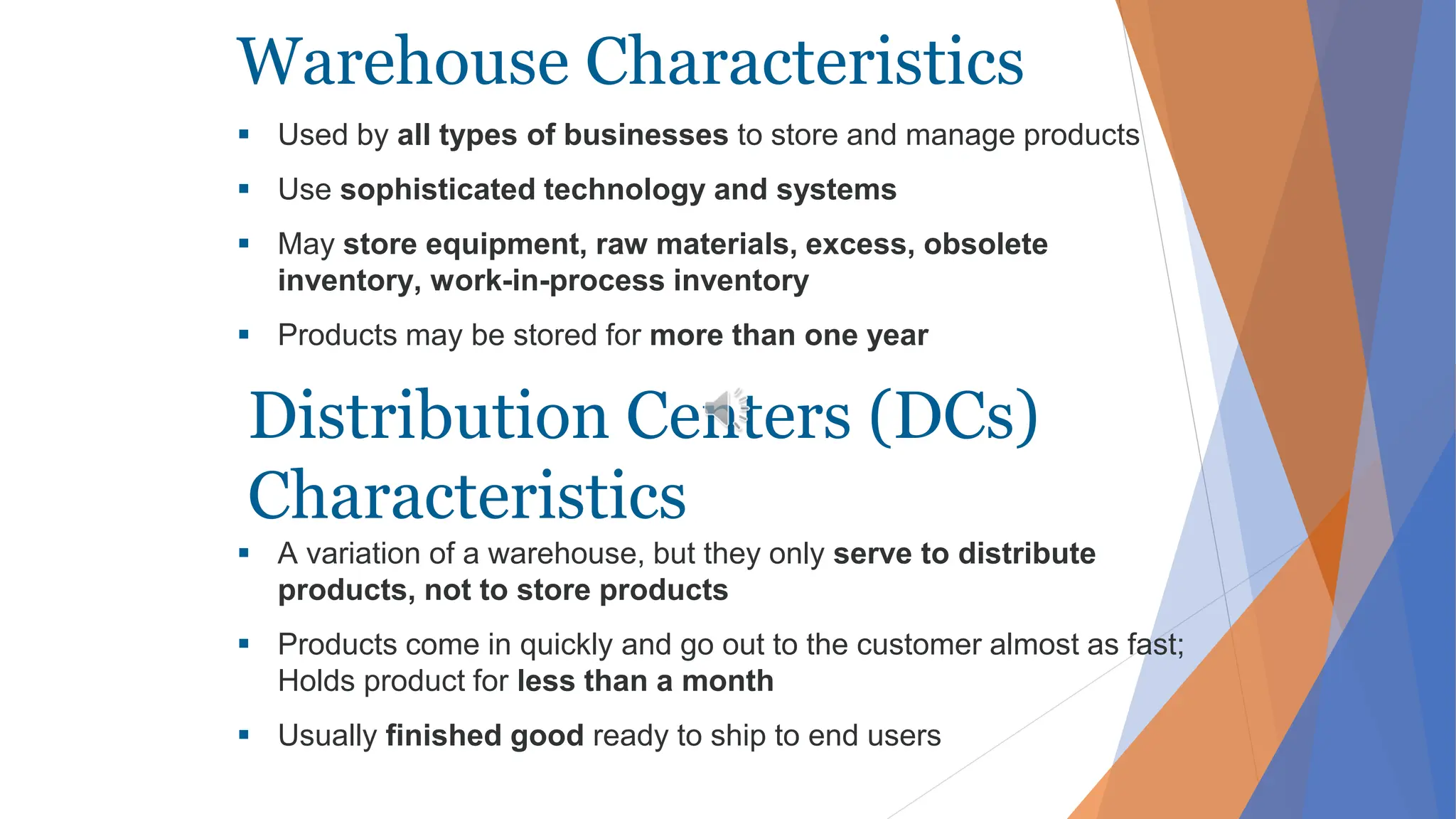
Warehouse Characteristics
 Used by all types of businesses to store and manage products
 Use sophisticated technology and systems
 May store equipment, raw materials, excess, obsolete
inventory, work-in-process inventory
 Products may be stored for more than one year
 A variation of a warehouse, but they only serve to distribute
products, not to store products
 Products come in quickly and go out to the customer almost as fast;
Holds product for less than a month
 Usually finished good ready to ship to end users
Distribution Centers (DCs)
Characteristics
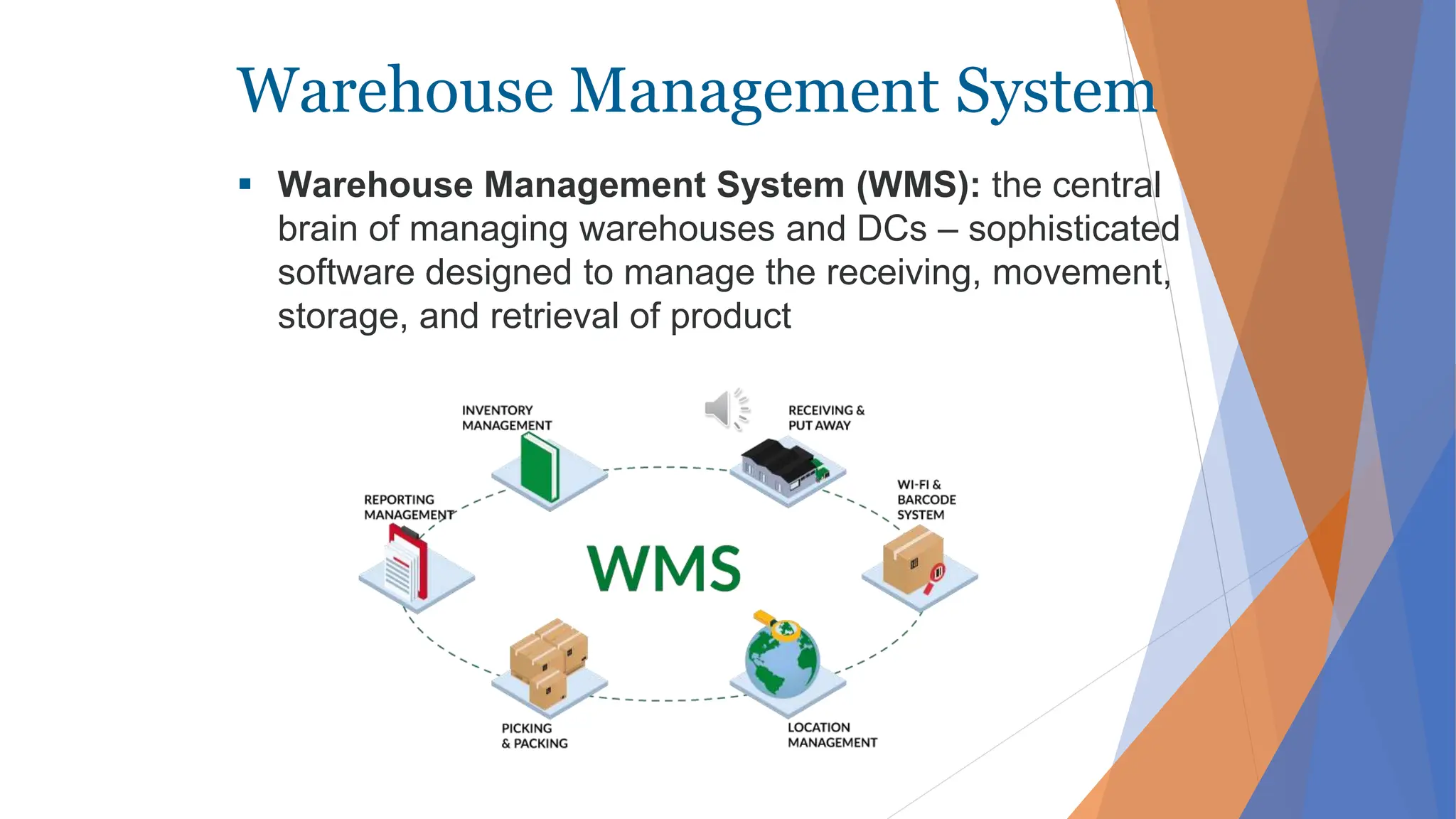
Warehouse Management System
 Warehouse Management System (WMS): the central
brain of managing warehouses and DCs – sophisticated
software designed to manage the receiving, movement,
storage, and retrieval of product
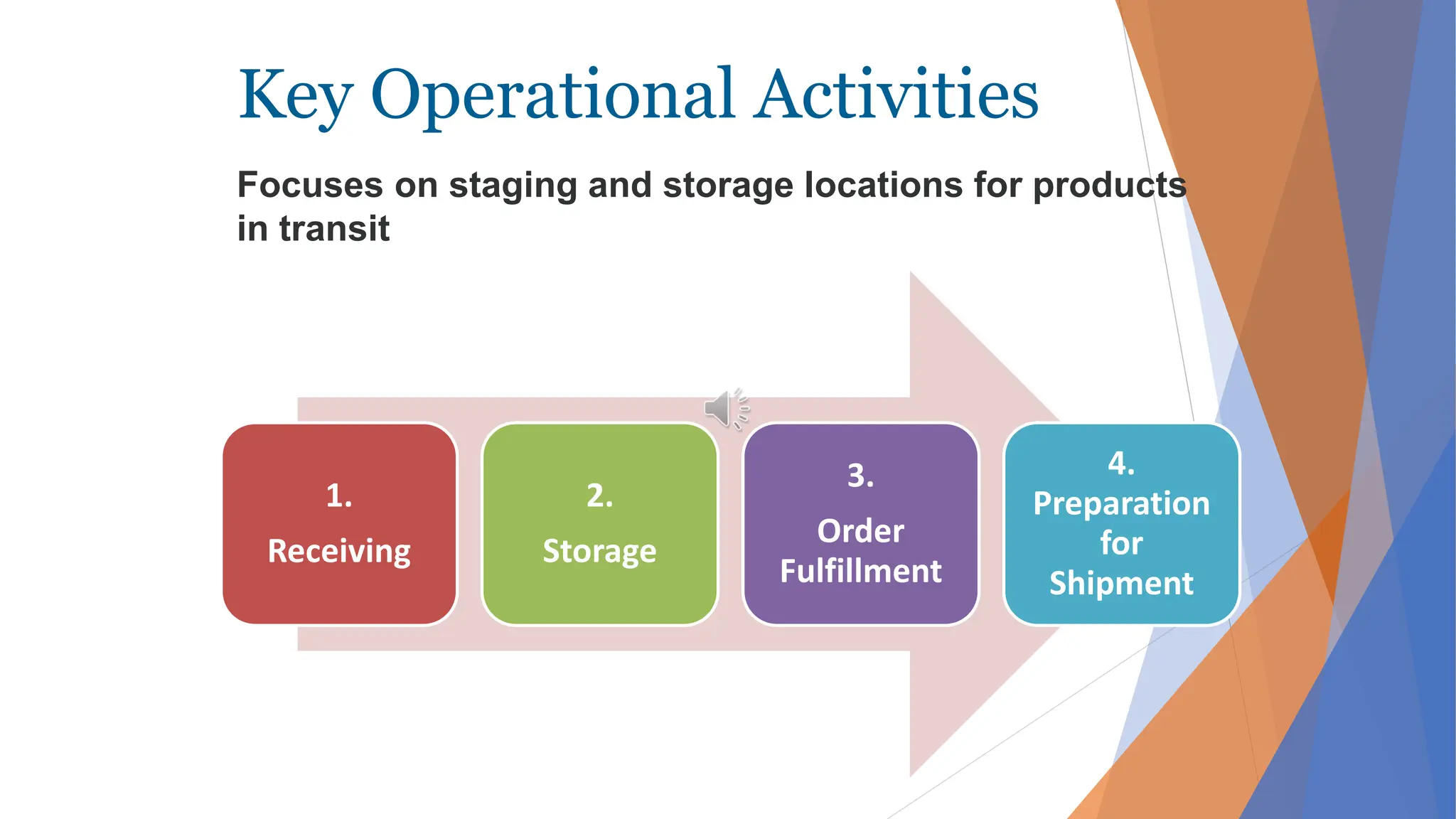
Key Operational Activities
Focuses on staging and storage locations for products
in transit
1.
Receiving
2.
Storage
3.
Order
Fulfillment
4.
Preparation
for
Shipment
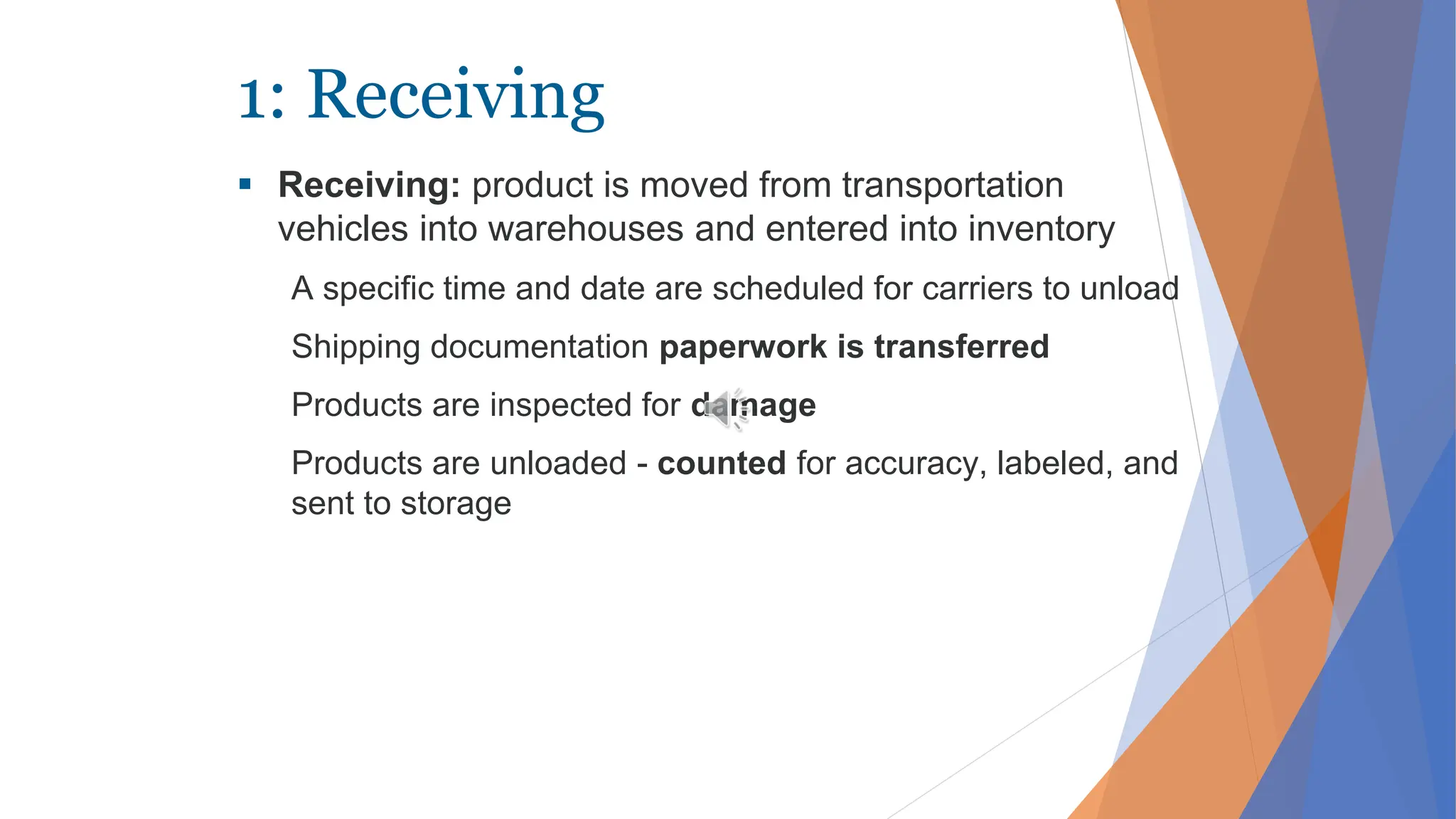
1: Receiving
 Receiving: product is moved from transportation
vehicles into warehouses and entered into inventory
A specific time and date are scheduled for carriers to unload
Shipping documentation paperwork is transferred
Products are inspected for damage
Products are unloaded - counted for accuracy, labeled, and
sent to storage
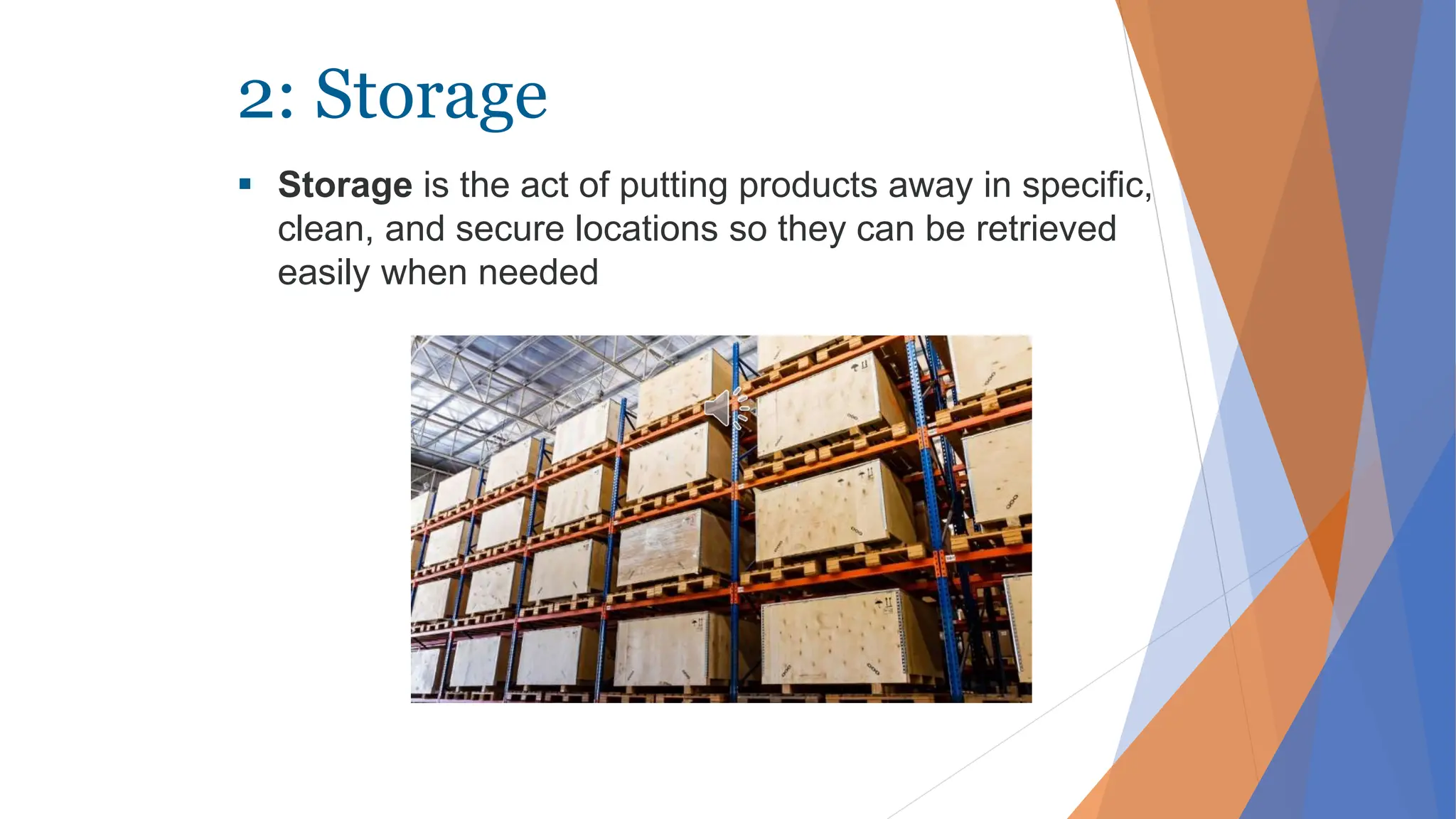
2: Storage
 Storage is the act of putting products away in specific,
clean, and secure locations so they can be retrieved
easily when needed
Strategies for Storage
Minimal Handing
 The most efficient management practice is minimizing the number of
times a product is handled
 Ideally items are received, stored, and shipped out
Product Demand
 Important key for proper storage is determining demand for particular
items
 Sometimes high demand items are never stored but moved directly to
outbound shipping area
 Low demand items may be stored in the farthest places in a
warehouse
Strategies for Storage
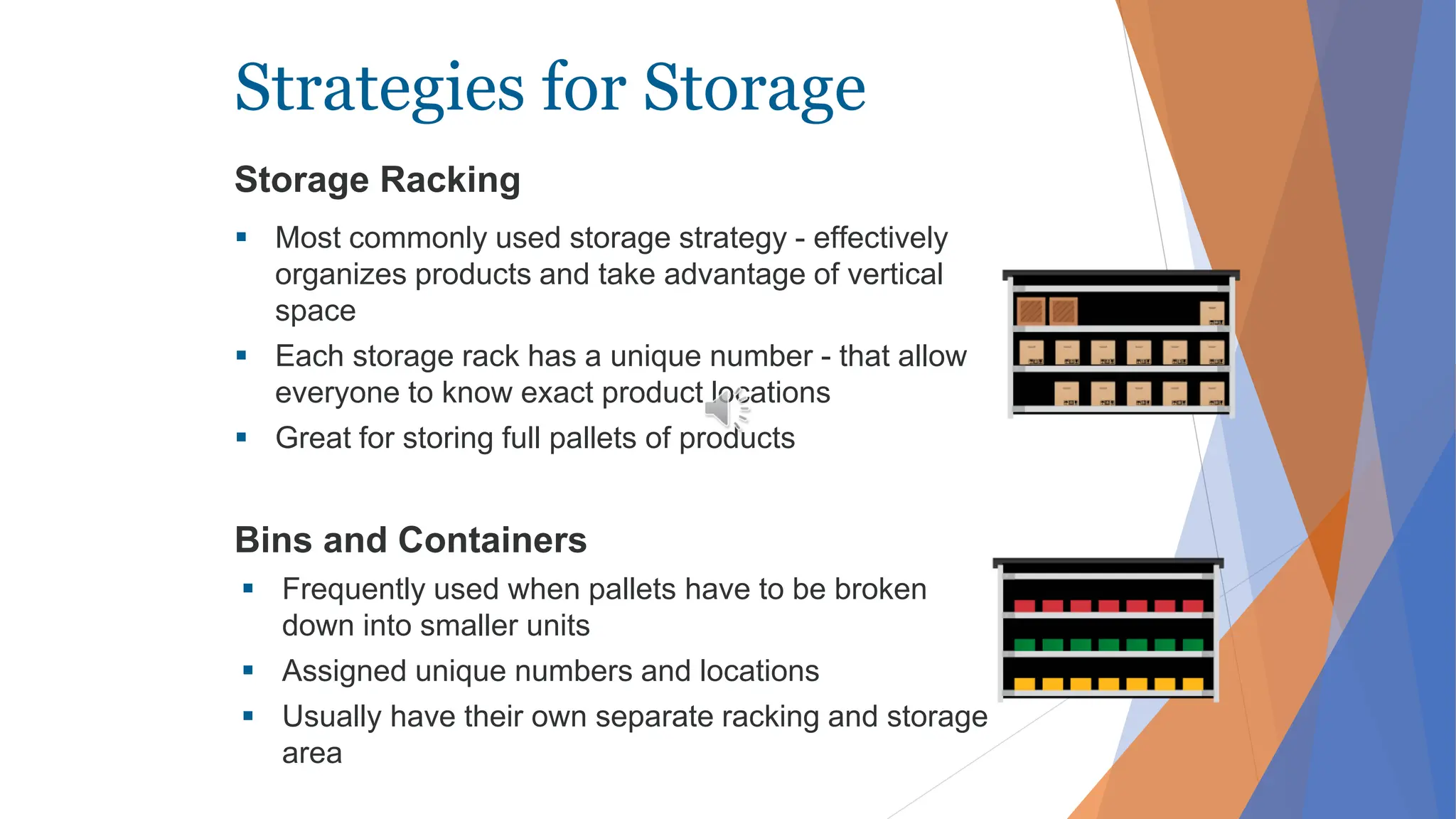
Storage Racking
 Most commonly used storage strategy - effectively
organizes products and take advantage of vertical
space
 Each storage rack has a unique number - that allow
everyone to know exact product locations
 Great for storing full pallets of products
Bins and Containers
 Frequently used when pallets have to be broken
down into smaller units
 Assigned unique numbers and locations
 Usually have their own separate racking and storage
area
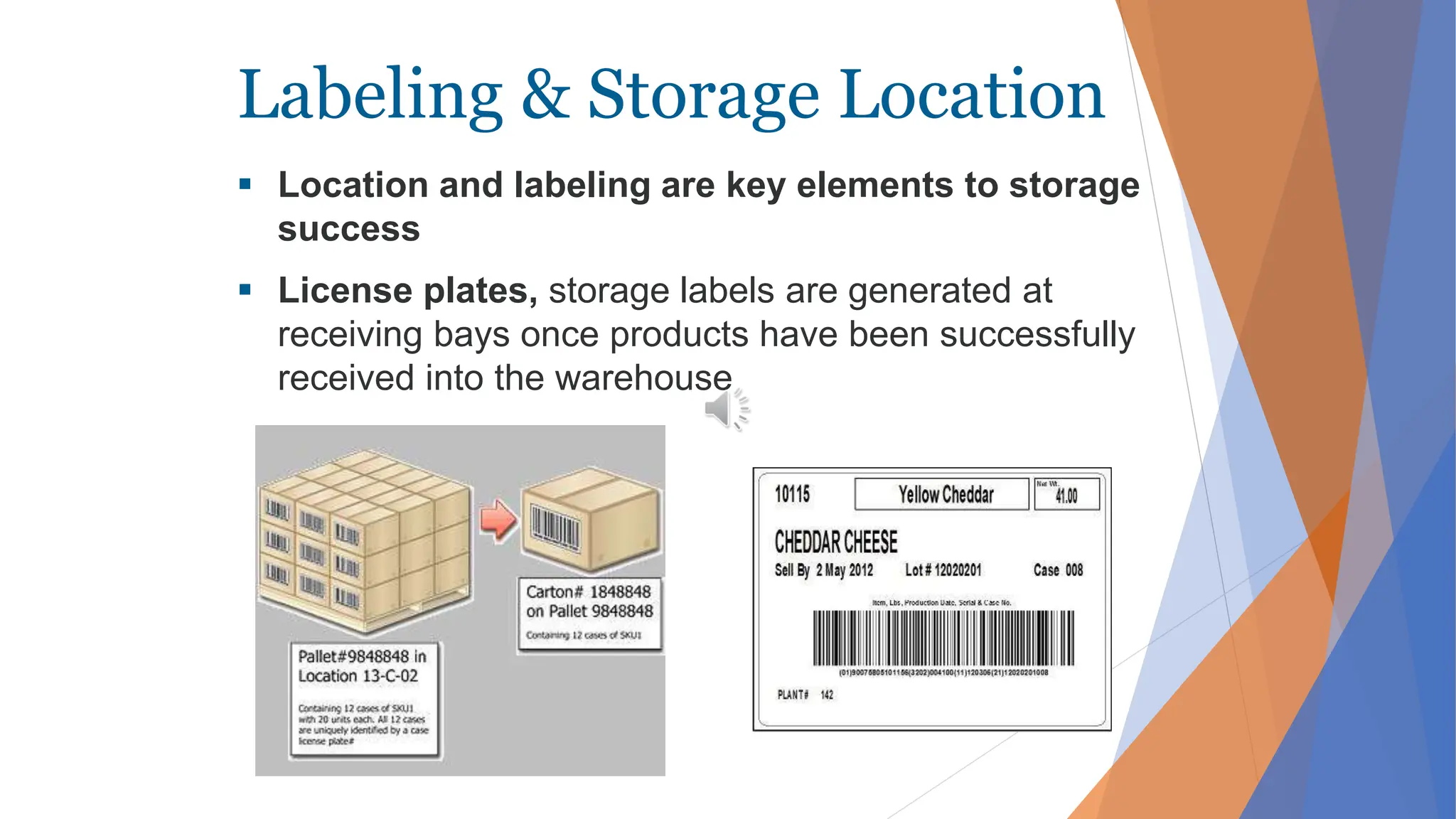
Labeling & Storage Location
 Location and labeling are key elements to storage
success
 License plates, storage labels are generated at
receiving bays once products have been successfully
received into the warehouse
3: Order Fulfillment
 This process starts when orders are placed by
customers
 Order Picking: products are located and brought out of
storage location
 Accuracy and speed are key concerns of order fulfillment
and order picking
Picking Types
 Manual Picking: Order pickers physically pick one item from
orders and bring it back to the shipping staging area
 Order Picking: Items are picked individually for an entire
orde; Once finished, pickers will take orders to the shipping
staging area
 Batch Picking: Pickers focus on picking a batch of items for
several different order; Improves picking efficiency and
accuracy
 Zone Picking: Warehouses are divided into zones; Picker(s)
are assigned to one specific zone or area; They pick all items
in their zone for any order
Picking Types
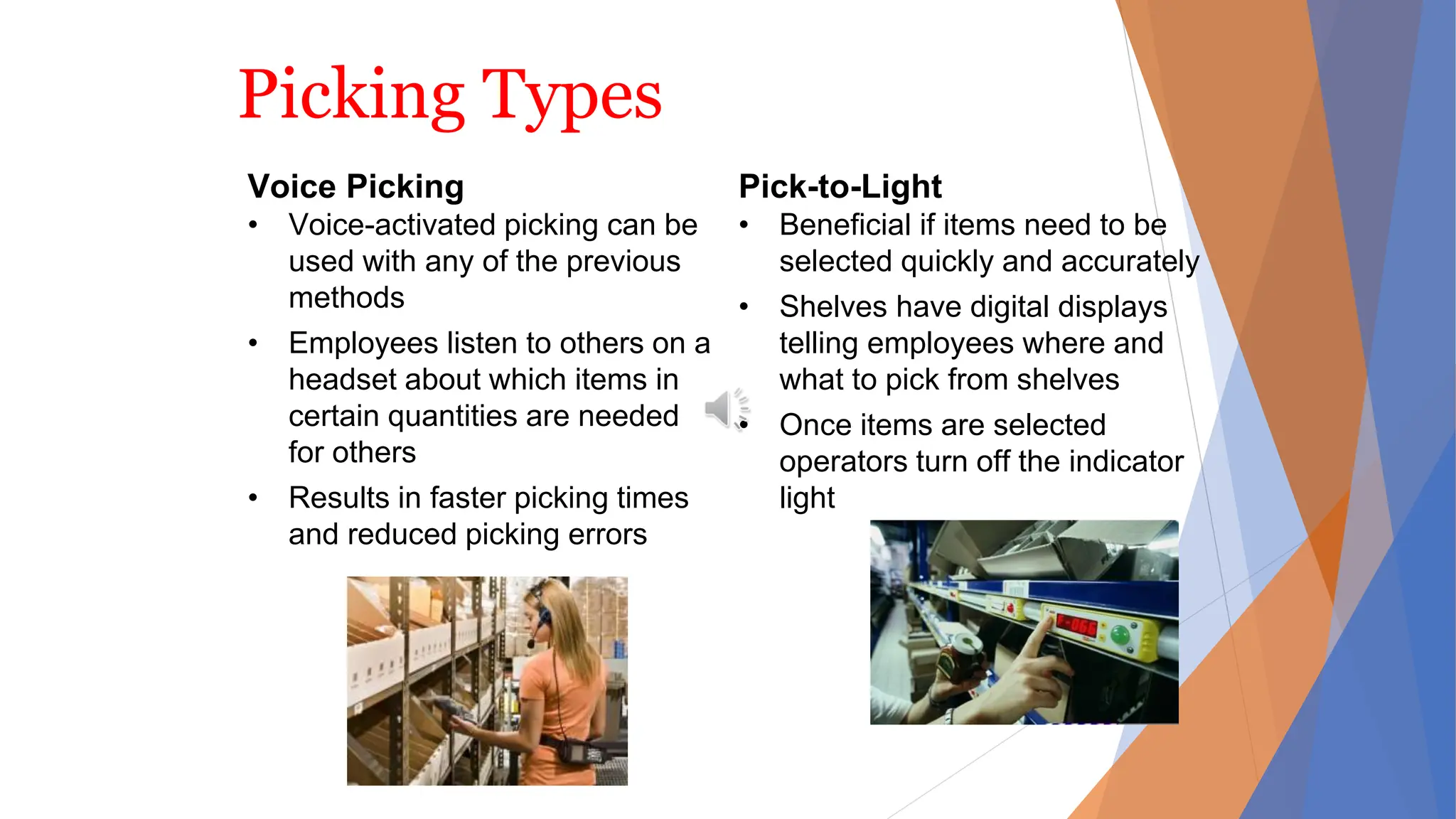
Voice Picking
• Voice-activated picking can be
used with any of the previous
methods
• Employees listen to others on a
headset about which items in
certain quantities are needed
for others
• Results in faster picking times
and reduced picking errors
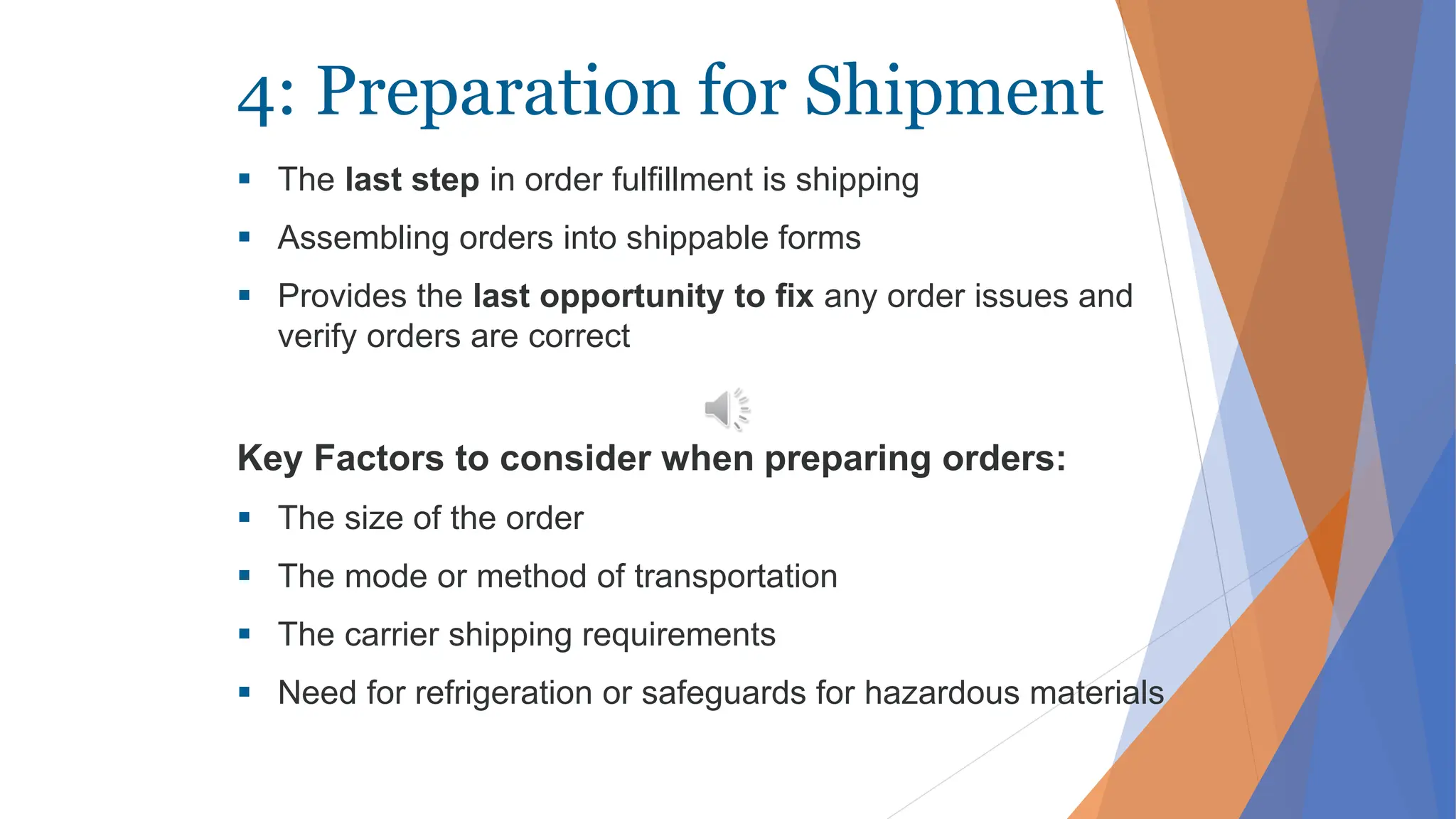
Pick-to-Light
• Beneficial if items need to be
selected quickly and accurately
• Shelves have digital displays
telling employees where and
what to pick from shelves
• Once items are selected
operators turn off the indicator
light
4: Preparation for Shipment
 The last step in order fulfillment is shipping
 Assembling orders into shippable forms
 Provides the last opportunity to fix any order issues and
verify orders are correct
Key Factors to consider when preparing orders:
 The size of the order
 The mode or method of transportation
 The carrier shipping requirements
 Need for refrigeration or safeguards for hazardous materials
Safety & Cleanliness
 Staging Area: the zone where products come off or go
onto trucks
 Safety is of utmost importance - this often the busiest
and most dangerous area in warehouses / DCs
 One way to make warehouses is safe is by ensuring they
are clean - It is everyone's job to keep warehouses
neat and clean
 Safety and organization also extends to the loading
process
Shipping Documentation
Bill of Lading
 The most important document, travels with the trucks
 Contract saying that a specific set of goods have been received by
a specific carrier as cargo to be delivered to a specific location and a
specific receiver
 Considered the official documentation that can be requested by
government officials
Shipping/Packing Lists, Shipping Manifest, and Waybill
 Itemized document that itemizes the complete inventory load
 It provides more details about the products than the bill of lading
Tracking
 Tracking is accomplished by entering data into a
transportation system with a unique identifier
 Today, customer service is priority, so carriers and
shippers track shipments.
Learning Block 4:
Inventory Management
What is Inventory?
 Inventory: the physical assets that are held or stored for
use, at some point, in…
Manufacturing products
Completing partially manufactured products
Direct sales to customers
Operating maintenance tasks
 Represents a monetary investment and therefore
needs to be turned to make a profit
Inventory Management
 Not all inventory is created equally
 Inventory management – the process of ensuring the
availability of products through inventory administration
 Inventory control will sometimes be used
interchangeable with inventory management
 Seeks to balance the risk between stockouts and leftover
inventory
Inventory Costs
 Acquisition Cost: The net price plus other costs needed
to purchase an item and move it to the point of use
 Carrying Cost: Costs of holding inventory, which may
include:
Warehousing costs
Labor
Risk of expiration or obsolescence that requires disposal
Damage
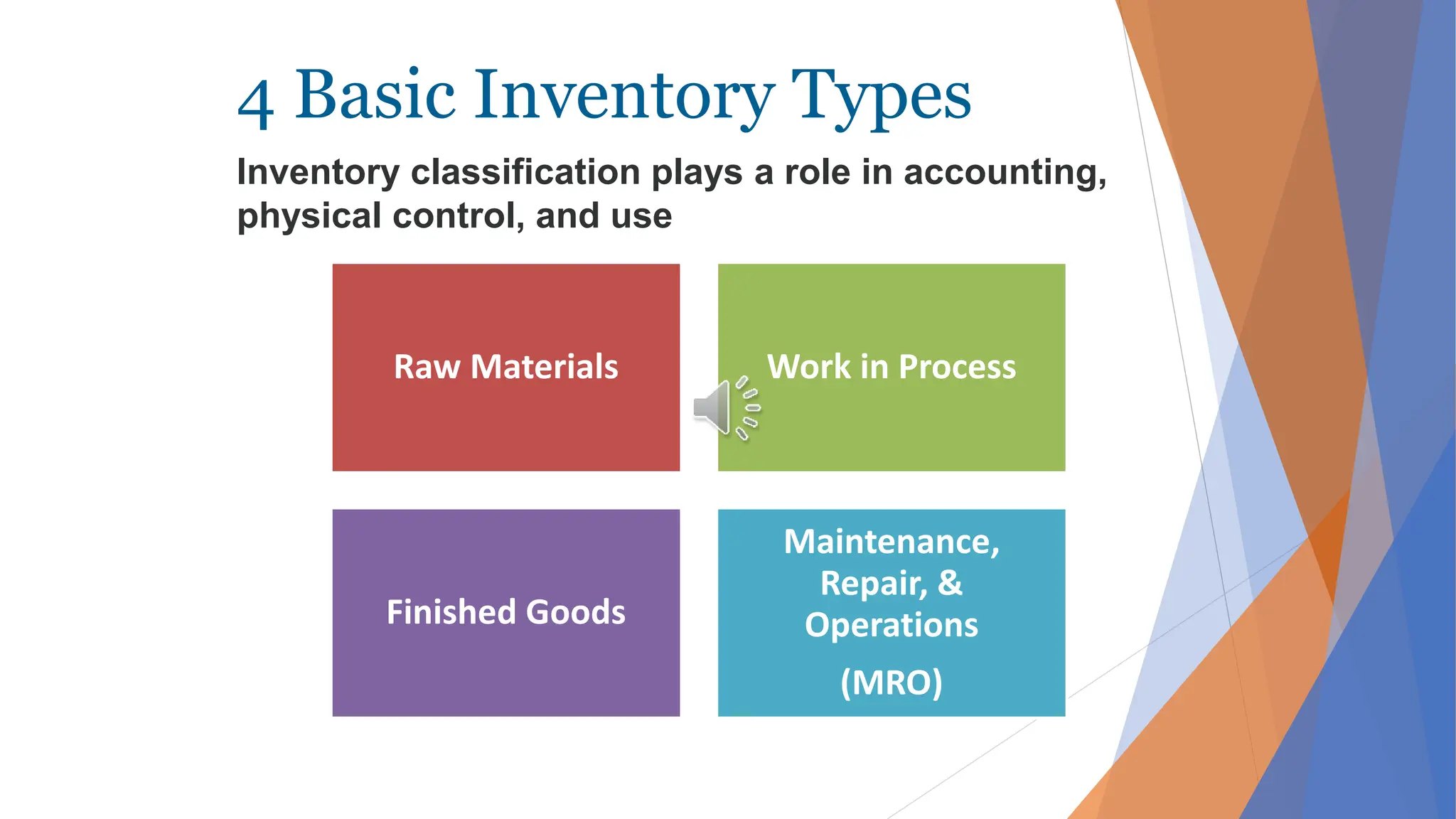
4 Basic Inventory Types
Inventory classification plays a role in accounting,
physical control, and use
Raw Materials Work in Process
Finished Goods
Maintenance,
Repair, &
Operations
(MRO)
Raw Materials
 Raw Materials - raw materials include any items consumed to
make finished goods
Raw materials from nature
Sub-categories: parts, components, semi-processed goods, catalysts,
commodities, critical components, packaging
 Work in Process - inventory that has been moved out of raw
materials and is in staging for manufacturing
Can be consumed to make finished goods, returned to raw materials,
or re-categorized as scrap
Work in Process
Finished Goods
 Finished Goods - can be a completed product, a component
that will be consumed in future manufacturing, or a service
repair part that can be sold
Finished goods may be unsellable for multiple reasons: Obsolete,
Rework, Return, Quarantine
 Maintenance, repair, and operating (MRO) - is not directly
consumed in the manufacturing and operations - is product that is
consumed to support the operations to manufacture and manage
inventory
gears to repair a conveyor, grease to lubricate machines
Maintenance, Repair, &
Operating (MRO)
Lead Time
 Lead Time: the average time from placing an order with
a supplier to receiving goods
 Increased lead time contributes directly to higher
inventory levels and greater inaccuracy in forecasting
 Longer lead times reduces flexibility because
adjustments are more difficult when merchandise is
ordered
Inventory Turns
 Inventory Turns: the metric that tracks how often product is used
and replaced in a given time period
high inventory turns = products are moving off the shelf quickly
low inventory turn ratio = can also indicate low sales and even
overstocking of inventory
 Lean: operational and procedural practices that create efficient flow
– tasks that do not contribute value are reduced or eliminated
 Just-in Time (JIT): an inventory control system where a company
receives raw materials as they are needed for manufacturing, which
can eliminate or dramatically reduce raw material warehousing and
material costs
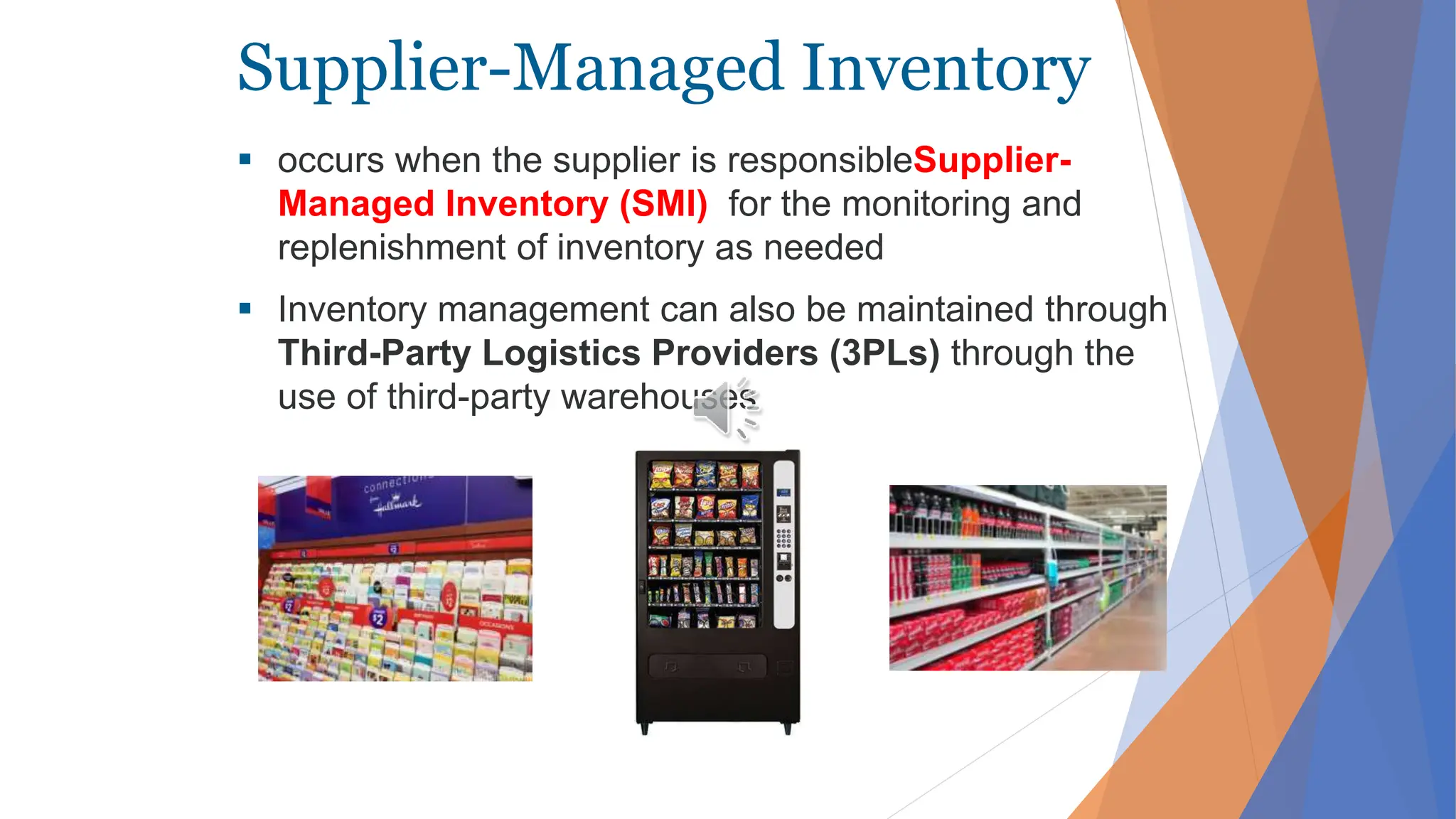
Supplier-Managed Inventory
 occurs when the supplier is responsibleSupplier-
Managed Inventory (SMI) for the monitoring and
replenishment of inventory as needed
 Inventory management can also be maintained through
Third-Party Logistics Providers (3PLs) through the
use of third-party warehouses
Learning Block 5:
Manufacturing & Service
Operations
What is a Process?
 Process: a set if individual activities that are combined
to product a product, service, or a combination or
products and services
 4 Elements of Processes
Inputs: raw or unfinished materials
Outputs: end product
Controls: rules, policies, guidelines
Resources: equipment, tools, supplies, labor
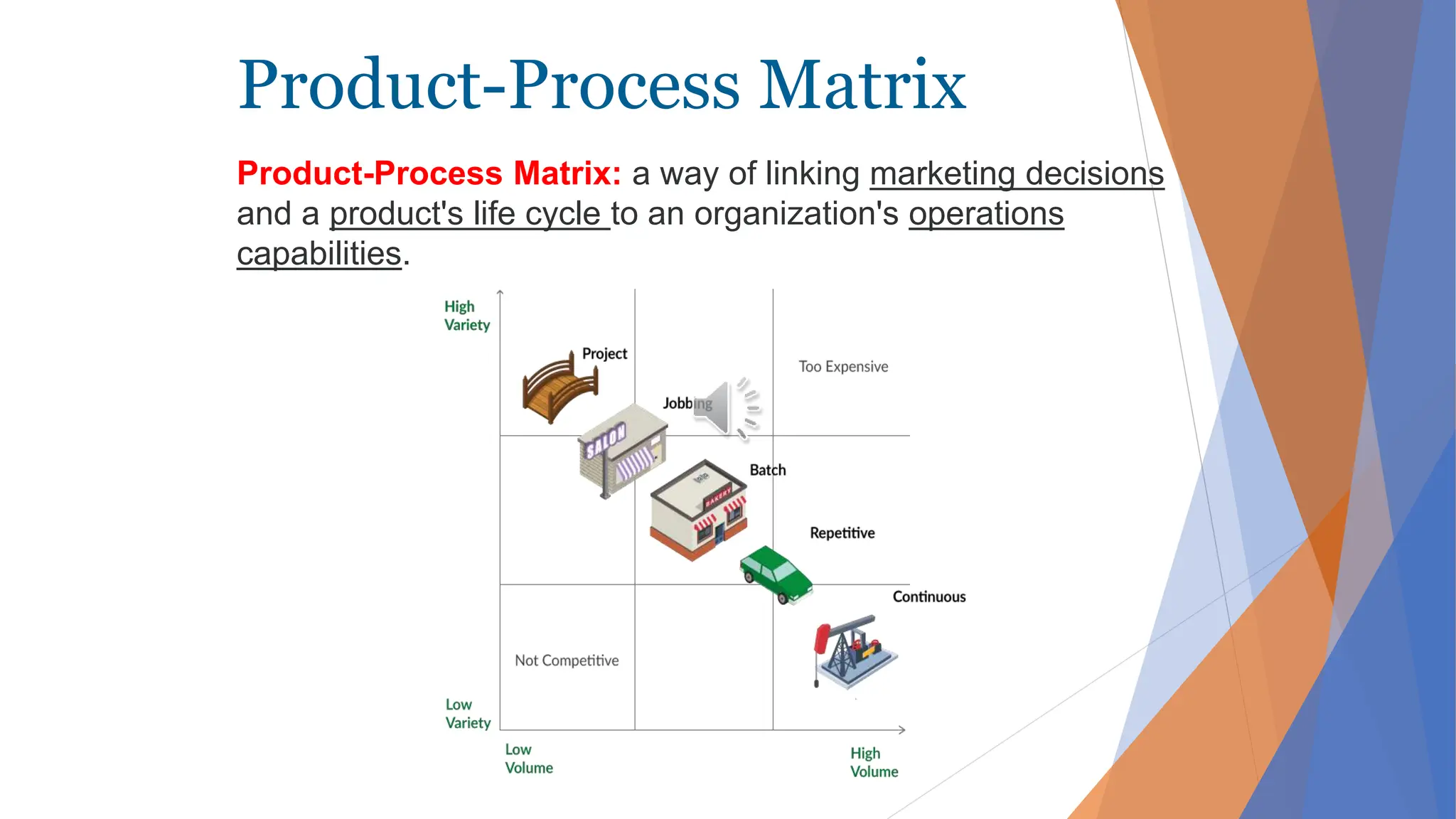
Product-Process Matrix
Product-Process Matrix: a way of linking marketing decisions
and a product's life cycle to an organization's operations
capabilities.
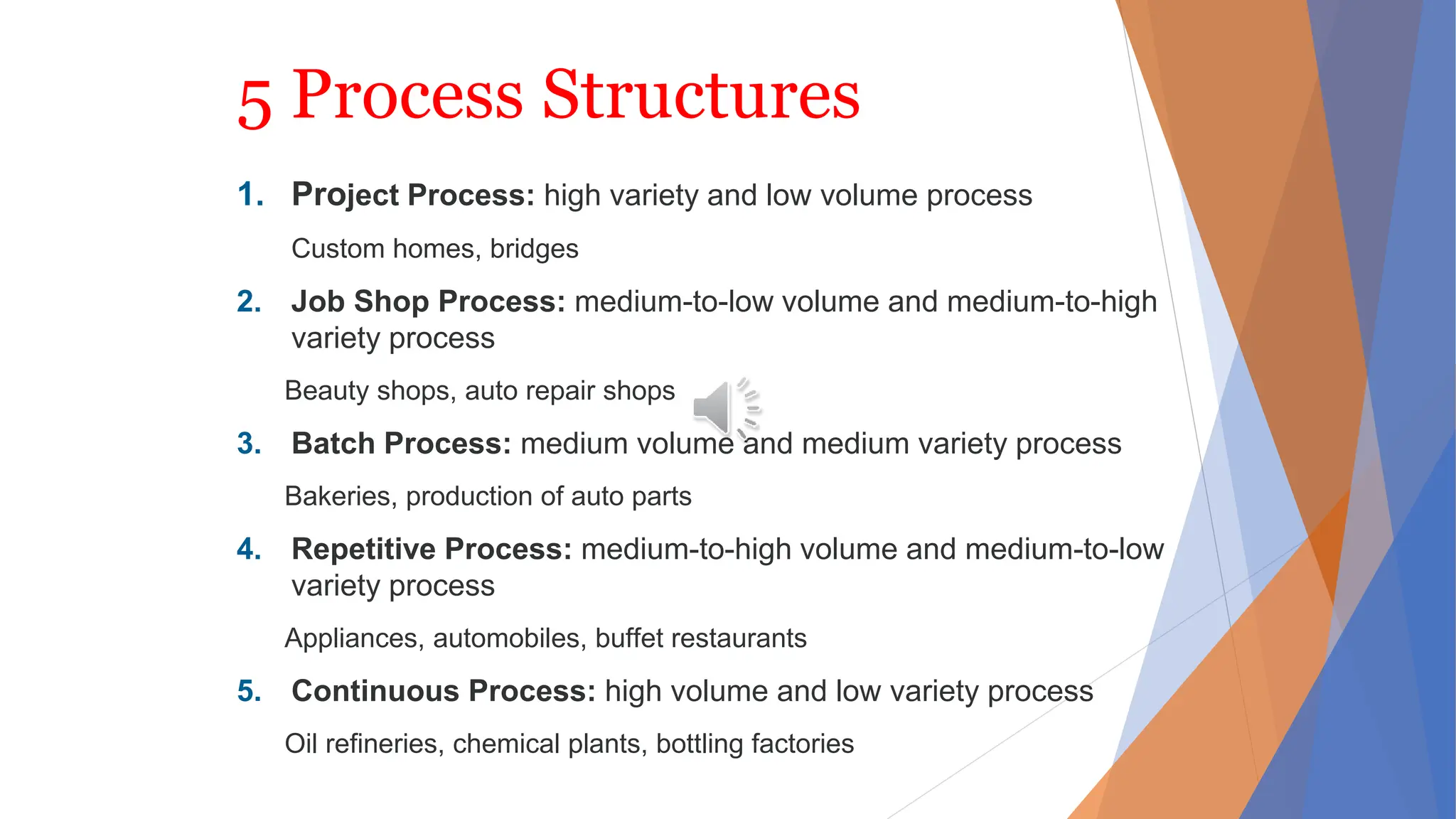
5 Process Structures
1. Project Process: high variety and low volume process
Custom homes, bridges
2. Job Shop Process: medium-to-low volume and medium-to-high
variety process
Beauty shops, auto repair shops
3. Batch Process: medium volume and medium variety process
Bakeries, production of auto parts
4. Repetitive Process: medium-to-high volume and medium-to-low
variety process
Appliances, automobiles, buffet restaurants
5. Continuous Process: high volume and low variety process
Oil refineries, chemical plants, bottling factories
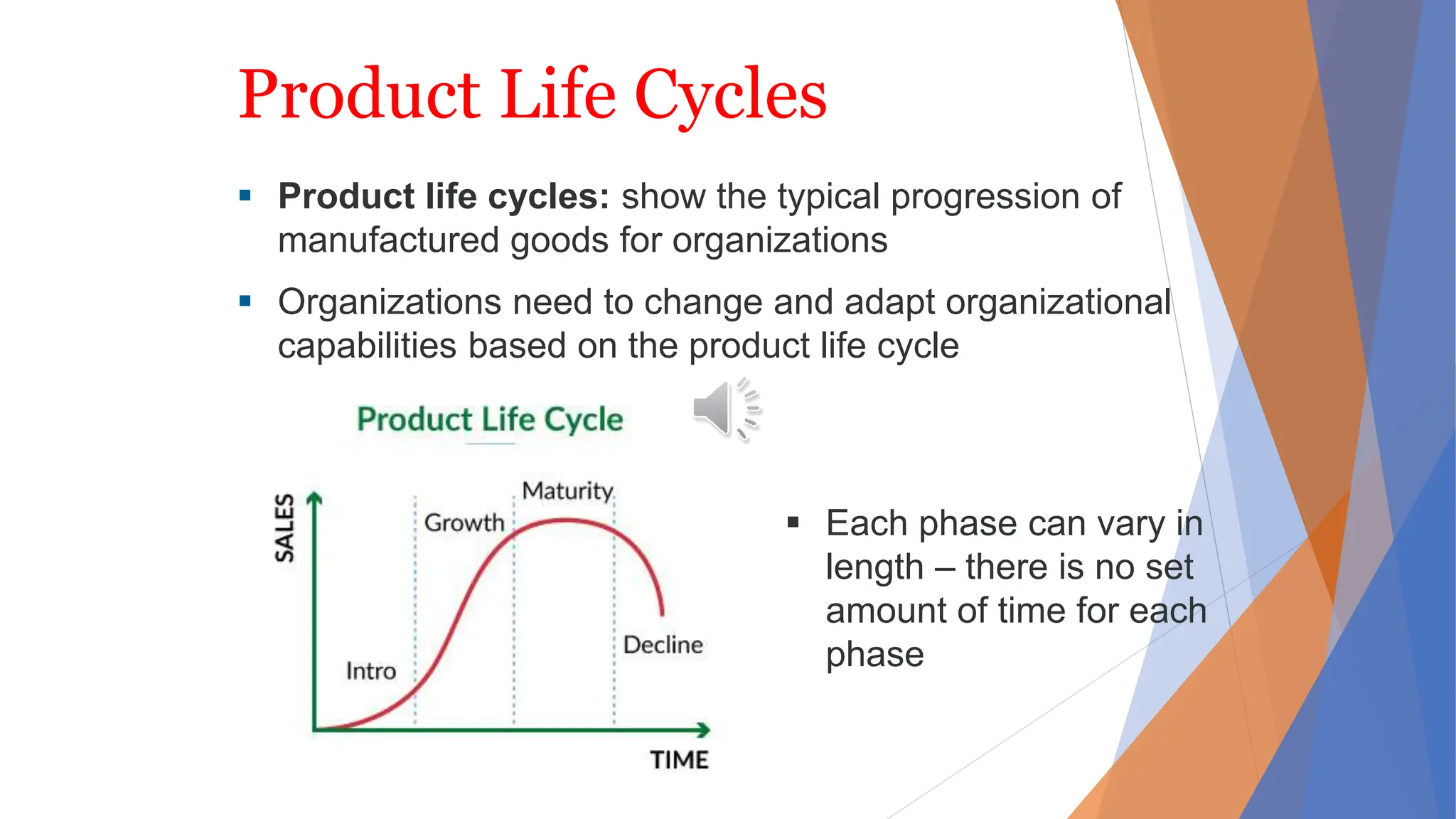
Product Life Cycles
 Product life cycles: show the typical progression of
manufactured goods for organizations
 Organizations need to change and adapt organizational
capabilities based on the product life cycle
 Each phase can vary in
length – there is no set
amount of time for each
phase
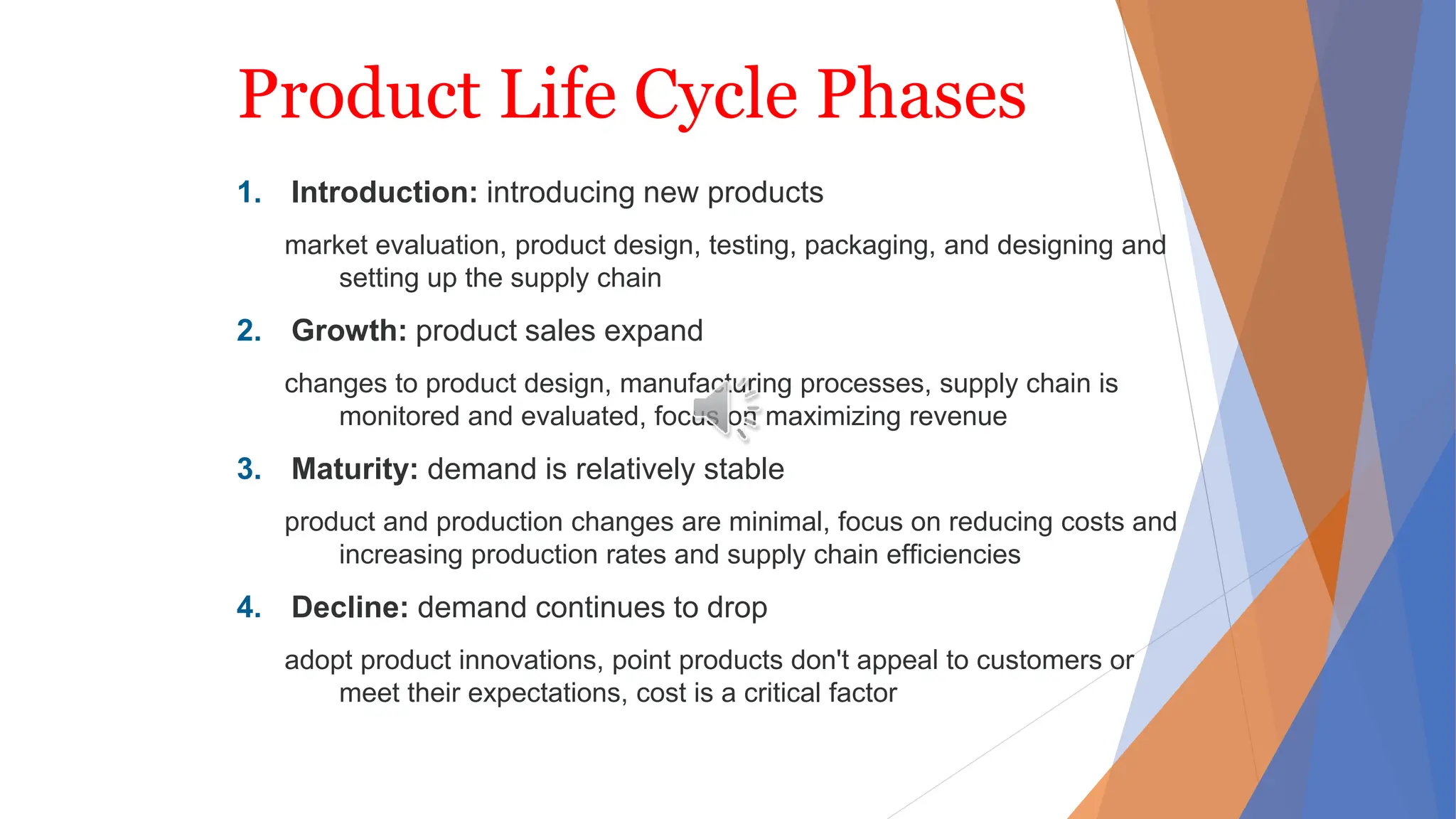
Product Life Cycle Phases
1. Introduction: introducing new products
market evaluation, product design, testing, packaging, and designing and
setting up the supply chain
2. Growth: product sales expand
changes to product design, manufacturing processes, supply chain is
monitored and evaluated, focus on maximizing revenue
3. Maturity: demand is relatively stable
product and production changes are minimal, focus on reducing costs and
increasing production rates and supply chain efficiencies
4. Decline: demand continues to drop
adopt product innovations, point products don't appeal to customers or
meet their expectations, cost is a critical factor
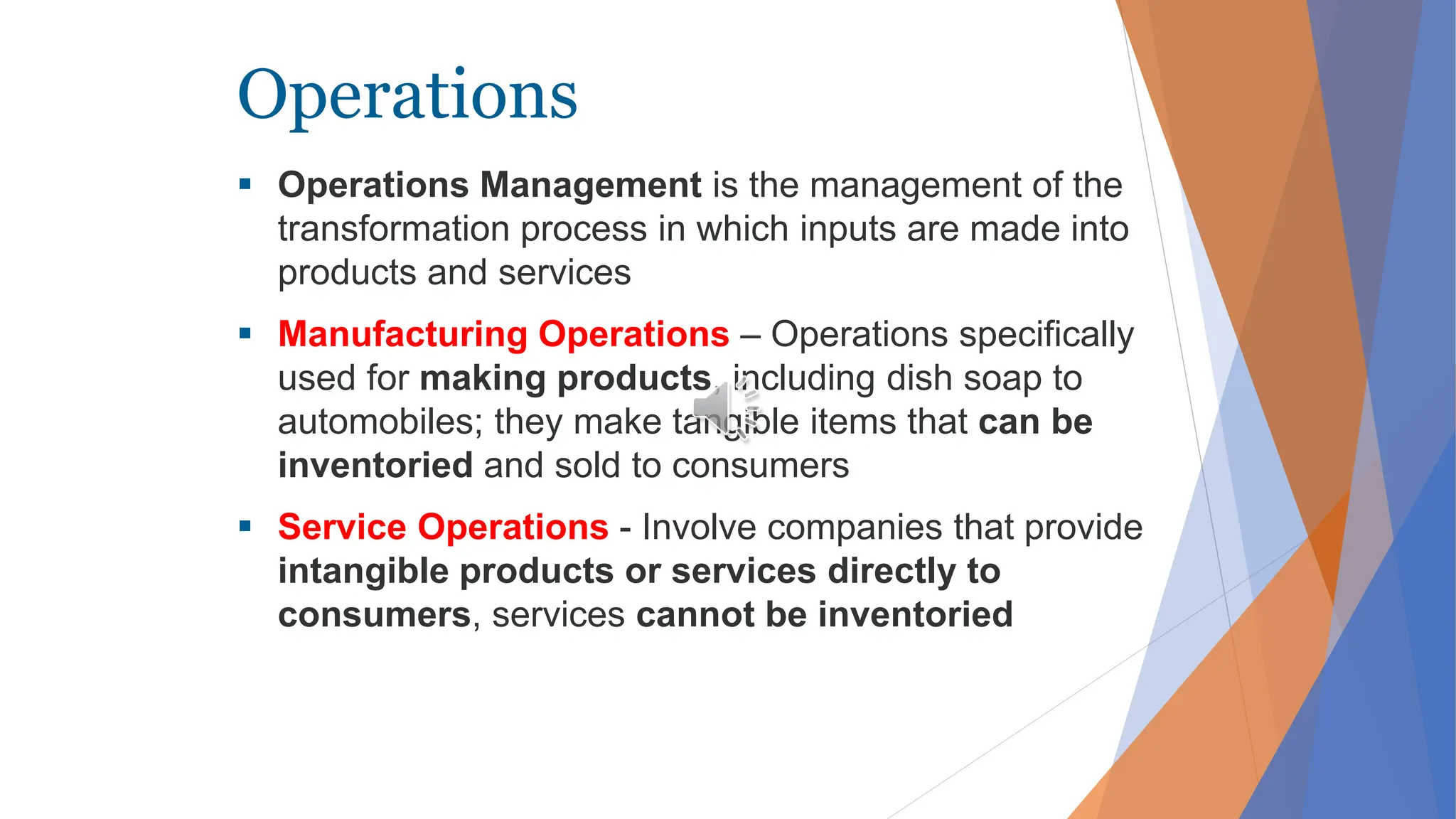
Operations
 Operations Management is the management of the
transformation process in which inputs are made into
products and services
 Manufacturing Operations – Operations specifically
used for making products, including dish soap to
automobiles; they make tangible items that can be
inventoried and sold to consumers
 Service Operations - Involve companies that provide
intangible products or services directly to
consumers, services cannot be inventoried
How Products are Sold
 Engineering-to-Order (ETO)
Long lead times and highly customized products
Customer orders are required before any work begins, once orders
are received, the process and new designs begin
Custom home, individually designed yacht
 Make-to-Order (MTO)
Larger customer base and allows for some customization
Orders are required before beginning the production process, most of the
design work is complete and some parts may be in inventory
Jet airplane, haircut, purchasing a mobile home
How Products are Sold
 Assemble to Order (ATO)
Products are assembled from standardized parts and modules
Usually several assembly options available to customers
Restaurants with assembly lines, hardware stores that mix paint
 Make-to-Stock (MTS)
Mass produce goods to be kept in inventory, ready to ship for customer
orders
Use demand forecasting to estimate production - best for mature products
Books, cars, groceries, retail clothing
Service Operations
 Service Operations: usually provides intangible
services directly to consumers, end products cannot be
inventoried
 Require some amount of interaction with consumers
 Inherently variably because of the customer
interactions and unpredictable nature of humans
 Customers contribute as much to the end product as
many service providers do
How Services are Offered
 Service Factory
Low labor cost, low customization, and low customer interactions
Customers focus on price and look for the best deal
Operations managers focus efforts on facilities and equipment utilization by
maximizing output and keeping costs low
Hotels, trucking companies, airlines
 Service Shop
High customization and customer interaction, but low labor and costs
Need to stay current with technology updates and scheduling
Auto repair shops
How Services are Offered
 Mass Service
Low customization and customer interaction, but high labor costs
Operations managers concerned with improving service times and
automated technologies
Retail banks
 Professional Shop
High customization, customer interaction, and labor costs
Service providers are highly educated and the services they perform are
time consuming and customized
Accountants, consultants, doctors, lawyers
Total Quality Management
 Total Quality Management (TQM): a focus on
designing processes to produce consistent quality
emphasis on quality is consistent throughout the entire organization
continuous quest to achieve improvements in product, service,
equipment, people, procedures, material, etc.
 Six Sigma - identifying the root cause of errors and
fixing them
 Lean - removing activities that do not add value
Learning Block 6:
Transportation Operations
Transportation Efficiency
 Demand for transportation services is derived from
customer demand
 7 Rights of Logistics: Transporting the…
right product
to the right customer
in the right quantity
and the right condition
at the right place
and the right time
and for the right cost.
Transportation Challenges
 Complexity of supply chains
 Growth of offshore manufacturing
 Customer demands for more tailored services
 Capacity constraints from other types of infrastructure
 Rising transportation rates
 Government regulations
Road Transport (Motor Carrier)
 Most widely used domestic mode of transportation - most
freight is regional in a nature
 Mode of choice for high-value, time-sensitive goods
 Challenges: rising costs, labor issues, and competition
 Mode of choice with large volume and shipment is over 900
miles
 Primarily used for long-distance or low-value raw materials
and manufactured products
 Challenges: large investment in terminals, capacity, and
unchangeable infrastructure
Rail Transport
Air Transport
 Historically viewed as expensive (emergency use)
 JIT demand, lower inventory levels, and growth of e-
commerce has increased demand
 Mode of choice to ship small quantities of high value, low-
weight, semi-finished, and finished goods
 Major mode for international trade
 Dominates all modes in international freight revenue
 Ships are slow, but offer tremendous capacities for volume
freight, efficient fuel consumption, and low cost
Water Transport
Pipeline
 “Hidden giant" of transportation
 Equipment is fixed in place, providing a warehousing function
and protecting the product from contamination
 Most economical form of transportation with the lowest cost
per ton-mile
 For-hire and private carriers
 Challenges: ongoing issues of safety and security
Intermodal Transportation
 Intermodal Transportation: two or more independent
modes used to transport and deliver the same cargo
Cargo stays in one standard container throughout the
transportation process
Has seen significant growth in the last 20 years
Freight Documentation
 Shipments are accompanied by documentation that details
what the shipment contains, where it is going, and to
whom it is shipping
 Common Shipment Documents
Bill of Lading
Freight Invoice / bill
Freight Claim
Freight Documentation
 Freight Invoice / Bill
Does not serve as a key piece of evidence in disputes
Include specific information, including transaction-related
information and charges that serve to describe the
information on the bill of lading
 Freight Claim
Legal claim by shippers against carriers for financial
compensation for loss or damage of shipment
3 types of Freight Claims: Shortage/Loss, Damage, Delay
Concealed damage: discovered after shipments have been
received and signed for; no visible damage to cartons or products
Safety & Security
 Governmental deregulation has provided carriers with
more feed to operate in competitive environments
 Hours of Service (HOS) Regulations
11 hours of driving time within a consecutive 14-hour period,
after which drivers must be off-duty for 10 hours
Limits maximum workweek to 70 hours
Drivers who reach 70 hours within a week, may resume
driving if they rest for 34 consecutive hours
30 minute break during the first 8-hours of a shift
Quality of Service
 Companies monitor and track the following to ensure quality
of service:
Customer service demands
Service level of carriers
Shipment date, arrival date, and shipment damage information
Use of standardized scorecards
 Key Performance Indicators (KPIs)
Transportation efficiency spending
Freight protection
Delivery service quality
Customer satisfaction
Transportation Management
Systems (TMS)
 Transportation Management Systems: include software
tools related to moving goods throughout the supply chain and
work in conjunction with other management tools (WMS, order
managements systems, supply chain planning tools)
 TMS Capabilities:
Routing and scheduling
Planning how to load containers or vessels
Tracking orders
Performance reporting and score carding
Auditing freight bills
Inbound, Outbound, & Reverse
Logistics
 Inbound Logistics: The transport, storage, and delivery of
goods coming into businesses. Covers anything companies
order from all suppliers.
 Outbound Logistics: The transport, storage, and delivery of
goods that are leaving businesses. Deals almost exclusively
with end products.
 Reverse Logistics: The transportation of good that need to
be returned through the supply chain because of defects or
because products have reached the end of their usage
Learning Block 7:
Customer Service Operations
Internal & External Customers
Internal Customers
 Customers within the same company or organization
 One department relies on another department for a
product/service
External Customers
 Customers outside an organization
 Usually consumers of the products/services
 Retailers may purchase products from wholesale distributors
to resell them to customers
CUSTOMERS ARE OFTEN CONFUSED WITH CONSUMERS
Customer Service
 Customer service is a key competitive advantage and a part
of every interaction with customers.
 Employees must act as ambassadors for their company.
 Customer service representative must be trained and be
proficient in:
Order process and customer relationship management (CRM)
Communications
Returns and reverse logistics
Challenging customers
Legal and regulatory concerns
The Order Cycle
The customer order cycles occurs when customers
interact with suppliers.
Relationship Management
 Customer Relationship Management (CRM)
The term given to developing different strategies to serve
most effectively the full range of customers that interact with
a company
CRM may also be used to refer to the computer systems that
help support the process of CRM
 Customer Life Cycle:
The term used to describe the relationship used by a
company to find, manage, retain, and develop interactions
with customers
Communications
 Communication involves the transfer of information
 Effective communicators need to:
Understand to whom they communicate
The message they communicate
The most appropriate form of communication
 Communication Channels
Verbal communication
Listening
Nonverbal communication
Written ciommunication
Challenging Customers
 Customer service representatives should have patience,
skill, and good communication skills when working with
challenging customers
 Challenging customers may be:
Angry or openly antagonistic and aggressive
Lacking good communication skills and the ability to express their
thoughts
Arrogant or supreme attitude
Prone to making unwarranted personal attacks
Overly talkative and lack the will or ability to listen
Inventory Optimization

addtionalinventorylecture-part 2.pptx addtionalinventorylecture-part 2.pptx

  • 1.
  • 2.
    Inventory Management Inventory refers tothe goods and materials that a business holds for the purpose of resale or use in production. It includes raw materials, work-in-progress (unfinished goods), and finished products ready for sale. Inventory plays a crucial role in business operations for several reasons:
  • 3.
    Inventory Management 1. Meeting CustomerDemand: Maintaining appropriate inventory levels ensures that businesses can fulfill customer orders promptly. This availability enhances customer satisfaction and helps retain clients. 2. Smooth Production and Operations: For manufacturing companies, having sufficient raw materials and components on hand ensures uninterrupted production. This helps in meeting production schedules and avoiding delays. 3. Buffer Against Uncertainty: Inventory serves as a buffer against fluctuations in demand or supply chain disruptions. It allows businesses to manage unexpected increases in demand or delays in receiving raw materials. 4. Economies of Scale: Holding inventory allows businesses to take advantage of economies of scale by ordering materials and products in larger quantities. This can lead to lower per-unit costs and increased profitability.
  • 4.
    Inventory Management 5. Supports Salesand Marketing Strategies: Businesses can leverage inventory to support sales and marketing strategies, such as offering promotions or discounts on excess inventory to increase sales. 6. Asset for Financial Purposes: Inventory is considered an asset on the balance sheet, which can be used as collateral for securing loans or financing for business expansion. 7. Strategic Planning and Decision Making: Accurate inventory data helps businesses make informed decisions about production, purchasing, pricing, and resource allocation. It supports strategic planning by providing insights into market trends and consumer behavior. 8. Optimizing Inventory Management: Effective inventory management practices, such as just-in- time (JIT) inventory systems or inventory turnover ratios, help businesses minimize holding costs while maximizing operational efficiency.
  • 5.
    Inventory Management In summary, inventoryis essential for businesses as it ensures operational continuity, supports sales and production activities, enhances financial stability, and enables strategic decision-making. Effective management of inventory levels is crucial for balancing supply and demand dynamics and maintaining competitive advantage in the marketplace.
  • 6.
    Inventory Management Effective inventory managementis crucial for businesses across various aspects of their operations. Here are several key reasons why: 1. Cost Reduction: Efficient inventory management helps minimize holding costs associated with storing excess inventory, such as storage space, insurance, and obsolescence. By optimizing inventory levels through methods like just-in-time (JIT) inventory systems or economic order quantity (EOQ), businesses can reduce carrying costs and improve overall profitability. 2. Meeting Customer Demand: Maintaining the right amount of inventory ensures that businesses can fulfill customer orders promptly. Stockouts (when demand exceeds supply) can lead to lost sales and dissatisfied customers, while excess inventory ties up capital unnecessarily. Effective inventory management helps strike a balance where customer demand can be consistently met without overstocking. 3. Optimizing Production Efficiency: For manufacturing companies, having the right amount of raw materials and components on hand is crucial for uninterrupted production. This prevents delays and ensures that production schedules are met efficiently, which in turn supports overall operational efficiency and reduces production costs. 4. Improved Cash Flow: Inventory ties up capital that could be used elsewhere in the business. Effective inventory management practices help minimize the amount of capital tied up in inventory, thus improving cash flow. This freed-up capital can be reinvested in other areas of the business or used for strategic initiatives.
  • 7.
    Inventory Management Effective inventory managementis crucial for businesses across various aspects of their operations. Here are several key reasons why: 5. Strategic Decision Making: Accurate inventory data and insights provided by effective inventory management systems enable businesses to make informed decisions. This includes decisions related to purchasing, production planning, pricing strategies, and resource allocation. Such strategic decisions are essential for maintaining competitiveness and adapting to changes in the market environment. 6. Reduced Risk of Obsolescence: Poor inventory management can lead to obsolete or expired inventory, which results in financial losses for the business. By monitoring inventory levels and implementing inventory turnover strategies, businesses can reduce the risk of holding obsolete stock and minimize write-offs. 7. Enhanced Customer Satisfaction: Consistently meeting customer demand through effective inventory management contributes to improved customer satisfaction. Customers receive their orders on time and in full, leading to positive experiences and potentially repeat business. 8. Compliance and Risk Management: In industries with regulatory requirements or volatile supply chains, effective inventory management helps businesses comply with regulations and manage risks associated with supply disruptions, quality issues, or changes in market conditions.
  • 8.
    Inventory Management In conclusion, effectiveinventory management is crucial because it directly impacts cost reduction, customer satisfaction, production efficiency, cash flow, strategic decision-making, and risk management. Businesses that prioritize and optimize their inventory management practices are better positioned to achieve operational excellence and maintain a competitive edge in their respective markets.
  • 9.
    Types of Inventory Raw materials,work-in-progress (WIP), and finished goods are three primary categories of inventory that businesses typically manage. Here’s a brief explanation of each: 1. Raw Materials: • Definition: Raw materials are the basic materials and components used in the production process to manufacture finished goods. • Examples: For a furniture manufacturer, raw materials could include wood, screws, nails, upholstery fabric, and other materials used in the construction of furniture. • Importance: Raw materials are essential for production. Ensuring an adequate supply of raw materials is crucial to maintain uninterrupted production schedules and meet customer demand.
  • 10.
    Types of Inventory • Examples:Wood, metal, fabric, chemicals, etc. • Management Challenges: 1. Procurement and Sourcing: Challenges may include finding reliable suppliers, managing supplier relationships, and ensuring a stable supply of high-quality materials. 2. Inventory Optimization: Balancing between maintaining sufficient inventory to support production needs without overstocking to avoid tying up capital or storage space. 3. Price Fluctuations: Raw material prices can be volatile due to factors like market demand, geopolitical issues, and weather conditions, posing challenges in cost management and pricing strategies.
  • 11.
    Types of Inventory Raw materials,work-in-progress (WIP), and finished goods are three primary categories of inventory that businesses typically manage. Here’s a brief explanation of each: 2. Work-in-Progress (WIP): • Definition: Work-in-progress refers to goods that are in the process of being manufactured but are not yet completed. • Examples: In a manufacturing plant, WIP includes partially assembled products or products undergoing various stages of production. For example, an automobile on an assembly line with the chassis and engine installed but awaiting paint and final assembly is considered WIP. • Importance: Managing WIP is critical to optimizing production efficiency and reducing lead times. It ensures that production processes flow smoothly and that resources are utilized effectively to complete goods according to schedule.
  • 12.
    Types of Inventory • Examples:Partially assembled products or products in various stages of production. • Management Challenges: 1. Production Planning: Ensuring smooth flow and synchronization of production processes to avoid bottlenecks and delays in completing WIP. 2. Quality Control: Monitoring and ensuring the quality of goods at each stage of production to minimize defects and rework. 3. Inventory Visibility: Maintaining visibility and tracking of WIP inventory across different production stages to optimize resource allocation and scheduling.
  • 13.
    Types of Inventory Raw materials,work-in-progress (WIP), and finished goods are three primary categories of inventory that businesses typically manage. Here’s a brief explanation of each: 3. Finished Goods: • Definition: Finished goods are products that have completed the production process and are ready for sale or distribution to customers. • Examples: Finished goods include fully assembled and packaged products ready for shipment to retailers or directly to consumers. Examples include packaged food items, electronics, clothing, and vehicles. • Importance: Finished goods inventory represents the end goal of production and is crucial for fulfilling customer orders promptly. Proper management of finished goods inventory ensures that products are available in the right quantities and locations to meet customer demand and maintain high service levels.
  • 14.
    Types of Inventory • Examples:Packaged goods ready for shipment to customers. • Management Challenges: 1. Demand Forecasting: Accurately predicting customer demand to avoid stockouts or overstock situations. 2. Inventory Distribution: Managing distribution channels and logistics to ensure timely delivery of finished goods to customers or retailers. 3. Seasonal Demand: Handling fluctuations in demand due to seasonal trends or promotional activities, which can impact inventory levels and storage requirements.
  • 15.
    Types of Inventory Role inInventory Management: • Balancing Act: Effective inventory management involves balancing the levels of raw materials, WIP, and finished goods to ensure efficient production and meet customer demand without overstocking or running out of key items. • Cost Management: Each category of inventory carries its own costs (e.g., storage, handling, obsolescence). Optimizing inventory levels across raw materials, WIP, and finished goods helps minimize these costs and improve overall profitability. • Supply Chain Coordination: Proper coordination of raw materials, WIP, and finished goods inventory is essential for optimizing the entire supply chain. It ensures smooth transitions between production stages, reduces lead times, and enhances overall supply chain efficiency.
  • 16.
    Types of Inventory Common ChallengesAcross All Types: • Inventory Holding Costs: Each type of inventory incurs costs such as storage, insurance, and handling, which need to be managed to optimize overall operational expenses. • Inventory Accuracy: Ensuring accurate tracking and visibility of inventory levels to prevent discrepancies and improve decision-making. • Supply Chain Coordination: Coordinating with suppliers, production teams, and distribution channels to maintain a seamless flow of materials and products. • Obsolete Inventory: Minimizing the risk of holding obsolete or expired inventory through effective inventory turnover strategies and product lifecycle management.
  • 17.
    Types of Inventory In summary,raw materials, work-in- progress, and finished goods are integral components of inventory management, each playing a vital role in ensuring smooth production processes, meeting customer demand, and ultimately contributing to the profitability and competitiveness of businesses. Effective management of raw materials, work-in- progress, and finished goods involves addressing specific challenges unique to each type while also implementing strategies to optimize overall inventory performance and support business objectives such as cost reduction, customer satisfaction, and operational efficiency.
  • 18.
    Inventory Management Techniques ABC Analysis isa technique used in inventory management to categorize items based on their value and importance to the business. It classifies inventory into three categories (A, B, and C) to prioritize management efforts and resources effectively. Here’s how each category is typically defined:
  • 19.
    Inventory Management Techniques 1. Category A(High-Value Items): • These are items that contribute the most value to the business in terms of monetary value or criticality. • Characteristics: o High unit cost per item. o High annual consumption value (typically accounts for a significant portion of total inventory value). o Critical for production, sales, or customer service. • Management Focus: o Tight inventory control and monitoring. o Rigorous forecasting and demand planning. o Regular review and optimization of ordering quantities and lead times. o Emphasis on minimizing stockouts and ensuring availability.
  • 20.
    Inventory Management Techniques 2) Category B(Medium-Value Items): • These items are of moderate importance and value compared to Category A. • Characteristics: o Moderate unit cost. o Moderate annual consumption value. o Necessary for regular operations but not as critical as Category A items. • Management Focus: o Periodic review and monitoring. o Balanced approach to inventory management. o Optimization of ordering and replenishment processes to maintain adequate stock levels. o Attention to cost-effective storage and handling.
  • 21.
    Inventory Management Techniques 3. Category C(Low-Value Items): • These are items of relatively low value and importance to the business. • Characteristics: o Low unit cost. o Low annual consumption value. o Generally, large quantities are stocked to meet occasional or sporadic demands. • Management Focus: o Minimal monitoring and control efforts. o Bulk ordering or just-in-time replenishment strategies. o Streamlined inventory management processes to reduce handling and storage costs. o Periodic review to adjust inventory levels based on actual usage patterns.
  • 22.
    Inventory Management Techniques Purpose and Benefitsof ABC Analysis: • Resource Allocation: By categorizing inventory into ABC groups, businesses can allocate resources, time, and attention more effectively. This ensures that critical items (Category A) receive the most stringent management practices and focus. • Cost Efficiency: It helps in optimizing inventory holding costs by identifying where to concentrate efforts (e.g., reducing excess inventory for low-value items in Category C). • Risk Management: Focus on Category A items reduces the risk of stockouts for high-value products, thereby minimizing potential revenue loss and customer dissatisfaction. • Strategic Planning: Provides insights for strategic decision-making, such as supplier negotiations, inventory policies, and operational improvements based on the criticality and value of inventory items.
  • 23.
    Inventory Management Techniques ABC Analysis isa powerful tool that aids in maintaining the balance between inventory availability and cost-effectiveness, ultimately supporting businesses in improving efficiency, profitability, and customer satisfaction through better inventory management practices.
  • 24.
    Inventory Management Techniques Just-in-Time (JIT) inventoryis a management strategy aimed at reducing inventory carrying costs and improving efficiency by receiving goods only as they are needed in the production process, thereby minimizing inventory levels.
  • 25.
    Inventory Management Techniques Principles of JITInventory: 1. Demand-Driven: JIT relies on accurate demand forecasting and inventory planning to ensure that materials and goods arrive just in time for production or sale. 2. Continuous Improvement: JIT emphasizes continuous improvement in processes, quality, and efficiency to reduce waste and enhance productivity. 3. Smooth Workflow: It aims to maintain a smooth and uninterrupted flow of materials and products throughout the production process, reducing bottlenecks and delays. 4. Supplier Relationships: Strong partnerships with suppliers are crucial in JIT, as timely delivery and quality are critical to its success. 5. Flexibility: JIT requires flexibility to respond quickly to changes in customer demand and production requirements.
  • 26.
    Inventory Management Techniques Benefits of JITInventory: 1. Reduced Inventory Costs: By minimizing inventory levels, businesses can reduce holding costs such as storage, insurance, and obsolescence. 2. Improved Cash Flow: Less capital is tied up in inventory, freeing up funds for other business operations or investments. 3. Lower Lead Times: JIT reduces lead times for materials and products, allowing for quicker response to customer orders and market changes. 4. Quality Improvement: With a focus on continuous improvement, JIT often leads to higher quality products as defects and issues are identified and addressed promptly. 5. Increased Efficiency: Streamlined processes and reduced waste lead to improved operational efficiency and productivity. 6. Enhanced Customer Satisfaction: Faster response times and consistent product availability contribute to better customer service and satisfaction. 7. Space Optimization: Reduced inventory levels require less storage space, allowing businesses to utilize their facilities more efficiently.
  • 27.
    Inventory Management Techniques Considerations and Challenges: •Dependency on Suppliers: JIT requires reliable suppliers capable of delivering materials and goods on time and in the desired quantities. • Risk of Disruptions: Any disruptions in the supply chain can quickly impact production schedules and customer fulfillment. • Implementation Costs: Initial setup and integration of JIT practices may require investments in technology, training, and process changes. • Demand Variability: Fluctuations in demand can challenge JIT systems, requiring robust forecasting and agile responses.
  • 28.
    Inventory Management Techniques Overall, JIT inventorymanagement offers significant advantages for businesses aiming to minimize waste, optimize resources, and improve responsiveness to customer needs. It aligns well with lean manufacturing principles and continues to be adopted across various industries seeking operational excellence and competitive advantage.
  • 29.
    Inventory Management Techniques EOQ, or EconomicOrder Quantity, is a formula used in inventory management to determine the optimal order quantity that minimizes total inventory costs. It balances the costs of holding inventory (holding costs) against the costs of ordering or setting up for production (ordering costs). Here’s how EOQ is calculated and applied:
  • 30.
    Inventory Management Techniques Calculation of EOQ: TheEOQ formula is derived based on the following assumptions: • Demand Rate (D): The annual demand for the product in units. • Ordering Cost (S): The cost incurred each time an order is placed (setup cost). • Holding Cost per Unit per Year (H): The cost to hold one unit of inventory for one year (includes storage, insurance, obsolescence, etc.).
  • 31.
    Inventory Management Techniques The EOQ formulais: Where: • 𝐷 = Annual demand in units • 𝑆 = Ordering cost per order • 𝐻 = Holding cost per unit per year
  • 32.
    Inventory Management Techniques Application of EOQ: 1.Minimizing Total Inventory Costs: The primary objective of EOQ is to find the order quantity that minimizes the total inventory costs, which include holding costs and ordering costs. 2. Inventory Planning: EOQ helps in determining how much to order each time to maintain optimal inventory levels, thereby preventing stockouts (which could lead to lost sales) and excess inventory (which ties up capital). 3. Order Frequency: EOQ calculation provides insights into how frequently orders should be placed based on the optimal order quantity.
  • 33.
    Inventory Management Techniques Application of EOQ: 4.Cost-Benefit Analysis: EOQ facilitates a cost-benefit analysis of ordering and holding costs. By comparing different order quantities, businesses can make informed decisions to balance costs and benefits. 5. Inventory Control: EOQ serves as a benchmark for inventory control policies and helps in setting reorder points (when to place an order) and safety stock levels (buffer stock to account for demand variability).
  • 34.
    Inventory Management Techniques Considerations and Assumptions: •Static Demand and Costs: EOQ assumes that demand, ordering costs, and holding costs remain constant over time. In reality, these factors can fluctuate, requiring periodic review and adjustment of EOQ calculations. • Sensitivity to Parameters: EOQ results can be sensitive to changes in demand, ordering costs, and holding costs. Sensitivity analysis may be necessary to understand the impact of these changes on EOQ. • Practical Implementation: Implementing EOQ requires accurate data on demand patterns, costs, and lead times. It also requires coordination with suppliers and production teams to ensure timely and cost- effective inventory management.
  • 35.
    Inventory Management Techniques In conclusion, EOQis a valuable tool in inventory management that helps businesses optimize their ordering policies to achieve cost efficiencies while maintaining adequate inventory levels to meet customer demand. It is widely used across industries to support strategic decision-making and operational effectiveness in managing inventory.
  • 36.
    Inventory Management Techniques Safety stock isadditional inventory held by a company to mitigate the risk of stockouts due to variability in demand or supply lead times. Its purpose is to ensure that there is enough inventory on hand to meet unexpected increases in demand or delays in supply without impacting customer service levels. Here’s an overview of the purpose of safety stock and common calculation methods:
  • 37.
    Inventory Management Techniques Purpose of SafetyStock: 1. Buffer Against Variability: Safety stock acts as a buffer to absorb fluctuations in demand that exceed forecasted levels or variations in lead times from suppliers. 2. Customer Service Levels: It helps maintain high service levels by reducing the risk of stockouts, which can lead to lost sales and dissatisfied customers. 3. Production Stability: For manufacturing businesses, safety stock ensures that production can continue smoothly even if there are disruptions in the supply chain or unexpected spikes in demand. 4. Insurance Against Uncertainty: It serves as insurance against uncertainties in demand forecasting, supplier reliability, transportation delays, and other unforeseen events.
  • 38.
    Inventory Management Techniques Calculation Methods forSafety Stock: There are several methods to calculate safety stock, depending on the level of complexity and available data: 1. Fixed Quantity Method: • Formula: 𝑆𝑆=𝑧×𝜎SS=z×σ • Description: In this method, safety stock 𝑆𝑆SS is calculated based on a multiple (z) of the standard deviation (𝜎σ) of demand or lead time variability. The value of z corresponds to a desired service level (probability of not having a stockout). • Example: If a company wants a 95% service level (z = 1.645 for 95% service level), and the standard deviation of daily demand is 20 units, then 𝑆𝑆=1.645×20=32.9SS=1.645×20=32.9 units. This means approximately 33 units should be kept as safety stock.
  • 39.
    Inventory Management Techniques 2. Percentage ofDemand Method: • Formula: 𝑆𝑆=Lead Time Demand × Safety Stock Percentage • Description: Safety stock is calculated as a percentage of the average demand during the lead time. This method is simpler but may not account for demand variability or lead time variability explicitly. • Example: If average daily demand during lead time is 100 units, and the safety stock percentage is 50%, then 𝑆𝑆=100×0.5=50SS=100×0.5=50 units.
  • 40.
    Inventory Management Techniques 3. Service LevelApproach: • Description: This method involves setting a target service level (e.g., 95%, 99%) and calculating safety stock based on the probability distribution of demand or lead time. • Formula: It typically involves using statistical techniques such as the normal distribution or empirical data to determine the safety stock that achieves the desired service level..
  • 41.
    Inventory Management Techniques Considerations for SafetyStock Calculation: • Demand Variability: Understanding the variability of demand patterns and lead times is crucial for accurate safety stock calculations. • Service Level Goals: The desired service level (probability of not having a stockout) should be clearly defined to determine the appropriate level of safety stock. • Costs: Balancing the costs of holding safety stock (storage, obsolescence) against the costs of stockouts is essential in determining the optimal amount of safety stock. • Continuous Review: Safety stock levels should be periodically reviewed and adjusted based on changes in demand patterns, lead times, and business objectives.
  • 42.
    Inventory Management Techniques In conclusion, safetystock plays a critical role in inventory management by providing a cushion against uncertainties in demand and supply. Choosing the right method for calculating safety stock ensures that businesses can maintain high service levels while managing inventory costs effectively.
  • 43.
    Inventory Management Systems Inventory Management Software (IMS)is a specialized application or system that helps businesses efficiently manage their inventory levels, orders, sales, and other related operations. It provides a centralized platform for businesses to track, control, and optimize their inventory throughout the supply chain. Here’s an introduction to IMS and its key features:
  • 44.
    Inventory Management Systems Key Features ofInventory Management Software: 1. Inventory Tracking and Visibility: • IMS enables real-time tracking of inventory levels across multiple locations or warehouses. It provides visibility into stock levels, including quantities on hand, on order, and in transit. • Barcode scanning and RFID technology integration facilitate accurate and efficient inventory management. 2. Order Management: • It streamlines order processing by automating workflows from order creation to fulfillment. IMS can generate purchase orders, sales orders, and transfer orders based on inventory levels and demand forecasts. • Integration with sales channels (e.g., e-commerce platforms) ensures synchronization of inventory and orders across different channels.
  • 45.
    Inventory Management Systems Key Features ofInventory Management Software: 3. Forecasting and Demand Planning: • Advanced IMS platforms offer demand forecasting and planning tools based on historical data, trends, and seasonality. This helps businesses optimize inventory levels and minimize stockouts or overstock situations. • Forecast accuracy improves with the ability to analyze sales patterns and adjust inventory strategies accordingly. 4. Inventory Optimization: • IMS employs algorithms and optimization techniques (like Economic Order Quantity, discussed earlier) to determine optimal reorder points, safety stock levels, and replenishment quantities. • This ensures that inventory is maintained at levels that balance between meeting customer demand and minimizing carrying costs.
  • 46.
    Inventory Management Systems Key Features ofInventory Management Software: 5. Warehouse Management: • IMS includes features for warehouse management, such as bin/location tracking, picking and packing management, and inventory rotation (FIFO, LIFO). • It optimizes warehouse layout and workflows to improve efficiency in receiving, storing, and shipping goods. 6. Reporting and Analytics: • IMS provides customizable reports and analytics dashboards that offer insights into inventory performance, turnover rates, stock movement, and financial metrics. • These insights help businesses make data-driven decisions to optimize inventory management strategies and improve overall operational efficiency. 7. Integration and Scalability: • Modern IMS solutions integrate with other business systems such as ERP (Enterprise Resource Planning), CRM (Customer Relationship Management), and accounting software. • Scalable IMS platforms can accommodate business growth by supporting additional users, locations, and functionalities as needed.
  • 47.
    Inventory Management Systems Benefits of InventoryManagement Software: • Improved Efficiency: Streamlined processes and automation reduce manual errors and save time in managing inventory-related tasks. • Cost Reduction: Optimized inventory levels and reduced stockouts minimize holding costs and improve cash flow. • Enhanced Customer Service: Accurate inventory tracking ensures timely order fulfillment and better customer satisfaction. • Data-driven Insights: Analytics and reporting tools provide actionable insights for strategic decision-making and continuous improvement.
  • 48.
    Inventory Management Systems Considerations for ChoosingIMS: • Business Needs: Assess specific requirements such as multi-location management, batch tracking, or integration capabilities. • Usability and Support: Evaluate user interface, ease of implementation, and availability of customer support. • Scalability: Ensure the IMS can grow with the business and adapt to future needs.
  • 49.
    Inventory Management Systems In summary, InventoryManagement Software plays a crucial role in modern supply chain management by optimizing inventory levels, improving operational efficiency, and enhancing overall business performance. It is an essential tool for businesses looking to maintain competitive advantage and meet customer expectations in today's dynamic marketplace.
  • 50.
    Inventory Management Systems Inventory Management Software(IMS) offers numerous benefits to modern businesses across various industries. Here are some key advantages: 1. Improved Inventory Control and Accuracy: • IMS provides real-time visibility into inventory levels across multiple locations or warehouses. This helps businesses track stock levels accurately, reduce instances of stockouts or overstocking, and ensure optimal inventory levels based on demand forecasts. 2. Enhanced Efficiency and Productivity: • Automation of inventory processes, such as order management, replenishment, and tracking, reduces manual effort and eliminates errors associated with manual data entry. This improves operational efficiency and allows employees to focus on higher-value tasks.
  • 51.
    Inventory Management Systems Inventory Management Software(IMS) offers numerous benefits to modern businesses across various industries. Here are some key advantages: 3. Cost Savings: • By optimizing inventory levels and reducing carrying costs (storage, insurance, obsolescence), IMS helps businesses save money. Accurate demand forecasting and inventory optimization minimize excess inventory and stockouts, leading to better cash flow management. 4. Better Customer Service: • IMS enables businesses to fulfill customer orders accurately and on time by maintaining adequate stock levels and optimizing order fulfillment processes. This results in improved customer satisfaction and retention.
  • 52.
    Inventory Management Systems Inventory Management Software(IMS) offers numerous benefits to modern businesses across various industries. Here are some key advantages: 5. Data-Driven Decision Making: • IMS provides robust reporting and analytics capabilities that offer actionable insights into inventory performance, trends, and financial metrics. Businesses can make informed decisions based on data, improving strategic planning and operational efficiency. 6. Streamlined Supply Chain Management: • Integration capabilities of IMS with other business systems such as ERP, CRM, and e- commerce platforms streamline supply chain processes. This includes seamless data exchange, automated order processing, and synchronized inventory management across the supply chain.
  • 53.
    Inventory Management Systems Inventory Management Software(IMS) offers numerous benefits to modern businesses across various industries. Here are some key advantages: 7. Compliance and Traceability: • IMS facilitates compliance with regulatory requirements by enabling accurate tracking and documentation of inventory movements, batch/lot tracking, and expiration dates. This enhances product traceability and ensures adherence to industry standards. 8. Scalability and Adaptability: • Modern IMS solutions are scalable and adaptable to accommodate business growth and changing needs. They support additional users, locations, and functionalities, making them suitable for businesses of all sizes and industries.
  • 54.
    Inventory Management Systems Inventory Management Software(IMS) offers numerous benefits to modern businesses across various industries. Here are some key advantages: 9. Inventory Optimization and Control: • With features like ABC analysis, Economic Order Quantity (EOQ) calculations, and safety stock management, IMS helps businesses optimize inventory levels and maintain control over stock movements. This ensures efficient use of resources and minimizes waste. 10. Competitive Advantage: • Utilizing IMS allows businesses to operate more efficiently, respond quickly to market demands, and adapt to changes in the competitive landscape. This strengthens their competitive position and supports sustainable growth.
  • 55.
    Inventory Management Systems There are severalpopular Inventory Management Software (IMS) tools available in the market, each offering a range of features tailored to different business needs and industries. Here are some well-known IMS tools widely used by businesses: 1. Fishbowl Inventory: • Fishbowl Inventory is a popular IMS solution designed for small to midsize businesses. It integrates with QuickBooks and provides features such as inventory tracking, order management, manufacturing, and reporting. 2. NetSuite ERP: • NetSuite ERP includes robust inventory management capabilities as part of its comprehensive enterprise resource planning (ERP) suite. It offers real-time visibility into inventory levels, demand forecasting, procurement management, and integration with other business functions. 3. SAP ERP: • SAP offers various ERP solutions that include advanced inventory management modules. SAP ERP provides features for inventory optimization, warehouse management, batch tracking, and integration with SAP’s extensive enterprise solutions.
  • 56.
    Inventory Management Systems There are severalpopular Inventory Management Software (IMS) tools available in the market, each offering a range of features tailored to different business needs and industries. Here are some well-known IMS tools widely used by businesses: 4. Oracle NetSuite: • Oracle NetSuite is a cloud-based ERP system that includes sophisticated inventory management functionalities. It supports multi-location inventory tracking, demand planning, order management, and integration with e-commerce platforms. 5. InFlow Inventory: • InFlow Inventory is a user-friendly IMS tool suitable for small businesses and startups. It offers features such as inventory tracking, order management, barcode scanning, and reporting, all accessible through a desktop application. 6. TradeGecko: • TradeGecko is a cloud-based inventory management and order fulfillment platform designed for e-commerce businesses. It includes features like inventory tracking across multiple channels, automated reordering, sales analytics, and integration with popular e-commerce platforms.
  • 57.
    Inventory Management Systems There are severalpopular Inventory Management Software (IMS) tools available in the market, each offering a range of features tailored to different business needs and industries. Here are some well- known IMS tools widely used by businesses: 7. Zoho Inventory: • Zoho Inventory is part of the Zoho suite of business applications and offers inventory management capabilities for small to midsize businesses. It includes features for tracking inventory levels, order management, warehouse operations, and integration with Zoho CRM and other Zoho applications. 8. QuickBooks Enterprise: • QuickBooks Enterprise includes advanced inventory management features for businesses that use QuickBooks as their accounting software. It supports inventory tracking, order fulfillment, barcode scanning, and integration with other QuickBooks modules.
  • 58.
    Inventory Management Systems 9. WMS byLogiwa: • Logiwa offers a Warehouse Management System (WMS) that includes robust inventory management features suitable for e-commerce and retail businesses. It supports multi-warehouse management, order picking, packing, shipping, and real-time inventory tracking. 10.DEAR Inventory: • DEAR Inventory is a cloud-based IMS solution that caters to small and medium-sized businesses. It offers features such as inventory tracking, purchasing, sales order management, manufacturing, and integrations with various e- commerce platforms and accounting software. These IMS tools vary in terms of features, scalability, integration capabilities, and pricing, allowing businesses to choose the solution that best fits their specific inventory management needs and operational requirements.
  • 59.
    Inventory Management Systems Poor inventory managementcan significantly impact businesses in various ways, leading to operational inefficiencies, financial losses, and even damage to reputation. Here are a few real-world scenarios and case studies that highlight the consequences of inadequate inventory management: 1. Chipotle Mexican Grill (2015 E. coli outbreak): • In 2015, Chipotle experienced an E. coli outbreak linked to contaminated ingredients. This incident forced the company to close several stores temporarily and led to a significant drop in sales and stock prices. • Impact of Poor Inventory Management: The outbreak was partly attributed to supply chain issues and inadequate inventory tracking of fresh ingredients. Chipotle's failure to manage inventory effectively in terms of sourcing, monitoring supplier quality, and maintaining safety standards had a severe impact on its brand reputation and financial performance.
  • 60.
    Inventory Management Systems Poor inventory managementcan significantly impact businesses in various ways, leading to operational inefficiencies, financial losses, and even damage to reputation. Here are a few real-world scenarios and case studies that highlight the consequences of inadequate inventory management: 2. Toys "R" Us Bankruptcy (2017): • Toys "R" Us, once a leading toy retailer, filed for bankruptcy in 2017 and eventually liquidated its U.S. operations. The company struggled with mounting debt and failed to adapt to changing consumer preferences and the rise of e-commerce. • Impact of Poor Inventory Management: Toys "R" Us faced challenges with excessive inventory levels and outdated product assortments. Poor inventory management practices, such as overstocking on less popular items and underestimating demand for trending products, contributed to financial losses and inability to compete effectively.
  • 61.
    Inventory Management Systems Poor inventory managementcan significantly impact businesses in various ways, leading to operational inefficiencies, financial losses, and even damage to reputation. Here are a few real-world scenarios and case studies that highlight the consequences of inadequate inventory management: 3. H&M Inventory Overstock (2018): • In 2018, H&M, a global fashion retailer, reported a $4 billion inventory backlog due to excessive stockpiling of unsold clothes. The company faced declining sales and profitability despite aggressive discounting. • Impact of Poor Inventory Management: H&M's over- reliance on seasonal forecasting and failure to adjust inventory levels led to a surplus of outdated fashion items. This resulted in heavy markdowns, eroded profit margins, and strained cash flow, highlighting the pitfalls of mismanaged inventory planning and forecasting.
  • 62.
    Inventory Management Systems Poor inventory managementcan significantly impact businesses in various ways, leading to operational inefficiencies, financial losses, and even damage to reputation. Here are a few real-world scenarios and case studies that highlight the consequences of inadequate inventory management: 4. Nike's Supply Chain Disruption (2020): • During the COVID-19 pandemic in 2020, Nike experienced supply chain disruptions that affected its ability to fulfill customer orders and meet demand for popular products. • Impact of Poor Inventory Management: Nike's reliance on global suppliers and just-in-time inventory strategies left the company vulnerable to disruptions in manufacturing and logistics. This led to delays in product launches, missed sales opportunities, and dissatisfied customers unable to purchase desired items.
  • 63.
    Inventory Management Systems Poor inventory managementcan significantly impact businesses in various ways, leading to operational inefficiencies, financial losses, and even damage to reputation. Here are a few real-world scenarios and case studies that highlight the consequences of inadequate inventory management: 5. General Motors Ignition Switch Recall (2014): • General Motors (GM) faced a major crisis in 2014 when it recalled millions of vehicles due to defective ignition switches linked to fatalities and injuries. • Impact of Poor Inventory Management: The recall process was hindered by poor inventory management practices within GM's supply chain and distribution network. Issues included inadequate tracking of faulty parts, delays in identifying affected vehicles, and challenges in coordinating replacements, resulting in significant reputational damage and financial liabilities.
  • 64.
    Inventory Management Systems These real-world examples underscorethe critical importance of effective inventory management in mitigating risks, optimizing operational performance, and safeguarding business continuity. Businesses that neglect to implement robust inventory management practices risk facing costly disruptions, reduced profitability, and diminished customer trust in the long term.
  • 65.
    Best Practices forDemand Forecasting & Inventory Planning
  • 66.
    Inventory Management Having inventory allowsfor a smoother operation in most cases since it alleviates the need to create product from scratch for each individual demand. Inventory is the result of a push system where the forecast determines how much inventory of each item is required.
  • 67.
    Excess Inventory There is,however, a problem with having too much inventory. Excess inventory can lead to spoilage, obsolescence, and damage. Also, spending too much on inventory limits the resources available for other activities and investments. Inventory analysis is essentially the determination of the right amount of product in the right location in the right form.
  • 68.
    Excess Inventory ▶ Strategicdecisions cover the inventory implications of product and network design. ▶ Tactical decisions cover deployment and determine what items to carry, in what form (raw materials, work-in- process, finished goods, etc.), and where. ▶ Finally, Operational decisions determine the replenishment policies (when and how much) of these inventories. This course mainly covers the operational decisions on replenishment.
  • 69.
    Inventory Classification ▶ We canclassify inventory in two main ways: Financial/Accounting or Functional. The financial classifications include raw materials, work in process (WIP), components, and finished goods. These are the forms that recognize the added value to a product and are needed for accounting purposes. The functional classifications, on the other hand, are based on how the items are used.
  • 70.
    Functional Classification ▶ The twomain functional classifications are Cycle Stock (the inventory that you will need during a replenishment cycle, that is, the time between order deliveries) and Safety or Buffer Stock (the inventory needed to cover any uncertainties in demand, supply, production, etc). There are others, but these are the two primary functional forms. Note that unlike the financial categories, you cannot identify specific items as belonging to either safety or cycle stock by looking just at it. The distinction is important, though, because we will manage cycle and safety stock very differently.
  • 71.
    Cost Equation ▶ TheTotal Cost equation is typically used to make the decisions of how much inventory to hold and how to replenish. It is the sum of the Purchasing, Ordering, Holding, and Shortage costs.
  • 72.
    Cost Equation ▶ ThePurchasing costs are usually variable or per-item costs and cover the total landed cost for acquiring that product – whether from internal manufacturing or purchasing it from outside. ▶ The Ordering costs are fixed costs that accrue when placing an order for products. It is often also called the set-up cost and it covers the activities required to place, receive, and process a batch of products in a single order. ▶ The Holding or Carrying costs are simply those costs that are required to keep inventory and include such things as storage costs, insurance, loss/shrinkage, damage, obsolescence, and capital costs. The units are typically in terms of cost per unit of time.
  • 73.
    Cost Equation ▶ Finally,the Shortage or Stock-Out Costs are those costs associated with not having an item available when demanded. This is the most nebulous of the four costs as it really depends on the assumptions of the buyer’s behavior. It covers situations such as; the cost of a backorder where the customer is willing to wait, lost sales where the customer goes elsewhere for that purchase, complete lost sales where the customer never purchases the products again, as well as disruptions in manufacturing lines that occur due to missing parts.
  • 74.
    Cost Component ▶ Weseek the Order Replenishment Policy that minimizes these total costs and specifically the Relevant Total Costs. A cost component is considered relevant if it impacts the decision at hand and we can control it by some action. A Replenishment Policy essentially states two things: the quantity to be ordered, and when it should be ordered.
  • 75.
    Cost Component ▶ Theexact form of the Total Cost Equation used depends on the assumptions we make in terms of the situation. There are many different assumptions inherent in any of the models we will use, but the primary assumptions are made concerning the form of the demand for the product (whether it is constant or variable, random or deterministic, continuous or discrete, etc.).
  • 76.
    Reasons to HoldInventory Reasons to hold inventory include: ▶ Cover process time ▶ Allow for uncoupling of processes ▶ Anticipation/Speculation ▶ Minimize control costs ▶ Buffer against uncertainties such as demand, supply, delivery and manufacturing.
  • 77.
    Inventory Decisions ▶ Strategicdecision about the supply chain such as potential alternatives to holding inventory and product design ▶ Tactical deployment decisions such as what items to carry as inventory, in what form to carry items and how much of each item to hold and where ▶ Operational replenishment decisions such as how often to review inventory status, how often to make replenishment decisions and how large replenishment should be
  • 78.
    Inventory Classification ▶ Financial/Accounting Categories: RawMaterials, Work in Progress (WIP), Components/Semi-Finished Goods and Finished Goods ▶ Functional: Cycle Stock, Safety Stock, Pipeline Inventory
  • 79.
    Relevant Costs ▶ Purchase:Total landed cost for acquiring product ▶ Ordering: Cost to place, receive and process a batch of good including processing invoicing, auditing, labor, etc. In manufacturing this is the set-up cost for a run. ▶ Holding: Costs required to hold inventory such as storage, service casts, risk costs and capital costs ▶ Shortage: Costs of not having an item in stock including backorder, lost sales, lost customers and disruption costs ▶ A cost is relevant if it is controllable, and it applies to the specific decision being made.
  • 80.
    Learning Block 1: DemandPlanning Supply chain management is about balancing supply with demand.
  • 81.
    Integrated Business Mangement Supplychains are the flow of materials, information, and finances as they move in all directions from supplier to manufacturer to wholesaler to retailer to consumer. Customer demand is the key driver of the supply chain.
  • 82.
    Balancing Supply &Demand  Balancing supply and demand is a constant process  Too much demand and low supply = business loss that may not be recaptured (stockouts)  Low demand and high supply = money tied up in inventory and storage facilities, risk that product become obsolete
  • 83.
    Demand Shaping  InternalMethod: being able to fluctuate how much is produced and how much inventory is stored Equipment may allow companies to change what they are producing  External Method: adapts price and lead time which shapes the demand – influencing demand to match supply Making 17" monitors the same price as 15" monitors to sell more 17" monitors
  • 84.
    Demand Plans  Demandplanning is a comprehensive, collaborative process that requires consensus  Companies need a common demand plan  Collaborative Planning, Forecasting, and Replenishing (CPFR) is the process used to achieve an agreed-upon plan  Key Terms: Materials Required Plan Master Production Schedule Enterprise Resource Planning
  • 85.
    Demand Plan Demand ForecastDemand Plan Material Requirements Plan (MRP) Master Production Schedule (MPS) Historical Data Sales, Marketing & Business Intelligence Procurement Manufacturing Execution Estimate of Future Demand Plan to Match Estimated Future Demand with Capability & Supply Detailed Plans for “What to Buy” & “What to Make”
  • 86.
    Enterprise Resource Planning ERP is software that combines multiple business functions (MRP, DRP, CRP) into one system and merges all the business planning systems  All parts of the companies use one system to manage the process of balancing supply and demand
  • 87.
    Demand Forecasting  QuantitativeForecasting: when historical data exists and is helpful in calculating future demand or forecasting based on numbers  Qualitative Forecasting: when there is little past data to rely on and intuition or expert judgment is used  Both methods include the need to understand events and conditions that modify demand
  • 88.
    Demand Patterns  Stationary- even demand  Trend - predictable growth or decline  Seasonal - patterns of increase and decline that repeat cycle after cycle  Cyclical - patterns that are influenced by external factors (e.g. recession, recovery)  Random - changes and variances that are not predictable
  • 89.
    Demand Planning Inaccuracies Forecasting is almost never perfect  May lack customer demand data early enough  New products also present more challenges due higher levels of coordination and no previous data  Plans should consider and allow for inaccuracies  Long-range forecasts tend to have a greater degree of error than short-term forecasts
  • 90.
    Bullwhip Effect  BullwhipEffect: inaccurate forecasts create disruption and expense within the organization and has a ripple effect of customers and supplier  Ultimately it reduces profit and inflates the end cost for customers  Variations of demand are amplified at each of the following: Inaccurate forecasting and planning Lack of communication Lack of visibility Excess lead time Late deliveries
  • 91.
    Types of Demand IndependentDemand  demand for finished products  demand is outside the company and is created by customers  independent demand creates a demand for finished good to be manufactured Dependent Demand  demand for one good or service occurs as a result for another rather than a customer  as demand for bicycles go up - tires and bicycle seats would be a dependent demand
  • 92.
    Learning Block 2: SupplyManagement & Procurement The goal of procurement in the supply chain is to balance supply with demand while creating value.
  • 93.
    Procurement  Procurement: thekey function in the supply chain that is responsible for buying, or procuring, good and services  Purchasing is the act of buying  Procurement process involves planning, negotiation, and administration associated with the eventual placement of purchase orders with suppliers  The right materials need to be purchased - based upon definition of requirements and formal specifications
  • 94.
    Procurement includes…  Receivingrequirements from MRP via purchase requisitions  Sourcing, or finding, suitable suppliers  Obtaining pricing and delivery data via requests for quotes (RFQs) and requests for price (RFPs)  Conduction negotiations with suppliers  Creating weighted scorecards to justify awards  Placing purchase orders (POs)  Tracking and expediting POs  Processing supplier invoices (payments)
  • 95.
    Procurement Adds Value Procurement is viewed as a strategic business function  Procurement is linked closely with other chain functions  Awards are made based upon the best value verses lowest price  Best value may include Price Delivery Quality Supplier reputation Environmental factors
  • 96.
    Relationship Management & StrategicSourcing  Relationships with suppliers are more important  Relationship Management: the focus on building, maintaining, and developing relationships for the future of both organizations  Buying no longer focuses only of the lowest price, but takes in to account a variety of factors  Strategic sourcing describes the concept of a win-win relationship
  • 97.
    Total Cost ofOwnerships  Total cost of ownership (TCO): measures all of the costs associated with planning the procurement, making the award, and other post-award process  This includes costs that are accrued before, during, and after the transaction
  • 98.
    Decision: Make orBuy  Companies usually like to make products they consider their core competencies  Core competencies or competitive advantage are what companies invest in, have expertise in, and strategically fit with the overall mission and visions  Benefits of buying include: funds to invest elsewhere product may be of better quality supplier can make it cheaper due to economies of scale
  • 99.
    Weighted Scorecard  Atool that identifies attributes of a requirement and generates a proportionate value based on a score multiplied by the value assigned to the attribute to achieve a total score of 100%.  Each attribute is then rated based on a consistent scale.  Example: a requirement may be a new supplier for product A. Scored attributes: price, quality, and flexibility.
  • 100.
    Learning Block 3: WarehousingOperations  Warehouse: a place in which inventory is held for vary periods of time  Primary Objective: to provide excellent and efficient customer service at the lowest cost possible
  • 101.
    Warehouse Characteristics  Usedby all types of businesses to store and manage products  Use sophisticated technology and systems  May store equipment, raw materials, excess, obsolete inventory, work-in-process inventory  Products may be stored for more than one year  A variation of a warehouse, but they only serve to distribute products, not to store products  Products come in quickly and go out to the customer almost as fast; Holds product for less than a month  Usually finished good ready to ship to end users Distribution Centers (DCs) Characteristics
  • 102.
    Warehouse Management System Warehouse Management System (WMS): the central brain of managing warehouses and DCs – sophisticated software designed to manage the receiving, movement, storage, and retrieval of product
  • 103.
    Key Operational Activities Focuseson staging and storage locations for products in transit 1. Receiving 2. Storage 3. Order Fulfillment 4. Preparation for Shipment
  • 104.
    1: Receiving  Receiving:product is moved from transportation vehicles into warehouses and entered into inventory A specific time and date are scheduled for carriers to unload Shipping documentation paperwork is transferred Products are inspected for damage Products are unloaded - counted for accuracy, labeled, and sent to storage
  • 105.
    2: Storage  Storageis the act of putting products away in specific, clean, and secure locations so they can be retrieved easily when needed
  • 106.
    Strategies for Storage MinimalHanding  The most efficient management practice is minimizing the number of times a product is handled  Ideally items are received, stored, and shipped out Product Demand  Important key for proper storage is determining demand for particular items  Sometimes high demand items are never stored but moved directly to outbound shipping area  Low demand items may be stored in the farthest places in a warehouse
  • 107.
    Strategies for Storage StorageRacking  Most commonly used storage strategy - effectively organizes products and take advantage of vertical space  Each storage rack has a unique number - that allow everyone to know exact product locations  Great for storing full pallets of products Bins and Containers  Frequently used when pallets have to be broken down into smaller units  Assigned unique numbers and locations  Usually have their own separate racking and storage area
  • 108.
    Labeling & StorageLocation  Location and labeling are key elements to storage success  License plates, storage labels are generated at receiving bays once products have been successfully received into the warehouse
  • 109.
    3: Order Fulfillment This process starts when orders are placed by customers  Order Picking: products are located and brought out of storage location  Accuracy and speed are key concerns of order fulfillment and order picking
  • 110.
    Picking Types  ManualPicking: Order pickers physically pick one item from orders and bring it back to the shipping staging area  Order Picking: Items are picked individually for an entire orde; Once finished, pickers will take orders to the shipping staging area  Batch Picking: Pickers focus on picking a batch of items for several different order; Improves picking efficiency and accuracy  Zone Picking: Warehouses are divided into zones; Picker(s) are assigned to one specific zone or area; They pick all items in their zone for any order
  • 111.
    Picking Types Voice Picking •Voice-activated picking can be used with any of the previous methods • Employees listen to others on a headset about which items in certain quantities are needed for others • Results in faster picking times and reduced picking errors Pick-to-Light • Beneficial if items need to be selected quickly and accurately • Shelves have digital displays telling employees where and what to pick from shelves • Once items are selected operators turn off the indicator light
  • 112.
    4: Preparation forShipment  The last step in order fulfillment is shipping  Assembling orders into shippable forms  Provides the last opportunity to fix any order issues and verify orders are correct Key Factors to consider when preparing orders:  The size of the order  The mode or method of transportation  The carrier shipping requirements  Need for refrigeration or safeguards for hazardous materials
  • 113.
    Safety & Cleanliness Staging Area: the zone where products come off or go onto trucks  Safety is of utmost importance - this often the busiest and most dangerous area in warehouses / DCs  One way to make warehouses is safe is by ensuring they are clean - It is everyone's job to keep warehouses neat and clean  Safety and organization also extends to the loading process
  • 114.
    Shipping Documentation Bill ofLading  The most important document, travels with the trucks  Contract saying that a specific set of goods have been received by a specific carrier as cargo to be delivered to a specific location and a specific receiver  Considered the official documentation that can be requested by government officials Shipping/Packing Lists, Shipping Manifest, and Waybill  Itemized document that itemizes the complete inventory load  It provides more details about the products than the bill of lading
  • 115.
    Tracking  Tracking isaccomplished by entering data into a transportation system with a unique identifier  Today, customer service is priority, so carriers and shippers track shipments.
  • 116.
  • 117.
    What is Inventory? Inventory: the physical assets that are held or stored for use, at some point, in… Manufacturing products Completing partially manufactured products Direct sales to customers Operating maintenance tasks  Represents a monetary investment and therefore needs to be turned to make a profit
  • 118.
    Inventory Management  Notall inventory is created equally  Inventory management – the process of ensuring the availability of products through inventory administration  Inventory control will sometimes be used interchangeable with inventory management  Seeks to balance the risk between stockouts and leftover inventory
  • 119.
    Inventory Costs  AcquisitionCost: The net price plus other costs needed to purchase an item and move it to the point of use  Carrying Cost: Costs of holding inventory, which may include: Warehousing costs Labor Risk of expiration or obsolescence that requires disposal Damage
  • 120.
    4 Basic InventoryTypes Inventory classification plays a role in accounting, physical control, and use Raw Materials Work in Process Finished Goods Maintenance, Repair, & Operations (MRO)
  • 121.
    Raw Materials  RawMaterials - raw materials include any items consumed to make finished goods Raw materials from nature Sub-categories: parts, components, semi-processed goods, catalysts, commodities, critical components, packaging  Work in Process - inventory that has been moved out of raw materials and is in staging for manufacturing Can be consumed to make finished goods, returned to raw materials, or re-categorized as scrap Work in Process
  • 122.
    Finished Goods  FinishedGoods - can be a completed product, a component that will be consumed in future manufacturing, or a service repair part that can be sold Finished goods may be unsellable for multiple reasons: Obsolete, Rework, Return, Quarantine  Maintenance, repair, and operating (MRO) - is not directly consumed in the manufacturing and operations - is product that is consumed to support the operations to manufacture and manage inventory gears to repair a conveyor, grease to lubricate machines Maintenance, Repair, & Operating (MRO)
  • 123.
    Lead Time  LeadTime: the average time from placing an order with a supplier to receiving goods  Increased lead time contributes directly to higher inventory levels and greater inaccuracy in forecasting  Longer lead times reduces flexibility because adjustments are more difficult when merchandise is ordered
  • 124.
    Inventory Turns  InventoryTurns: the metric that tracks how often product is used and replaced in a given time period high inventory turns = products are moving off the shelf quickly low inventory turn ratio = can also indicate low sales and even overstocking of inventory  Lean: operational and procedural practices that create efficient flow – tasks that do not contribute value are reduced or eliminated  Just-in Time (JIT): an inventory control system where a company receives raw materials as they are needed for manufacturing, which can eliminate or dramatically reduce raw material warehousing and material costs
  • 125.
    Supplier-Managed Inventory  occurswhen the supplier is responsibleSupplier- Managed Inventory (SMI) for the monitoring and replenishment of inventory as needed  Inventory management can also be maintained through Third-Party Logistics Providers (3PLs) through the use of third-party warehouses
  • 126.
    Learning Block 5: Manufacturing& Service Operations
  • 127.
    What is aProcess?  Process: a set if individual activities that are combined to product a product, service, or a combination or products and services  4 Elements of Processes Inputs: raw or unfinished materials Outputs: end product Controls: rules, policies, guidelines Resources: equipment, tools, supplies, labor
  • 128.
    Product-Process Matrix Product-Process Matrix:a way of linking marketing decisions and a product's life cycle to an organization's operations capabilities.
  • 129.
    5 Process Structures 1.Project Process: high variety and low volume process Custom homes, bridges 2. Job Shop Process: medium-to-low volume and medium-to-high variety process Beauty shops, auto repair shops 3. Batch Process: medium volume and medium variety process Bakeries, production of auto parts 4. Repetitive Process: medium-to-high volume and medium-to-low variety process Appliances, automobiles, buffet restaurants 5. Continuous Process: high volume and low variety process Oil refineries, chemical plants, bottling factories
  • 130.
    Product Life Cycles Product life cycles: show the typical progression of manufactured goods for organizations  Organizations need to change and adapt organizational capabilities based on the product life cycle  Each phase can vary in length – there is no set amount of time for each phase
  • 131.
    Product Life CyclePhases 1. Introduction: introducing new products market evaluation, product design, testing, packaging, and designing and setting up the supply chain 2. Growth: product sales expand changes to product design, manufacturing processes, supply chain is monitored and evaluated, focus on maximizing revenue 3. Maturity: demand is relatively stable product and production changes are minimal, focus on reducing costs and increasing production rates and supply chain efficiencies 4. Decline: demand continues to drop adopt product innovations, point products don't appeal to customers or meet their expectations, cost is a critical factor
  • 132.
    Operations  Operations Managementis the management of the transformation process in which inputs are made into products and services  Manufacturing Operations – Operations specifically used for making products, including dish soap to automobiles; they make tangible items that can be inventoried and sold to consumers  Service Operations - Involve companies that provide intangible products or services directly to consumers, services cannot be inventoried
  • 133.
    How Products areSold  Engineering-to-Order (ETO) Long lead times and highly customized products Customer orders are required before any work begins, once orders are received, the process and new designs begin Custom home, individually designed yacht  Make-to-Order (MTO) Larger customer base and allows for some customization Orders are required before beginning the production process, most of the design work is complete and some parts may be in inventory Jet airplane, haircut, purchasing a mobile home
  • 134.
    How Products areSold  Assemble to Order (ATO) Products are assembled from standardized parts and modules Usually several assembly options available to customers Restaurants with assembly lines, hardware stores that mix paint  Make-to-Stock (MTS) Mass produce goods to be kept in inventory, ready to ship for customer orders Use demand forecasting to estimate production - best for mature products Books, cars, groceries, retail clothing
  • 135.
    Service Operations  ServiceOperations: usually provides intangible services directly to consumers, end products cannot be inventoried  Require some amount of interaction with consumers  Inherently variably because of the customer interactions and unpredictable nature of humans  Customers contribute as much to the end product as many service providers do
  • 136.
    How Services areOffered  Service Factory Low labor cost, low customization, and low customer interactions Customers focus on price and look for the best deal Operations managers focus efforts on facilities and equipment utilization by maximizing output and keeping costs low Hotels, trucking companies, airlines  Service Shop High customization and customer interaction, but low labor and costs Need to stay current with technology updates and scheduling Auto repair shops
  • 137.
    How Services areOffered  Mass Service Low customization and customer interaction, but high labor costs Operations managers concerned with improving service times and automated technologies Retail banks  Professional Shop High customization, customer interaction, and labor costs Service providers are highly educated and the services they perform are time consuming and customized Accountants, consultants, doctors, lawyers
  • 138.
    Total Quality Management Total Quality Management (TQM): a focus on designing processes to produce consistent quality emphasis on quality is consistent throughout the entire organization continuous quest to achieve improvements in product, service, equipment, people, procedures, material, etc.  Six Sigma - identifying the root cause of errors and fixing them  Lean - removing activities that do not add value
  • 139.
  • 140.
    Transportation Efficiency  Demandfor transportation services is derived from customer demand  7 Rights of Logistics: Transporting the… right product to the right customer in the right quantity and the right condition at the right place and the right time and for the right cost.
  • 141.
    Transportation Challenges  Complexityof supply chains  Growth of offshore manufacturing  Customer demands for more tailored services  Capacity constraints from other types of infrastructure  Rising transportation rates  Government regulations
  • 142.
    Road Transport (MotorCarrier)  Most widely used domestic mode of transportation - most freight is regional in a nature  Mode of choice for high-value, time-sensitive goods  Challenges: rising costs, labor issues, and competition  Mode of choice with large volume and shipment is over 900 miles  Primarily used for long-distance or low-value raw materials and manufactured products  Challenges: large investment in terminals, capacity, and unchangeable infrastructure Rail Transport
  • 143.
    Air Transport  Historicallyviewed as expensive (emergency use)  JIT demand, lower inventory levels, and growth of e- commerce has increased demand  Mode of choice to ship small quantities of high value, low- weight, semi-finished, and finished goods  Major mode for international trade  Dominates all modes in international freight revenue  Ships are slow, but offer tremendous capacities for volume freight, efficient fuel consumption, and low cost Water Transport
  • 144.
    Pipeline  “Hidden giant"of transportation  Equipment is fixed in place, providing a warehousing function and protecting the product from contamination  Most economical form of transportation with the lowest cost per ton-mile  For-hire and private carriers  Challenges: ongoing issues of safety and security
  • 145.
    Intermodal Transportation  IntermodalTransportation: two or more independent modes used to transport and deliver the same cargo Cargo stays in one standard container throughout the transportation process Has seen significant growth in the last 20 years
  • 146.
    Freight Documentation  Shipmentsare accompanied by documentation that details what the shipment contains, where it is going, and to whom it is shipping  Common Shipment Documents Bill of Lading Freight Invoice / bill Freight Claim
  • 147.
    Freight Documentation  FreightInvoice / Bill Does not serve as a key piece of evidence in disputes Include specific information, including transaction-related information and charges that serve to describe the information on the bill of lading  Freight Claim Legal claim by shippers against carriers for financial compensation for loss or damage of shipment 3 types of Freight Claims: Shortage/Loss, Damage, Delay Concealed damage: discovered after shipments have been received and signed for; no visible damage to cartons or products
  • 148.
    Safety & Security Governmental deregulation has provided carriers with more feed to operate in competitive environments  Hours of Service (HOS) Regulations 11 hours of driving time within a consecutive 14-hour period, after which drivers must be off-duty for 10 hours Limits maximum workweek to 70 hours Drivers who reach 70 hours within a week, may resume driving if they rest for 34 consecutive hours 30 minute break during the first 8-hours of a shift
  • 149.
    Quality of Service Companies monitor and track the following to ensure quality of service: Customer service demands Service level of carriers Shipment date, arrival date, and shipment damage information Use of standardized scorecards  Key Performance Indicators (KPIs) Transportation efficiency spending Freight protection Delivery service quality Customer satisfaction
  • 150.
    Transportation Management Systems (TMS) Transportation Management Systems: include software tools related to moving goods throughout the supply chain and work in conjunction with other management tools (WMS, order managements systems, supply chain planning tools)  TMS Capabilities: Routing and scheduling Planning how to load containers or vessels Tracking orders Performance reporting and score carding Auditing freight bills
  • 151.
    Inbound, Outbound, &Reverse Logistics  Inbound Logistics: The transport, storage, and delivery of goods coming into businesses. Covers anything companies order from all suppliers.  Outbound Logistics: The transport, storage, and delivery of goods that are leaving businesses. Deals almost exclusively with end products.  Reverse Logistics: The transportation of good that need to be returned through the supply chain because of defects or because products have reached the end of their usage
  • 152.
    Learning Block 7: CustomerService Operations
  • 153.
    Internal & ExternalCustomers Internal Customers  Customers within the same company or organization  One department relies on another department for a product/service External Customers  Customers outside an organization  Usually consumers of the products/services  Retailers may purchase products from wholesale distributors to resell them to customers CUSTOMERS ARE OFTEN CONFUSED WITH CONSUMERS
  • 154.
    Customer Service  Customerservice is a key competitive advantage and a part of every interaction with customers.  Employees must act as ambassadors for their company.  Customer service representative must be trained and be proficient in: Order process and customer relationship management (CRM) Communications Returns and reverse logistics Challenging customers Legal and regulatory concerns
  • 155.
    The Order Cycle Thecustomer order cycles occurs when customers interact with suppliers.
  • 156.
    Relationship Management  CustomerRelationship Management (CRM) The term given to developing different strategies to serve most effectively the full range of customers that interact with a company CRM may also be used to refer to the computer systems that help support the process of CRM  Customer Life Cycle: The term used to describe the relationship used by a company to find, manage, retain, and develop interactions with customers
  • 157.
    Communications  Communication involvesthe transfer of information  Effective communicators need to: Understand to whom they communicate The message they communicate The most appropriate form of communication  Communication Channels Verbal communication Listening Nonverbal communication Written ciommunication
  • 158.
    Challenging Customers  Customerservice representatives should have patience, skill, and good communication skills when working with challenging customers  Challenging customers may be: Angry or openly antagonistic and aggressive Lacking good communication skills and the ability to express their thoughts Arrogant or supreme attitude Prone to making unwarranted personal attacks Overly talkative and lack the will or ability to listen
  • 159.