Equity InvestmentsHimanshuShah9970836701shahhr21@gmail.com
OverviewOrganization and Functioning of Securities Market
Overview of Markets
Security market indices
Efficient Capital Markets
Market Efficiency and Anomalies
Security Valuation
Industry, Company and Stock Analysis
Types of Price MultiplesCharacteristics ofSecurity Market
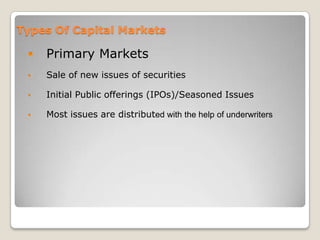
Types Of Capital MarketsPrimary Markets
Sale of new issues of securities
Initial Public offerings (IPOs)/Seasoned Issues
Most issues are distributed with the help of underwritersTypes Of Capital MarketsSecondary Markets
Where securities trade after their initial offerings
Provide liquidity to the investors
Liquid secondary market makes the task easier of raising funds in primary market.TYPES Order driven (NYSE) –  Brokers match buying and selling orders Quote Driven (NASDAQ) – Dealers provide bid-ask quote and dealer markets bring together buyers and sellers to transact at efficient prices
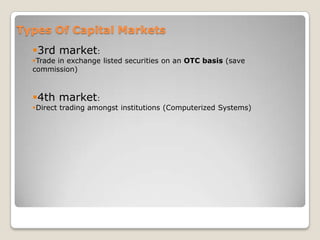
Types Of Capital Markets3rd market:
Trade in exchange listed securities on an OTC basis(save commission)
4th market:
Direct trading amongst institutions (Computerized Systems)Structure of Securities ExchangesCall Markets
Stock is only traded at specific times
All bids, asks are declared and then one price is set at which all      trades occurSmall exchanges adopt this kind of structure
This method is generally used for setting opening price or setting   prices after halting the trade Continuous Markets
Trade occur at any time till the market is open
The price is set either by  auction process (Order Driven) or by   dealer bid-ask quotes(Quote Driven)
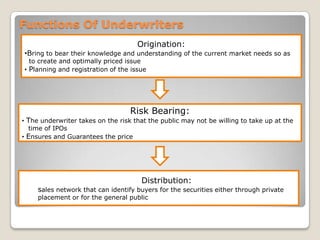
Functions Of UnderwritersOrigination: Bring to bear their knowledge and understanding of the current market needs so as     to create and optimally priced issuePlanning and registration of the issueRisk Bearing:The underwriter takes on the risk that the public may not be willing to take up at the    time of IPOsEnsures and Guarantees the price Distribution:sales network that can identify buyers for the securities either through private placement or for the general public
Types of Exchange MembershipThe Specialist
Controls the limit order book. Use the information to         stabilize the markets.  Posts bid and ask prices and trades on their own account to     maintain liquidity in the market.  Provides bridge the liquidity to market. Helps to improve          Bid-Ask spread. Known as Market Making. The Commission broker - Executes clients’ trades
Floor Brokers – Work as a broker for other commission broker
Registered Traders – Trade for their own accountTypes of OrdersMarket order:
 Best possible price when the order reaches the trading floor
 Executes the transaction at current price
Limit order:
 Execute order at price limit or better
 Buy: price < = limit and Sell: price > = limit
 May have time limits- Day, Week, GTC (Good till Cancelled)
Stop order:
 Becomes a market order when the stop price is reached
  Used to limit the losses. Specially used with Short Sales Oreder
Short sales:
Sale of borrowed shares; requires margin to insure adverse movement in prices;
Borrower needs to pay the dividends to the owner during the short period;
Uptick Rule is scrapped by SEC from June,2007.Margin TransactionsBuying securities on borrowed money, brokers lend money against clients securitiesIn US, Margin lending limit is fixed by US Fed reserve board.Due to leveraged position, investor enjoys magnification of profits as well as bears the high risk.Initial Margin-
It is the minimum amount investor should provide as equity at inception
Current requirement – 50%Types Of Margin
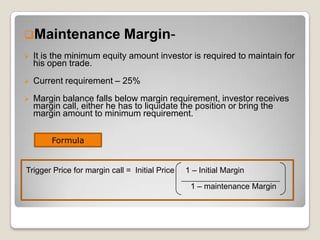
Maintenance Margin-
It is the minimum equity amount investor is required to maintain for his open trade.
Current requirement – 25%
Margin balance falls below margin requirement, investor receives margin call, either he has to liquidate the position or bring the margin amount to minimum requirement.   Trigger Price for margin call =  Initial Price     1 – Initial Margin                                                                           1 – maintenance MarginFormula
Stock Market IndexMeasure of average performance of a group of stocks
Functions include:Enable indexed portfolio creationWorks as a Benchmark for investment managersProxy for market portfolio to measure beta and systematic riskFacilitate comparisons across international marketsAiding market technicians for investment decisions
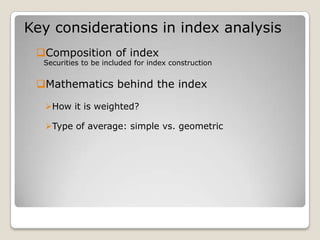
Key considerations in index analysisComposition of index    Securities to be included for index constructionMathematics behind the index
How it is weighted?
Type of average: simple vs. geometricTypes Of IndexesPrice Weighted Index
Market Value Weighted Index
Un weighted Index
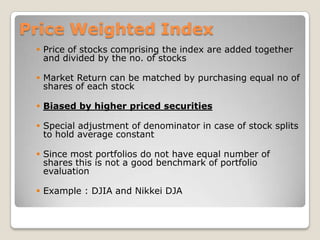
Style IndexPrice Weighted IndexPrice of stocks comprising the index are added together and divided by the no. of stocks
Market Return can be matched by purchasing equal no of shares of each stock
Biased by higher priced securities
Special adjustment of denominator in case of stock splits to hold average constant
Since most portfolios do not have equal number of shares this is not a good benchmark of portfolio evaluation
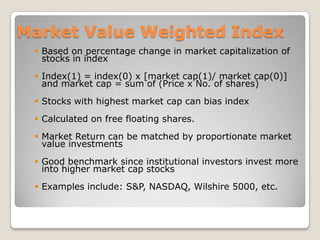
Example : DJIA and Nikkei DJAMarket Value Weighted IndexBased on percentage change in market capitalization of stocks in index
Index(1) = index(0) x [market cap(1)/ market cap(0)] and market cap = sum of (Price x No. of shares)
Stocks with highest market cap can bias index
Calculated on free floating shares.
Market Return can be matched by proportionate market value investments
Good benchmark since institutional investors invest more into higher market cap stocks
Examples include: S&P, NASDAQ, Wilshire 5000, etc.Un weighted IndexPlaces equal weight on returns of all stocks, no differentiation on price or market cap
Here, all attention is given to returns of each stock
Index may be calculated on arithmetic or geometric basis.
Index Value    (Arithmetic Mean) = ƩXi /n…. Xi is return on each stock   (Geometric Mean) = n√X1 * X2 *…Xn  - 1                               …..Xi is (1+Holding period Return) Use of geometric mean rather than arithmetic mean will always result lower index value. Style IndexIndexes that reflect investment styles used by portfolio managers or market capitalization or investment classification (Growth/ Value Stocks).
Can be used to measure the relative performance of portfolio managers. Bond Market IndexRelatively new
Difficult in creation of bond index rather than stock index-

Equity Investments