Business Organization, Market Structure & Investment Unit 3
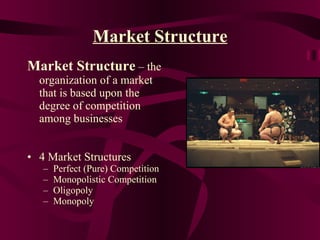
Market Structure Market Structure  – the organization of a market that is based upon the degree of competition among businesses 4 Market Structures Perfect (Pure) Competition Monopolistic Competition Oligopoly Monopoly
Characteristics of Market Structure Number of Producers Markets with more businesses will be more competitive Similarity of Products Similar products create more competition Ease of Entry Markets that are easy to get into are more competitive Control over Prices Ability to influence price gives a company more market power
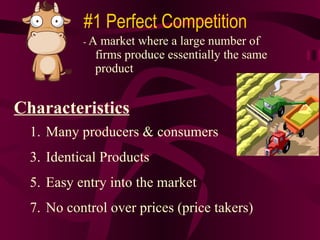
-  A market where a large number of firms produce essentially the same product Characteristics Many producers & consumers Identical Products Easy entry into the market No control over prices (price takers) #1 Perfect Competition
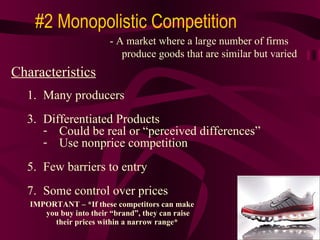
IMPORTANT – *If these competitors can make  you buy into their “brand”, they can raise their prices within a narrow range* #2 Monopolistic Competition Characteristics Many producers Differentiated Products  Could be real or “perceived differences” Use nonprice competition  Few barriers to entry Some control over prices - A market where a large number of firms produce goods that are similar but varied
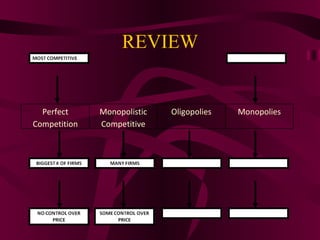
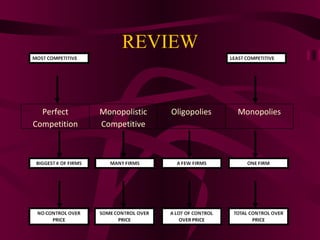
REVIEW Perfect Competition Monopolistic Competitive Oligopolies Monopolies
**IMPORTANT – Each firm has the ability to cause a change in output, sales, & prices of entire industry!!** #3 Oligopoly -  A market where a few firms produce similar or identical products Characteristics Few Producers Similar Products (minor variations) High barriers to entry Some control over prices Independent Behavior Price Leadership/War Collusion
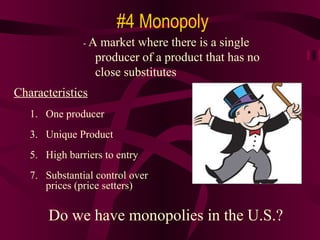
#4 Monopoly Characteristics One producer Unique Product High barriers to entry Substantial control over prices (price setters) -  A market where there is a single producer of a product that has no close substitutes Do we have monopolies in the U.S.?
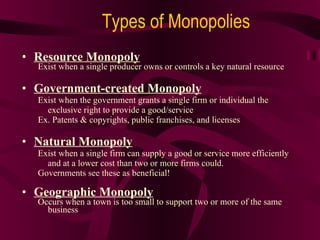
Resource Monopoly Exist when a single producer owns or controls a key natural resource Government-created Monopoly Exist when the government grants a single firm or individual the exclusive right to provide a good/service Ex. Patents & copyrights, public franchises, and licenses Natural Monopoly Exist when a single firm can supply a good or service more efficiently and at a lower cost than two or more firms could. Governments see these as beneficial! Geographic Monopoly Occurs when a town is too small to support two or more of the same business Types of Monopolies
REVIEW Perfect Competition Monopolistic Competitive Oligopolies Monopolies
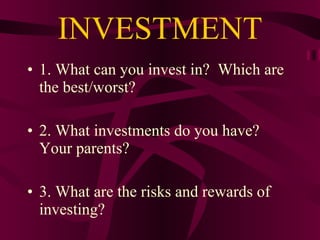
INVESTMENT 1. What can you invest in?  Which are the best/worst? 2. What investments do you have?  Your parents? 3. What are the risks and rewards of investing?
People invest to make money off of their savings! Investment allows businesses to expand! All of this leads to ECONOMIC GROWTH People invest their money in  financial securities  (also called investment options or financial assets) Financial Securities  - Investments that give their holders some form of return, or profit Importance of Investment
Risk vs. Return Relationship Risk – situation in which the outcome is not certain, but probabilities can be estimated = the higher the risk (of losses rather than gains), then the higher the possible returns Other Considerations Investor objectives What to know before investing!
What are my investment options? Some of the major investment options are Bonds CDs Stocks Mutual Funds
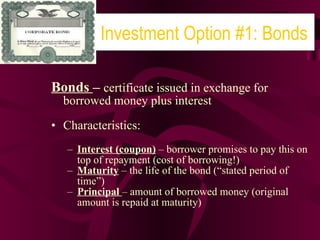
Bonds  –  certificate issued in exchange for borrowed money plus interest Characteristics: Interest (coupon)  – borrower promises to pay this on top of repayment (cost of borrowing!) Maturity  – the life of the bond (“stated period of time”) Principal  – amount of borrowed money (original amount is repaid at maturity) Investment Option #1: Bonds
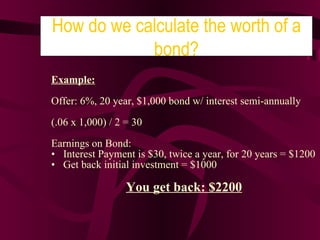
Example: Offer: 6%, 20 year, $1,000 bond w/ interest semi-annually  (.06 x 1,000) / 2 = 30 Earnings on Bond:  Interest Payment is $30, twice a year, for 20 years = $1200 Get back initial investment = $1000 You get back: $2200 How do we calculate the worth of a bond?
Most corporate bonds are rated on the financial health of the issuer, the ability to make future interest and principal payments, and the issuer’s past credit history. Bond ratings , ranging from  D (lowest)  to  AAA (highest),  indicate the quality of the bond. AAA to BBB are usually higher quality bonds while Junk Bonds (like BB to D) are the riskiest! Which bonds are best??? = Bond Ratings
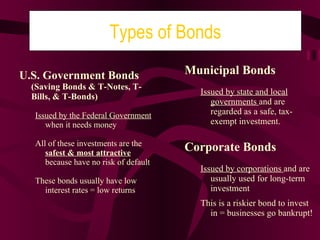
U.S. Government Bonds  (Saving Bonds & T-Notes, T-Bills, & T-Bonds) Issued by the Federal Government  when it needs money All of these investments are the  safest & most attractive  because have no risk of default These bonds usually have low interest rates = low returns Municipal Bonds Issued by state and local governments  and are regarded as a safe, tax-exempt investment. Corporate Bonds Issued by corporations  and are usually used for long-term investment This is a riskier bond to invest in = businesses go bankrupt! Types of Bonds
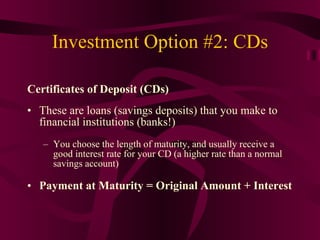
Investment Option #2: CDs Certificates of Deposit (CDs) These are loans (savings deposits) that you make to financial institutions (banks!) You choose the length of maturity, and usually receive a good interest rate for your CD (a higher rate than a normal savings account) Payment at Maturity = Original Amount + Interest
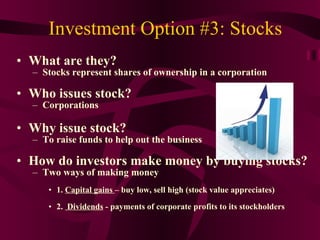
Investment Option #3: Stocks What are they?  Stocks represent shares of ownership in a corporation Who issues stock? Corporations Why issue stock? To raise funds to help out the business How do investors make money by buying stocks? Two ways of making money 1.  Capital gains  – buy low, sell high (stock value appreciates) 2.  Dividends  - payments of corporate profits to its stockholders
Investment Option #4: Mutual Funds A mutual fund is just a SPECIAL stock A mutual fund company pools the money of investors in order to buy stocks, bonds, or other investments in a variety of OTHER COMPANIES Advantages of Mutual Funds Your holdings become more diverse Your money is more safe because losses in the value of one stock can be made up by gains in the value of another stock
LIFE Capital Market:  money is loaned for more than one year Money Market : loans of less than a year ABILITY TO BE RESOLD Primary Market:  nontransferable investments Secondary Markets:  transferable investments Characteristics of Securities
Wait…don’t corporations already raise money by issuing bonds? Yes, you’re right!  Corporations use both bonds & stocks to raise money.  But here are some differences between the two: Stocks represent ownership  - Bonds represent debt Stocks don’t have a fixed return rate – Bonds have a fixed return rate Stocks do not have a maturity date – Bonds do have a maturity date
The Stock Market
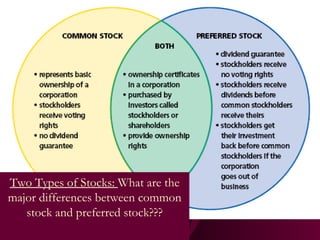
1. What type of stock represents ownership in a corporation? 2. Which type of stock gives its owner voting rights in the corporation? Two Types of Stocks:  What are the major differences between common stock and preferred stock???
Stock Market Terms Who are  stockholders/shareholders ? People who have invested in a corporation by purchasing stocks Who are  stockbrokers ? Buying & selling middle man that helps to conduct securities transactions
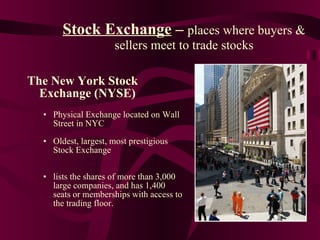
Stock Exchange  –  places where buyers & sellers meet to trade stocks The New York Stock Exchange (NYSE) Physical Exchange located on Wall Street in NYC Oldest, largest, most prestigious Stock Exchange lists the shares of more than 3,000 large companies, and has 1,400 seats or memberships with access to the trading floor.
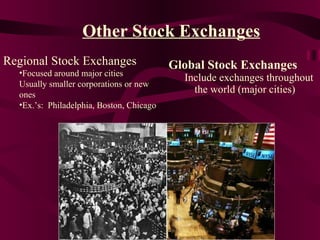
Other Stock Exchanges Global Stock Exchanges Include exchanges throughout the world (major cities) Regional Stock Exchanges   Focused around major cities Usually smaller corporations or new ones Ex.’s:  Philadelphia, Boston, Chicago
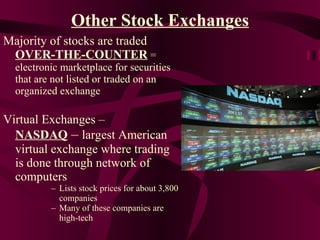
Other Stock Exchanges Majority of stocks are traded  OVER-THE-COUNTER  = electronic marketplace for securities that are not listed or traded on an organized exchange Virtual Exchanges –  NASDAQ  –  largest American virtual exchange where trading is done through network of computers Lists stock prices for about 3,800 companies Many of these companies are high-tech
What determines a stock’s price? Investors perceptions of what a stock is worth influenced by: Company earnings Recent company news State of the U.S. and world economy Trends or World Events
 
How do we measure the performance of the entire market? Use a  market index Dow-Jones Industrial Average (DJIA) Publishes the average closing price for 30 representative stocks Look at % change to see how market is doing Uses only stocks on NYSE Standard & Poor’s 500 (S&P 500) Stock performance index that uses price changes of 500 representative stocks as indicator of market performance Measures stocks from more than one stock exchange Nasdaq Composite Index Stock performance index that uses price changes of  over 3,000 representative stocks from Nasdaq ONLY
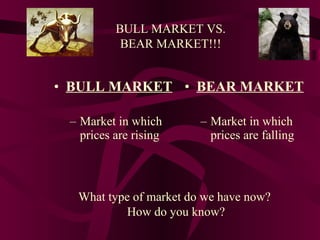
BULL MARKET Market in which prices are rising BEAR MARKET Market in which prices are falling BULL MARKET VS. BEAR MARKET!!! What type of market do we have now?  How do you know?
What is day trading? Buying and selling a particular stock in the same day!
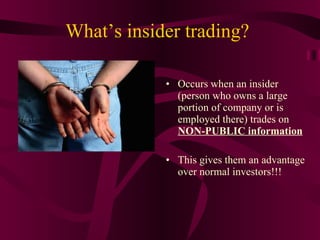
What’s insider trading? Occurs when an insider (person who owns a large portion of company or is employed there) trades on  NON-PUBLIC information This gives them an advantage over normal investors!!!
Investment Techniques Long positions (“going long”) Buying a security at a lower price with the expectation that it will increase in value over time and then you can sell for profit Short positions (“short sell”) act of selling stock that you don't own at a high price by borrowing it from a brokerage and then buying it back at a lower price in the future. The expectation is that the price of the stock falls and you can buy it back at a lower value, thus profiting!  Options contracts that give investors the option to buy or sell securities at some point in the future at a price agreed upon today Call Option vs. Put Option Call option – right to buy in future Put – right to sell in future
Time Frame of Trading Spot Markets Market in which a transaction is made immediately at the prevailing price Futures Markets markets in which futures are bought & sold Futures: contracts to buy or sell at a specific date in the future, at a price specified today Options Markets Markets in which options are traded Options: contracts that give investors the option to buy or sell securities at some point in the future at a price agreed upon today Call Option vs. Put Option Call – buy in future Put – sell in future
Why is diversity important? Downfalls of Investing The Efficient Market Hypothesis states that it is not possible to “beat the market” regularly. “ Don’t put all of your eggs in one basket” Solution Instead of trying to beat the market, investors should  diversify their portfolios  by holding a large number of different stocks, bonds, assets, etc. or enlist the assistance of a stockbroker.

Unit #3 student

  • 1.
    Business Organization, MarketStructure & Investment Unit 3
  • 2.
    Market Structure MarketStructure – the organization of a market that is based upon the degree of competition among businesses 4 Market Structures Perfect (Pure) Competition Monopolistic Competition Oligopoly Monopoly
  • 3.
    Characteristics of MarketStructure Number of Producers Markets with more businesses will be more competitive Similarity of Products Similar products create more competition Ease of Entry Markets that are easy to get into are more competitive Control over Prices Ability to influence price gives a company more market power
  • 4.
    - Amarket where a large number of firms produce essentially the same product Characteristics Many producers & consumers Identical Products Easy entry into the market No control over prices (price takers) #1 Perfect Competition
  • 5.
    IMPORTANT – *Ifthese competitors can make you buy into their “brand”, they can raise their prices within a narrow range* #2 Monopolistic Competition Characteristics Many producers Differentiated Products Could be real or “perceived differences” Use nonprice competition Few barriers to entry Some control over prices - A market where a large number of firms produce goods that are similar but varied
  • 6.
    REVIEW Perfect CompetitionMonopolistic Competitive Oligopolies Monopolies
  • 7.
    **IMPORTANT – Eachfirm has the ability to cause a change in output, sales, & prices of entire industry!!** #3 Oligopoly - A market where a few firms produce similar or identical products Characteristics Few Producers Similar Products (minor variations) High barriers to entry Some control over prices Independent Behavior Price Leadership/War Collusion
  • 8.
    #4 Monopoly CharacteristicsOne producer Unique Product High barriers to entry Substantial control over prices (price setters) - A market where there is a single producer of a product that has no close substitutes Do we have monopolies in the U.S.?
  • 9.
    Resource Monopoly Existwhen a single producer owns or controls a key natural resource Government-created Monopoly Exist when the government grants a single firm or individual the exclusive right to provide a good/service Ex. Patents & copyrights, public franchises, and licenses Natural Monopoly Exist when a single firm can supply a good or service more efficiently and at a lower cost than two or more firms could. Governments see these as beneficial! Geographic Monopoly Occurs when a town is too small to support two or more of the same business Types of Monopolies
  • 10.
    REVIEW Perfect CompetitionMonopolistic Competitive Oligopolies Monopolies
  • 11.
    INVESTMENT 1. Whatcan you invest in? Which are the best/worst? 2. What investments do you have? Your parents? 3. What are the risks and rewards of investing?
  • 12.
    People invest tomake money off of their savings! Investment allows businesses to expand! All of this leads to ECONOMIC GROWTH People invest their money in financial securities (also called investment options or financial assets) Financial Securities - Investments that give their holders some form of return, or profit Importance of Investment
  • 13.
    Risk vs. ReturnRelationship Risk – situation in which the outcome is not certain, but probabilities can be estimated = the higher the risk (of losses rather than gains), then the higher the possible returns Other Considerations Investor objectives What to know before investing!
  • 14.
    What are myinvestment options? Some of the major investment options are Bonds CDs Stocks Mutual Funds
  • 15.
    Bonds – certificate issued in exchange for borrowed money plus interest Characteristics: Interest (coupon) – borrower promises to pay this on top of repayment (cost of borrowing!) Maturity – the life of the bond (“stated period of time”) Principal – amount of borrowed money (original amount is repaid at maturity) Investment Option #1: Bonds
  • 16.
    Example: Offer: 6%,20 year, $1,000 bond w/ interest semi-annually (.06 x 1,000) / 2 = 30 Earnings on Bond: Interest Payment is $30, twice a year, for 20 years = $1200 Get back initial investment = $1000 You get back: $2200 How do we calculate the worth of a bond?
  • 17.
    Most corporate bondsare rated on the financial health of the issuer, the ability to make future interest and principal payments, and the issuer’s past credit history. Bond ratings , ranging from D (lowest) to AAA (highest), indicate the quality of the bond. AAA to BBB are usually higher quality bonds while Junk Bonds (like BB to D) are the riskiest! Which bonds are best??? = Bond Ratings
  • 18.
    U.S. Government Bonds (Saving Bonds & T-Notes, T-Bills, & T-Bonds) Issued by the Federal Government when it needs money All of these investments are the safest & most attractive because have no risk of default These bonds usually have low interest rates = low returns Municipal Bonds Issued by state and local governments and are regarded as a safe, tax-exempt investment. Corporate Bonds Issued by corporations and are usually used for long-term investment This is a riskier bond to invest in = businesses go bankrupt! Types of Bonds
  • 19.
    Investment Option #2:CDs Certificates of Deposit (CDs) These are loans (savings deposits) that you make to financial institutions (banks!) You choose the length of maturity, and usually receive a good interest rate for your CD (a higher rate than a normal savings account) Payment at Maturity = Original Amount + Interest
  • 20.
    Investment Option #3:Stocks What are they? Stocks represent shares of ownership in a corporation Who issues stock? Corporations Why issue stock? To raise funds to help out the business How do investors make money by buying stocks? Two ways of making money 1. Capital gains – buy low, sell high (stock value appreciates) 2. Dividends - payments of corporate profits to its stockholders
  • 21.
    Investment Option #4:Mutual Funds A mutual fund is just a SPECIAL stock A mutual fund company pools the money of investors in order to buy stocks, bonds, or other investments in a variety of OTHER COMPANIES Advantages of Mutual Funds Your holdings become more diverse Your money is more safe because losses in the value of one stock can be made up by gains in the value of another stock
  • 22.
    LIFE Capital Market: money is loaned for more than one year Money Market : loans of less than a year ABILITY TO BE RESOLD Primary Market: nontransferable investments Secondary Markets: transferable investments Characteristics of Securities
  • 23.
    Wait…don’t corporations alreadyraise money by issuing bonds? Yes, you’re right! Corporations use both bonds & stocks to raise money. But here are some differences between the two: Stocks represent ownership - Bonds represent debt Stocks don’t have a fixed return rate – Bonds have a fixed return rate Stocks do not have a maturity date – Bonds do have a maturity date
  • 24.
  • 25.
    1. What typeof stock represents ownership in a corporation? 2. Which type of stock gives its owner voting rights in the corporation? Two Types of Stocks: What are the major differences between common stock and preferred stock???
  • 26.
    Stock Market TermsWho are stockholders/shareholders ? People who have invested in a corporation by purchasing stocks Who are stockbrokers ? Buying & selling middle man that helps to conduct securities transactions
  • 27.
    Stock Exchange – places where buyers & sellers meet to trade stocks The New York Stock Exchange (NYSE) Physical Exchange located on Wall Street in NYC Oldest, largest, most prestigious Stock Exchange lists the shares of more than 3,000 large companies, and has 1,400 seats or memberships with access to the trading floor.
  • 28.
    Other Stock ExchangesGlobal Stock Exchanges Include exchanges throughout the world (major cities) Regional Stock Exchanges Focused around major cities Usually smaller corporations or new ones Ex.’s: Philadelphia, Boston, Chicago
  • 29.
    Other Stock ExchangesMajority of stocks are traded OVER-THE-COUNTER = electronic marketplace for securities that are not listed or traded on an organized exchange Virtual Exchanges – NASDAQ – largest American virtual exchange where trading is done through network of computers Lists stock prices for about 3,800 companies Many of these companies are high-tech
  • 30.
    What determines astock’s price? Investors perceptions of what a stock is worth influenced by: Company earnings Recent company news State of the U.S. and world economy Trends or World Events
  • 31.
  • 32.
    How do wemeasure the performance of the entire market? Use a market index Dow-Jones Industrial Average (DJIA) Publishes the average closing price for 30 representative stocks Look at % change to see how market is doing Uses only stocks on NYSE Standard & Poor’s 500 (S&P 500) Stock performance index that uses price changes of 500 representative stocks as indicator of market performance Measures stocks from more than one stock exchange Nasdaq Composite Index Stock performance index that uses price changes of over 3,000 representative stocks from Nasdaq ONLY
  • 33.
    BULL MARKET Marketin which prices are rising BEAR MARKET Market in which prices are falling BULL MARKET VS. BEAR MARKET!!! What type of market do we have now? How do you know?
  • 34.
    What is daytrading? Buying and selling a particular stock in the same day!
  • 35.
    What’s insider trading?Occurs when an insider (person who owns a large portion of company or is employed there) trades on NON-PUBLIC information This gives them an advantage over normal investors!!!
  • 36.
    Investment Techniques Longpositions (“going long”) Buying a security at a lower price with the expectation that it will increase in value over time and then you can sell for profit Short positions (“short sell”) act of selling stock that you don't own at a high price by borrowing it from a brokerage and then buying it back at a lower price in the future. The expectation is that the price of the stock falls and you can buy it back at a lower value, thus profiting! Options contracts that give investors the option to buy or sell securities at some point in the future at a price agreed upon today Call Option vs. Put Option Call option – right to buy in future Put – right to sell in future
  • 37.
    Time Frame ofTrading Spot Markets Market in which a transaction is made immediately at the prevailing price Futures Markets markets in which futures are bought & sold Futures: contracts to buy or sell at a specific date in the future, at a price specified today Options Markets Markets in which options are traded Options: contracts that give investors the option to buy or sell securities at some point in the future at a price agreed upon today Call Option vs. Put Option Call – buy in future Put – sell in future
  • 38.
    Why is diversityimportant? Downfalls of Investing The Efficient Market Hypothesis states that it is not possible to “beat the market” regularly. “ Don’t put all of your eggs in one basket” Solution Instead of trying to beat the market, investors should diversify their portfolios by holding a large number of different stocks, bonds, assets, etc. or enlist the assistance of a stockbroker.