Supply Chain Management
Presented by – Yousef Al-Safadi
Senior Consultant
+962777444435
CASE STUDY OUTLINES
 Definition of SCM and SCM main components.
 SCM Process.
 Analysis SCM Process.
 Main KPI’s for SCM.
2
SUPPLY CHAIN MANAGEMENT (1/2)
Supply Chain :
 Refers to the players, activities and resources involved in producing and transferring
a good or service to a customer.
Supply Chain Management :
 Manages all movement and storage of raw materials, work-in-process inventory, and
finished goods from point-of origin to point-of-consumption.
 SCM usually focuses on inventory, purchasing, & delivery.
Supplier Manufacturer Distributor Retailer Customers
3
Supply Chain Planning
Payment Flows
Information Flows
Supply Chain Execution
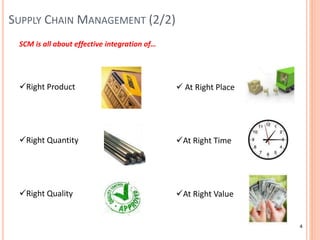
Right Product
Right Quantity
Right Quality
 At Right Place
At Right Time
At Right Value
SCM is all about effective integration of…
SUPPLY CHAIN MANAGEMENT (2/2)
4
SUPPLY CHAIN PROCESS
Plan
production
Source
(Purchase)
materials
Make
product Deliver Sell
Returns?
Y
N
Inventory
process
Purchasing
process
Delivery process:
Scheduling,
Transporting,
Warehousing
5
Seeks to create
effective long-
and short-range
supply chain
strategies.
From the
design of the
supply chain
network to the
prediction of
customer
demand.
Procurement
Process –
focuses on the
purchase of
required raw
materials,
components,
and goods. As a
consumer,
you're pretty
familiar with
buying stuff!
Production
Process – the
process that
involves the
manufacture,
conversion, or
assembly of
materials into
finished goods
or parts for
other products.
Production
process
Distribution –
Transportation
companies,
that goods are
flowing quickly
and safely
toward the
point of
demand.
The demand
process revolves
around all the
issues that are
related to
planning customer
interactions,
satisfying their
needs, and
fulfilling orders
perfectly.
 Analysis the Following related with inventory, purchasing and delivery.
SUPPLY CHAIN ANALYSIS (1/2)
Nb. Items Definition Calculator
1 Inventory Turnover
how many times a year your organization is able
to sell its entire inventory
Cost of Goods Sold
÷ Average inventory
2 Average days to turn inventory
The number of days it takes to sell all on-hand
inventory
365 ÷ inventory
turn
3 Inventory to Sales Ratio
measures the amount of inventory you are
carrying compared to the number of sales orders
being fulfilled
(Inventory value $)
÷ (Sales value $)
4 Days Sales Outstanding
A measure of how quickly revenue can be
collected from customers.
(Receivables/Sales) *
Days in Period
5 Carrying Cost of Inventory
measures how much it costs your organization to
store inventory over a given period of time.
Inventory carrying
rate * Average
inventory value
6 Inventory Days of Supply
The number of days it would take to run out of
supply if it was not replenished.
inventory on hand /
average daily usage
7 Freight cost per unit Usually measured as the cost of freight per item
total freight cost /
number of items
8 Inventory Days of Supply
The number of days it would take to run out of
supply if it was not replenished.
inventory on hand /
average daily usage
9 Customer Order Cycle Time
Measures how long it takes to deliver a
customer order after the purchase order (PO) is
received.
actual delivery date -
purchase order
creation date
6
 Analysis the Following related with inventory, purchasing and delivery.
SUPPLY CHAIN ANALYSIS (2/2)
Nb. Items Definition Calculator
10 Order Cycle Measure how many order (sales)/year
12 X (# of
purchasing order
/year)
11 Order Status
the real-time status of all orders and
categorizes them based on the action taken,
such as "Backordered," "On Hold," or
"Shipped."
-
12 Cash to Cash Cycle Time
The number of days between paying for
materials and getting paid for product.
materials payment
date - customer
order payment date
13 Units per Transaction
measures the average number of units
purchased over a period of time and compares
that value to target values
# of units sold ÷ #
of transactions
14 On Time Shipping Rate
The percentage of items, that arrives on or
before the requested ship date
(Number of On Time
Items / Total Items)
* 100
15 Perfect Order Rate
how many orders you ship without incident,
(damaged goods, inaccurate orders or late
shipments)
((total orders - error
orders) / total
orders) * 100
16 Lead Time Time to receive the goods to warehouse -
7
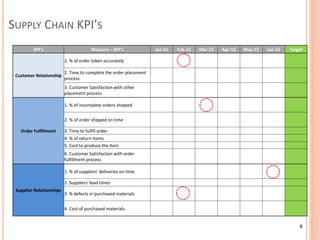
SUPPLY CHAIN KPI’S
KPI’s Measure – KPI’s Jan-15 Feb-15 Mar-15 Apr-15 May-15 Jun-15 Target
Customer Relationship
1. % of order taken accurately
2. Time to complete the order placement
process
3. Customer Satisfaction with other
placement process
Order Fulfillment
1. % of incomplete orders shipped
2. % of order shipped on time
3. Time to fulfill order
4. % of return items
5. Cost to produce the item
6. Customer Satisfaction with order
fulfillment process
Supplier Relationships
1. % of suppliers' deliveries on time
2. Suppliers' lead times
3. % defects in purchased materials
4. Cost of purchased materials.
8
Supply chain management

Supply chain management

  • 1.
    Supply Chain Management Presentedby – Yousef Al-Safadi Senior Consultant +962777444435
  • 2.
    CASE STUDY OUTLINES Definition of SCM and SCM main components.  SCM Process.  Analysis SCM Process.  Main KPI’s for SCM. 2
  • 3.
    SUPPLY CHAIN MANAGEMENT(1/2) Supply Chain :  Refers to the players, activities and resources involved in producing and transferring a good or service to a customer. Supply Chain Management :  Manages all movement and storage of raw materials, work-in-process inventory, and finished goods from point-of origin to point-of-consumption.  SCM usually focuses on inventory, purchasing, & delivery. Supplier Manufacturer Distributor Retailer Customers 3 Supply Chain Planning Payment Flows Information Flows Supply Chain Execution
  • 4.
    Right Product Right Quantity RightQuality  At Right Place At Right Time At Right Value SCM is all about effective integration of… SUPPLY CHAIN MANAGEMENT (2/2) 4
  • 5.
    SUPPLY CHAIN PROCESS Plan production Source (Purchase) materials Make productDeliver Sell Returns? Y N Inventory process Purchasing process Delivery process: Scheduling, Transporting, Warehousing 5 Seeks to create effective long- and short-range supply chain strategies. From the design of the supply chain network to the prediction of customer demand. Procurement Process – focuses on the purchase of required raw materials, components, and goods. As a consumer, you're pretty familiar with buying stuff! Production Process – the process that involves the manufacture, conversion, or assembly of materials into finished goods or parts for other products. Production process Distribution – Transportation companies, that goods are flowing quickly and safely toward the point of demand. The demand process revolves around all the issues that are related to planning customer interactions, satisfying their needs, and fulfilling orders perfectly.
  • 6.
     Analysis theFollowing related with inventory, purchasing and delivery. SUPPLY CHAIN ANALYSIS (1/2) Nb. Items Definition Calculator 1 Inventory Turnover how many times a year your organization is able to sell its entire inventory Cost of Goods Sold ÷ Average inventory 2 Average days to turn inventory The number of days it takes to sell all on-hand inventory 365 ÷ inventory turn 3 Inventory to Sales Ratio measures the amount of inventory you are carrying compared to the number of sales orders being fulfilled (Inventory value $) ÷ (Sales value $) 4 Days Sales Outstanding A measure of how quickly revenue can be collected from customers. (Receivables/Sales) * Days in Period 5 Carrying Cost of Inventory measures how much it costs your organization to store inventory over a given period of time. Inventory carrying rate * Average inventory value 6 Inventory Days of Supply The number of days it would take to run out of supply if it was not replenished. inventory on hand / average daily usage 7 Freight cost per unit Usually measured as the cost of freight per item total freight cost / number of items 8 Inventory Days of Supply The number of days it would take to run out of supply if it was not replenished. inventory on hand / average daily usage 9 Customer Order Cycle Time Measures how long it takes to deliver a customer order after the purchase order (PO) is received. actual delivery date - purchase order creation date 6
  • 7.
     Analysis theFollowing related with inventory, purchasing and delivery. SUPPLY CHAIN ANALYSIS (2/2) Nb. Items Definition Calculator 10 Order Cycle Measure how many order (sales)/year 12 X (# of purchasing order /year) 11 Order Status the real-time status of all orders and categorizes them based on the action taken, such as "Backordered," "On Hold," or "Shipped." - 12 Cash to Cash Cycle Time The number of days between paying for materials and getting paid for product. materials payment date - customer order payment date 13 Units per Transaction measures the average number of units purchased over a period of time and compares that value to target values # of units sold ÷ # of transactions 14 On Time Shipping Rate The percentage of items, that arrives on or before the requested ship date (Number of On Time Items / Total Items) * 100 15 Perfect Order Rate how many orders you ship without incident, (damaged goods, inaccurate orders or late shipments) ((total orders - error orders) / total orders) * 100 16 Lead Time Time to receive the goods to warehouse - 7
  • 8.
    SUPPLY CHAIN KPI’S KPI’sMeasure – KPI’s Jan-15 Feb-15 Mar-15 Apr-15 May-15 Jun-15 Target Customer Relationship 1. % of order taken accurately 2. Time to complete the order placement process 3. Customer Satisfaction with other placement process Order Fulfillment 1. % of incomplete orders shipped 2. % of order shipped on time 3. Time to fulfill order 4. % of return items 5. Cost to produce the item 6. Customer Satisfaction with order fulfillment process Supplier Relationships 1. % of suppliers' deliveries on time 2. Suppliers' lead times 3. % defects in purchased materials 4. Cost of purchased materials. 8