Speaker
A Transducer/device that converts sound energy to electrical Energy.
How do speakers work?
• Speakers come in all shapes and sizes, enabling you to listen to music on your
iPod, enjoy a film at the cinema or hear a friend’s voice over the phone.
In order to translate an electrical signal into an audible sound, speakers contain
an electromagnet: a metal coil which creates a magnetic field when an electric
current flows through it. This coil behaves much like a normal (permanent)
magnet, with one particularly handy property: reversing the direction of the
current in the coil flips the poles of the magnet.
Inside a speaker, an electromagnet is placed in front of a permanent magnet.
The permanent magnet is fixed firmly into position whereas the electromagnet
is mobile. As pulses of electricity pass through the coil of the electromagnet, the
direction of its magnetic field is rapidly changed. This means that it is in turn
attracted to and repelled from the permanent magnet, vibrating back and forth.
Speakers External Parts
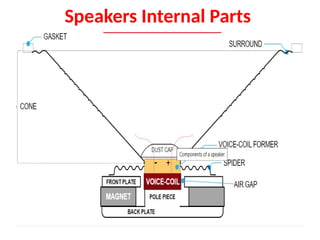
Speakers Internal Parts
Speaker Impedance, Power Handling and Wiring
• The speaker ohm rating is an indication of the
speaker's AC impedance, which varies with the
frequency of the input signal.
• This variation of the speaker's impedance can
be seen on the speaker's spec sheet impedance
curve.
• This is why the spec sheet indicates this speaker
to have an 8 ohm "nominal impedance."
Most of the speakers are available in alternative ohm ratings
(usually 4, 8 an 16 ohm versions). This variety allows for more
flexibility in matching the overall equivalent impedance of
your speaker(s) to the output impedance of the amplifier. It is
important that the output impedance of your amplifier
matches the overall equivalent impedance of your speaker(s)
for maximum power transfer and so that you do not damage
the amplifier.
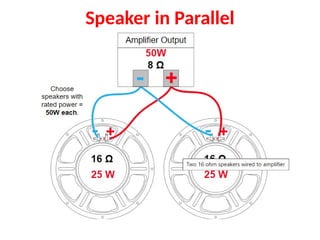
When using more than one speaker with your amp the
equivalent overall impedance changes depending on how the
speakers are wired. You can wire multiple speakers "in
series," "in parallel" or in a combination of the two wiring
configurations ("series/parallel").
Speakers also have a wattage rating which indicates how
much power from the amp they can handle before being
damaged. When you use multiple speakers, the output power
Speaker in Series
Speaker in Parallel
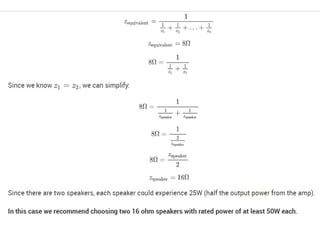
Computation of Speaker Impedance in Parallel
• When multiple speakers are wired in
parallel, things are a little more
complicated as the overall impedance of
the parallel circuit will be less than the
individual speaker impedance ratings as
shown in the following formula.
• When multiple speakers are wired in a series/parallel
configuration, things become even more complicated.
• First,the equivalent impedance needs to be determined
for all speakers wired in series using the same formula
as in Example 2 above. Once this is done, then the
overall circuit impedance rating of the circuit can be
calculated using the parallel circuit formula in Example
3 above.
• In example 4, we have a 50W amp with an 8 ohm
output impedance. To determine the impedance of the
speakers, we will have to solve using both the perallel
formula and the series formula for equivalent
impedance.
Types of speaker
• WOOFER OR BASS SPEAKER is a technical
term for loudspeaker driver designed to
produce low frequency sounds, typically from
20 Hz up to 500 Hz. The name is from the
onomatopoeic English word for a dog's bark,
"woof" (in contrast to the name used
for speakers designed to reproduce high-
frequency sounds, tweeter).
Types of speaker
• A SUBWOOFER (or sub) is a loudspeaker designed to
reproduce low-pitched audio frequencies known
as bass and sub-bass, lower in frequency than those
which can be (optimally) generated by a woofer. ... The
first subwoofers were developed in the 1960s to
add bass response to home stereo systems.
• Subwoofer Technicalities
• The frequency range that a subwoofer delivers depends
on its use. So a subwoofer for home-use would have a
frequency that would typically range from 20-200Hz;
while that used for professional sound would be below
100 Hz. There are subwoofers with frequency below 80
Hz as well.
TYPES OF SPEAKER BAFFLE/ENCLOSURE
Sealed Enclosure
• PROS
• If space is an issue, sealed
enclosures are the smallest.
• Easy to design.
• Easy to build.
• Design errors don’t have big
impact on overall sound.
• High power handling.
• Great transient response (plays
with little effort short duration
sudden sound waves, like drums).
• Smooth roll-off of 12 db / octave.
• CONS
• Low efficiency.
Infinite Enclosure
• PROS
• Doesn’t need much power.
• Usually less distortion compared to
other enclosures.
• In an ideal infinite baffle setup
(which is actually a finite baffle, but
sufficiently large), there are no
resonances and no diffraction
issues.
• CONS
• Hard to separate back waves from
front waves in a basic, real life
setup (like a car).
• The woofer can reach maximum
excursion easily, so you need to be
aware not to damage it
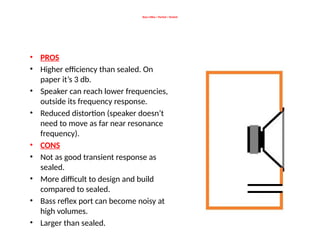
Bass reflex / Ported / Vented
• PROS
• Higher efficiency than sealed. On
paper it’s 3 db.
• Speaker can reach lower frequencies,
outside its frequency response.
• Reduced distortion (speaker doesn’t
need to move as far near resonance
frequency).
• CONS
• Not as good transient response as
sealed.
• More difficult to design and build
compared to sealed.
• Bass reflex port can become noisy at
high volumes.
• Larger than sealed.
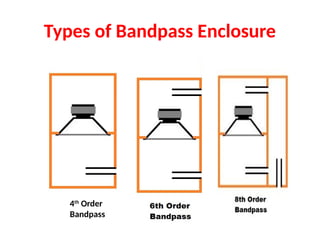
Types of Bandpass Enclosure
4th
Order
Bandpass
Bandpass
• PROS
• High efficiency. Theoretical +5 db compared to sealed. Even
higher efficiency for 6th and 8th order.
• Low woofer excursion. Excursion is defined as how far the
cone of a speaker linearly travels from its resting position. Lower
frequency drivers or subwoofers are designed to move more air
and have more excursion than those of higher frequency.
• Good choice for high (sound Pressure Level) SPL
applications.
• CONS
• Enclosure can get impractically big.
• Extremely difficult to design, with no room for error
(especially for 6th and 8th order).
• If tuned for efficiency, sound quality is very poor.
• If pushed to the limit, you don’t hear the woofer
“struggling” (as it is inside the cabinet) and might kill it
unknowingly.
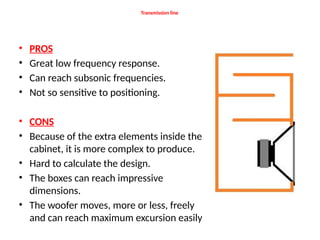
Transmission line
• PROS
• Great low frequency response.
• Can reach subsonic frequencies.
• Not so sensitive to positioning.
• CONS
• Because of the extra elements inside the
cabinet, it is more complex to produce.
• Hard to calculate the design.
• The boxes can reach impressive
dimensions.
• The woofer moves, more or less, freely
and can reach maximum excursion easily
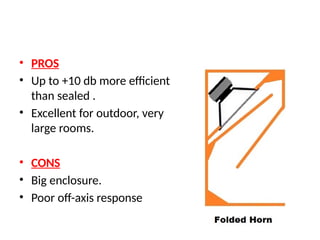
• PROS
• Up to +10 db more efficient
than sealed .
• Excellent for outdoor, very
large rooms.
• CONS
• Big enclosure.
• Poor off-axis response

-Speakers.pptx..........................

  • 1.
    Speaker A Transducer/device thatconverts sound energy to electrical Energy. How do speakers work? • Speakers come in all shapes and sizes, enabling you to listen to music on your iPod, enjoy a film at the cinema or hear a friend’s voice over the phone. In order to translate an electrical signal into an audible sound, speakers contain an electromagnet: a metal coil which creates a magnetic field when an electric current flows through it. This coil behaves much like a normal (permanent) magnet, with one particularly handy property: reversing the direction of the current in the coil flips the poles of the magnet. Inside a speaker, an electromagnet is placed in front of a permanent magnet. The permanent magnet is fixed firmly into position whereas the electromagnet is mobile. As pulses of electricity pass through the coil of the electromagnet, the direction of its magnetic field is rapidly changed. This means that it is in turn attracted to and repelled from the permanent magnet, vibrating back and forth.
  • 2.
  • 3.
  • 4.
    Speaker Impedance, PowerHandling and Wiring • The speaker ohm rating is an indication of the speaker's AC impedance, which varies with the frequency of the input signal. • This variation of the speaker's impedance can be seen on the speaker's spec sheet impedance curve. • This is why the spec sheet indicates this speaker to have an 8 ohm "nominal impedance."
  • 5.
    Most of thespeakers are available in alternative ohm ratings (usually 4, 8 an 16 ohm versions). This variety allows for more flexibility in matching the overall equivalent impedance of your speaker(s) to the output impedance of the amplifier. It is important that the output impedance of your amplifier matches the overall equivalent impedance of your speaker(s) for maximum power transfer and so that you do not damage the amplifier. When using more than one speaker with your amp the equivalent overall impedance changes depending on how the speakers are wired. You can wire multiple speakers "in series," "in parallel" or in a combination of the two wiring configurations ("series/parallel"). Speakers also have a wattage rating which indicates how much power from the amp they can handle before being damaged. When you use multiple speakers, the output power
  • 6.
  • 7.
  • 8.
    Computation of SpeakerImpedance in Parallel • When multiple speakers are wired in parallel, things are a little more complicated as the overall impedance of the parallel circuit will be less than the individual speaker impedance ratings as shown in the following formula.
  • 11.
    • When multiplespeakers are wired in a series/parallel configuration, things become even more complicated. • First,the equivalent impedance needs to be determined for all speakers wired in series using the same formula as in Example 2 above. Once this is done, then the overall circuit impedance rating of the circuit can be calculated using the parallel circuit formula in Example 3 above. • In example 4, we have a 50W amp with an 8 ohm output impedance. To determine the impedance of the speakers, we will have to solve using both the perallel formula and the series formula for equivalent impedance.
  • 12.
    Types of speaker •WOOFER OR BASS SPEAKER is a technical term for loudspeaker driver designed to produce low frequency sounds, typically from 20 Hz up to 500 Hz. The name is from the onomatopoeic English word for a dog's bark, "woof" (in contrast to the name used for speakers designed to reproduce high- frequency sounds, tweeter).
  • 13.
    Types of speaker •A SUBWOOFER (or sub) is a loudspeaker designed to reproduce low-pitched audio frequencies known as bass and sub-bass, lower in frequency than those which can be (optimally) generated by a woofer. ... The first subwoofers were developed in the 1960s to add bass response to home stereo systems. • Subwoofer Technicalities • The frequency range that a subwoofer delivers depends on its use. So a subwoofer for home-use would have a frequency that would typically range from 20-200Hz; while that used for professional sound would be below 100 Hz. There are subwoofers with frequency below 80 Hz as well.
  • 14.
    TYPES OF SPEAKERBAFFLE/ENCLOSURE
  • 15.
    Sealed Enclosure • PROS •If space is an issue, sealed enclosures are the smallest. • Easy to design. • Easy to build. • Design errors don’t have big impact on overall sound. • High power handling. • Great transient response (plays with little effort short duration sudden sound waves, like drums). • Smooth roll-off of 12 db / octave. • CONS • Low efficiency.
  • 16.
    Infinite Enclosure • PROS •Doesn’t need much power. • Usually less distortion compared to other enclosures. • In an ideal infinite baffle setup (which is actually a finite baffle, but sufficiently large), there are no resonances and no diffraction issues. • CONS • Hard to separate back waves from front waves in a basic, real life setup (like a car). • The woofer can reach maximum excursion easily, so you need to be aware not to damage it
  • 17.
    Bass reflex /Ported / Vented • PROS • Higher efficiency than sealed. On paper it’s 3 db. • Speaker can reach lower frequencies, outside its frequency response. • Reduced distortion (speaker doesn’t need to move as far near resonance frequency). • CONS • Not as good transient response as sealed. • More difficult to design and build compared to sealed. • Bass reflex port can become noisy at high volumes. • Larger than sealed.
  • 18.
    Types of BandpassEnclosure 4th Order Bandpass
  • 19.
    Bandpass • PROS • Highefficiency. Theoretical +5 db compared to sealed. Even higher efficiency for 6th and 8th order. • Low woofer excursion. Excursion is defined as how far the cone of a speaker linearly travels from its resting position. Lower frequency drivers or subwoofers are designed to move more air and have more excursion than those of higher frequency. • Good choice for high (sound Pressure Level) SPL applications. • CONS • Enclosure can get impractically big. • Extremely difficult to design, with no room for error (especially for 6th and 8th order). • If tuned for efficiency, sound quality is very poor. • If pushed to the limit, you don’t hear the woofer “struggling” (as it is inside the cabinet) and might kill it unknowingly.
  • 20.
    Transmission line • PROS •Great low frequency response. • Can reach subsonic frequencies. • Not so sensitive to positioning. • CONS • Because of the extra elements inside the cabinet, it is more complex to produce. • Hard to calculate the design. • The boxes can reach impressive dimensions. • The woofer moves, more or less, freely and can reach maximum excursion easily
  • 21.
    • PROS • Upto +10 db more efficient than sealed . • Excellent for outdoor, very large rooms. • CONS • Big enclosure. • Poor off-axis response