CONSTRUCTION &
WORKING OF
ELECTROSTATIC
LOUD SPEAKERS
GROUP
MEMBERS
• Hamza Rafiq (14-EE-076)
• Zeeshan Hayat (14-EE-108)
• Hafeez-Ur-Rehman (14-EE-128)
• Muhammad Hamza (14-EE-148)
• Rizwan Ali (14-EE-152)
• Muhammad Usman (14-EE-172)
ELECTROSTATIC
LOUD SPEAKER
• An electrostatic loudspeaker is a
device in which sound is generated
by exerting force on diaphragm
suspended in an electrostatic field.
OPERATING PRINCIPLE OF
ELECTROSTATIC LOUD SPEAKER
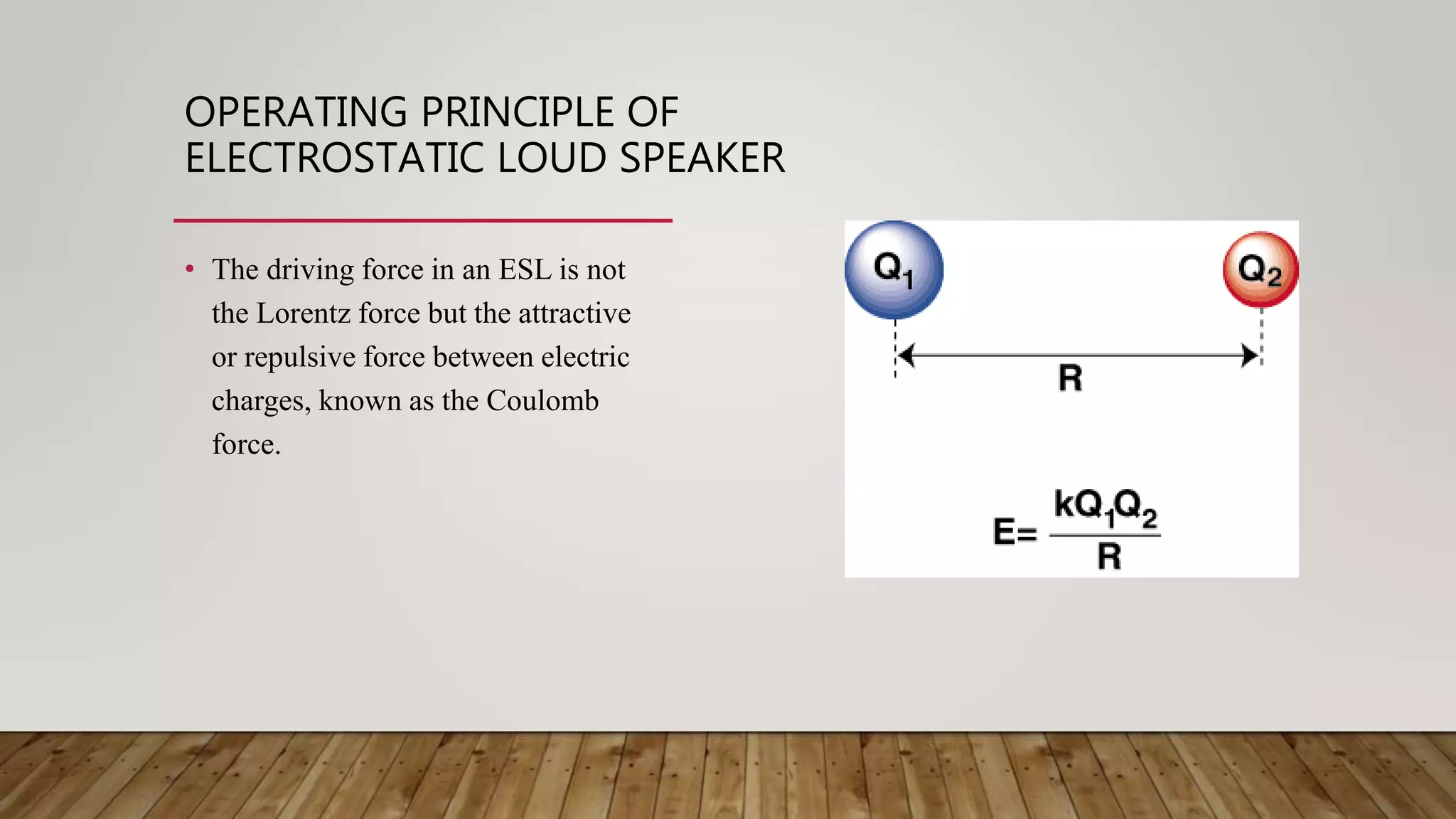
• The driving force in an ESL is not
the Lorentz force but the attractive
or repulsive force between electric
charges, known as the Coulomb
force.
CIRCUIT
DIAGRAM
CONSTRUCTION OF LOUD SPEAKERS
• A practical electrostatic speaker uses a flexible film that is as thin and light
as possible as its moving component. A partially conductive coating is
applied to its just conductive enough to allow it to accumulate charge, but
not enough to allow that charge to flow away freely.
• Two acoustically transparent conductive electrodes are suspended next to
the film, one on either side. These electrodes can be wire mesh, an array of
parallel wires, or a perforated metal sheet.
COMPONENTS
Diaphragm
Stator plates
Audio transformer
EHT voltage source
COMPONENTS
Diaphragm:
• The generally accepted diaphragm material is polyester.
• It can also me made of polyethylene terephtalate (PET).
• The film is made in thicknesses of 4 µm, 6 µm, 12 µm and 25 µm.
• In order to make the diaphragm mass negligible, the thickness should ideally be 3 - 4 µm.
• Diaphragm thicknesses of 12 μm or 25 μm are only suitable for bass panels or for
loudspeakers that are voltage driven.
COMPONENTS
Diaphragm coating:
• Nylon
• Graphite paint
• Soap
• Conductive material
• Anti-static spray
• Wall glue
• Metalized film
COMPONENTS
Diaphragm stretching:
• In order to keep the diaphragm in its place, in the middle of the air gap between the
stators, it must be stretched.
• Typically the film must be stretched by 1% to 2%. If you stretch it further, you no longer
stretch it elastically
• Amount of stretching influences the stability and the resonance frequency.
COMPONENTS
Spacers and Other Isolation Materials:
• For loudspeakers using perforated metal sheets as stators you need spacers made from
some good isolator
• Materials that are considered reasonable isolators at low voltages are not good enough at
the high voltages we have in an ESL.
• We must use good isolators such as most plastics and pertinax.
• Suitable plastics are polycarbonate or poly-acrylate PVC works well too.
COMPONENTS
Audio transformer:
The step-up transformer is one of the
most difficult parts of the loudspeaker
to properly design. Many of these
trade-offs become easier when we
design a step-up transformer only for
the mid-range and high frequencies;
that is when we build a hybrid
loudspeaker.
COMPONENTS
Stator plates:
The largest practical stator width without intermediate support for the diaphragm
depends on the polarizing voltage and the diaphragm-to-stator distance.
When using a diaphragm-to-stator distance of 1.5 - 2.5 mm and a polarizing voltage of
4000 – 5500 V is about 20 cm.
COMPONENTS
Stator isolation:
• It is wise to isolate the stator electrodes.
• First of all, this increases safety.
• Secondly, when arcing occurs (as it surely will) the isolation limits the discharge current.
Without such a current limitation a loud spark will result, which could damage the
diaphragm.
COMPONENTS
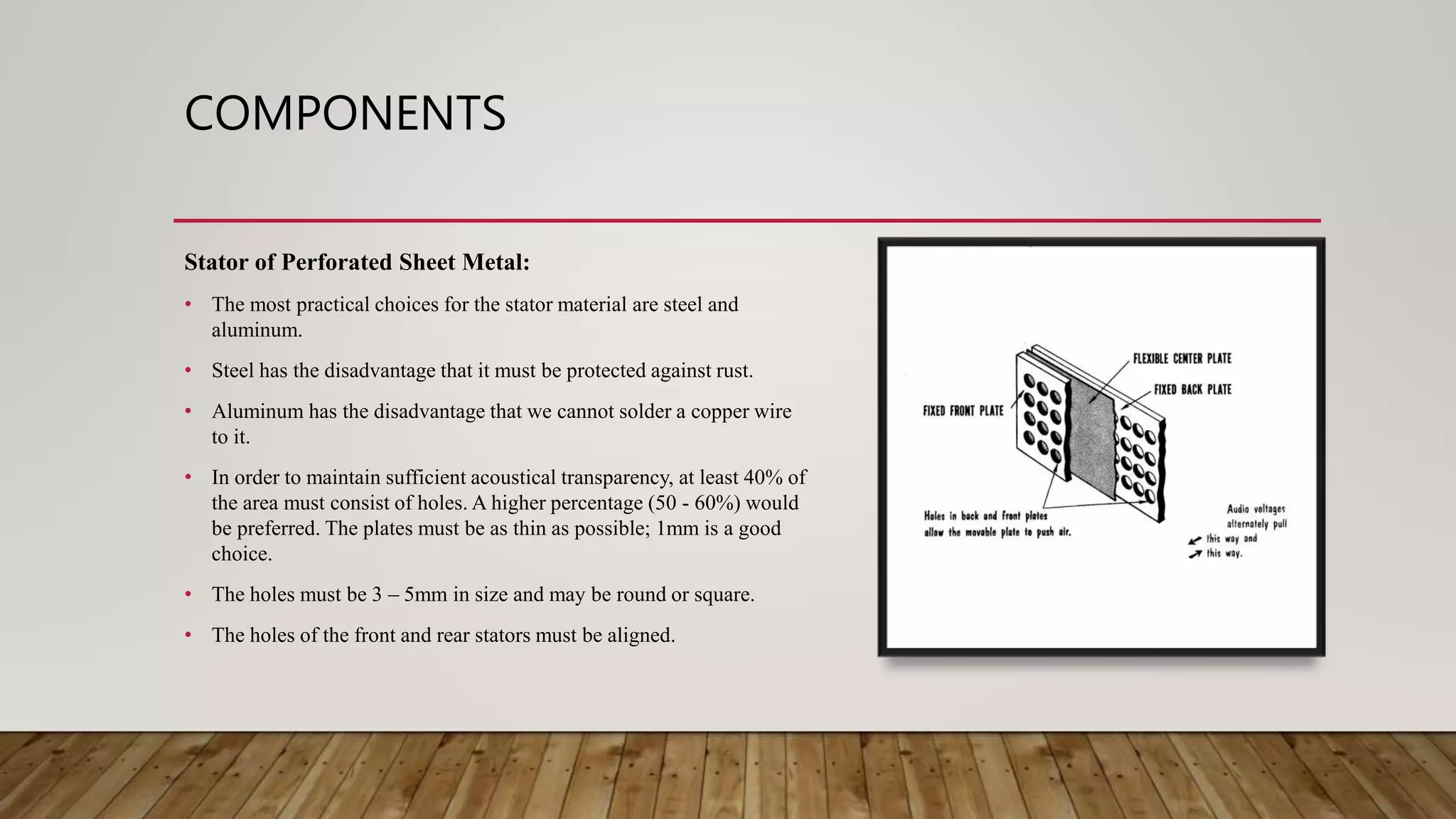
Stator of Perforated Sheet Metal:
• The most practical choices for the stator material are steel and
aluminum.
• Steel has the disadvantage that it must be protected against rust.
• Aluminum has the disadvantage that we cannot solder a copper wire
to it.
• In order to maintain sufficient acoustical transparency, at least 40% of
the area must consist of holes. A higher percentage (50 - 60%) would
be preferred. The plates must be as thin as possible; 1mm is a good
choice.
• The holes must be 3 – 5mm in size and may be round or square.
• The holes of the front and rear stators must be aligned.
WORKING
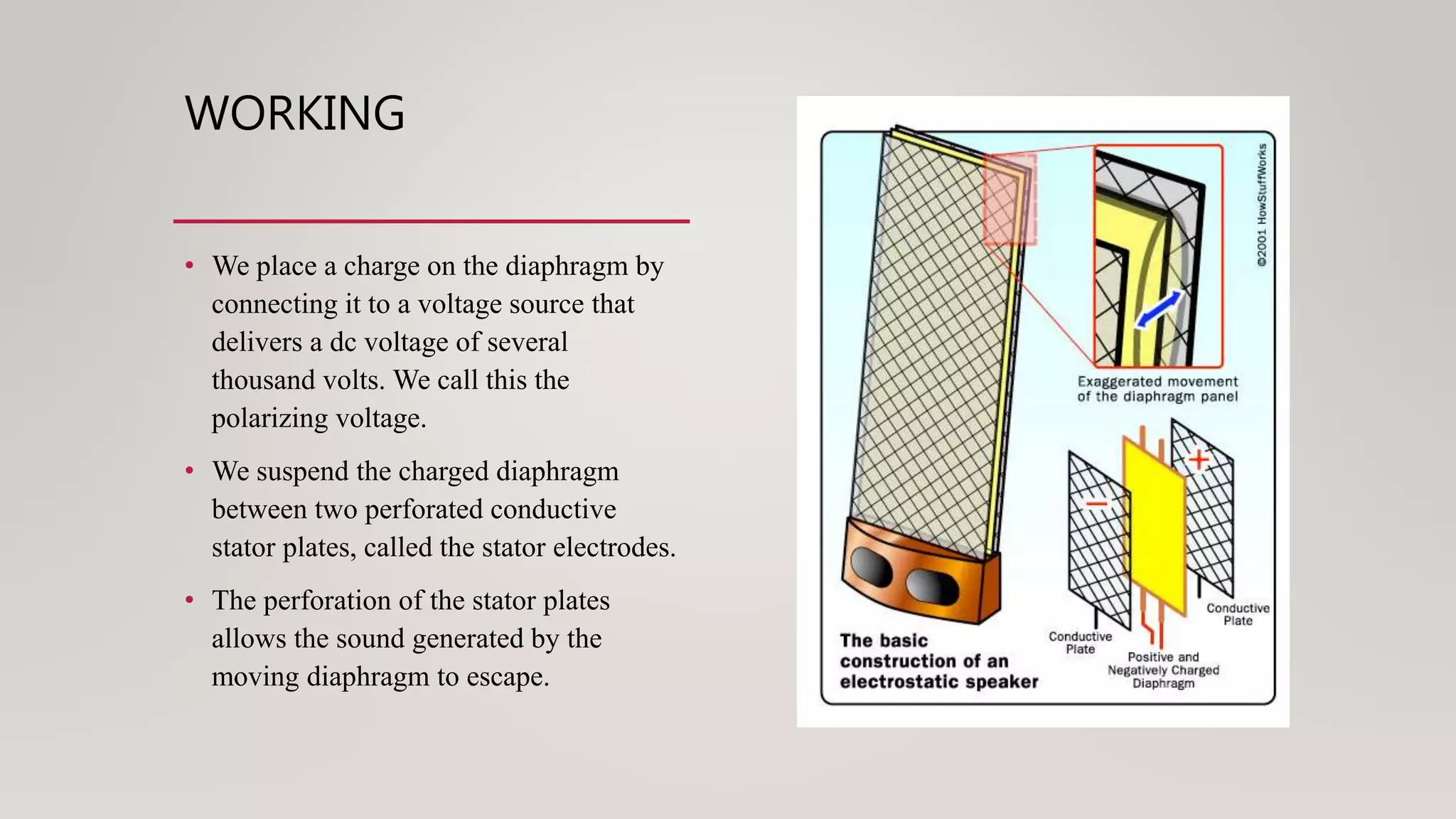
• We place a charge on the diaphragm by
connecting it to a voltage source that
delivers a dc voltage of several
thousand volts. We call this the
polarizing voltage.
• We suspend the charged diaphragm
between two perforated conductive
stator plates, called the stator electrodes.
• The perforation of the stator plates
allows the sound generated by the
moving diaphragm to escape.
WORKING
• Now, we connect the stator plates to a high voltage
audio source.
• We typically obtain the high audio voltage from a
normal audio amplifier in combination with a so called
step-up transformer, although we can also build a
special purpose high voltage audio amplifier.
• The high voltage audio that we apply to the stator
plates generates an electric field between these plates,
which pulls on the diaphragm charge.
USES OF LOUD
SPEAKERS
Aural communication
Sound reinforcement
Sound production
CHARACTERISTICS
OF LOUD
SPEAKERS
• Light weight
• Generated sound has mid to high frequency
range
• Costly
• Diaphragm has thickness of 1/10th of human
hair
COMPARISON
Pros:
• Doesn’t require magnet
• Zero distortion in sound
• better sound quality
• Reproduction of high frequency content
• Less interference
• Oscillation frequency can be precisely and
rapidly changeable
Cons:
• Not compatible with sound having high
bass
• Costly
• Sensitive to humidity
Electrostatic Loud Speakers

Electrostatic Loud Speakers

  • 2.
  • 3.
    GROUP MEMBERS • Hamza Rafiq(14-EE-076) • Zeeshan Hayat (14-EE-108) • Hafeez-Ur-Rehman (14-EE-128) • Muhammad Hamza (14-EE-148) • Rizwan Ali (14-EE-152) • Muhammad Usman (14-EE-172)
  • 4.
    ELECTROSTATIC LOUD SPEAKER • Anelectrostatic loudspeaker is a device in which sound is generated by exerting force on diaphragm suspended in an electrostatic field.
  • 5.
    OPERATING PRINCIPLE OF ELECTROSTATICLOUD SPEAKER • The driving force in an ESL is not the Lorentz force but the attractive or repulsive force between electric charges, known as the Coulomb force.
  • 6.
  • 7.
    CONSTRUCTION OF LOUDSPEAKERS • A practical electrostatic speaker uses a flexible film that is as thin and light as possible as its moving component. A partially conductive coating is applied to its just conductive enough to allow it to accumulate charge, but not enough to allow that charge to flow away freely. • Two acoustically transparent conductive electrodes are suspended next to the film, one on either side. These electrodes can be wire mesh, an array of parallel wires, or a perforated metal sheet.
  • 8.
  • 9.
    COMPONENTS Diaphragm: • The generallyaccepted diaphragm material is polyester. • It can also me made of polyethylene terephtalate (PET). • The film is made in thicknesses of 4 µm, 6 µm, 12 µm and 25 µm. • In order to make the diaphragm mass negligible, the thickness should ideally be 3 - 4 µm. • Diaphragm thicknesses of 12 μm or 25 μm are only suitable for bass panels or for loudspeakers that are voltage driven.
  • 10.
    COMPONENTS Diaphragm coating: • Nylon •Graphite paint • Soap • Conductive material • Anti-static spray • Wall glue • Metalized film
  • 11.
    COMPONENTS Diaphragm stretching: • Inorder to keep the diaphragm in its place, in the middle of the air gap between the stators, it must be stretched. • Typically the film must be stretched by 1% to 2%. If you stretch it further, you no longer stretch it elastically • Amount of stretching influences the stability and the resonance frequency.
  • 12.
    COMPONENTS Spacers and OtherIsolation Materials: • For loudspeakers using perforated metal sheets as stators you need spacers made from some good isolator • Materials that are considered reasonable isolators at low voltages are not good enough at the high voltages we have in an ESL. • We must use good isolators such as most plastics and pertinax. • Suitable plastics are polycarbonate or poly-acrylate PVC works well too.
  • 13.
    COMPONENTS Audio transformer: The step-uptransformer is one of the most difficult parts of the loudspeaker to properly design. Many of these trade-offs become easier when we design a step-up transformer only for the mid-range and high frequencies; that is when we build a hybrid loudspeaker.
  • 14.
    COMPONENTS Stator plates: The largestpractical stator width without intermediate support for the diaphragm depends on the polarizing voltage and the diaphragm-to-stator distance. When using a diaphragm-to-stator distance of 1.5 - 2.5 mm and a polarizing voltage of 4000 – 5500 V is about 20 cm.
  • 15.
    COMPONENTS Stator isolation: • Itis wise to isolate the stator electrodes. • First of all, this increases safety. • Secondly, when arcing occurs (as it surely will) the isolation limits the discharge current. Without such a current limitation a loud spark will result, which could damage the diaphragm.
  • 16.
    COMPONENTS Stator of PerforatedSheet Metal: • The most practical choices for the stator material are steel and aluminum. • Steel has the disadvantage that it must be protected against rust. • Aluminum has the disadvantage that we cannot solder a copper wire to it. • In order to maintain sufficient acoustical transparency, at least 40% of the area must consist of holes. A higher percentage (50 - 60%) would be preferred. The plates must be as thin as possible; 1mm is a good choice. • The holes must be 3 – 5mm in size and may be round or square. • The holes of the front and rear stators must be aligned.
  • 17.
    WORKING • We placea charge on the diaphragm by connecting it to a voltage source that delivers a dc voltage of several thousand volts. We call this the polarizing voltage. • We suspend the charged diaphragm between two perforated conductive stator plates, called the stator electrodes. • The perforation of the stator plates allows the sound generated by the moving diaphragm to escape.
  • 18.
    WORKING • Now, weconnect the stator plates to a high voltage audio source. • We typically obtain the high audio voltage from a normal audio amplifier in combination with a so called step-up transformer, although we can also build a special purpose high voltage audio amplifier. • The high voltage audio that we apply to the stator plates generates an electric field between these plates, which pulls on the diaphragm charge.
  • 19.
    USES OF LOUD SPEAKERS Auralcommunication Sound reinforcement Sound production
  • 20.
    CHARACTERISTICS OF LOUD SPEAKERS • Lightweight • Generated sound has mid to high frequency range • Costly • Diaphragm has thickness of 1/10th of human hair
  • 21.
    COMPARISON Pros: • Doesn’t requiremagnet • Zero distortion in sound • better sound quality • Reproduction of high frequency content • Less interference • Oscillation frequency can be precisely and rapidly changeable Cons: • Not compatible with sound having high bass • Costly • Sensitive to humidity