THE MURPHY
MULTIMEDIA SPEAKER
Presentation By : Dinesh(23123) and Divyansh (23124)
Group : B-12
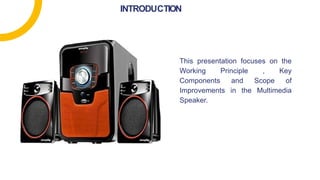
This presentation focuses on the
Working Principle , Key
Components and Scope of
Improvements in the Multimedia
Speaker.
INTRODUCTION
3
ELECTRICAL SIGNAL
An electrical audio signal is received by the speaker and sent to the internal
components. This signal contains information about the sound , such as its
frequency, amplitude, and phase.
VIBRATION
The speaker components vibrate in response to the electrical signal creating
sound waves. These vibrations are generated by a diaphragm or cone that
moves back and forth rapidly.
WORKING PRINCIPLE
4
SOUND AMPLIFICATION
The created sound waves are amplified and projected into the surrounding
environment, producing audible sound. This amplification process ensures that
the sound produced by the speaker is loud and clear.
Finally the produced and amplified sound is transmitted with the properly
maintained voice tone and quality.
WORKING PRINCIPLE
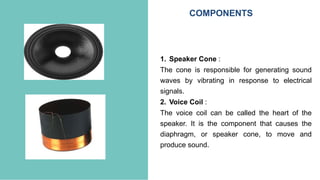
1. Speaker Cone :
The cone is responsible for generating sound
waves by vibrating in response to electrical
signals.
2. Voice Coil :
The voice coil can be called the heart of the
speaker. It is the component that causes the
diaphragm, or speaker cone, to move and
produce sound.
COMPONENTS
6
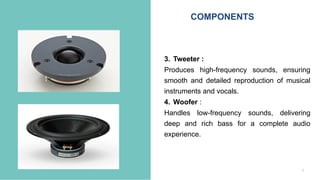
3. Tweeter :
Produces high-frequency sounds, ensuring
smooth and detailed reproduction of musical
instruments and vocals.
4. Woofer :
Handles low-frequency sounds, delivering
deep and rich bass for a complete audio
experience.
COMPONENTS
7
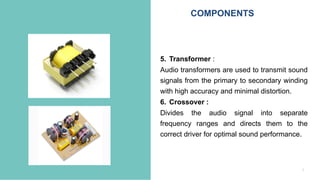
5. Transformer :
Audio transformers are used to transmit sound
signals from the primary to secondary winding
with high accuracy and minimal distortion.
6. Crossover :
Divides the audio signal into separate
frequency ranges and directs them to the
correct driver for optimal sound performance.
COMPONENTS
8
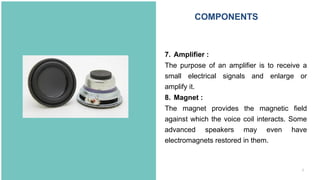
7. Amplifier :
The purpose of an amplifier is to receive a
small electrical signals and enlarge or
amplify it.
8. Magnet :
The magnet provides the magnetic field
against which the voice coil interacts. Some
advanced speakers may even have
electromagnets restored in them.
COMPONENTS
1. Sound Quality :
Continuous improvement in sound quality is a fundamental goal
for music speakers. This includes enhancing clarity, accuracy,
and the ability to reproduce a wide range of frequencies.
Research and development efforts may focus on refining speaker
SCOPE OF IMPROVEMENT
10
2. Wireless Connectivity :
With the growing popularity of wireless audio systems, improving
the reliability, range, and quality of wireless connectivity is crucial.
Advancements in Bluetooth technology, Wi-Fi connectivity, and
other wireless protocols can lead to better and more seamless
integration with various devices.
SCOPE OF IMPROVEMENT
11
THANKS

Music_system(Speaker)_Multimedia_work.pptx

  • 1.
    THE MURPHY MULTIMEDIA SPEAKER PresentationBy : Dinesh(23123) and Divyansh (23124) Group : B-12
  • 2.
    This presentation focuseson the Working Principle , Key Components and Scope of Improvements in the Multimedia Speaker. INTRODUCTION
  • 3.
    3 ELECTRICAL SIGNAL An electricalaudio signal is received by the speaker and sent to the internal components. This signal contains information about the sound , such as its frequency, amplitude, and phase. VIBRATION The speaker components vibrate in response to the electrical signal creating sound waves. These vibrations are generated by a diaphragm or cone that moves back and forth rapidly. WORKING PRINCIPLE
  • 4.
    4 SOUND AMPLIFICATION The createdsound waves are amplified and projected into the surrounding environment, producing audible sound. This amplification process ensures that the sound produced by the speaker is loud and clear. Finally the produced and amplified sound is transmitted with the properly maintained voice tone and quality. WORKING PRINCIPLE
  • 5.
    1. Speaker Cone: The cone is responsible for generating sound waves by vibrating in response to electrical signals. 2. Voice Coil : The voice coil can be called the heart of the speaker. It is the component that causes the diaphragm, or speaker cone, to move and produce sound. COMPONENTS
  • 6.
    6 3. Tweeter : Produceshigh-frequency sounds, ensuring smooth and detailed reproduction of musical instruments and vocals. 4. Woofer : Handles low-frequency sounds, delivering deep and rich bass for a complete audio experience. COMPONENTS
  • 7.
    7 5. Transformer : Audiotransformers are used to transmit sound signals from the primary to secondary winding with high accuracy and minimal distortion. 6. Crossover : Divides the audio signal into separate frequency ranges and directs them to the correct driver for optimal sound performance. COMPONENTS
  • 8.
    8 7. Amplifier : Thepurpose of an amplifier is to receive a small electrical signals and enlarge or amplify it. 8. Magnet : The magnet provides the magnetic field against which the voice coil interacts. Some advanced speakers may even have electromagnets restored in them. COMPONENTS
  • 9.
    1. Sound Quality: Continuous improvement in sound quality is a fundamental goal for music speakers. This includes enhancing clarity, accuracy, and the ability to reproduce a wide range of frequencies. Research and development efforts may focus on refining speaker SCOPE OF IMPROVEMENT
  • 10.
    10 2. Wireless Connectivity: With the growing popularity of wireless audio systems, improving the reliability, range, and quality of wireless connectivity is crucial. Advancements in Bluetooth technology, Wi-Fi connectivity, and other wireless protocols can lead to better and more seamless integration with various devices. SCOPE OF IMPROVEMENT
  • 11.