Chapter 5
Documentation Systems,
Documents and Record Keeping
Title slide
 Inspired Pharma Training Ltd 10/06/13 Quality Management Systems 2
Documentation principle
• Chapter 4 – Documentation
• Essential part of the quality assurance system
• Documentation may exist in a variety of forms
• Accuracy, integrity, availability and legibility of
documents
• Free from errors
• Available in writing
 Inspired Pharma Training Ltd 10/06/13 Quality Management Systems 3
Instructions and records
• Instructions
– Specifications
– Manufacturing formulae, processing, packaging and
testing instructions
– Procedures
– Protocols
– Technical agreements
• Records or reports
– Records
– Certificates of analysis
– Reports
 Inspired Pharma Training Ltd 10/06/13 Quality Management Systems 4
EU GMP Chapter 4
• Good documentation practice
– Documents must be followed
– Designed, prepared, reviewed and distributed with care
– Comply with registered requirements
– Free from errors
– Approved, signed and dated by appropriate and
authorised personnel
• Heads of Production and QC
• These tasks can be delegated
• “Quality Assurance” to approve documents rather than “Quality
Control”
 Inspired Pharma Training Ltd 10/06/13 Quality Management Systems 5
EU GMP Chapter 4
• Good documentation practice
– Clearly written, laid out in an orderly fashion and easy to
check
– Regularly reviewed and kept up-to-date
– Need to define what “regularly” means to you
– Documents cannot be handwritten
– Sufficient space is provided for entry of data
– Entries should be clear, legible and indelible
– Made at the time of the action
– Alterations:
• Signed and dated
• Original entry still legible
• A reason provided
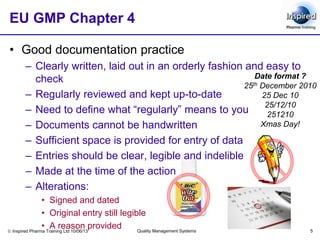
Date format ?
25th December 2010
25 Dec 10
25/12/10
251210
Xmas Day!
 Inspired Pharma Training Ltd 10/06/13 Quality Management Systems 6
IQ OQ
EU GMP Chapter 4
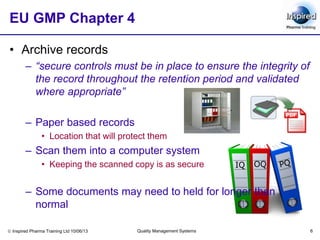
• Archive records
– “secure controls must be in place to ensure the integrity of
the record throughout the retention period and validated
where appropriate”
– Paper based records
• Location that will protect them
– Scan them into a computer system
• Keeping the scanned copy is as secure
– Some documents may need to held for longer than
normal
 Inspired Pharma Training Ltd 10/06/13 Quality Management Systems 7
EU GMP Chapter 4
• Various documents and records needed to be
compliant with GMP
• Detailed guidance of what should be contained in
each type of document
– Starting material specifications
• Designated name
• Directions for sampling
• Storage conditions
 Inspired Pharma Training Ltd 10/06/13 Quality Management Systems 8
Documents and records required
• Specifications:
– Starting, packaging, intermediate, bulk & finished product
• For each product:
– Manufacturing formulae
– Processing and packaging instructions and records
– Product quality review
• Procedures and records for:
– Maintenance
– Cleaning and sanitisation
– Personnel matters
– Environmental monitoring
– Pest control
– Distribution
– Complaints
– Recalls
– Returns
– Change control
– Deviations
– Non-conformities
– Audits
– Major items of equipment
– Log books
– Master list of documents
– Training records
– Organisation charts
– Job descriptions
– Analytical reports
– On-going stability
– Site Master File
– Quality Manual
– Receipt
– Labeling
– Quarantine
– Storage
– Sampling
– Testing
– Release
– Rejection
– Validation
– Equipment assembly
– Equipment calibration
– Technology transfer
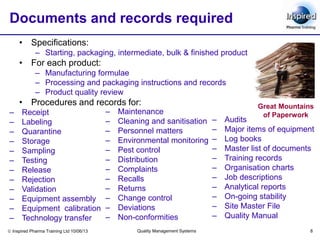
Great Mountains
of Paperwork
 Inspired Pharma Training Ltd 10/06/13 Quality Management Systems 9
Approval of documents
• Named list exists which defines who can approve
what type of document
• Signatures on the front page
– Working copies are then photocopied and issued
• Too many people signing documents
– Everyone to assume that all the other people have
reviewed the document
• Involve the end user as part of the review process
– Some input into how they are worded and laid
– Clear for the end user
 Inspired Pharma Training Ltd 10/06/13 Quality Management Systems 10
Review of records
• Records need to be reviewed
• Extent and frequency can vary
– Established and documented
– Responsibilities of the individuals defined
• Batch records must be reviewed prior to batch
release
– At no point in EU GMP does it state that a QP must
review batch records
– A QP needs to know that they have been reviewed
correctly
 Inspired Pharma Training Ltd 10/06/13 Quality Management Systems 11
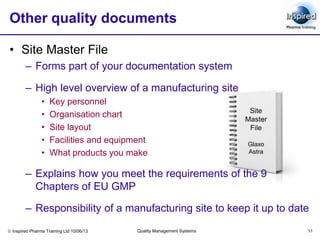
Site
Master
File
Glaxo
Astra
Other quality documents
• Site Master File
– Forms part of your documentation system
– High level overview of a manufacturing site
• Key personnel
• Organisation chart
• Site layout
• Facilities and equipment
• What products you make
– Explains how you meet the requirements of the 9
Chapters of EU GMP
– Responsibility of a manufacturing site to keep it up to date
 Inspired Pharma Training Ltd 10/06/13 Quality Management Systems 12
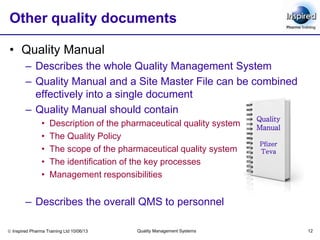
Quality
Manual
Pfizer
Teva
Other quality documents
• Quality Manual
– Describes the whole Quality Management System
– Quality Manual and a Site Master File can be combined
effectively into a single document
– Quality Manual should contain
• Description of the pharmaceutical quality system
• The Quality Policy
• The scope of the pharmaceutical quality system
• The identification of the key processes
• Management responsibilities
– Describes the overall QMS to personnel
 Inspired Pharma Training Ltd 10/06/13 Quality Management Systems 13
Other quality documents
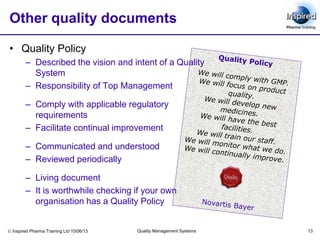
• Quality Policy
– Described the vision and intent of a Quality
System
– Responsibility of Top Management
– Comply with applicable regulatory
requirements
– Facilitate continual improvement
– Communicated and understood
– Reviewed periodically
– Living document
– It is worthwhile checking if your own
organisation has a Quality Policy
 Inspired Pharma Training Ltd 10/06/13 Quality Management Systems 14
A documentation system
• Documentation system
– Designed
– Implemented
– Maintained
– Evaluated
– Improved
– Your system then needs to meet the requirements of the
standard
• One system for all standards
 Inspired Pharma Training Ltd 10/06/13 Quality Management Systems 15
Policies
Training
Validation
Procurement
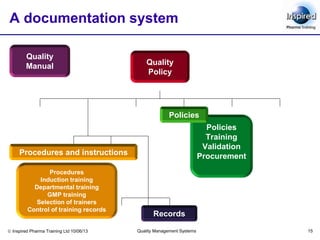
A documentation system
Quality
Manual Quality
Policy
Procedures and instructions
Policies
Procedures
Induction training
Departmental training
GMP training
Selection of trainers
Control of training records
Records
 Inspired Pharma Training Ltd 10/06/13 Quality Management Systems 16
Records
• The records associated with the manufacture of a batch of
product are just as important as the batch itself
“if it isn’t written down it’s a rumour”
• Records must also be retained:
– Safely and securely
– 1 year after the expiry of the batch or 5 years after QP certification
• Records can be kept off-site
• Scanning
 Inspired Pharma Training Ltd 10/06/13 Quality Management Systems 17
Finally
• We have looked at the GMP requirements for documentation
and records
– Should be done
– Has been done
– Are restricted to the core GMP areas
• A more holistic view of quality
– Traditionally outside of the scope of GMP
– Areas that can impact on product quality and level of service
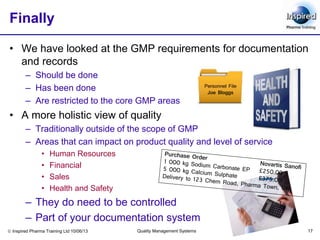
• Human Resources
• Financial
• Sales
• Health and Safety
– They do need to be controlled
– Part of your documentation system
Personnel File
Joe Bloggs

Unit 02 chapter 05 documentation systems documents and record keeping

  • 1.
    Chapter 5 Documentation Systems, Documentsand Record Keeping Title slide
  • 2.
     Inspired PharmaTraining Ltd 10/06/13 Quality Management Systems 2 Documentation principle • Chapter 4 – Documentation • Essential part of the quality assurance system • Documentation may exist in a variety of forms • Accuracy, integrity, availability and legibility of documents • Free from errors • Available in writing
  • 3.
     Inspired PharmaTraining Ltd 10/06/13 Quality Management Systems 3 Instructions and records • Instructions – Specifications – Manufacturing formulae, processing, packaging and testing instructions – Procedures – Protocols – Technical agreements • Records or reports – Records – Certificates of analysis – Reports
  • 4.
     Inspired PharmaTraining Ltd 10/06/13 Quality Management Systems 4 EU GMP Chapter 4 • Good documentation practice – Documents must be followed – Designed, prepared, reviewed and distributed with care – Comply with registered requirements – Free from errors – Approved, signed and dated by appropriate and authorised personnel • Heads of Production and QC • These tasks can be delegated • “Quality Assurance” to approve documents rather than “Quality Control”
  • 5.
     Inspired PharmaTraining Ltd 10/06/13 Quality Management Systems 5 EU GMP Chapter 4 • Good documentation practice – Clearly written, laid out in an orderly fashion and easy to check – Regularly reviewed and kept up-to-date – Need to define what “regularly” means to you – Documents cannot be handwritten – Sufficient space is provided for entry of data – Entries should be clear, legible and indelible – Made at the time of the action – Alterations: • Signed and dated • Original entry still legible • A reason provided Date format ? 25th December 2010 25 Dec 10 25/12/10 251210 Xmas Day!
  • 6.
     Inspired PharmaTraining Ltd 10/06/13 Quality Management Systems 6 IQ OQ EU GMP Chapter 4 • Archive records – “secure controls must be in place to ensure the integrity of the record throughout the retention period and validated where appropriate” – Paper based records • Location that will protect them – Scan them into a computer system • Keeping the scanned copy is as secure – Some documents may need to held for longer than normal
  • 7.
     Inspired PharmaTraining Ltd 10/06/13 Quality Management Systems 7 EU GMP Chapter 4 • Various documents and records needed to be compliant with GMP • Detailed guidance of what should be contained in each type of document – Starting material specifications • Designated name • Directions for sampling • Storage conditions
  • 8.
     Inspired PharmaTraining Ltd 10/06/13 Quality Management Systems 8 Documents and records required • Specifications: – Starting, packaging, intermediate, bulk & finished product • For each product: – Manufacturing formulae – Processing and packaging instructions and records – Product quality review • Procedures and records for: – Maintenance – Cleaning and sanitisation – Personnel matters – Environmental monitoring – Pest control – Distribution – Complaints – Recalls – Returns – Change control – Deviations – Non-conformities – Audits – Major items of equipment – Log books – Master list of documents – Training records – Organisation charts – Job descriptions – Analytical reports – On-going stability – Site Master File – Quality Manual – Receipt – Labeling – Quarantine – Storage – Sampling – Testing – Release – Rejection – Validation – Equipment assembly – Equipment calibration – Technology transfer Great Mountains of Paperwork
  • 9.
     Inspired PharmaTraining Ltd 10/06/13 Quality Management Systems 9 Approval of documents • Named list exists which defines who can approve what type of document • Signatures on the front page – Working copies are then photocopied and issued • Too many people signing documents – Everyone to assume that all the other people have reviewed the document • Involve the end user as part of the review process – Some input into how they are worded and laid – Clear for the end user
  • 10.
     Inspired PharmaTraining Ltd 10/06/13 Quality Management Systems 10 Review of records • Records need to be reviewed • Extent and frequency can vary – Established and documented – Responsibilities of the individuals defined • Batch records must be reviewed prior to batch release – At no point in EU GMP does it state that a QP must review batch records – A QP needs to know that they have been reviewed correctly
  • 11.
     Inspired PharmaTraining Ltd 10/06/13 Quality Management Systems 11 Site Master File Glaxo Astra Other quality documents • Site Master File – Forms part of your documentation system – High level overview of a manufacturing site • Key personnel • Organisation chart • Site layout • Facilities and equipment • What products you make – Explains how you meet the requirements of the 9 Chapters of EU GMP – Responsibility of a manufacturing site to keep it up to date
  • 12.
     Inspired PharmaTraining Ltd 10/06/13 Quality Management Systems 12 Quality Manual Pfizer Teva Other quality documents • Quality Manual – Describes the whole Quality Management System – Quality Manual and a Site Master File can be combined effectively into a single document – Quality Manual should contain • Description of the pharmaceutical quality system • The Quality Policy • The scope of the pharmaceutical quality system • The identification of the key processes • Management responsibilities – Describes the overall QMS to personnel
  • 13.
     Inspired PharmaTraining Ltd 10/06/13 Quality Management Systems 13 Other quality documents • Quality Policy – Described the vision and intent of a Quality System – Responsibility of Top Management – Comply with applicable regulatory requirements – Facilitate continual improvement – Communicated and understood – Reviewed periodically – Living document – It is worthwhile checking if your own organisation has a Quality Policy
  • 14.
     Inspired PharmaTraining Ltd 10/06/13 Quality Management Systems 14 A documentation system • Documentation system – Designed – Implemented – Maintained – Evaluated – Improved – Your system then needs to meet the requirements of the standard • One system for all standards
  • 15.
     Inspired PharmaTraining Ltd 10/06/13 Quality Management Systems 15 Policies Training Validation Procurement A documentation system Quality Manual Quality Policy Procedures and instructions Policies Procedures Induction training Departmental training GMP training Selection of trainers Control of training records Records
  • 16.
     Inspired PharmaTraining Ltd 10/06/13 Quality Management Systems 16 Records • The records associated with the manufacture of a batch of product are just as important as the batch itself “if it isn’t written down it’s a rumour” • Records must also be retained: – Safely and securely – 1 year after the expiry of the batch or 5 years after QP certification • Records can be kept off-site • Scanning
  • 17.
     Inspired PharmaTraining Ltd 10/06/13 Quality Management Systems 17 Finally • We have looked at the GMP requirements for documentation and records – Should be done – Has been done – Are restricted to the core GMP areas • A more holistic view of quality – Traditionally outside of the scope of GMP – Areas that can impact on product quality and level of service • Human Resources • Financial • Sales • Health and Safety – They do need to be controlled – Part of your documentation system Personnel File Joe Bloggs

Editor's Notes

  • #2 COMMENTARY: Welcome to this chapter on “Documentation systems, documents and record keeping”. In this chapter we will explain the importance of documentation and how you establish, maintain and operate a documentation system – an essential element in the design of a QMS. YOUR NOTES:
  • #3 COMMENTARY: The most significant chapter of EU GMP in relation to this subject is Chapter 4 – Documentation. This was last updated in June 2011. A copy can be found in the ATTACHMENTS part of this presentation. You don’t need to print it off – it is just here for reference if you wanted to refer to it. The opening “Principle” of each chapter of EU GMP usually corresponds roughly with the text from associated article from the GMP Directive (2003/ 94/ EC for human products or 91/ 412/ EEC for veterinary products). The principle at the start of Chapter 4 includes the following statements: Good documentation constitutes an essential part of the quality assurance system. Documentation may exist in a variety of forms, including paper-based, electronic or photographic media. Suitable controls should be implemented to ensure the accuracy, integrity, availability and legibility of documents. Instruction documents should be free from errors and available in writing. YOUR NOTES:
  • #4 COMMENTARY: GMP states that documents generally fall into one of two types – instructions (providing direction) and records or reports. Instructions include specifications, manufacturing formulae, processing, packaging and testing instructions, procedures (or Standard Operating Procedures – SOPs), protocols and technical agreements. Records or reports include records, certificates of analysis and reports. Note – despite the image – please don’t use a pencil in a GMP environment! YOUR NOTES:
  • #5 COMMENTARY: Within Chapter 4 there are a series of requirements that collectively form good documentation practice. These include: Documents must be followed (clause 4.1). Note – if you are involved in auditing then this is a common finding (not following a procedure) and a clause worth remembering should you need to raise a non-conformity. The should be designed, prepared, reviewed and distributed with care. Note that GMP does not state that documents must be located at point of use. It’s a good idea to have them easily accessible, hence the requirement to distributed with care. They should comply with registered requirements. Working documents should be free from errors. They should be approved, signed and dated by appropriate and authorised personnel. Note – it does not then say who is appropriate and authorised! However in EU GMP Chapter 2 (on Personnel) the duties of the Heads of Production and QC are defined (clause 2.7). One of these duties is “the authorisation of written procedures and other documents” so at a minimum you must have 2 signatures on your procedures, one for Production and one for QC. These tasks can be delegated to other people of suitable competence and authority, and this is defined in clause 2.2. This is often how organisations get “Quality Assurance” to approve documents rather than “Quality Control”. As long as QA are independent of Production then this is usually fine. YOUR NOTES:
  • #6 COMMENTARY: Also in Chapter 4 it states that: Documents should be clearly written, laid out in an orderly fashion and easy to check. They should be regularly reviewed and kept up-to-date. Of note is that it doesn’t state a timeframe for review (i.e. every year) it states “regularly”. When GMP uses words like regularly then you need to define what “regularly” means to you. For most organisations regularly means every year or every two years. The important thing is that you define what is a suitable review period and then ensure that you implement this. Chapter 4 also goes on to say that documents cannot be handwritten. Sufficient space is provided for entry of data. Note that there is no mention in GMP of how you write the time and date (date format). However, if you have a procedure on writing the time and date a certain way – then this procedure must be followed. Entries should be clear, legible and indelible and made at the time of the action. Note that there is no mention of the words “pen” or “ink” or even “pen colour” in GMP. The word is “indelible” which means permanent – so you cannot use a pencil. Finally alternations to entries should be signed and dated, leaving the original entry still legible and if necessary a reason provided. Of note here is that there is no mention of not using Typex or correction fluid to correct errors in EU GMP. However, this clause stops the use of these – albeit, like the use of a pencil, implicitly. YOUR NOTES:
  • #7 COMMENTARY: Chapter 4 also give guidance on how long you archive records for. It states that “secure controls must be in place to ensure the integrity of the record throughout the retention period and validated where appropriate”. This means that if you stored paper based records then they need to be securely stored in a location that will protect them. Usually fire-proof cabinets or archive rooms designed with no ignition or water source are used. You can also used paper-based records and then scan them into a computer system. As long as you can prove that keeping the scanned copy is as secure as keeping the original paper copy then you can scan a document and then discard it. It also states that some documents may need to held for longer than normal, for example if they formed part of the Marketing Authorisation (Product Licence) application or were related to a validation or stability studies that has not been repeated for more than 5 years. YOUR NOTES:
  • #8 COMMENTARY: Much of the rest of Chapter 4 covers the various documents and records needed to be compliant with GMP. It also gives detailed guidance of what should be contained in each type of document, for example starting material specifications should contain the designated name, directions for sampling, storage conditions and so on. On the next slide we list all of the documents and records specifically required to comply with GMP – you will see that it is a lot! YOUR NOTES:
  • #9 COMMENTARY: The slide shows the documents and records required as specified in EU GMP Chapter 4 (Documentation), Chapter 1 (Pharmaceutical Quality System), Chapter 2 (Personnel) and Chapter 6 (Quality Control). It may not be an exhaustive list and also does not include the documents and records required elsewhere in GMP, such as in the Annexes. What the slide should show you is that GMP is very document and record focused, and as a result needs a good documentation system in place to manage it effectively and efficiently. This is why GMP is often nick-named Great Mountains of Paperwork! YOUR NOTES:
  • #10 COMMENTARY: We covered earlier who is responsible for the approval of documents in EU GMP – namely the Heads of Production and QC, and that these activities can be delegated. What is normal practice if people other then the Heads of Production and QC are to approve documents is that some form of named list exists which defines who can approve what type of document. It is also normal practice to have the signatures of whoever approves a document on the front page, so it can be clearly seen once all relevant people have signed the document. Once approved and issued working copies are then normally photocopied and issued for access to members of staff. Always be careful of having too many people signing documents in order to approve them! Not only does this make the approval process longer but there is always the temptation of everyone to assume that all the other people have reviewed the document thoroughly. Finally on this point – always remember to involve the end-user of a document as part of the review and approval process. This so often doesn’t happen, yet we blame the individual if they don’t follow a document. Make sure that the people who are expected to follow documents at least have some input into how they are worded and laid out so that they are clear for the end user. YOUR NOTES:
  • #11 COMMENTARY: Once records, including batch records, are completed then they need to be reviewed. The extend and frequency of this review can vary, often depending on the risk. For example critical environmental data or sterilisation records may be reviewed daily (or even more frequency) but other records (for example pest control records) may be reviewed less frequently – perhaps once a month or even longer. The frequency of such reviews should be established and documented with the responsibilities of the individual’s who perform the review clearly defined. Batch records must be reviewed prior to batch release. As a Qualified Person (QP) it is essential that you know that batch records have been reviewed. If anything out of the ordinarily occurred, if there were any deviations, unexplained events, problems and changes that were not authorised and controlled properly then these need to be assessed. Whilst some QP’s do review every batch record it is worth pointing out that at no point in EU GMP does it state that a QP must review batch records. A QP needs to know that they have been reviewed correctly. In EU GMP the responsibility for review of batch records lies with the Head of Production and QC, as stated in Chapter 2. YOUR NOTES:
  • #12 COMMENTARY: There are three other quality related documents that we should mention. One has been a GMP requirement for a long time and the other two are relatively new. A Site Master File (SMF) is a GMP specified document that has been required for decades. It is an important document and therefore forms part of your documentation system. A SMF gives a high level overview of a manufacturing site and includes information such as key personnel, organisation chart, site layout, facilities and equipment, what products you make and so on. In essence a SMF is a document that explains how you meet the requirements of the 9 Chapters of EU GMP. Once a SMF has been written and approved there is a responsibility of a manufacturing site to keep it up to date. YOUR NOTES:
  • #13 COMMENTARY: Then there is a Quality Manual. This is not mentioned in EU GMP Chapter 4, where it should be mentioned, but is mentioned in very general terms in EU GMP Chapter 1 and ICH Q10. A Quality Manual describes the whole Quality Management System and differs from a SMF which more describes the GMP and physical organisation of the facility. A Quality Manual and a Site Master File can be combined effectively into a single document, and this can make sense as one of the requirements of the SMF is to have a description of the Quality Management System – and this is exactly what a Quality Manual should do. From ICH Q10 a Quality Manual should contain: A description of the pharmaceutical quality system. The Quality Policy. The scope of the pharmaceutical quality system. Note – this could be what parts and/or activities of the organisation it covers/ does not cover. The identification of the key processes, as well as their sequences, linkages and interdependencies and the Management responsibilities within the pharmaceutical quality system. As such a Quality Manual is a high level document that describes the overall QMS to personnel. YOUR NOTES:
  • #14 COMMENTARY: The final document is the Quality Policy. This again is a relatively new concept to GMP and, like the Quality Manual, is an idea taken from ISO 9001. The quality policy is a high level document that describes the vision and intent of a Quality System, and as such, an organisation. It is not mentioned in either EU GMP Chapters 4 or 1 (although it should be), but again is covered in ICH Q10. It is the responsibility of Top Management to establish a Quality Policy. The Quality Policy should include: An expectation to comply with applicable regulatory requirements. Note – this is likely to be a statement on complying with GMP and other legislation. It should facilitate continual improvement of the system. Note – the policy should have these words in it and state how the organisation will facilitate improvements. It should also be: Communicated to and understood by personnel at all levels in the company and be Reviewed periodically for continuing effectiveness. As such the Quality Policy is a living document, that is a simple yet powerful way of documenting the organisation’s vision. It should be communicated to all and reviewed regularly for suitability – not just put in a picture frame in Reception and never looked at again! It is worthwhile checking if your own organisation has a Quality Policy, that you know what it roughly is about (you should know if you have the word “Quality” in your job title) and, more importantly, that it meets the requirements of the above. YOUR NOTES:
  • #15 COMMENTARY: So far we have covered what documents and records are needed to comply with EU GMP. What you really need to have however is a documentation system. A documentation system is an important part of a QMS as it describes the actions needed to be done to achieved planned results. As such a documentation system needs to be designed, implemented, maintained, evaluated and improved. When designing a system you normally need to look at the standard, or standards, that you are expected to work to in the first instance. If you are a pharmaceutical manufacturing site then this will inevitably be GMP. Your system then needs to meet the requirements of the standard, but don’t forget that you may have other standards to also work to, such as Corporate Standards, Health and Safety Standards, Environmental Standards and so on. Where possible your documentation system should have flexibility to allows you to have one system for all standards. The documentation system then also needs to be adapted to the organisation. YOUR NOTES:
  • #16 COMMENTARY: The documentation system is often in layers and often looks something like this (see the slide). Your Quality Manual describes the QMS. You also have a Quality Policy, a vision for the organisation. Each areas of the business may then have policies. These are usually linked to different departments and/or processes and state how you will achieve the requirements of the Quality Policy. They should be based on business needs as well as any regulatory requirements. As such you may well have policies on training, validation, procurement, etc. Then there are a number of procedures and instructions established to describe how you achieve the policies. These may include, such as in the case of training, the training related procedures (see the slide) established to meet the training policy. All of this is recorded in records. YOUR NOTES:
  • #17 COMMENTARY: GMP also has quite stringent requirements for records, and the records associated with the manufacture of a batch of product are just as important as the batch itself. A good adage is – “if it isn’t written down it’s a rumour”. Records are carefully examined at various stages, especially prior to batch release. Records must also be retained safely and securely, in a manner that will not permit their deterioration. EU GMP requires records for the kept for 1 year after the expiry of the batch to which they relate or 5 years after QP certification, which ever is longest (EU GMP Directive 2003/94 EC Article 9). Normally organisations keep their records for slightly longer than this, and keeping records for 6 or 7 years (or even longer) is often the norm. Records can be kept off-site, and external documentation archive firms are often used. These should be approved and audited as part of your supplier/ outsourced activities arrangements. Likewise the physical record does not need to be kept, as scanning (microfiche in the olden days) is a very common alternative to keeping (and paying for keeping) large amounts of paper, as long as it is validated. YOUR NOTES:
  • #18 COMMENTARY: So in summary we have looked at the GMP requirements for documentation and records. They form an essential part of your QMS as they describe what actions should be done (and how) and record what actually has been done. We have focused on the GMP requirements for documents and records, and these, whilst detailed, are restricted to the core GMP areas of Production and Quality Control. As we conclude this chapter don’t forget that we are trying to encourage a more holistic view of quality, and you should not forget the importance of documents and records in areas and departments traditionally outside of the scope of GMP. These areas that can impact on product quality and level of service. These may include Human Resources procedures (perhaps for recruitment), Financial records (Purchase Order and Invoices), Sales records (orders from customers) and Health and Safety procedures and records (in the event of fires and accidents, manual handling, working conditions, etc.). Whilst these do not necessary need to be controlled to the same extent as GMP related documents and records – they do need to be controlled, and as such should also be, in some way, part of your documentation system. YOUR NOTES: