Unintentional
Injury
Prevention
Safety
First Aid
Ms. Joana Marie M. Bernasol
Bro. Andrew Gonzalez Technical High School
First Aid
is an immediate and temporary care given to
a person who suddenly gets ill or injured.
It includes self-help and home care if medical
assistance is not available or delayed.
It can mean the difference between life and
death in extreme cases.
Roles of First Aid
1. It is a bridge that feels the gap between the
victim and the physician
2. It is not intended to compete with or to take
place of the services of the physician
3. It ends when the services of the physician
begins.
Objectives of First Aid
1. To save lives
2. To prolong life
3. To alleviate suffering
4. To prevent further injury
Characteristics of a Good
First Aider
1. Gentle- does not cause pain and panic
2. Observant- notices all signs
3. Resourceful- makes the best use of things at
hand
4. Tactful- does not frighten the victim
5. Sympathetic- comforts and reassures the
victim
Principles of First Aid
Do’s
1. Stay calm
2. Reassure and comfort the
victim
3. Check for medical bracelet
4. Loosen any tight clothing
5. Keep the victim covered to
reduce shock
Don’ts
1. Don’t give food and
drink to an unconscious
person
2. Don’t move an injured
person unless you need
to place him/her in the
recovery position
Steps in Assessing
Emergency Situations
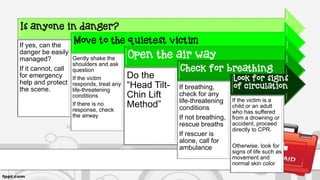
Is anyone in danger?
If yes, can the
danger be easily
managed?
If it cannot, call
for emergency
help and protect
the scene.
Move to the quietest victim
Gently shake the
shoulders and ask
question
If the victim
responds, treat any
life-threatening
conditions
If there is no
response, check
the airway
Open the air way
Do the
“Head Tilt-
Chin Lift
Method”
Check for breathing
If breathing,
check for any
life-threatening
conditions
If not breathing,
rescue breaths
If rescuer is
alone, call for
ambulance
Look for signs
of circulation
If the victim is a
child or an adult
who has suffered
from a drowning or
accident, proceed
directly to CPR.
Otherwise, look for
signs of life such as
movement and
normal skin color
Dressing and
Bandaging
Wounds
is a break in the continuity of a
tissue in the body.
It may be closed in which there is
no break or damage in the skin. It is
also called hematoma or contusions.
Kinds of Open Wounds
1. Puncture is a piercing wound caused by nails, needles and
other pointed objects
2. Abrasion is caused by rubbing or scraping the skin
against a rough surface.
3. Incision is a cut caused by knife, broken glass or any
sharp object.
4. Laceration is a blunt breaking or tearing of soft tissues
usually resulting from mishandling tools and other
accidents.
5. Avulsion is a forcible tearing or partial tearing away of
tissues.
Dressing
•A piece of sterile cloth that
covers a wound to prevent
infection and/or to stop
bleeding
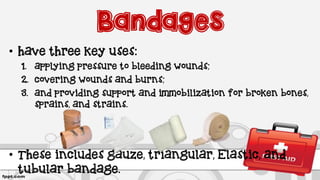
Bandages
• have three key uses:
1. applying pressure to bleeding wounds;
2. covering wounds and burns;
3. and providing support and immobilization for broken bones,
sprains, and strains.
• These includes gauze, triangular, Elastic, and
tubular bandage.
Two Phases of Bandaging
Open Phase Bandaging
Cravat Phase bandaging
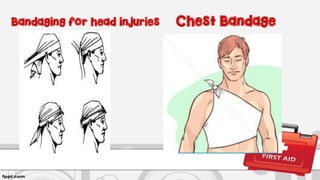
Bandaging for head injuries Chest Bandage
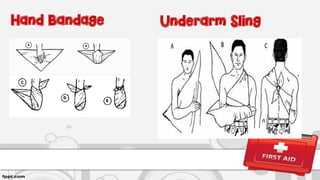
Hand Bandage Underarm Sling
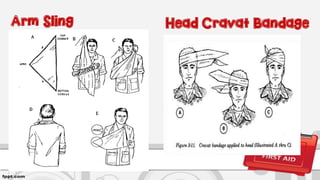
Head Cravat BandageArm Sling
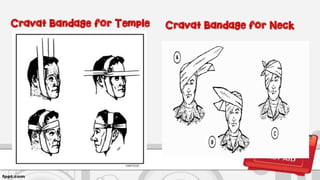
Cravat Bandage for NeckCravat Bandage for Temple
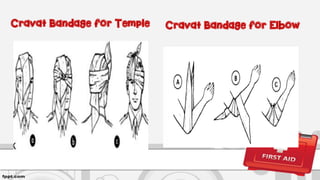
Cravat Bandage for ElbowCravat Bandage for Temple
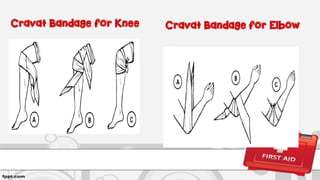
Cravat Bandage for ElbowCravat Bandage for Knee
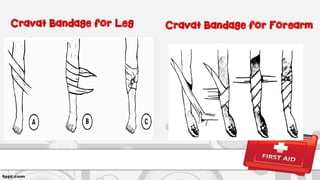
Cravat Bandage for ForearmCravat Bandage for Leg
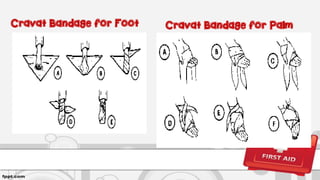
Cravat Bandage for PalmCravat Bandage for Foot
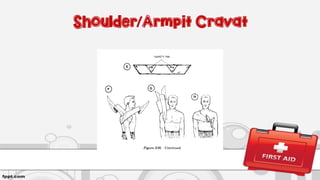
Shoulder/Armpit Cravat
Carrying and
Transporting
Factors to consider:
• Weight and height of the victim
• Status of the victim (conscious or unconscious)
• Environment (safe, floor is smooth, narrow or
wide)
• Special need considerations (injuries of the
victims)
Kinds of
Transport
One Man Transport
Three or More Man Transport
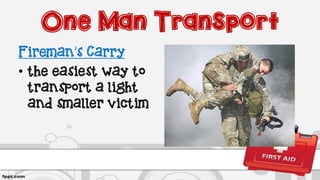
One Man Transport
Fireman’s Carry
• the easiest way to
transport a light
and smaller victim
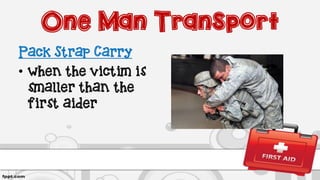
One Man Transport
Pack Strap Carry
• when the victim is
smaller than the
first aider
One Man Transport
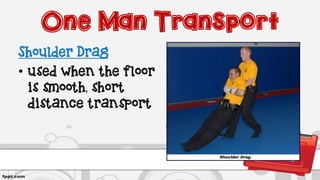
Shoulder Drag
• used when the floor
is smooth, short
distance transport
One Man Transport
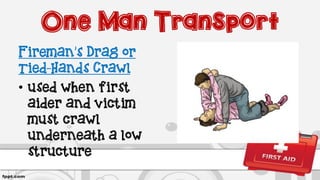
Fireman’s Drag or
Tied-Hands Crawl
• used when first
aider and victim
must crawl
underneath a low
structure
One Man Transport
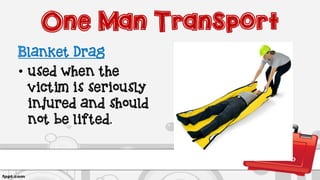
Blanket Drag
• used when the
victim is seriously
injured and should
not be lifted.
Three or more-Man Transport
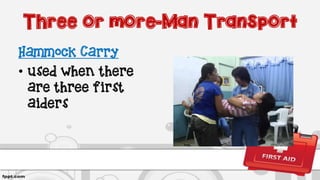
Hammock Carry
• used when there
are three first
aiders
Three or more-Man Transport
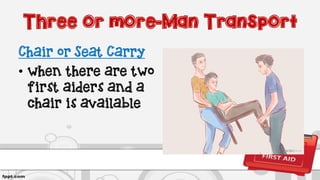
Chair or Seat Carry
• when there are two
first aiders and a
chair is available
Three or more-Man Transport
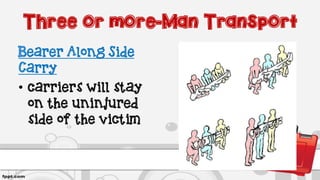
Bearer Along Side
Carry
• carriers will stay
on the uninjured
side of the victim
Three or more-Man Transport
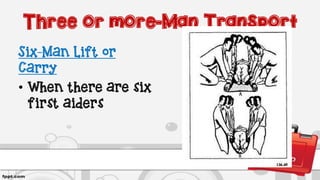
Six-Man Lift or
Carry
• When there are six
first aiders
First Aid for Common
Unintentional Injuries
Fracture Dislocation Heat exhaustion
Sprain Food Poisoning Choking
Drowning Heart Attack Chemical Burns
Burns Heat Stroke Stroke
Fracture
1. Check vital Signs
2. Do not move the injured part
3. Stop bleeding if there is any
4. If you have to move the person, immobilize
the broken part by splinting
5. Seek medical help immediately
Dislocation
1. Call for help immediately
2. Splint the affected part
3. Do not try to move the dislocated part or
force it back into place
4. Apply ice on the injured part to induce
swelling
Sprain/Strain
1. Rest the injured part
2. Apply ice
3. Compress the injured part
4. Elevate
Heat Exhaustion
1. Transport the victim to a cool place
2. Give him plenty of water
3. Check for vital signs
4. Seek for medical help
Food Poisoning
1. Help the person to lie down and rest
2. Give him plenty of flavorless fluid and a
bowl to use if he vomits
3. Call for medical help if the condition
worsens
Choking
1. Ask the person if he is choking
2. Encourage him to cough
3. Give him 5 back blows if he cannot speak
or stops coughing
4. If it fails, try abdominal thrusts
5. Check his mouth for obstructions
6. If not clear, call for ambulance
Drowning
1. Lay the person down
2. Check breathing and open the airway
3. Give CPR if necessary
4. If he is breathing, place him in recovery
position
5. Treat for hypothermia by removing wet
clothes and cover with dry blanket
Heart Attack
1. Help the person sit or lie down with head
elevated
2. Call for medical help
3. If he is conscious, give full-dose aspirin
and advise to chew slowly
4. Monitor vital signs
5. Give rescue breaths and chest
compression if necessary
Chemical Burns
1. Make sure that contact with the
electrical source is broken
2. Flood with plenty of water
3. Wear gloves and place sterile dressing
or bandage
4. Call for medical help
5. Treat for possible shock
Burns
1. Flood with cold water and cover if minor
2. Fro severe, help the person to lie down
and douse the burn with cold liquid
3. Do not delay medical help
4. Wear gloves and gently remove
accessories/clothing then cover
5. Monitor vital signs and treat for shock
Heat Stroke
1. Move to a cool place and loosen clothing
2. Call for medical help
3. Wrap in cold wet sheet until it returns
to normal body temperature
4. Monitor vital signs
Stroke
1. If conscious, help the victim to lie down with head
and shoulders raised/supported
2. Place a towel on shoulder to absord any dribbling
3. Call for help
4. Loosen tight clothing
5. Monitor vital signs
6. Be ready to give rescue breaths and chest
compressions

Unintentional injury

  • 1.
    Unintentional Injury Prevention Safety First Aid Ms. JoanaMarie M. Bernasol Bro. Andrew Gonzalez Technical High School
  • 2.
    First Aid is animmediate and temporary care given to a person who suddenly gets ill or injured. It includes self-help and home care if medical assistance is not available or delayed. It can mean the difference between life and death in extreme cases.
  • 3.
    Roles of FirstAid 1. It is a bridge that feels the gap between the victim and the physician 2. It is not intended to compete with or to take place of the services of the physician 3. It ends when the services of the physician begins.
  • 4.
    Objectives of FirstAid 1. To save lives 2. To prolong life 3. To alleviate suffering 4. To prevent further injury
  • 5.
    Characteristics of aGood First Aider 1. Gentle- does not cause pain and panic 2. Observant- notices all signs 3. Resourceful- makes the best use of things at hand 4. Tactful- does not frighten the victim 5. Sympathetic- comforts and reassures the victim
  • 6.
    Principles of FirstAid Do’s 1. Stay calm 2. Reassure and comfort the victim 3. Check for medical bracelet 4. Loosen any tight clothing 5. Keep the victim covered to reduce shock Don’ts 1. Don’t give food and drink to an unconscious person 2. Don’t move an injured person unless you need to place him/her in the recovery position
  • 7.
  • 8.
    Is anyone indanger? If yes, can the danger be easily managed? If it cannot, call for emergency help and protect the scene. Move to the quietest victim Gently shake the shoulders and ask question If the victim responds, treat any life-threatening conditions If there is no response, check the airway Open the air way Do the “Head Tilt- Chin Lift Method” Check for breathing If breathing, check for any life-threatening conditions If not breathing, rescue breaths If rescuer is alone, call for ambulance Look for signs of circulation If the victim is a child or an adult who has suffered from a drowning or accident, proceed directly to CPR. Otherwise, look for signs of life such as movement and normal skin color
  • 9.
  • 10.
    Wounds is a breakin the continuity of a tissue in the body. It may be closed in which there is no break or damage in the skin. It is also called hematoma or contusions.
  • 11.
    Kinds of OpenWounds 1. Puncture is a piercing wound caused by nails, needles and other pointed objects 2. Abrasion is caused by rubbing or scraping the skin against a rough surface. 3. Incision is a cut caused by knife, broken glass or any sharp object. 4. Laceration is a blunt breaking or tearing of soft tissues usually resulting from mishandling tools and other accidents. 5. Avulsion is a forcible tearing or partial tearing away of tissues.
  • 12.
    Dressing •A piece ofsterile cloth that covers a wound to prevent infection and/or to stop bleeding
  • 13.
    Bandages • have threekey uses: 1. applying pressure to bleeding wounds; 2. covering wounds and burns; 3. and providing support and immobilization for broken bones, sprains, and strains. • These includes gauze, triangular, Elastic, and tubular bandage.
  • 14.
    Two Phases ofBandaging Open Phase Bandaging Cravat Phase bandaging
  • 15.
    Bandaging for headinjuries Chest Bandage
  • 16.
  • 17.
  • 18.
    Cravat Bandage forNeckCravat Bandage for Temple
  • 19.
    Cravat Bandage forElbowCravat Bandage for Temple
  • 20.
    Cravat Bandage forElbowCravat Bandage for Knee
  • 21.
    Cravat Bandage forForearmCravat Bandage for Leg
  • 22.
    Cravat Bandage forPalmCravat Bandage for Foot
  • 23.
  • 24.
  • 25.
    Factors to consider: •Weight and height of the victim • Status of the victim (conscious or unconscious) • Environment (safe, floor is smooth, narrow or wide) • Special need considerations (injuries of the victims)
  • 26.
    Kinds of Transport One ManTransport Three or More Man Transport
  • 27.
    One Man Transport Fireman’sCarry • the easiest way to transport a light and smaller victim
  • 28.
    One Man Transport PackStrap Carry • when the victim is smaller than the first aider
  • 29.
    One Man Transport ShoulderDrag • used when the floor is smooth, short distance transport
  • 30.
    One Man Transport Fireman’sDrag or Tied-Hands Crawl • used when first aider and victim must crawl underneath a low structure
  • 31.
    One Man Transport BlanketDrag • used when the victim is seriously injured and should not be lifted.
  • 32.
    Three or more-ManTransport Hammock Carry • used when there are three first aiders
  • 33.
    Three or more-ManTransport Chair or Seat Carry • when there are two first aiders and a chair is available
  • 34.
    Three or more-ManTransport Bearer Along Side Carry • carriers will stay on the uninjured side of the victim
  • 35.
    Three or more-ManTransport Six-Man Lift or Carry • When there are six first aiders
  • 36.
    First Aid forCommon Unintentional Injuries Fracture Dislocation Heat exhaustion Sprain Food Poisoning Choking Drowning Heart Attack Chemical Burns Burns Heat Stroke Stroke
  • 37.
    Fracture 1. Check vitalSigns 2. Do not move the injured part 3. Stop bleeding if there is any 4. If you have to move the person, immobilize the broken part by splinting 5. Seek medical help immediately
  • 38.
    Dislocation 1. Call forhelp immediately 2. Splint the affected part 3. Do not try to move the dislocated part or force it back into place 4. Apply ice on the injured part to induce swelling
  • 39.
    Sprain/Strain 1. Rest theinjured part 2. Apply ice 3. Compress the injured part 4. Elevate
  • 40.
    Heat Exhaustion 1. Transportthe victim to a cool place 2. Give him plenty of water 3. Check for vital signs 4. Seek for medical help
  • 41.
    Food Poisoning 1. Helpthe person to lie down and rest 2. Give him plenty of flavorless fluid and a bowl to use if he vomits 3. Call for medical help if the condition worsens
  • 42.
    Choking 1. Ask theperson if he is choking 2. Encourage him to cough 3. Give him 5 back blows if he cannot speak or stops coughing 4. If it fails, try abdominal thrusts 5. Check his mouth for obstructions 6. If not clear, call for ambulance
  • 43.
    Drowning 1. Lay theperson down 2. Check breathing and open the airway 3. Give CPR if necessary 4. If he is breathing, place him in recovery position 5. Treat for hypothermia by removing wet clothes and cover with dry blanket
  • 44.
    Heart Attack 1. Helpthe person sit or lie down with head elevated 2. Call for medical help 3. If he is conscious, give full-dose aspirin and advise to chew slowly 4. Monitor vital signs 5. Give rescue breaths and chest compression if necessary
  • 45.
    Chemical Burns 1. Makesure that contact with the electrical source is broken 2. Flood with plenty of water 3. Wear gloves and place sterile dressing or bandage 4. Call for medical help 5. Treat for possible shock
  • 46.
    Burns 1. Flood withcold water and cover if minor 2. Fro severe, help the person to lie down and douse the burn with cold liquid 3. Do not delay medical help 4. Wear gloves and gently remove accessories/clothing then cover 5. Monitor vital signs and treat for shock
  • 47.
    Heat Stroke 1. Moveto a cool place and loosen clothing 2. Call for medical help 3. Wrap in cold wet sheet until it returns to normal body temperature 4. Monitor vital signs
  • 48.
    Stroke 1. If conscious,help the victim to lie down with head and shoulders raised/supported 2. Place a towel on shoulder to absord any dribbling 3. Call for help 4. Loosen tight clothing 5. Monitor vital signs 6. Be ready to give rescue breaths and chest compressions