WARM-UP
ACTIVITY
ACTIVITY 1:
PHYSICAL ACTIVITY QUESTIONNAIRE
AND YOU
3
Physical
Activity and
Physical Fitness
Assessment
Objectives:
▸ undertakes physical activity and physical
fitness assessments PE9PF-Ia-h-23; and
▸ monitors periodically one’s progress towards
the fitness goals PE9PF-IIb-h-28.
5
ACTIVITY 2: WORKOUT ACTIVITY
Physical Fitness Assessment
6
GROUP 1. HEALTH - RELATED FITNESS
 Muscular Strength
 Flexibility
7
GROUP 2. HEALTH-RELATED FITNESS
 Muscular Endurance
 Cardiovascular Endurance
8
GROUP 3. SKILL-RELATED FITNESS
 Agility
 Balance
9
GROUP 4. SKILL-RELATED FITNESS
 Coordination
 Power
10
GROUP 5. SKILL-RELATED FITNESS
 Reaction Time
 Speed
11
PHYSICAL FITNESS
is a set of measures designed to
determine one’s level of physical
fitness.
Health-related and Skill-related
fitness
12
HEALTH-RELATED FITNESS
1. Muscular Strength
2. Muscular Endurance
3. Flexibility
4. Cardiovascular Endurance
5. Body Composition
13
SKILL-RELATED FITNESS
1. Agility
2. Balance
3. Coordination
4. Power
5. Reaction Time
6. Speed
14
MUSCULAR STRENGTH
the amount of force your muscles
can produce.
15
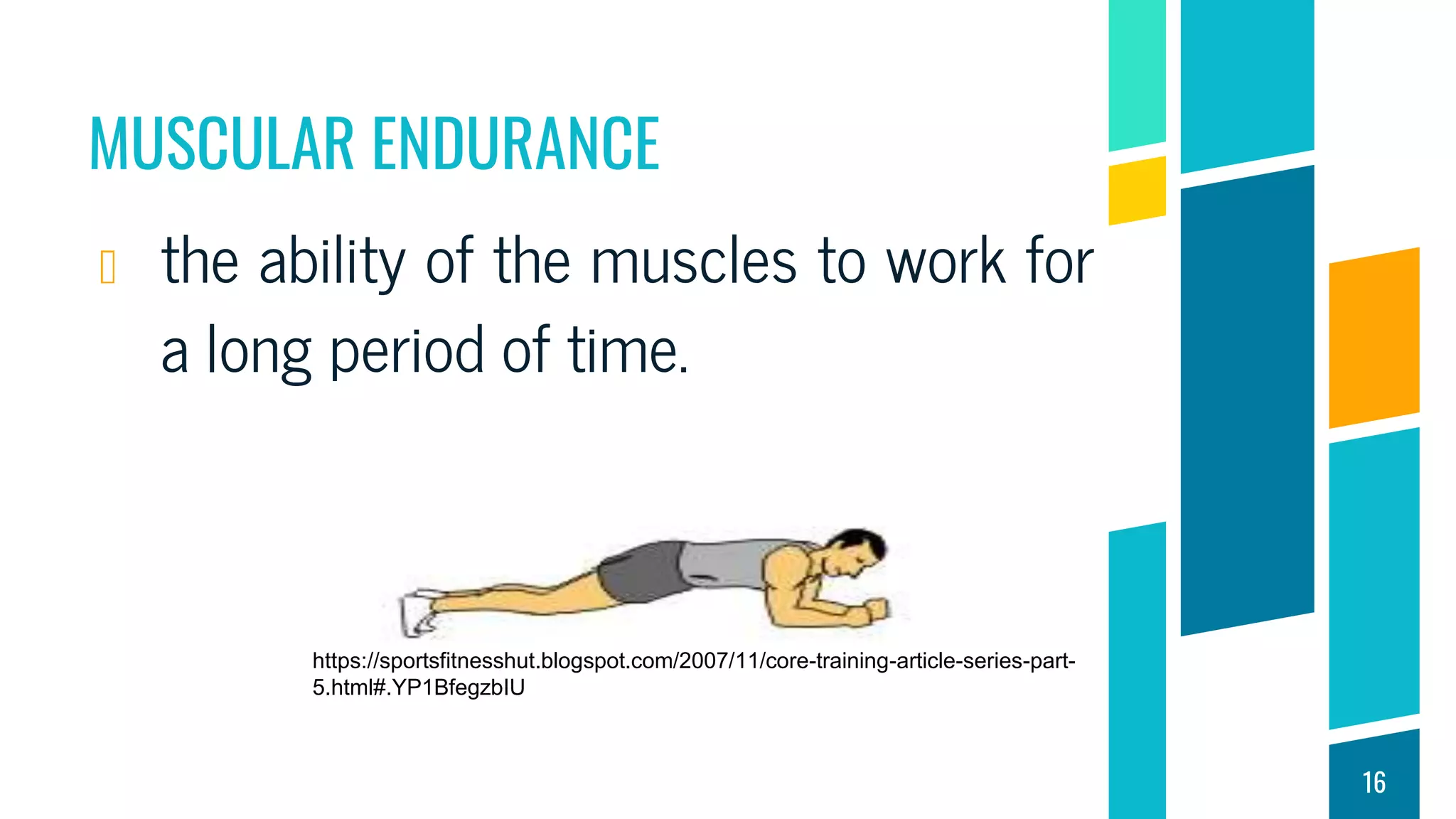
MUSCULAR ENDURANCE
the ability of the muscles to work for
a long period of time.
16
https://sportsfitnesshut.blogspot.com/2007/11/core-training-article-series-part-
5.html#.YP1BfegzbIU
FLEXIBILITY
the ability to use your joints fully
through a wide range of motion.
17
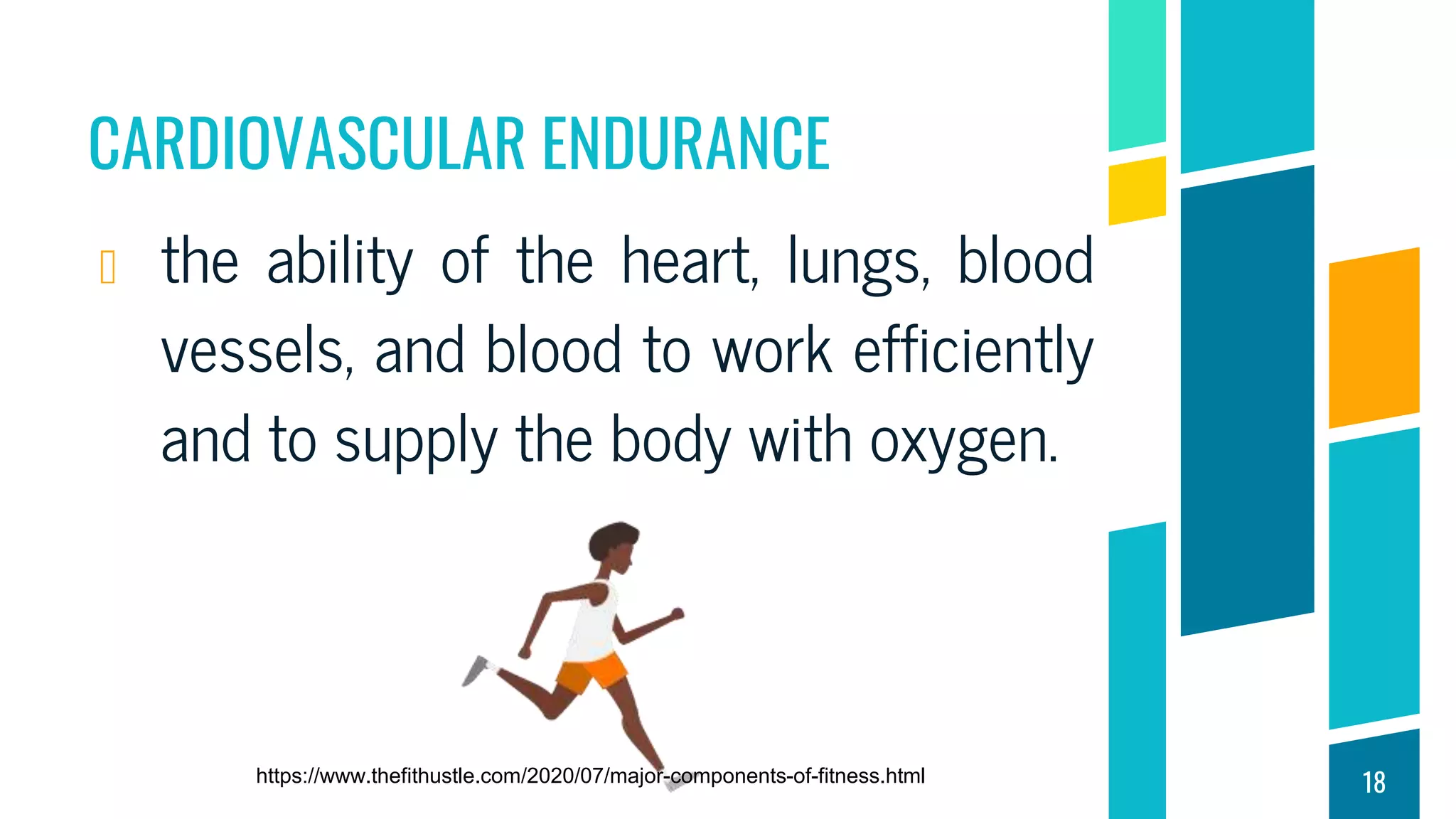
CARDIOVASCULAR ENDURANCE
the ability of the heart, lungs, blood
vessels, and blood to work efficiently
and to supply the body with oxygen.
18
https://www.thefithustle.com/2020/07/major-components-of-fitness.html
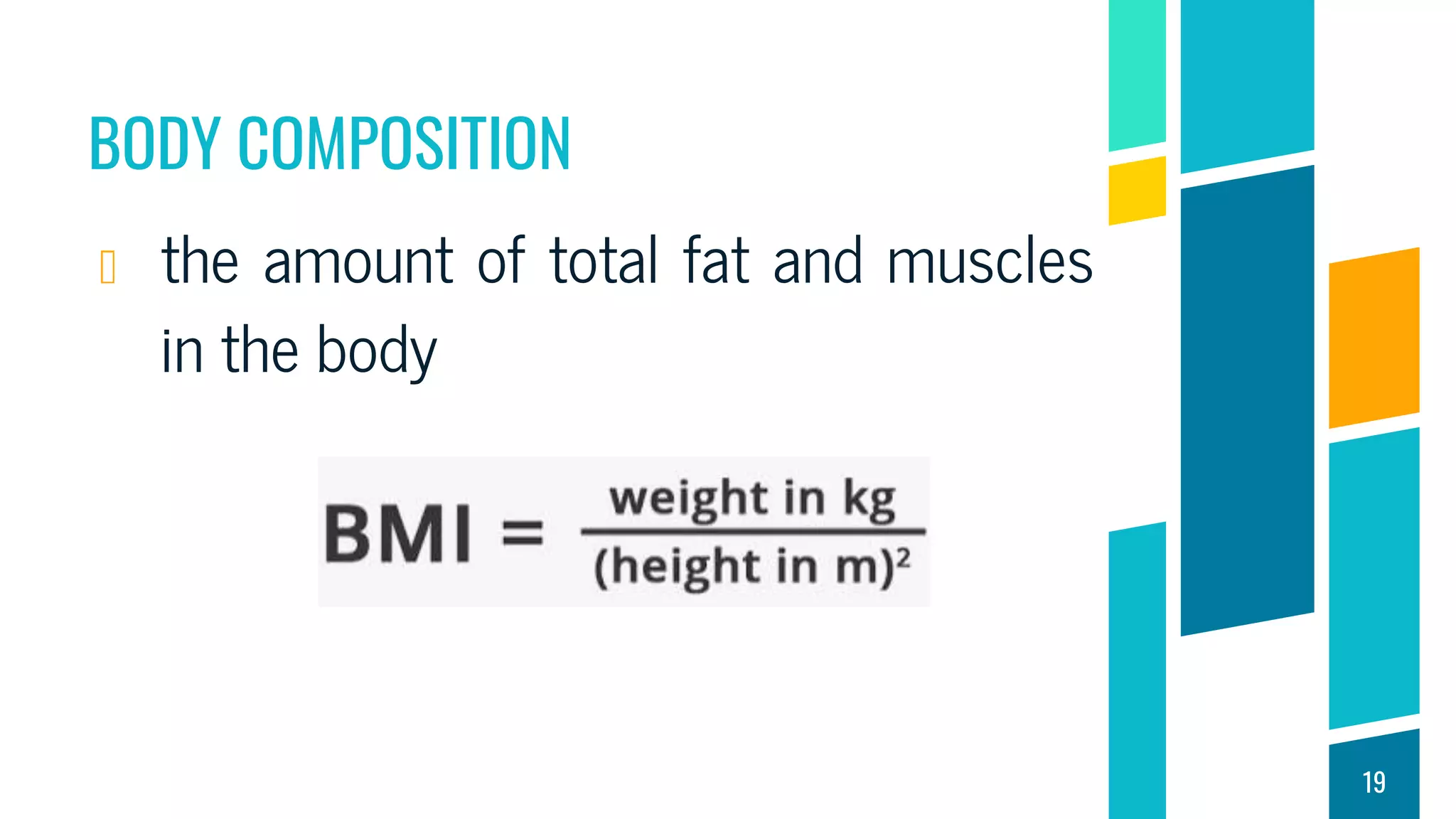
BODY COMPOSITION
the amount of total fat and muscles
in the body
19
BODY COMPOSITION
20
BODY COMPOSITION
21
AGILITY
ability to rapidly and accurately
change direction of the whole body
in space.
22
BALANCE
ability to maintain equilibrium while
stationary or moving.
23
COORDINATION
ability to use senses and body parts
in order to perform motor tasks
smoothly and accurately.
24
https://www.presentermedia.com/powerpoint-
animation/figure-juggling-balls-pid-4301
POWER
amount of force a muscle can exert.
25
https://www.pinterest.ph/pin/473440979559502293/
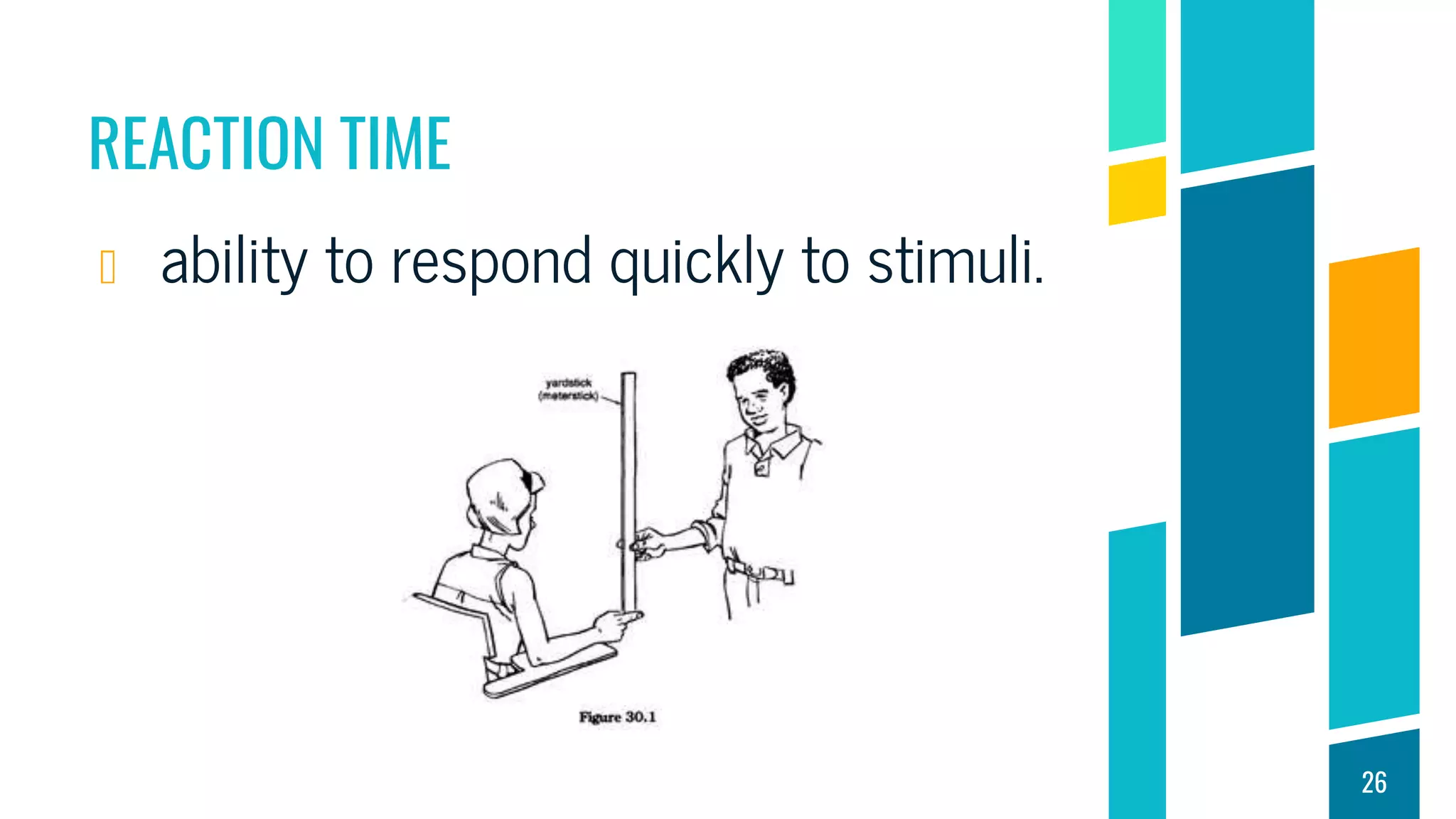
REACTION TIME
ability to respond quickly to stimuli.
26
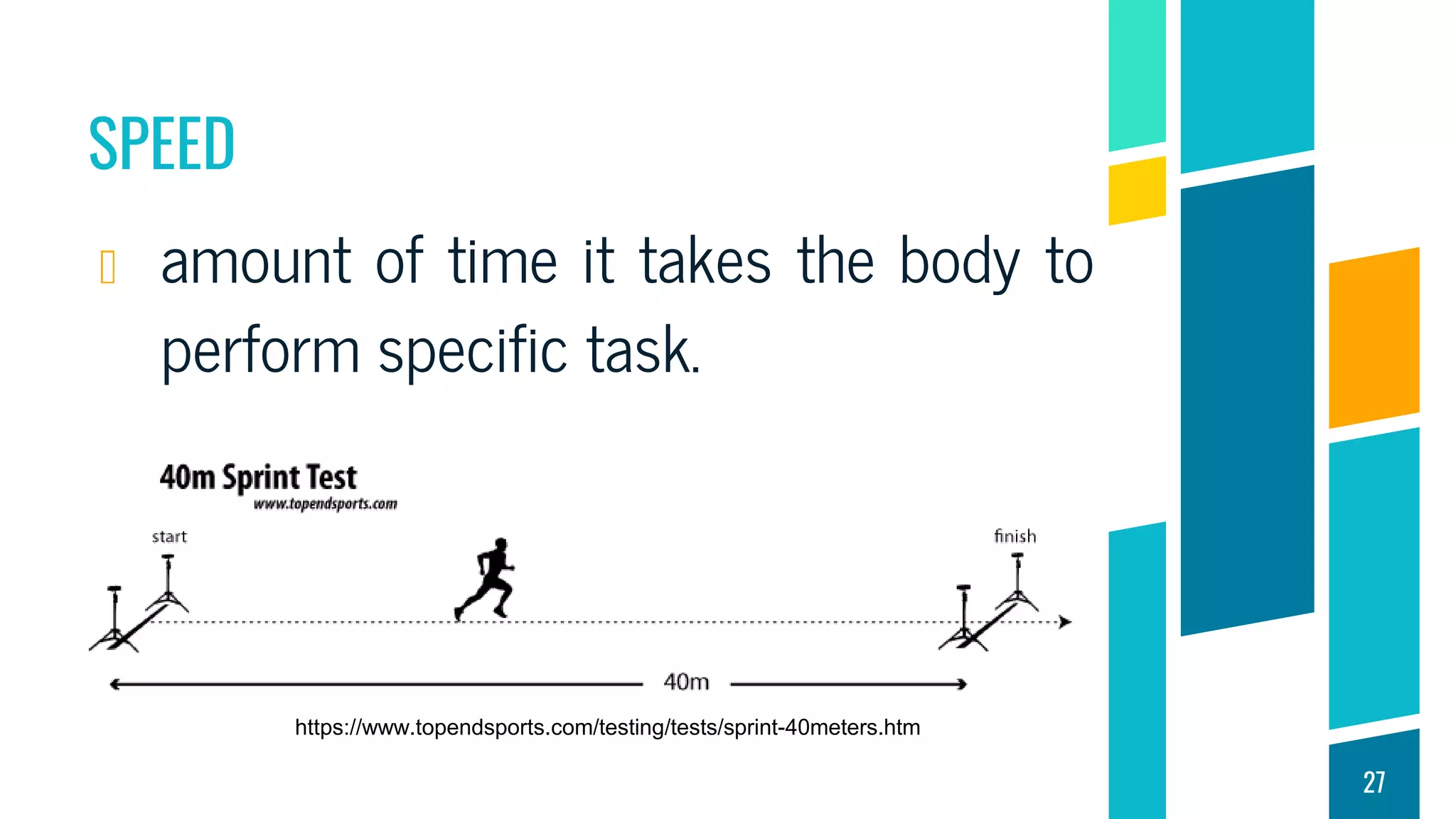
SPEED
amount of time it takes the body to
perform specific task.
27
https://www.topendsports.com/testing/tests/sprint-40meters.htm
Thanks You!
28

Grade 9 p.e w1

Editor's Notes

  • #13 Health related fitness involves exercise activities that you do in order to try to improve your physical health and stay healthy Skill related fitness is the ability to do well in everyday life activities and sports.
  • #16 Benefits of Muscular Strength Increase your ability to do activities like opening doors, lifting boxes Improve confidence and how you feel about yourself. There are many ways to improve muscular strength and endurance. A gym or fitness centre is a good place to go if you’re interested in doing resistance training
  • #17 Muscular endurance refers to the ability of a given muscle to exert force, consistently and repetitively, over a period of time. It plays a big role in almost every athletic endeavor.  Muscular endurance is the ability of a muscle or group of muscles to perform repetitive contractions against a force for an extended period of time. The greater your muscular endurance the higher number of repetitions you could complete.
  • #18  Flexibility is an important component of physical fitness and has many positive effects on the body. For instance, it improves mobility, posture, muscle coordination, reduces the risk of injuries and muscle soreness. It even leads to a better overall “shape”.
  • #19 Cardiovascular endurance is a measure of how well you can do exercises that involve your whole body at moderate to high intensity for an extended time. When you do aerobic exercise, your body responds in the following ways: Your heart pumps more efficiently. Your lungs work better. Your muscles get stronger. Your ligaments, tendons, and bones get stronger. As you increase your cardiovascular endurance through aerobic exercise, you'll get stronger and fitter.
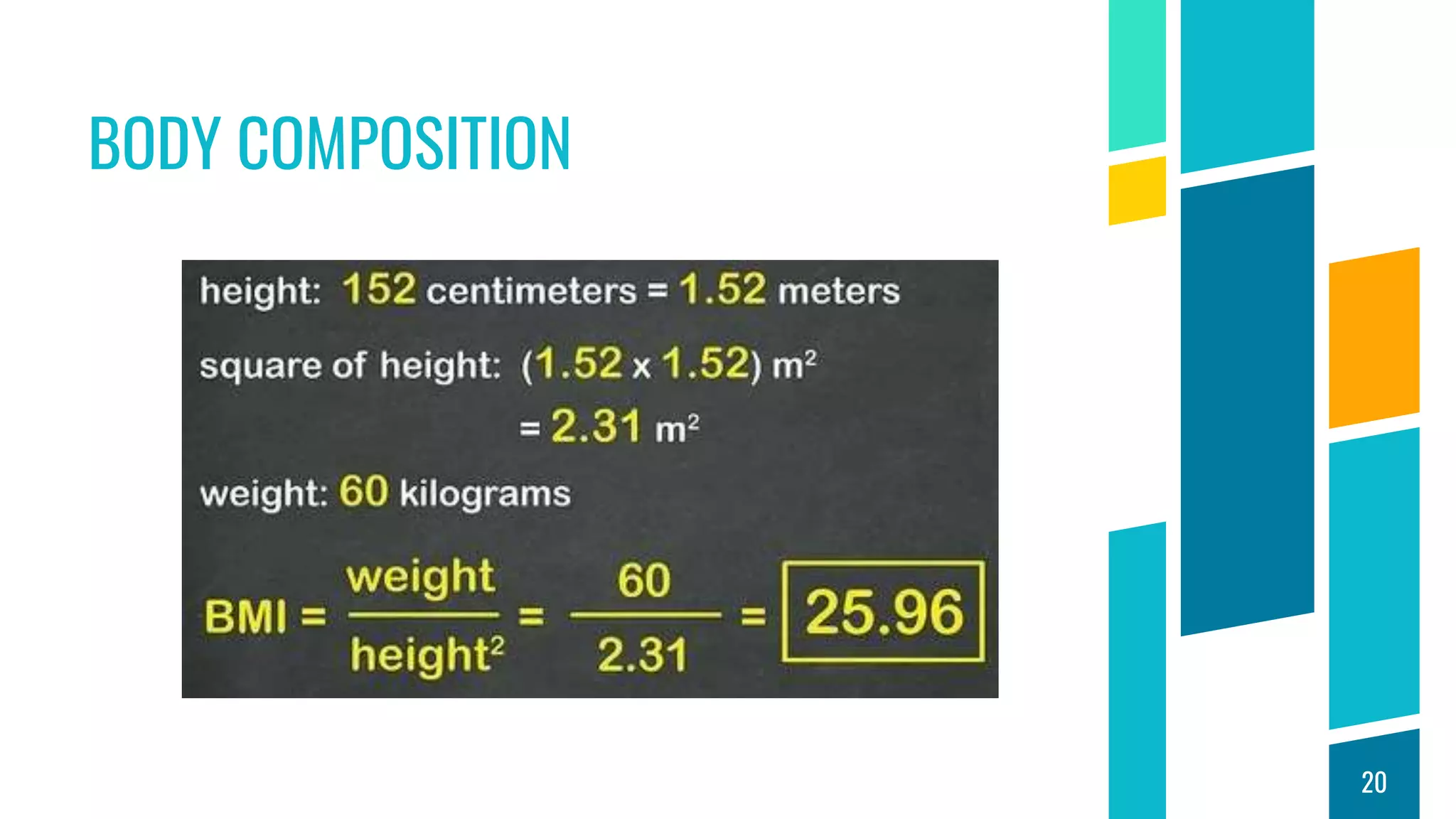
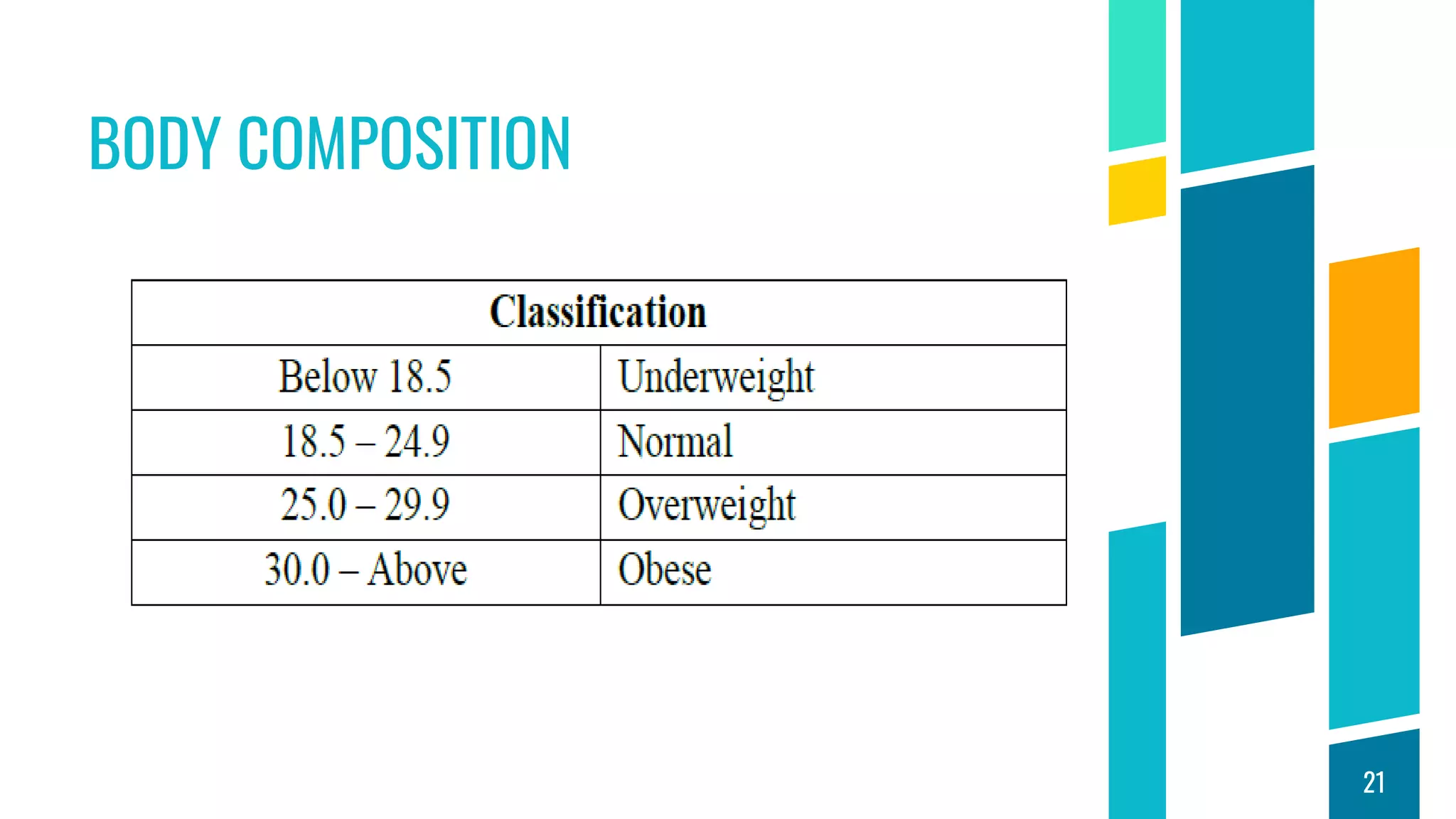
  • #20 - Body composition is a universal term used in the health and fitness industry. - Doctors use body composition to find what percentage of your body weight is fat. - important because someone else can be the same height and weight as you, but they might have more body fat and less muscle. This could lead to different health issues in them.  Our body is made up of water, protein, fat, and minerals. Non-fat mass (essential fats) required for your body to function normally; fat mass (stored fats) adipose tissue; used as energy for your body. BMI doesn’t measure body fat. Doctors use BMI to find out your weight status. There’s a range of healthy to unhealthy BMIs. BMI only tells you the ratio of your weight to your height, however, so it's not an incredibly accurate tool to know if you’re at a healthy level or not. 
  • #23 - Agility is our ability to change directions quickly. While it is useful in many sports including basketball, netball and soccer, it is also useful in everyday life for avoiding obstacles, playing games with children and preventing injuries. Why is it important to act with agility in all aspects of your life? It helps us to respond to change better, be more resilient, see the positives out of every change and learn and grow from every opportunity, even when we fail. In fact, it is when we fail that we can often learn the most, and being agile helps us to see those opportunities as learning moments.
  • #24 - Balance is linked to agility, as in order to quickly and efficiently change direction you must be balanced. - striking a balance helps you lead a happy and contented life, it ensures your growth as an individual and secures your mental peace and well being. ... Helps you dream bigger: By maintaining a healthy balance, you secure your future.
  • #25 Coordination is the ability to use the senses together with body parts during movement. For example, dribbling a basketball. Using hands and eyes together is called hand-eye coordination. Speed is the ability to move your body or parts of your body swiftly.
  • #26 Power refers to a person's ability to transfer energy into force at a rapid pace also known as explosive body movement. Power is considered to be a combi- nation of strength and speed.
  • #27 Reaction time drills often focus on quick decision making during in-game situations. For example, sitting or standing in different positions (backwards, one knee or athletic position) and accelerating once the coach blows the whistle. For example, a football player who has a faster reaction time will be able to respond faster when his opponent tries to beat him.
  • #28 Speed refers to a person's ability to move fast. Speed. combined with strength will provide power and force. This is a skill-related component of physical fitness. that relates to the ability to perform a movement.