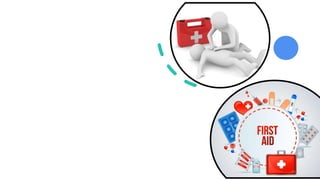
Unintentional Injury
Prevention,
Safety and First Aid
3rd Quarter
Health
2
“Prevention
is better than
cure”
Diagnostic
Assessment
4
Diagnostic
Assessment
Test 1: MULTIPLE CHOICE
Direction: Choose the letter of the correct answer.
1. What do you call the immediate
care given to an injured person before
the arrival of a physician?
a. Cardiopulmonary Resuscitation
b. Chest Compression
c. First Aid
d. Intensive care
5
Diagnostic
Assessment
Test 1: MULTIPLE CHOICE
Direction: Choose the letter of the correct answer.
2. Which is an objective of first aid?
a. to prolong life
b. to intensify suffering
c. to end the service of physician
d. to bridge the gap between the
victim and the physician
6
Diagnostic
Assessment
Test 1: MULTIPLE CHOICE
Direction: Choose the letter of the correct answer.
3. When a first aider does not alarm a
victim, what characteristic does s/he show?
a. being observant
b. resourcefulness
c. gentleness
d. tactfulness
7
Diagnostic
Assessment
Test 1: MULTIPLE CHOICE
Direction: Choose the letter of the correct answer.
4. What is the first thing to do in assessing
an emergency situation?
a. call for help
b. survey if the scene is safe
c. do a head-to-toe examination
d. check the vital signs of the
victim
8
Diagnostic
Assessment
Test 1: MULTIPLE CHOICE
Direction: Choose the letter of the correct answer.
5. When is the primary survey of the victim
done?
a. when the victim is conscious
b. during the survey of the scene
c. when the victim is unconscious
d. after the victim has regained
consciousness
9
Diagnostic
Assessment
Test 1: MULTIPLE CHOICE
Direction: Choose the letter of the correct answer.
6. What sterile cloth is used to cover a
wound?
a. bandage
b. cold compress
c. dressing
d. hot compress
10
Diagnostic
Assessment
Test 1: MULTIPLE CHOICE
Direction: Choose the letter of the correct answer.
7. What is used to stop bleeding and
provide support for immobilization of a
fracture?
a. bandage
b. cold compress
c. dressing
d. hot compress
11
Diagnostic
Assessment
Test 1: MULTIPLE CHOICE
Direction: Choose the letter of the correct answer.
8. Which is a break in the continuity of the
tissue in the body?
a. fracture
b. laceration
c. sprain
d. wound
12
Diagnostic
Assessment
Test 1: MULTIPLE CHOICE
Direction: Choose the letter of the correct answer.
9. What open wound is caused by nails,
needles and other pointed objects?
a. avulsion
b. incision
c. laceration
d. puncture
13
Diagnostic
Assessment
Test 1: MULTIPLE CHOICE
Direction: Choose the letter of the correct answer.
10. Which is used to transport an
unconscious victim who should not be
lifted due to serious injuries?
a. blanket drag
b. chair drag
c. hammock carry
d. lover’s carry
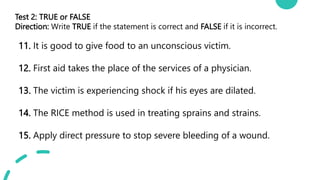
Test 2: TRUE or FALSE
Direction: Write TRUE if the statement is correct and FALSE if it is incorrect.
11. It is good to give food to an unconscious victim.
12. First aid takes the place of the services of a physician.
13. The victim is experiencing shock if his eyes are dilated.
14. The RICE method is used in treating sprains and strains.
15. Apply direct pressure to stop severe bleeding of a wound.
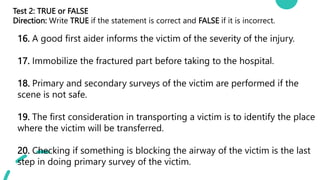
Test 2: TRUE or FALSE
Direction: Write TRUE if the statement is correct and FALSE if it is incorrect.
16. A good first aider informs the victim of the severity of the injury.
17. Immobilize the fractured part before taking to the hospital.
18. Primary and secondary surveys of the victim are performed if the
scene is not safe.
19. The first consideration in transporting a victim is to identify the place
where the victim will be transferred.
20. Checking if something is blocking the airway of the victim is the last
step in doing primary survey of the victim.
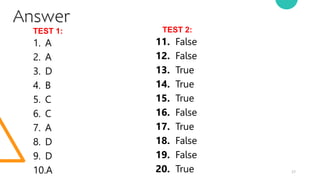
Answer
TEST 1:
1. A
2. A
3. D
4. B
5. C
6. C
7. A
8. D
9. D
10.A
TEST 2:
11. False
12. False
13. True
14. True
15. True
16. False
17. True
18. False
19. False
20. True 17
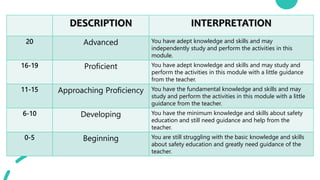
DESCRIPTION INTERPRETATION
20 Advanced You have adept knowledge and skills and may
independently study and perform the activities in this
module.
16-19 Proficient You have adept knowledge and skills and may study and
perform the activities in this module with a little guidance
from the teacher.
11-15 Approaching Proficiency You have the fundamental knowledge and skills and may
study and perform the activities in this module with a little
guidance from the teacher.
6-10 Developing You have the minimum knowledge and skills about safety
education and still need guidance and help from the
teacher.
0-5 Beginning You are still struggling with the basic knowledge and skills
about safety education and greatly need guidance of the
teacher.
Group
Activity
20
Your younger sister cuts
her finger with a knife.
21
Your mother accidentally
touches a hot pan.
22
Your classmate has drunk
poison.
23
Your friend falls down the
stairs from 2nd floor and can
hardly stand.
24
Your classmate suffers a
heart attack.
25
Your neighbor
experiences stroke.
26
Your brother accidentally
swallows his food and it
gets stuck in his throat.
27
Your cousin who does not
know how to swim falls into
a deep river.
To start a presentation,
go to the Slide Show tab,
and select From
Beginning.
1
To display Presenter
view, in Slide Show view,
on the control bar at the
bottom left select the
three dots, and then
Show Presenter View.
2
During your presentation,
the speaker notes are
visible on your monitor,
but aren't visible to the
audience.
3
The Notes pane is a box
that appears below each
slide. Tap it to add
notes.
4
If you don’t see the Notes
pane or it is completely
minimized, click Notes on
the task bar across the
bottom of the PowerPoint
window.
5
9/3/20XX Presentation Title 28
29

Health-9-Q3 (1).pptx

  • 1.
    Unintentional Injury Prevention, Safety andFirst Aid 3rd Quarter Health
  • 2.
  • 3.
  • 4.
    4 Diagnostic Assessment Test 1: MULTIPLECHOICE Direction: Choose the letter of the correct answer. 1. What do you call the immediate care given to an injured person before the arrival of a physician? a. Cardiopulmonary Resuscitation b. Chest Compression c. First Aid d. Intensive care
  • 5.
    5 Diagnostic Assessment Test 1: MULTIPLECHOICE Direction: Choose the letter of the correct answer. 2. Which is an objective of first aid? a. to prolong life b. to intensify suffering c. to end the service of physician d. to bridge the gap between the victim and the physician
  • 6.
    6 Diagnostic Assessment Test 1: MULTIPLECHOICE Direction: Choose the letter of the correct answer. 3. When a first aider does not alarm a victim, what characteristic does s/he show? a. being observant b. resourcefulness c. gentleness d. tactfulness
  • 7.
    7 Diagnostic Assessment Test 1: MULTIPLECHOICE Direction: Choose the letter of the correct answer. 4. What is the first thing to do in assessing an emergency situation? a. call for help b. survey if the scene is safe c. do a head-to-toe examination d. check the vital signs of the victim
  • 8.
    8 Diagnostic Assessment Test 1: MULTIPLECHOICE Direction: Choose the letter of the correct answer. 5. When is the primary survey of the victim done? a. when the victim is conscious b. during the survey of the scene c. when the victim is unconscious d. after the victim has regained consciousness
  • 9.
    9 Diagnostic Assessment Test 1: MULTIPLECHOICE Direction: Choose the letter of the correct answer. 6. What sterile cloth is used to cover a wound? a. bandage b. cold compress c. dressing d. hot compress
  • 10.
    10 Diagnostic Assessment Test 1: MULTIPLECHOICE Direction: Choose the letter of the correct answer. 7. What is used to stop bleeding and provide support for immobilization of a fracture? a. bandage b. cold compress c. dressing d. hot compress
  • 11.
    11 Diagnostic Assessment Test 1: MULTIPLECHOICE Direction: Choose the letter of the correct answer. 8. Which is a break in the continuity of the tissue in the body? a. fracture b. laceration c. sprain d. wound
  • 12.
    12 Diagnostic Assessment Test 1: MULTIPLECHOICE Direction: Choose the letter of the correct answer. 9. What open wound is caused by nails, needles and other pointed objects? a. avulsion b. incision c. laceration d. puncture
  • 13.
    13 Diagnostic Assessment Test 1: MULTIPLECHOICE Direction: Choose the letter of the correct answer. 10. Which is used to transport an unconscious victim who should not be lifted due to serious injuries? a. blanket drag b. chair drag c. hammock carry d. lover’s carry
  • 14.
    Test 2: TRUEor FALSE Direction: Write TRUE if the statement is correct and FALSE if it is incorrect. 11. It is good to give food to an unconscious victim. 12. First aid takes the place of the services of a physician. 13. The victim is experiencing shock if his eyes are dilated. 14. The RICE method is used in treating sprains and strains. 15. Apply direct pressure to stop severe bleeding of a wound.
  • 15.
    Test 2: TRUEor FALSE Direction: Write TRUE if the statement is correct and FALSE if it is incorrect. 16. A good first aider informs the victim of the severity of the injury. 17. Immobilize the fractured part before taking to the hospital. 18. Primary and secondary surveys of the victim are performed if the scene is not safe. 19. The first consideration in transporting a victim is to identify the place where the victim will be transferred. 20. Checking if something is blocking the airway of the victim is the last step in doing primary survey of the victim.
  • 17.
    Answer TEST 1: 1. A 2.A 3. D 4. B 5. C 6. C 7. A 8. D 9. D 10.A TEST 2: 11. False 12. False 13. True 14. True 15. True 16. False 17. True 18. False 19. False 20. True 17
  • 18.
    DESCRIPTION INTERPRETATION 20 AdvancedYou have adept knowledge and skills and may independently study and perform the activities in this module. 16-19 Proficient You have adept knowledge and skills and may study and perform the activities in this module with a little guidance from the teacher. 11-15 Approaching Proficiency You have the fundamental knowledge and skills and may study and perform the activities in this module with a little guidance from the teacher. 6-10 Developing You have the minimum knowledge and skills about safety education and still need guidance and help from the teacher. 0-5 Beginning You are still struggling with the basic knowledge and skills about safety education and greatly need guidance of the teacher.
  • 19.
  • 20.
    20 Your younger sistercuts her finger with a knife.
  • 21.
  • 22.
    22 Your classmate hasdrunk poison.
  • 23.
    23 Your friend fallsdown the stairs from 2nd floor and can hardly stand.
  • 24.
  • 25.
  • 26.
    26 Your brother accidentally swallowshis food and it gets stuck in his throat.
  • 27.
    27 Your cousin whodoes not know how to swim falls into a deep river.
  • 28.
    To start apresentation, go to the Slide Show tab, and select From Beginning. 1 To display Presenter view, in Slide Show view, on the control bar at the bottom left select the three dots, and then Show Presenter View. 2 During your presentation, the speaker notes are visible on your monitor, but aren't visible to the audience. 3 The Notes pane is a box that appears below each slide. Tap it to add notes. 4 If you don’t see the Notes pane or it is completely minimized, click Notes on the task bar across the bottom of the PowerPoint window. 5 9/3/20XX Presentation Title 28
  • 29.

Editor's Notes

  • #3  Practicing this principle advocates safety awareness which is essential in achieving quality of life. But our immediate environment poses danger to everyone. No place is considered safe, not even in the comfort of our homes. Accidents may happen to anybody at any place, anytime. Thus, taking the right safety measures greatly helps prevent accidents and injuries. Nevertheless, when accidents happen, it is important to have knowledge and skills on safety education and injury prevention could help you, your loved ones and other people in your community during emergency situations.
  • #7 Tactful- careful
  • #21 Rinse the cut or wound with water and apply pressure with sterile gauze, a bandage, or a clean cloth.
  • #22 Apply cold compress at the burnt part to help it ease the pain and to let the injury cool down. After a few minutes, pat it dry and cover it with a gauze
  • #23 Swallowed poison. Remove anything remaining in the person's mouth. If the suspected poison is a household cleaner or other chemical, read the container's label and follow instructions for accidental poisoning. If the person vomits, turn his or her head to the side to prevent choking. The first thing we should do is to seek medical assistance immediately. Then, we will make sure that the victim will have someone to look up to him. And while waiting for the medics, be ready to describe other medications he is taking and any information you have about the victim. And lastly, if possible, find the substance package that is used by the victim.
  • #24 *Carefully and very slowly help them into a sitting position – watch them carefully for any signs of pain, discomfort or dizziness *If they are conscious and you think they  may have fallen from a height or could have injured their neck or spine – Do not move them. Try and keep them as still as possible and discourage them from twisting. Phone an ambulance and calmly keep reassuring them until paramedics arrive.
  • #25 *Call for emergency assistance or paramedics. *Perform CPR (not fast, count 1001, 1002, etc.), once conscious check the pulse rate or heartbeat. Raise left hand and put their right hand over their chest , place their right foot over left foot and turn the victim sideways, and massage their back, try communicate with the patient for them to feel that you are aware so that they can relax.
  • #26 *Don’t give water. Loosen up the victims cloth and make sure the victim has proper airway. Perform FAST method F- facial drooping (try to communicate with them, close their eyes) A- arms weakness (pataasin ang kamay) S-Speech Difficulty (and if the have difficulty in speaking….) T-Time to call for help
  • #27 *Give five back blows. Stand to the side and just behind a choking adult. For a child, kneel down behind. Place your arm across the person's chest to support the person's body. Bend the person over at the waist to face the ground. Strike five separate times between the person's shoulder blades with the heel of your hand. *Give five abdominal thrusts. If back blows don't remove the stuck object, give five abdominal thrusts, also known as the Heimlich maneuver. If you're alone and choking Place a fist slightly above your navel. Grasp your fist with the other hand. Bend over a hard surface such as a countertop or chair. Shove your fist inward and upward.
  • #28 *NEVER attempt a direct rescue of a conscious drowning patient without proper training. There are many reports of drowning patients and their would-be rescuers being lost together *If more than one rescuer is available, have someone emergency assistance immediately. *If the patient is conscious, try to reach the patient with something rigid enough to pull him or her back.  *If the patient is unconscious, take a boat to the patient or tie a rope around the rescuer's waist and let the rescuer pull the patient to shore