Mini Case Study Presentation
on
Introduction
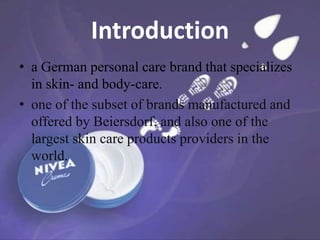
• a German personal care brand that specializes
in skin- and body-care.
• one of the subset of brands manufactured and
offered by Beiersdorf, and also one of the
largest skin care products providers in the
world.
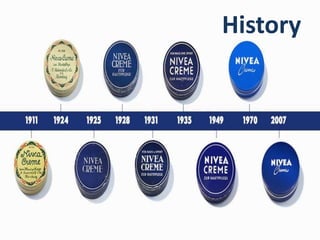
History
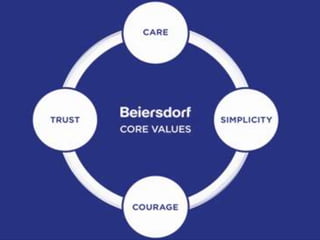
Why BLUE?
• This strategic program is focused on strengthening
our brands, increasing our innovative power,
expanding our presence in the emerging markets, and
on our dedicated employees.
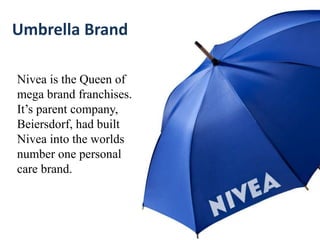
Umbrella Brand
Nivea is the Queen of
mega brand franchises.
It’s parent company,
Beiersdorf, had built
Nivea into the worlds
number one personal
care brand.
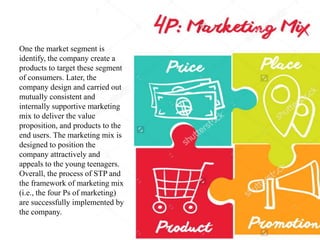
One the market segment is
identify, the company create a
products to target these segment
of consumers. Later, the
company design and carried out
mutually consistent and
internally supportive marketing
mix to deliver the value
proposition, and products to the
end users. The marketing mix is
designed to position the
company attractively and
appeals to the young teenagers.
Overall, the process of STP and
the framework of marketing mix
(i.e., the four Ps of marketing)
are successfully implemented by
the company.
Nivea employs extensive market research to target key market segments. The
knowledge and information from the research assists in the formulation of new
products. Nivea arranges and implements its market research efforts with consumers in
a number of different ways. Three strategies are applied. Firstly, the company uses
focus groups to collect feedbacks from consumers directly. Secondly, the company
gathers data from customers via different research techniques. Lastly, the company
launched product testing activities with customers in different geographical locations.
PRICE
As a price leader, the company sets the price benchmark that
competitors will either follow or undercut. However in the
future, Nivea needs to constantly review prices if any
competitor joins the market at the ‘market growth’ stage of
the product life cycle in order to ensure that the products are
competitively priced.
Nivea distributes through a variety of outlets that are cost effective, while at
the similar time, able to reach the largest possible amount of consumers. In
fact, the company’s distribution strategies also take into account the
environmental effects due to transport. The company employs a central
distribution system in UK. The company does not distribute directly to smaller
retailers because the volume of products sold cannot justify the high costs to
do so. Instead, the company uses wholesalers for these smaller retailers. Not
only that, the company also decided not to sell directly through its corporate
website as the costs of producing and distributing small orders would be too
impractical.
Nivea selects promotional techniques that appeals to the tastes of its target
market through the range of mass media available. The company believes that
one way advertising methods are less effective if compared to communicating
directly to the customers. Therefore the company does not plan to use any
above-the-line promotion techniques. The company arranges the promotional
techniques to be consumer-led through below the line promotion. By
employing various below-the-line routes, the company implements ways of
communicating to teenagers and their mothers as well directly. One of the
critical parts of this strategy is the distribution of product samples. These
enable the prospective consumers to touch, feel, smell and test the products.
What were the key steps in
maintaining Nivea's leading
position in the global facial care
market?
• Nivea changed its logo, packaging appearance to look modern and global.
• It adapted ergonomic designs to comfort its consumers for using.
• Nivea increased length of its product line by introducing its products in new areas. It
switched from being a skin cream to being skin and person care & cosmetics, for both
genders.
• It kept on changing its core values according to market needs, but continued to innovate.
• Nivea identified the new market by observing the increasing needs of cosmetics for men
and came up with the products for the consumer new segment.
• Nivea kept on expanding globally, but with some adaptations to take care local market
requirements. However, it maintained its global appearance. Thus it brought trust of a
well-known brand as well as customized services along with its products.
Explain the connection between cultural norms and
product choice. What is Nivea's strategy in
respecting cultural diversity while pursuing a global
brand strategy?
Culture plays in an important role in having a product or brand being accepted by its
customers. If a company respects a culture and make its products to satisfy customized
needs of people, it has high chances of being accepted by market. For example, South
Asia is obsessed with having a fair complexion. So Nivea makes its products
accordingly and publicizes its USP, hence receives high chances of being successful. At
the same time, it brings reliability and trust of being a global brand. It keeps its logo
and appearance in line with its global image.
Discuss Nivea's future? What should Beiersdorf do
next with its product line? Where is the future
growth for the brand?
• Personally what I feel is that there is a lot of scope in Nivea's product line
depth. Though of various sizes but there is only one face cream of Nivea.
Hence it can come up with many more similar products so that consumers
has more choices to pick from and the company's name becomes more
visible in the shelves of super market.
• Nivea can stretch its product line for high class consumer segment, where
sales might be less but profitability will be more. It can come with exclusive
offers and facilities for them such as sponsoring a fashion event and inviting
its loyal customers. This will also inspire its middle class consumers to spend
more on royal products and remain loyal to the company.
Created By :Shrishti Yadav
Student
(VIT UNIVERSITY,VELLORE)
During the 4 weeks marketing
internship by
PROF.SAMEER MATHUR

Nivea mini case study presentation

  • 1.
    Mini Case StudyPresentation on
  • 2.
    Introduction • a Germanpersonal care brand that specializes in skin- and body-care. • one of the subset of brands manufactured and offered by Beiersdorf, and also one of the largest skin care products providers in the world.
  • 3.
  • 5.
    Why BLUE? • Thisstrategic program is focused on strengthening our brands, increasing our innovative power, expanding our presence in the emerging markets, and on our dedicated employees.
  • 6.
    Umbrella Brand Nivea isthe Queen of mega brand franchises. It’s parent company, Beiersdorf, had built Nivea into the worlds number one personal care brand.
  • 9.
    One the marketsegment is identify, the company create a products to target these segment of consumers. Later, the company design and carried out mutually consistent and internally supportive marketing mix to deliver the value proposition, and products to the end users. The marketing mix is designed to position the company attractively and appeals to the young teenagers. Overall, the process of STP and the framework of marketing mix (i.e., the four Ps of marketing) are successfully implemented by the company.
  • 10.
    Nivea employs extensivemarket research to target key market segments. The knowledge and information from the research assists in the formulation of new products. Nivea arranges and implements its market research efforts with consumers in a number of different ways. Three strategies are applied. Firstly, the company uses focus groups to collect feedbacks from consumers directly. Secondly, the company gathers data from customers via different research techniques. Lastly, the company launched product testing activities with customers in different geographical locations.
  • 11.
    PRICE As a priceleader, the company sets the price benchmark that competitors will either follow or undercut. However in the future, Nivea needs to constantly review prices if any competitor joins the market at the ‘market growth’ stage of the product life cycle in order to ensure that the products are competitively priced.
  • 12.
    Nivea distributes througha variety of outlets that are cost effective, while at the similar time, able to reach the largest possible amount of consumers. In fact, the company’s distribution strategies also take into account the environmental effects due to transport. The company employs a central distribution system in UK. The company does not distribute directly to smaller retailers because the volume of products sold cannot justify the high costs to do so. Instead, the company uses wholesalers for these smaller retailers. Not only that, the company also decided not to sell directly through its corporate website as the costs of producing and distributing small orders would be too impractical.
  • 13.
    Nivea selects promotionaltechniques that appeals to the tastes of its target market through the range of mass media available. The company believes that one way advertising methods are less effective if compared to communicating directly to the customers. Therefore the company does not plan to use any above-the-line promotion techniques. The company arranges the promotional techniques to be consumer-led through below the line promotion. By employing various below-the-line routes, the company implements ways of communicating to teenagers and their mothers as well directly. One of the critical parts of this strategy is the distribution of product samples. These enable the prospective consumers to touch, feel, smell and test the products.
  • 15.
    What were thekey steps in maintaining Nivea's leading position in the global facial care market?
  • 16.
    • Nivea changedits logo, packaging appearance to look modern and global. • It adapted ergonomic designs to comfort its consumers for using. • Nivea increased length of its product line by introducing its products in new areas. It switched from being a skin cream to being skin and person care & cosmetics, for both genders. • It kept on changing its core values according to market needs, but continued to innovate. • Nivea identified the new market by observing the increasing needs of cosmetics for men and came up with the products for the consumer new segment. • Nivea kept on expanding globally, but with some adaptations to take care local market requirements. However, it maintained its global appearance. Thus it brought trust of a well-known brand as well as customized services along with its products.
  • 17.
    Explain the connectionbetween cultural norms and product choice. What is Nivea's strategy in respecting cultural diversity while pursuing a global brand strategy?
  • 18.
    Culture plays inan important role in having a product or brand being accepted by its customers. If a company respects a culture and make its products to satisfy customized needs of people, it has high chances of being accepted by market. For example, South Asia is obsessed with having a fair complexion. So Nivea makes its products accordingly and publicizes its USP, hence receives high chances of being successful. At the same time, it brings reliability and trust of being a global brand. It keeps its logo and appearance in line with its global image.
  • 19.
    Discuss Nivea's future?What should Beiersdorf do next with its product line? Where is the future growth for the brand? • Personally what I feel is that there is a lot of scope in Nivea's product line depth. Though of various sizes but there is only one face cream of Nivea. Hence it can come up with many more similar products so that consumers has more choices to pick from and the company's name becomes more visible in the shelves of super market. • Nivea can stretch its product line for high class consumer segment, where sales might be less but profitability will be more. It can come with exclusive offers and facilities for them such as sponsoring a fashion event and inviting its loyal customers. This will also inspire its middle class consumers to spend more on royal products and remain loyal to the company.
  • 21.
    Created By :ShrishtiYadav Student (VIT UNIVERSITY,VELLORE) During the 4 weeks marketing internship by PROF.SAMEER MATHUR