Methods of Tariff Fixation
Cost-based Approach
Market-based Approach
Definition: Price
• Price is the value in ₹ that is put to a product or
service.
• It is the result of a complex set of calculations,
research, understanding and risk taking ability.
• A pricing strategy takes into account market
segment’s ability to pay, market conditions like
level of supply & demand, competitor actions,
industry profit margins and costs of production,
plus others.
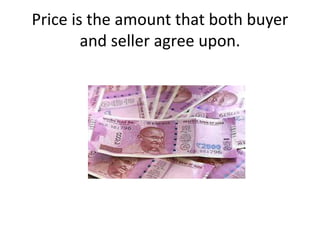
Price is the amount that both buyer
and seller agree upon.
What is the process of pricing?
• Pricing can be defined as a process of
determining the value (₹) that is received by
an organization in exchange of its products or
services.
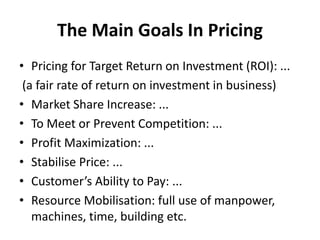
The Main Goals In Pricing
• Pricing for Target Return on Investment (ROI): ...
(a fair rate of return on investment in business)
• Market Share Increase: ...
• To Meet or Prevent Competition: ...
• Profit Maximization: ...
• Stabilise Price: ...
• Customer’s Ability to Pay: ...
• Resource Mobilisation: full use of manpower,
machines, time, building etc.
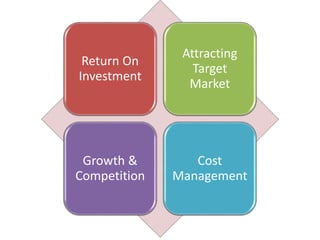
Return On
Investment
Attracting
Target
Market
Growth &
Competition
Cost
Management
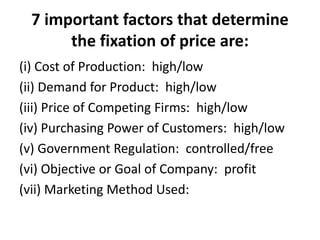
7 important factors that determine
the fixation of price are:
(i) Cost of Production: high/low
(ii) Demand for Product: high/low
(iii) Price of Competing Firms: high/low
(iv) Purchasing Power of Customers: high/low
(v) Government Regulation: controlled/free
(vi) Objective or Goal of Company: profit
(vii) Marketing Method Used:
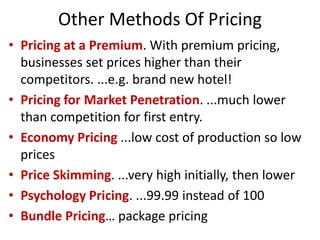
Other Methods Of Pricing
• Pricing at a Premium. With premium pricing,
businesses set prices higher than their
competitors. ...e.g. brand new hotel!
• Pricing for Market Penetration. ...much lower
than competition for first entry.
• Economy Pricing ...low cost of production so low
prices
• Price Skimming. ...very high initially, then lower
• Psychology Pricing. ...99.99 instead of 100
• Bundle Pricing… package pricing
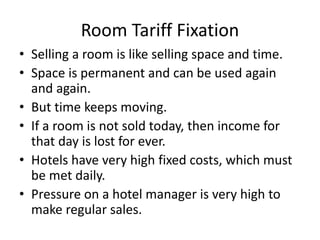
Room Tariff Fixation
• Selling a room is like selling space and time.
• Space is permanent and can be used again
and again.
• But time keeps moving.
• If a room is not sold today, then income for
that day is lost for ever.
• Hotels have very high fixed costs, which must
be met daily.
• Pressure on a hotel manager is very high to
make regular sales.
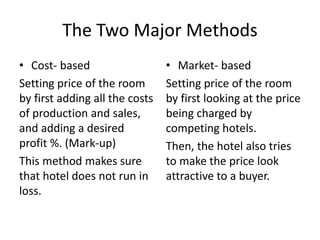
The Two Major Methods
• Cost- based
Setting price of the room
by first adding all the costs
of production and sales,
and adding a desired
profit %. (Mark-up)
This method makes sure
that hotel does not run in
loss.
• Market- based
Setting price of the room
by first looking at the price
being charged by
competing hotels.
Then, the hotel also tries
to make the price look
attractive to a buyer.
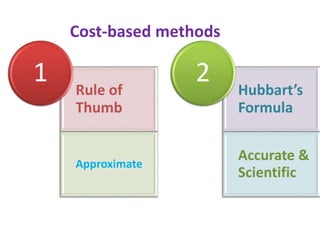
Rule of
Thumb
Approximate
1 Hubbart’s
Formula
Accurate &
Scientific
2
Cost-based methods
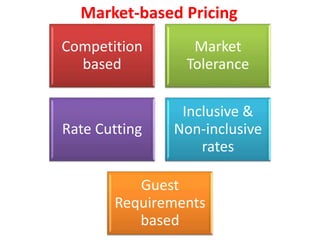
Competition
based
Market
Tolerance
Rate Cutting
Inclusive &
Non-inclusive
rates
Guest
Requirements
based
Market-based Pricing
Rule of Thumb Method
• The English phrase rule of thumb refers to a
principle with broad application, that is not
supposed to be strictly accurate or reliable, for
every situation.
• It refers to an easily learned and easily applied
procedure or standard, based on practical
experience rather than theory.
Rule-of-Thumb for Hotel Rates
If a hotel has spent ₹ 1000/- for making one
room, it should charge ₹ 1/- for tariff per day. (in
the year 1960, it was ₹ 1/-. Now it should be
₹ 2/-)
This is an experience-based calculation.
Since this rate never changes, with change in
time, this number may not be useful any more.
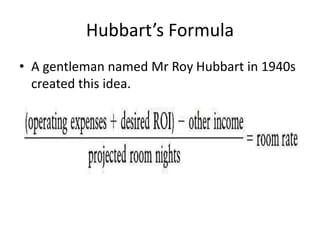
Hubbart’s Formula
• A gentleman named Mr Roy Hubbart in 1940s
created this idea.
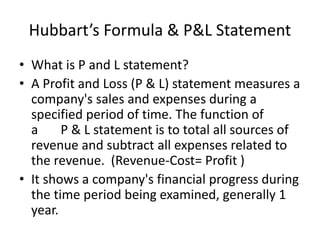
Hubbart’s Formula & P&L Statement
• What is P and L statement?
• A Profit and Loss (P & L) statement measures a
company's sales and expenses during a
specified period of time. The function of
a P & L statement is to total all sources of
revenue and subtract all expenses related to
the revenue. (Revenue-Cost= Profit )
• It shows a company's financial progress during
the time period being examined, generally 1
year.
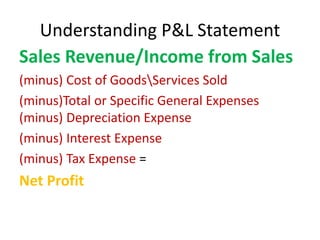
Understanding P&L Statement
Sales Revenue/Income from Sales
(minus) Cost of GoodsServices Sold
(minus)Total or Specific General Expenses
(minus) Depreciation Expense
(minus) Interest Expense
(minus) Tax Expense =
Net Profit
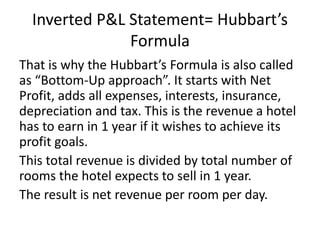
Inverted P&L Statement= Hubbart’s
Formula
That is why the Hubbart’s Formula is also called
as “Bottom-Up approach”. It starts with Net
Profit, adds all expenses, interests, insurance,
depreciation and tax. This is the revenue a hotel
has to earn in 1 year if it wishes to achieve its
profit goals.
This total revenue is divided by total number of
rooms the hotel expects to sell in 1 year.
The result is net revenue per room per day.
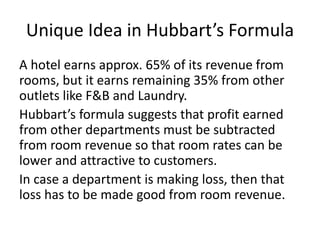
Unique Idea in Hubbart’s Formula
A hotel earns approx. 65% of its revenue from
rooms, but it earns remaining 35% from other
outlets like F&B and Laundry.
Hubbart’s formula suggests that profit earned
from other departments must be subtracted
from room revenue so that room rates can be
lower and attractive to customers.
In case a department is making loss, then that
loss has to be made good from room revenue.
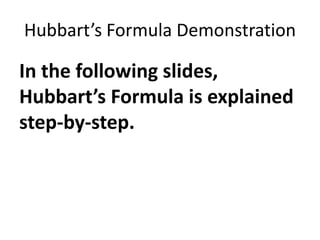
Hubbart’s Formula Demonstration
In the following slides,
Hubbart’s Formula is explained
step-by-step.
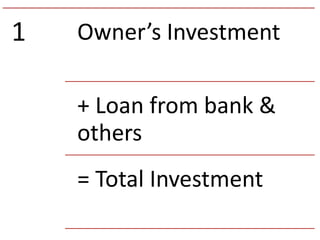
1 Owner’s Investment
+ Loan from bank &
others
= Total Investment
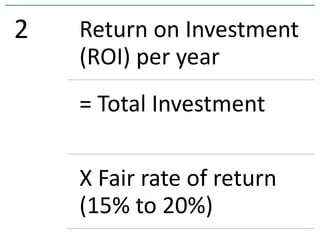
2 Return on Investment
(ROI) per year
= Total Investment
X Fair rate of return
(15% to 20%)
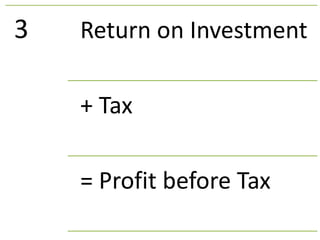
3 Return on Investment
+ Tax
= Profit before Tax
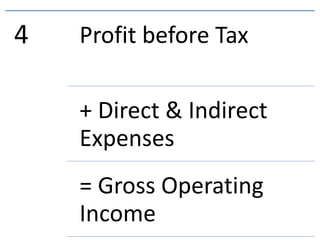
4 Profit before Tax
+ Direct & Indirect
Expenses
= Gross Operating
Income
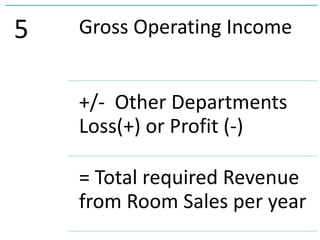
5 Gross Operating Income
+/- Other Departments
Loss(+) or Profit (-)
= Total required Revenue
from Room Sales per year
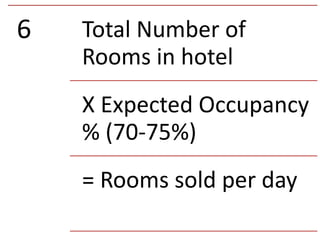
6 Total Number of
Rooms in hotel
X Expected Occupancy
% (70-75%)
= Rooms sold per day
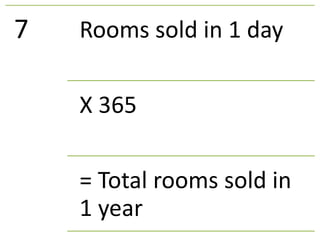
7 Rooms sold in 1 day
X 365
= Total rooms sold in
1 year
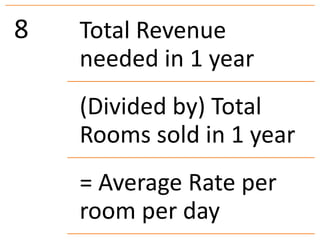
8 Total Revenue
needed in 1 year
(Divided by) Total
Rooms sold in 1 year
= Average Rate per
room per day
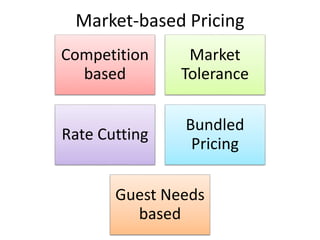
Market-based Pricing
Competition
based
Market
Tolerance
Rate Cutting
Bundled
Pricing
Guest Needs
based
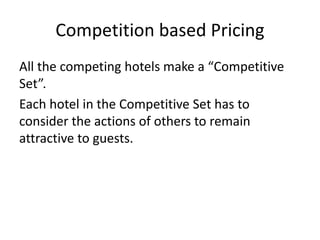
Competition based Pricing
All the competing hotels make a “Competitive
Set”.
Each hotel in the Competitive Set has to
consider the actions of others to remain
attractive to guests.
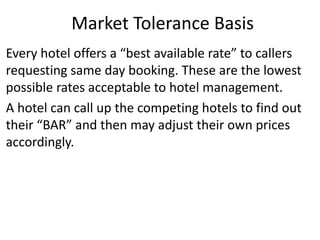
Market Tolerance Basis
Every hotel offers a “best available rate” to callers
requesting same day booking. These are the lowest
possible rates acceptable to hotel management.
A hotel can call up the competing hotels to find out
their “BAR” and then may adjust their own prices
accordingly.
Best Available Rate
Also known as Best Rate Guaranteed (BRG) &
Rate Parity, it is the practice of selling the room
at same price by hotel & Online Travel Agents
(OTA).
Galileo, a Global Distribution System provider,
defines BAR as "a rate available to the general
public that does not require pre-payment and
does not impose cancellation or charge
penalties and/or fees, other than those imposed
as a result of a hotel property's normal
cancellation policy.“
Rate Cutting
• The discounted pricing, especially during off-
season, or to compete for greater market
share is known as Rate Cutting.
Bundled Pricing
• Hotels may package prices as inclusive or non-
inclusive of some other product or service.
• For example, Meal Plans & Meeting packages.
Guest Requirement
• All guests have unique travel plan, purpose of
journey, eating & sleeping habits. They also
differ on the basis of nationality, religion, race,
occupation and income levels.
• A hotel has to assess their situation and offer
a tailor-made rate to each guest, if possible.
• This will satisfy the guest and help increase
sales of hotel product and services.

Hubbart's Formula: Tariff fixation methods in Hotels

  • 1.
    Methods of TariffFixation Cost-based Approach Market-based Approach
  • 2.
    Definition: Price • Priceis the value in ₹ that is put to a product or service. • It is the result of a complex set of calculations, research, understanding and risk taking ability. • A pricing strategy takes into account market segment’s ability to pay, market conditions like level of supply & demand, competitor actions, industry profit margins and costs of production, plus others.
  • 3.
    Price is theamount that both buyer and seller agree upon.
  • 4.
    What is theprocess of pricing? • Pricing can be defined as a process of determining the value (₹) that is received by an organization in exchange of its products or services.
  • 5.
    The Main GoalsIn Pricing • Pricing for Target Return on Investment (ROI): ... (a fair rate of return on investment in business) • Market Share Increase: ... • To Meet or Prevent Competition: ... • Profit Maximization: ... • Stabilise Price: ... • Customer’s Ability to Pay: ... • Resource Mobilisation: full use of manpower, machines, time, building etc.
  • 6.
  • 7.
    7 important factorsthat determine the fixation of price are: (i) Cost of Production: high/low (ii) Demand for Product: high/low (iii) Price of Competing Firms: high/low (iv) Purchasing Power of Customers: high/low (v) Government Regulation: controlled/free (vi) Objective or Goal of Company: profit (vii) Marketing Method Used:
  • 8.
    Other Methods OfPricing • Pricing at a Premium. With premium pricing, businesses set prices higher than their competitors. ...e.g. brand new hotel! • Pricing for Market Penetration. ...much lower than competition for first entry. • Economy Pricing ...low cost of production so low prices • Price Skimming. ...very high initially, then lower • Psychology Pricing. ...99.99 instead of 100 • Bundle Pricing… package pricing
  • 9.
    Room Tariff Fixation •Selling a room is like selling space and time. • Space is permanent and can be used again and again. • But time keeps moving. • If a room is not sold today, then income for that day is lost for ever. • Hotels have very high fixed costs, which must be met daily. • Pressure on a hotel manager is very high to make regular sales.
  • 10.
    The Two MajorMethods • Cost- based Setting price of the room by first adding all the costs of production and sales, and adding a desired profit %. (Mark-up) This method makes sure that hotel does not run in loss. • Market- based Setting price of the room by first looking at the price being charged by competing hotels. Then, the hotel also tries to make the price look attractive to a buyer.
  • 11.
  • 12.
  • 13.
    Rule of ThumbMethod • The English phrase rule of thumb refers to a principle with broad application, that is not supposed to be strictly accurate or reliable, for every situation. • It refers to an easily learned and easily applied procedure or standard, based on practical experience rather than theory.
  • 14.
    Rule-of-Thumb for HotelRates If a hotel has spent ₹ 1000/- for making one room, it should charge ₹ 1/- for tariff per day. (in the year 1960, it was ₹ 1/-. Now it should be ₹ 2/-) This is an experience-based calculation. Since this rate never changes, with change in time, this number may not be useful any more.
  • 15.
    Hubbart’s Formula • Agentleman named Mr Roy Hubbart in 1940s created this idea.
  • 16.
    Hubbart’s Formula &P&L Statement • What is P and L statement? • A Profit and Loss (P & L) statement measures a company's sales and expenses during a specified period of time. The function of a P & L statement is to total all sources of revenue and subtract all expenses related to the revenue. (Revenue-Cost= Profit ) • It shows a company's financial progress during the time period being examined, generally 1 year.
  • 17.
    Understanding P&L Statement SalesRevenue/Income from Sales (minus) Cost of GoodsServices Sold (minus)Total or Specific General Expenses (minus) Depreciation Expense (minus) Interest Expense (minus) Tax Expense = Net Profit
  • 18.
    Inverted P&L Statement=Hubbart’s Formula That is why the Hubbart’s Formula is also called as “Bottom-Up approach”. It starts with Net Profit, adds all expenses, interests, insurance, depreciation and tax. This is the revenue a hotel has to earn in 1 year if it wishes to achieve its profit goals. This total revenue is divided by total number of rooms the hotel expects to sell in 1 year. The result is net revenue per room per day.
  • 19.
    Unique Idea inHubbart’s Formula A hotel earns approx. 65% of its revenue from rooms, but it earns remaining 35% from other outlets like F&B and Laundry. Hubbart’s formula suggests that profit earned from other departments must be subtracted from room revenue so that room rates can be lower and attractive to customers. In case a department is making loss, then that loss has to be made good from room revenue.
  • 20.
    Hubbart’s Formula Demonstration Inthe following slides, Hubbart’s Formula is explained step-by-step.
  • 21.
    1 Owner’s Investment +Loan from bank & others = Total Investment
  • 22.
    2 Return onInvestment (ROI) per year = Total Investment X Fair rate of return (15% to 20%)
  • 23.
    3 Return onInvestment + Tax = Profit before Tax
  • 24.
    4 Profit beforeTax + Direct & Indirect Expenses = Gross Operating Income
  • 25.
    5 Gross OperatingIncome +/- Other Departments Loss(+) or Profit (-) = Total required Revenue from Room Sales per year
  • 26.
    6 Total Numberof Rooms in hotel X Expected Occupancy % (70-75%) = Rooms sold per day
  • 27.
    7 Rooms soldin 1 day X 365 = Total rooms sold in 1 year
  • 28.
    8 Total Revenue neededin 1 year (Divided by) Total Rooms sold in 1 year = Average Rate per room per day
  • 29.
  • 30.
    Competition based Pricing Allthe competing hotels make a “Competitive Set”. Each hotel in the Competitive Set has to consider the actions of others to remain attractive to guests.
  • 31.
    Market Tolerance Basis Everyhotel offers a “best available rate” to callers requesting same day booking. These are the lowest possible rates acceptable to hotel management. A hotel can call up the competing hotels to find out their “BAR” and then may adjust their own prices accordingly.
  • 32.
    Best Available Rate Alsoknown as Best Rate Guaranteed (BRG) & Rate Parity, it is the practice of selling the room at same price by hotel & Online Travel Agents (OTA). Galileo, a Global Distribution System provider, defines BAR as "a rate available to the general public that does not require pre-payment and does not impose cancellation or charge penalties and/or fees, other than those imposed as a result of a hotel property's normal cancellation policy.“
  • 33.
    Rate Cutting • Thediscounted pricing, especially during off- season, or to compete for greater market share is known as Rate Cutting.
  • 34.
    Bundled Pricing • Hotelsmay package prices as inclusive or non- inclusive of some other product or service. • For example, Meal Plans & Meeting packages.
  • 35.
    Guest Requirement • Allguests have unique travel plan, purpose of journey, eating & sleeping habits. They also differ on the basis of nationality, religion, race, occupation and income levels. • A hotel has to assess their situation and offer a tailor-made rate to each guest, if possible. • This will satisfy the guest and help increase sales of hotel product and services.