CONSTRUCTIVISM
THEORY
M I R N A D E A K L E
JEAN PIAGET
(1896-1980)
• Jean Piaget was born in Neuchâtel (Switzerland) on August 9, 1896.
• His researches in developmental psychology and genetic epistemology
had one unique goal: how does knowledge grow?
• His theory includes 4 Stages of Cognitive Development
– Sensorimotor stage: birth to 2 years
– Preoperational stage: ages 2 to 7
– Concrete operational stage: ages 7 to 11
– Formal operational stage: ages 12 and up
THEORY
• He suggested that through processes of accommodation and
assimilation, individuals construct new knowledge from their
experiences.
• constructivism is not a particular pedagogy. In fact,
constructivism is a theory describing how learning happens,.
SOME KEY WORDS AND PHRASES
• Learning and not teaching: The learner is the
one in charge of their own learning.
• Accepts learner’s autonomy and initiative.
• Learning process: Thinks of learning as a
process.
• Consider how the student learns.
• Acknowledges the critical role of experience in
learning.
• Emphasizes performance and understanding
when assessing learning.
• Supports co-operative learning.
• Encourages learner to engage in dialogue with
other students and the teacher.
• Meta learning
• Meaningful learning
• Discovery learning
• Cognitive learning and thinking
• Problem solving
• Prediction
• reflection
• Teacher facilitation
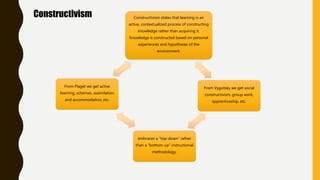
Constructivism states that learning is an
active, contextualized process of constructing
knowledge rather than acquiring it.
Knowledge is constructed based on personal
experiences and hypotheses of the
environment.
From Vygotsky we get social
constructivism, group work,
apprenticeship, etc.
embraces a “top-down” rather
than a “bottom-up” instructional
methodology.
From Piaget we get active
learning, schemes, assimilation
and accommodation, etc.
Constructivism
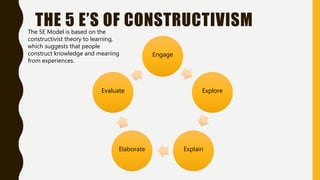
THE 5 E’S OF CONSTRUCTIVISM
Engage
Explore
ExplainElaborate
Evaluate
The 5E Model is based on the
constructivist theory to learning,
which suggests that people
construct knowledge and meaning
from experiences.
IN THE CLASSROOM
• Engagement: the objective is to stimulate the learners curiosity.
– On a new lesson, you may use a 5 word prediction to let student predict the topic of a lesson or by
playing a video that embeds information that will help them to connect with the main idea.
– I use this video below to help my students to predict the topic of a lesson.
– Also, I started a lesson with a story telling “Soy Guapo” before engaging the students with any
grammar structure or telling the topic of the lesson.
IN THE CLASSROOM
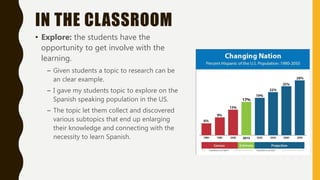
• Explore: the students have the
opportunity to get involve with the
learning.
– Given students a topic to research can be
an clear example.
– I gave my students topic to explore on the
Spanish speaking population in the US.
– The topic let them collect and discovered
various subtopics that end up enlarging
their knowledge and connecting with the
necessity to learn Spanish.
IN THE CLASSROOM
• Explain: the learner put in place the abstract concepts explored and is able to
communicate and explain in an easy way to others.
– A great example is the collaboration work that my students need to do in order to decode
information or gather information that forms a whole concept. “ Decoding a Weekly Forecast”
IN THE CLASSROOM
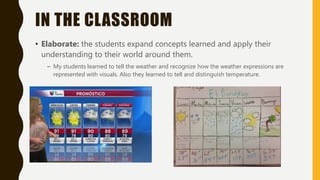
• Elaborate: the students expand concepts learned and apply their
understanding to their world around them.
– My students learned to tell the weather and recognize how the weather expressions are
represented with visuals. Also they learned to tell and distinguish temperature.
IN THE CLASSROOM
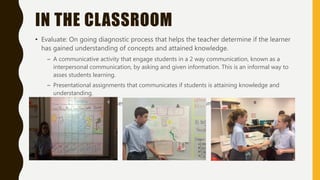
• Evaluate: On going diagnostic process that helps the teacher determine if the learner
has gained understanding of concepts and attained knowledge.
– A communicative activity that engage students in a 2 way communication, known as a
interpersonal communication, by asking and given information. This is an informal way to
asses students learning.
– Presentational assignments that communicates if students is attaining knowledge and
understanding.
– Project base learning assessments that can be used as a summative way to assess students
learning.
THEORY INFORMS MY LESSON
PLANNING
• Understanding the theory of constructivism, helps me to become more aware during
my lesson planning to include engaging activities that will stimulate my students
learning on a way that they can control and enlarge their learning.
• It’s very important for me to dedicate time planning and ensuring that all 5E’s are
embedded in the lesson along with other learning strategies.
• Lastly, making sure that I have given the students enough time to add content in a
manner that students will feel that they are adding more knowledge in a healthy
manner. Making sure that they are understanding.
SOURCES
• Journal of Literature and Art Studies, January 2017, Vol. 7, No. 1, 97-107
http://davidpublisher.org/Public/uploads/Contribute/583d2297ba95a.pdf
• Jean Piaget Society. http://www.piaget.org/aboutPiaget.html
• Theory and Practice in Language Studies, Vol. 1, No. 3, pp. 273-277, March 2011 ©
2011 ACADEMY PUBLISHER Manufactured in Finland.
http://www.academypublication.com/issues/past/tpls/vol01/03/09.pdf
• Empowering Students: The 5E Model Explained
https://lesley.edu/article/empowering-students-the-5e-model-explained

Constructivism ppt deakle

  • 1.
  • 2.
    JEAN PIAGET (1896-1980) • JeanPiaget was born in Neuchâtel (Switzerland) on August 9, 1896. • His researches in developmental psychology and genetic epistemology had one unique goal: how does knowledge grow? • His theory includes 4 Stages of Cognitive Development – Sensorimotor stage: birth to 2 years – Preoperational stage: ages 2 to 7 – Concrete operational stage: ages 7 to 11 – Formal operational stage: ages 12 and up
  • 3.
    THEORY • He suggestedthat through processes of accommodation and assimilation, individuals construct new knowledge from their experiences. • constructivism is not a particular pedagogy. In fact, constructivism is a theory describing how learning happens,.
  • 4.
    SOME KEY WORDSAND PHRASES • Learning and not teaching: The learner is the one in charge of their own learning. • Accepts learner’s autonomy and initiative. • Learning process: Thinks of learning as a process. • Consider how the student learns. • Acknowledges the critical role of experience in learning. • Emphasizes performance and understanding when assessing learning. • Supports co-operative learning. • Encourages learner to engage in dialogue with other students and the teacher. • Meta learning • Meaningful learning • Discovery learning • Cognitive learning and thinking • Problem solving • Prediction • reflection • Teacher facilitation
  • 5.
    Constructivism states thatlearning is an active, contextualized process of constructing knowledge rather than acquiring it. Knowledge is constructed based on personal experiences and hypotheses of the environment. From Vygotsky we get social constructivism, group work, apprenticeship, etc. embraces a “top-down” rather than a “bottom-up” instructional methodology. From Piaget we get active learning, schemes, assimilation and accommodation, etc. Constructivism
  • 6.
    THE 5 E’SOF CONSTRUCTIVISM Engage Explore ExplainElaborate Evaluate The 5E Model is based on the constructivist theory to learning, which suggests that people construct knowledge and meaning from experiences.
  • 7.
    IN THE CLASSROOM •Engagement: the objective is to stimulate the learners curiosity. – On a new lesson, you may use a 5 word prediction to let student predict the topic of a lesson or by playing a video that embeds information that will help them to connect with the main idea. – I use this video below to help my students to predict the topic of a lesson. – Also, I started a lesson with a story telling “Soy Guapo” before engaging the students with any grammar structure or telling the topic of the lesson.
  • 8.
    IN THE CLASSROOM •Explore: the students have the opportunity to get involve with the learning. – Given students a topic to research can be an clear example. – I gave my students topic to explore on the Spanish speaking population in the US. – The topic let them collect and discovered various subtopics that end up enlarging their knowledge and connecting with the necessity to learn Spanish.
  • 9.
    IN THE CLASSROOM •Explain: the learner put in place the abstract concepts explored and is able to communicate and explain in an easy way to others. – A great example is the collaboration work that my students need to do in order to decode information or gather information that forms a whole concept. “ Decoding a Weekly Forecast”
  • 10.
    IN THE CLASSROOM •Elaborate: the students expand concepts learned and apply their understanding to their world around them. – My students learned to tell the weather and recognize how the weather expressions are represented with visuals. Also they learned to tell and distinguish temperature.
  • 11.
    IN THE CLASSROOM •Evaluate: On going diagnostic process that helps the teacher determine if the learner has gained understanding of concepts and attained knowledge. – A communicative activity that engage students in a 2 way communication, known as a interpersonal communication, by asking and given information. This is an informal way to asses students learning. – Presentational assignments that communicates if students is attaining knowledge and understanding. – Project base learning assessments that can be used as a summative way to assess students learning.
  • 12.
    THEORY INFORMS MYLESSON PLANNING • Understanding the theory of constructivism, helps me to become more aware during my lesson planning to include engaging activities that will stimulate my students learning on a way that they can control and enlarge their learning. • It’s very important for me to dedicate time planning and ensuring that all 5E’s are embedded in the lesson along with other learning strategies. • Lastly, making sure that I have given the students enough time to add content in a manner that students will feel that they are adding more knowledge in a healthy manner. Making sure that they are understanding.
  • 13.
    SOURCES • Journal ofLiterature and Art Studies, January 2017, Vol. 7, No. 1, 97-107 http://davidpublisher.org/Public/uploads/Contribute/583d2297ba95a.pdf • Jean Piaget Society. http://www.piaget.org/aboutPiaget.html • Theory and Practice in Language Studies, Vol. 1, No. 3, pp. 273-277, March 2011 © 2011 ACADEMY PUBLISHER Manufactured in Finland. http://www.academypublication.com/issues/past/tpls/vol01/03/09.pdf • Empowering Students: The 5E Model Explained https://lesley.edu/article/empowering-students-the-5e-model-explained