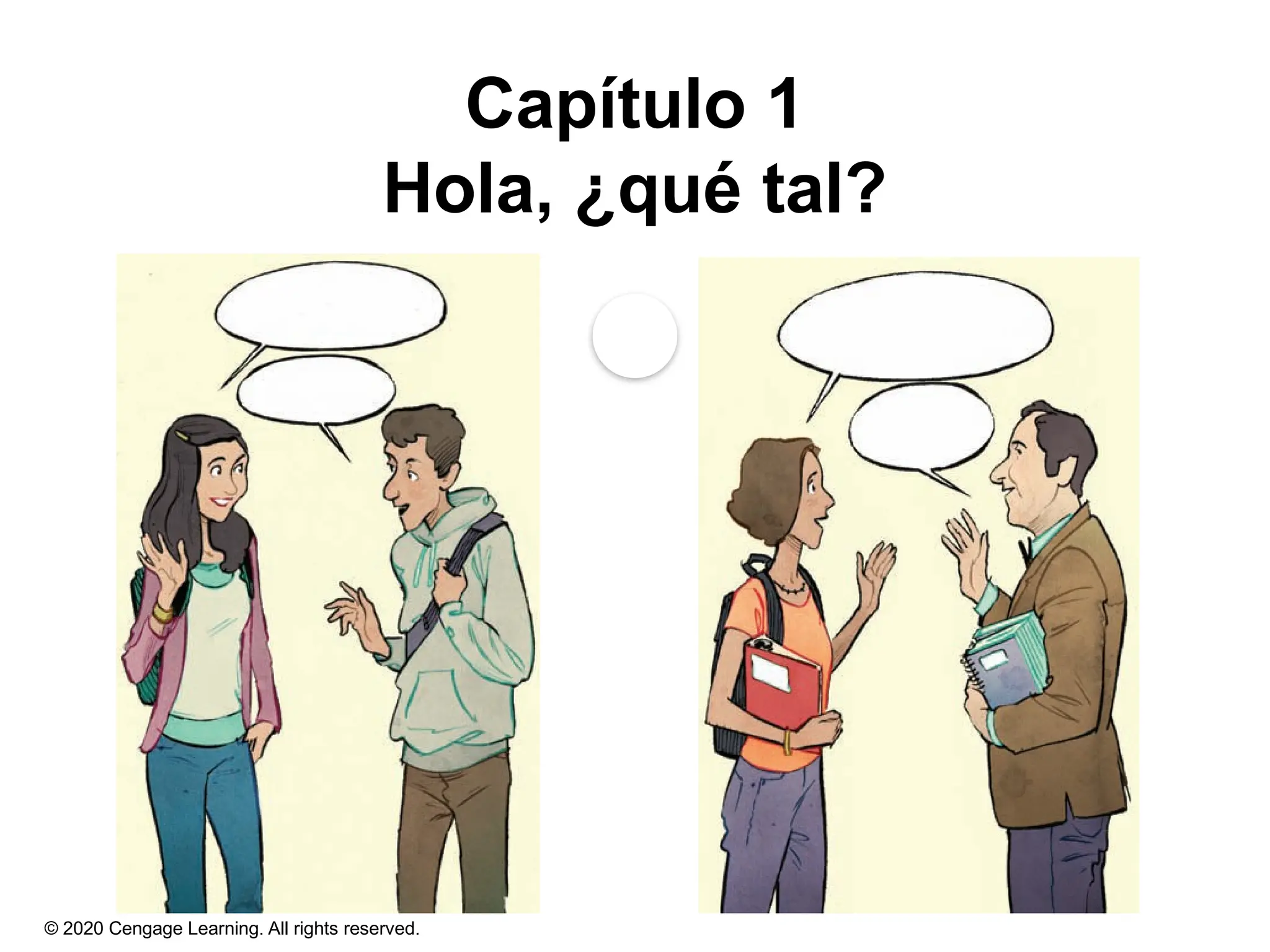
#1 Suggestions for use: Guide students to page 4 in their textbook. Have them review the vocabulary silently for a moment, and then review its pronunciation together as a class. Then, ask them to offer suggestions as to how to complete the speech bubbles in the two conversations above. You may wish to project this image on a chalkboard or white board, and have student volunteers to write their ideas in the bubbles. Or have two or three pairs give oral responses for each drawing.
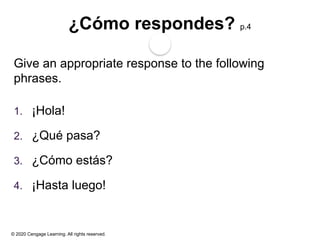
#2 Suggestions for use: Direct attention to each item individually, and ask for two possible responses for each.
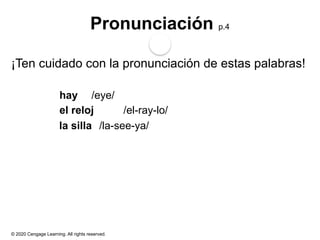
#3 Suggestions for use: Play the audio recording of all vocabulary words and have student volunteers repeat the words aloud, paying attention to the pronunciation. All of the vocabulary words also appear at the End-of-chapter vocabulary list “Vocabulario 1”.
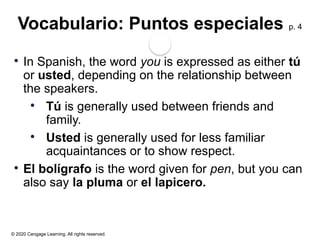
#4 Suggestions for use: Point out to students that they will learn more about the difference between tú and usted later in the chapter.
#5 Suggestions for use:
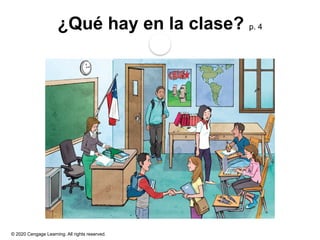
Project this image on a white board or chalkboard. Have students study the vocabulary on page 4, and then ask them to close their books. Call on volunteers to come up and label as many items as they can remember in a turn.
Point to various items and give students two words. For example, ask “¿Es un lápiz o un libro?” Students can use their vocabulary list on page 4 to respond.
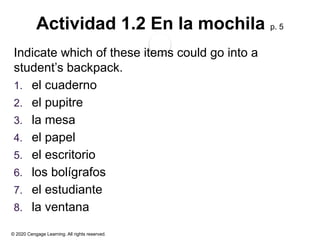
#6 Suggestions for use: To extend this activity, ask students to pull five things out of their backpack for a partner to identify.
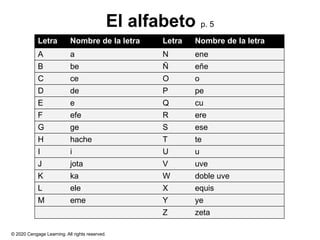
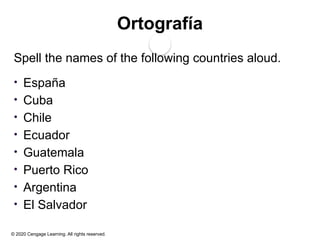
#7 Suggestions for use: Play the audio recording of the pronunciation of the alphabet, and have student volunteers repeat the letters aloud.
#8 Suggestions for use:
Have students spell the words to a partner first before sharing their spellings with the whole class.
Have a student randomly spell countries from the list, and then call on others to identify which country’s name is being spelled.
Extend this activity by having students spell Spanish-speaking countries not on the list for their classmates to identify.
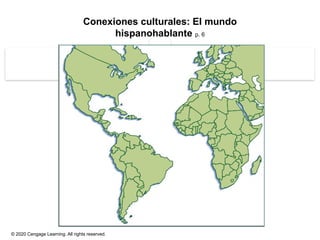
#9 Suggestions for use:
Project this image on a white board or chalkboard. Call on volunteers to come up and label as many Spanish-speaking countries as they can remember in a turn.
Refer students to the Maps on pages 492–495 if they need them as a reference.
#10 Suggestions for use:
Before having students complete the Estereotipos activity in groups, encourage them to discuss the Piensa en el tema questions as a class.
Then discuss possible stereotypes that other countries may have about the United States of America.
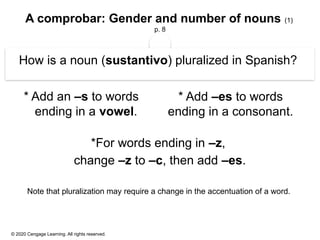
#11 Suggestions for use: Hold up specific items such as books, pens, pencils, etc. Ask students to identify the object and give the plural forms. Encourage them to do this without looking at their vocabulary list.
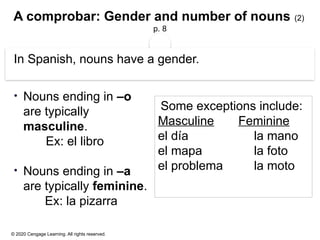
#12 Suggestions for use:
Point out that not only males and females carry masculine and feminine gender, respectively, but that objects also carry gender. Explain that gender assignment is arbitrary.
Return to slide 5 to use the images, and ask student volunteers to identify masculine and feminine nouns.
Ask students to identify one masculine noun and one feminine noun from the items in their backpacks.
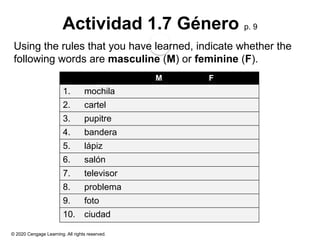
#13 Suggestions for use: Project this image on a white board or chalkboard. Call on volunteers to come up and check as many words in either the M or F column as they can remember in a turn. Review answers as a class.
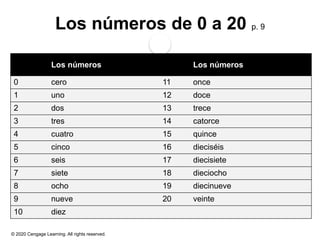
#14 Suggestions for use:
1) Play the audio recording of the pronunciation of all vocabulary words and have student volunteers repeat the numbers aloud.
2) After students study the list for a moment, have volunteers count in different patterns (backwards, odd numbers, even numbers, etc.)
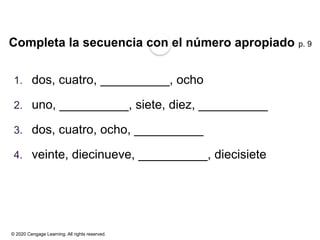
#15 Answers:
1) dos, cuatro, seis, ocho
2) uno, cuatro, siete, diez, trece
3) dos, cuatro, ocho, dieciséis
4) veinte, diecinueve, dieciocho, diecisiete
Suggestions for use: Extend the activity by having students come up with their own pattern and share it with a partner.
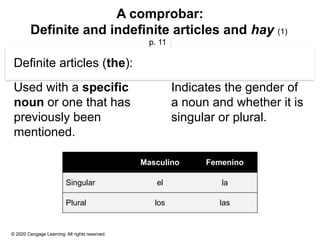
#16 Suggestions for use: Write or say 5 vocabulary words, and ask students to identify the definite article.
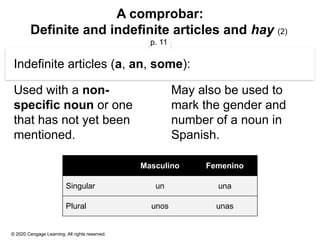
#17 Suggestions for use: Write or say 5 vocabulary words and ask students to identify the indefinite article.
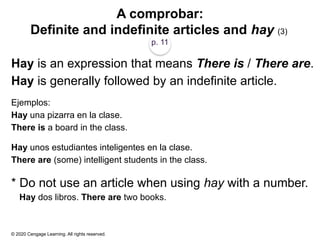
#18 Suggestions for use: Ask student volunteers true/false questions using hay, and encourage answers in complete sentences.
For example, ask: ¿Hay una pizarra en el salón de clase? ¿Hay diez estudiantes en la clase?
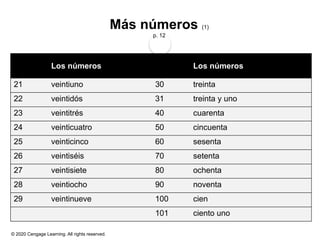
#19 Suggestions for use: Play the audio recording of the numbers, and have student volunteers repeat them.
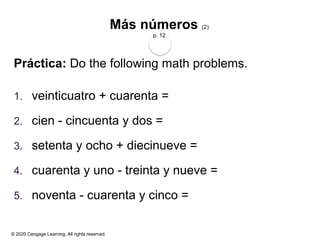
#20 Answers:
1) sesenta y cuatro
2) cuarenta y ocho
3) noventa y siete
4) dos
5) cuarenta y cinco
Suggestions for use: Extend the activity by having students come up with their own math problems and share them with a partner.
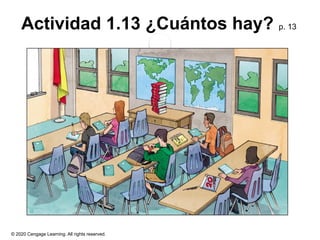
#21 Suggestions for use: Have student volunteers read the questions aloud from the book on p. 13 as one volunteer points to the item in the projected photo and provides the response.
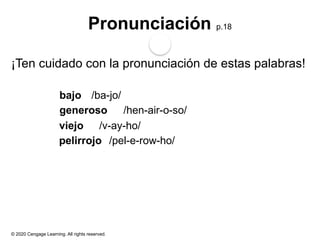
#22 “Suggestions for use: Play the audio recording of all vocabulary words and have student volunteers repeat the words aloud, paying attention to the pronunciation. All of the vocabulary words also appear at the End-of-chapter vocabulary list “Vocabulario 2”.
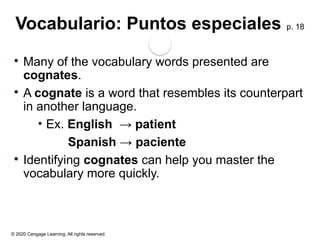
#23 Suggestions for use: Ask students to skim the glossary of their books and list three additional cognates.
#24 Suggestions for use:
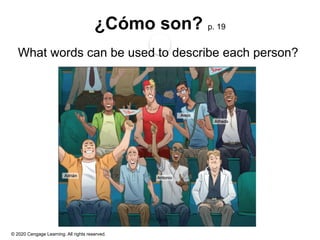
Project this image on a white board or chalkboard, and number the male characters. Have students study the vocabulary on page 18, and then ask them to close their books. Call on volunteers to provide as many descriptive adjectives for each number as possible.
Point to each person and give students two words. For example, ask “¿Es alto o bajo?” Students can use their vocabulary list on page 18 to respond.
For each person, make a statement about appearance. Have students use the vocabulary list on page 18 to determine whether or not your statement is true or false.
#25 Suggestions for use:
Continue referring students to the vocabulary on p.18.
#26 Suggestions for use:
Continue referring students to the vocabulary on p.18
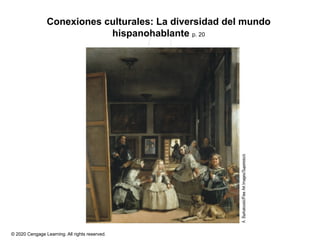
#27 Suggestions for use:
Refer students to the Piensa en el tema at the top of p. 20 and lead the class in a discussion about any Hispanic artists or famous Hispanic artwork they may be familiar with.
Have students work in groups and read about Velázquez and “Las meninas”.
Complete Hablemos del tema in those groups.
#28 Suggestions for use:
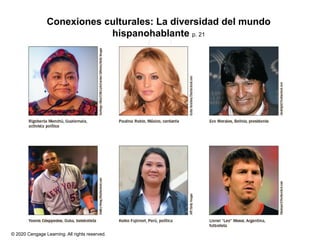
Ask students “Who looks like they may be Hispanic?”
Once students have offered/ discussed responses, refer students to the Piensa en el tema at the top of p. 21 and lead the class in a discussion about what the word “Hispanic” means.
Have students work with a partner to complete Hablemos del tema.
#29 Suggestions for use:
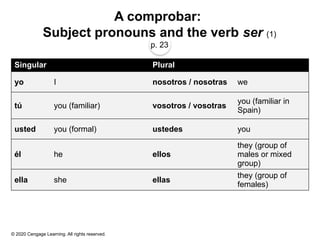
Before showing this slide, ask students to list subject pronouns in English.
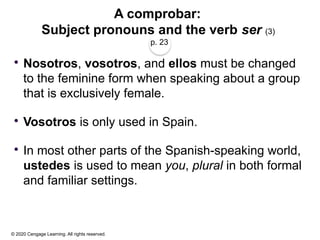
Explain that the nosotros / vosotros forms must agree in gender with the nouns they are replacing.
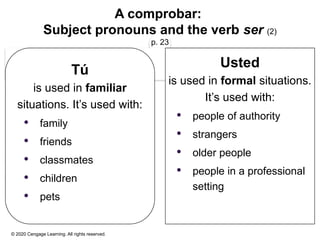
#30 Suggestions for use:
Give students different scenarios and ask them to identify if they would use tú or usted. For example, you might ask: “What would you use if you were speaking to your mother?” Other possibilities are: your dentist, your best friend, your nephew, your friend’s mother, a police officer, etc.
Be sensitive to the fact that some native speakers may use usted with greater frequency, depending on their country of origin. If you have native speakers in your class, ask them to compare and contrast their own use of usted with what is shown on the slide.
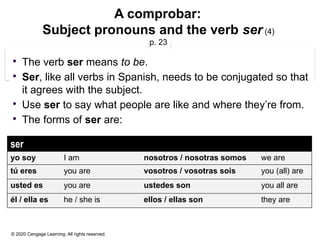
#32 Suggestions for use:
Have students ask 3 other students where they are from, and then have them share their responses, using different forms of ser.
Point out that the usted and ustedes forms are conjugated in the third person, not the second person. Use the example of his majesty , her honor, etc. to show how English speakers also may use the third person to show respect, even though it is done less frequently.
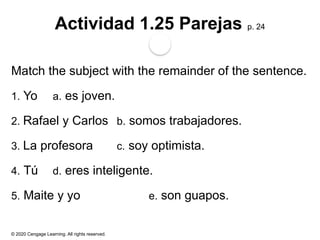
#33 Suggestions for use: Have students extend the activity by using identifying people in the class to replace the subjects given in the activity. Students can re-write or re-state the activities with their classmates as subjects.
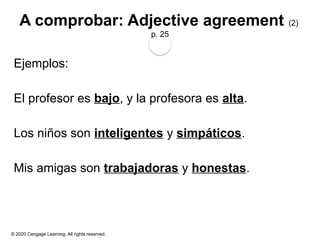
#34 Suggestions for use:
1) Before presenting this slide, call students’ attention to the vocabulary list on page 18. Ask them to categorize the adjectives by their endings (end in –o, –e, etc.) As you present each bulleted point, ask students to name specific adjectives to which that rule applies.
2) List five adjectives on the board (masculine or feminine form) and have students give you the plural form.
#35 Suggestions for use:
Ask students to provide one additional example to share with a partner. Have volunteers share their examples with the class.
Name people in the class or celebrities and have students choose one adjective to describe them.
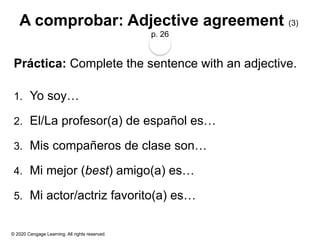
#36 Suggestions for use: Have students write their responses and walk around the room to check them for agreement.
#37 Suggestions for use: To extend the activity, have students come up with their own question or prompt and ask a partner for an appropriate response.
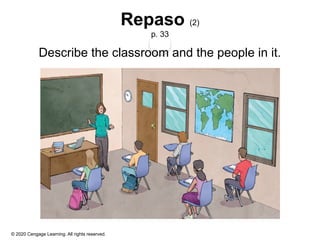
#38 Suggestions for use:
This may be done in pairs, or as a whole-class activity. Ask students to name at least 8 items in the classroom, and to describe at least 2 people.
To structure this activity more, project the image on a white board, and number 5 people or things. Ask students to write or say short sentences describing the items or people that correspond with each number.

![© 2020 Cengage Learning. All rights reserved.
A comprobar: Adjective agreement (1)
p. 25
In Spanish, adjectives must agree in gender and
number with the nouns they modify.
Adjectives that end in –o change to end in –a when
they modify a feminine noun.
Adjectives that end in –a, –e, or a consonant do
not change when modifying a feminine noun.
[Exception: trabajador → trabajadora (–or ending)]
Follow the rules you learned for pluralizing words to
pluralize adjectives.](https://image.slidesharecdn.com/exploraciones3ecaptulo1-250602054755-ea950959/85/Exploraciones-Espanol-Spanish-Capitulo-1-pptx-34-320.jpg)