
Unemployment and the
   Foundations of
  Aggregate Supply
Foundations of Aggregate Supply
 • Aggregate supply describes the behavior of the production
   side of the economy.
 • The aggregate supply curve or AS curve, is the schedule
   showing the level of total national output that will be
   produced at each possible price level, the other things being
   equal.
 • Aggregate supply curve in the short-run is upward sloping -
   one along which higher prices are associated with increases in
   the production of goods and services.
 • Long-run aggregate supply curve is vertical, one in which
   increases in the price level are not associated with an increase
   in total output supplied.
Determinants of Aggregate Supply
• Aggregate supply depends fundamentally upon
  two distinct set of forces: potential output and
  input costs.
• Potential output is the highest sustainable level
  of national output.
• Input cost is the cost incurred in the production
  of goods and services.
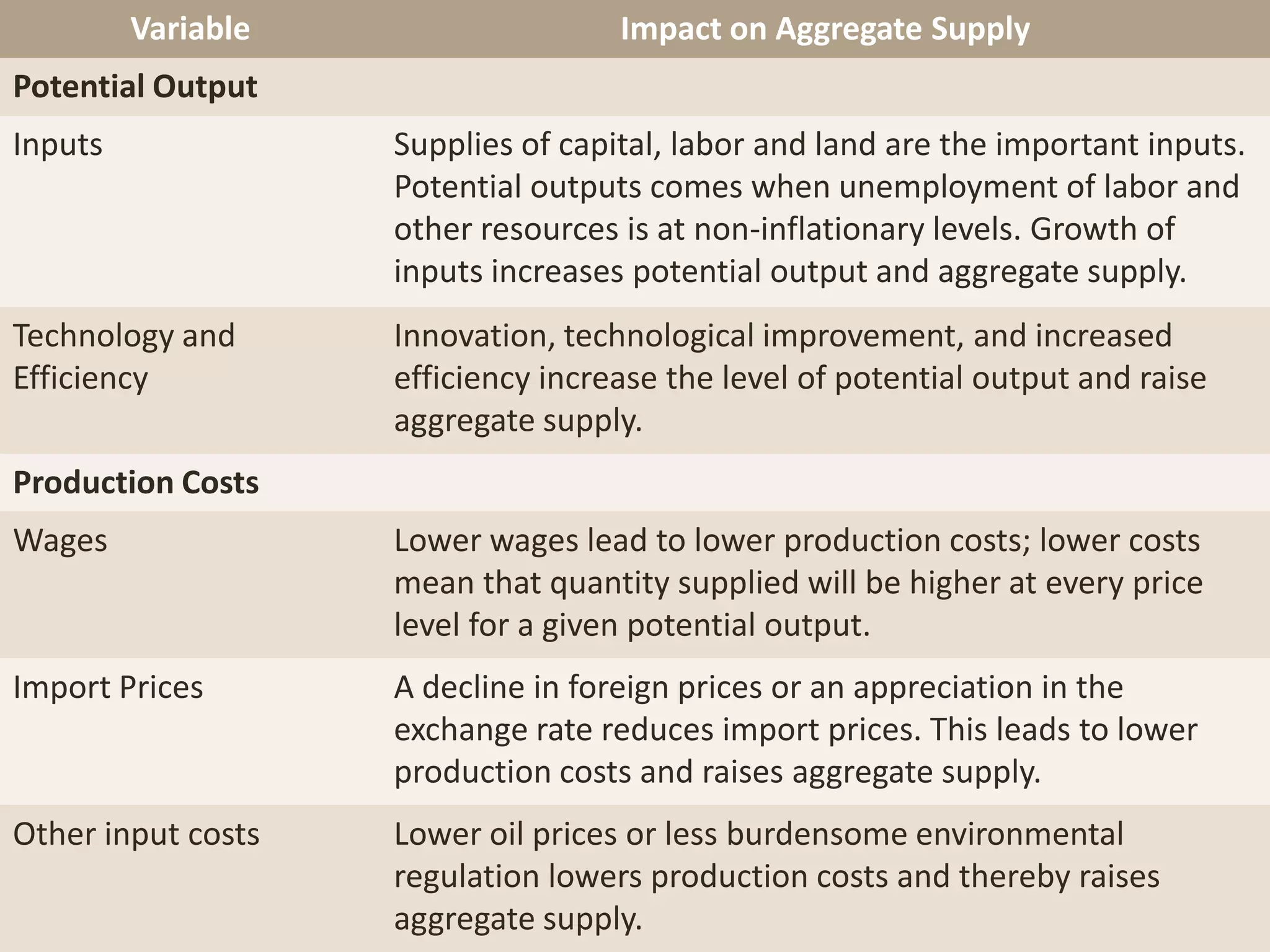
Variable                   Impact on Aggregate Supply
Potential Output
Inputs              Supplies of capital, labor and land are the important inputs.
                    Potential outputs comes when unemployment of labor and
                    other resources is at non-inflationary levels. Growth of
                    inputs increases potential output and aggregate supply.
Technology and      Innovation, technological improvement, and increased
Efficiency          efficiency increase the level of potential output and raise
                    aggregate supply.
Production Costs
Wages               Lower wages lead to lower production costs; lower costs
                    mean that quantity supplied will be higher at every price
                    level for a given potential output.
Import Prices       A decline in foreign prices or an appreciation in the
                    exchange rate reduces import prices. This leads to lower
                    production costs and raises aggregate supply.
Other input costs   Lower oil prices or less burdensome environmental
                    regulation lowers production costs and thereby raises
                    aggregate supply.
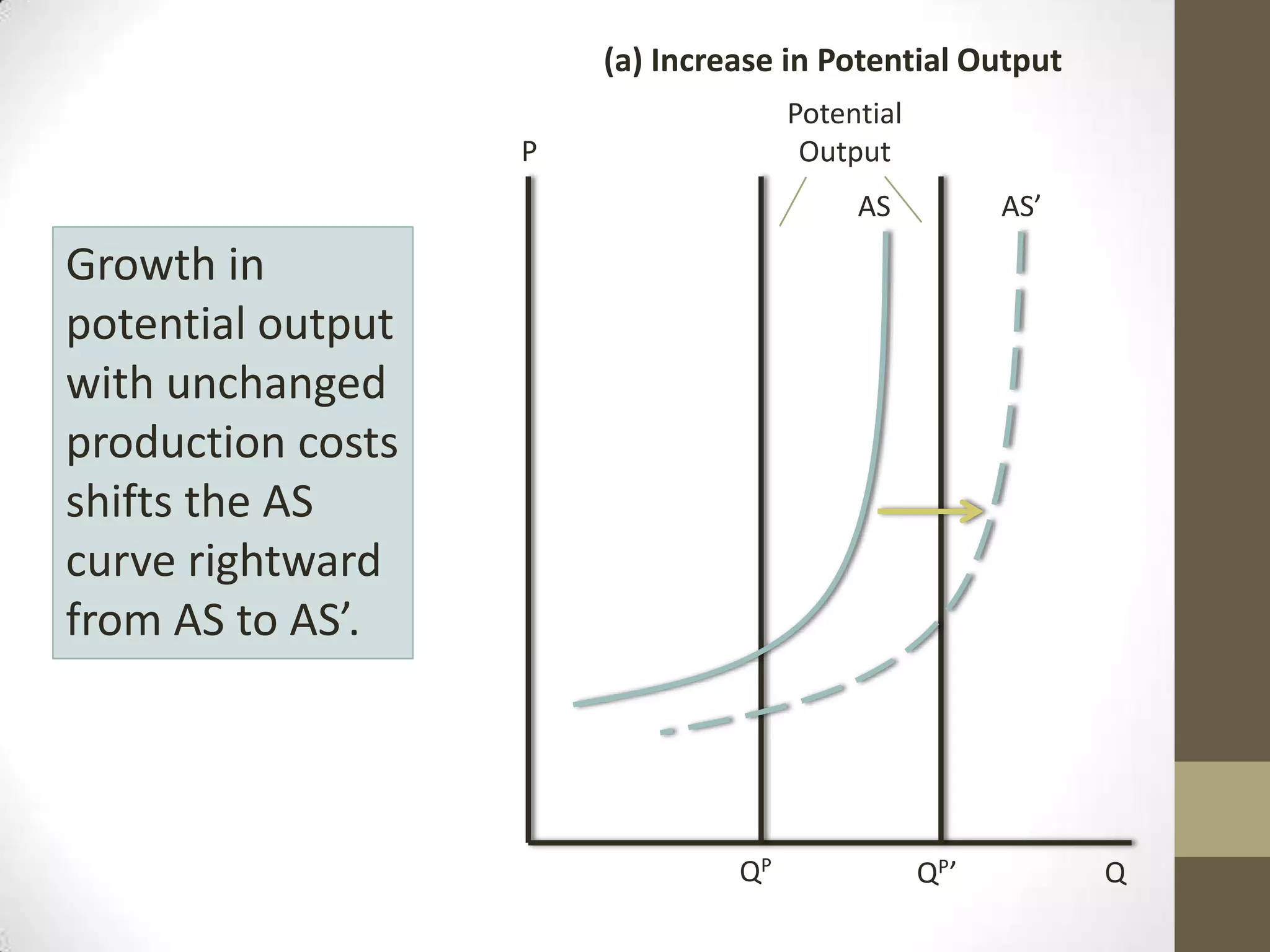
(a) Increase in Potential Output
                                     Potential
                   P                  Output
                                          AS            AS’

Growth in
potential output
with unchanged
production costs
shifts the AS
curve rightward
from AS to AS’.


                                QP               QP ’         Q
(a) Increase in Potential Output

                      P
                                       Potential
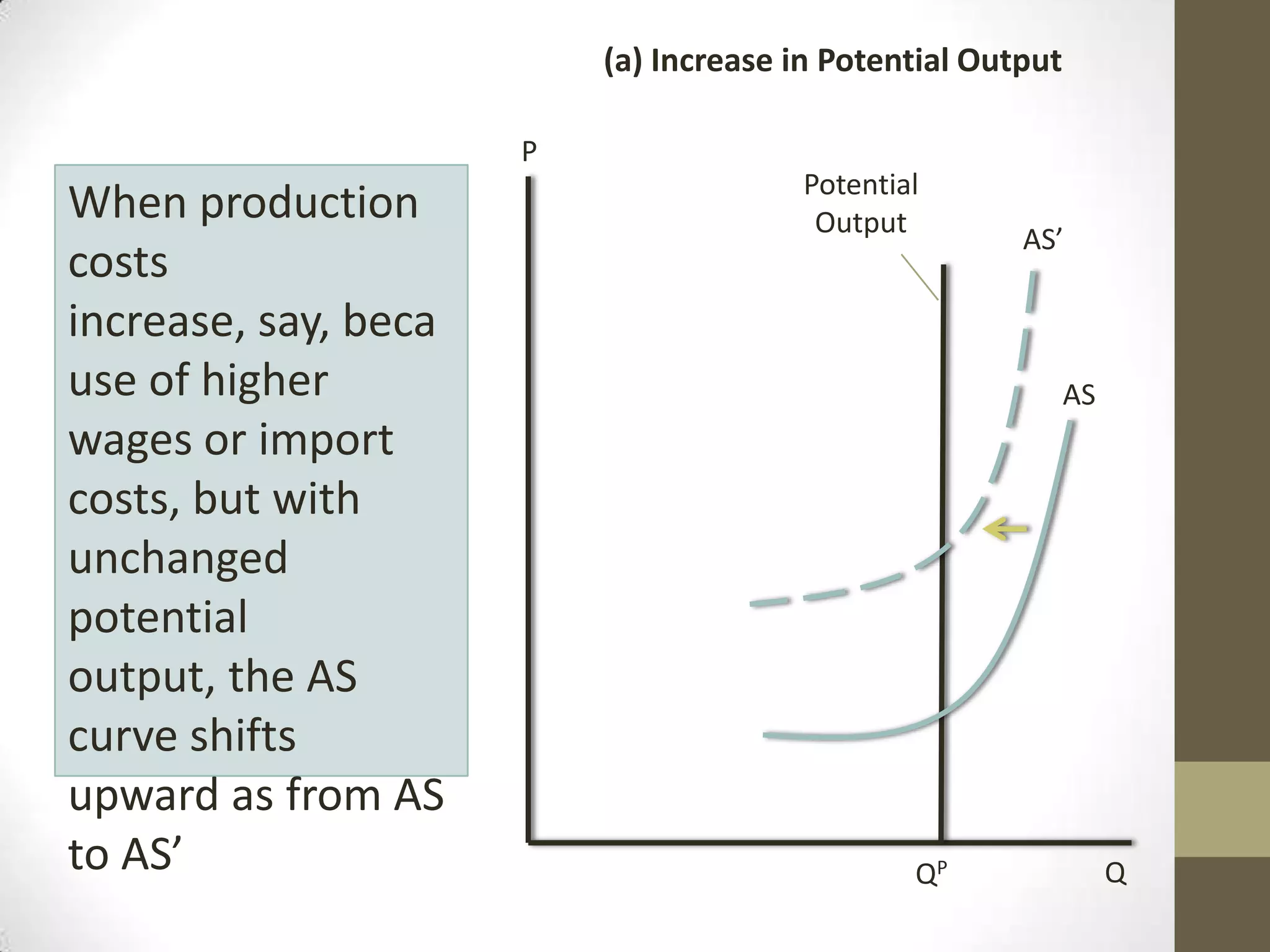
When production                         Output
                                                       AS’
costs
increase, say, beca
use of higher                                                AS
wages or import
costs, but with
unchanged
potential
output, the AS
curve shifts
upward as from AS
to AS’                                         QP                 Q
Aggregate Supply in the Short-run and Long-run
P                                               P                                          AS
                      Potential
                       Output
                                       AS


                                                                        Potential Output
                              QP            Q                                          QP       Q

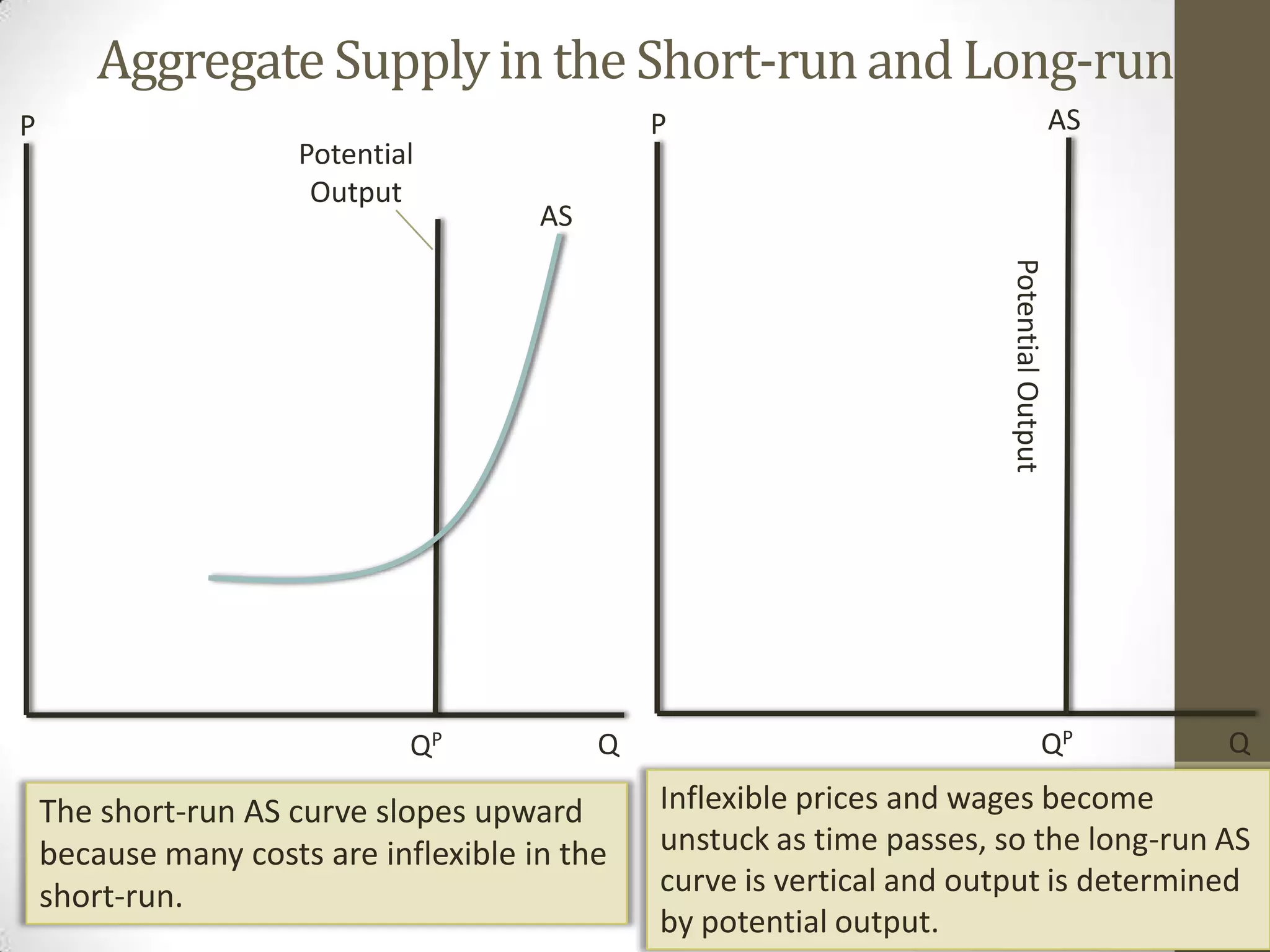
    The short-run AS curve slopes upward        Inflexible prices and wages become
    because many costs are inflexible in the    unstuck as time passes, so the long-run AS
    short-run.                                  curve is vertical and output is determined
                                                by potential output.
Unemployment
Employed- people who perform any paid work, as well as those who
      have jobs but are absent from work because of illness, strikes,
      or vacations.
Unemployed- includes people who are not employed but are actively
     looking for work or waiting to return to work. To be counted as
     unemployed, a person must do more than simply think about
     work.
Not in the Labor Force- includes the adult population keeping the
        house, retired, too ill to work, or simply not looking for work.
Labor Force- includes all those who are either employed or
       unemployed.
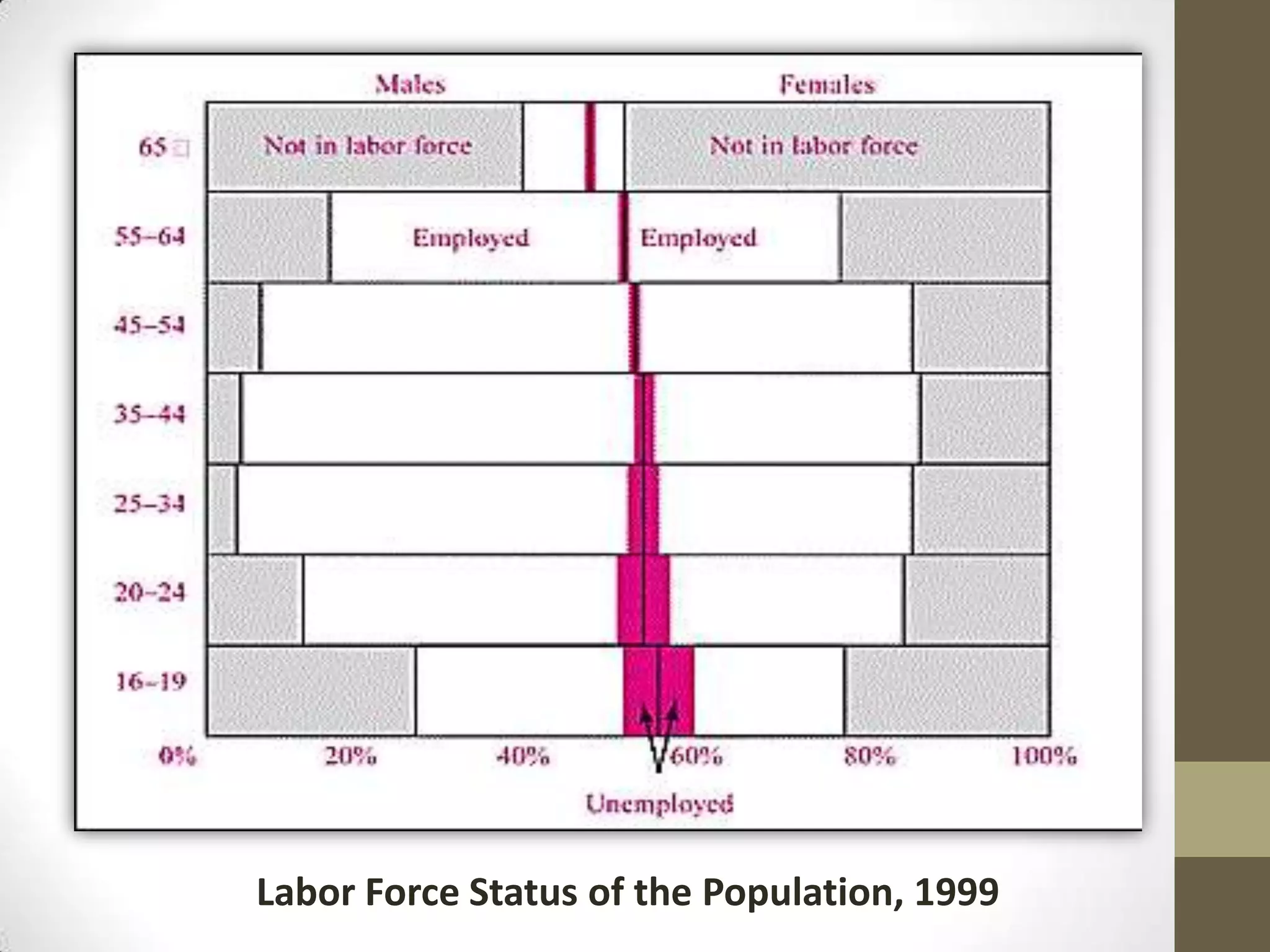
Labor Force Status of the Population, 1999
Impact of Unemployment
• High unemployment is both an economic and social
  problem. Unemployment is an economic problem
  because it represents waste of a valuable resource.
• It is a major social problem because it causes
  enormous suffering as the unemployed workers
  struggle with reduced incomes.
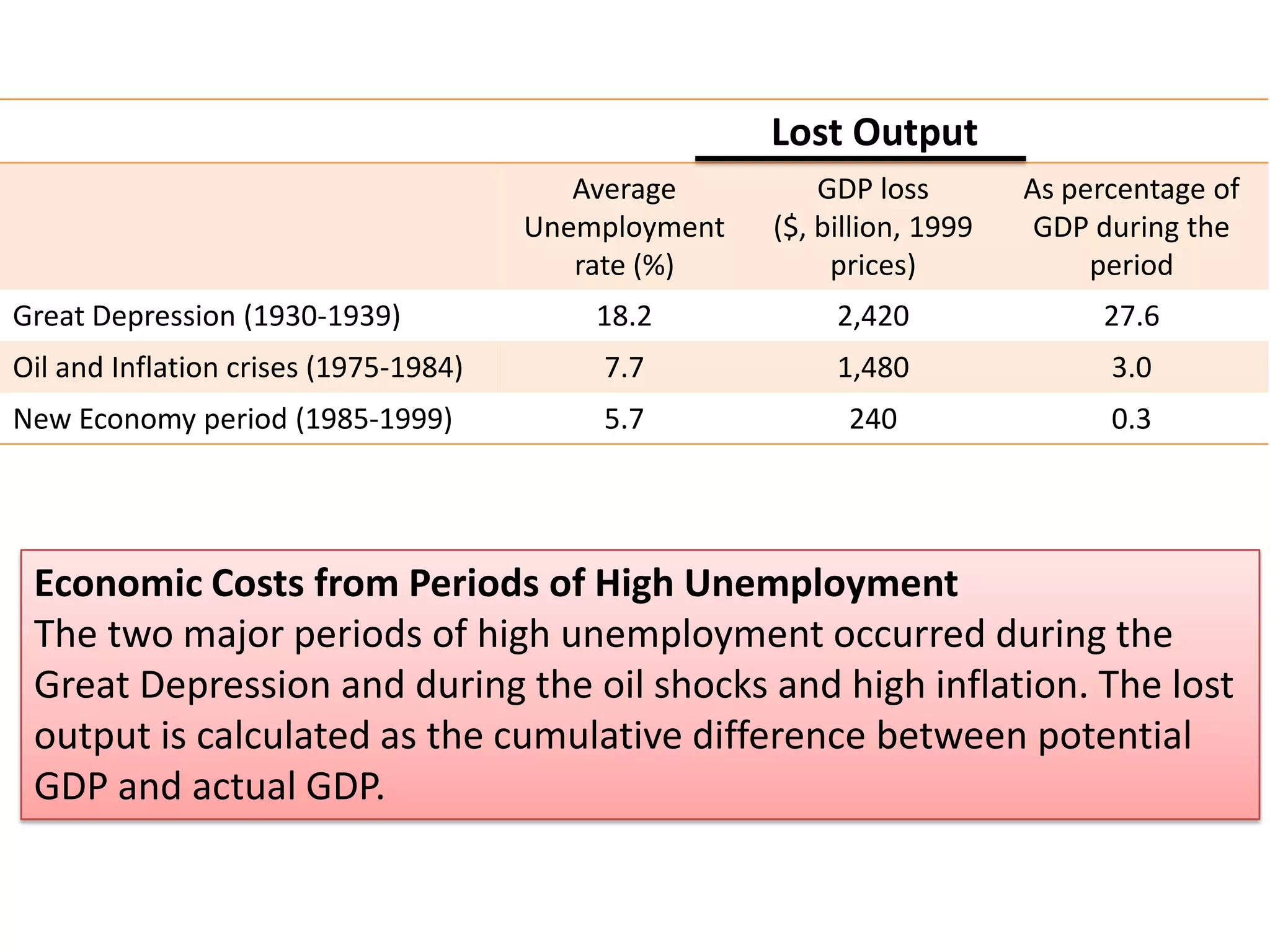
Lost Output
                                          Average         GDP loss        As percentage of
                                       Unemployment   ($, billion, 1999    GDP during the
                                          rate (%)         prices)             period
Great Depression (1930-1939)               18.2            2,420               27.6
Oil and Inflation crises (1975-1984)       7.7             1,480                3.0
New Economy period (1985-1999)             5.7              240                 0.3


 Economic Costs from Periods of High Unemployment
 The two major periods of high unemployment occurred during the
 Great Depression and during the oil shocks and high inflation. The lost
 output is calculated as the cumulative difference between potential
 GDP and actual GDP.
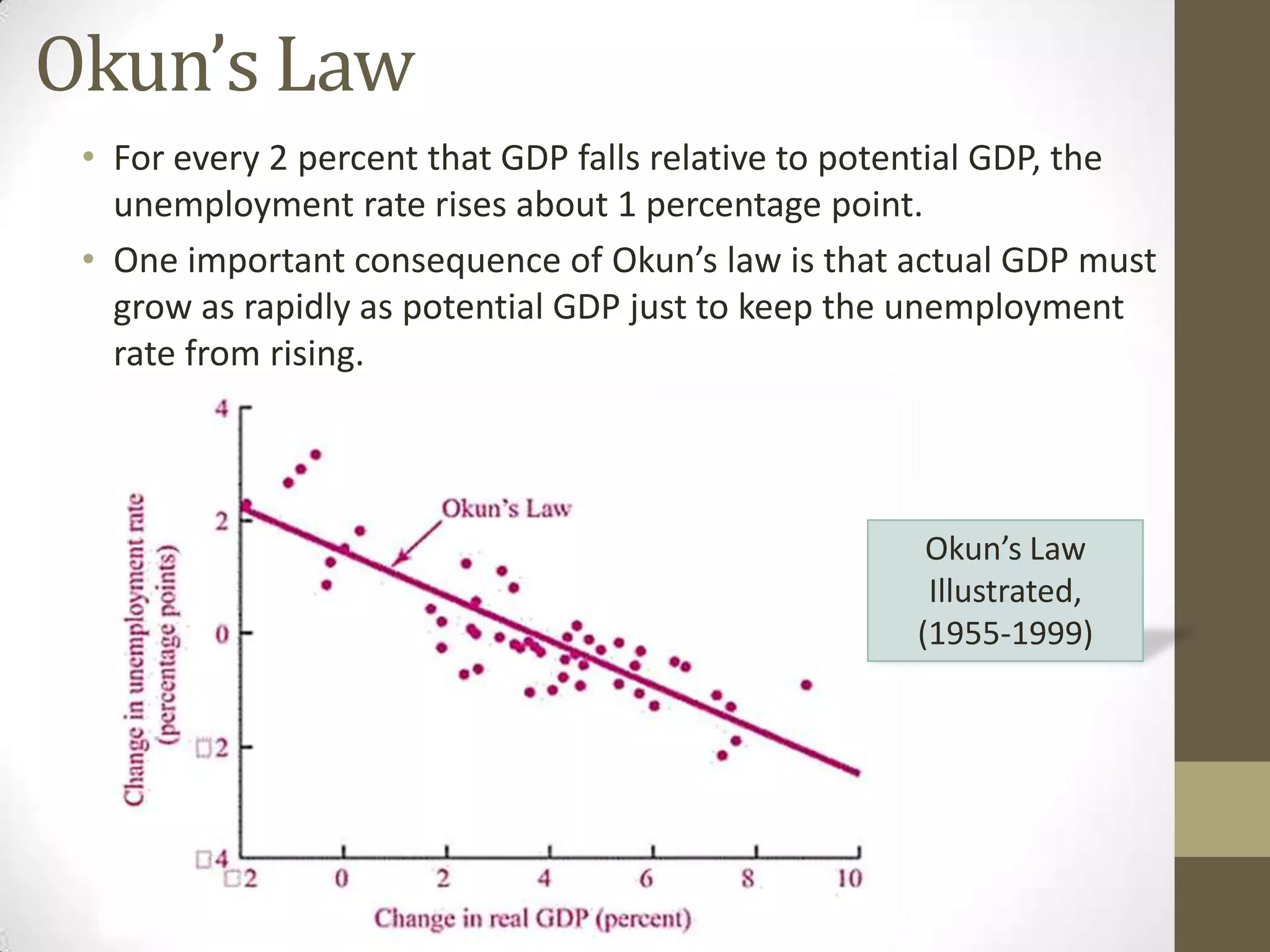
Okun’s Law
 • For every 2 percent that GDP falls relative to potential GDP, the
   unemployment rate rises about 1 percentage point.
 • One important consequence of Okun’s law is that actual GDP must
   grow as rapidly as potential GDP just to keep the unemployment
   rate from rising.


                                                      Okun’s Law
                                                      Illustrated,
                                                     (1955-1999)
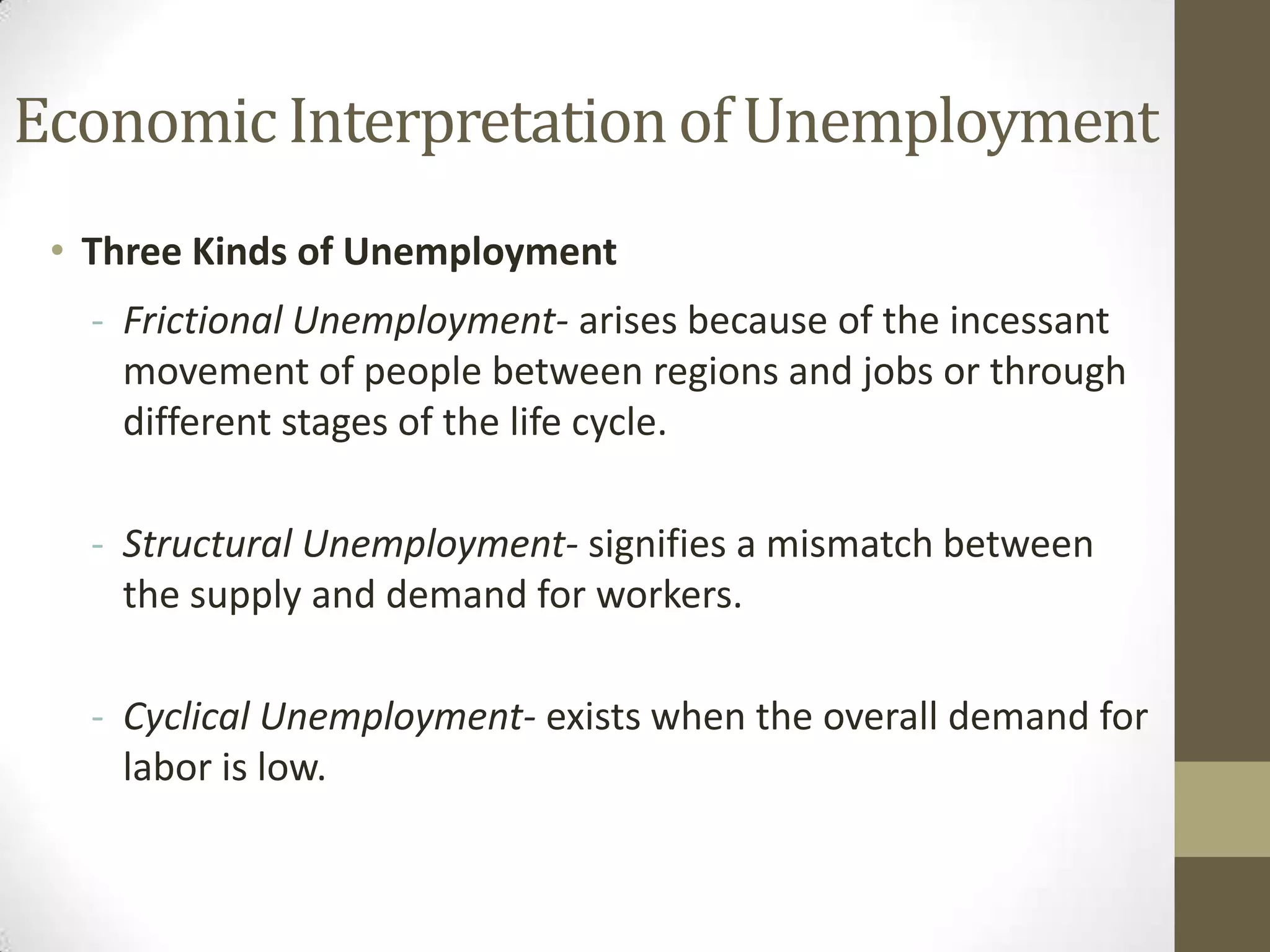
Economic Interpretation of Unemployment
 • Three Kinds of Unemployment
   - Frictional Unemployment- arises because of the incessant
     movement of people between regions and jobs or through
     different stages of the life cycle.

   - Structural Unemployment- signifies a mismatch between
     the supply and demand for workers.

   - Cyclical Unemployment- exists when the overall demand for
     labor is low.
Voluntary and Involuntary Unemployment
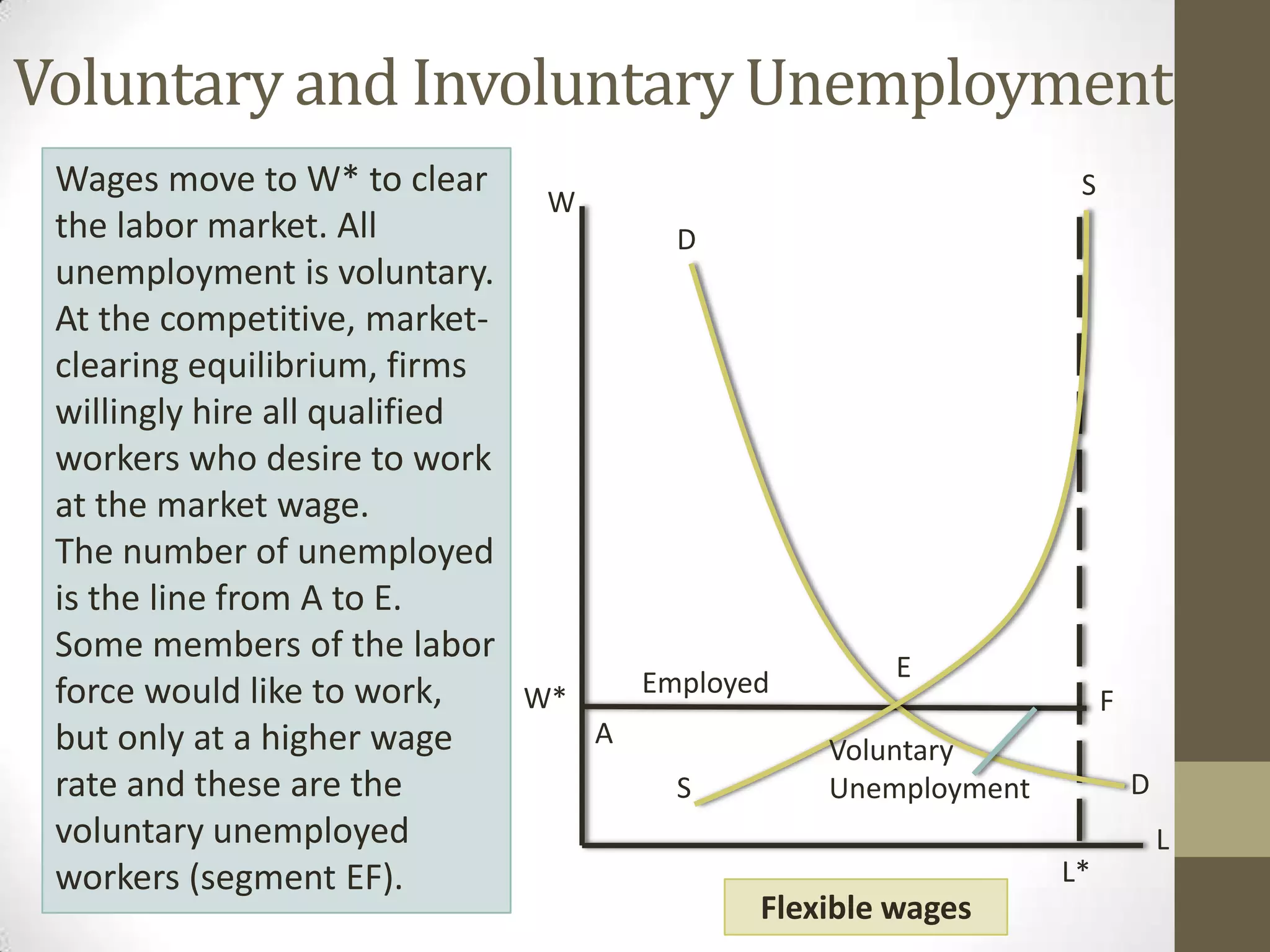
 Wages move to W* to clear                                    S
                               W
 the labor market. All               D
 unemployment is voluntary.
 At the competitive, market-
 clearing equilibrium, firms
 willingly hire all qualified
 workers who desire to work
 at the market wage.
 The number of unemployed
 is the line from A to E.
 Some members of the labor
                                   Employed       E
 force would like to work,    W*                                  F
 but only at a higher wage       A
                                              Voluntary
 rate and these are the              S        Unemployment            D
 voluntary unemployed                                                     L
 workers (segment EF).                                       L*
                                          Flexible wages
S
                           W
                                     D


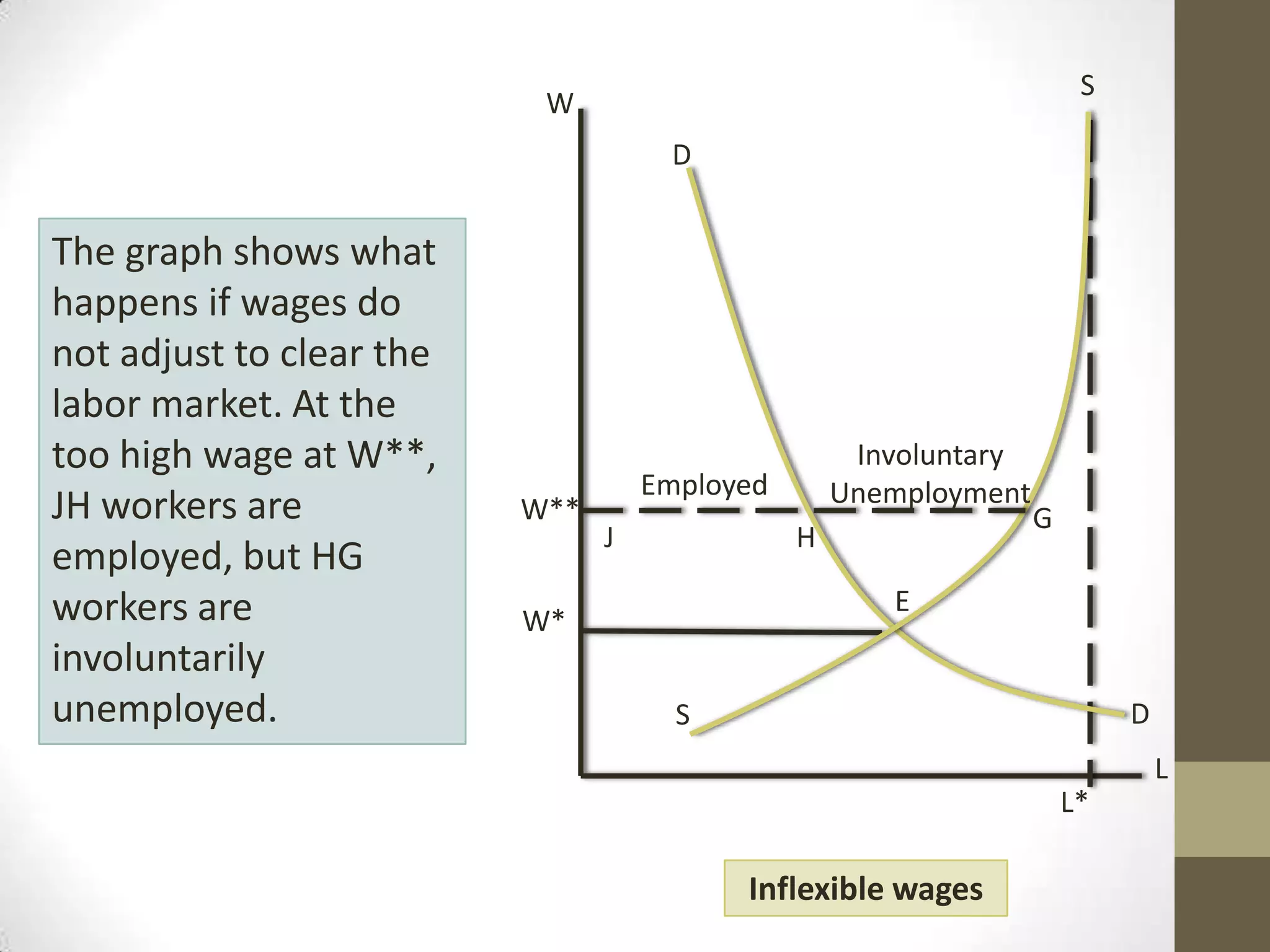
The graph shows what
happens if wages do
not adjust to clear the
labor market. At the
too high wage at W**,                               Involuntary
                                    Employed       Unemployment
JH workers are            W**                                     G
                                J              H
employed, but HG
workers are                                           E
                          W*
involuntarily
unemployed.                           S                                    D
                                                                               L
                                                                      L*

                                          Inflexible wages
Labor Market Issues
  • Who are the unemployed

  • Duration of unemployment

  • Source of Joblessness

  • Unemployment by Age
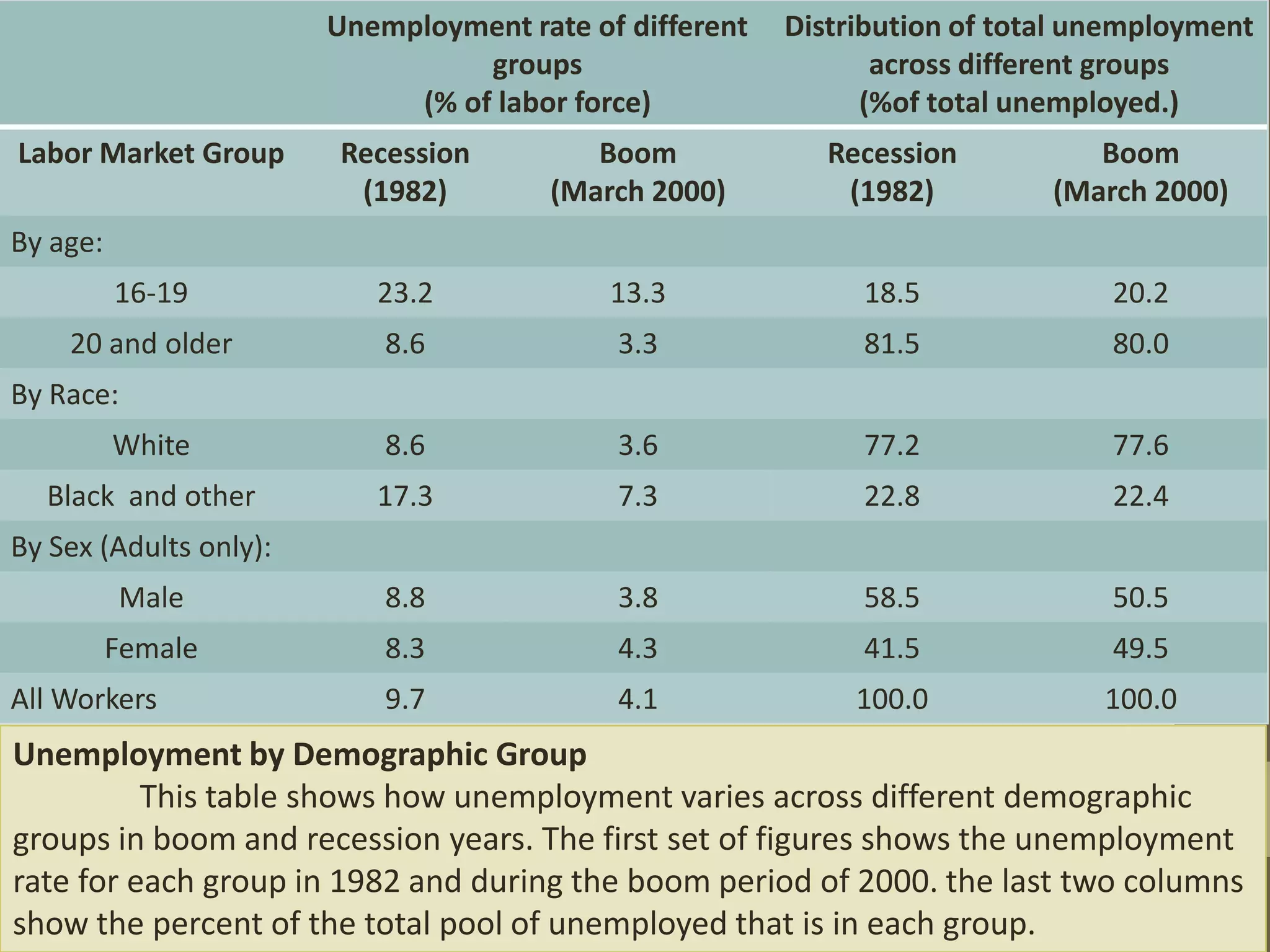
Unemployment rate of different   Distribution of total unemployment
                                  groups                        across different groups
                             (% of labor force)                (%of total unemployed.)
Labor Market Group      Recession         Boom              Recession          Boom
                         (1982)        (March 2000)          (1982)         (March 2000)
By age:
          16-19            23.2             13.3              18.5              20.2
    20 and older            8.6             3.3               81.5              80.0
By Race:
          White             8.6             3.6               77.2              77.6
  Black and other          17.3             7.3               22.8              22.4
By Sex (Adults only):
          Male              8.8             3.8               58.5              50.5
          Female            8.3             4.3               41.5              49.5
All Workers                 9.7             4.1               100.0             100.0
Unemployment by Demographic Group
          This table shows how unemployment varies across different demographic
groups in boom and recession years. The first set of figures shows the unemployment
rate for each group in 1982 and during the boom period of 2000. the last two columns
show the percent of the total pool of unemployed that is in each group.
45
 40
 35
 30
 25
 20
 15
 10
  5
  0
           <5          10-14        15-26        27-51          52+
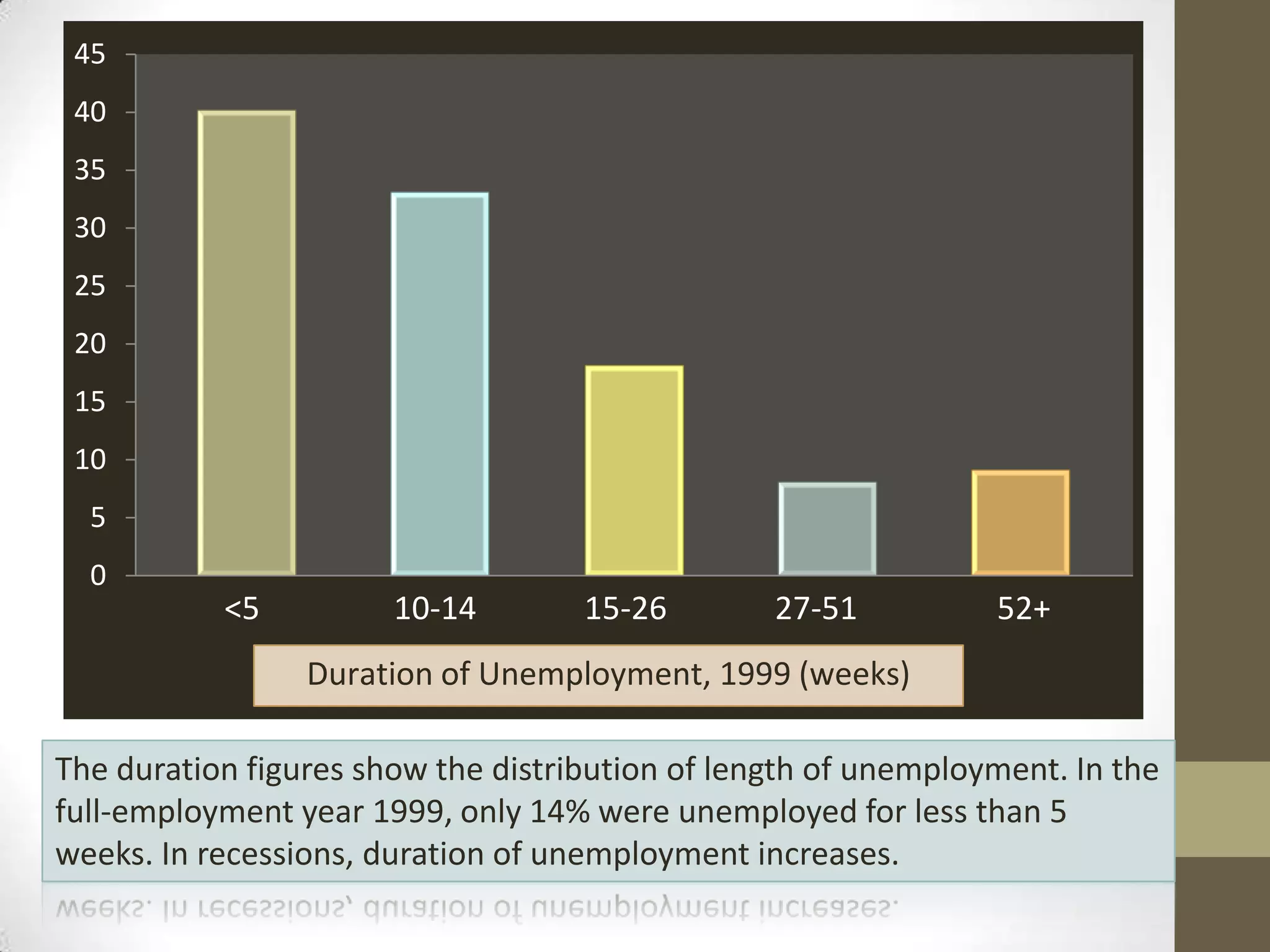
                 Duration of Unemployment, 1999 (weeks)

The duration figures show the distribution of length of unemployment. In the
full-employment year 1999, only 14% were unemployed for less than 5
weeks. In recessions, duration of unemployment increases.
Recession
                                                    Unemployment by
                                                    Reason
                                                    (percent of the labor
                                                    force that is unemployed
 Job Loser       5.7                                for different reasons)


                                                           Boom

 Reentrant       2.2                                                       Job Loser
                                                            1.9

New Entrant      1.1                                        1.4            Reentrant
                                                            0.3            New Entrant
 Job Leaver      0.8                                        0.6            Job Leaver
                1982                                      1999

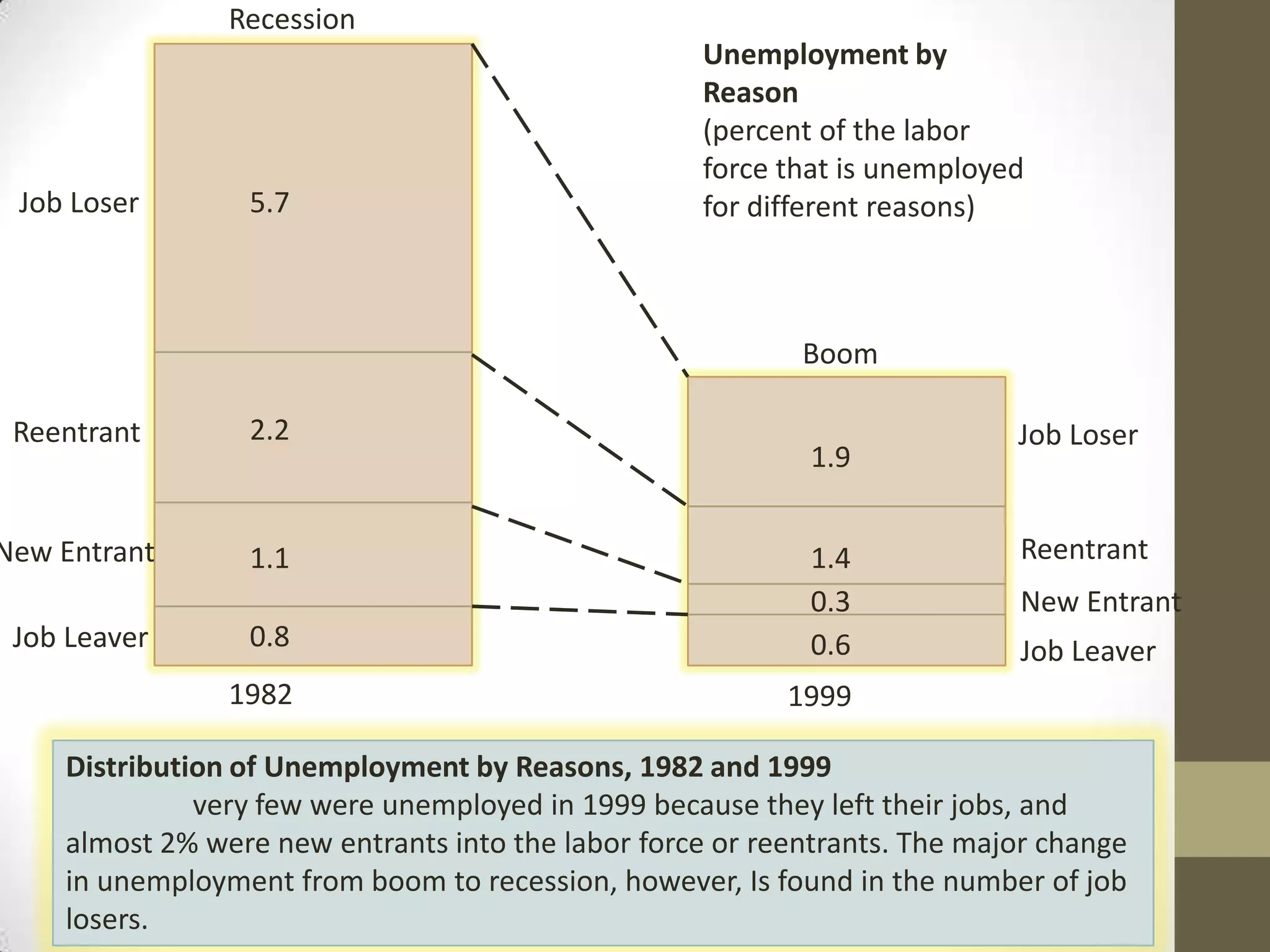
    Distribution of Unemployment by Reasons, 1982 and 1999
              very few were unemployed in 1999 because they left their jobs, and
    almost 2% were new entrants into the labor force or reentrants. The major change
    in unemployment from boom to recession, however, Is found in the number of job
    losers.
Unemployment rate
                                            (% of labor force)
        Age                         White                        Black
       16-17                        14.5                         31.0
       18-19                        10.2                         26.2
       20-24                         6.3                         14.6
       25-34                         3.3                          7.6
       35-44                         2.7                          5.3
       45-54                         2.4                          4.0
       55-64                         2.5                          3.9
   65 and older                      2.9                          5.0


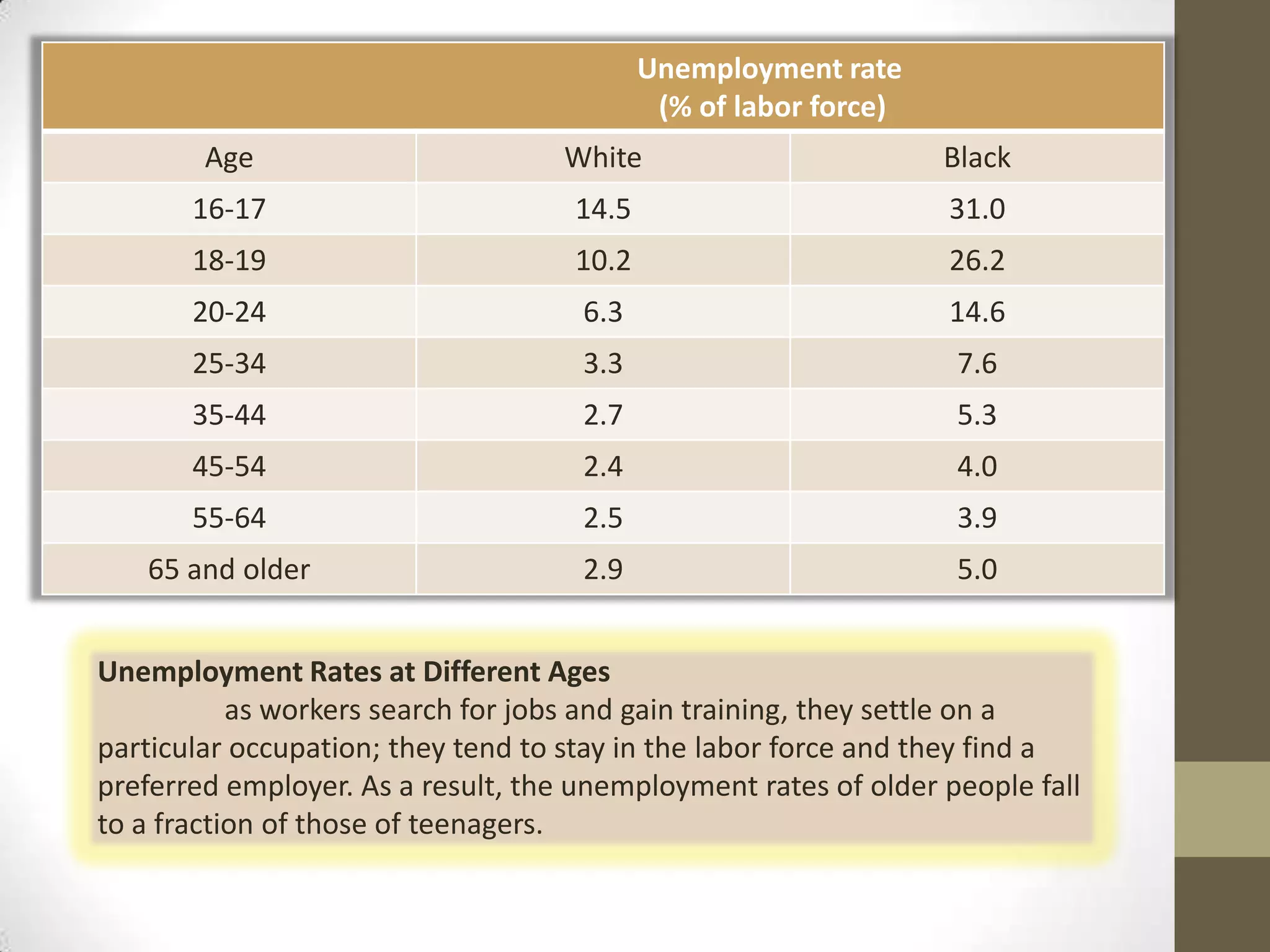
Unemployment Rates at Different Ages
           as workers search for jobs and gain training, they settle on a
particular occupation; they tend to stay in the labor force and they find a
preferred employer. As a result, the unemployment rates of older people fall
to a fraction of those of teenagers.

Unemployment and the foundations of aggregate supply

  • 1.
    Unemployment and the Foundations of Aggregate Supply
  • 2.
    Foundations of AggregateSupply • Aggregate supply describes the behavior of the production side of the economy. • The aggregate supply curve or AS curve, is the schedule showing the level of total national output that will be produced at each possible price level, the other things being equal. • Aggregate supply curve in the short-run is upward sloping - one along which higher prices are associated with increases in the production of goods and services. • Long-run aggregate supply curve is vertical, one in which increases in the price level are not associated with an increase in total output supplied.
  • 3.
    Determinants of AggregateSupply • Aggregate supply depends fundamentally upon two distinct set of forces: potential output and input costs. • Potential output is the highest sustainable level of national output. • Input cost is the cost incurred in the production of goods and services.
  • 4.
    Variable Impact on Aggregate Supply Potential Output Inputs Supplies of capital, labor and land are the important inputs. Potential outputs comes when unemployment of labor and other resources is at non-inflationary levels. Growth of inputs increases potential output and aggregate supply. Technology and Innovation, technological improvement, and increased Efficiency efficiency increase the level of potential output and raise aggregate supply. Production Costs Wages Lower wages lead to lower production costs; lower costs mean that quantity supplied will be higher at every price level for a given potential output. Import Prices A decline in foreign prices or an appreciation in the exchange rate reduces import prices. This leads to lower production costs and raises aggregate supply. Other input costs Lower oil prices or less burdensome environmental regulation lowers production costs and thereby raises aggregate supply.
  • 5.
    (a) Increase inPotential Output Potential P Output AS AS’ Growth in potential output with unchanged production costs shifts the AS curve rightward from AS to AS’. QP QP ’ Q
  • 6.
    (a) Increase inPotential Output P Potential When production Output AS’ costs increase, say, beca use of higher AS wages or import costs, but with unchanged potential output, the AS curve shifts upward as from AS to AS’ QP Q
  • 7.
    Aggregate Supply inthe Short-run and Long-run P P AS Potential Output AS Potential Output QP Q QP Q The short-run AS curve slopes upward Inflexible prices and wages become because many costs are inflexible in the unstuck as time passes, so the long-run AS short-run. curve is vertical and output is determined by potential output.
  • 8.
    Unemployment Employed- people whoperform any paid work, as well as those who have jobs but are absent from work because of illness, strikes, or vacations. Unemployed- includes people who are not employed but are actively looking for work or waiting to return to work. To be counted as unemployed, a person must do more than simply think about work. Not in the Labor Force- includes the adult population keeping the house, retired, too ill to work, or simply not looking for work. Labor Force- includes all those who are either employed or unemployed.
  • 9.
    Labor Force Statusof the Population, 1999
  • 10.
    Impact of Unemployment •High unemployment is both an economic and social problem. Unemployment is an economic problem because it represents waste of a valuable resource. • It is a major social problem because it causes enormous suffering as the unemployed workers struggle with reduced incomes.
  • 11.
    Lost Output Average GDP loss As percentage of Unemployment ($, billion, 1999 GDP during the rate (%) prices) period Great Depression (1930-1939) 18.2 2,420 27.6 Oil and Inflation crises (1975-1984) 7.7 1,480 3.0 New Economy period (1985-1999) 5.7 240 0.3 Economic Costs from Periods of High Unemployment The two major periods of high unemployment occurred during the Great Depression and during the oil shocks and high inflation. The lost output is calculated as the cumulative difference between potential GDP and actual GDP.
  • 12.
    Okun’s Law •For every 2 percent that GDP falls relative to potential GDP, the unemployment rate rises about 1 percentage point. • One important consequence of Okun’s law is that actual GDP must grow as rapidly as potential GDP just to keep the unemployment rate from rising. Okun’s Law Illustrated, (1955-1999)
  • 13.
    Economic Interpretation ofUnemployment • Three Kinds of Unemployment - Frictional Unemployment- arises because of the incessant movement of people between regions and jobs or through different stages of the life cycle. - Structural Unemployment- signifies a mismatch between the supply and demand for workers. - Cyclical Unemployment- exists when the overall demand for labor is low.
  • 14.
    Voluntary and InvoluntaryUnemployment Wages move to W* to clear S W the labor market. All D unemployment is voluntary. At the competitive, market- clearing equilibrium, firms willingly hire all qualified workers who desire to work at the market wage. The number of unemployed is the line from A to E. Some members of the labor Employed E force would like to work, W* F but only at a higher wage A Voluntary rate and these are the S Unemployment D voluntary unemployed L workers (segment EF). L* Flexible wages
  • 15.
    S W D The graph shows what happens if wages do not adjust to clear the labor market. At the too high wage at W**, Involuntary Employed Unemployment JH workers are W** G J H employed, but HG workers are E W* involuntarily unemployed. S D L L* Inflexible wages
  • 16.
    Labor Market Issues • Who are the unemployed • Duration of unemployment • Source of Joblessness • Unemployment by Age
  • 17.
    Unemployment rate ofdifferent Distribution of total unemployment groups across different groups (% of labor force) (%of total unemployed.) Labor Market Group Recession Boom Recession Boom (1982) (March 2000) (1982) (March 2000) By age: 16-19 23.2 13.3 18.5 20.2 20 and older 8.6 3.3 81.5 80.0 By Race: White 8.6 3.6 77.2 77.6 Black and other 17.3 7.3 22.8 22.4 By Sex (Adults only): Male 8.8 3.8 58.5 50.5 Female 8.3 4.3 41.5 49.5 All Workers 9.7 4.1 100.0 100.0 Unemployment by Demographic Group This table shows how unemployment varies across different demographic groups in boom and recession years. The first set of figures shows the unemployment rate for each group in 1982 and during the boom period of 2000. the last two columns show the percent of the total pool of unemployed that is in each group.
  • 18.
    45 40 35 30 25 20 15 10 5 0 <5 10-14 15-26 27-51 52+ Duration of Unemployment, 1999 (weeks) The duration figures show the distribution of length of unemployment. In the full-employment year 1999, only 14% were unemployed for less than 5 weeks. In recessions, duration of unemployment increases.
  • 19.
    Recession Unemployment by Reason (percent of the labor force that is unemployed Job Loser 5.7 for different reasons) Boom Reentrant 2.2 Job Loser 1.9 New Entrant 1.1 1.4 Reentrant 0.3 New Entrant Job Leaver 0.8 0.6 Job Leaver 1982 1999 Distribution of Unemployment by Reasons, 1982 and 1999 very few were unemployed in 1999 because they left their jobs, and almost 2% were new entrants into the labor force or reentrants. The major change in unemployment from boom to recession, however, Is found in the number of job losers.
  • 20.
    Unemployment rate (% of labor force) Age White Black 16-17 14.5 31.0 18-19 10.2 26.2 20-24 6.3 14.6 25-34 3.3 7.6 35-44 2.7 5.3 45-54 2.4 4.0 55-64 2.5 3.9 65 and older 2.9 5.0 Unemployment Rates at Different Ages as workers search for jobs and gain training, they settle on a particular occupation; they tend to stay in the labor force and they find a preferred employer. As a result, the unemployment rates of older people fall to a fraction of those of teenagers.