Upper Six Unit 2 Module 1 Topic 2
 
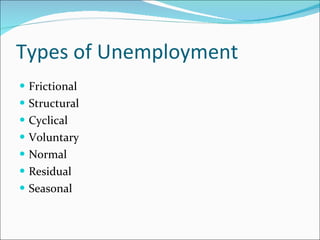
Types of Unemployment Frictional Structural Cyclical Voluntary Normal Residual Seasonal
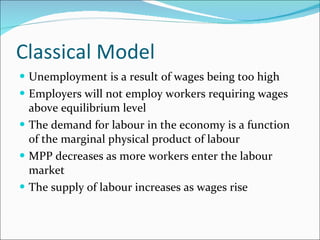
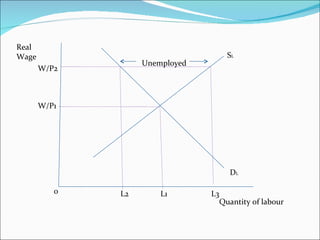
Classical Model Unemployment is a result of wages being too high Employers will not employ workers requiring wages above equilibrium level The demand for labour in the economy is a function of the marginal physical product of labour MPP decreases as more workers enter the labour market The supply of labour increases as wages rise
Quantity of labour Real Wage D L S L Unemployed 0 L2 L1 L3 W/P1 W/P2
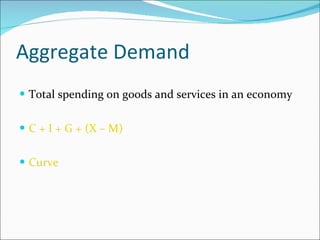
Aggregate Demand Total spending on goods and services in an economy C + I + G + (X – M) Curve
C+I+G+(X-M) Consumer spending – amount consumers spend on goods, dependent on level of disposable income Investment spending – expenditure by private sector on capital goods, affected by interest rates, technological change, expectations Government spending – current and capital spending on public services Net Exports – difference between exports and imports
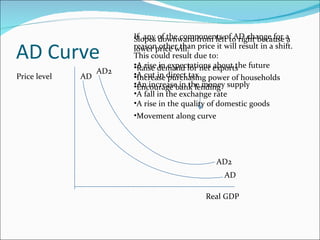
AD Curve AD AD Real GDP Price level Slopes downward from left to right because a lower price will: Raise demand for net exports Increase purchasing power of households Encourage bank lending Movement along curve AD2 AD2 If  any of the components of AD change for a reason other than price it will result in a shift.  This could result due to: A rise in expectations about the future A cut in direct tax An increase in the money supply A fall in the exchange rate A rise in the quality of domestic goods
Aggregate Supply Total output that firms in an economy are willing and able to supply at different price levels in a given period of time SRAS LRAS
Short run Aggregate Supply Slopes upwards from left to right – higher prices mean ability to meet costs and greater profits Shifts if productivity changes or payments to fop change
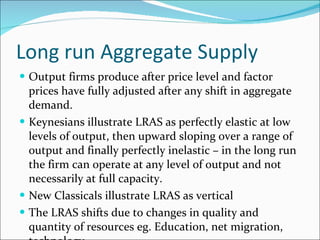
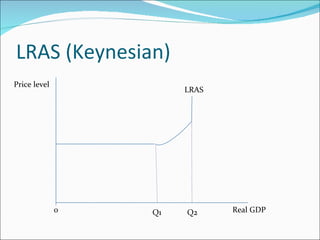
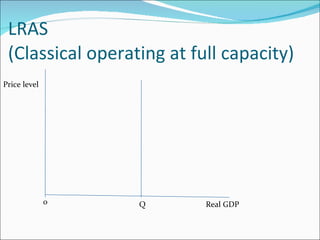
Long run Aggregate Supply Output firms produce after price level and factor prices have fully adjusted after any shift in aggregate demand. Keynesians illustrate LRAS as perfectly elastic at low levels of output, then upward sloping over a range of output and finally perfectly inelastic – in the long run the firm can operate at any level of output and not necessarily at full capacity. New Classicals illustrate LRAS as vertical The LRAS shifts due to changes in quality and quantity of resources eg. Education, net migration, technology
LRAS (Keynesian) LRAS Q1 Q2 Real GDP Price level 0
LRAS  (Classical operating at full capacity) Real GDP Price level Q 0
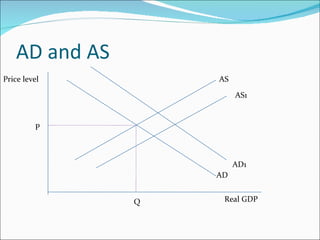
AD and AS AD AS Q P Real GDP Price level AD1 AS1
Great Work Show your understanding by doing some questions

Classical models of_the_macroeconomy

  • 1.
    Upper Six Unit2 Module 1 Topic 2
  • 2.
  • 3.
    Types of UnemploymentFrictional Structural Cyclical Voluntary Normal Residual Seasonal
  • 4.
    Classical Model Unemploymentis a result of wages being too high Employers will not employ workers requiring wages above equilibrium level The demand for labour in the economy is a function of the marginal physical product of labour MPP decreases as more workers enter the labour market The supply of labour increases as wages rise
  • 5.
    Quantity of labourReal Wage D L S L Unemployed 0 L2 L1 L3 W/P1 W/P2
  • 6.
    Aggregate Demand Totalspending on goods and services in an economy C + I + G + (X – M) Curve
  • 7.
    C+I+G+(X-M) Consumer spending– amount consumers spend on goods, dependent on level of disposable income Investment spending – expenditure by private sector on capital goods, affected by interest rates, technological change, expectations Government spending – current and capital spending on public services Net Exports – difference between exports and imports
  • 8.
    AD Curve ADAD Real GDP Price level Slopes downward from left to right because a lower price will: Raise demand for net exports Increase purchasing power of households Encourage bank lending Movement along curve AD2 AD2 If any of the components of AD change for a reason other than price it will result in a shift. This could result due to: A rise in expectations about the future A cut in direct tax An increase in the money supply A fall in the exchange rate A rise in the quality of domestic goods
  • 9.
    Aggregate Supply Totaloutput that firms in an economy are willing and able to supply at different price levels in a given period of time SRAS LRAS
  • 10.
    Short run AggregateSupply Slopes upwards from left to right – higher prices mean ability to meet costs and greater profits Shifts if productivity changes or payments to fop change
  • 11.
    Long run AggregateSupply Output firms produce after price level and factor prices have fully adjusted after any shift in aggregate demand. Keynesians illustrate LRAS as perfectly elastic at low levels of output, then upward sloping over a range of output and finally perfectly inelastic – in the long run the firm can operate at any level of output and not necessarily at full capacity. New Classicals illustrate LRAS as vertical The LRAS shifts due to changes in quality and quantity of resources eg. Education, net migration, technology
  • 12.
    LRAS (Keynesian) LRASQ1 Q2 Real GDP Price level 0
  • 13.
    LRAS (Classicaloperating at full capacity) Real GDP Price level Q 0
  • 14.
    AD and ASAD AS Q P Real GDP Price level AD1 AS1
  • 15.
    Great Work Showyour understanding by doing some questions