Integrated climate change strategies
Mainstreaming integrated policy and planning for climate-resilient & sustainable development
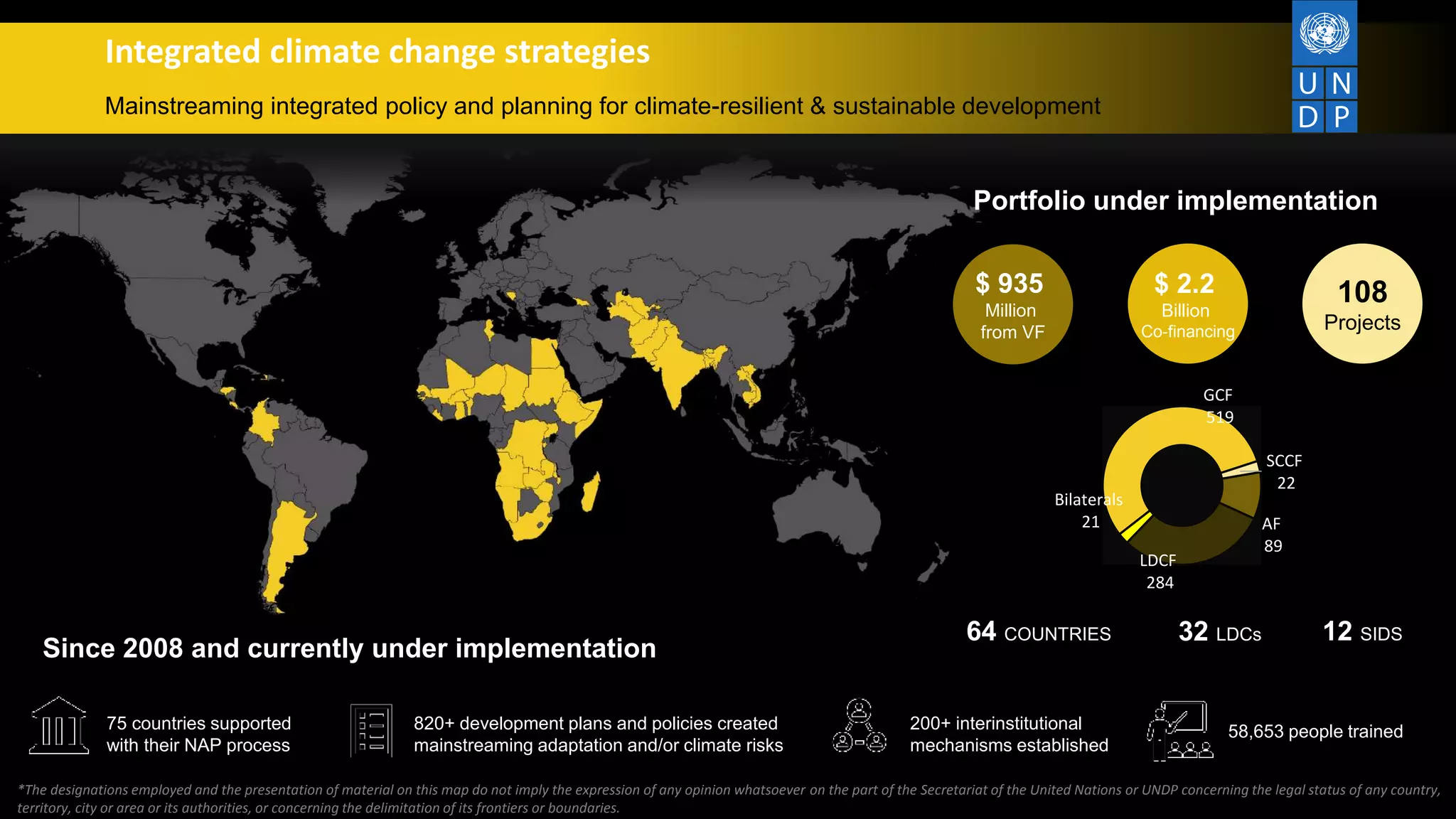
$ 935
Million
from VF
108
Projects
Portfolio under implementation
Since 2008 and currently under implementation
$ 2.2
Billion
Co-financing
64 COUNTRIES 32 LDCs 12 SIDS
75 countries supported
with their NAP process
820+ development plans and policies created
mainstreaming adaptation and/or climate risks
58,653 people trained200+ interinstitutional
mechanisms established
SCCF
22
AF
89
LDCF
284
Bilaterals
21
GCF
519
*The designations employed and the presentation of material on this map do not imply the expression of any opinion whatsoever on the part of the Secretariat of the United Nations or UNDP concerning the legal status of any country,
territory, city or area or its authorities, or concerning the delimitation of its frontiers or boundaries.
Integrated climate change strategies
Mainstreaming integrated policy and planning for climate-resilient & sustainable development
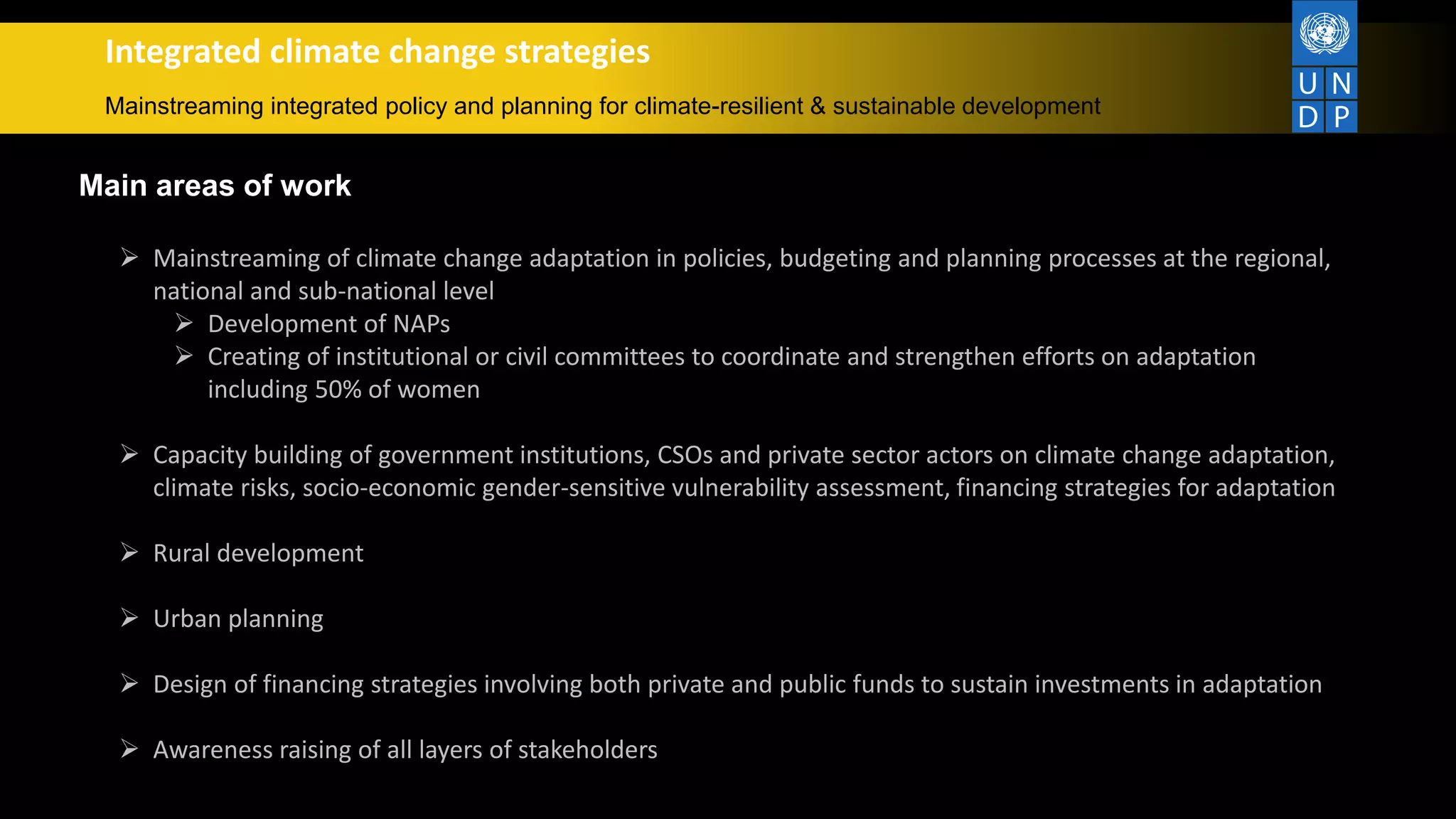
Main areas of work
 Mainstreaming of climate change adaptation in policies, budgeting and planning processes at the regional,
national and sub-national level
 Development of NAPs
 Creating of institutional or civil committees to coordinate and strengthen efforts on adaptation
including 50% of women
 Capacity building of government institutions, CSOs and private sector actors on climate change adaptation,
climate risks, socio-economic gender-sensitive vulnerability assessment, financing strategies for adaptation
 Rural development
 Urban planning
 Design of financing strategies involving both private and public funds to sustain investments in adaptation
 Awareness raising of all layers of stakeholders
Cross-sectoral resilient livelihoods
Advancing sustainable economic development and promote the sharing of climate-smart tools and techniques
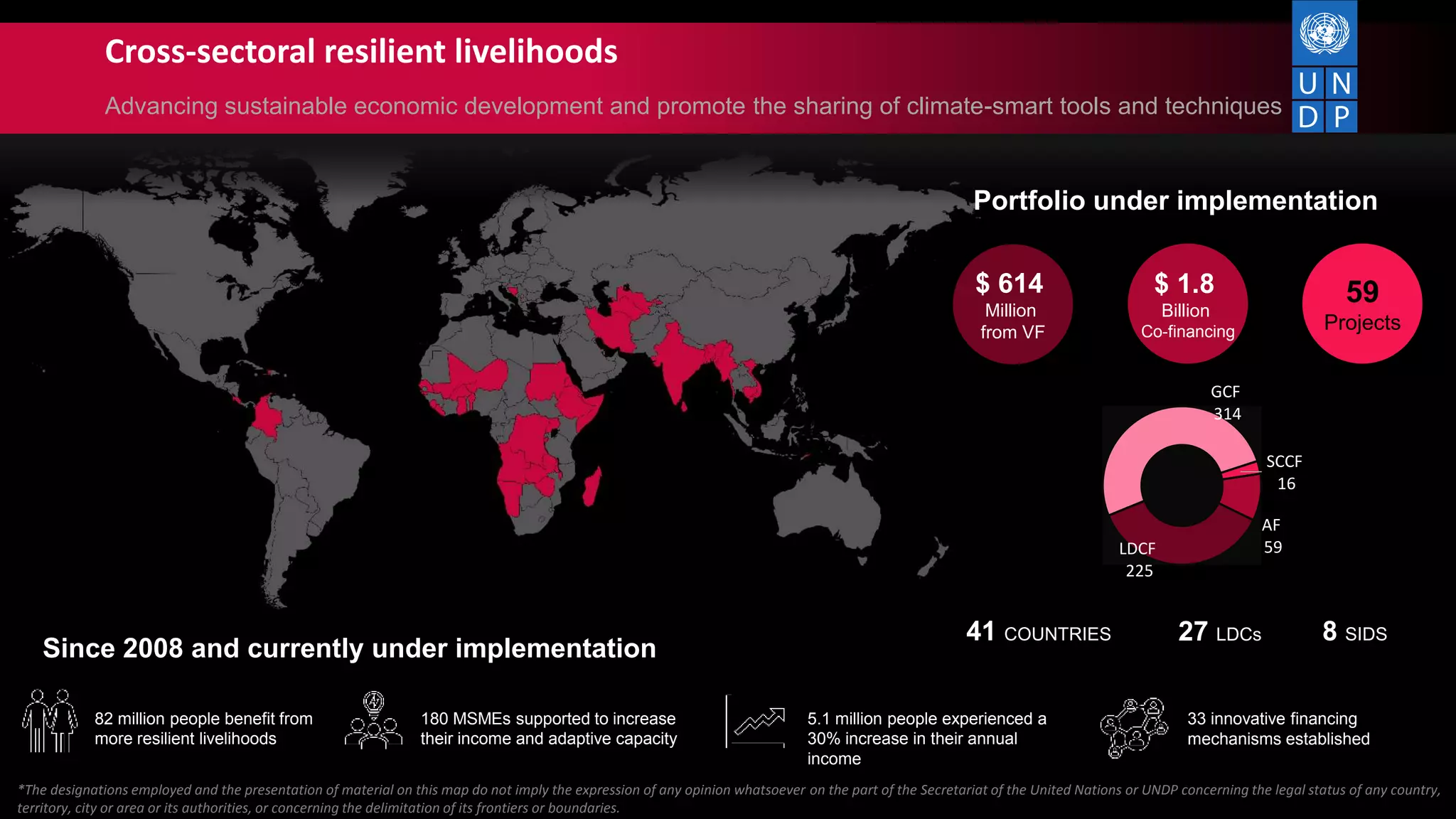
$ 614
Million
from VF
59
Projects
Portfolio under implementation
$ 1.8
Billion
Co-financing
41 COUNTRIES 27 LDCs 8 SIDS
*The designations employed and the presentation of material on this map do not imply the expression of any opinion whatsoever on the part of the Secretariat of the United Nations or UNDP concerning the legal status of any country,
territory, city or area or its authorities, or concerning the delimitation of its frontiers or boundaries.
82 million people benefit from
more resilient livelihoods
5.1 million people experienced a
30% increase in their annual
income
180 MSMEs supported to increase
their income and adaptive capacity
33 innovative financing
mechanisms established
SCCF
16
AF
59LDCF
225
GCF
314
Since 2008 and currently under implementation
Cross-sectoral resilient livelihoods
Advancing sustainable economic development and promote the sharing of climate-smart tools and techniques
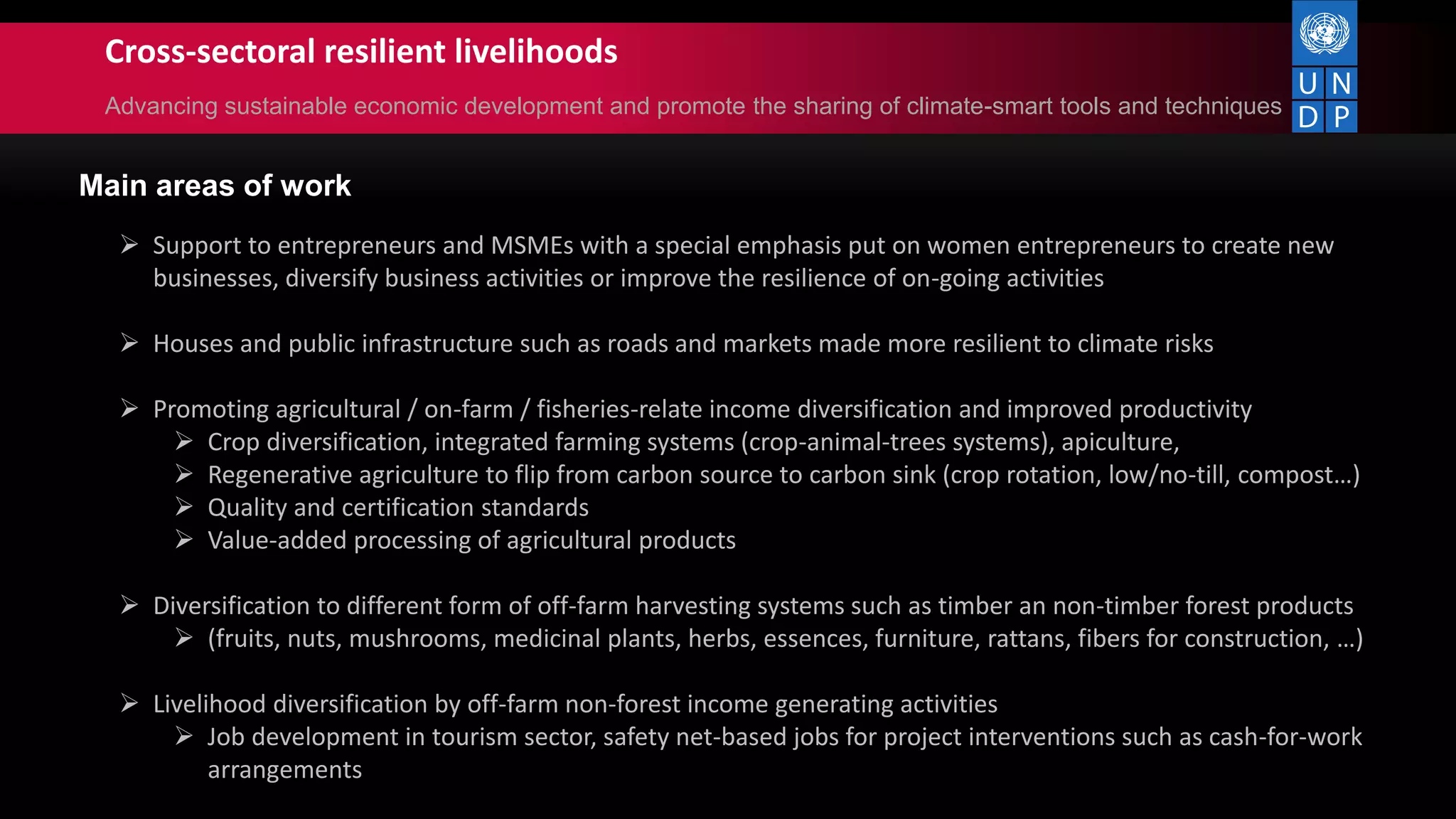
Main areas of work
 Support to entrepreneurs and MSMEs with a special emphasis put on women entrepreneurs to create new
businesses, diversify business activities or improve the resilience of on-going activities
 Houses and public infrastructure such as roads and markets made more resilient to climate risks
 Promoting agricultural / on-farm / fisheries-relate income diversification and improved productivity
 Crop diversification, integrated farming systems (crop-animal-trees systems), apiculture,
 Regenerative agriculture to flip from carbon source to carbon sink (crop rotation, low/no-till, compost…)
 Quality and certification standards
 Value-added processing of agricultural products
 Diversification to different form of off-farm harvesting systems such as timber an non-timber forest products
 (fruits, nuts, mushrooms, medicinal plants, herbs, essences, furniture, rattans, fibers for construction, …)
 Livelihood diversification by off-farm non-forest income generating activities
 Job development in tourism sector, safety net-based jobs for project interventions such as cash-for-work
arrangements
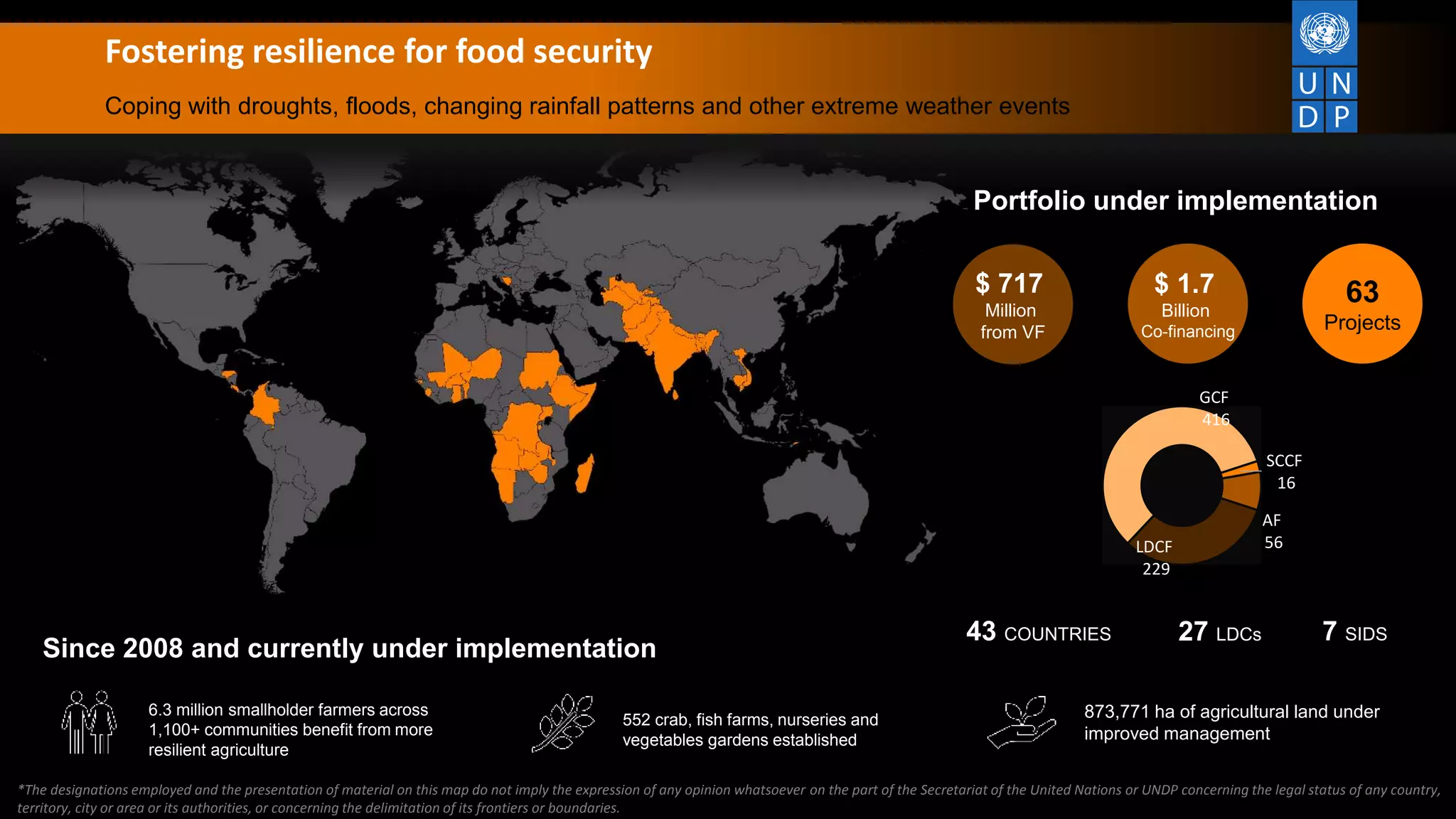
Fostering resilience for food security
Coping with droughts, floods, changing rainfall patterns and other extreme weather events
$ 717
Million
from VF
63
Projects
Portfolio under implementation
$ 1.7
Billion
Co-financing
43 COUNTRIES 27 LDCs 7 SIDS
*The designations employed and the presentation of material on this map do not imply the expression of any opinion whatsoever on the part of the Secretariat of the United Nations or UNDP concerning the legal status of any country,
territory, city or area or its authorities, or concerning the delimitation of its frontiers or boundaries.
6.3 million smallholder farmers across
1,100+ communities benefit from more
resilient agriculture
552 crab, fish farms, nurseries and
vegetables gardens established
873,771 ha of agricultural land under
improved management
SCCF
16
AF
56LDCF
229
GCF
416
Since 2008 and currently under implementation
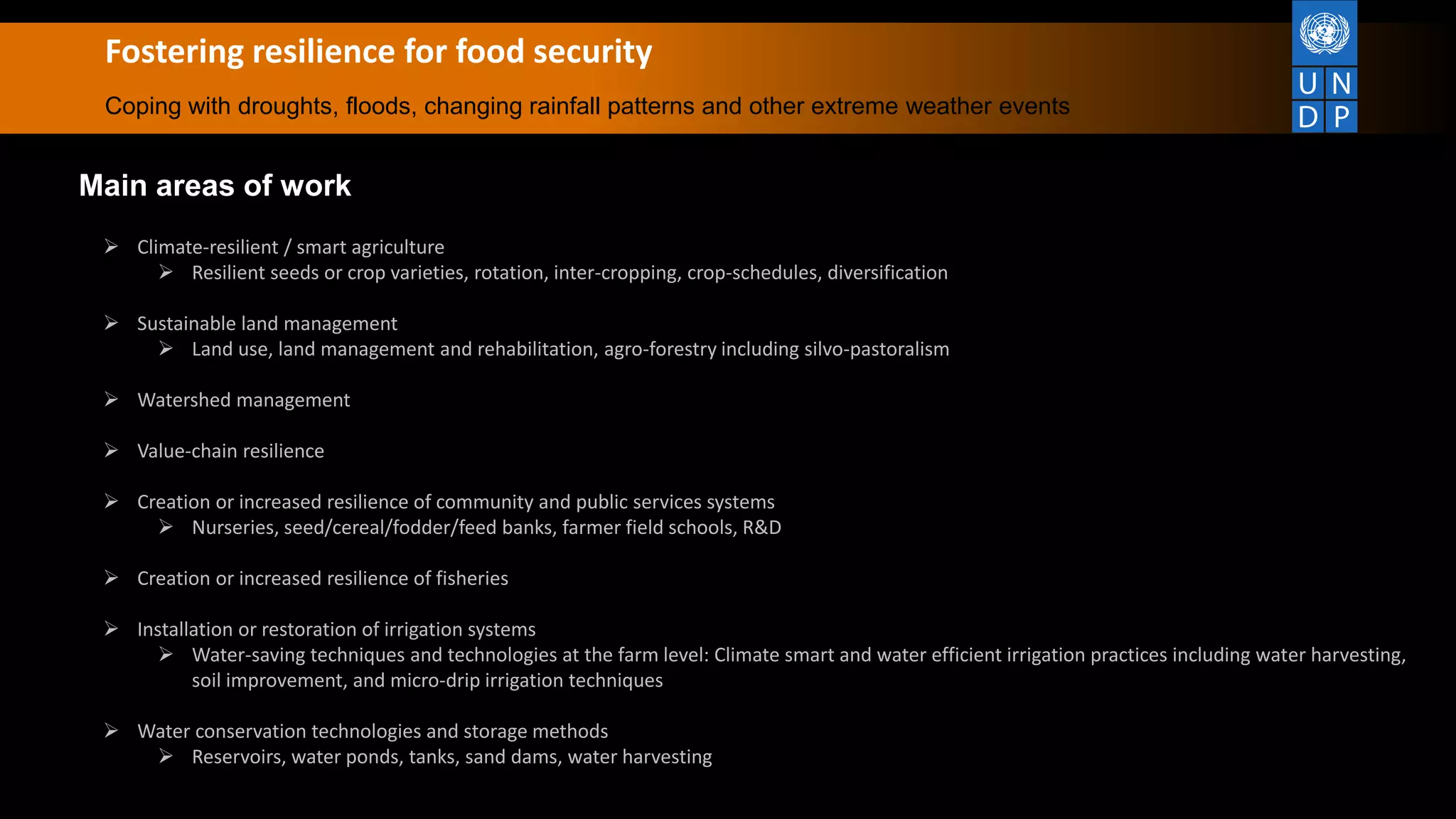
Fostering resilience for food security
Coping with droughts, floods, changing rainfall patterns and other extreme weather events
Main areas of work
 Climate-resilient / smart agriculture
 Resilient seeds or crop varieties, rotation, inter-cropping, crop-schedules, diversification
 Sustainable land management
 Land use, land management and rehabilitation, agro-forestry including silvo-pastoralism
 Watershed management
 Value-chain resilience
 Creation or increased resilience of community and public services systems
 Nurseries, seed/cereal/fodder/feed banks, farmer field schools, R&D
 Creation or increased resilience of fisheries
 Installation or restoration of irrigation systems
 Water-saving techniques and technologies at the farm level: Climate smart and water efficient irrigation practices including water harvesting,
soil improvement, and micro‐drip irrigation techniques
 Water conservation technologies and storage methods
 Reservoirs, water ponds, tanks, sand dams, water harvesting
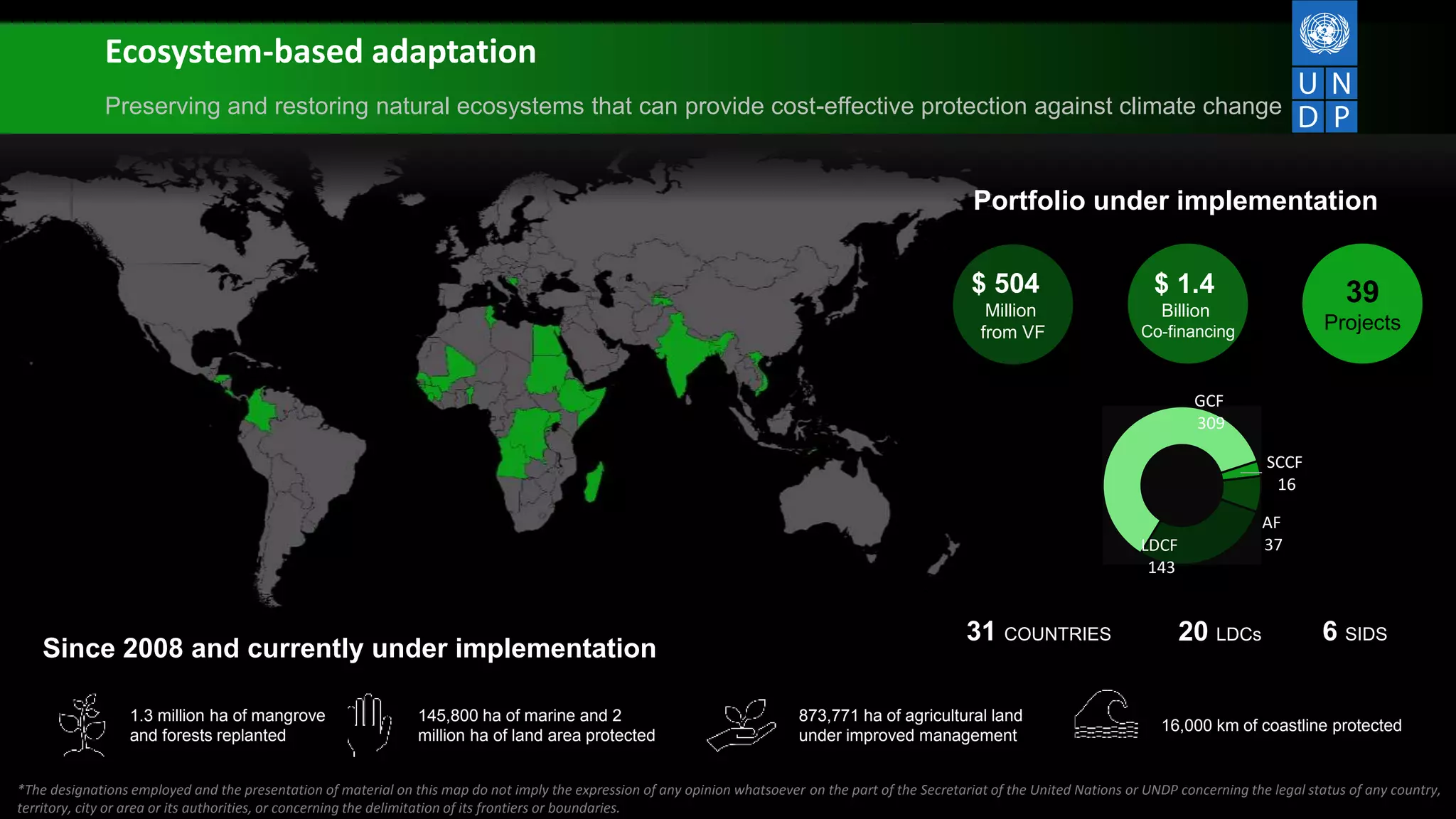
Ecosystem-based adaptation
Preserving and restoring natural ecosystems that can provide cost-effective protection against climate change
$ 504
Million
from VF
39
Projects
Portfolio under implementation
$ 1.4
Billion
Co-financing
31 COUNTRIES 20 LDCs 6 SIDS
*The designations employed and the presentation of material on this map do not imply the expression of any opinion whatsoever on the part of the Secretariat of the United Nations or UNDP concerning the legal status of any country,
territory, city or area or its authorities, or concerning the delimitation of its frontiers or boundaries.
16,000 km of coastline protected
1.3 million ha of mangrove
and forests replanted
145,800 ha of marine and 2
million ha of land area protected
873,771 ha of agricultural land
under improved management
SCCF
16
AF
37LDCF
143
GCF
309
Since 2008 and currently under implementation
Ecosystem-based adaptation
Preserving and restoring natural ecosystems that can provide cost-effective protection against climate change
Main areas of work
 Ecosystem restoration and conservation (soft measures)
 Management of coastal / riverine / freshwater ecosystems protection against climate change threats (soft
measures)
 Sustainable land management
 Reforestation, restoration of land
 Establishment of protected land and marine areas
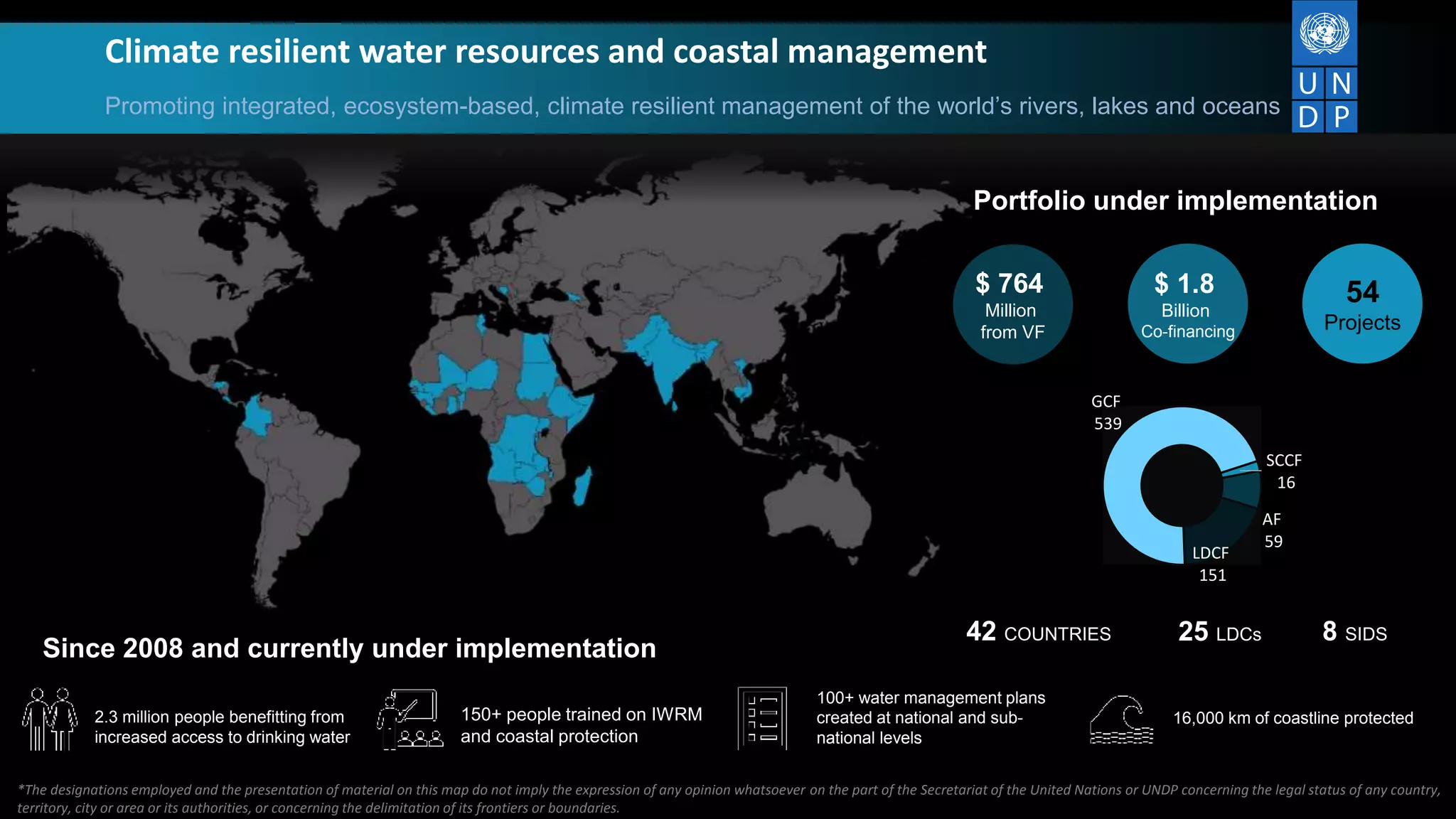
Climate resilient water resources and coastal management
Promoting integrated, ecosystem-based, climate resilient management of the world’s rivers, lakes and oceans
$ 764
Million
from VF
54
Projects
Portfolio under implementation
$ 1.8
Billion
Co-financing
42 COUNTRIES 25 LDCs 8 SIDS
*The designations employed and the presentation of material on this map do not imply the expression of any opinion whatsoever on the part of the Secretariat of the United Nations or UNDP concerning the legal status of any country,
territory, city or area or its authorities, or concerning the delimitation of its frontiers or boundaries.
16,000 km of coastline protected2.3 million people benefitting from
increased access to drinking water
150+ people trained on IWRM
and coastal protection
100+ water management plans
created at national and sub-
national levels
SCCF
16
AF
59
LDCF
151
GCF
539
Since 2008 and currently under implementation
Climate resilient water resources and coastal management
Promoting integrated, ecosystem-based, climate resilient management of the world’s rivers, lakes and oceans
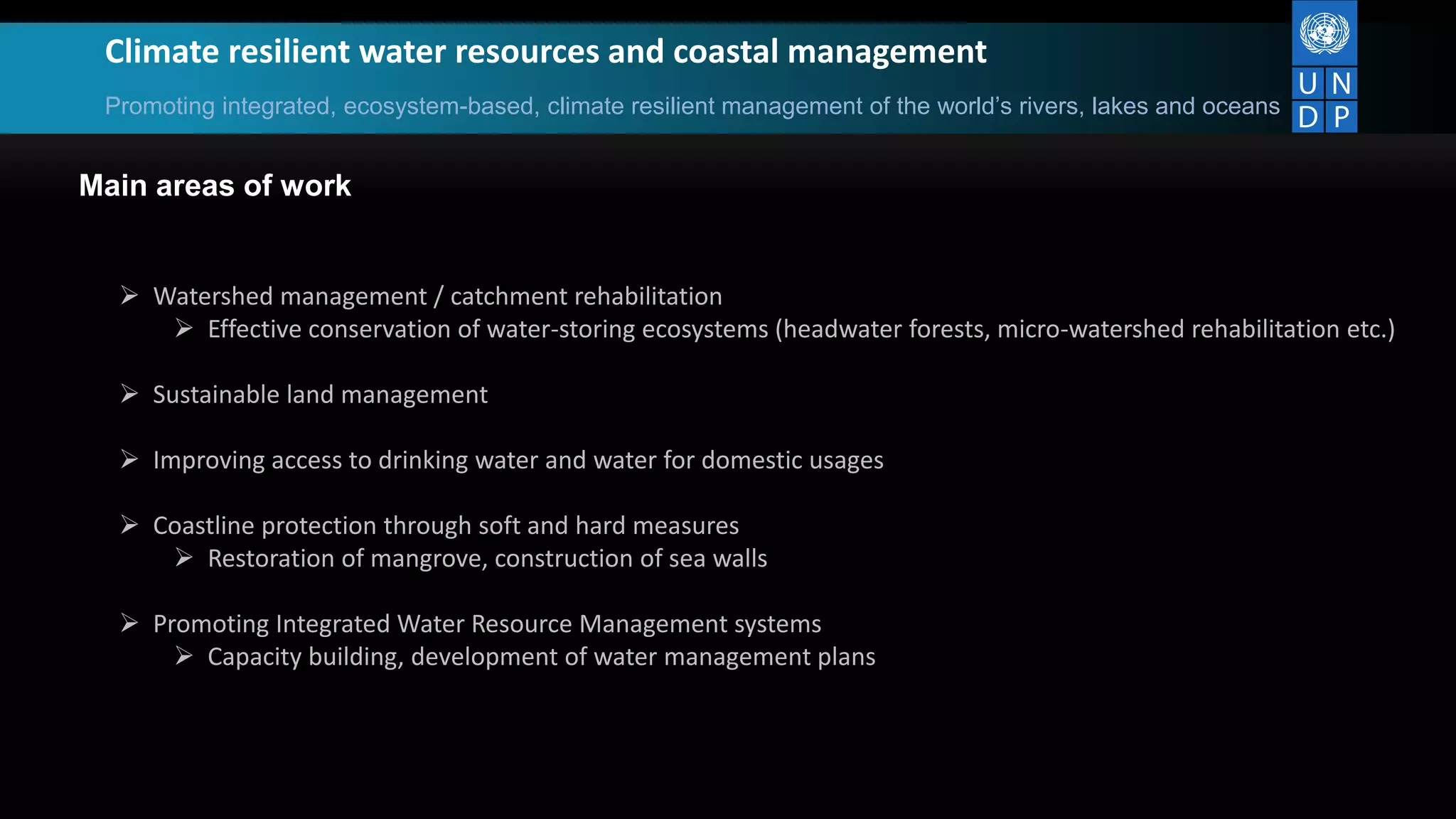
Main areas of work
 Watershed management / catchment rehabilitation
 Effective conservation of water-storing ecosystems (headwater forests, micro-watershed rehabilitation etc.)
 Sustainable land management
 Improving access to drinking water and water for domestic usages
 Coastline protection through soft and hard measures
 Restoration of mangrove, construction of sea walls
 Promoting Integrated Water Resource Management systems
 Capacity building, development of water management plans
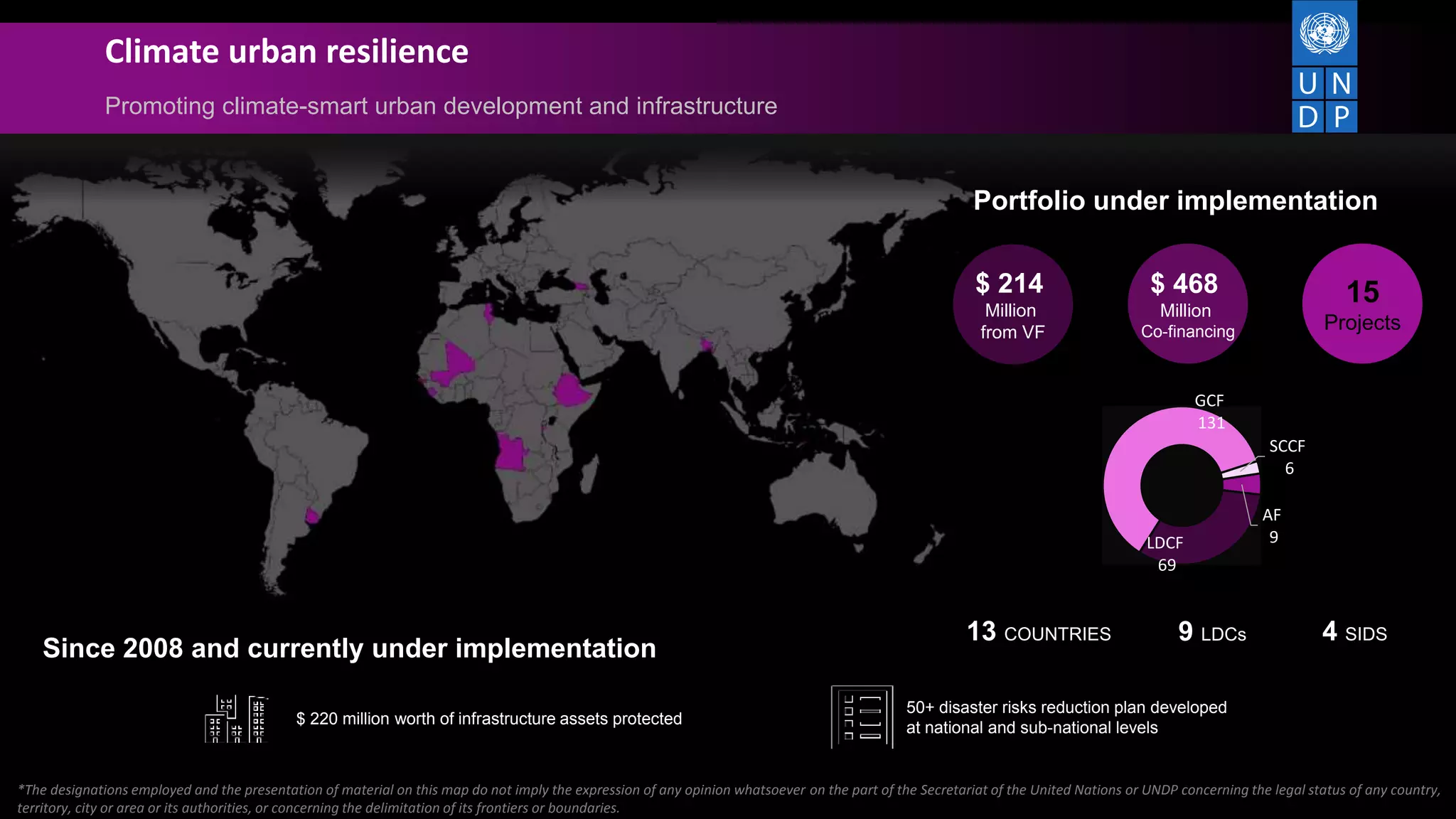
Climate urban resilience
Promoting climate-smart urban development and infrastructure
$ 214
Million
from VF
15
Projects
Portfolio under implementation
$ 468
Million
Co-financing
13 COUNTRIES 9 LDCs 4 SIDS
*The designations employed and the presentation of material on this map do not imply the expression of any opinion whatsoever on the part of the Secretariat of the United Nations or UNDP concerning the legal status of any country,
territory, city or area or its authorities, or concerning the delimitation of its frontiers or boundaries.
$ 220 million worth of infrastructure assets protected
50+ disaster risks reduction plan developed
at national and sub-national levels
SCCF
6
AF
9LDCF
69
GCF
131
Since 2008 and currently under implementation
Climate urban resilience
Promoting climate-smart urban development and infrastructure
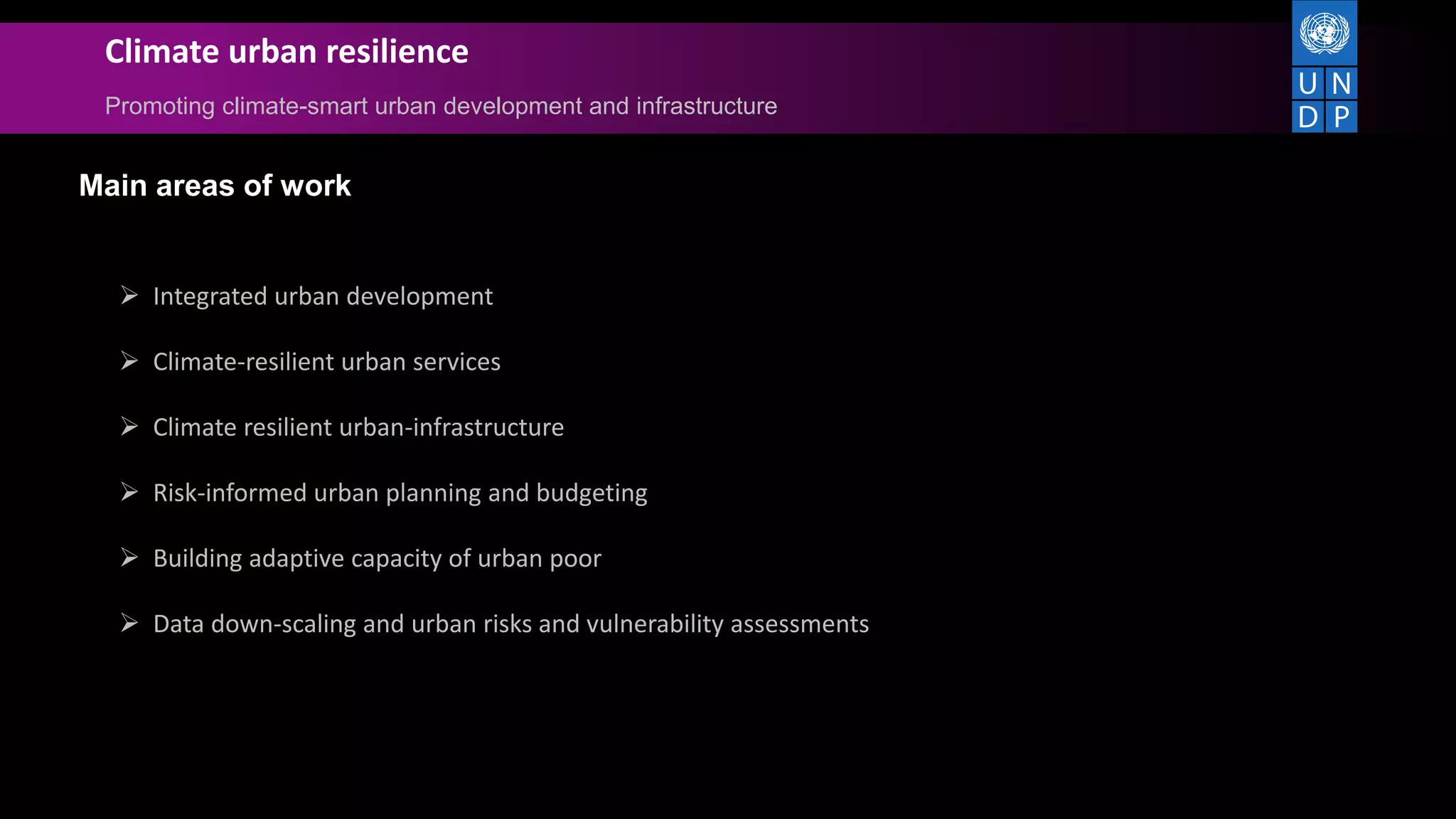
Main areas of work
 Integrated urban development
 Climate-resilient urban services
 Climate resilient urban-infrastructure
 Risk-informed urban planning and budgeting
 Building adaptive capacity of urban poor
 Data down-scaling and urban risks and vulnerability assessments
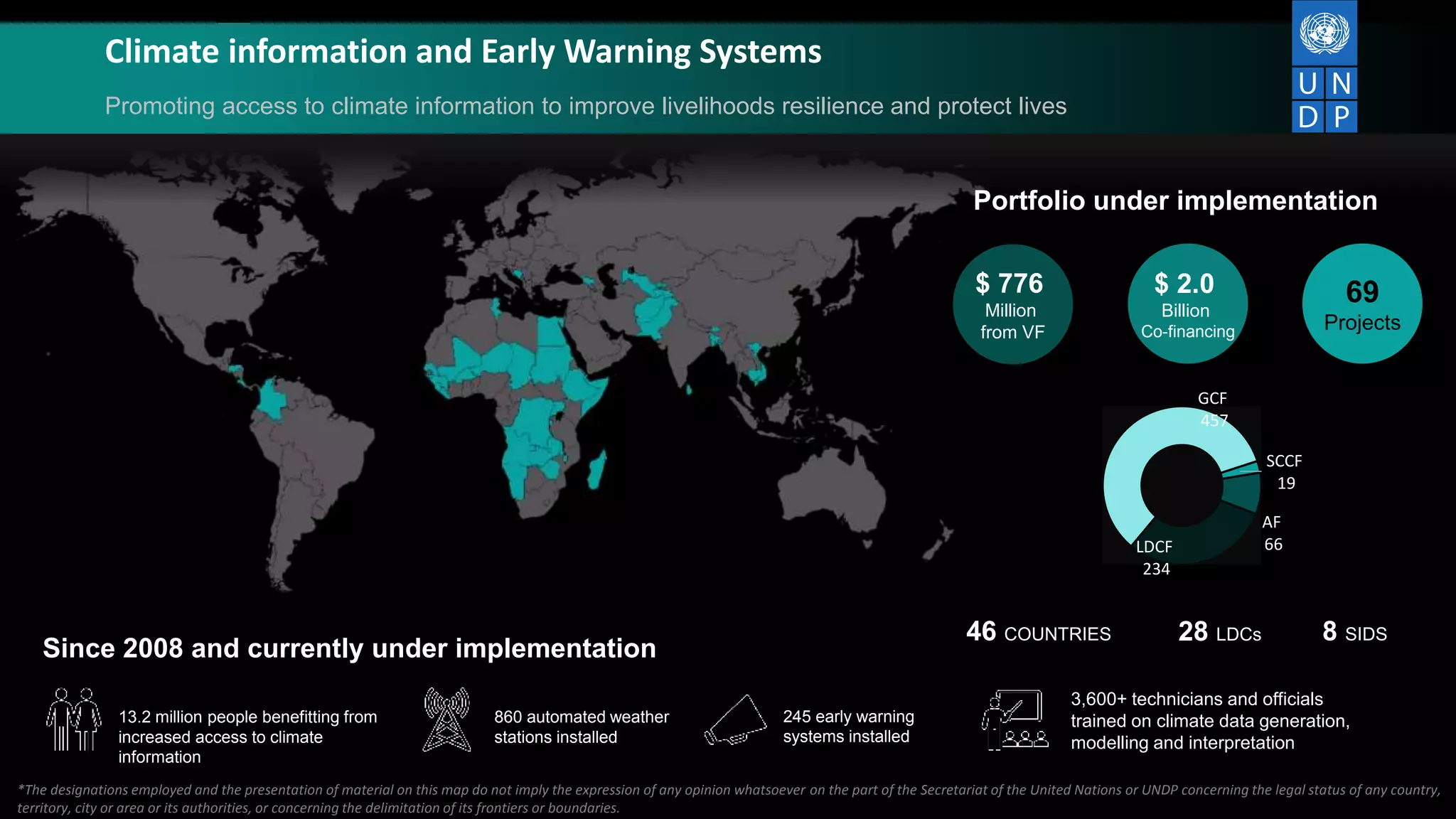
Climate information and Early Warning Systems
Promoting access to climate information to improve livelihoods resilience and protect lives
$ 776
Million
from VF
69
Projects
Portfolio under implementation
$ 2.0
Billion
Co-financing
46 COUNTRIES 28 LDCs 8 SIDS
*The designations employed and the presentation of material on this map do not imply the expression of any opinion whatsoever on the part of the Secretariat of the United Nations or UNDP concerning the legal status of any country,
territory, city or area or its authorities, or concerning the delimitation of its frontiers or boundaries.
13.2 million people benefitting from
increased access to climate
information
860 automated weather
stations installed
245 early warning
systems installed
3,600+ technicians and officials
trained on climate data generation,
modelling and interpretation
SCCF
19
AF
66LDCF
234
GCF
457
Since 2008 and currently under implementation
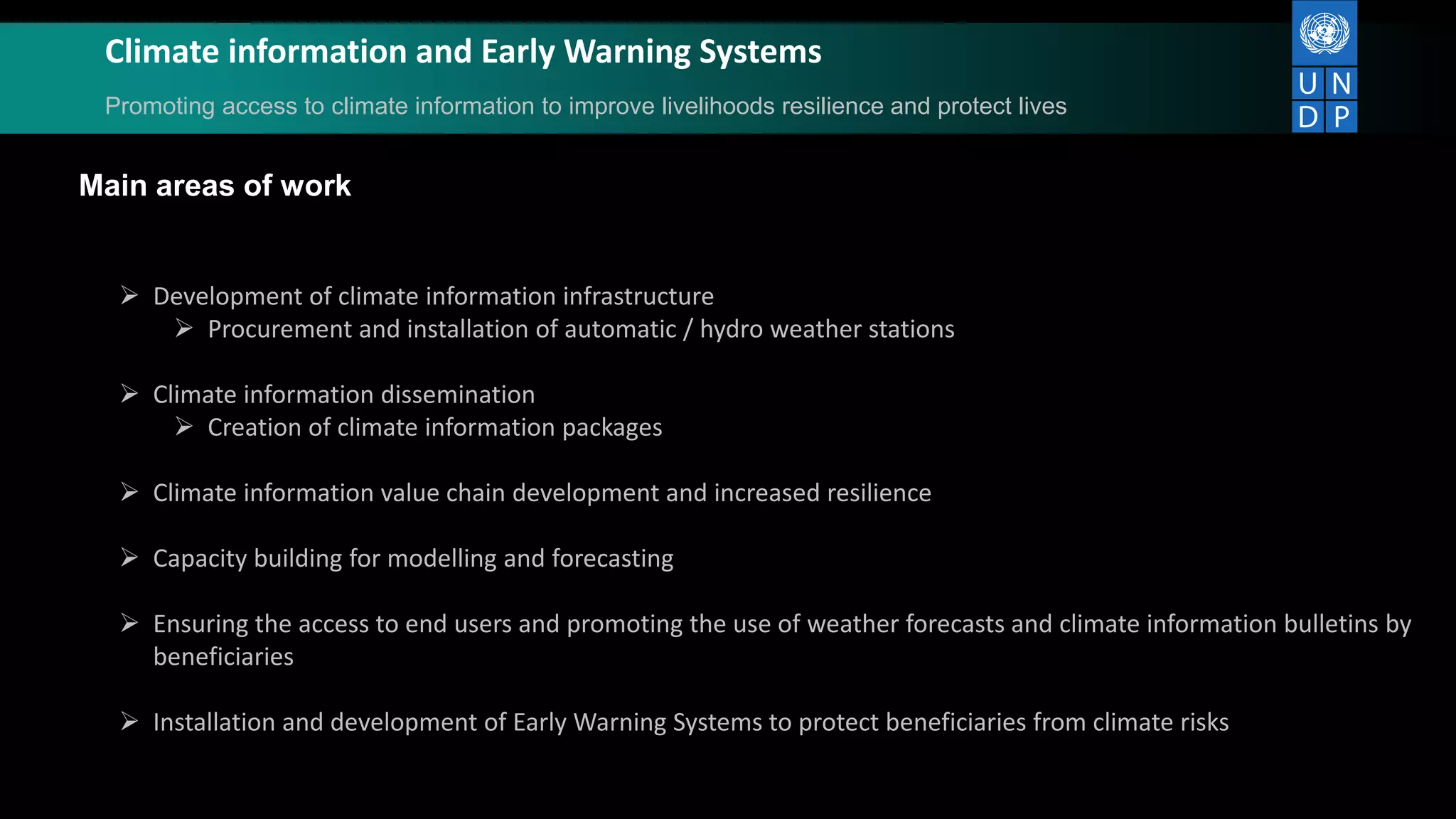
Climate information and Early Warning Systems
Promoting access to climate information to improve livelihoods resilience and protect lives
Main areas of work
 Development of climate information infrastructure
 Procurement and installation of automatic / hydro weather stations
 Climate information dissemination
 Creation of climate information packages
 Climate information value chain development and increased resilience
 Capacity building for modelling and forecasting
 Ensuring the access to end users and promoting the use of weather forecasts and climate information bulletins by
beneficiaries
 Installation and development of Early Warning Systems to protect beneficiaries from climate risks

UNDP Climate Change Adaptation Impact

  • 1.
    Integrated climate changestrategies Mainstreaming integrated policy and planning for climate-resilient & sustainable development $ 935 Million from VF 108 Projects Portfolio under implementation Since 2008 and currently under implementation $ 2.2 Billion Co-financing 64 COUNTRIES 32 LDCs 12 SIDS 75 countries supported with their NAP process 820+ development plans and policies created mainstreaming adaptation and/or climate risks 58,653 people trained200+ interinstitutional mechanisms established SCCF 22 AF 89 LDCF 284 Bilaterals 21 GCF 519 *The designations employed and the presentation of material on this map do not imply the expression of any opinion whatsoever on the part of the Secretariat of the United Nations or UNDP concerning the legal status of any country, territory, city or area or its authorities, or concerning the delimitation of its frontiers or boundaries.
  • 2.
    Integrated climate changestrategies Mainstreaming integrated policy and planning for climate-resilient & sustainable development Main areas of work  Mainstreaming of climate change adaptation in policies, budgeting and planning processes at the regional, national and sub-national level  Development of NAPs  Creating of institutional or civil committees to coordinate and strengthen efforts on adaptation including 50% of women  Capacity building of government institutions, CSOs and private sector actors on climate change adaptation, climate risks, socio-economic gender-sensitive vulnerability assessment, financing strategies for adaptation  Rural development  Urban planning  Design of financing strategies involving both private and public funds to sustain investments in adaptation  Awareness raising of all layers of stakeholders
  • 3.
    Cross-sectoral resilient livelihoods Advancingsustainable economic development and promote the sharing of climate-smart tools and techniques $ 614 Million from VF 59 Projects Portfolio under implementation $ 1.8 Billion Co-financing 41 COUNTRIES 27 LDCs 8 SIDS *The designations employed and the presentation of material on this map do not imply the expression of any opinion whatsoever on the part of the Secretariat of the United Nations or UNDP concerning the legal status of any country, territory, city or area or its authorities, or concerning the delimitation of its frontiers or boundaries. 82 million people benefit from more resilient livelihoods 5.1 million people experienced a 30% increase in their annual income 180 MSMEs supported to increase their income and adaptive capacity 33 innovative financing mechanisms established SCCF 16 AF 59LDCF 225 GCF 314 Since 2008 and currently under implementation
  • 4.
    Cross-sectoral resilient livelihoods Advancingsustainable economic development and promote the sharing of climate-smart tools and techniques Main areas of work  Support to entrepreneurs and MSMEs with a special emphasis put on women entrepreneurs to create new businesses, diversify business activities or improve the resilience of on-going activities  Houses and public infrastructure such as roads and markets made more resilient to climate risks  Promoting agricultural / on-farm / fisheries-relate income diversification and improved productivity  Crop diversification, integrated farming systems (crop-animal-trees systems), apiculture,  Regenerative agriculture to flip from carbon source to carbon sink (crop rotation, low/no-till, compost…)  Quality and certification standards  Value-added processing of agricultural products  Diversification to different form of off-farm harvesting systems such as timber an non-timber forest products  (fruits, nuts, mushrooms, medicinal plants, herbs, essences, furniture, rattans, fibers for construction, …)  Livelihood diversification by off-farm non-forest income generating activities  Job development in tourism sector, safety net-based jobs for project interventions such as cash-for-work arrangements
  • 5.
    Fostering resilience forfood security Coping with droughts, floods, changing rainfall patterns and other extreme weather events $ 717 Million from VF 63 Projects Portfolio under implementation $ 1.7 Billion Co-financing 43 COUNTRIES 27 LDCs 7 SIDS *The designations employed and the presentation of material on this map do not imply the expression of any opinion whatsoever on the part of the Secretariat of the United Nations or UNDP concerning the legal status of any country, territory, city or area or its authorities, or concerning the delimitation of its frontiers or boundaries. 6.3 million smallholder farmers across 1,100+ communities benefit from more resilient agriculture 552 crab, fish farms, nurseries and vegetables gardens established 873,771 ha of agricultural land under improved management SCCF 16 AF 56LDCF 229 GCF 416 Since 2008 and currently under implementation
  • 6.
    Fostering resilience forfood security Coping with droughts, floods, changing rainfall patterns and other extreme weather events Main areas of work  Climate-resilient / smart agriculture  Resilient seeds or crop varieties, rotation, inter-cropping, crop-schedules, diversification  Sustainable land management  Land use, land management and rehabilitation, agro-forestry including silvo-pastoralism  Watershed management  Value-chain resilience  Creation or increased resilience of community and public services systems  Nurseries, seed/cereal/fodder/feed banks, farmer field schools, R&D  Creation or increased resilience of fisheries  Installation or restoration of irrigation systems  Water-saving techniques and technologies at the farm level: Climate smart and water efficient irrigation practices including water harvesting, soil improvement, and micro‐drip irrigation techniques  Water conservation technologies and storage methods  Reservoirs, water ponds, tanks, sand dams, water harvesting
  • 7.
    Ecosystem-based adaptation Preserving andrestoring natural ecosystems that can provide cost-effective protection against climate change $ 504 Million from VF 39 Projects Portfolio under implementation $ 1.4 Billion Co-financing 31 COUNTRIES 20 LDCs 6 SIDS *The designations employed and the presentation of material on this map do not imply the expression of any opinion whatsoever on the part of the Secretariat of the United Nations or UNDP concerning the legal status of any country, territory, city or area or its authorities, or concerning the delimitation of its frontiers or boundaries. 16,000 km of coastline protected 1.3 million ha of mangrove and forests replanted 145,800 ha of marine and 2 million ha of land area protected 873,771 ha of agricultural land under improved management SCCF 16 AF 37LDCF 143 GCF 309 Since 2008 and currently under implementation
  • 8.
    Ecosystem-based adaptation Preserving andrestoring natural ecosystems that can provide cost-effective protection against climate change Main areas of work  Ecosystem restoration and conservation (soft measures)  Management of coastal / riverine / freshwater ecosystems protection against climate change threats (soft measures)  Sustainable land management  Reforestation, restoration of land  Establishment of protected land and marine areas
  • 9.
    Climate resilient waterresources and coastal management Promoting integrated, ecosystem-based, climate resilient management of the world’s rivers, lakes and oceans $ 764 Million from VF 54 Projects Portfolio under implementation $ 1.8 Billion Co-financing 42 COUNTRIES 25 LDCs 8 SIDS *The designations employed and the presentation of material on this map do not imply the expression of any opinion whatsoever on the part of the Secretariat of the United Nations or UNDP concerning the legal status of any country, territory, city or area or its authorities, or concerning the delimitation of its frontiers or boundaries. 16,000 km of coastline protected2.3 million people benefitting from increased access to drinking water 150+ people trained on IWRM and coastal protection 100+ water management plans created at national and sub- national levels SCCF 16 AF 59 LDCF 151 GCF 539 Since 2008 and currently under implementation
  • 10.
    Climate resilient waterresources and coastal management Promoting integrated, ecosystem-based, climate resilient management of the world’s rivers, lakes and oceans Main areas of work  Watershed management / catchment rehabilitation  Effective conservation of water-storing ecosystems (headwater forests, micro-watershed rehabilitation etc.)  Sustainable land management  Improving access to drinking water and water for domestic usages  Coastline protection through soft and hard measures  Restoration of mangrove, construction of sea walls  Promoting Integrated Water Resource Management systems  Capacity building, development of water management plans
  • 11.
    Climate urban resilience Promotingclimate-smart urban development and infrastructure $ 214 Million from VF 15 Projects Portfolio under implementation $ 468 Million Co-financing 13 COUNTRIES 9 LDCs 4 SIDS *The designations employed and the presentation of material on this map do not imply the expression of any opinion whatsoever on the part of the Secretariat of the United Nations or UNDP concerning the legal status of any country, territory, city or area or its authorities, or concerning the delimitation of its frontiers or boundaries. $ 220 million worth of infrastructure assets protected 50+ disaster risks reduction plan developed at national and sub-national levels SCCF 6 AF 9LDCF 69 GCF 131 Since 2008 and currently under implementation
  • 12.
    Climate urban resilience Promotingclimate-smart urban development and infrastructure Main areas of work  Integrated urban development  Climate-resilient urban services  Climate resilient urban-infrastructure  Risk-informed urban planning and budgeting  Building adaptive capacity of urban poor  Data down-scaling and urban risks and vulnerability assessments
  • 13.
    Climate information andEarly Warning Systems Promoting access to climate information to improve livelihoods resilience and protect lives $ 776 Million from VF 69 Projects Portfolio under implementation $ 2.0 Billion Co-financing 46 COUNTRIES 28 LDCs 8 SIDS *The designations employed and the presentation of material on this map do not imply the expression of any opinion whatsoever on the part of the Secretariat of the United Nations or UNDP concerning the legal status of any country, territory, city or area or its authorities, or concerning the delimitation of its frontiers or boundaries. 13.2 million people benefitting from increased access to climate information 860 automated weather stations installed 245 early warning systems installed 3,600+ technicians and officials trained on climate data generation, modelling and interpretation SCCF 19 AF 66LDCF 234 GCF 457 Since 2008 and currently under implementation
  • 14.
    Climate information andEarly Warning Systems Promoting access to climate information to improve livelihoods resilience and protect lives Main areas of work  Development of climate information infrastructure  Procurement and installation of automatic / hydro weather stations  Climate information dissemination  Creation of climate information packages  Climate information value chain development and increased resilience  Capacity building for modelling and forecasting  Ensuring the access to end users and promoting the use of weather forecasts and climate information bulletins by beneficiaries  Installation and development of Early Warning Systems to protect beneficiaries from climate risks