Welcome
Community Resilience Linking Livelihoods:
,
13 & 14 Feb,2015
DMI, Rajgir,Patna Bihar
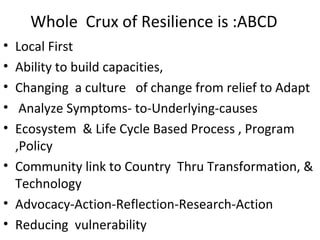
Whole Crux of Resilience is :ABCD
• Local First
• Ability to build capacities,
• Changing a culture of change from relief to Adapt
• Analyze Symptoms- to-Underlying-causes
• Ecosystem & Life Cycle Based Process , Program
,Policy
• Community link to Country Thru Transformation, &
Technology
• Advocacy-Action-Reflection-Research-Action
• Reducing vulnerability
a
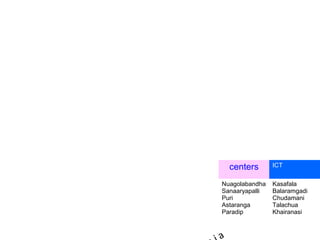
centers ICT
Nuagolabandha
Sanaaryapalli
Puri
Astaranga
Paradip
Kasafala
Balaramgadi
Chudamani
Talachua
Khairanasi
WE ARE WITH
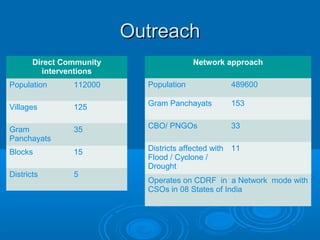
OutreachOutreach
Direct Community
interventions
Population 112000
Villages 125
Gram
Panchayats
35
Blocks 15
Districts 5
Network approach
Population 489600
Gram Panchayats 153
CBO/ PNGOs 33
Districts affected with
Flood / Cyclone /
Drought
11
Operates on CDRF in a Network mode with
CSOs in 08 States of India
Key Results of UDYAMA at Community Level
• 35 model micro projects developed encompassing Gravity Flow Irrigation
initiative and Crop diversification
• Livelihood interventions scaled up in a network mode consisting of 30 CBOs
and 10 grass root NGOs
• 200 barefoot trainers from distressed migrant families capacitated on
managing micro- watershed and building community institutions around
resource conservation
• 2485 nos. of women SHGs from the network engaged in enterprising
activity through leveraging resources from mainstream & Close interaction
established with local governance system
• 10000 hectares of SRI (System of Crop Intensification) demonstrated under
Bringing Green Revolution to Eastern India(BGREI) under the aegis of State
Agriculture department
• 2000 farming community adopted Eco-Agriculture under Government
supported agriculture program funded by World Bank and Panchayati-raj
Department of Government of Odisha
• 500 hectares of Cereals covered under National Food Security Mission in
tribal hinter lands of one of the most mal-nutrition prone area of the State
• 10000 hectares of forest protected and regenerated by local community in
different locations
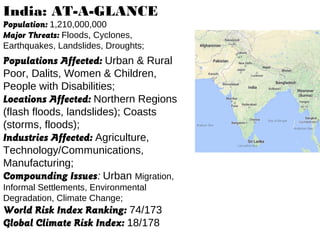
Linking Local & Global Issues & Initiatives for
community resilience thru Networking
International relationship
• UN-ECOSOC status, Accredited to UN-Global compact, UN-CONGO,
UNISDRR,UNEP, UNFCCC,UNCCD,UNURBAN GATE-WAY, UN Solution Exchange
•Membership in Global Citynet, GFDRR , Global Water Partnership, Water
Climate Coalition, Global Network for Disaster Risk Reduction, WSSCC and End
Water Poverty, Charity Navigator, Susan A, HAP, Stakeholders Forum and
SDGs
National Relationship
•Accredited partner of National Institute of Open Learning for Vocational
Training , India Gateway, Government of India (NPO)
•SAMHITA, CDRN, AADRR, SPHERE-India, NDMA, NIDM, India Water
partnership, Central Soil & Water Conservation
Local relationship
•Odisha State Disaster Mitigation Authority, Red Cross, Inter Agency Group,
livelihood mission, SRI
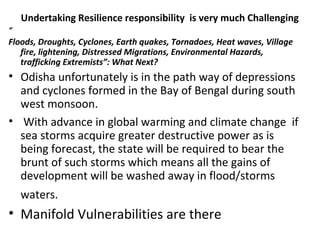
India: AT-A-GLANCE
Population: 1,210,000,000
Major Threats: Floods, Cyclones,
Earthquakes, Landslides, Droughts;
Populations Affected: Urban & Rural
Poor, Dalits, Women & Children,
People with Disabilities;
Locations Affected: Northern Regions
(flash floods, landslides); Coasts
(storms, floods);
Industries Affected: Agriculture,
Technology/Communications,
Manufacturing;
Compounding Issues: Urban Migration,
Informal Settlements, Environmental
Degradation, Climate Change;
World Risk Index Ranking: 74/173
Global Climate Risk Index: 18/178
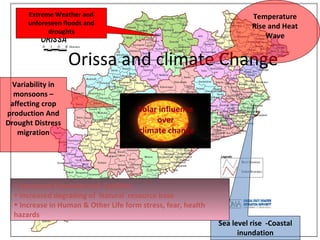
Undertaking Resilience responsibility is very much Challenging
“
Floods, Droughts, Cyclones, Earth quakes, Tornadoes, Heat waves, Village 
fire, lightening, Distressed Migrations, Environmental Hazards, 
trafficking Extremists”: What Next?
• Odisha unfortunately is in the path way of depressions
and cyclones formed in the Bay of Bengal during south
west monsoon.
• With advance in global warming and climate change if
sea storms acquire greater destructive power as is
being forecast, the state will be required to bear the
brunt of such storms which means all the gains of
development will be washed away in flood/storms
waters.
• Manifold Vulnerabilities are there
Orissa and climate Change
Solar influence
over
climate change
Sea level rise -Coastal
inundation
Temperature
Rise and Heat
Wave
Variability in
monsoons –
affecting crop
production And
Drought Distress
migration
• Increased Extremist and Conflicts
• Increased degrading of Natural resource base
• Increase in Human & Other Life form stress, fear, health
hazards
Extreme Weather and
unforeseen floods and
droughts
Undertaking Resilience interventions is
very much Challenging
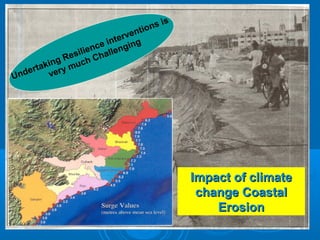
Impact of climateImpact of climate
change Coastalchange Coastal
ErosionErosion
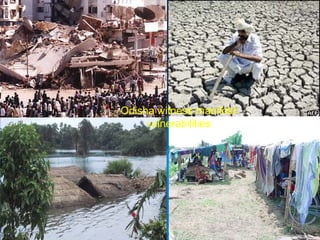
Odisha witness manifold
vulnerabilities
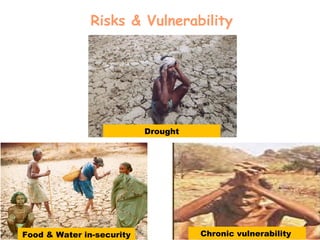
Risks & Vulnerability
Food & Water in-security Chronic vulnerability
Drought
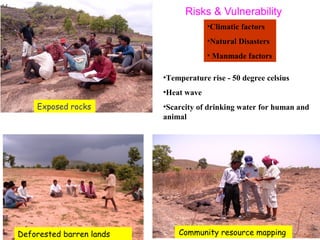
Exposed rocks
•Climatic factors
•Natural Disasters
• Manmade factors
•Temperature rise - 50 degree celsius
•Heat wave
•Scarcity of drinking water for human and
animal
Risks & Vulnerability
Deforested barren lands Community resource mapping
High Socio- and economic inequity
Skewed land distribution
Low productivity
High debt trap
Shifting from productivity to high profit
Livelihood displacement
Rituals systems
Unorganized
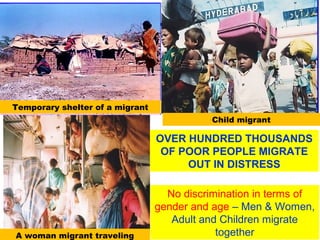
OVER HUNDRED THOUSANDS
OF POOR PEOPLE MIGRATE
OUT IN DISTRESS
No discrimination in terms of
gender and age – Men & Women,
Adult and Children migrate
together
Temporary shelter of a migrant
Child migrant
A woman migrant traveling
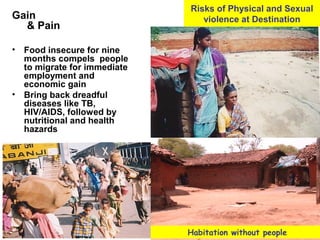
Gain
& Pain
• Food insecure for nine
months compels people
to migrate for immediate
employment and
economic gain
• Bring back dreadful
diseases like TB,
HIV/AIDS, followed by
nutritional and health
hazards
•.
Risks of Physical and Sexual
violence at Destination
Habitation without people
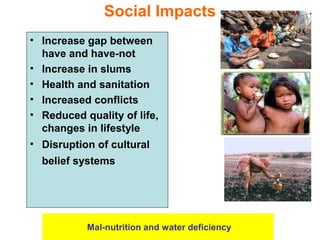
• Increase gap between
have and have-not
• Increase in slums
• Health and sanitation
• Increased conflicts
• Reduced quality of life,
changes in lifestyle
• Disruption of cultural
belief systems
Social Impacts
Mal-nutrition and water deficiency
Environmental Impacts
• Damage to animal species
• Damage to flora and fauna
• Damage to plant communities
• Receding ground water
• Inundation of minerals into fresh
water aquifer
• Increase in temperature
• Pressure on agro-ecology
•Degradation of land mass
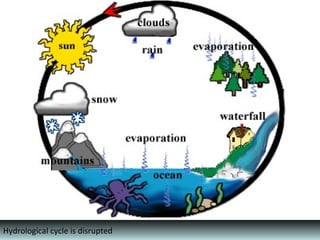
Hydrological cycle is disrupted
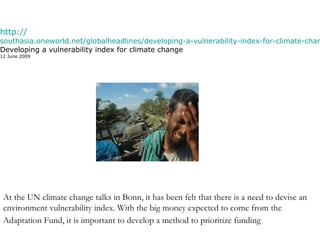
At the UN climate change talks in Bonn, it has been felt that there is a need to devise an
environment vulnerability index. With the big money expected to come from the
Adaptation Fund, it is important to develop a method to prioritize funding
http://
southasia.oneworld.net/globalheadlines/developing-a-vulnerability-index-for-climate-chan
Developing a vulnerability index for climate change
12 June 2009
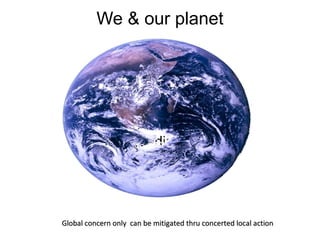
We & our planet
For The next development
challenge -disaster risk
management
Global concern only can be mitigated thru concerted local actionGlobal concern only can be mitigated thru concerted local action
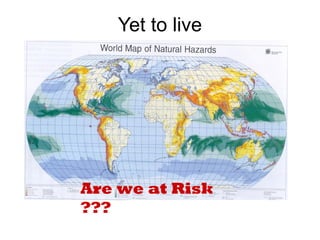
Yet to live
Are we at Risk
???
Our future
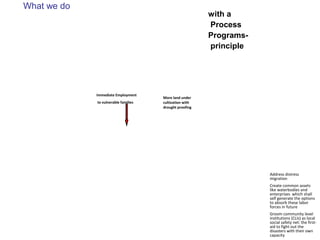
What we do
Immediate Employment
to vulnerable families
More land under
cultivation with
drought proofing
Address distress
migration
Create common assets
like waterbodies and
enterprises which shall
self generate the options
to absorb these labor
forces in future
Groom community level
institutions (CLIs) as local
social safety net: the first-
aid to fight out the
disasters with their own
capacity
with a
Process
Programs-
principle
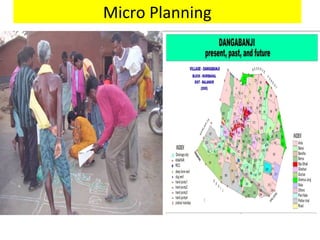
Micro Planning
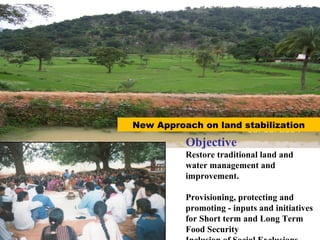
Objective
Restore traditional land and
water management and
improvement.
Provisioning, protecting and
promoting - inputs and initiatives
for Short term and Long Term
Food Security
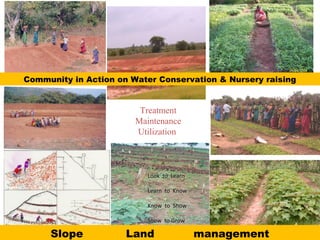
New Approach on land stabilization
Treatment
Maintenance
Utilization
Look to LearnLook to Learn
Learn to KnowLearn to Know
Know to ShowKnow to Show
Show to GrowShow to Grow
Community in Action on Water Conservation & Nursery raising
Slope Land management
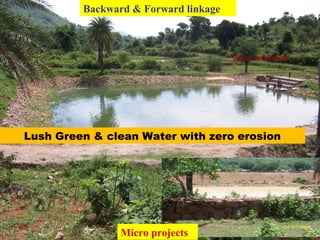
Micro watersheds
Micro projects
Backward & Forward linkage
Lush Green & clean Water with zero erosion
Dugwell
Contour Earth bunding preventing Soil Erosion
Stone wall for water conservation
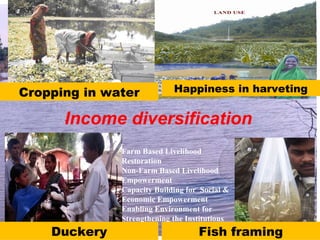
Farm Based Livelihood
Restoration
Non-Farm Based Livelihood
Empowerment
Capacity Building for Social &
Economic Empowerment
Enabling Environment for
Strengthening the Institutions
Income diversification
Cropping in water
Fish framingDuckery
Happiness in harveting
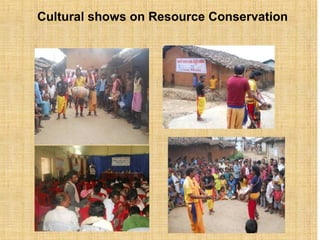
Cultural shows on Resource Conservation
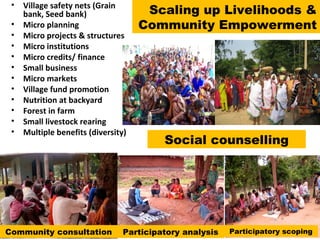
• Village safety nets (Grain
bank, Seed bank)
• Micro planning
• Micro projects & structures
• Micro institutions
• Micro credits/ finance
• Small business
• Micro markets
• Village fund promotion
• Nutrition at backyard
• Forest in farm
• Small livestock rearing
• Multiple benefits (diversity)
Scaling up Livelihoods &
Community Empowerment
Social counselling
Participatory analysis Participatory scopingCommunity consultation
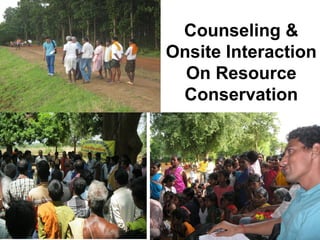
Counseling &
Onsite Interaction
On Resource
Conservation
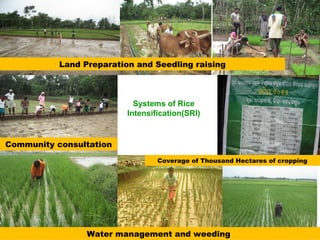
Systems of Rice
Intensification(SRI)
Water management and weeding
Coverage of Thousand Hectares of cropping
Community consultation
Land Preparation and Seedling raising
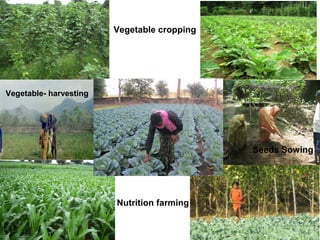
Vegetable cropping
Seeds Sowing
Vegetable- harvesting
Nutrition farming
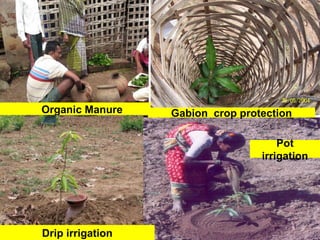
Organic Manure
Pot
irrigation
Drip irrigation
Gabion crop protection
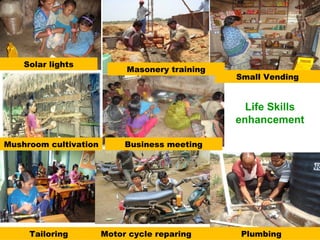
Life Life Skills
enhancement
Mushroom cultivation
Motor cycle reparing Plumbing
Masonery training
Solar lights
Tailoring
Business meeting
Small Vending
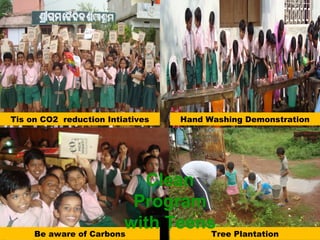
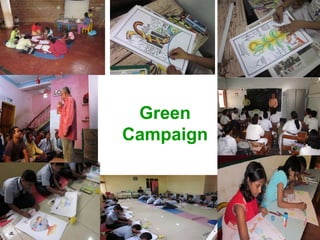
Green
Campaign
Tree Plantation
Hand Washing DemonstrationTis on CO2 reduction Intiatives
Be aware of Carbons
Clean
Program
with Teens
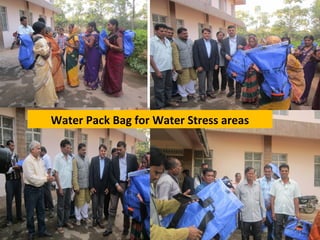
Water Pack Bag for Water Stress areas
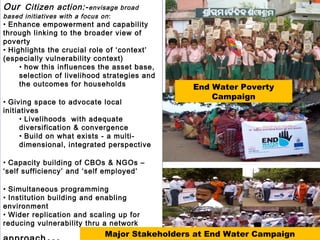
Our Citizen action:-envisage broad
based initiatives with a focus on:
• Enhance empowerment and capability
through linking to the broader view of
poverty
• Highlights the crucial role of ‘context’
(especially vulnerability context)
• how this influences the asset base,
selection of livelihood strategies and
the outcomes for households
• Giving space to advocate local
initiatives
• Livelihoods with adequate
diversification & convergence
• Build on what exists - a multi-
dimensional, integrated perspective
• Capacity building of CBOs & NGOs –
‘self sufficiency’ and ‘self employed’
• Simultaneous programming
• Institution building and enabling
environment
• Wider replication and scaling up for
reducing vulnerability thru a network
Major Stakeholders at End Water Campaign
End Water Poverty
Campaign
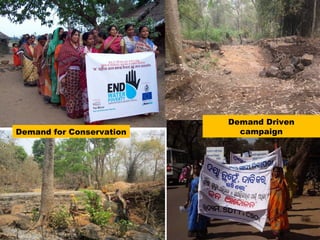
Demand Driven
campaignDemand for Conservation
It is not Enough
• We need your support
• Hand holding
• Linkage, leverage
• Personal touch,
complements,compassion,commitment
• Togeth we can
Pradeep Mohapatra
HIG140, K-6, Kalinga Vihar,
Patrapadapost-751019
Bhubaneswar, Orisssa
Email : pradeep.udyama@gmail.com
udyama.pradeep@gmail.com
www.udyama.org
Cell-09437110892
Phone -0674 2475656

Udyama ppt 1

  • 1.
    Welcome Community Resilience LinkingLivelihoods: , 13 & 14 Feb,2015 DMI, Rajgir,Patna Bihar
  • 2.
    Whole Crux ofResilience is :ABCD • Local First • Ability to build capacities, • Changing a culture of change from relief to Adapt • Analyze Symptoms- to-Underlying-causes • Ecosystem & Life Cycle Based Process , Program ,Policy • Community link to Country Thru Transformation, & Technology • Advocacy-Action-Reflection-Research-Action • Reducing vulnerability
  • 3.
  • 4.
  • 5.
    OutreachOutreach Direct Community interventions Population 112000 Villages125 Gram Panchayats 35 Blocks 15 Districts 5 Network approach Population 489600 Gram Panchayats 153 CBO/ PNGOs 33 Districts affected with Flood / Cyclone / Drought 11 Operates on CDRF in a Network mode with CSOs in 08 States of India
  • 6.
    Key Results ofUDYAMA at Community Level • 35 model micro projects developed encompassing Gravity Flow Irrigation initiative and Crop diversification • Livelihood interventions scaled up in a network mode consisting of 30 CBOs and 10 grass root NGOs • 200 barefoot trainers from distressed migrant families capacitated on managing micro- watershed and building community institutions around resource conservation • 2485 nos. of women SHGs from the network engaged in enterprising activity through leveraging resources from mainstream & Close interaction established with local governance system • 10000 hectares of SRI (System of Crop Intensification) demonstrated under Bringing Green Revolution to Eastern India(BGREI) under the aegis of State Agriculture department • 2000 farming community adopted Eco-Agriculture under Government supported agriculture program funded by World Bank and Panchayati-raj Department of Government of Odisha • 500 hectares of Cereals covered under National Food Security Mission in tribal hinter lands of one of the most mal-nutrition prone area of the State • 10000 hectares of forest protected and regenerated by local community in different locations
  • 7.
    Linking Local &Global Issues & Initiatives for community resilience thru Networking International relationship • UN-ECOSOC status, Accredited to UN-Global compact, UN-CONGO, UNISDRR,UNEP, UNFCCC,UNCCD,UNURBAN GATE-WAY, UN Solution Exchange •Membership in Global Citynet, GFDRR , Global Water Partnership, Water Climate Coalition, Global Network for Disaster Risk Reduction, WSSCC and End Water Poverty, Charity Navigator, Susan A, HAP, Stakeholders Forum and SDGs National Relationship •Accredited partner of National Institute of Open Learning for Vocational Training , India Gateway, Government of India (NPO) •SAMHITA, CDRN, AADRR, SPHERE-India, NDMA, NIDM, India Water partnership, Central Soil & Water Conservation Local relationship •Odisha State Disaster Mitigation Authority, Red Cross, Inter Agency Group, livelihood mission, SRI
  • 8.
    India: AT-A-GLANCE Population: 1,210,000,000 Major Threats: Floods,Cyclones, Earthquakes, Landslides, Droughts; Populations Affected: Urban & Rural Poor, Dalits, Women & Children, People with Disabilities; Locations Affected: Northern Regions (flash floods, landslides); Coasts (storms, floods); Industries Affected: Agriculture, Technology/Communications, Manufacturing; Compounding Issues: Urban Migration, Informal Settlements, Environmental Degradation, Climate Change; World Risk Index Ranking: 74/173 Global Climate Risk Index: 18/178
  • 9.
    Undertaking Resilience responsibilityis very much Challenging “ Floods, Droughts, Cyclones, Earth quakes, Tornadoes, Heat waves, Village  fire, lightening, Distressed Migrations, Environmental Hazards,  trafficking Extremists”: What Next? • Odisha unfortunately is in the path way of depressions and cyclones formed in the Bay of Bengal during south west monsoon. • With advance in global warming and climate change if sea storms acquire greater destructive power as is being forecast, the state will be required to bear the brunt of such storms which means all the gains of development will be washed away in flood/storms waters. • Manifold Vulnerabilities are there
  • 10.
    Orissa and climateChange Solar influence over climate change Sea level rise -Coastal inundation Temperature Rise and Heat Wave Variability in monsoons – affecting crop production And Drought Distress migration • Increased Extremist and Conflicts • Increased degrading of Natural resource base • Increase in Human & Other Life form stress, fear, health hazards Extreme Weather and unforeseen floods and droughts
  • 11.
    Undertaking Resilience interventionsis very much Challenging Impact of climateImpact of climate change Coastalchange Coastal ErosionErosion
  • 12.
  • 13.
    Risks & Vulnerability Food& Water in-security Chronic vulnerability Drought
  • 14.
    Exposed rocks •Climatic factors •NaturalDisasters • Manmade factors •Temperature rise - 50 degree celsius •Heat wave •Scarcity of drinking water for human and animal Risks & Vulnerability Deforested barren lands Community resource mapping
  • 15.
    High Socio- andeconomic inequity Skewed land distribution Low productivity High debt trap Shifting from productivity to high profit Livelihood displacement Rituals systems Unorganized OVER HUNDRED THOUSANDS OF POOR PEOPLE MIGRATE OUT IN DISTRESS No discrimination in terms of gender and age – Men & Women, Adult and Children migrate together Temporary shelter of a migrant Child migrant A woman migrant traveling
  • 16.
    Gain & Pain • Foodinsecure for nine months compels people to migrate for immediate employment and economic gain • Bring back dreadful diseases like TB, HIV/AIDS, followed by nutritional and health hazards •. Risks of Physical and Sexual violence at Destination Habitation without people
  • 17.
    • Increase gapbetween have and have-not • Increase in slums • Health and sanitation • Increased conflicts • Reduced quality of life, changes in lifestyle • Disruption of cultural belief systems Social Impacts Mal-nutrition and water deficiency
  • 18.
    Environmental Impacts • Damageto animal species • Damage to flora and fauna • Damage to plant communities • Receding ground water • Inundation of minerals into fresh water aquifer • Increase in temperature • Pressure on agro-ecology •Degradation of land mass
  • 19.
  • 20.
    At the UNclimate change talks in Bonn, it has been felt that there is a need to devise an environment vulnerability index. With the big money expected to come from the Adaptation Fund, it is important to develop a method to prioritize funding http:// southasia.oneworld.net/globalheadlines/developing-a-vulnerability-index-for-climate-chan Developing a vulnerability index for climate change 12 June 2009
  • 21.
    We & ourplanet For The next development challenge -disaster risk management Global concern only can be mitigated thru concerted local actionGlobal concern only can be mitigated thru concerted local action
  • 22.
    Yet to live Arewe at Risk ???
  • 23.
  • 24.
    What we do ImmediateEmployment to vulnerable families More land under cultivation with drought proofing Address distress migration Create common assets like waterbodies and enterprises which shall self generate the options to absorb these labor forces in future Groom community level institutions (CLIs) as local social safety net: the first- aid to fight out the disasters with their own capacity with a Process Programs- principle
  • 25.
  • 26.
    Objective Restore traditional landand water management and improvement. Provisioning, protecting and promoting - inputs and initiatives for Short term and Long Term Food Security New Approach on land stabilization
  • 27.
    Treatment Maintenance Utilization Look to LearnLookto Learn Learn to KnowLearn to Know Know to ShowKnow to Show Show to GrowShow to Grow Community in Action on Water Conservation & Nursery raising Slope Land management
  • 28.
    Micro watersheds Micro projects Backward& Forward linkage Lush Green & clean Water with zero erosion
  • 29.
    Dugwell Contour Earth bundingpreventing Soil Erosion Stone wall for water conservation
  • 30.
    Farm Based Livelihood Restoration Non-FarmBased Livelihood Empowerment Capacity Building for Social & Economic Empowerment Enabling Environment for Strengthening the Institutions Income diversification Cropping in water Fish framingDuckery Happiness in harveting
  • 31.
    Cultural shows onResource Conservation
  • 32.
    • Village safetynets (Grain bank, Seed bank) • Micro planning • Micro projects & structures • Micro institutions • Micro credits/ finance • Small business • Micro markets • Village fund promotion • Nutrition at backyard • Forest in farm • Small livestock rearing • Multiple benefits (diversity) Scaling up Livelihoods & Community Empowerment Social counselling Participatory analysis Participatory scopingCommunity consultation
  • 33.
  • 34.
    Systems of Rice Intensification(SRI) Watermanagement and weeding Coverage of Thousand Hectares of cropping Community consultation Land Preparation and Seedling raising
  • 35.
    Vegetable cropping Seeds Sowing Vegetable-harvesting Nutrition farming
  • 36.
  • 37.
    Life Life Skills enhancement Mushroomcultivation Motor cycle reparing Plumbing Masonery training Solar lights Tailoring Business meeting Small Vending
  • 38.
  • 39.
    Tree Plantation Hand WashingDemonstrationTis on CO2 reduction Intiatives Be aware of Carbons Clean Program with Teens
  • 40.
    Water Pack Bagfor Water Stress areas
  • 41.
    Our Citizen action:-envisagebroad based initiatives with a focus on: • Enhance empowerment and capability through linking to the broader view of poverty • Highlights the crucial role of ‘context’ (especially vulnerability context) • how this influences the asset base, selection of livelihood strategies and the outcomes for households • Giving space to advocate local initiatives • Livelihoods with adequate diversification & convergence • Build on what exists - a multi- dimensional, integrated perspective • Capacity building of CBOs & NGOs – ‘self sufficiency’ and ‘self employed’ • Simultaneous programming • Institution building and enabling environment • Wider replication and scaling up for reducing vulnerability thru a network Major Stakeholders at End Water Campaign End Water Poverty Campaign
  • 42.
  • 43.
    It is notEnough • We need your support • Hand holding • Linkage, leverage • Personal touch, complements,compassion,commitment • Togeth we can
  • 44.
    Pradeep Mohapatra HIG140, K-6,Kalinga Vihar, Patrapadapost-751019 Bhubaneswar, Orisssa Email : pradeep.udyama@gmail.com udyama.pradeep@gmail.com www.udyama.org Cell-09437110892 Phone -0674 2475656

Editor's Notes

  • #6 UDYAMA’ Coverage working directly with community , coverage in facilitating Network towards community resilience process
  • #7 Various quantitative and qualitative thematic actions at ground on water, environment, grooming the groups and skill bilding towards community resilience programs
  • #8 UDYAMA’s netwoking relationship with local and global organisations on issues, challenges actions and advocacy to community resilience and environmental sustainability
  • #12 Evidence of Coastal Erosion and Expected Sea Surge if there will be destructive cyclone
  • #13 With advance in global warming and climate change if sea storms acquire greater destructive power as is being forecast, the state will be required to bear the brunt of such storms which means all the gains of development will be washed away in flood/storms waters.
  • #14 Environmental Degradation, Loss of Bio diversity, water shortage, crop failure and drought like situation make people vulnerable manifold
  • #15 Temperature Hike Exposed rocks, degraded land mass causes more risks on survival
  • #16 - Where shock and stress is prolonged, sustained vulnerability starts Hunger, Starvation, child sale and women trafficking are a common occurrence with rampant social, mental and physical abuse Risk and vulnerability is getting compounded due to devastating natural, social, physical, economical and environmental capital in Odisha
  • #17 Survival risk (covers food, water, health, nutrition and basic needs) Social risk (covers community cohesiveness, ethical and cultural relationships with better education, sanitation) Economical Risk (covers production, marketing, credit and linkages) Environmental Risk (covers climate change and temperature rise, deforestation and desertification) that is moving towards desertification in Western and inlands of the state to generate assured livelihoods
  • #18 Impacts on children - food and water in-security, reducing social cohesiveness due to degradation of environment
  • #19 Environmental Impacts due to devastation of Ecology and it’s repercussions on biodiversity
  • #25 LAND related High % of unbunded uplands Undulated & Uneven land & Accelerated Soil erosion , less cultivable area recurrent drought Frequent op loss single cropping no diversification water related… Erratic & scanty rainfall less storage capacity due to heavy siltation No proper drainage system Low water retention , conservation Poor water management Forest related… Commercial plantation leads to Deforestation Encroachment Degraded and Eroded reduced NTFP Exposed rocks Temperature hike & moving towards desertification lead to Ecological imbalance Titlagada becomes tatlagada Institutiom related Poor intra and inter relationship Village institutions not institutionalized Poor cohesiveness at village Poor governance extension related Poor linkages Skill mapping Poor delivery services Lack of awareness on gender and diversity Less awareness on utilization of government scheme Poor literacy rate 80% households are resource poor and BPL Poor wage employment opportunity leads to distress sale No holistic plan
  • #26 Undertaking community micro planning, as a tool for development and technology for vulnerability mapping, resource mapping and prioritizing issues and activity and making digitization and documentation
  • #27 A New Approache towards Capacity Building CBOs & NGOs towards asset based development of good practices. Advocacy & Sensitization to larger fora Institution building and enabling environment at ground linking micro- macro relatinship
  • #28 Actions in ground geared towards sustainable water resources utilization, gearing greening and rejuvenating land and water resource base
  • #29 Adopting landscape approach for resource conservation such as, generating green cover, promoting community water harvesting structures
  • #30 Various types of water harvesting structures and Land development preventing degradation
  • #31 Community Water resource improvement with fish farming , duckery and water cropping
  • #32 Community sensitization & Awareness generation through folk media on various issues and opportunities
  • #33 Interface with community on the organisational approaches to achieve resilience , giving priority to community counseling and empowerment, decision making to bring lush green, addressing food, water and social and ecological richness, environmental sustainability
  • #34 Interaction on Food Security & Agro Ecology Development , Counseling and Exposure at different demo sites
  • #35 Accelerating Systems of Rice Intensification and Crop Diversification towards food and nutrition security and sustainable land and water utilisation and management.
  • #36 Various types of Vegetable cropping adoption for nutrition diversification & income enhancement especially done by women folk
  • #37 Cost effective Organic manure preparation in order to reduce dependence on chemical fertilizers, to minimize water contamination and water pollution & promoting application of drip irrigation as an appropriate local technology in water stress areas with crop protection
  • #38 Various types of life skill building trainings for youth dropouts and adolescents towards income enhancement and addressing distress migration.
  • #39 Engaging Teenage in Green Campaigning in Urban areas – preparing the future generation.
  • #40 Under climate change initiatives, Green campaign with teenage towards low carbon initiative and inculcating idea with students and pupil
  • #41 Water back pack distribution in water stressed areas reducing burden from head to shoulder. Usually women are engaged in collecting drinking water traveling long distances.
  • #42 Thus we need the further support, handholding and resource linkage to make holistic efforts with an emphasis on sustainable consumption, enhanced productivity and environmental richness that Asia Wants. Lets Put our synergy together.
  • #43 Sustainable development is threatened by increasing disasters. Development practices and investments need to systematically take into account the risks of natural and related hazards. To learn to live with risks, Education, professional training and information exchange are vital. Hence it is required at the start of the decade to impart education for sustainable development, to expand educational and training process to develop a broader culture of prevention.