The Role of Cost-Benefit Analysis
Presentation by Dr. Benoit Laplante
Bangkok, Thailand
November 23 to 25, 2016
Session 6:
CBA Step 5 Discounting
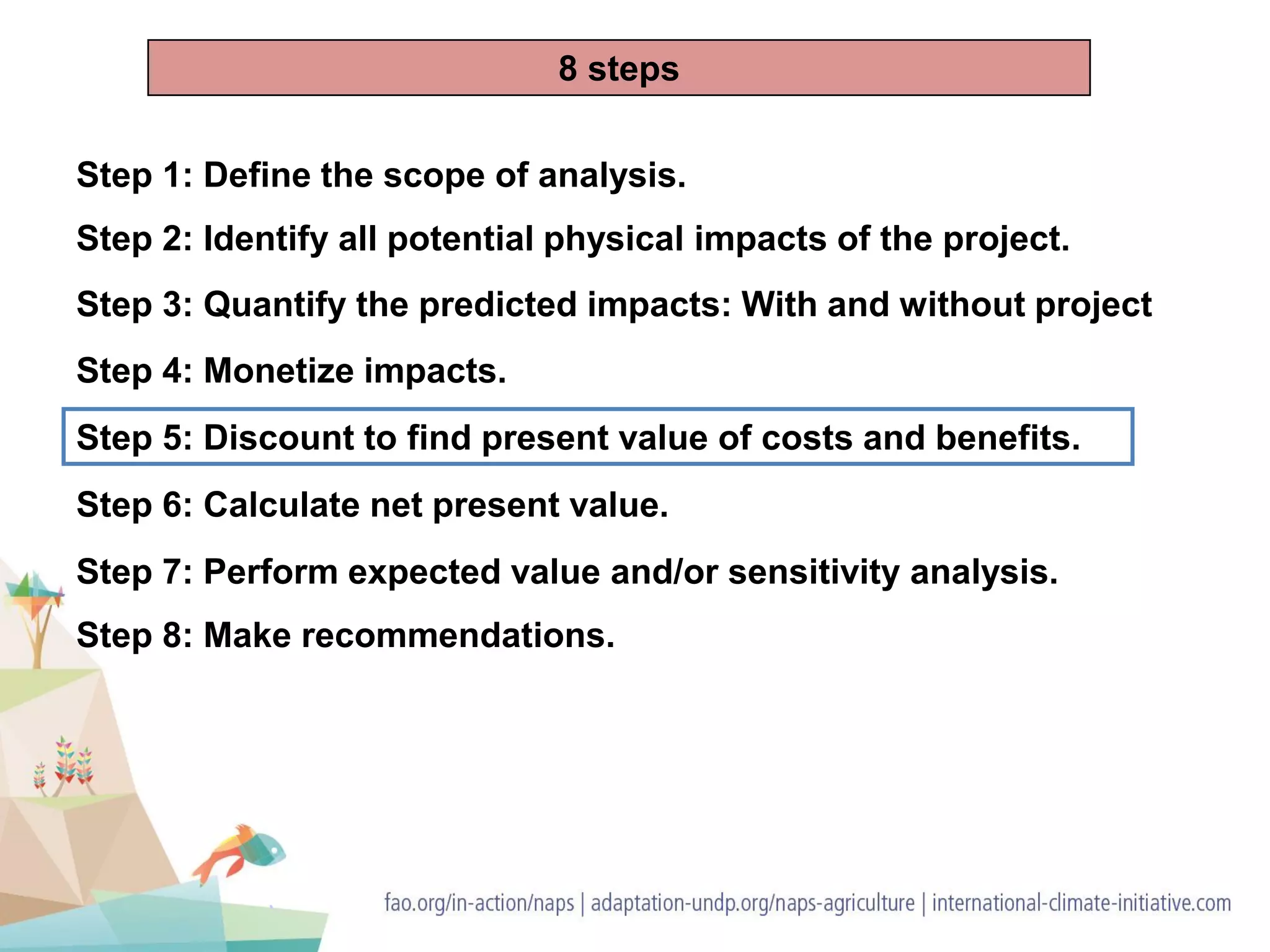
Step 2: Identify all potential physical impacts of the project.
Step 4: Monetize impacts.
Step 5: Discount to find present value of costs and benefits.
Step 6: Calculate net present value.
Step 8: Make recommendations.
Step 3: Quantify the predicted impacts: With and without project
Step 1: Define the scope of analysis.
Step 7: Perform expected value and/or sensitivity analysis.
8 steps
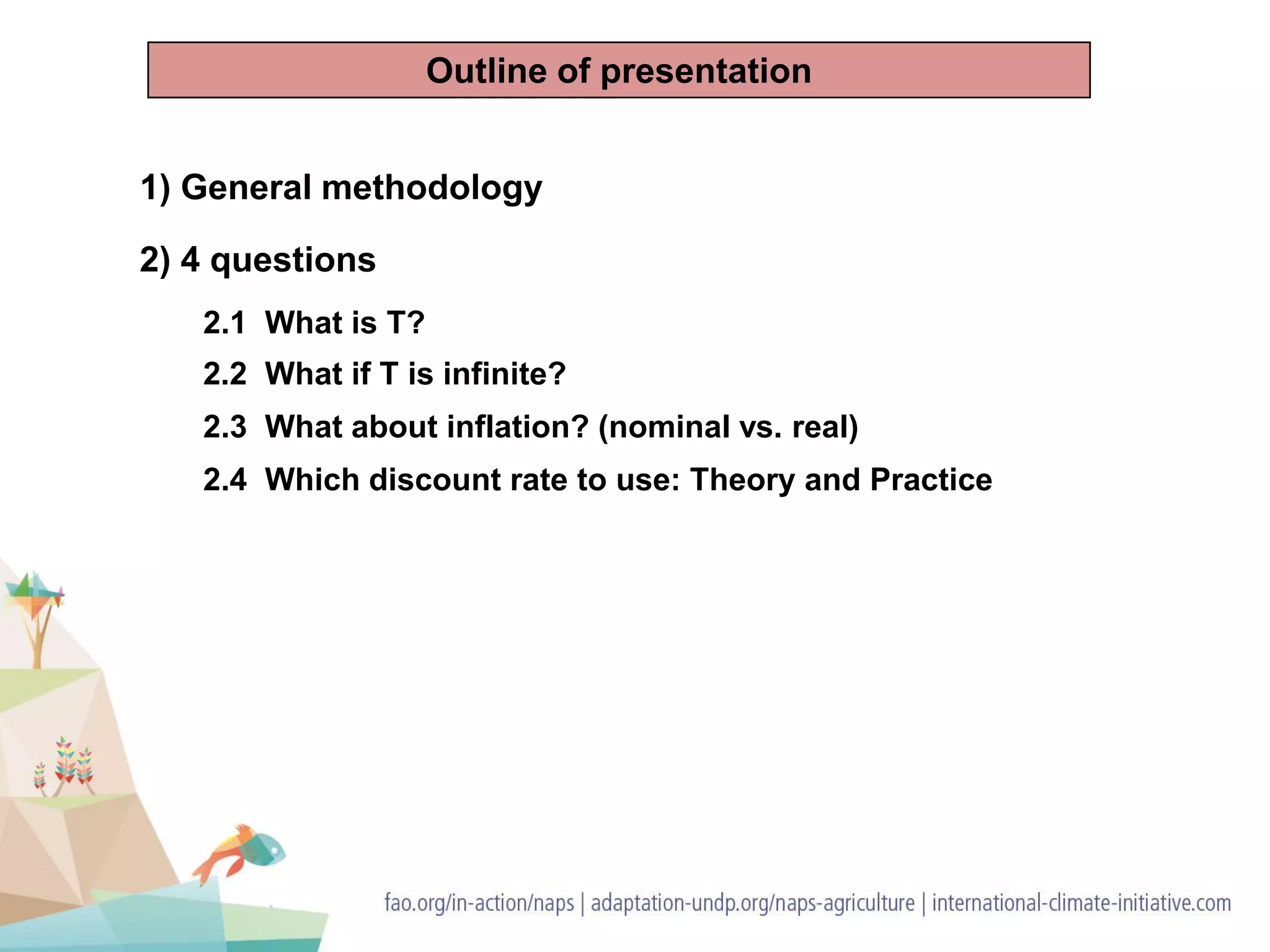
1) General methodology
2) 4 questions
2.1 What is T?
2.2 What if T is infinite?
2.3 What about inflation? (nominal vs. real)
2.4 Which discount rate to use: Theory and Practice
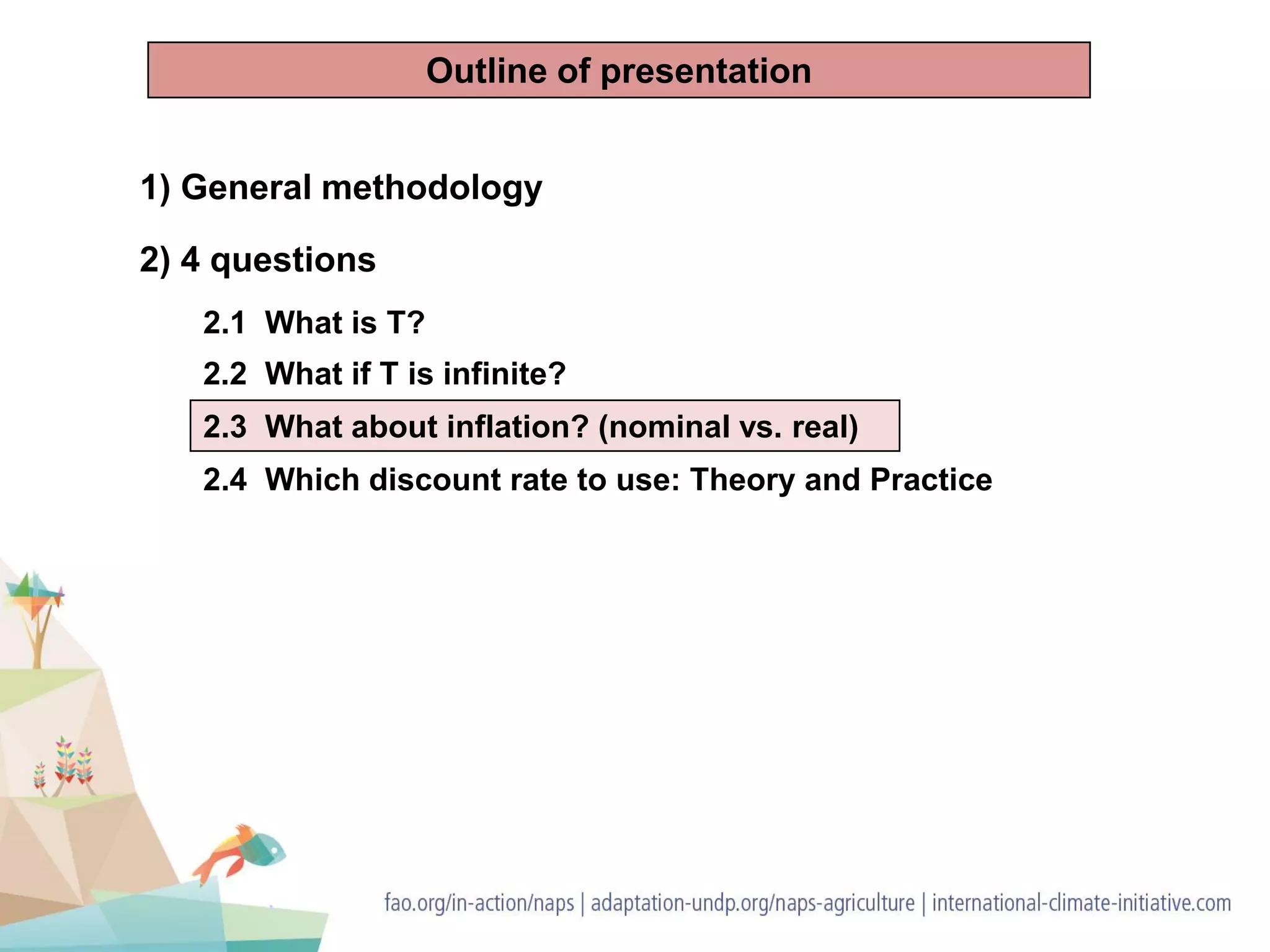
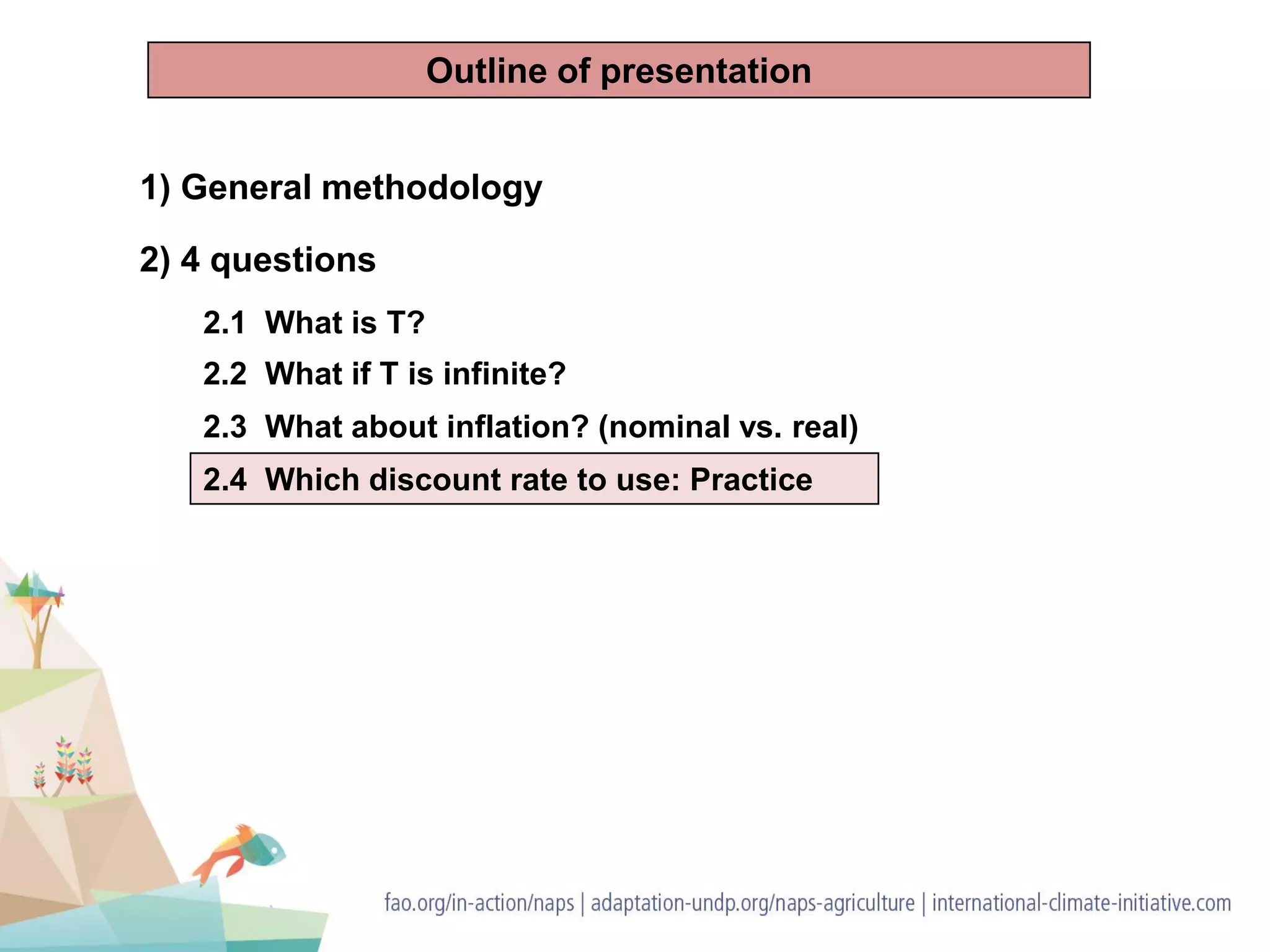
Outline of presentation
1) General methodology
2) 4 questions
2.1 What is T?
2.2 What if T is infinite?
2.3 What about inflation? (nominal vs. real)
2.4 Which discount rate to use: Theory and Practice
Outline of presentation
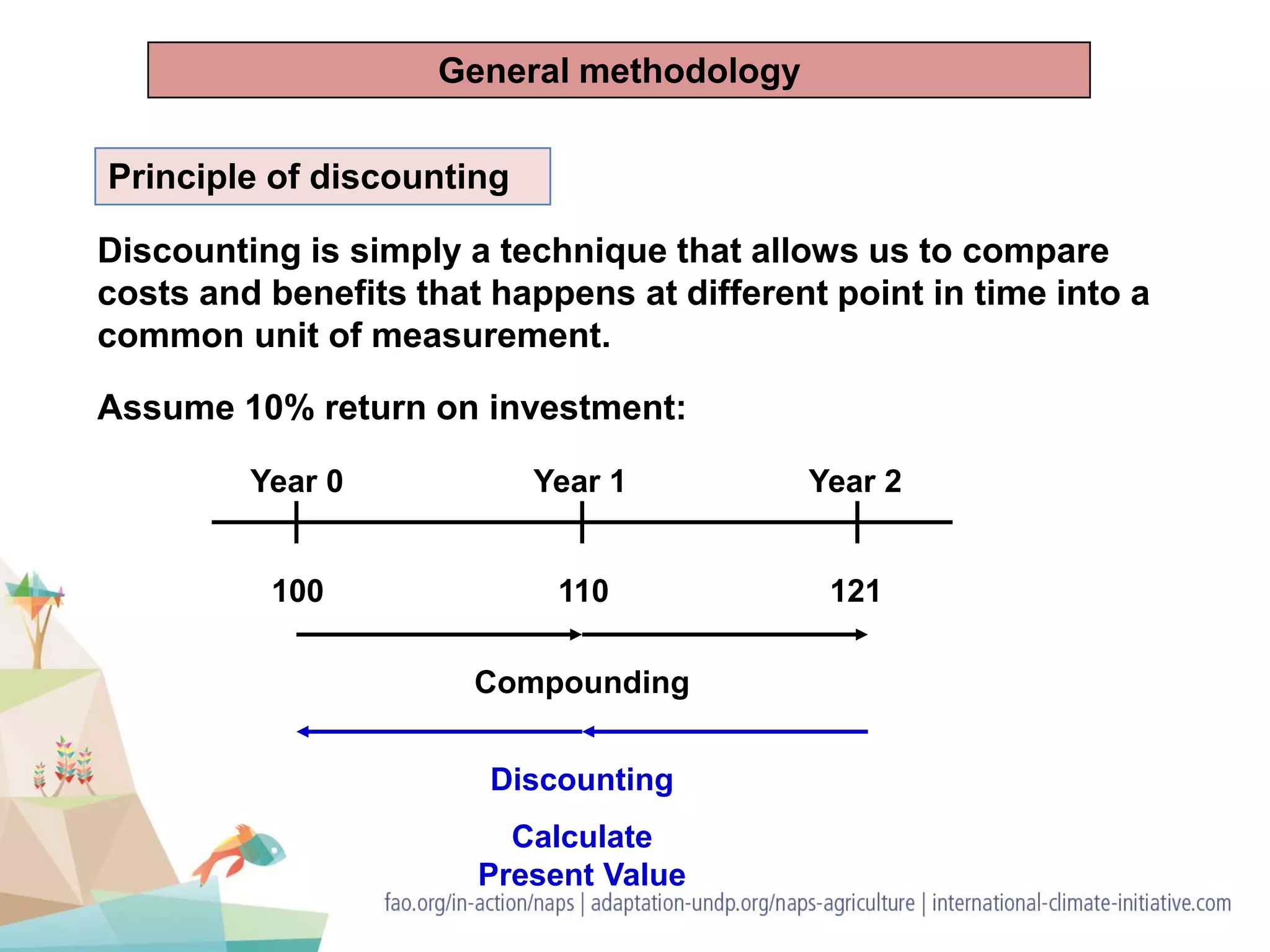
Discounting is simply a technique that allows us to compare
costs and benefits that happens at different point in time into a
common unit of measurement.
100 110 121
Year 0 Year 1 Year 2
Assume 10% return on investment:
Compounding
Discounting
Calculate
Present Value
Principle of discounting
General methodology
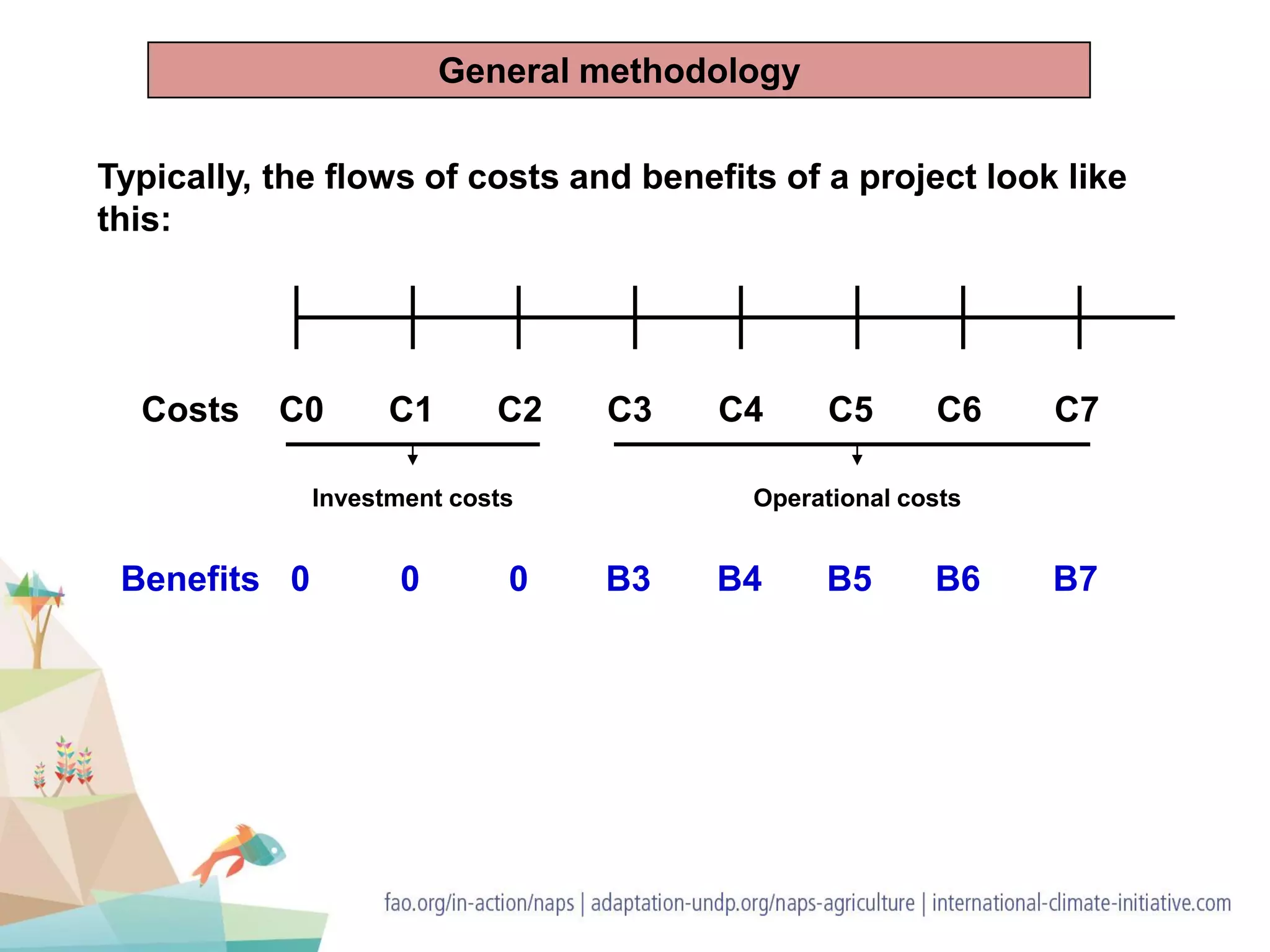
Typically, the flows of costs and benefits of a project look like
this:
Costs
Benefits
C0 C1 C2 C3 C4 C5 C6 C7
0 0 0 B3 B4 B5 B6 B7
Investment costs Operational costs
General methodology
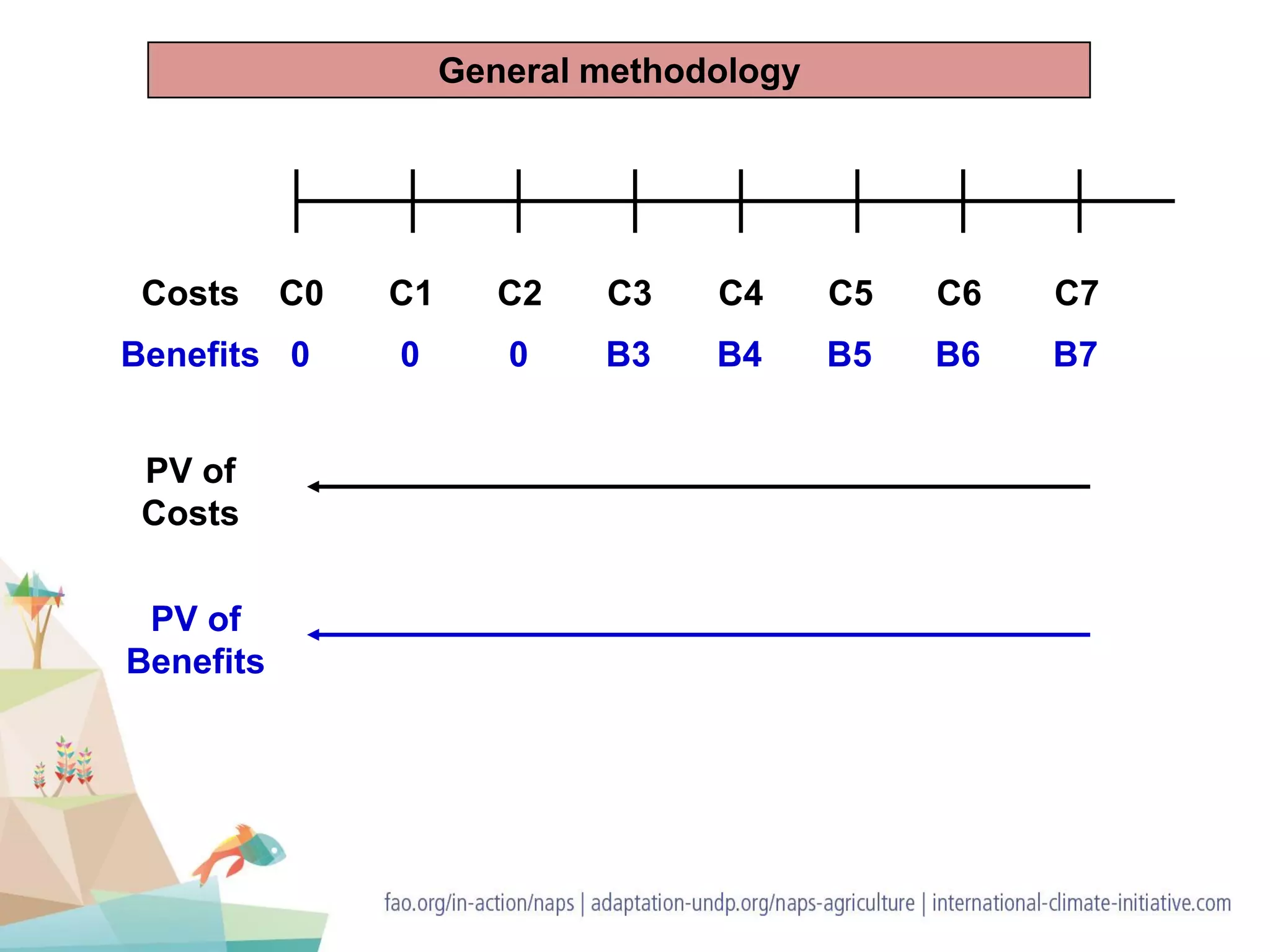
Costs
Benefits
C0 C1 C2 C3 C4 C5 C6 C7
0 0 0 B3 B4 B5 B6 B7
PV of
Costs
PV of
Benefits
General methodology
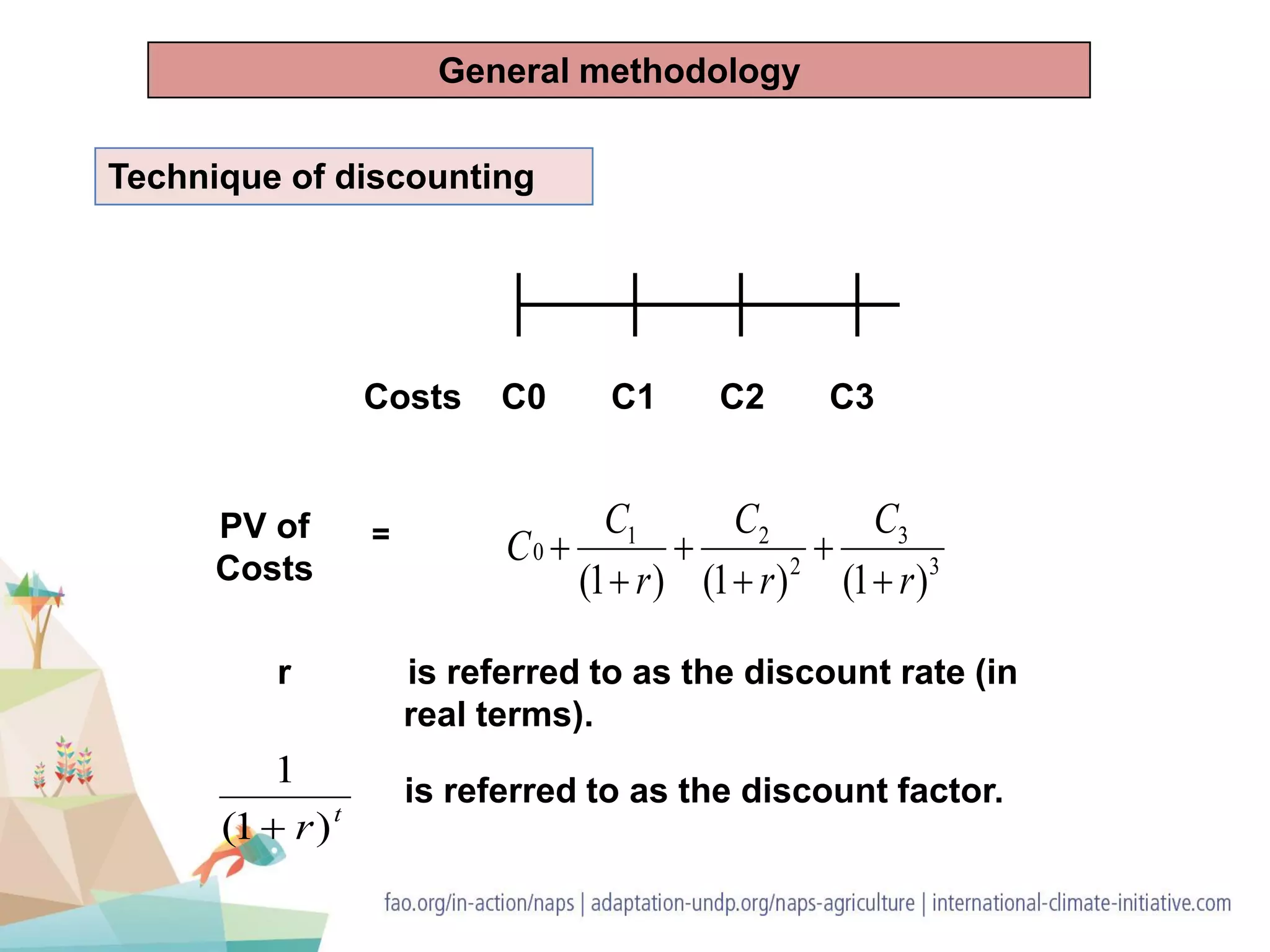
Costs C0 C1 C2 C3
PV of
Costs 3
3
2
21
0
)1()1()1( r
C
r
C
r
C
C





=
r is referred to as the discount rate (in
real terms).
t
r)1(
1

is referred to as the discount factor.
Technique of discounting
General methodology
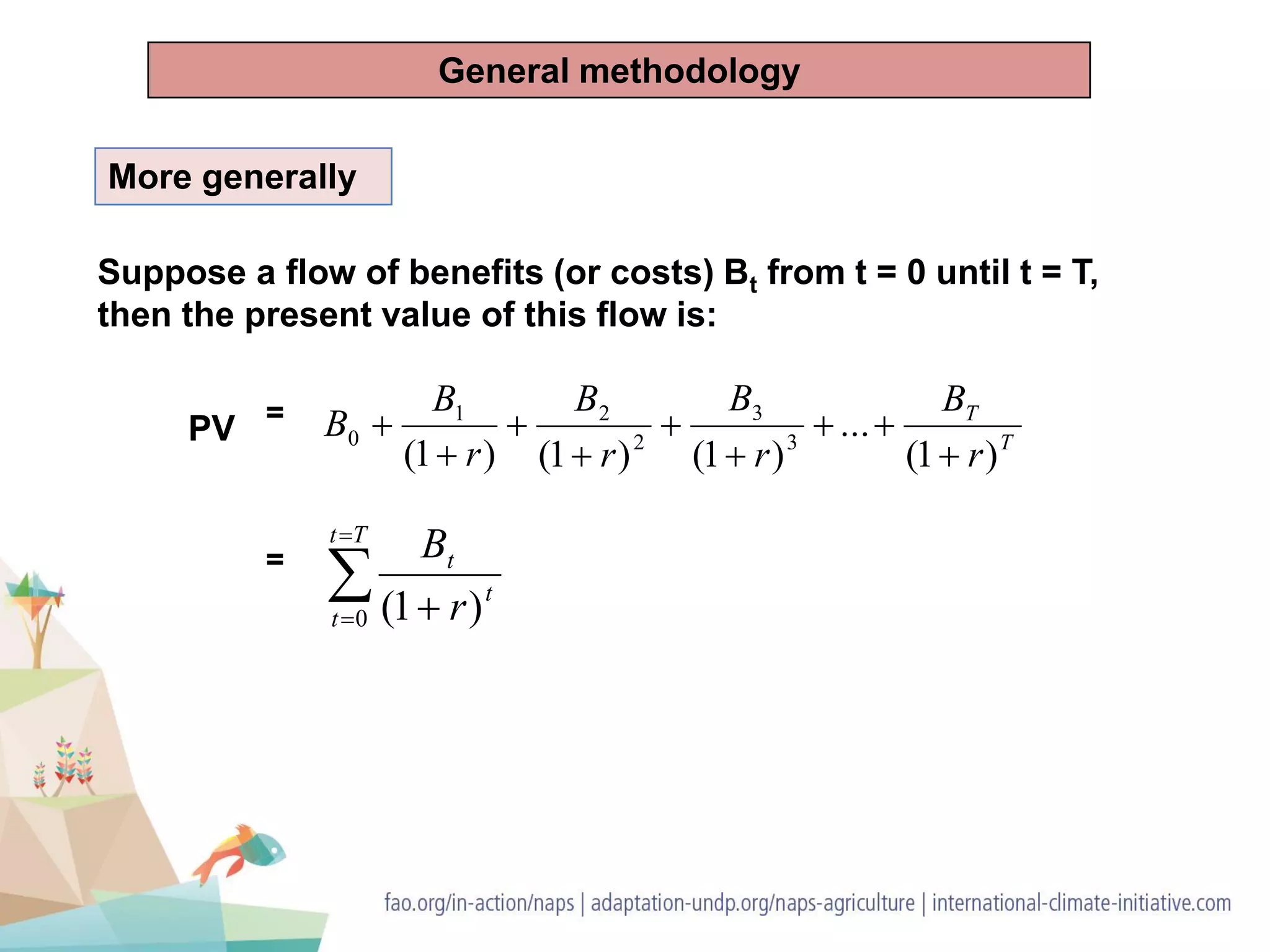
PV =
Suppose a flow of benefits (or costs) Bt from t = 0 until t = T,
then the present value of this flow is:
More generally
T
T
r
B
r
B
r
B
r
B
B
)1(
...
)1()1()1( 3
3
2
21
0








=


 
Tt
t
t
t
r
B
0 )1(
General methodology
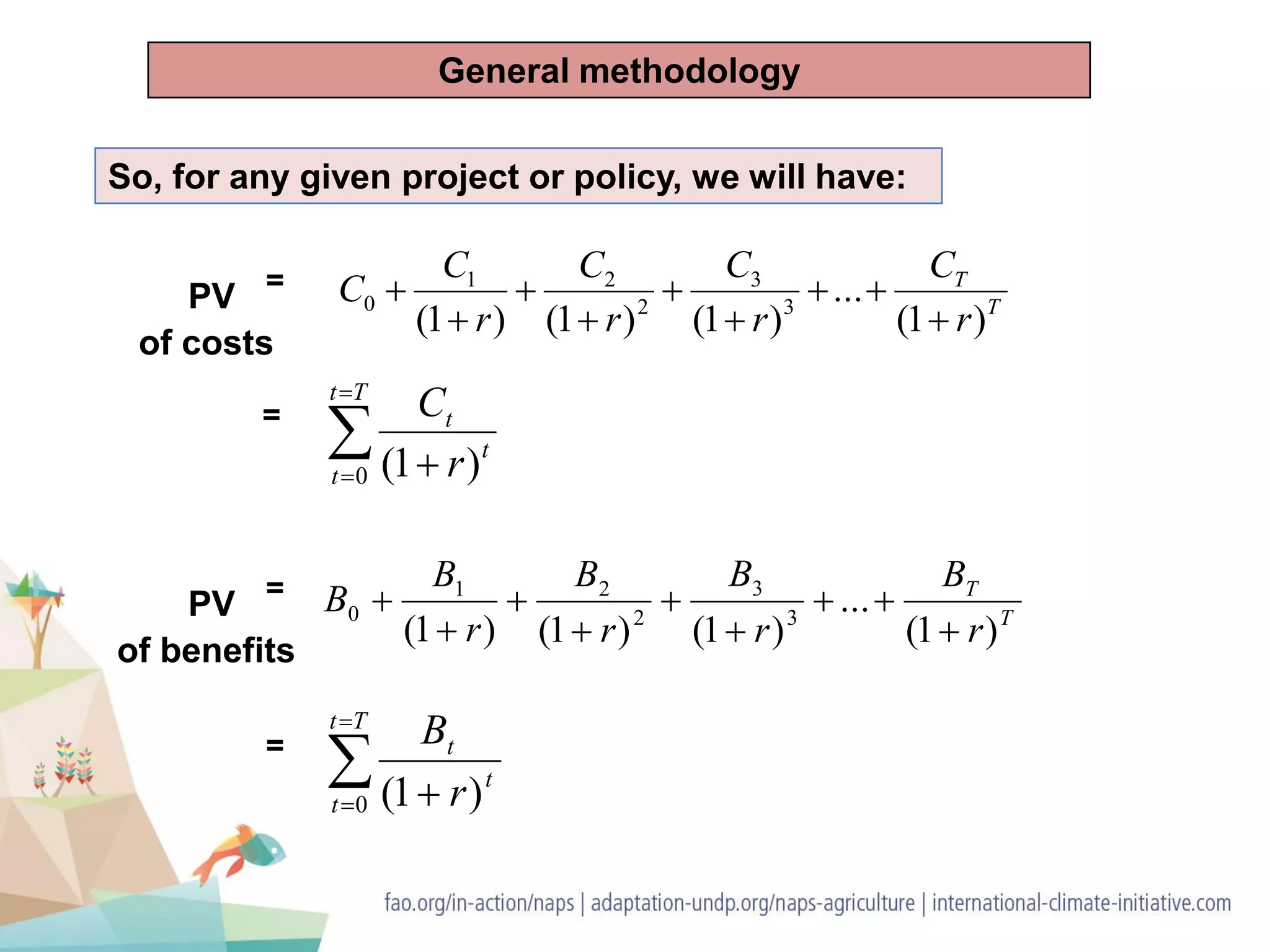
PV =
So, for any given project or policy, we will have:
T
T
r
B
r
B
r
B
r
B
B
)1(
...
)1()1()1( 3
3
2
21
0








=


 
Tt
t
t
t
r
B
0 )1(
of benefits
PV =
of costs
T
T
r
C
r
C
r
C
r
C
C
)1(
...
)1()1()1( 3
3
2
21
0








=


 
Tt
t
t
t
r
C
0 )1(
General methodology
1) General methodology
2) 4 questions
2.1 What is T?
2.2 What if T is infinite?
2.3 What about inflation? (nominal vs. real)
2.4 Which discount rate to use: Theory and Practice
Outline of presentation
1) General methodology
2) 4 questions
2.1 What is T?
2.2 What if T is infinite?
2.3 What about inflation? (nominal vs. real)
2.4 Which discount rate to use: Theory and Practice
Outline of presentation
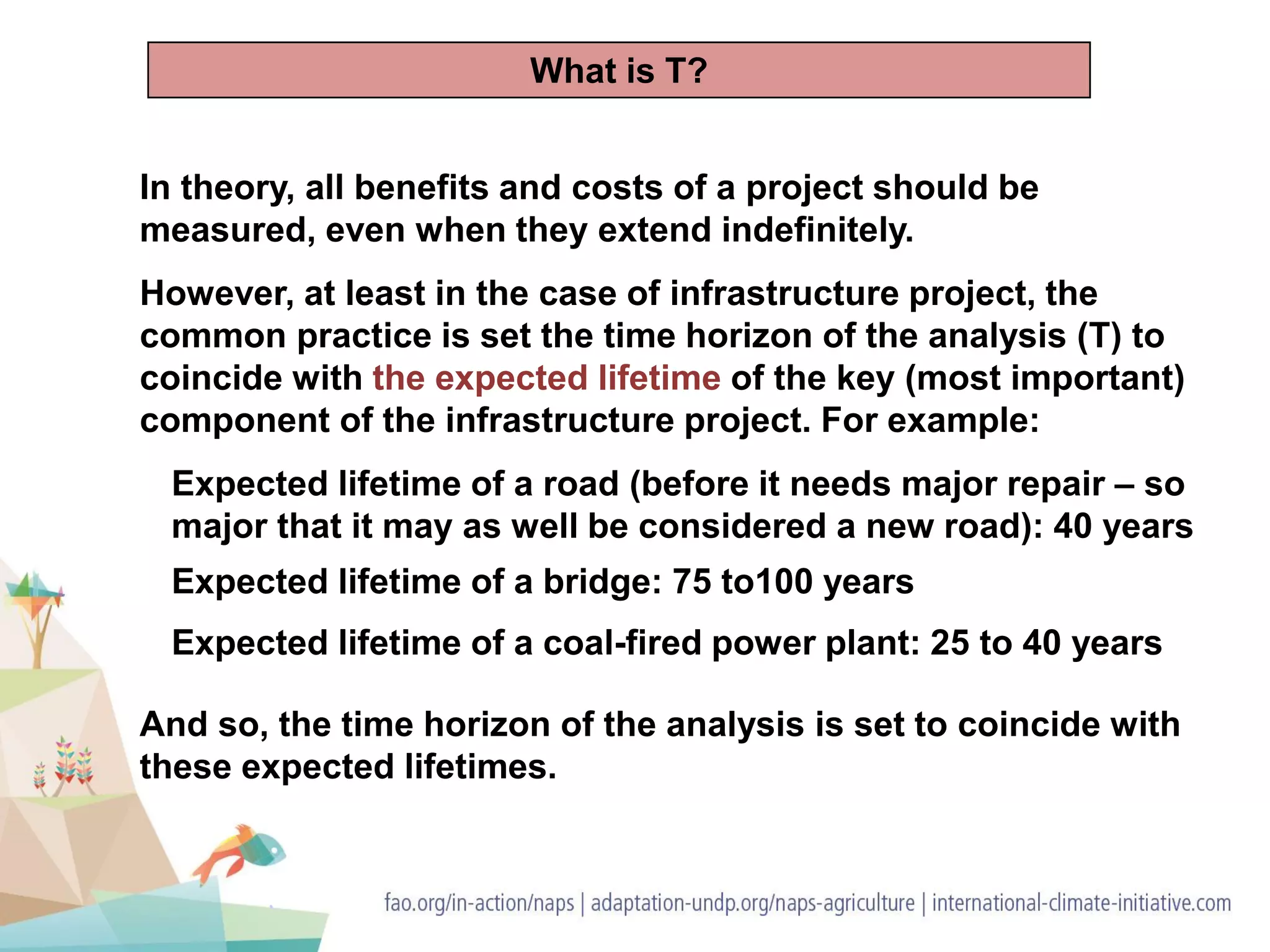
In theory, all benefits and costs of a project should be
measured, even when they extend indefinitely.
However, at least in the case of infrastructure project, the
common practice is set the time horizon of the analysis (T) to
coincide with the expected lifetime of the key (most important)
component of the infrastructure project. For example:
Expected lifetime of a road (before it needs major repair – so
major that it may as well be considered a new road): 40 years
Expected lifetime of a bridge: 75 to100 years
Expected lifetime of a coal-fired power plant: 25 to 40 years
And so, the time horizon of the analysis is set to coincide with
these expected lifetimes.
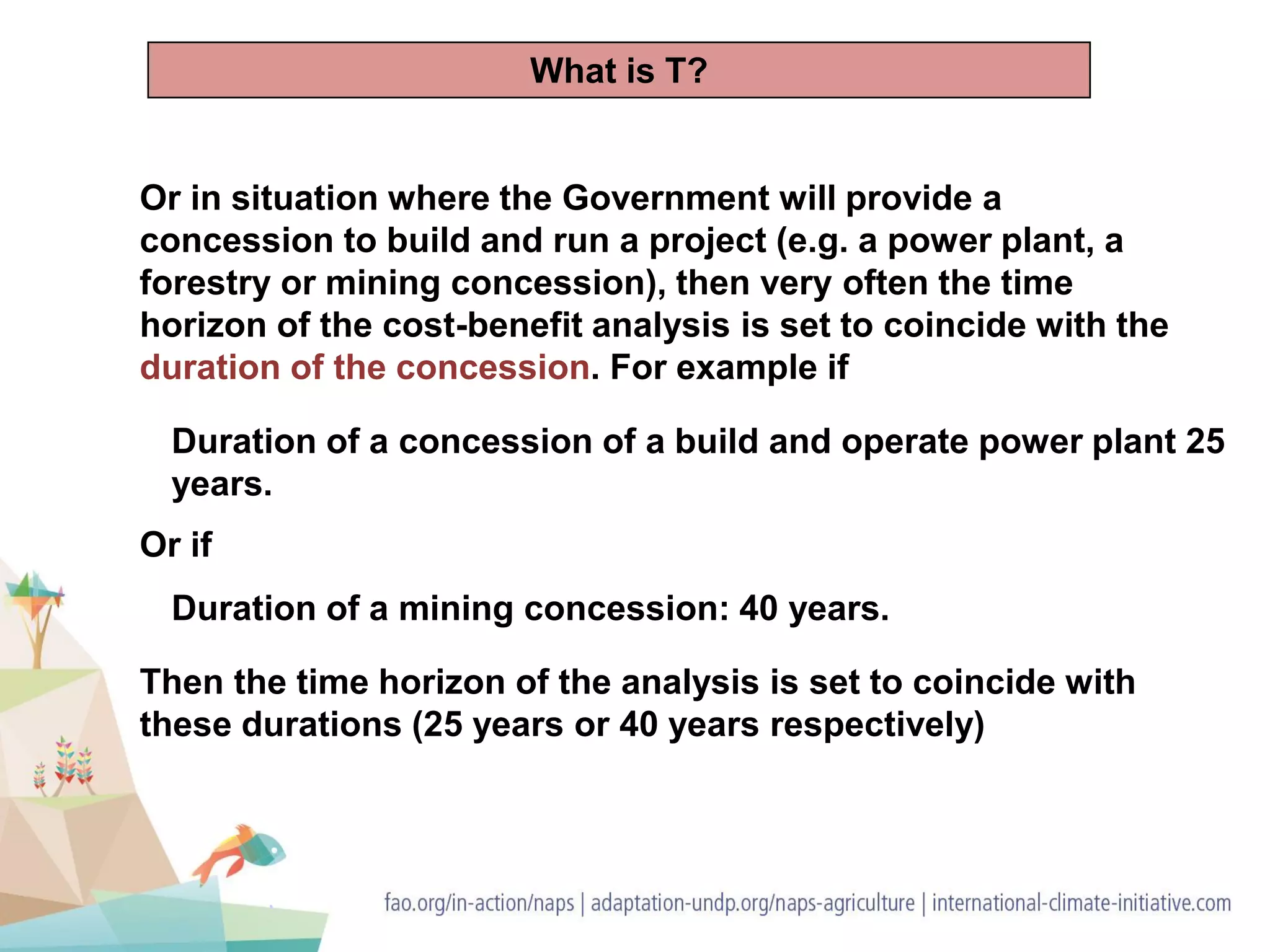
What is T?
Or in situation where the Government will provide a
concession to build and run a project (e.g. a power plant, a
forestry or mining concession), then very often the time
horizon of the cost-benefit analysis is set to coincide with the
duration of the concession. For example if
Duration of a concession of a build and operate power plant 25
years.
Then the time horizon of the analysis is set to coincide with
these durations (25 years or 40 years respectively)
Duration of a mining concession: 40 years.
Or if
What is T?
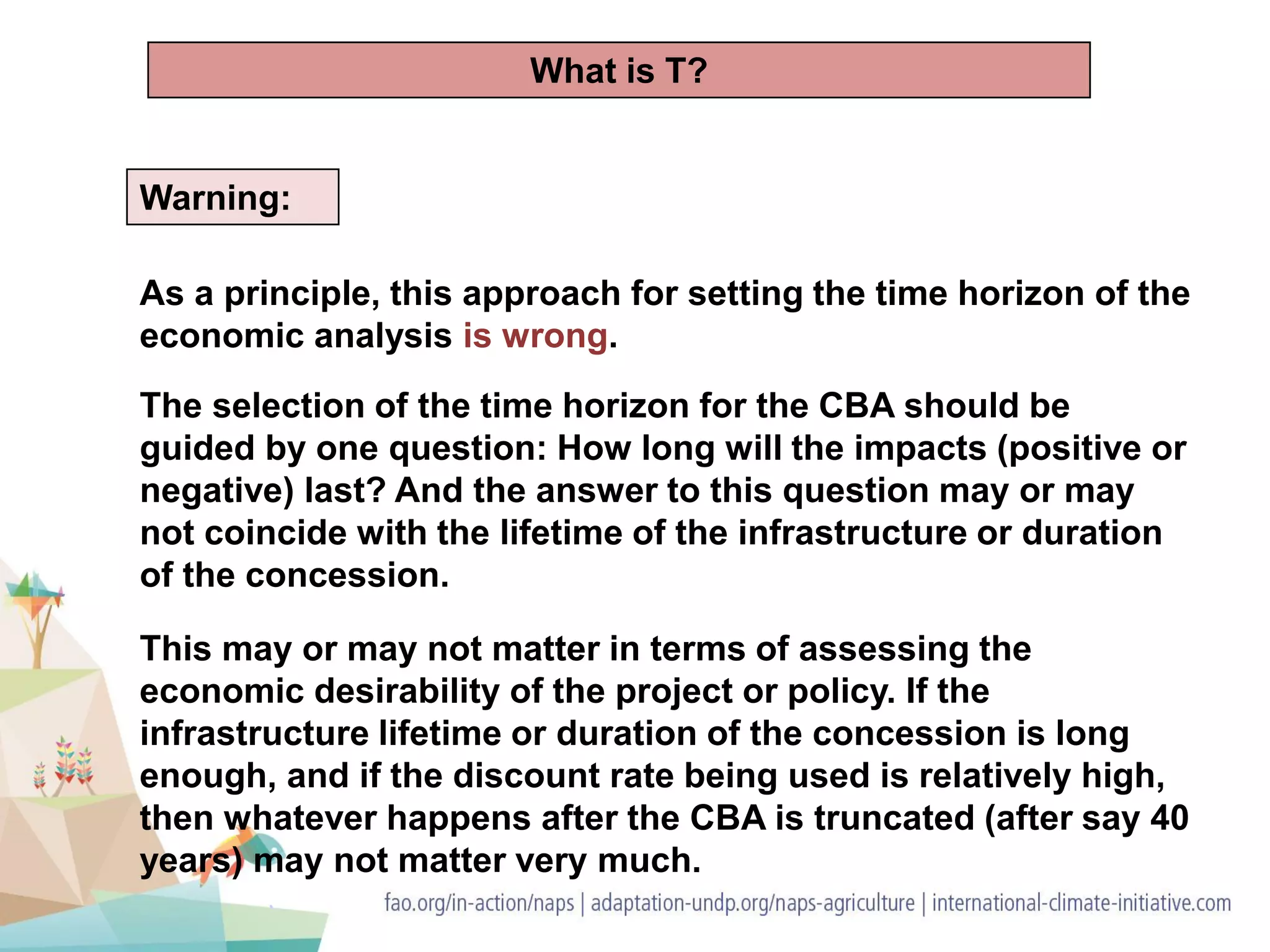
Warning:
As a principle, this approach for setting the time horizon of the
economic analysis is wrong.
The selection of the time horizon for the CBA should be
guided by one question: How long will the impacts (positive or
negative) last? And the answer to this question may or may
not coincide with the lifetime of the infrastructure or duration
of the concession.
This may or may not matter in terms of assessing the
economic desirability of the project or policy. If the
infrastructure lifetime or duration of the concession is long
enough, and if the discount rate being used is relatively high,
then whatever happens after the CBA is truncated (after say 40
years) may not matter very much.
What is T?
1) General methodology
2) 4 questions
2.1 What is T?
2.2 What if T is infinite?
2.3 What about inflation? (nominal vs. real)
2.4 Which discount rate to use: Theory and Practice
Outline of presentation
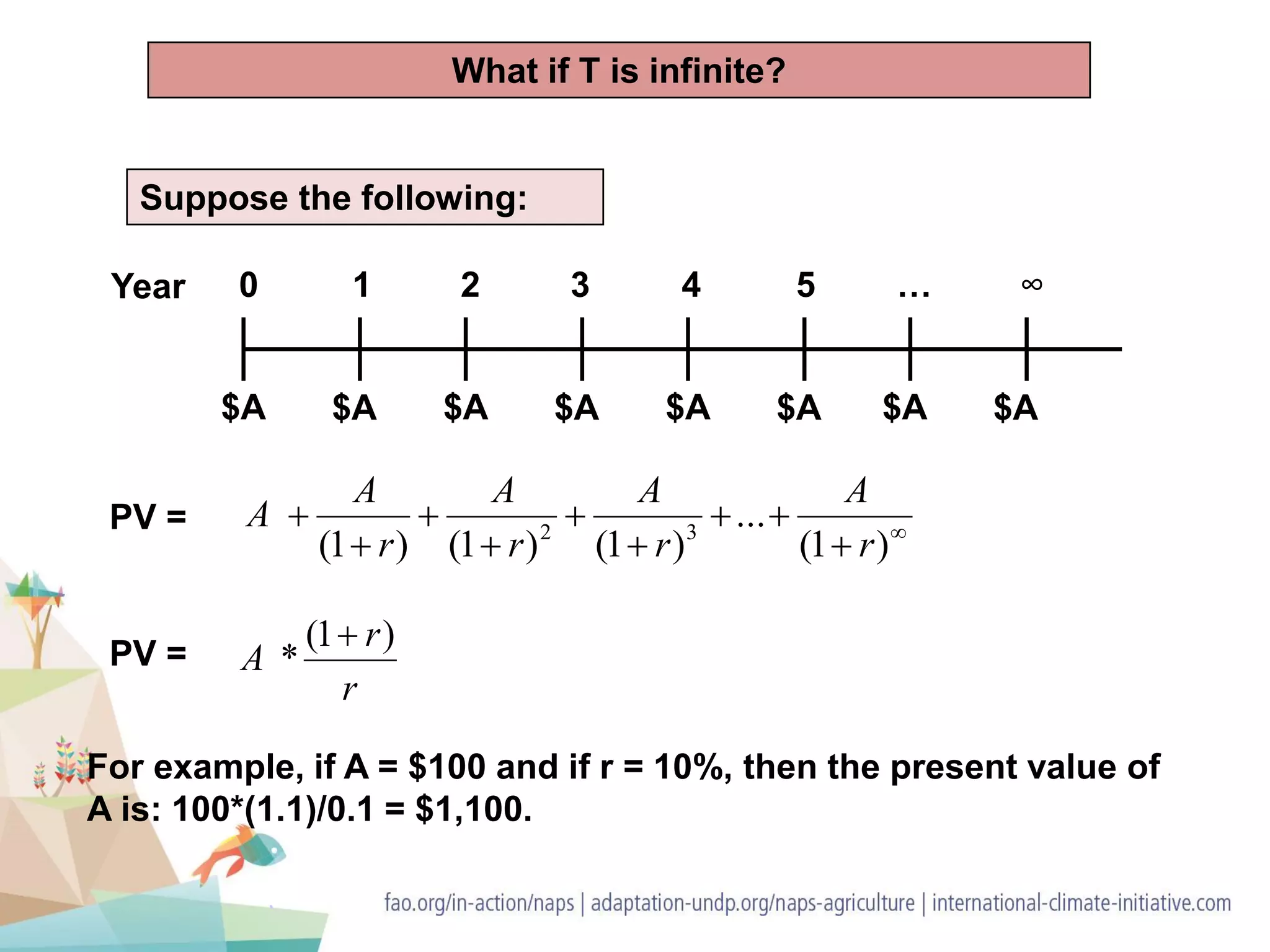
Suppose the following:
0 1 2 3 4 5 … ∞Year
$A $A $A $A $A $A $A $A
PV = 








)1(
...
)1()1()1( 32
r
A
r
A
r
A
r
A
A
PV =
r
r
A
)1(
*

For example, if A = $100 and if r = 10%, then the present value of
A is: 100*(1.1)/0.1 = $1,100.
What if T is infinite?
1) General methodology
2) 4 questions
2.1 What is T?
2.2 What if T is infinite?
2.3 What about inflation? (nominal vs. real)
2.4 Which discount rate to use: Theory and Practice
Outline of presentation
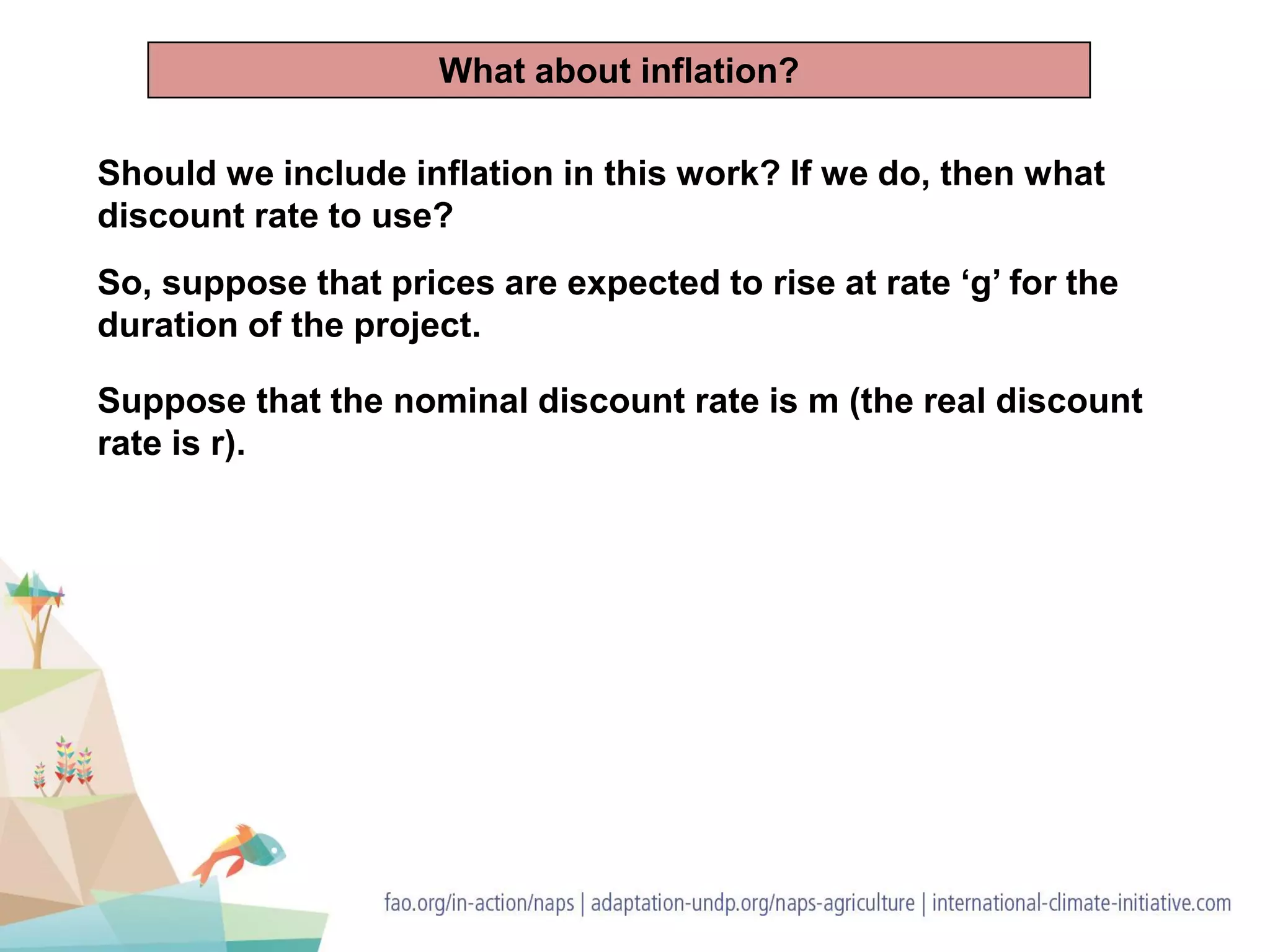
Should we include inflation in this work? If we do, then what
discount rate to use?
So, suppose that prices are expected to rise at rate ‘g’ for the
duration of the project.
Suppose that the nominal discount rate is m (the real discount
rate is r).
What about inflation?
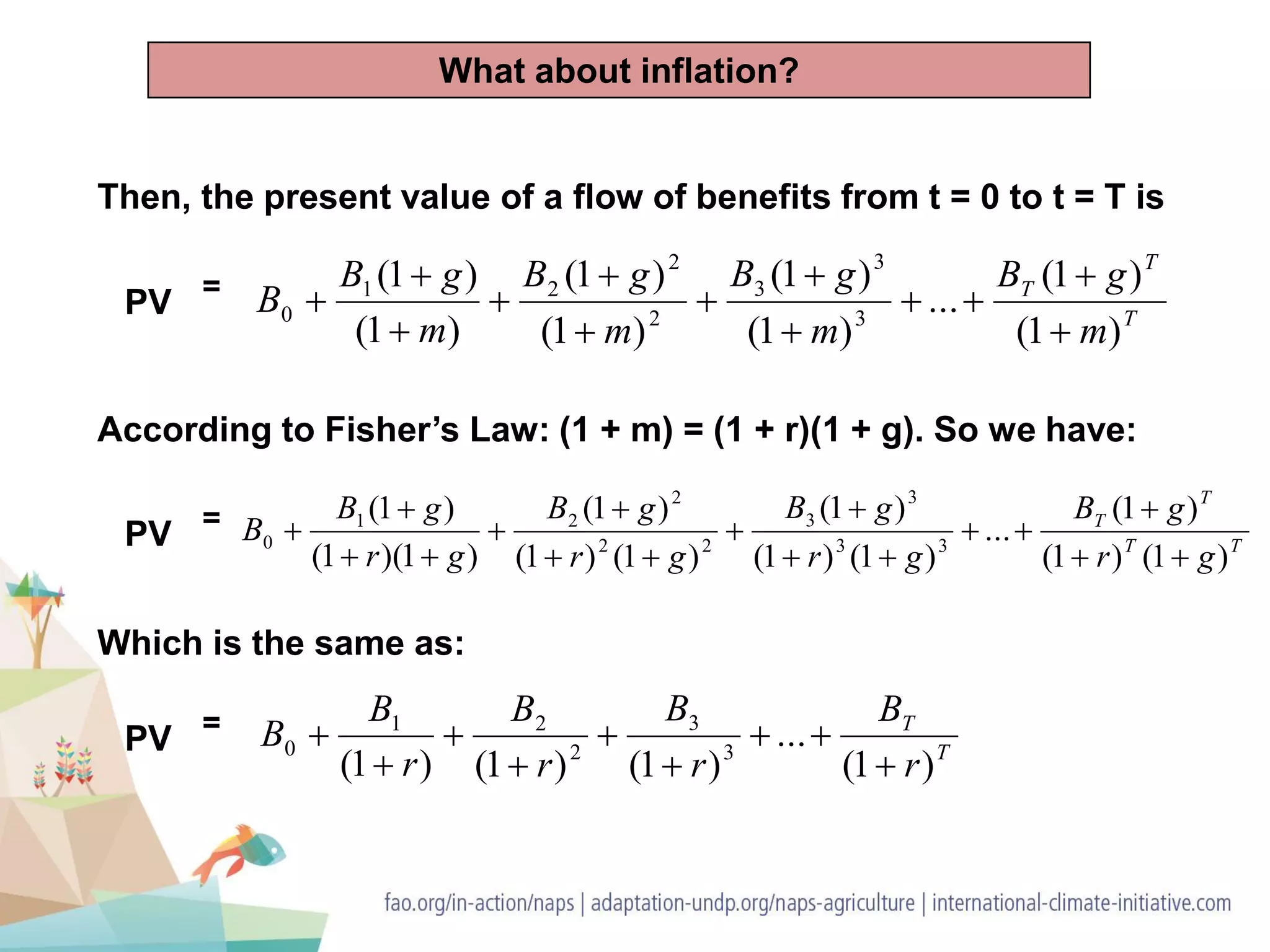
Then, the present value of a flow of benefits from t = 0 to t = T is
PV =
T
T
T
m
gB
m
gB
m
gB
m
gB
B
)1(
)1(
...
)1(
)1(
)1(
)1(
)1(
)1(
3
3
3
2
2
21
0












According to Fisher’s Law: (1 + m) = (1 + r)(1 + g). So we have:
TT
T
T
gr
gB
gr
gB
gr
gB
gr
gB
B
)1()1(
)1(
...
)1()1(
)1(
)1()1(
)1(
)1)(1(
)1(
33
3
3
22
2
21
0











PV =
Which is the same as:
PV =
T
T
r
B
r
B
r
B
r
B
B
)1(
...
)1()1()1( 3
3
2
21
0








What about inflation?
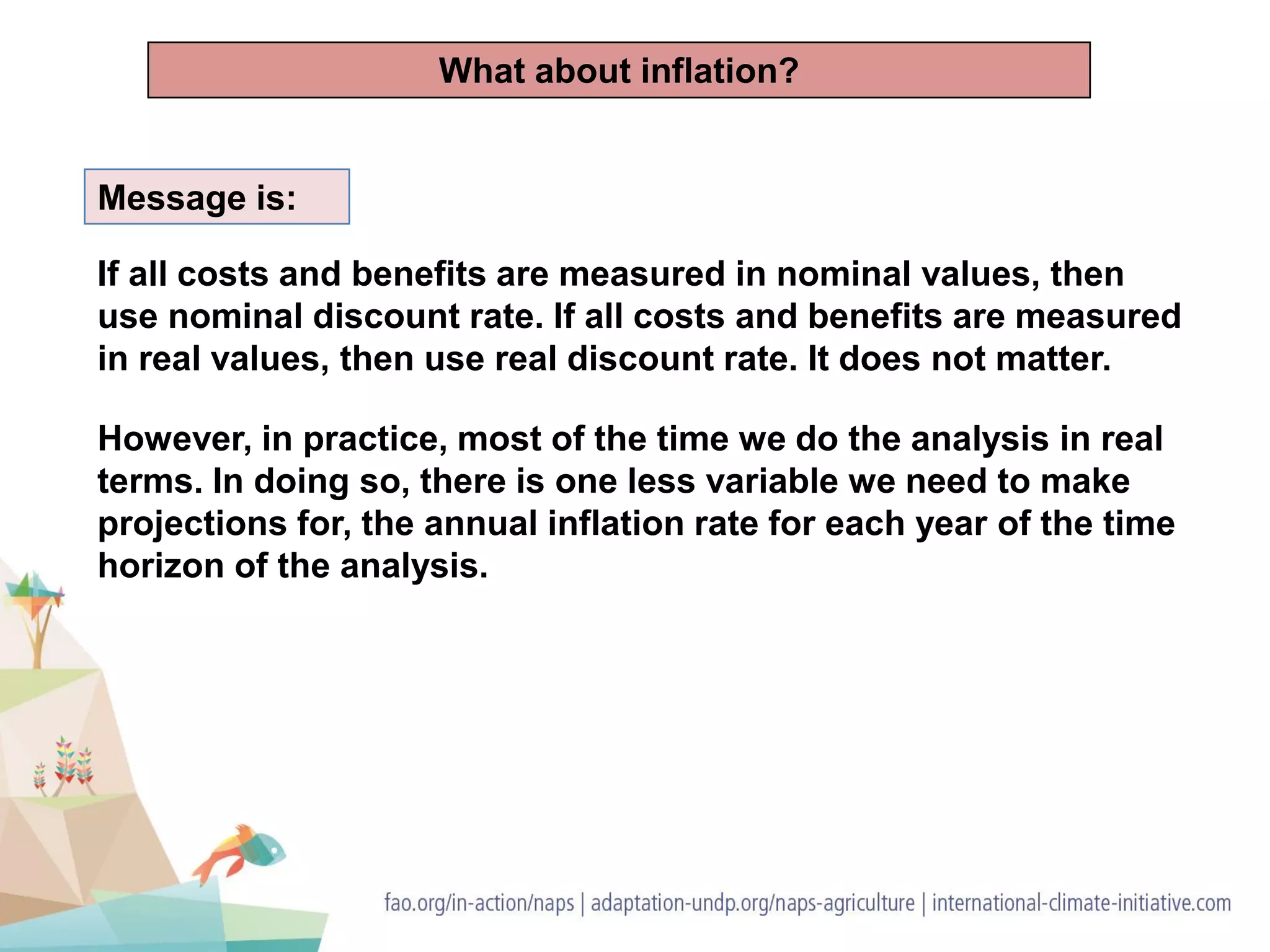
Message is:
If all costs and benefits are measured in nominal values, then
use nominal discount rate. If all costs and benefits are measured
in real values, then use real discount rate. It does not matter.
However, in practice, most of the time we do the analysis in real
terms. In doing so, there is one less variable we need to make
projections for, the annual inflation rate for each year of the time
horizon of the analysis.
What about inflation?
1) General methodology
2) 4 questions
2.1 What is T?
2.2 What if T is infinite?
2.3 What about inflation? (nominal vs. real)
2.4 Which discount rate to use: Practice
Outline of presentation
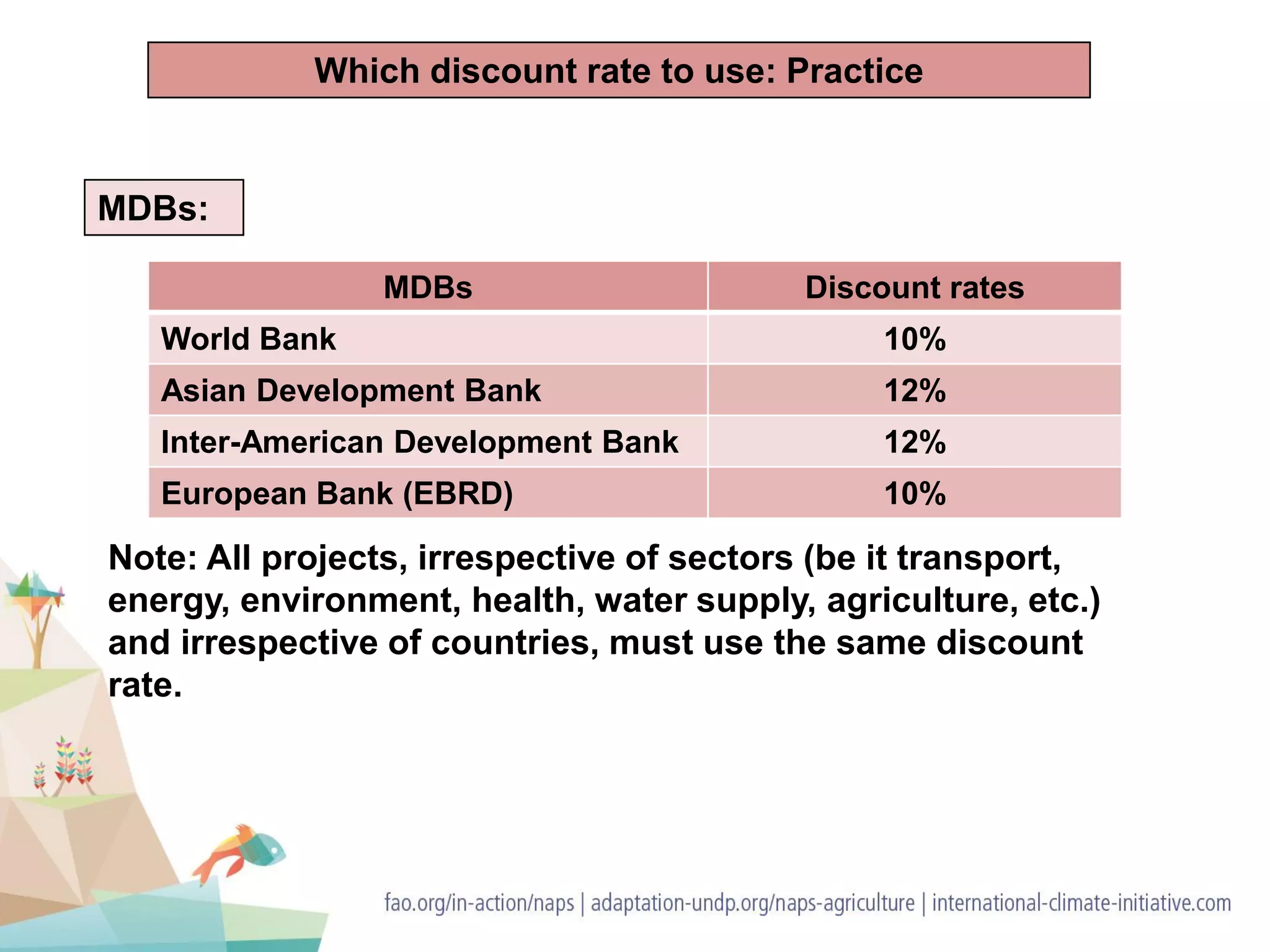
MDBs:
MDBs Discount rates
World Bank 10%
Asian Development Bank 12%
Inter-American Development Bank 12%
European Bank (EBRD) 10%
Note: All projects, irrespective of sectors (be it transport,
energy, environment, health, water supply, agriculture, etc.)
and irrespective of countries, must use the same discount
rate.
Which discount rate to use: Practice
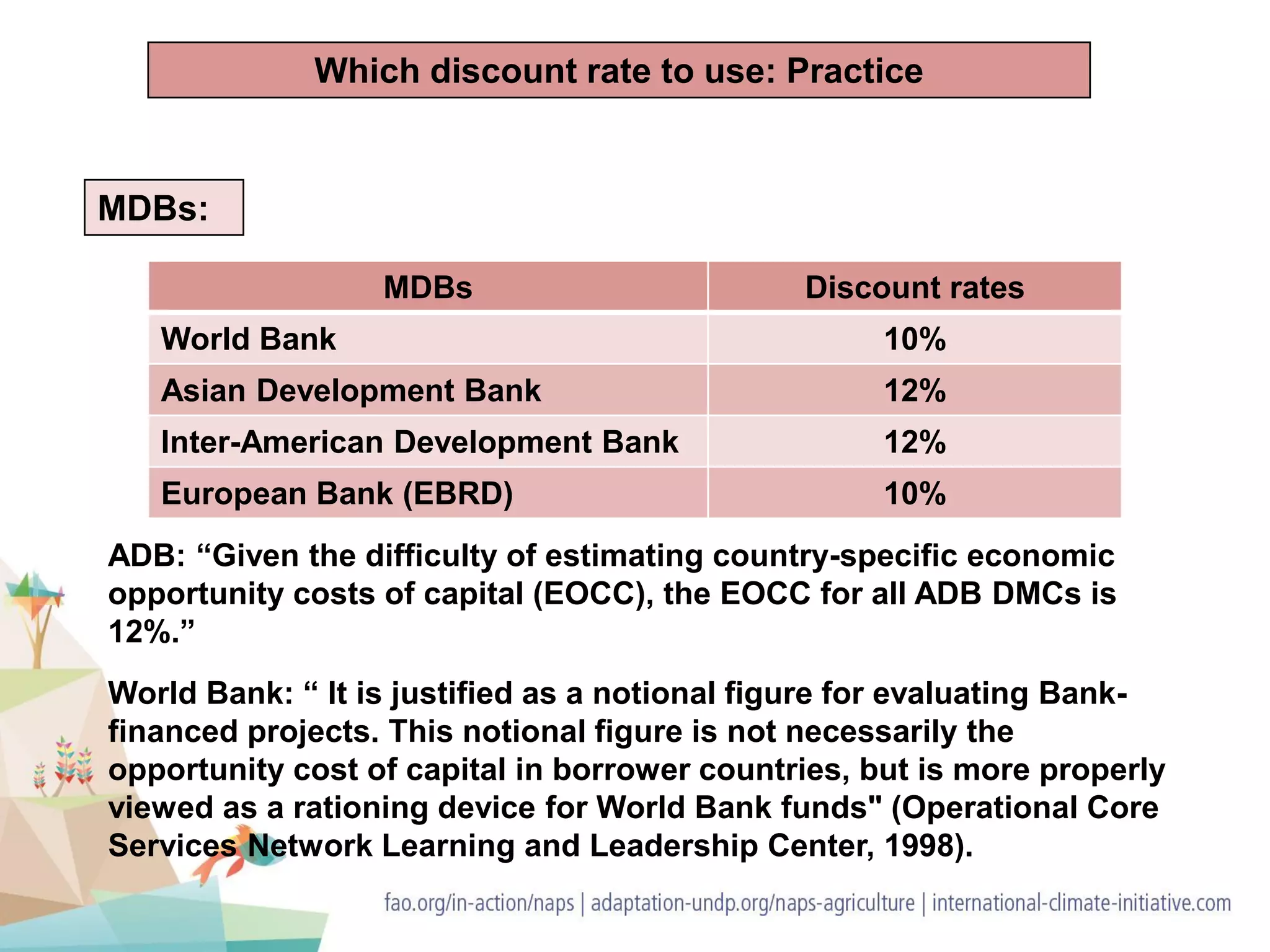
MDBs:
ADB: “Given the difficulty of estimating country-specific economic
opportunity costs of capital (EOCC), the EOCC for all ADB DMCs is
12%.”
World Bank: “ It is justified as a notional figure for evaluating Bank-
financed projects. This notional figure is not necessarily the
opportunity cost of capital in borrower countries, but is more properly
viewed as a rationing device for World Bank funds" (Operational Core
Services Network Learning and Leadership Center, 1998).
Which discount rate to use: Practice
MDBs Discount rates
World Bank 10%
Asian Development Bank 12%
Inter-American Development Bank 12%
European Bank (EBRD) 10%
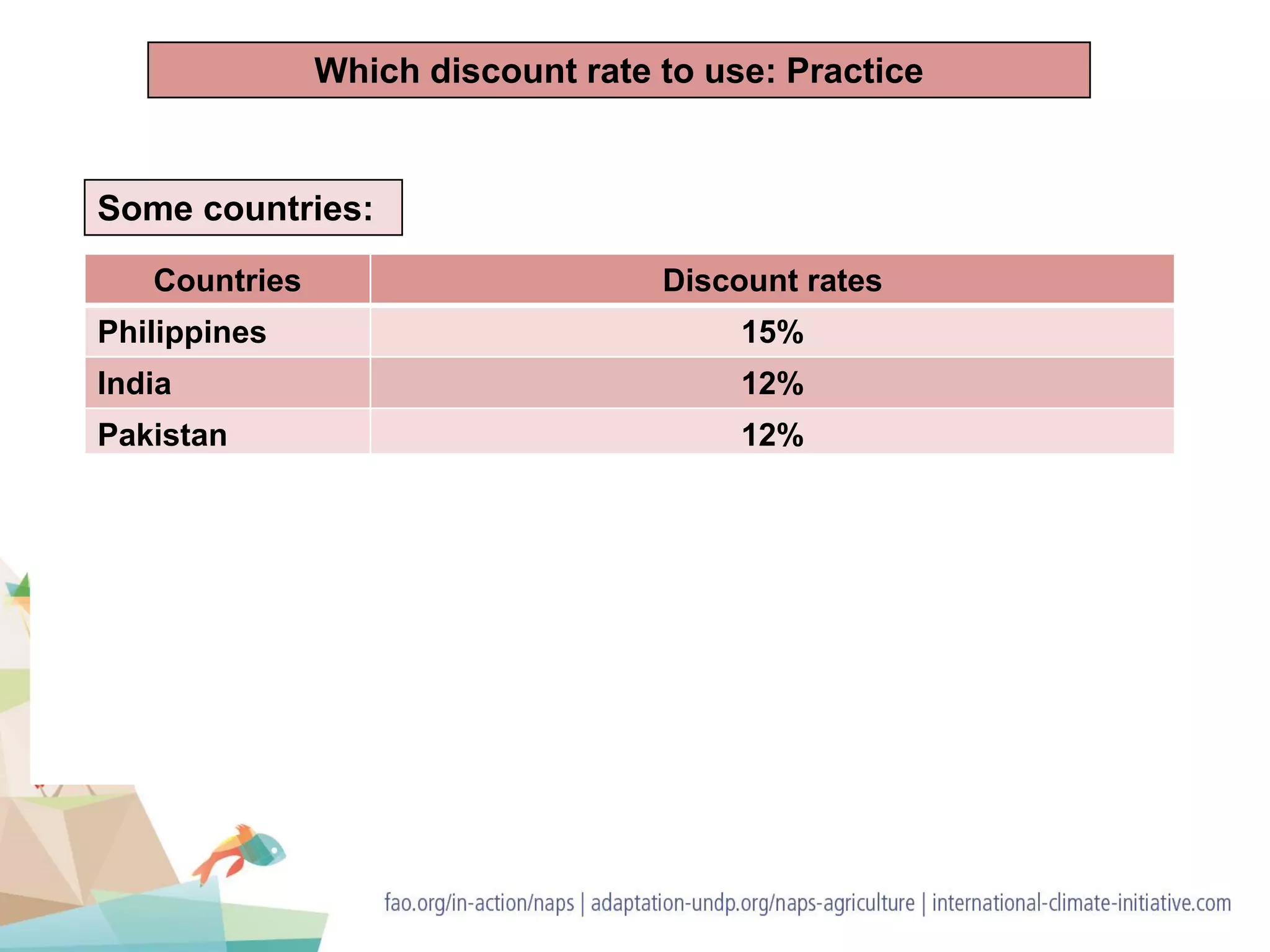
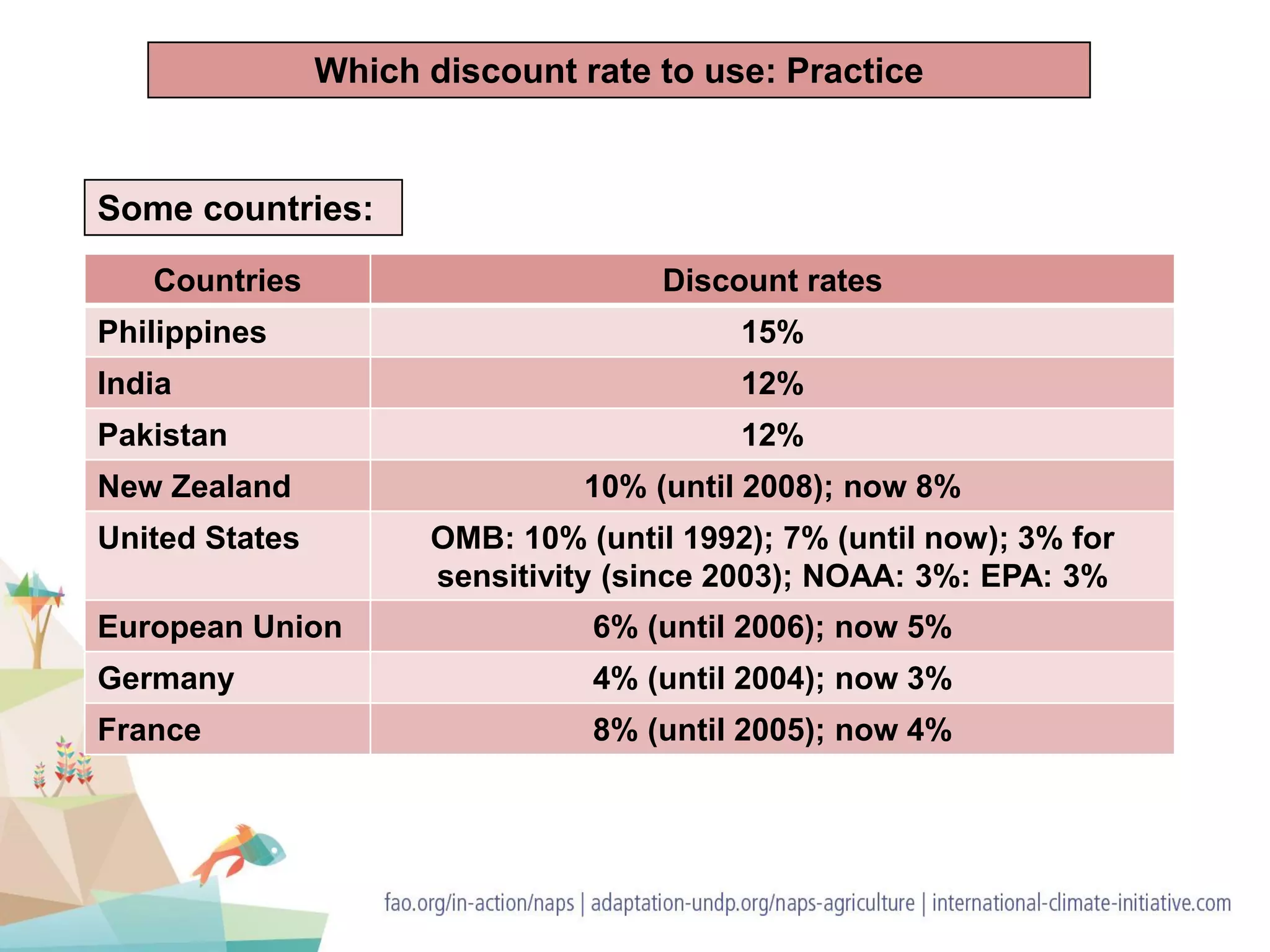
Some countries:
Countries Discount rates
Philippines 15%
India 12%
Pakistan 12%
New Zealand 10% (until 2008); now 8%
United States OMB: 10% (until 1992); 7% (until now); 3% for sensitivity
(since 2003); NOAA: 3%: EPA: 3%
European Union 6% (until 2006); now 5%
Germany 4% (until 2004); now 3%
France 8% (until 2005); now 4%
Which discount rate to use: Practice
Line ministries (or operational departments in MDBs) would
prefer to have their policies or projects accepted.
Incentives to over-estimate benefits and under-estimate
costs.
Strategic reaction from those who allocate resources:
Set a high discount rate.
Which discount rate to use: Practice
Some countries:
Countries Discount rates
Philippines 15%
India 12%
Pakistan 12%
New Zealand 10% (until 2008); now 8%
United States OMB: 10% (until 1992); 7% (until now); 3% for
sensitivity (since 2003); NOAA: 3%: EPA: 3%
European Union 6% (until 2006); now 5%
Germany 4% (until 2004); now 3%
France 8% (until 2005); now 4%
Which discount rate to use: Practice
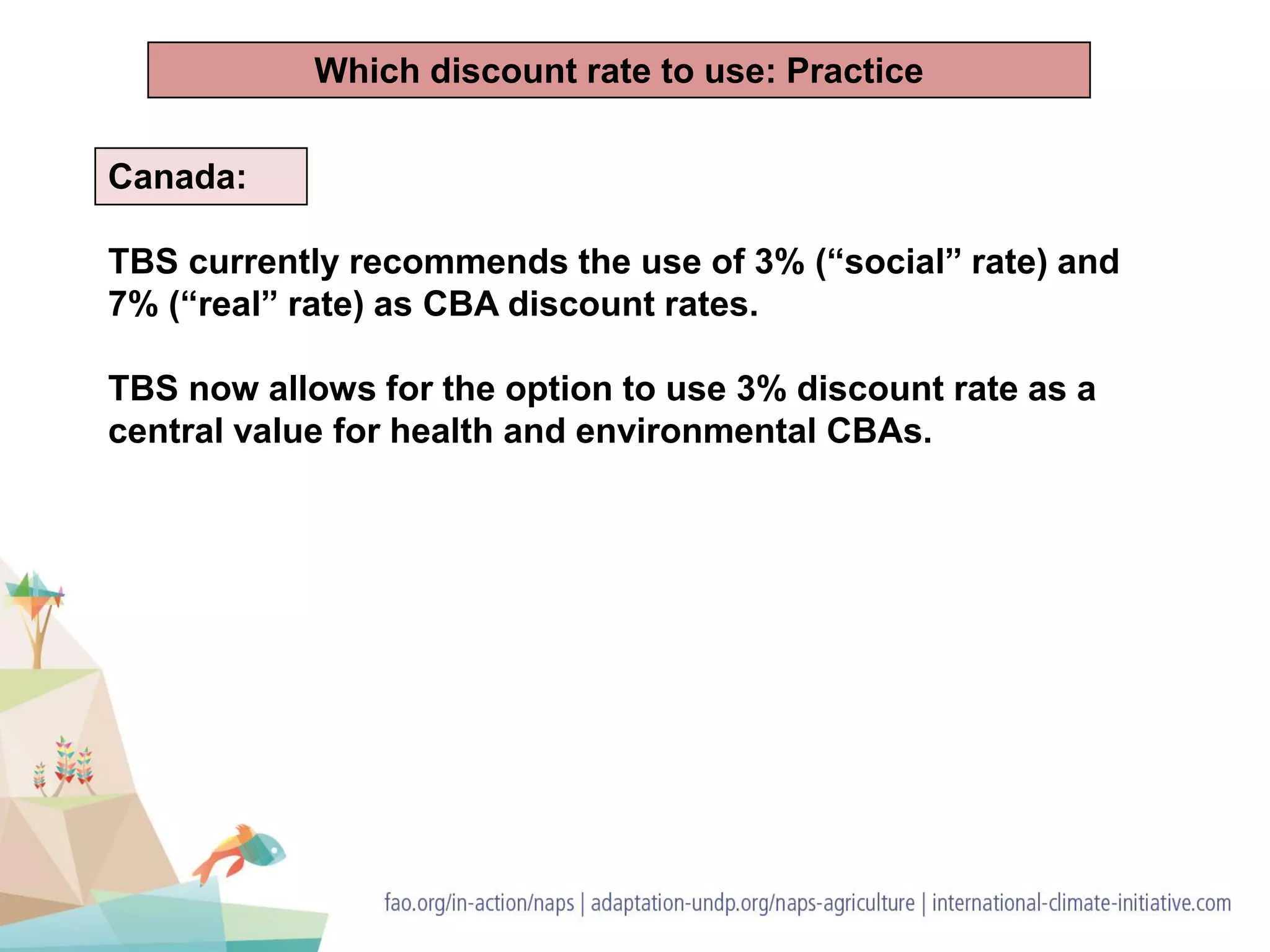
Canada:
TBS currently recommends the use of 3% (“social” rate) and
7% (“real” rate) as CBA discount rates.
TBS now allows for the option to use 3% discount rate as a
central value for health and environmental CBAs.
Which discount rate to use: Practice
The Role of Cost-Benefit Analysis
Presentation by Dr. Benoit Laplante
Bangkok, Thailand
November 23 to 25, 2016
Session 6:
CBA Step 5 Discounting

Building Institutional Capacity in Thailand to Design and Implement Climate Programs - CBA step 5

  • 1.
    The Role ofCost-Benefit Analysis Presentation by Dr. Benoit Laplante Bangkok, Thailand November 23 to 25, 2016 Session 6: CBA Step 5 Discounting
  • 2.
    Step 2: Identifyall potential physical impacts of the project. Step 4: Monetize impacts. Step 5: Discount to find present value of costs and benefits. Step 6: Calculate net present value. Step 8: Make recommendations. Step 3: Quantify the predicted impacts: With and without project Step 1: Define the scope of analysis. Step 7: Perform expected value and/or sensitivity analysis. 8 steps
  • 3.
    1) General methodology 2)4 questions 2.1 What is T? 2.2 What if T is infinite? 2.3 What about inflation? (nominal vs. real) 2.4 Which discount rate to use: Theory and Practice Outline of presentation
  • 4.
    1) General methodology 2)4 questions 2.1 What is T? 2.2 What if T is infinite? 2.3 What about inflation? (nominal vs. real) 2.4 Which discount rate to use: Theory and Practice Outline of presentation
  • 5.
    Discounting is simplya technique that allows us to compare costs and benefits that happens at different point in time into a common unit of measurement. 100 110 121 Year 0 Year 1 Year 2 Assume 10% return on investment: Compounding Discounting Calculate Present Value Principle of discounting General methodology
  • 6.
    Typically, the flowsof costs and benefits of a project look like this: Costs Benefits C0 C1 C2 C3 C4 C5 C6 C7 0 0 0 B3 B4 B5 B6 B7 Investment costs Operational costs General methodology
  • 7.
    Costs Benefits C0 C1 C2C3 C4 C5 C6 C7 0 0 0 B3 B4 B5 B6 B7 PV of Costs PV of Benefits General methodology
  • 8.
    Costs C0 C1C2 C3 PV of Costs 3 3 2 21 0 )1()1()1( r C r C r C C      = r is referred to as the discount rate (in real terms). t r)1( 1  is referred to as the discount factor. Technique of discounting General methodology
  • 9.
    PV = Suppose aflow of benefits (or costs) Bt from t = 0 until t = T, then the present value of this flow is: More generally T T r B r B r B r B B )1( ... )1()1()1( 3 3 2 21 0         =     Tt t t t r B 0 )1( General methodology
  • 10.
    PV = So, forany given project or policy, we will have: T T r B r B r B r B B )1( ... )1()1()1( 3 3 2 21 0         =     Tt t t t r B 0 )1( of benefits PV = of costs T T r C r C r C r C C )1( ... )1()1()1( 3 3 2 21 0         =     Tt t t t r C 0 )1( General methodology
  • 11.
    1) General methodology 2)4 questions 2.1 What is T? 2.2 What if T is infinite? 2.3 What about inflation? (nominal vs. real) 2.4 Which discount rate to use: Theory and Practice Outline of presentation
  • 12.
    1) General methodology 2)4 questions 2.1 What is T? 2.2 What if T is infinite? 2.3 What about inflation? (nominal vs. real) 2.4 Which discount rate to use: Theory and Practice Outline of presentation
  • 13.
    In theory, allbenefits and costs of a project should be measured, even when they extend indefinitely. However, at least in the case of infrastructure project, the common practice is set the time horizon of the analysis (T) to coincide with the expected lifetime of the key (most important) component of the infrastructure project. For example: Expected lifetime of a road (before it needs major repair – so major that it may as well be considered a new road): 40 years Expected lifetime of a bridge: 75 to100 years Expected lifetime of a coal-fired power plant: 25 to 40 years And so, the time horizon of the analysis is set to coincide with these expected lifetimes. What is T?
  • 14.
    Or in situationwhere the Government will provide a concession to build and run a project (e.g. a power plant, a forestry or mining concession), then very often the time horizon of the cost-benefit analysis is set to coincide with the duration of the concession. For example if Duration of a concession of a build and operate power plant 25 years. Then the time horizon of the analysis is set to coincide with these durations (25 years or 40 years respectively) Duration of a mining concession: 40 years. Or if What is T?
  • 15.
    Warning: As a principle,this approach for setting the time horizon of the economic analysis is wrong. The selection of the time horizon for the CBA should be guided by one question: How long will the impacts (positive or negative) last? And the answer to this question may or may not coincide with the lifetime of the infrastructure or duration of the concession. This may or may not matter in terms of assessing the economic desirability of the project or policy. If the infrastructure lifetime or duration of the concession is long enough, and if the discount rate being used is relatively high, then whatever happens after the CBA is truncated (after say 40 years) may not matter very much. What is T?
  • 16.
    1) General methodology 2)4 questions 2.1 What is T? 2.2 What if T is infinite? 2.3 What about inflation? (nominal vs. real) 2.4 Which discount rate to use: Theory and Practice Outline of presentation
  • 17.
    Suppose the following: 01 2 3 4 5 … ∞Year $A $A $A $A $A $A $A $A PV =          )1( ... )1()1()1( 32 r A r A r A r A A PV = r r A )1( *  For example, if A = $100 and if r = 10%, then the present value of A is: 100*(1.1)/0.1 = $1,100. What if T is infinite?
  • 18.
    1) General methodology 2)4 questions 2.1 What is T? 2.2 What if T is infinite? 2.3 What about inflation? (nominal vs. real) 2.4 Which discount rate to use: Theory and Practice Outline of presentation
  • 19.
    Should we includeinflation in this work? If we do, then what discount rate to use? So, suppose that prices are expected to rise at rate ‘g’ for the duration of the project. Suppose that the nominal discount rate is m (the real discount rate is r). What about inflation?
  • 20.
    Then, the presentvalue of a flow of benefits from t = 0 to t = T is PV = T T T m gB m gB m gB m gB B )1( )1( ... )1( )1( )1( )1( )1( )1( 3 3 3 2 2 21 0             According to Fisher’s Law: (1 + m) = (1 + r)(1 + g). So we have: TT T T gr gB gr gB gr gB gr gB B )1()1( )1( ... )1()1( )1( )1()1( )1( )1)(1( )1( 33 3 3 22 2 21 0            PV = Which is the same as: PV = T T r B r B r B r B B )1( ... )1()1()1( 3 3 2 21 0         What about inflation?
  • 21.
    Message is: If allcosts and benefits are measured in nominal values, then use nominal discount rate. If all costs and benefits are measured in real values, then use real discount rate. It does not matter. However, in practice, most of the time we do the analysis in real terms. In doing so, there is one less variable we need to make projections for, the annual inflation rate for each year of the time horizon of the analysis. What about inflation?
  • 22.
    1) General methodology 2)4 questions 2.1 What is T? 2.2 What if T is infinite? 2.3 What about inflation? (nominal vs. real) 2.4 Which discount rate to use: Practice Outline of presentation
  • 23.
    MDBs: MDBs Discount rates WorldBank 10% Asian Development Bank 12% Inter-American Development Bank 12% European Bank (EBRD) 10% Note: All projects, irrespective of sectors (be it transport, energy, environment, health, water supply, agriculture, etc.) and irrespective of countries, must use the same discount rate. Which discount rate to use: Practice
  • 24.
    MDBs: ADB: “Given thedifficulty of estimating country-specific economic opportunity costs of capital (EOCC), the EOCC for all ADB DMCs is 12%.” World Bank: “ It is justified as a notional figure for evaluating Bank- financed projects. This notional figure is not necessarily the opportunity cost of capital in borrower countries, but is more properly viewed as a rationing device for World Bank funds" (Operational Core Services Network Learning and Leadership Center, 1998). Which discount rate to use: Practice MDBs Discount rates World Bank 10% Asian Development Bank 12% Inter-American Development Bank 12% European Bank (EBRD) 10%
  • 25.
    Some countries: Countries Discountrates Philippines 15% India 12% Pakistan 12% New Zealand 10% (until 2008); now 8% United States OMB: 10% (until 1992); 7% (until now); 3% for sensitivity (since 2003); NOAA: 3%: EPA: 3% European Union 6% (until 2006); now 5% Germany 4% (until 2004); now 3% France 8% (until 2005); now 4% Which discount rate to use: Practice
  • 26.
    Line ministries (oroperational departments in MDBs) would prefer to have their policies or projects accepted. Incentives to over-estimate benefits and under-estimate costs. Strategic reaction from those who allocate resources: Set a high discount rate. Which discount rate to use: Practice
  • 27.
    Some countries: Countries Discountrates Philippines 15% India 12% Pakistan 12% New Zealand 10% (until 2008); now 8% United States OMB: 10% (until 1992); 7% (until now); 3% for sensitivity (since 2003); NOAA: 3%: EPA: 3% European Union 6% (until 2006); now 5% Germany 4% (until 2004); now 3% France 8% (until 2005); now 4% Which discount rate to use: Practice
  • 28.
    Canada: TBS currently recommendsthe use of 3% (“social” rate) and 7% (“real” rate) as CBA discount rates. TBS now allows for the option to use 3% discount rate as a central value for health and environmental CBAs. Which discount rate to use: Practice
  • 29.
    The Role ofCost-Benefit Analysis Presentation by Dr. Benoit Laplante Bangkok, Thailand November 23 to 25, 2016 Session 6: CBA Step 5 Discounting