Mobilizing	
  adapta.on	
  finance	
  	
  
UNDP-GEF
April 2016
Mobilizing	
  MSEs	
  and	
  private	
  sector	
  investments	
  
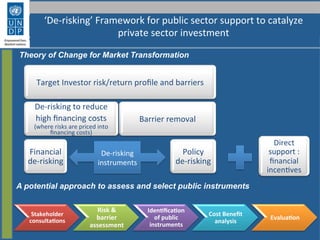
‘De-­‐risking’	
  Framework	
  for	
  public	
  sector	
  support	
  to	
  catalyze	
  
private	
  sector	
  investment	
  	
  
Theory of Change for Market Transformation
Target	
  Investor	
  risk/return	
  profile	
  and	
  barriers	
  
De-­‐risking	
  to	
  reduce	
  	
  
high	
  financing	
  costs	
  
(where	
  risks	
  are	
  priced	
  into	
  
financing	
  costs)	
  
Financial	
  
de-­‐risking	
  
Barrier	
  removal	
  
Policy	


de-­‐risking	
  
A potential approach to assess and select public instruments
Stakeholder	
  
consulta.ons	
  
Risk	
  &	
  
barrier	
  
assessment	
  
Iden.fica.on	
  
of	
  public	
  
instruments	
  
Cost	
  Benefit	
  
analysis	
  
Evalua.on	
  
De-­‐risking	
  
instruments	
  
Direct	
  
support	
  :	
  
financial	
  
incenGves	
  
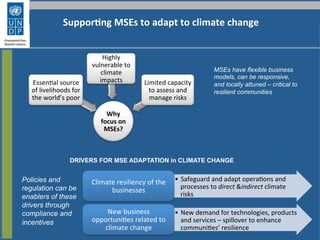
Suppor.ng	
  MSEs	
  to	
  adapt	
  to	
  climate	
  change	
  
Why	
  
focus	
  on	
  
MSEs?	
  
EssenGal	
  source	
  
of	
  livelihoods	
  for	
  
the	
  world’s	
  poor	
  
Highly	
  
vulnerable	
  to	
  
climate	
  
impacts	
   Limited	
  capacity	
  
to	
  assess	
  and	
  
manage	
  risks	
  
•  Safeguard	
  and	
  adapt	
  operaGons	
  and	
  
processes	
  to	
  direct	
  &indirect	
  climate	
  
risks	
  
Climate	
  resiliency	
  of	
  the	
  
businesses	
  
•  New	
  demand	
  for	
  technologies,	
  products	
  
and	
  services	
  –	
  spillover	
  to	
  enhance	
  
communiGes’	
  resilience	
  
New	
  business	
  
opportuniGes	
  related	
  to	
  
climate	
  change	
  
MSEs have flexible business
models, can be responsive,
and locally attuned – critical to
resilient communities
DRIVERS FOR MSE ADAPTATION in CLIMATE CHANGE
Policies and
regulation can be
enablers of these
drivers through
compliance and
incentives
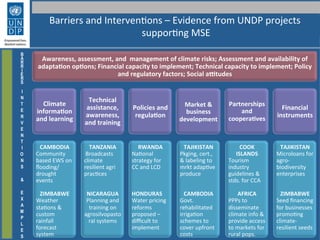
Barriers	
  and	
  IntervenGons	
  –	
  Evidence	
  from	
  UNDP	
  projects	
  
supporGng	
  MSE	
  
Awareness,	
  assessment,	
  and	
  	
  management	
  of	
  climate	
  risks;	
  Assessment	
  and	
  availability	
  of	
  
adapta.on	
  op.ons;	
  Financial	
  capacity	
  to	
  implement;	
  Technical	
  capacity	
  to	
  implement;	
  Policy	
  
and	
  regulatory	
  factors;	
  Social	
  aKtudes	
  
Climate	
  
informa.on	
  
and	
  learning	
  
CAMBODIA	
  
Community	
  
based	
  EWS	
  on	
  
flooding/
drought	
  
events	


ZIMBABWE	
  
Weather	
  
staGons	
  &	
  
custom	
  
rainfall	
  
forecast	
  
system	
  
Technical	
  
assistance,	
  
awareness,	
  
and	
  training	
  
TANZANIA	
  
	
  Broadcasts	
  
climate	
  
resilient	
  agri	
  
pracGces	


NICARAGUA	
  
Planning	
  and	
  
training	
  on	
  
agrosilvopasto
ral	
  systems	
  
Policies	
  and	
  
regula.on	
  
RWANDA	
  
NaGonal	
  
strategy	
  for	
  
CC	
  and	
  LCD	


HONDURAS	
  
Water	
  pricing	
  
reforms	
  
proposed	
  –	
  
difficult	
  to	
  
implement	


Market	
  &	
  
business	
  
development	


TAJIKISTAN	
  
Pkging,	
  cert.,	
  
&	
  labeling	
  to	
  
mrkt	
  adapGve	
  
produce	


CAMBODIA	
  
Govt.	
  
rehabilitated	
  
irrigaGon	
  
schemes	
  to	
  
cover	
  upfront	
  
costs	
  
Partnerships	
  
and	
  
coopera.ves	
  
COOK	
  
ISLANDS	
  
Tourism	
  
industry	
  
guidelines	
  &	
  
stds.	
  for	
  CCA	


AFRICA	
  
PPPs	
  to	
  
disseminate	
  
climate	
  info	
  &	
  
provide	
  access	
  
to	
  markets	
  for	
  
rural	
  pops.	
  
Financial	
  
instruments	
  
TAJIKISTAN	
  
Microloans	
  for	
  
agro-­‐
biodiversity	
  
enterprises	


ZIMBABWE	
  
Seed	
  financing	
  
for	
  businesses	
  
promoGng	
  
climate-­‐
resilient	
  seeds	


B
A
R
R
I
E
R
S
I
N
T
E
R
V
E
N
T
I
O
N
S
&
E
X
A
M
P
L
E
S
Mobilizing	
  GEF	
  Funds	
  
GEF	
  objec.ve:	
  Global	
  Environmental	
  Benefits	
  
LDCF/SCCF:	
  Objec.ve:	
  Adapta.on	
  Benefits	
  
142 GEF
eligible
countries
GEF $ allocated to
countries
CC, BD, LD
IW, CD, POPs, ODS, Hg
Replenished on 4 year
funding cycle
(GEF-6 = >4 billion USD)
UNEP
World Bank
UNIDO
FAO
IFAD
AFDB
ADB
IADB
EBRD
WWF
CI
UNDP
GEF Agencies
TA for Project
design and
Implementation
support
PIF
GEF has its own:
Governance
Trustees
Policy and Programming
Arrangements
Project +
fee for
services
Mobilizing	
  GCF	
  Funds	
  
Aims to finance a paradigm shift towards low-emission and climate
resilient pathways
Is the largest single source of climate finance
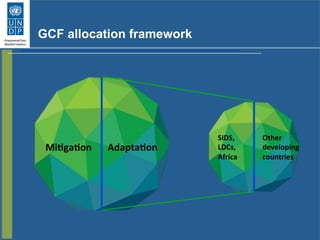
GCF allocation framework
Mi.ga.on	
   Adapta.on	
  
SIDS,	
  
LDCs,	
  
Africa	
  
Other	
  
developing	
  
countries	
  
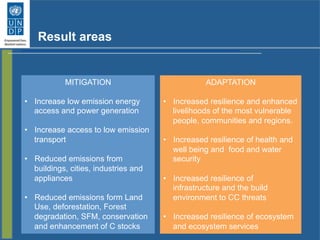
Result areas
MITIGATION
•  Increase low emission energy
access and power generation
•  Increase access to low emission
transport
•  Reduced emissions from
buildings, cities, industries and
appliances
•  Reduced emissions form Land
Use, deforestation, Forest
degradation, SFM, conservation
and enhancement of C stocks
ADAPTATION
•  Increased resilience and enhanced
livelihoods of the most vulnerable
people, communities and regions.
•  Increased resilience of health and
well being and food and water
security
•  Increased resilience of
infrastructure and the build
environment to CC threats
•  Increased resilience of ecosystem
and ecosystem services
Five investment priorities
•  Transforming energy generation and access
–  Renewables, energy efficiency, etc.
•  Creating climate-compatible cities
–  Urban resilient infrastructure, urban water supply, etc.
•  Encouraging low-emission and climate-resilient agriculture
–  Low-emission cultivation practices, resilient agricultural livelihoods, etc.
•  Scaling up finance for forests and climate change
–  Sustainable forest management, forest degradation/deforestation, etc.
•  Enhancing resilience in Small Island Developing States
(SIDS)
–  Coastal zone adaptation, drinking water supply and management, etc.
Six high level investment criteria
Potential to catalyse impact beyond a one-off
project or programme investment
Potential to the achieve the Fund's objectives and
result areas
Beneficiary country ownership of and capacity to
implement funded activities
Economic and financial soundness of programme/
project; appropriateness of concessionality
Potential to provide wider benefits and priorities -
environmental, economic, social, gender
Vulnerability and financing needs of the beneficiary
country and target groups
Impact Potential
Paradigm Shift Potential
Sustainable
Development Potential
Needs of Recipient
Country Ownership
Efficiency &
Effectiveness
Open	
  Discussion	


•  What	
  challenges	
  do	
  you	
  face	
  in	
  your	
  countries	
  to	
  mobilize	
  adaptaGon	
  
investments?	
  
–  Public	
  Sector	
  
–  Private	
  Sector	
  
•  What	
  lessons	
  learned/experiences	
  can	
  you	
  share	
  with	
  others	
  on	
  effecGve	
  
approaches	
  to	
  mobilize	
  adaptaGon	
  financing?	


•  How	
  can	
  the	
  BMUB	
  NAP	
  Agriculture	
  programme	
  play	
  a	
  role	
  in	
  supporGng	
  
your	
  country’s	
  efforts	
  to	
  mobilize	
  investments	
  for	
  adaptaGon	
  in	
  the	
  
agricultural	
  sector?	
  
Annex
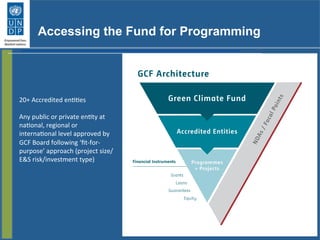
How do countries access the fund?
Accessing the Fund for Programming
20+	
  Accredited	
  enGGes	


Any	
  public	
  or	
  private	
  enGty	
  at	
  
naGonal,	
  regional	
  or	
  
internaGonal	
  level	
  approved	
  by	
  
GCF	
  Board	
  following	
  ‘fit-­‐for-­‐
purpose’	
  approach	
  (project	
  size/
E&S	
  risk/investment	
  type)	
  
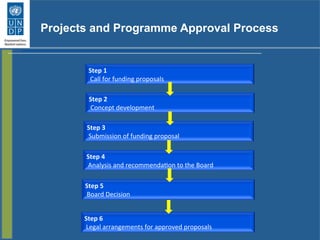
Projects and Programme Approval Process
Step	
  1	
  
	
  Call	
  for	
  funding	
  proposals	
  
Step	
  2	
  
	
  Concept	
  development	
  
Step	
  5	
  
	
  Board	
  Decision	
  
Step	
  4	
  
	
  Analysis	
  and	
  recommendaGon	
  to	
  the	
  Board	
  
Step	
  6	
  
	
  Legal	
  arrangements	
  for	
  approved	
  proposals	
  
Step	
  3	
  
	
  Submission	
  of	
  funding	
  proposal	
  
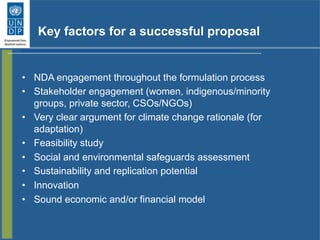
Key factors for a successful proposal
•  NDA engagement throughout the formulation process
•  Stakeholder engagement (women, indigenous/minority
groups, private sector, CSOs/NGOs)
•  Very clear argument for climate change rationale (for
adaptation)
•  Feasibility study
•  Social and environmental safeguards assessment
•  Sustainability and replication potential
•  Innovation
•  Sound economic and/or financial model
Current status
•  First 8 proposals have been approved for funding ($168M)
Country Focus Value ($
million)
Type Public/
Private
AE
Malawi Livelihoods and EWS 12.3 CCA Public UNDP
Maldives Water security 23.6 CCA Public UNDP
Peru Wetland resilience 6.2 Cross-
cutting
Public Profonanpe
(national)
Senegal EBA in salinized lands 7.6 CCA Public CSE (national)
Bangladesh Resilient infrastructure 40 CCA Public KfW
Eastern Africa CC venture fund for EBA
and off-grid solar
25 Cross-
cutting
Private Acumen
(regional)
LAC EE green bond 22 CCM Private IDB
Fiji Urban water supply 31 Cross-
cutting
Public ADB
Thank you

Mobilizing adaptation finance

  • 1.
     Mobilizing  adapta.on  finance     UNDP-GEF April 2016
  • 2.
    Mobilizing  MSEs  and  private  sector  investments  
  • 3.
    ‘De-­‐risking’  Framework  for  public  sector  support  to  catalyze   private  sector  investment     Theory of Change for Market Transformation Target  Investor  risk/return  profile  and  barriers   De-­‐risking  to  reduce     high  financing  costs   (where  risks  are  priced  into   financing  costs)   Financial   de-­‐risking   Barrier  removal   Policy       de-­‐risking   A potential approach to assess and select public instruments Stakeholder   consulta.ons   Risk  &   barrier   assessment   Iden.fica.on   of  public   instruments   Cost  Benefit   analysis   Evalua.on   De-­‐risking   instruments   Direct   support  :   financial   incenGves  
  • 4.
    Suppor.ng  MSEs  to  adapt  to  climate  change   Why   focus  on   MSEs?   EssenGal  source   of  livelihoods  for   the  world’s  poor   Highly   vulnerable  to   climate   impacts   Limited  capacity   to  assess  and   manage  risks   •  Safeguard  and  adapt  operaGons  and   processes  to  direct  &indirect  climate   risks   Climate  resiliency  of  the   businesses   •  New  demand  for  technologies,  products   and  services  –  spillover  to  enhance   communiGes’  resilience   New  business   opportuniGes  related  to   climate  change   MSEs have flexible business models, can be responsive, and locally attuned – critical to resilient communities DRIVERS FOR MSE ADAPTATION in CLIMATE CHANGE Policies and regulation can be enablers of these drivers through compliance and incentives
  • 5.
    Barriers  and  IntervenGons  –  Evidence  from  UNDP  projects   supporGng  MSE   Awareness,  assessment,  and    management  of  climate  risks;  Assessment  and  availability  of   adapta.on  op.ons;  Financial  capacity  to  implement;  Technical  capacity  to  implement;  Policy   and  regulatory  factors;  Social  aKtudes   Climate   informa.on   and  learning   CAMBODIA   Community   based  EWS  on   flooding/ drought   events     ZIMBABWE   Weather   staGons  &   custom   rainfall   forecast   system   Technical   assistance,   awareness,   and  training   TANZANIA    Broadcasts   climate   resilient  agri   pracGces       NICARAGUA   Planning  and   training  on   agrosilvopasto ral  systems   Policies  and   regula.on   RWANDA   NaGonal   strategy  for   CC  and  LCD         HONDURAS   Water  pricing   reforms   proposed  –   difficult  to   implement     Market  &   business   development     TAJIKISTAN   Pkging,  cert.,   &  labeling  to   mrkt  adapGve   produce       CAMBODIA   Govt.   rehabilitated   irrigaGon   schemes  to   cover  upfront   costs   Partnerships   and   coopera.ves   COOK   ISLANDS   Tourism   industry   guidelines  &   stds.  for  CCA     AFRICA   PPPs  to   disseminate   climate  info  &   provide  access   to  markets  for   rural  pops.   Financial   instruments   TAJIKISTAN   Microloans  for   agro-­‐ biodiversity   enterprises         ZIMBABWE   Seed  financing   for  businesses   promoGng   climate-­‐ resilient  seeds       B A R R I E R S I N T E R V E N T I O N S & E X A M P L E S
  • 6.
  • 7.
    GEF  objec.ve:  Global  Environmental  Benefits   LDCF/SCCF:  Objec.ve:  Adapta.on  Benefits   142 GEF eligible countries GEF $ allocated to countries CC, BD, LD IW, CD, POPs, ODS, Hg Replenished on 4 year funding cycle (GEF-6 = >4 billion USD) UNEP World Bank UNIDO FAO IFAD AFDB ADB IADB EBRD WWF CI UNDP GEF Agencies TA for Project design and Implementation support PIF GEF has its own: Governance Trustees Policy and Programming Arrangements Project + fee for services
  • 8.
  • 9.
    Aims to financea paradigm shift towards low-emission and climate resilient pathways Is the largest single source of climate finance
  • 10.
    GCF allocation framework Mi.ga.on   Adapta.on   SIDS,   LDCs,   Africa   Other   developing   countries  
  • 11.
    Result areas MITIGATION •  Increaselow emission energy access and power generation •  Increase access to low emission transport •  Reduced emissions from buildings, cities, industries and appliances •  Reduced emissions form Land Use, deforestation, Forest degradation, SFM, conservation and enhancement of C stocks ADAPTATION •  Increased resilience and enhanced livelihoods of the most vulnerable people, communities and regions. •  Increased resilience of health and well being and food and water security •  Increased resilience of infrastructure and the build environment to CC threats •  Increased resilience of ecosystem and ecosystem services
  • 12.
    Five investment priorities • Transforming energy generation and access –  Renewables, energy efficiency, etc. •  Creating climate-compatible cities –  Urban resilient infrastructure, urban water supply, etc. •  Encouraging low-emission and climate-resilient agriculture –  Low-emission cultivation practices, resilient agricultural livelihoods, etc. •  Scaling up finance for forests and climate change –  Sustainable forest management, forest degradation/deforestation, etc. •  Enhancing resilience in Small Island Developing States (SIDS) –  Coastal zone adaptation, drinking water supply and management, etc.
  • 13.
    Six high levelinvestment criteria Potential to catalyse impact beyond a one-off project or programme investment Potential to the achieve the Fund's objectives and result areas Beneficiary country ownership of and capacity to implement funded activities Economic and financial soundness of programme/ project; appropriateness of concessionality Potential to provide wider benefits and priorities - environmental, economic, social, gender Vulnerability and financing needs of the beneficiary country and target groups Impact Potential Paradigm Shift Potential Sustainable Development Potential Needs of Recipient Country Ownership Efficiency & Effectiveness
  • 14.
    Open  Discussion     •  What  challenges  do  you  face  in  your  countries  to  mobilize  adaptaGon   investments?   –  Public  Sector   –  Private  Sector   •  What  lessons  learned/experiences  can  you  share  with  others  on  effecGve   approaches  to  mobilize  adaptaGon  financing?     •  How  can  the  BMUB  NAP  Agriculture  programme  play  a  role  in  supporGng   your  country’s  efforts  to  mobilize  investments  for  adaptaGon  in  the   agricultural  sector?  
  • 15.
  • 16.
    How do countriesaccess the fund?
  • 17.
    Accessing the Fundfor Programming 20+  Accredited  enGGes     Any  public  or  private  enGty  at   naGonal,  regional  or   internaGonal  level  approved  by   GCF  Board  following  ‘fit-­‐for-­‐ purpose’  approach  (project  size/ E&S  risk/investment  type)  
  • 18.
    Projects and ProgrammeApproval Process Step  1    Call  for  funding  proposals   Step  2    Concept  development   Step  5    Board  Decision   Step  4    Analysis  and  recommendaGon  to  the  Board   Step  6    Legal  arrangements  for  approved  proposals   Step  3    Submission  of  funding  proposal  
  • 19.
    Key factors fora successful proposal •  NDA engagement throughout the formulation process •  Stakeholder engagement (women, indigenous/minority groups, private sector, CSOs/NGOs) •  Very clear argument for climate change rationale (for adaptation) •  Feasibility study •  Social and environmental safeguards assessment •  Sustainability and replication potential •  Innovation •  Sound economic and/or financial model
  • 20.
    Current status •  First8 proposals have been approved for funding ($168M) Country Focus Value ($ million) Type Public/ Private AE Malawi Livelihoods and EWS 12.3 CCA Public UNDP Maldives Water security 23.6 CCA Public UNDP Peru Wetland resilience 6.2 Cross- cutting Public Profonanpe (national) Senegal EBA in salinized lands 7.6 CCA Public CSE (national) Bangladesh Resilient infrastructure 40 CCA Public KfW Eastern Africa CC venture fund for EBA and off-grid solar 25 Cross- cutting Private Acumen (regional) LAC EE green bond 22 CCM Private IDB Fiji Urban water supply 31 Cross- cutting Public ADB
  • 21.