Stephane Hallegatte, Mook Bangalore, Laura Bonzanigo, Marianne Fay, Tamaro Kane, Ulf
Narloch, Julie Rozenberg, David Treguer, Adrien Vogt-Schilb
Climate Change Cross-Cutting Solutions Area
The World Bank Group 1
Climate-related shocks and stresses, already
a major obstacle to poverty reduction, will
worsen with climate change
Main Message #1
2
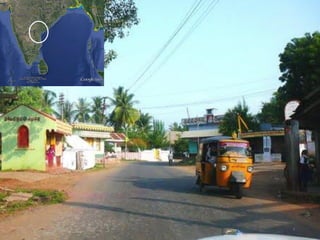
3
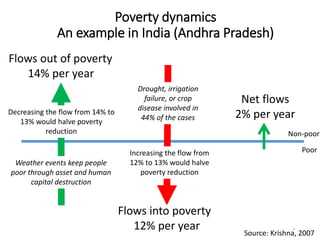
Flows into poverty
12% per year
Poverty dynamics
An example in India (Andhra Pradesh)
Non-poor
Poor
Flows out of poverty
14% per year
Net flows
2% per year
Drought, irrigation
failure, or crop
disease involved in
44% of the cases
Increasing the flow from
12% to 13% would halve
poverty reduction
Decreasing the flow from 14% to
13% would halve poverty
reduction
Weather events keep people
poor through asset and human
capital destruction
Source: Krishna, 2007
4
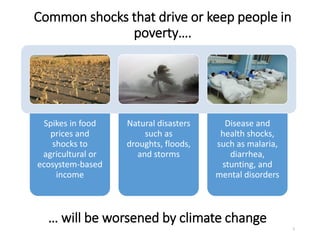
Common shocks that drive or keep people in
poverty….
Spikes in food
prices and
shocks to
agricultural or
ecosystem-based
income
Natural disasters
such as
droughts, floods,
and storms
Disease and
health shocks,
such as malaria,
diarrhea,
stunting, and
mental disorders
… will be worsened by climate change
5
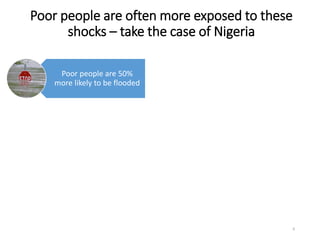
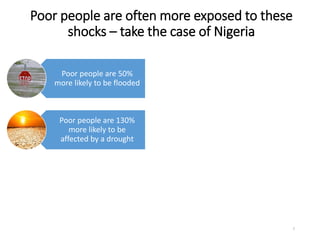
Poor people are often more exposed to these
shocks – take the case of Nigeria
6
Poor people are 50%
more likely to be flooded
Poor people are 130%
more likely to be
affected by a drought
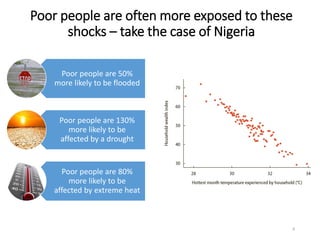
Poor people are 80%
more likely to be
affected by extreme heat
7
Poor people are 50%
more likely to be flooded
Poor people are 130%
more likely to be
affected by a drought
Poor people are 80%
more likely to be
affected by extreme heat
Poor people are often more exposed to these
shocks – take the case of Nigeria
8
Poor people are 50%
more likely to be flooded
Poor people are 130%
more likely to be
affected by a drought
Poor people are 80%
more likely to be
affected by extreme heat
Poor people are often more exposed to these
shocks – take the case of Nigeria
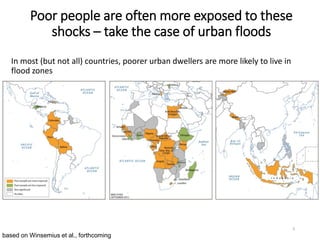
In most (but not all) countries, poorer urban dwellers are more likely to live in
flood zones
9
based on Winsemius et al., forthcoming
Poor people are often more exposed to these
shocks – take the case of urban floods
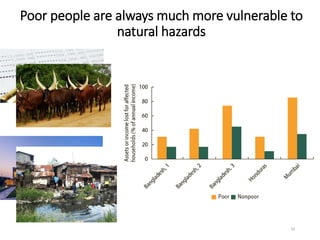
Poor people are always much more vulnerable to
natural hazards
10
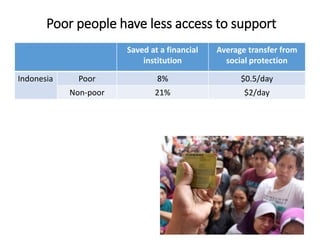
Saved at a financial
institution
Average transfer from
social protection
Indonesia Poor 8% $0.5/day
Non-poor 21% $2/day
Poor people have less access to support
11
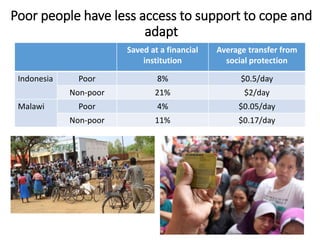
Saved at a financial
institution
Average transfer from
social protection
Indonesia Poor 8% $0.5/day
Non-poor 21% $2/day
Malawi Poor 4% $0.05/day
Non-poor 11% $0.17/day
Poor people have less access to support to cope and
adapt
12
Rapid, inclusive, and climate-informed
development can prevent most
consequences of climate change on
poverty till 2030.
Main Message #2
13
Absent such good development, climate change
could add more than 100 million people in
extreme poverty by 2030.
14
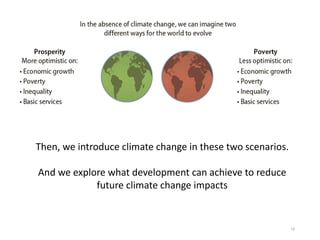
Then, we introduce climate change in these two scenarios.
And we explore what development can achieve to reduce
future climate change impacts
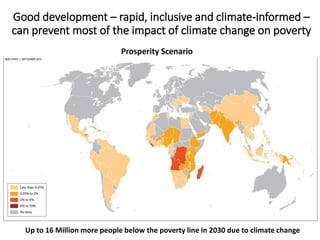
Good development – rapid, inclusive and climate-informed –
can prevent most of the impact of climate change on poverty
Up to 16 Million more people below the poverty line in 2030 due to climate change
Prosperity Scenario
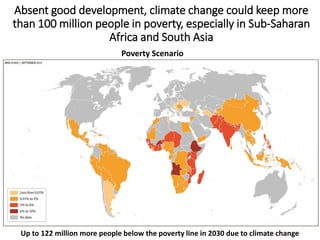
Absent good development, climate change could keep more
than 100 million people in poverty, especially in Sub-Saharan
Africa and South Asia
Up to 122 million more people below the poverty line in 2030 due to climate change
Poverty Scenario
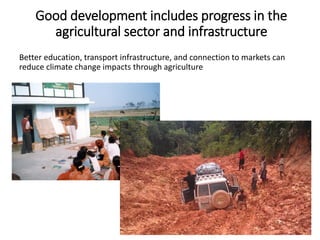
Better education, transport infrastructure, and connection to markets can
reduce climate change impacts through agriculture
Good development includes progress in the
agricultural sector and infrastructure
17
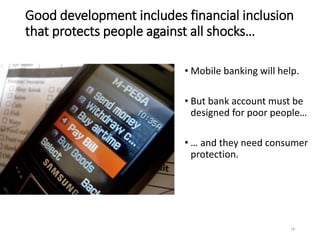
Good development includes financial inclusion
that protects people against all shocks…
• Mobile banking will help.
• But bank account must be
designed for poor people…
• … and they need consumer
protection.
18
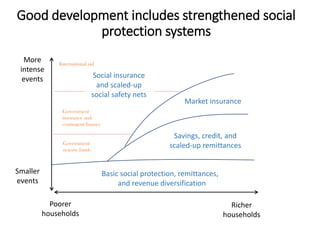
More
intense
events
Richer
households
Basic social protection, remittances,
and revenue diversification
Market insurance
Savings, credit, and
scaled-up remittances
Smaller
events
Poorer
households
Government
reserve funds
Government
insurance and
contingent finance
Social insurance
and scaled-up
social safety nets
International aid
Good development includes strengthened social
protection systems
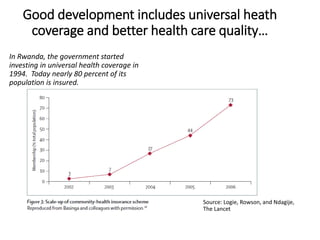
Good development includes universal heath
coverage and better health care quality…
In Rwanda, the government started
investing in universal health coverage in
1994. Today nearly 80 percent of its
population is insured.
Source: Logie, Rowson, and Ndagije,
The Lancet
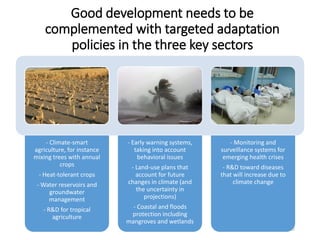
- Climate-smart
agriculture, for instance
mixing trees with annual
crops
- Heat-tolerant crops
- Water reservoirs and
groundwater
management
- R&D for tropical
agriculture
- Early warning systems,
taking into account
behavioral issues
- Land-use plans that
account for future
changes in climate (and
the uncertainty in
projections)
- Coastal and floods
protection including
mangroves and wetlands
- Monitoring and
surveillance systems for
emerging health crises
- R&D toward diseases
that will increase due to
climate change
Good development needs to be
complemented with targeted adaptation
policies in the three key sectors
22
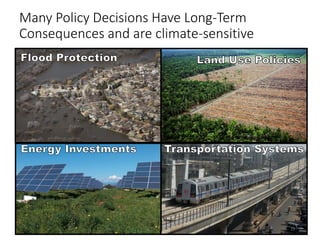
Many Policy Decisions Have Long-Term
Consequences and are climate-sensitive
23
Immediate mitigation is required to
remove the long-term threat that
climate change creates for poverty eradication.
Mitigation need not threaten short-
term progress on poverty
reduction provided that policies are well
designed and international support is available.
Main Message #3
24
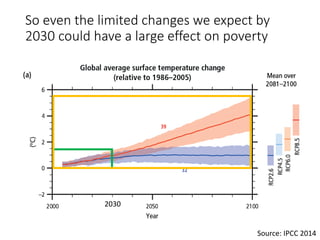
So even the limited changes we expect by
2030 could have a large effect on poverty
25
2030
Source: IPCC 2014
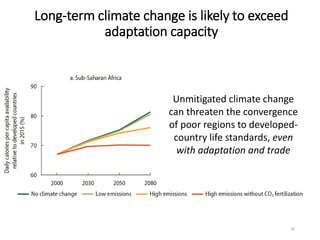
Long-term climate change is likely to exceed
adaptation capacity
26
Unmitigated climate change
can threaten the convergence
of poor regions to developed-
country life standards, even
with adaptation and trade
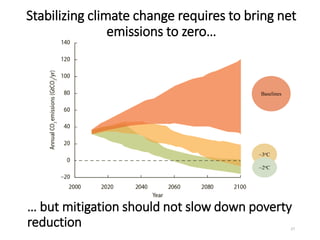
~3oC
~2oC
Baselines
… but mitigation should not slow down poverty
reduction
Stabilizing climate change requires to bring net
emissions to zero…
27
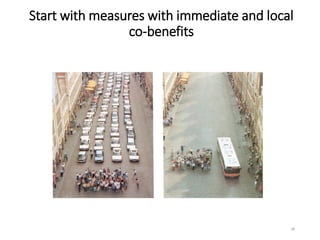
Start with measures with immediate and local
co-benefits
28
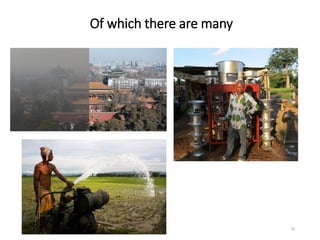
Of which there are many
29
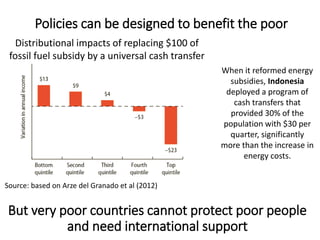
When it reformed energy
subsidies, Indonesia
deployed a program of
cash transfers that
provided 30% of the
population with $30 per
quarter, significantly
more than the increase in
energy costs.
Source: based on Arze del Granado et al (2012)
Policies can be designed to benefit the poor
But very poor countries cannot protect poor people
and need international support
Distributional impacts of replacing $100 of
fossil fuel subsidy by a universal cash transfer
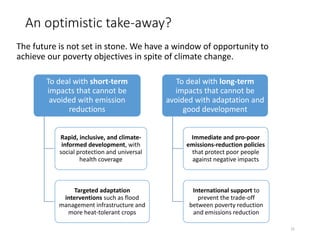
An optimistic take-away?
The future is not set in stone. We have a window of opportunity to
achieve our poverty objectives in spite of climate change.
31
To deal with short-term
impacts that cannot be
avoided with emission
reductions
Rapid, inclusive, and climate-
informed development, with
social protection and universal
health coverage
Targeted adaptation
interventions such as flood
management infrastructure and
more heat-tolerant crops
To deal with long-term
impacts that cannot be
avoided with adaptation and
good development
Immediate and pro-poor
emissions-reduction policies
that protect poor people
against negative impacts
International support to
prevent the trade-off
between poverty reduction
and emissions reduction
Stephane Hallegatte, Mook Bangalore, Laura Bonzanigo, Marianne Fay, Tamaro Kane, Ulf
Narloch, Julie Rozenberg, David Treguer, Adrien Vogt-Schilb
Climate Change Cross-Cutting Solutions Area
The World Bank Group 32

3.1 hallegatte world bank

  • 1.
    Stephane Hallegatte, MookBangalore, Laura Bonzanigo, Marianne Fay, Tamaro Kane, Ulf Narloch, Julie Rozenberg, David Treguer, Adrien Vogt-Schilb Climate Change Cross-Cutting Solutions Area The World Bank Group 1
  • 2.
    Climate-related shocks andstresses, already a major obstacle to poverty reduction, will worsen with climate change Main Message #1 2
  • 3.
  • 4.
    Flows into poverty 12%per year Poverty dynamics An example in India (Andhra Pradesh) Non-poor Poor Flows out of poverty 14% per year Net flows 2% per year Drought, irrigation failure, or crop disease involved in 44% of the cases Increasing the flow from 12% to 13% would halve poverty reduction Decreasing the flow from 14% to 13% would halve poverty reduction Weather events keep people poor through asset and human capital destruction Source: Krishna, 2007 4
  • 5.
    Common shocks thatdrive or keep people in poverty…. Spikes in food prices and shocks to agricultural or ecosystem-based income Natural disasters such as droughts, floods, and storms Disease and health shocks, such as malaria, diarrhea, stunting, and mental disorders … will be worsened by climate change 5
  • 6.
    Poor people areoften more exposed to these shocks – take the case of Nigeria 6 Poor people are 50% more likely to be flooded Poor people are 130% more likely to be affected by a drought Poor people are 80% more likely to be affected by extreme heat
  • 7.
    7 Poor people are50% more likely to be flooded Poor people are 130% more likely to be affected by a drought Poor people are 80% more likely to be affected by extreme heat Poor people are often more exposed to these shocks – take the case of Nigeria
  • 8.
    8 Poor people are50% more likely to be flooded Poor people are 130% more likely to be affected by a drought Poor people are 80% more likely to be affected by extreme heat Poor people are often more exposed to these shocks – take the case of Nigeria
  • 9.
    In most (butnot all) countries, poorer urban dwellers are more likely to live in flood zones 9 based on Winsemius et al., forthcoming Poor people are often more exposed to these shocks – take the case of urban floods
  • 10.
    Poor people arealways much more vulnerable to natural hazards 10
  • 11.
    Saved at afinancial institution Average transfer from social protection Indonesia Poor 8% $0.5/day Non-poor 21% $2/day Poor people have less access to support 11
  • 12.
    Saved at afinancial institution Average transfer from social protection Indonesia Poor 8% $0.5/day Non-poor 21% $2/day Malawi Poor 4% $0.05/day Non-poor 11% $0.17/day Poor people have less access to support to cope and adapt 12
  • 13.
    Rapid, inclusive, andclimate-informed development can prevent most consequences of climate change on poverty till 2030. Main Message #2 13 Absent such good development, climate change could add more than 100 million people in extreme poverty by 2030.
  • 14.
    14 Then, we introduceclimate change in these two scenarios. And we explore what development can achieve to reduce future climate change impacts
  • 15.
    Good development –rapid, inclusive and climate-informed – can prevent most of the impact of climate change on poverty Up to 16 Million more people below the poverty line in 2030 due to climate change Prosperity Scenario
  • 16.
    Absent good development,climate change could keep more than 100 million people in poverty, especially in Sub-Saharan Africa and South Asia Up to 122 million more people below the poverty line in 2030 due to climate change Poverty Scenario
  • 17.
    Better education, transportinfrastructure, and connection to markets can reduce climate change impacts through agriculture Good development includes progress in the agricultural sector and infrastructure 17
  • 18.
    Good development includesfinancial inclusion that protects people against all shocks… • Mobile banking will help. • But bank account must be designed for poor people… • … and they need consumer protection. 18
  • 19.
    More intense events Richer households Basic social protection,remittances, and revenue diversification Market insurance Savings, credit, and scaled-up remittances Smaller events Poorer households Government reserve funds Government insurance and contingent finance Social insurance and scaled-up social safety nets International aid Good development includes strengthened social protection systems
  • 20.
    Good development includesuniversal heath coverage and better health care quality… In Rwanda, the government started investing in universal health coverage in 1994. Today nearly 80 percent of its population is insured. Source: Logie, Rowson, and Ndagije, The Lancet
  • 21.
    - Climate-smart agriculture, forinstance mixing trees with annual crops - Heat-tolerant crops - Water reservoirs and groundwater management - R&D for tropical agriculture - Early warning systems, taking into account behavioral issues - Land-use plans that account for future changes in climate (and the uncertainty in projections) - Coastal and floods protection including mangroves and wetlands - Monitoring and surveillance systems for emerging health crises - R&D toward diseases that will increase due to climate change Good development needs to be complemented with targeted adaptation policies in the three key sectors 22
  • 22.
    Many Policy DecisionsHave Long-Term Consequences and are climate-sensitive 23
  • 23.
    Immediate mitigation isrequired to remove the long-term threat that climate change creates for poverty eradication. Mitigation need not threaten short- term progress on poverty reduction provided that policies are well designed and international support is available. Main Message #3 24
  • 24.
    So even thelimited changes we expect by 2030 could have a large effect on poverty 25 2030 Source: IPCC 2014
  • 25.
    Long-term climate changeis likely to exceed adaptation capacity 26 Unmitigated climate change can threaten the convergence of poor regions to developed- country life standards, even with adaptation and trade
  • 26.
    ~3oC ~2oC Baselines … but mitigationshould not slow down poverty reduction Stabilizing climate change requires to bring net emissions to zero… 27
  • 27.
    Start with measureswith immediate and local co-benefits 28
  • 28.
    Of which thereare many 29
  • 29.
    When it reformedenergy subsidies, Indonesia deployed a program of cash transfers that provided 30% of the population with $30 per quarter, significantly more than the increase in energy costs. Source: based on Arze del Granado et al (2012) Policies can be designed to benefit the poor But very poor countries cannot protect poor people and need international support Distributional impacts of replacing $100 of fossil fuel subsidy by a universal cash transfer
  • 30.
    An optimistic take-away? Thefuture is not set in stone. We have a window of opportunity to achieve our poverty objectives in spite of climate change. 31 To deal with short-term impacts that cannot be avoided with emission reductions Rapid, inclusive, and climate- informed development, with social protection and universal health coverage Targeted adaptation interventions such as flood management infrastructure and more heat-tolerant crops To deal with long-term impacts that cannot be avoided with adaptation and good development Immediate and pro-poor emissions-reduction policies that protect poor people against negative impacts International support to prevent the trade-off between poverty reduction and emissions reduction
  • 31.
    Stephane Hallegatte, MookBangalore, Laura Bonzanigo, Marianne Fay, Tamaro Kane, Ulf Narloch, Julie Rozenberg, David Treguer, Adrien Vogt-Schilb Climate Change Cross-Cutting Solutions Area The World Bank Group 32