Understanding Team Building Transfer
A White Paper from CLI

Susan Cain, Ed.D.
The Corporate Learning Institute
May 2010
The Corporate Learning Institute’s programs teach, inspire, renew, and challenge
your people to become powerful performers. Our expert consultation and facilitation
ensures that participants learn the skills that are critical to their success back at work.
Our bottom line is to help achieve both personal and organizational success.
The Corporate Learning Institute offers a continuum of services from short-term
training events to full-scale change projects. For maximum return on investment, our
services are custom designed for each client we work with. Our services encompass the
following five areas:
Consulting Services: Our approach is rooted in process consultation, organizational
behavior, organizational development and expert facilitation. We provide strategic
planning, vision, mission and values development, change management, culture work
and executive planning retreats.
Training and Development Workshops: These dynamic skill building sessions
include leadership, management and supervisory training, performance accountability,
change management, customer service, diversity, personality styles, conflict
management, train the trainer and communication.
Performance Coaching: Our expert coaches provide assistance with team coaching
and development, individual performance coaching and executive coaching.
Adventure Programming: We provide provocative Team Challenge and High Ropes
Courses tangibly designed to target performance improvement.
Corporate Team Building Events: Our lively, well-orchestrated, and power packed
events create awareness of your organizations goals.
Organizations

across the world use
teams and teamwork as a basic unit of
operation to accomplish goals. The
popular notion of teams, that they are a
group of people who get along well
enough to get things done, has been
thrown by the wayside. Today, every
conceivable measurement and training
apparatus are employed to ensure that
teams, like any other important resource
within a company, are developed with
strategic precision. Companies invest
millions of dollars in training each year,
because “they believe that their people do
not have the right skills to compete
effectively”, (Cheese, 2004, p.12). A
continuous challenge for developers of
training programs is to
ensure that training dollars
are well spent and that
training impact transfers to
the work place.

In their monograph “Making
it Sticky, How to facilitate the
Transfer
of
Executive
education
experiences Back to the Workplace”,
researchers Haskins and Clawson (2005)
of the University of Virginia found that
there were three areas in their executive
education program that would allow for
“sticky” mechanisms to be embedded:
before, during, and after the training.
They believe that the “stickiness” of a
mechanism increases as it moves from
the pre-program to post-program phases.
The authors note that this phenomenon
exists in both open enrollment programs
as well as custom designed single
corporation
training
programs.
Additionally, they found that adults learn
best in response to immediate concerns,

which implies that training must focus on
the impact back in the workplace.
Traditional training transfer studies have
explored the significance of trainee
characteristics, training design, and work
climate variables on training transfer in
attempting to validate the influence of
each of these independent variables on
training transfer (Baldwin & Ford, 1988,
Ford & Weinstein, 1997).

After an extensive review of the
literature, it was found that many
different theories have been used to
explain training transfer variables (Miles,
1975). Noël and Schmitt
(1986)
found
that
individuals might attend
training to gain equity in pay
or other rewards. Baldwin
&Ford (2000) developed a
training transfer construct
composed
of
trainee’s
characteristics- ability and
aptitude, personality and
motivation, as well as work environment
variables (supportive organizational
climate, discussion with supervisor,
opportunity to use knowledge and skills,
post training goal setting and feedback).
Holton et al (2000) created the Learning
Transfer Systems Inventory, which
considers a comprehensive list of training
transfer variables including trainee
characteristics,
motivation,
work
environment, and ability. Mathieu and
Martineau (1997) classified trainee’s
motivation in two areas: motivation to
learn, and motivation to transfer learning.
It is important that programs address
both needs and deliver programs for
adult learners with both preferences.
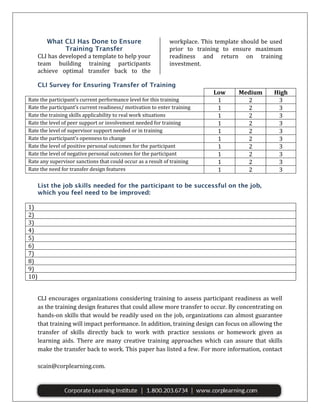
CLI has developed a template to help your
team building training participants
achieve optimal transfer back to the

workplace. This template should be used
prior to training to ensure maximum
readiness and return on training
investment.

Rate the participant’s current performance level for this training
Rate the participant’s current readiness/ motivation to enter training
Rate the training skills applicability to real work situations
Rate the level of peer support or involvement needed for training
Rate the level of supervisor support needed or in training
Rate the participant’s openness to change
Rate the level of positive personal outcomes for the participant
Rate the level of negative personal outcomes for the participant
Rate any supervisor sanctions that could occur as a result of training
Rate the need for transfer design features

Low
1
1
1
1
1
1
1
1
1
1

Medium
2
2
2
2
2
2
2
2
2
2

High
3
3
3
3
3
3
3
3
3
3

1)
2)
3)
4)
5)
6)
7)
8)
9)
10)
CLI encourages organizations considering training to assess participant readiness as well
as the training design features that could allow more transfer to occur. By concentrating on
hands-on skills that would be readily used on the job, organizations can almost guarantee
that training will impact performance. In addition, training design can focus on allowing the
transfer of skills directly back to work with practice sessions or homework given as
learning aids. There are many creative training approaches which can assure that skills
make the transfer back to work. This paper has listed a few. For more information, contact
the Corporate Learning Institute at 1.800.203.6734, or Dr. Susan Cain at scain@corplearning.com
scain@corplearning.com.

Understanding Team Building Tranfer

  • 1.
    Understanding Team BuildingTransfer A White Paper from CLI Susan Cain, Ed.D. The Corporate Learning Institute May 2010
  • 2.
    The Corporate LearningInstitute’s programs teach, inspire, renew, and challenge your people to become powerful performers. Our expert consultation and facilitation ensures that participants learn the skills that are critical to their success back at work. Our bottom line is to help achieve both personal and organizational success. The Corporate Learning Institute offers a continuum of services from short-term training events to full-scale change projects. For maximum return on investment, our services are custom designed for each client we work with. Our services encompass the following five areas: Consulting Services: Our approach is rooted in process consultation, organizational behavior, organizational development and expert facilitation. We provide strategic planning, vision, mission and values development, change management, culture work and executive planning retreats. Training and Development Workshops: These dynamic skill building sessions include leadership, management and supervisory training, performance accountability, change management, customer service, diversity, personality styles, conflict management, train the trainer and communication. Performance Coaching: Our expert coaches provide assistance with team coaching and development, individual performance coaching and executive coaching. Adventure Programming: We provide provocative Team Challenge and High Ropes Courses tangibly designed to target performance improvement. Corporate Team Building Events: Our lively, well-orchestrated, and power packed events create awareness of your organizations goals.
  • 3.
    Organizations across the worlduse teams and teamwork as a basic unit of operation to accomplish goals. The popular notion of teams, that they are a group of people who get along well enough to get things done, has been thrown by the wayside. Today, every conceivable measurement and training apparatus are employed to ensure that teams, like any other important resource within a company, are developed with strategic precision. Companies invest millions of dollars in training each year, because “they believe that their people do not have the right skills to compete effectively”, (Cheese, 2004, p.12). A continuous challenge for developers of training programs is to ensure that training dollars are well spent and that training impact transfers to the work place. In their monograph “Making it Sticky, How to facilitate the Transfer of Executive education experiences Back to the Workplace”, researchers Haskins and Clawson (2005) of the University of Virginia found that there were three areas in their executive education program that would allow for “sticky” mechanisms to be embedded: before, during, and after the training. They believe that the “stickiness” of a mechanism increases as it moves from the pre-program to post-program phases. The authors note that this phenomenon exists in both open enrollment programs as well as custom designed single corporation training programs. Additionally, they found that adults learn best in response to immediate concerns, which implies that training must focus on the impact back in the workplace. Traditional training transfer studies have explored the significance of trainee characteristics, training design, and work climate variables on training transfer in attempting to validate the influence of each of these independent variables on training transfer (Baldwin & Ford, 1988, Ford & Weinstein, 1997). After an extensive review of the literature, it was found that many different theories have been used to explain training transfer variables (Miles, 1975). Noël and Schmitt (1986) found that individuals might attend training to gain equity in pay or other rewards. Baldwin &Ford (2000) developed a training transfer construct composed of trainee’s characteristics- ability and aptitude, personality and motivation, as well as work environment variables (supportive organizational climate, discussion with supervisor, opportunity to use knowledge and skills, post training goal setting and feedback). Holton et al (2000) created the Learning Transfer Systems Inventory, which considers a comprehensive list of training transfer variables including trainee characteristics, motivation, work environment, and ability. Mathieu and Martineau (1997) classified trainee’s motivation in two areas: motivation to learn, and motivation to transfer learning. It is important that programs address both needs and deliver programs for adult learners with both preferences.
  • 4.
    CLI has developeda template to help your team building training participants achieve optimal transfer back to the workplace. This template should be used prior to training to ensure maximum readiness and return on training investment. Rate the participant’s current performance level for this training Rate the participant’s current readiness/ motivation to enter training Rate the training skills applicability to real work situations Rate the level of peer support or involvement needed for training Rate the level of supervisor support needed or in training Rate the participant’s openness to change Rate the level of positive personal outcomes for the participant Rate the level of negative personal outcomes for the participant Rate any supervisor sanctions that could occur as a result of training Rate the need for transfer design features Low 1 1 1 1 1 1 1 1 1 1 Medium 2 2 2 2 2 2 2 2 2 2 High 3 3 3 3 3 3 3 3 3 3 1) 2) 3) 4) 5) 6) 7) 8) 9) 10) CLI encourages organizations considering training to assess participant readiness as well as the training design features that could allow more transfer to occur. By concentrating on hands-on skills that would be readily used on the job, organizations can almost guarantee that training will impact performance. In addition, training design can focus on allowing the transfer of skills directly back to work with practice sessions or homework given as learning aids. There are many creative training approaches which can assure that skills make the transfer back to work. This paper has listed a few. For more information, contact the Corporate Learning Institute at 1.800.203.6734, or Dr. Susan Cain at scain@corplearning.com scain@corplearning.com.