ADDING –ED AND – 
ING
Verbs ending in –ed or –ing 
• The past tense refers to things that happened in the 
past. To make the past tense of regular verbs, the 
ending -ed is added to the infinitive. To make the 
present participle, the ending -ing is added to the 
infinitive. 
•Often there's no need to make any other spelling 
changes when you add -ed and -ing to the infinitive 
but there are some cases when it's necessary.
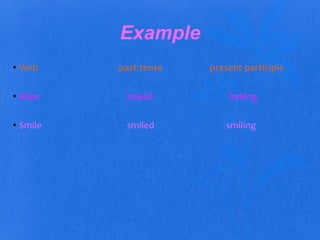
Example 
• Verb past tense present participle 
• Bake baked baking 
• Smile smiled smiling
Give me 2 examples of verbs ending in –ed or in 
–ing .
Adjectives ending in –ed or –ing. 
• Terminations "-ed" and "-ing" are used not only to form 
tenses of past and present continuous, also used with 
adjectives. These adjectives are composed of a verb and 
these two endings, but keep in mind that the meaning 
changes depending on which termination is used.
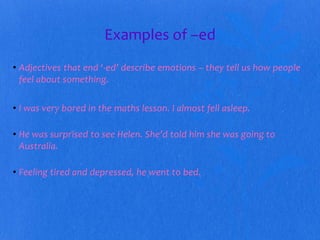
Examples of –ed 
• Adjectives that end ‘-ed’ describe emotions – they tell us how people 
feel about something. 
• I was very bored in the maths lesson. I almost fell asleep. 
• He was surprised to see Helen. She’d told him she was going to 
Australia. 
• Feeling tired and depressed, he went to bed.
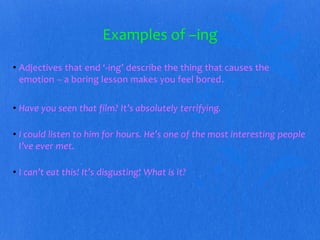
Examples of –ing 
• Adjectives that end ‘-ing’ describe the thing that causes the 
emotion – a boring lesson makes you feel bored. 
• Have you seen that film? It’s absolutely terrifying. 
• I could listen to him for hours. He’s one of the most interesting people 
I’ve ever met. 
• I can’t eat this! It’s disgusting! What is it?
Say 1 example of an adjective ending in –ed
Video 
• https://www.youtube.com/watch?feature=player_detailpage&v=5j5 
g5xThho4

Language test

  • 1.
  • 2.
    Verbs ending in–ed or –ing • The past tense refers to things that happened in the past. To make the past tense of regular verbs, the ending -ed is added to the infinitive. To make the present participle, the ending -ing is added to the infinitive. •Often there's no need to make any other spelling changes when you add -ed and -ing to the infinitive but there are some cases when it's necessary.
  • 3.
    Example • Verbpast tense present participle • Bake baked baking • Smile smiled smiling
  • 4.
    Give me 2examples of verbs ending in –ed or in –ing .
  • 5.
    Adjectives ending in–ed or –ing. • Terminations "-ed" and "-ing" are used not only to form tenses of past and present continuous, also used with adjectives. These adjectives are composed of a verb and these two endings, but keep in mind that the meaning changes depending on which termination is used.
  • 6.
    Examples of –ed • Adjectives that end ‘-ed’ describe emotions – they tell us how people feel about something. • I was very bored in the maths lesson. I almost fell asleep. • He was surprised to see Helen. She’d told him she was going to Australia. • Feeling tired and depressed, he went to bed.
  • 7.
    Examples of –ing • Adjectives that end ‘-ing’ describe the thing that causes the emotion – a boring lesson makes you feel bored. • Have you seen that film? It’s absolutely terrifying. • I could listen to him for hours. He’s one of the most interesting people I’ve ever met. • I can’t eat this! It’s disgusting! What is it?
  • 8.
    Say 1 exampleof an adjective ending in –ed
  • 9.