Organisational Structure
Copyright © 2021 Talent & Skills HuB
What is Organisational Structure?
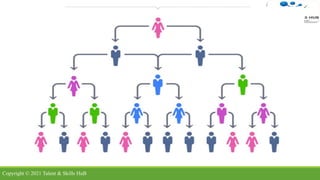
Organisational structure refers to the way that roles are coordinated, controlled and
communicated within an organisation.
The structure is often represented in a diagram called an organisation chart.
An organisation's structure should be designed to deliver goals and objectives of the
organisation as well as use resources in the best possible way.
An organizational structure is a visual diagram of an organisation that describes what
employees do, whom they report to, and how decisions are made across the organisation.
Copyright © 2021 Talent & Skills HuB
Importance of Organisational Structure
Organisational structures help to define the key elements of how an organisation controlled and
managed.
An organizational structure can be helpful for new employees to learn who manages and what
processes that exist in the organisation.
With organisational structure, you can visualize how the work flows in the diagrams.
To put it simple, the chart explains how an organisation works and how its roles are organized.
Copyright © 2021 Talent & Skills HuB
Category of Organisational Structure
Organisational Structure can be categorised as Mechanistic or Organic.
The mechanistic structure represents the traditional, top-down approach to
organizational structure, whereas the organic structure represents a more
collaborative, flexible approach.
Copyright © 2021 Talent & Skills HuB
Mechanistic Structure
Mechanistic structures, also called bureaucratic structures, are known for having
narrow spans of control, as well as high specialization, and formalization.
They are also quite rigid in what specific departments are designed and permitted
to do for the company.
This organizational structure is much more formal than organic structure, using
specific standards and practices to govern every decision the business makes.
As daunting and inflexible as mechanistic structure sounds, the chain of command,
whether long or short, is always clear under this model.
Copyright © 2021 Talent & Skills HuB
Organic Structure
Organic structures (also known as "flat" structures) are known for their wide spans of
control, decentralization, low specialization, and loose departmentalization.
This structure might have multiple teams answering to one person and taking on projects
based on their importance and what the team is capable of rather than what the team is
designed to do.
As you can probably tell, this organizational structure is much less formal than mechanistic,
and takes a bit of an ad-hoc approach to business needs.
With this nature of structure, leaders might give certain projects the green light more
quickly but it cause confusion in a project's division of labour.
Copyright © 2021 Talent & Skills HuB
Types of Organizational Structure
Functional Organizational Structure
Product-Based Divisional Structure
Geographical Divisional Structure
Process-Based Structure
Matrix Structure
Flat Structure
Copyright © 2021 Talent & Skills HuB
Functional Organizational Structure
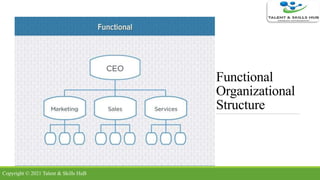
The functional structure departmentalizes an organization based on common
job functions.
An organization with a functional organisational structure, for instance, would
group all of the marketers together in one department, group all of the
salespeople together in a separate department, and group all of the customer
service people together in another department.
Copyright © 2021 Talent & Skills HuB
Functional
Organizational
Structure
Copyright © 2021 Talent & Skills HuB
Disadvantages of Functional Structure
Functional structure has the potential to create barriers between different functions --
and it can be inefficient if the organization has a variety of different products or target
markets.
The barriers created between departments can also limit peoples' knowledge of and
communication with other departments, especially those that depend on other
departments to succeed.
Copyright © 2021 Talent & Skills HuB
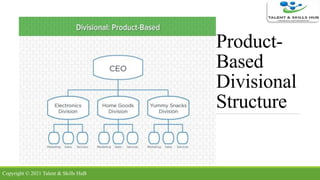
Product-Based Divisional Structure
A divisional organizational structure is comprised of multiple, smaller functional
structures (i.e. each division within a divisional structure can have its own
marketing team, its own sales team, and so on).
In a product-based divisional structure, each division within the organization is
dedicated to a particular product line.
This type of structure is ideal for organizations with multiple products and can
help shorten product development cycles. This allows small businesses to go to
market with new offerings fast.
Copyright © 2021 Talent & Skills HuB
Product-
Based
Divisional
Structure
Copyright © 2021 Talent & Skills HuB
Disadvantages of Product-Based Divisional
Structure
It can be difficult to scale under a product-based divisional structure, and the
organization could end up with duplicate resources as different divisions strive to
develop new offerings.
Copyright © 2021 Talent & Skills HuB
Geographical
Divisional
Structure
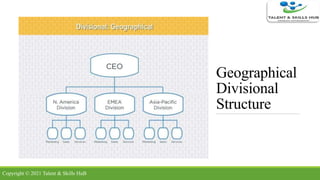
The geographical organizational structure establishes
its divisions based on geographical locations.
More specifically, the divisions of a geographical
structure can include territories, regions, or districts.
This type of structure is best-suited to organizations
that need to be near sources of supply and/or
customers (e.g. for deliveries or for on-site support).
It also brings together many forms of business
expertise, allowing each geographical division to
make decisions from more diverse points of view.
Copyright © 2021 Talent & Skills HuB
Geographical
Divisional
Structure
Copyright © 2021 Talent & Skills HuB
Disadvantage of Geographical
Divisional Structure
The main downside of a geographical organisational structure:
It can be easy for decision- making to become decentralized, as geographic divisions
(which can be hundreds, if not thousands of miles away from corporate headquarters)
often have a great deal of autonomy.
And when you have more than one marketing department (one for each region) you
run the risk of creating campaigns that compete with (and weaken) other divisions
across your digital channels.
Copyright © 2021 Talent & Skills HuB
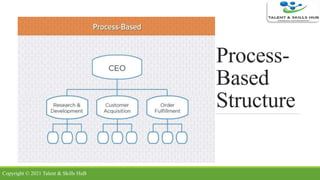
Process-Based Structure
Process-based organizational structures are designed around the end-to-end
flow of different processes, such as "Research & Development," "Customer
Acquisition," and "Order Fulfilment.“

Unlike a strictly functional structure, a process-based structure considers not
only the activities employees perform, but also how those different activities
interact with one another.
Process-based organizational structure is ideal for improving the speed and
efficiency of a business, and is best-suited for those in rapidly changing
industries, as it is easily adaptable.
Copyright © 2021 Talent & Skills HuB
Process-
Based
Structure
Copyright © 2021 Talent & Skills HuB
Disadvantages of Process-Based
Structure
Similar to a few other structures on this list, process-based structure can erect
barriers between the different process groups. This leads to problems
communicating and handing off work to other teams and employees.
Copyright © 2021 Talent & Skills HuB
Matrix Structure
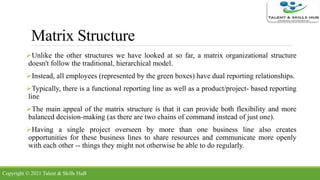
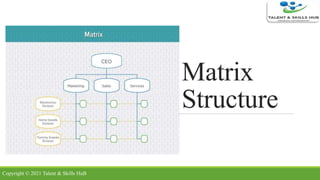
Unlike the other structures we have looked at so far, a matrix organizational structure
doesn't follow the traditional, hierarchical model.
Instead, all employees (represented by the green boxes) have dual reporting relationships.
Typically, there is a functional reporting line as well as a product/project- based reporting
line
The main appeal of the matrix structure is that it can provide both flexibility and more
balanced decision-making (as there are two chains of command instead of just one).
Having a single project overseen by more than one business line also creates
opportunities for these business lines to share resources and communicate more openly
with each other -- things they might not otherwise be able to do regularly.
Copyright © 2021 Talent & Skills HuB
Matrix
Structure
Copyright © 2021 Talent & Skills HuB
Disadvantages of Matrix Structure
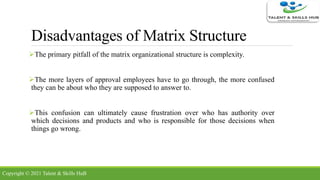
The primary pitfall of the matrix organizational structure is complexity.
The more layers of approval employees have to go through, the more confused
they can be about who they are supposed to answer to.
This confusion can ultimately cause frustration over who has authority over
which decisions and products and who is responsible for those decisions when
things go wrong.
Copyright © 2021 Talent & Skills HuB
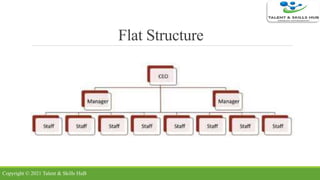
Flat Structure
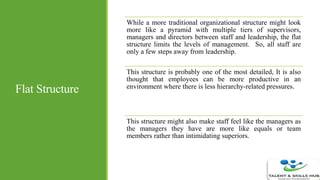
While a more traditional organizational structure might look
more like a pyramid with multiple tiers of supervisors,
managers and directors between staff and leadership, the flat
structure limits the levels of management. So, all staff are
only a few steps away from leadership.
This structure is probably one of the most detailed, It is also
thought that employees can be more productive in an
environment where there is less hierarchy-related pressures.
This structure might also make staff feel like the managers as
the managers they have are more like equals or team
members rather than intimidating superiors.
Flat Structure
Copyright © 2021 Talent & Skills HuB
Disadvantages of Flat Structure
If there's a time when teams in a flat organization disagree on something, such as a
project, it can be hard to get aligned and back on track without executive decisions
from a leader or manager.
Because of how complicated the structure's design is, it can be tricky to determine
which manager an employee should go to if they need approval or an executive
decision for something.
So if you do choose to have a flat organization, you should have a clearly marked
tier of management or path that employees can refer to when they run into these
scenarios.
Copyright © 2021 Talent & Skills HuB
Talent &
Skills HuB
T&S-HuB is an enabling environment that supports people
in the development of their talents and skills and in the
actualisation of their personal passions and ambitions.
We help learners and individuals sharpen and exhibit their
talents and skills while exploring relevant and life
changing opportunities that suit their passions.
You can be supported by our instructors, counsellors, and
mentors on employability skills and other personal and
professional development.
Book an appointment for one-to-one or group tutoring
through our website; ts-hub.com
You can also contact us via email: contactus@ts-hub.com
Copyright © 2021 Talent & Skills HuB

Understanding Organisational Structure

  • 1.
    Organisational Structure Copyright ©2021 Talent & Skills HuB
  • 2.
    What is OrganisationalStructure? Organisational structure refers to the way that roles are coordinated, controlled and communicated within an organisation. The structure is often represented in a diagram called an organisation chart. An organisation's structure should be designed to deliver goals and objectives of the organisation as well as use resources in the best possible way. An organizational structure is a visual diagram of an organisation that describes what employees do, whom they report to, and how decisions are made across the organisation. Copyright © 2021 Talent & Skills HuB
  • 3.
    Copyright © 2021Talent & Skills HuB
  • 4.
    Importance of OrganisationalStructure Organisational structures help to define the key elements of how an organisation controlled and managed. An organizational structure can be helpful for new employees to learn who manages and what processes that exist in the organisation. With organisational structure, you can visualize how the work flows in the diagrams. To put it simple, the chart explains how an organisation works and how its roles are organized. Copyright © 2021 Talent & Skills HuB
  • 5.
    Category of OrganisationalStructure Organisational Structure can be categorised as Mechanistic or Organic. The mechanistic structure represents the traditional, top-down approach to organizational structure, whereas the organic structure represents a more collaborative, flexible approach. Copyright © 2021 Talent & Skills HuB
  • 6.
    Mechanistic Structure Mechanistic structures,also called bureaucratic structures, are known for having narrow spans of control, as well as high specialization, and formalization. They are also quite rigid in what specific departments are designed and permitted to do for the company. This organizational structure is much more formal than organic structure, using specific standards and practices to govern every decision the business makes. As daunting and inflexible as mechanistic structure sounds, the chain of command, whether long or short, is always clear under this model. Copyright © 2021 Talent & Skills HuB
  • 7.
    Organic Structure Organic structures(also known as "flat" structures) are known for their wide spans of control, decentralization, low specialization, and loose departmentalization. This structure might have multiple teams answering to one person and taking on projects based on their importance and what the team is capable of rather than what the team is designed to do. As you can probably tell, this organizational structure is much less formal than mechanistic, and takes a bit of an ad-hoc approach to business needs. With this nature of structure, leaders might give certain projects the green light more quickly but it cause confusion in a project's division of labour. Copyright © 2021 Talent & Skills HuB
  • 8.
    Types of OrganizationalStructure Functional Organizational Structure Product-Based Divisional Structure Geographical Divisional Structure Process-Based Structure Matrix Structure Flat Structure Copyright © 2021 Talent & Skills HuB
  • 9.
    Functional Organizational Structure Thefunctional structure departmentalizes an organization based on common job functions. An organization with a functional organisational structure, for instance, would group all of the marketers together in one department, group all of the salespeople together in a separate department, and group all of the customer service people together in another department. Copyright © 2021 Talent & Skills HuB
  • 10.
  • 11.
    Disadvantages of FunctionalStructure Functional structure has the potential to create barriers between different functions -- and it can be inefficient if the organization has a variety of different products or target markets. The barriers created between departments can also limit peoples' knowledge of and communication with other departments, especially those that depend on other departments to succeed. Copyright © 2021 Talent & Skills HuB
  • 12.
    Product-Based Divisional Structure Adivisional organizational structure is comprised of multiple, smaller functional structures (i.e. each division within a divisional structure can have its own marketing team, its own sales team, and so on). In a product-based divisional structure, each division within the organization is dedicated to a particular product line. This type of structure is ideal for organizations with multiple products and can help shorten product development cycles. This allows small businesses to go to market with new offerings fast. Copyright © 2021 Talent & Skills HuB
  • 13.
  • 14.
    Disadvantages of Product-BasedDivisional Structure It can be difficult to scale under a product-based divisional structure, and the organization could end up with duplicate resources as different divisions strive to develop new offerings. Copyright © 2021 Talent & Skills HuB
  • 15.
    Geographical Divisional Structure The geographical organizationalstructure establishes its divisions based on geographical locations. More specifically, the divisions of a geographical structure can include territories, regions, or districts. This type of structure is best-suited to organizations that need to be near sources of supply and/or customers (e.g. for deliveries or for on-site support). It also brings together many forms of business expertise, allowing each geographical division to make decisions from more diverse points of view. Copyright © 2021 Talent & Skills HuB
  • 16.
  • 17.
    Disadvantage of Geographical DivisionalStructure The main downside of a geographical organisational structure: It can be easy for decision- making to become decentralized, as geographic divisions (which can be hundreds, if not thousands of miles away from corporate headquarters) often have a great deal of autonomy. And when you have more than one marketing department (one for each region) you run the risk of creating campaigns that compete with (and weaken) other divisions across your digital channels. Copyright © 2021 Talent & Skills HuB
  • 18.
    Process-Based Structure Process-based organizationalstructures are designed around the end-to-end flow of different processes, such as "Research & Development," "Customer Acquisition," and "Order Fulfilment.“  Unlike a strictly functional structure, a process-based structure considers not only the activities employees perform, but also how those different activities interact with one another. Process-based organizational structure is ideal for improving the speed and efficiency of a business, and is best-suited for those in rapidly changing industries, as it is easily adaptable. Copyright © 2021 Talent & Skills HuB
  • 19.
  • 20.
    Disadvantages of Process-Based Structure Similarto a few other structures on this list, process-based structure can erect barriers between the different process groups. This leads to problems communicating and handing off work to other teams and employees. Copyright © 2021 Talent & Skills HuB
  • 21.
    Matrix Structure Unlike theother structures we have looked at so far, a matrix organizational structure doesn't follow the traditional, hierarchical model. Instead, all employees (represented by the green boxes) have dual reporting relationships. Typically, there is a functional reporting line as well as a product/project- based reporting line The main appeal of the matrix structure is that it can provide both flexibility and more balanced decision-making (as there are two chains of command instead of just one). Having a single project overseen by more than one business line also creates opportunities for these business lines to share resources and communicate more openly with each other -- things they might not otherwise be able to do regularly. Copyright © 2021 Talent & Skills HuB
  • 22.
  • 23.
    Disadvantages of MatrixStructure The primary pitfall of the matrix organizational structure is complexity. The more layers of approval employees have to go through, the more confused they can be about who they are supposed to answer to. This confusion can ultimately cause frustration over who has authority over which decisions and products and who is responsible for those decisions when things go wrong. Copyright © 2021 Talent & Skills HuB
  • 24.
    Flat Structure While amore traditional organizational structure might look more like a pyramid with multiple tiers of supervisors, managers and directors between staff and leadership, the flat structure limits the levels of management. So, all staff are only a few steps away from leadership. This structure is probably one of the most detailed, It is also thought that employees can be more productive in an environment where there is less hierarchy-related pressures. This structure might also make staff feel like the managers as the managers they have are more like equals or team members rather than intimidating superiors.
  • 25.
    Flat Structure Copyright ©2021 Talent & Skills HuB
  • 26.
    Disadvantages of FlatStructure If there's a time when teams in a flat organization disagree on something, such as a project, it can be hard to get aligned and back on track without executive decisions from a leader or manager. Because of how complicated the structure's design is, it can be tricky to determine which manager an employee should go to if they need approval or an executive decision for something. So if you do choose to have a flat organization, you should have a clearly marked tier of management or path that employees can refer to when they run into these scenarios. Copyright © 2021 Talent & Skills HuB
  • 27.
    Talent & Skills HuB T&S-HuBis an enabling environment that supports people in the development of their talents and skills and in the actualisation of their personal passions and ambitions. We help learners and individuals sharpen and exhibit their talents and skills while exploring relevant and life changing opportunities that suit their passions. You can be supported by our instructors, counsellors, and mentors on employability skills and other personal and professional development. Book an appointment for one-to-one or group tutoring through our website; ts-hub.com You can also contact us via email: contactus@ts-hub.com Copyright © 2021 Talent & Skills HuB