Munazza FalakSher
What are Incentives?
Incentives
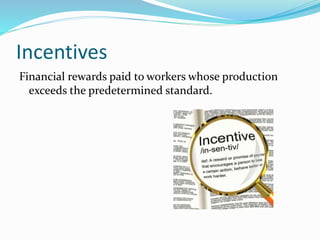
Financial rewards paid to workers whose production
exceeds the predetermined standard.
Cont..
ď‚— We can say an incentive is an event, object, item of
value or an action that is intended to spur and
employee to work hard.
Incentive Programs
ď‚— An incentive program is a formal scheme used to
promote or encourage specific group of people during
a defined period.
Motivation & Incentives
ď‚—Frederick Taylor
• Popularized scientific management and the use
of financial incentives in the late 1800s.
ď‚— Systematic soldiering
 Fair day’s work
Individual Employee Incentive &
Recognition Programs
ď‚— Several incentive plans are particularly suited for we
with individual employees.
1. Piece work
A system of pay based on the number of items
processed by each individual worker in a unit of
time, such as item per hour or item per day.
• Straight piece work
• Standard hour plan
Cont….
2. Merit pay as Incentive
Any salary increase awarded to an employee based
on his or her individual performance.
3. Incentives for Professional Employees
Firms mostly pay incentives to professional
employees as compared to non professional or new
employees.
4. Non financial & Recognition based Awards
Recognition has a positive impact on
performance.
Can financial & non financial
Incentives boost in a fast food
chain?
Incentives for Salespeople
ď‚— Salary Plan
ď‚— Straight salaries
ď‚— Best for: prospecting (finding new clients), account servicing,
training customer’s sales force, or participating in national and local
trade shows.
ď‚— Commission Plan
ď‚— Pay is a percentage of sales results.
ď‚— Keeps sales costs proportionate to sales revenues.
ď‚— May cause a neglect of no selling duties.
 Can create wide variation in salesperson’s income.
ď‚— Likelihood of sales success may be linked to external factors rather
than to salesperson’s performance.
ď‚— Can increase turnover of salespeople.
Incentives for Salespeople (cont’d)
ď‚— Combination Plan
ď‚— Pay is a combination of salary and commissions, usually
with a sizable salary component.
ď‚— Plan gives salespeople a floor (safety net) to their
earnings.
ď‚— Salary component covers company-specified service
activities.
ď‚— Plans tend to become complicated, and
misunderstandings can result.
Specialized Combination Plans
ď‚— Commission-plus-Drawing-Account Plan
ď‚— Commissions are paid but a draw on future earnings
helps the salesperson to get through low sales periods.
ď‚— Commission-plus-Bonus Plan
ď‚— Pay is mostly based on commissions.
ď‚— Small bonuses are paid for directed activities like selling
slow-moving items.
Team/Group Incentive Plans
ď‚— Team (or Group) Incentive Plans
 Incentives are based on team’s performance.
ď‚— How to Design Team Incentives
ď‚— Set individual work standards.
ď‚— Set work standards for each team member and then calculate
each member’s output.
ď‚— Members are paid based on one of three formulas:
ď‚— All receive the same pay earned by the highest producer.
ď‚— All receive the same pay earned by the lowest producer.
ď‚— All receive the same pay equal to the average pay earned by the
group.
Team/Group Incentive Plans
(cont’d)
ď‚— Pros
ď‚— Reinforces team planning and problem solving
ď‚— Helps ensure collaboration
ď‚— Encourages a sense of cooperation
ď‚— Encourages rapid training of new members
ď‚— Cons
 Pay is not proportionate to an individual’s effort
 Rewards “free riders”
Organization wide Incentive Plans
ď‚— Employee Stock Ownership Plan (ESOP)
 A firm annually contributes its own stock—or cash (with
a limit of 15% of compensation) to be used to purchase
the stock—to a trust established for the employees.
ď‚— The trust holds the stock in individual employee
accounts and distributes it to employees upon
separation from the firm if the employee has worked
long enough to earn ownership of the stock.
At-Risk Variable Pay Plans
 Put some portion of the employee’s weekly pay at
risk.
ď‚— If employees meet or exceed their goals, they earn
incentives.
ď‚— If they fail to meet their goals, they forgo some of the
pay they would normally have earned.

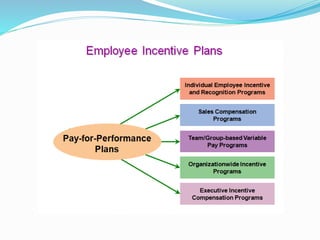
Pay for performance & financial incentives

  • 1.
  • 3.
  • 4.
    Incentives Financial rewards paidto workers whose production exceeds the predetermined standard.
  • 5.
    Cont.. ď‚— We cansay an incentive is an event, object, item of value or an action that is intended to spur and employee to work hard.
  • 6.
    Incentive Programs ď‚— Anincentive program is a formal scheme used to promote or encourage specific group of people during a defined period.
  • 8.
    Motivation & Incentives FrederickTaylor • Popularized scientific management and the use of financial incentives in the late 1800s.  Systematic soldiering  Fair day’s work
  • 10.
    Individual Employee Incentive& Recognition Programs  Several incentive plans are particularly suited for we with individual employees. 1. Piece work A system of pay based on the number of items processed by each individual worker in a unit of time, such as item per hour or item per day. • Straight piece work • Standard hour plan
  • 11.
    Cont…. 2. Merit payas Incentive Any salary increase awarded to an employee based on his or her individual performance. 3. Incentives for Professional Employees Firms mostly pay incentives to professional employees as compared to non professional or new employees. 4. Non financial & Recognition based Awards Recognition has a positive impact on performance.
  • 12.
    Can financial &non financial Incentives boost in a fast food chain?
  • 13.
    Incentives for Salespeople Salary Plan  Straight salaries  Best for: prospecting (finding new clients), account servicing, training customer’s sales force, or participating in national and local trade shows.  Commission Plan  Pay is a percentage of sales results.  Keeps sales costs proportionate to sales revenues.  May cause a neglect of no selling duties.  Can create wide variation in salesperson’s income.  Likelihood of sales success may be linked to external factors rather than to salesperson’s performance.  Can increase turnover of salespeople.
  • 14.
    Incentives for Salespeople(cont’d)  Combination Plan  Pay is a combination of salary and commissions, usually with a sizable salary component.  Plan gives salespeople a floor (safety net) to their earnings.  Salary component covers company-specified service activities.  Plans tend to become complicated, and misunderstandings can result.
  • 15.
    Specialized Combination Plans ď‚—Commission-plus-Drawing-Account Plan ď‚— Commissions are paid but a draw on future earnings helps the salesperson to get through low sales periods. ď‚— Commission-plus-Bonus Plan ď‚— Pay is mostly based on commissions. ď‚— Small bonuses are paid for directed activities like selling slow-moving items.
  • 16.
    Team/Group Incentive Plans Team (or Group) Incentive Plans  Incentives are based on team’s performance.  How to Design Team Incentives  Set individual work standards.  Set work standards for each team member and then calculate each member’s output.  Members are paid based on one of three formulas:  All receive the same pay earned by the highest producer.  All receive the same pay earned by the lowest producer.  All receive the same pay equal to the average pay earned by the group.
  • 17.
    Team/Group Incentive Plans (cont’d) Pros  Reinforces team planning and problem solving  Helps ensure collaboration  Encourages a sense of cooperation  Encourages rapid training of new members  Cons  Pay is not proportionate to an individual’s effort  Rewards “free riders”
  • 18.
    Organization wide IncentivePlans  Employee Stock Ownership Plan (ESOP)  A firm annually contributes its own stock—or cash (with a limit of 15% of compensation) to be used to purchase the stock—to a trust established for the employees.  The trust holds the stock in individual employee accounts and distributes it to employees upon separation from the firm if the employee has worked long enough to earn ownership of the stock.
  • 20.
    At-Risk Variable PayPlans  Put some portion of the employee’s weekly pay at risk.  If employees meet or exceed their goals, they earn incentives.  If they fail to meet their goals, they forgo some of the pay they would normally have earned.