UNDERSTANDING MIND
AND BEHAVIOUR
MADE BY MANSVI
SEHRAWAT
11-D
WHY IT IS HARD TO DEFINE MIND ?
Firstly, mind cannot be defined in concrete behavioural terms.
Secondly, there are no animal models to study human mind or
mental illnesses.
Thirdly, the study of human mind is done invariably by another
human mind . And , hence, an unbiased objective interpretation of
finding become difficult.
Fourthly, any concept of mind has far reaching implications not just
in medicine, but also outside it .
Lastly, stringent research about the human mind has several human
rights related and ethical limiations.
MIND
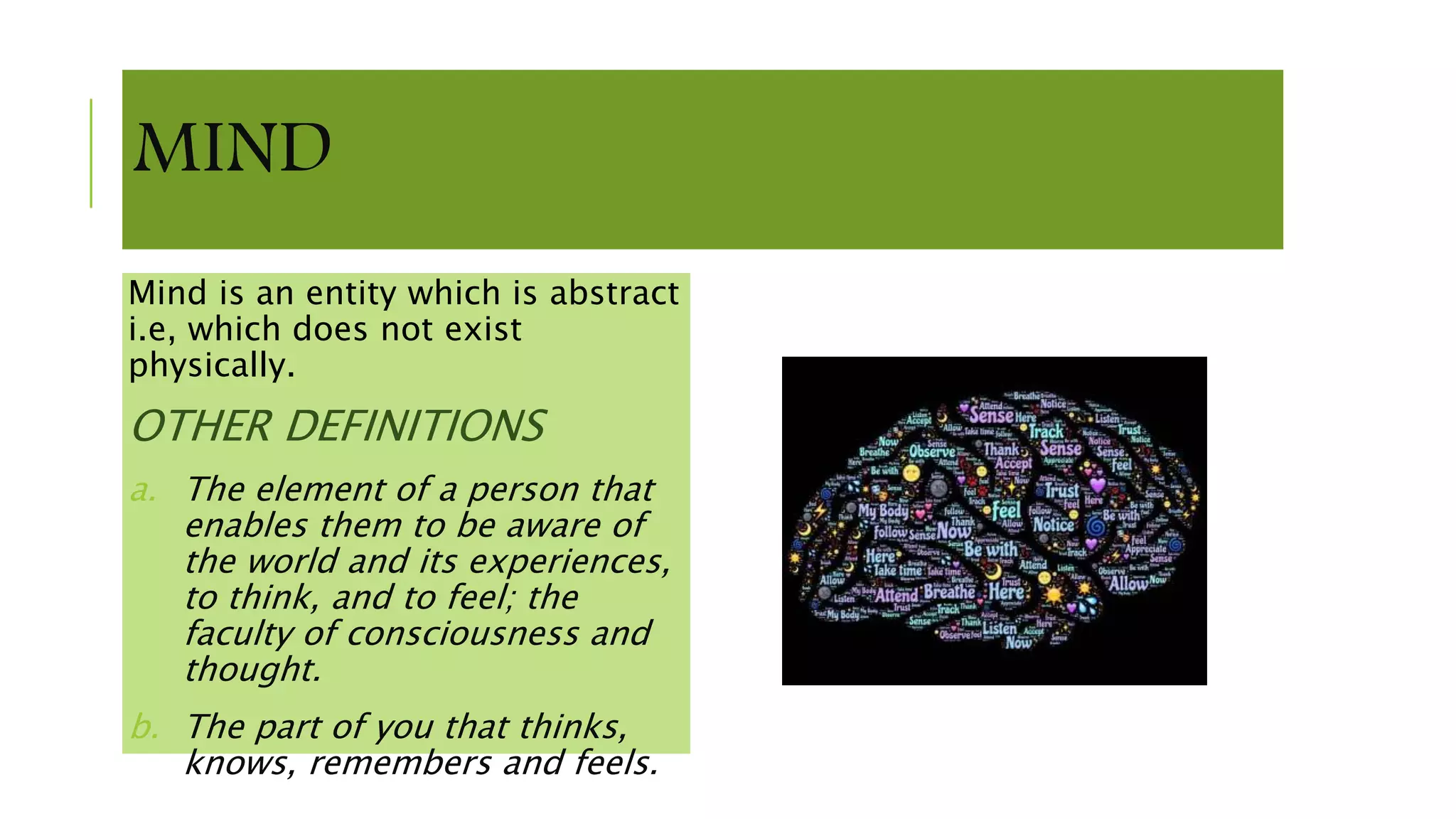
Mind is an entity which is abstract
i.e, which does not exist
physically.
OTHER DEFINITIONS
a. The element of a person that
enables them to be aware of
the world and its experiences,
to think, and to feel; the
faculty of consciousness and
thought.
b. The part of you that thinks,
knows, remembers and feels.
If the term “mind” has returned to
psychology, we should thank neuroscientists
like Sperry and physicists like Penrose, who
have given it the respect which it deserved
and now has . There are scientists in various
disciplines including psychology, although it
is still far away.
TYPES OF MIND
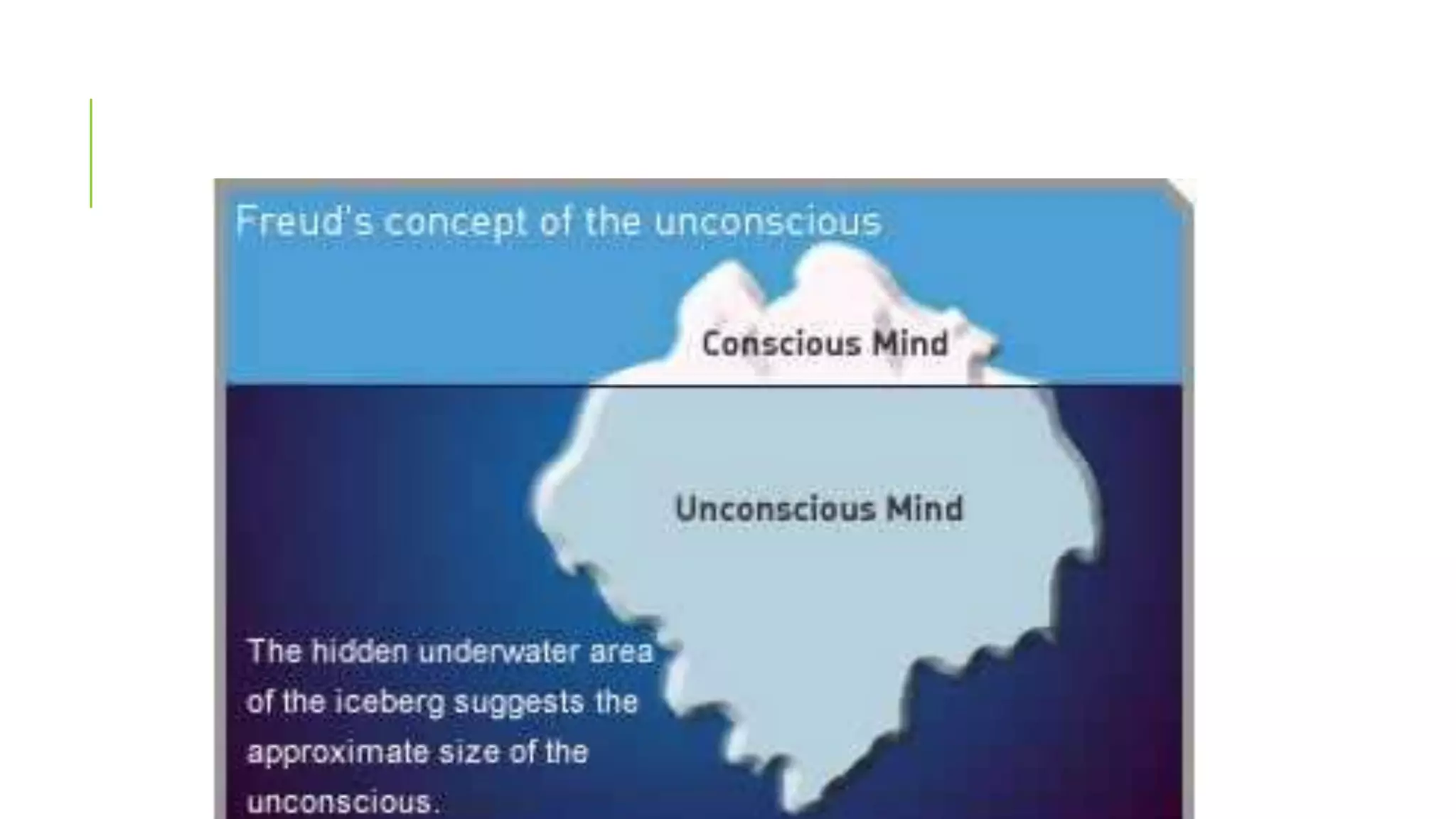
There are basically 3 types of minds :
1. SUBCONCIOUS MIND
2. CONCIOUS MIND
3. UNCONCIOUS MIND
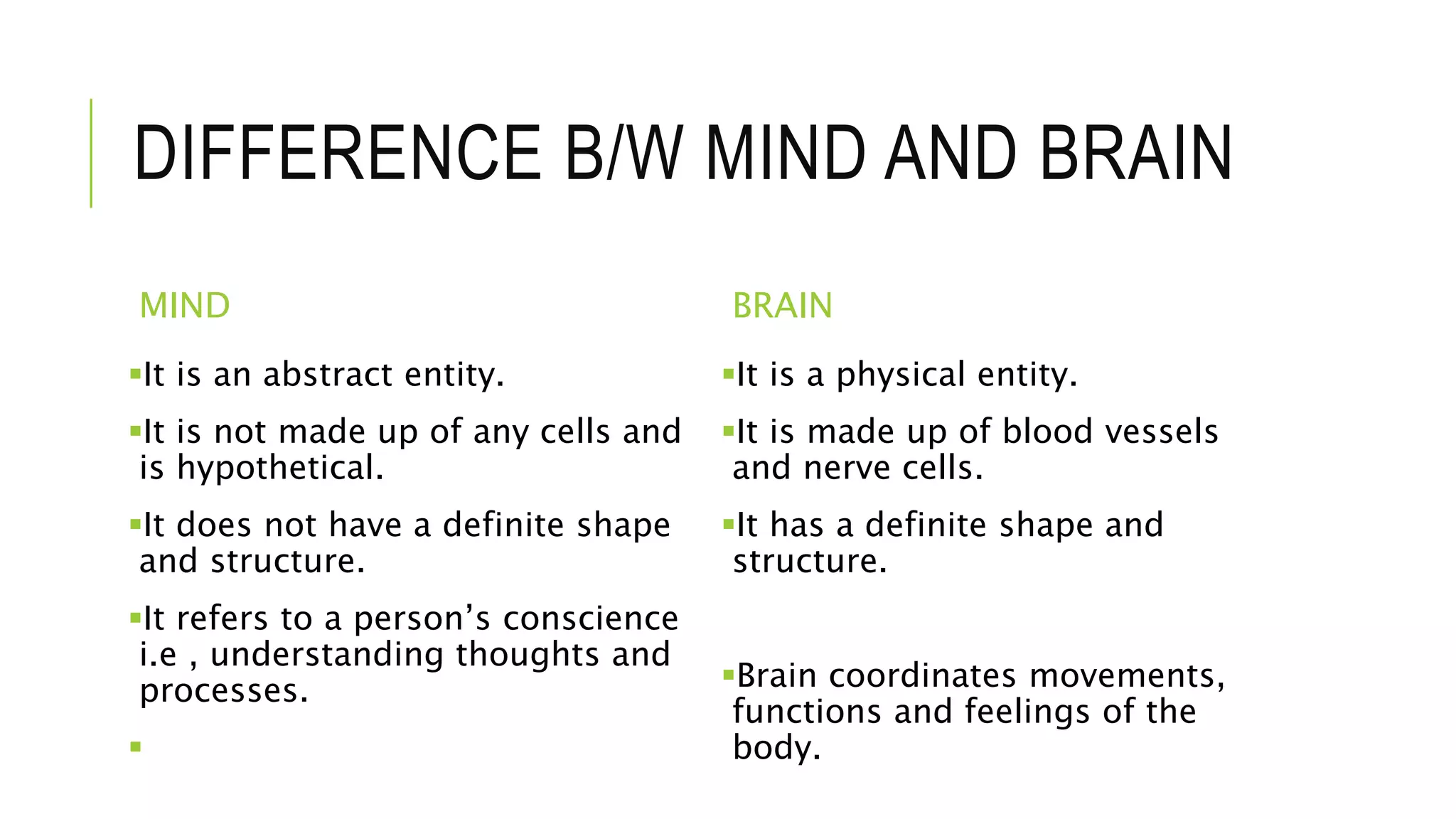
DIFFERENCE B/W MIND AND BRAIN
MIND
It is an abstract entity.
It is not made up of any cells and
is hypothetical.
It does not have a definite shape
and structure.
It refers to a person’s conscience
i.e , understanding thoughts and
processes.

BRAIN
It is a physical entity.
It is made up of blood vessels
and nerve cells.
It has a definite shape and
structure.
Brain coordinates movements,
functions and feelings of the
body.
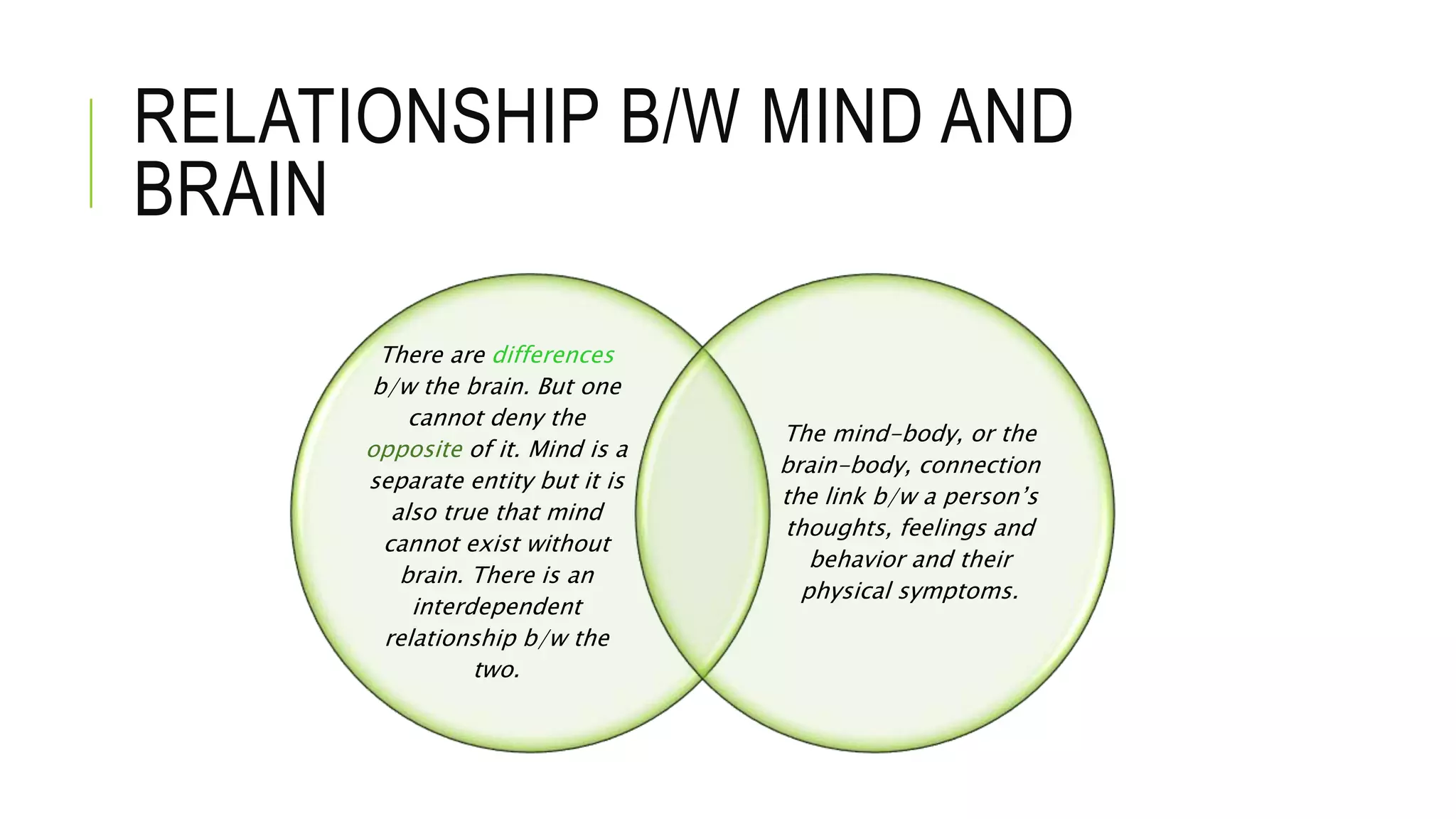
RELATIONSHIP B/W MIND AND
BRAIN
There are differences
b/w the brain. But one
cannot deny the
opposite of it. Mind is a
separate entity but it is
also true that mind
cannot exist without
brain. There is an
interdependent
relationship b/w the
two.
The mind-body, or the
brain-body, connection
the link b/w a person’s
thoughts, feelings and
behavior and their
physical symptoms.
EXAMPLES OF MIND-BODY
CONNECTION
EXAMPLE OF AN ATHLETE
An amateur athlete lost his arm in a motorcycle accident but
continued to feelan “arm” and also continued to feel its movements.
When offered coffee, his “phantom arm” reached out to the coffee cup
and when someone pulled it away, he protested.
EXAMPLE OF A YOUNG MAN
A young man who had suffered brain injury in an accident, after he
returned home from the hospital, claimed that his parents had been
replaced by their “duplicates”, and in reality, they were imposters.
CONCLUSION
In each of these cases, the person had
suffered from damage of some part of the
brain but his “mind” had remained intact .
Earlier it was believed by scientists that
there is no relationship b/w mind and
body. But, recent studies have shown that
there is a relationship b/w mind and
behavior.
INTERESTING FACT ABOUT
DREAMING
THE SENSE OF FALLING INVOLVED IN A
DREAM ACTUALLY COMES FROM THE
BRAIN FALLING ASLEEP TOO FAST AND
ASSUMING IT IS DYING.
PSYCHONEUROIMMUNOLOGY
Breaking down the word:
Psycho- emotional behavior
Neuro - hypothalamic/pituitary axis
Immuno- immune system involvement
Logy- study of
INTRODUCTION
Psychoneuroimmunology(PNI) deals with the
study of the interaction b/w psychological
processes and the nervous and immune systems of
the human body.
Until 1970, it was thought among the modern
western medical community that immune system
functions without any influence from any other
parts or functions of the body.
Dr. Robert Ader in 1975 coined the term
psychoneuroimmunology to show a link b/w the
way people think and about there health.
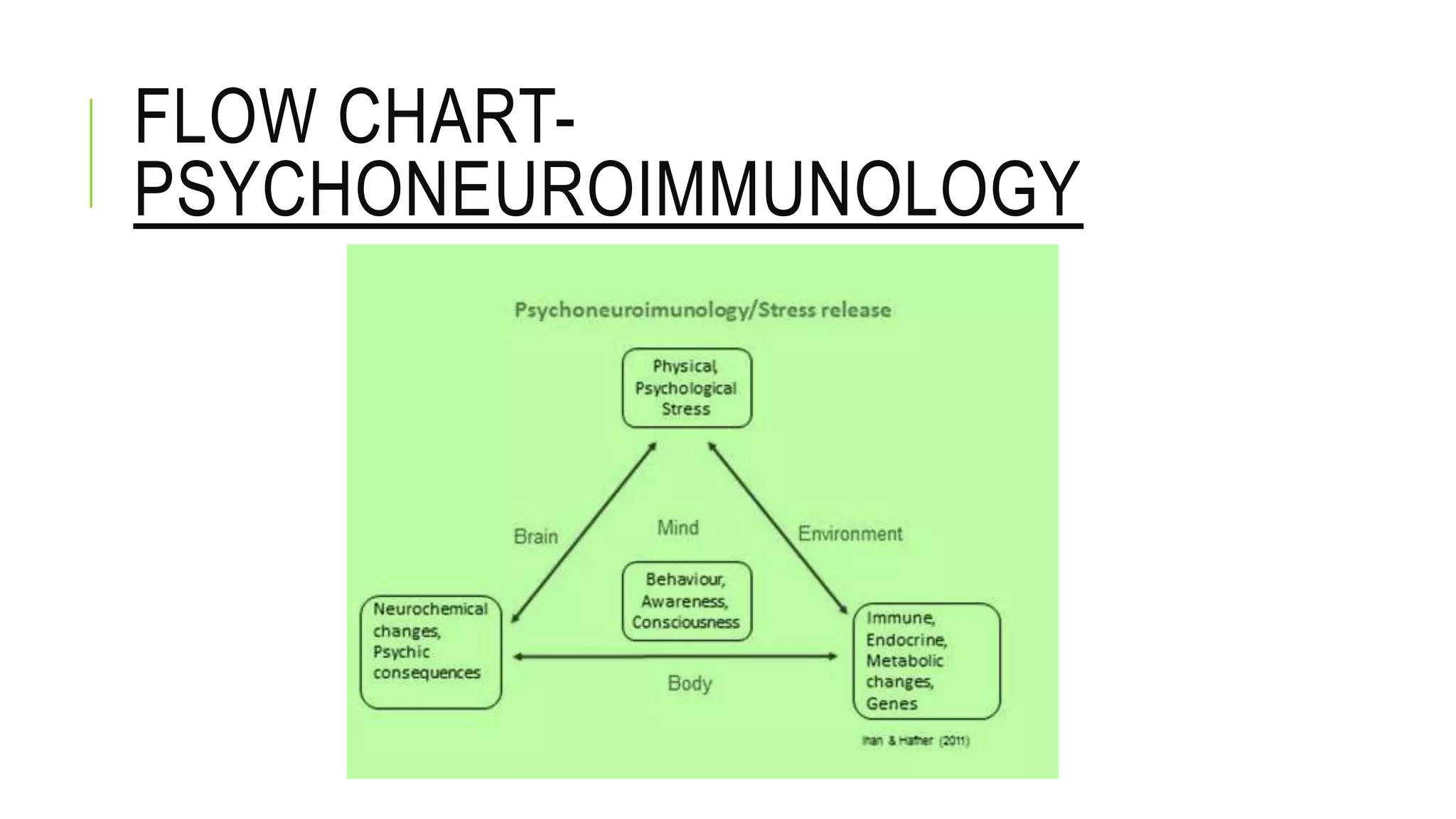
FLOW CHART-
PSYCHONEUROIMMUNOLOGY
EXAMPLE
FOR EXAMPLE, IF A PERSON IS TOLD THAT THEY HAVE ADANGEROUS
AND POSSIBLY FATAL DISEASE, THEY ARE MORE LIKELY TO BECOME
DEPRESSED.
PSYCHONEUROIMMUNOLOGY SUGGEST THAT THIS DEPRESSION CAN
ACTUALLY LEAD TO MORE HEALTH PROBLEMS.
RESEARCH OF THE LATE 20TH CENTURY AND EARLY 21ST CENTURY
INDICATES THAT THERE IS A CONNECTION B/W STRONG EMOTIONS
LIKE RAGE, ANGER, FEAR, JOY AND STRENGTH WITH THE IMMUNE
SYSTEM.

Understanding mind and behavior Class 11 PSYCHOLOGY

  • 1.
  • 2.
    WHY IT ISHARD TO DEFINE MIND ? Firstly, mind cannot be defined in concrete behavioural terms. Secondly, there are no animal models to study human mind or mental illnesses. Thirdly, the study of human mind is done invariably by another human mind . And , hence, an unbiased objective interpretation of finding become difficult. Fourthly, any concept of mind has far reaching implications not just in medicine, but also outside it . Lastly, stringent research about the human mind has several human rights related and ethical limiations.
  • 3.
    MIND Mind is anentity which is abstract i.e, which does not exist physically. OTHER DEFINITIONS a. The element of a person that enables them to be aware of the world and its experiences, to think, and to feel; the faculty of consciousness and thought. b. The part of you that thinks, knows, remembers and feels.
  • 4.
    If the term“mind” has returned to psychology, we should thank neuroscientists like Sperry and physicists like Penrose, who have given it the respect which it deserved and now has . There are scientists in various disciplines including psychology, although it is still far away.
  • 5.
    TYPES OF MIND Thereare basically 3 types of minds : 1. SUBCONCIOUS MIND 2. CONCIOUS MIND 3. UNCONCIOUS MIND
  • 7.
    DIFFERENCE B/W MINDAND BRAIN MIND It is an abstract entity. It is not made up of any cells and is hypothetical. It does not have a definite shape and structure. It refers to a person’s conscience i.e , understanding thoughts and processes.  BRAIN It is a physical entity. It is made up of blood vessels and nerve cells. It has a definite shape and structure. Brain coordinates movements, functions and feelings of the body.
  • 8.
    RELATIONSHIP B/W MINDAND BRAIN There are differences b/w the brain. But one cannot deny the opposite of it. Mind is a separate entity but it is also true that mind cannot exist without brain. There is an interdependent relationship b/w the two. The mind-body, or the brain-body, connection the link b/w a person’s thoughts, feelings and behavior and their physical symptoms.
  • 9.
    EXAMPLES OF MIND-BODY CONNECTION EXAMPLEOF AN ATHLETE An amateur athlete lost his arm in a motorcycle accident but continued to feelan “arm” and also continued to feel its movements. When offered coffee, his “phantom arm” reached out to the coffee cup and when someone pulled it away, he protested. EXAMPLE OF A YOUNG MAN A young man who had suffered brain injury in an accident, after he returned home from the hospital, claimed that his parents had been replaced by their “duplicates”, and in reality, they were imposters.
  • 10.
    CONCLUSION In each ofthese cases, the person had suffered from damage of some part of the brain but his “mind” had remained intact . Earlier it was believed by scientists that there is no relationship b/w mind and body. But, recent studies have shown that there is a relationship b/w mind and behavior.
  • 11.
    INTERESTING FACT ABOUT DREAMING THESENSE OF FALLING INVOLVED IN A DREAM ACTUALLY COMES FROM THE BRAIN FALLING ASLEEP TOO FAST AND ASSUMING IT IS DYING.
  • 12.
    PSYCHONEUROIMMUNOLOGY Breaking down theword: Psycho- emotional behavior Neuro - hypothalamic/pituitary axis Immuno- immune system involvement Logy- study of
  • 13.
    INTRODUCTION Psychoneuroimmunology(PNI) deals withthe study of the interaction b/w psychological processes and the nervous and immune systems of the human body. Until 1970, it was thought among the modern western medical community that immune system functions without any influence from any other parts or functions of the body. Dr. Robert Ader in 1975 coined the term psychoneuroimmunology to show a link b/w the way people think and about there health.
  • 14.
  • 15.
    EXAMPLE FOR EXAMPLE, IFA PERSON IS TOLD THAT THEY HAVE ADANGEROUS AND POSSIBLY FATAL DISEASE, THEY ARE MORE LIKELY TO BECOME DEPRESSED. PSYCHONEUROIMMUNOLOGY SUGGEST THAT THIS DEPRESSION CAN ACTUALLY LEAD TO MORE HEALTH PROBLEMS. RESEARCH OF THE LATE 20TH CENTURY AND EARLY 21ST CENTURY INDICATES THAT THERE IS A CONNECTION B/W STRONG EMOTIONS LIKE RAGE, ANGER, FEAR, JOY AND STRENGTH WITH THE IMMUNE SYSTEM.