Understanding
Intellectual Property
Presented by Tonia Brugh
Purpose of this session
• To help you understand:
- how to identify intellectual property;
- how to protect intellectual property;
- the commercial issues surrounding intellectual property; and
- methods used to commercialise intellectual property.
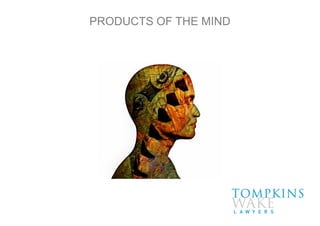
PRODUCTS OF THE MIND
- Intangible Assets are High Value
- Attract and secure investment
- Increase value of a business
- Competitive edge $$$$$
• $US87.1 billion APPLE Trade Mark (alone)
• $US100+ billion - Facebook networking technology
• $US72 billion - Coca Cola secret recipe and brand
• NZ$438 million – Air New Zealand
• NZ$600 million - Telecom
Identifying Your Valuable Intellectual Property
Categorise into five main areas:
– Brand (trade mark)
– Look (design)
– Copyright
– Function (patent)
– Knowledge (confidential information and trade secrets)
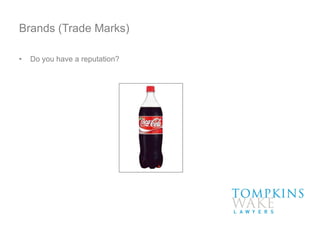
Brands (Trade Marks)
• Do you have a reputation?
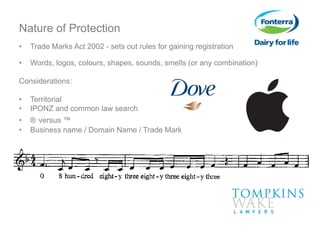
• Trade Marks Act 2002 - sets out rules for gaining registration
• Words, logos, colours, shapes, sounds, smells (or any combination)
Considerations:
• Territorial
• IPONZ and common law search
• ® versus ™
• Business name / Domain Name / Trade Mark
Nature of Protection
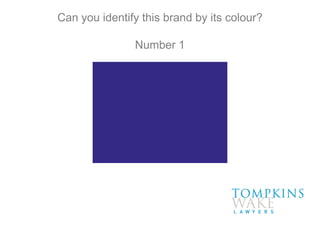
Can you identify this brand by its colour?
Number 1
Look – (Designs)
• Do you have something that looks nice?
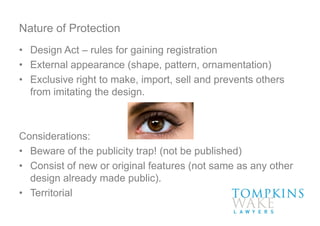
Nature of Protection
• Design Act – rules for gaining registration
• External appearance (shape, pattern, ornamentation)
• Exclusive right to make, import, sell and prevents others
from imitating the design.
Considerations:
• Beware of the publicity trap! (not be published)
• Consist of new or original features (not same as any other
design already made public).
• Territorial
Design Example
Copyright
• Covers:
– Literary (emails, training manuals, lyrics, computer programs)
– Dramatic (dance, mime, film scenarios or script)
– Musical (score and sheet music)
– Artistic (paintings, drawings maps, photographs, sculptures)
– Sounds recordings
– Communications (radio and TV broadcasts, internet webcasts)
Copyright (continued)
Considerations:
• Automatic – no registration required
• Protects the expression, not the idea
• Permission to use and attribute rightful owner (social media)
• Copyright Notice
• Ownership
– Employee in normal course of employment, in which case the
employer is the owner.
– Contractor carrying out a “commissioned work”, in which case
the “commissioner” is the owner.
(Above positions can be varied by agreement).
Can you identify this brand by its colour?
Number 2
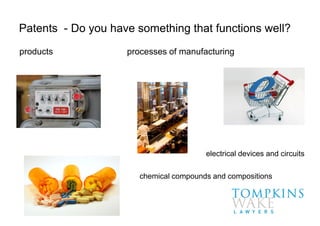
products processes of manufacturing
Patents - Do you have something that functions well?
chemical compounds and compositions
electrical devices and circuits
• Registration process
• Protection for 20 years (subject to payment of renewal fees)
• Exclusive right to use and license your invention
Considerations:
– Searching (to see whether a similar invention developed or published)
– Territorial
– Beware publicity trap
– Confidentiality Agreement if decide not to patent and keep a secret (Coke)
– Cost of Enforcement / Provisional Application (12 months)
Nature of protection
Can all inventions be patented?
• No, it must:
– be industrially applicable, (i.e. be able to be made or used in some kind of
industry);
– contain an inventive step that is, “non-obvious”. The invention cannot be
already known, or be two or more products or processes put together with
no new or improved effect ;
– be new or novel (confidentiality essential prior to application)
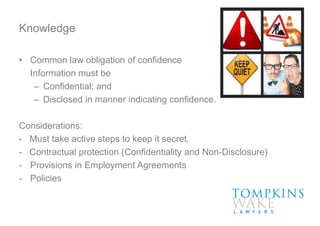
Knowledge
• Common law obligation of confidence
Information must be
– Confidential; and
– Disclosed in manner indicating confidence.
Considerations:
- Must take active steps to keep it secret.
- Contractual protection (Confidentiality and Non-Disclosure)
- Provisions in Employment Agreements
- Policies
Commercial Issues
• Before starting to market or sell a product or service seek
professional advice regarding:
– Search and be sure!
– Novelty assessments.
– Correct form of protection.
– Protection before you publicise.
• Get permission for source material.
• Retain ownership records/proof of ownership.
• Stop infringement happening to you (copyright notice).
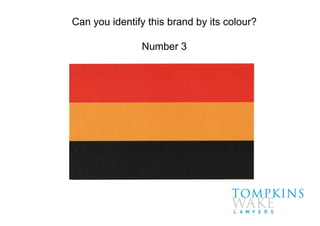
Can you identify this brand by its colour?
Number 3
Commercialisation – IP
• Start up, venture capital, angel investors...
Studies have shown that inadequate protection of IP is an
important reason for capital providers declining to invest. It is
important that you have a business plan which includes a
strong program for protecting IP.
Business Plan
• Prudent, focused strategy for the next 5 years.
• An experienced, enthusiastic management team with specific objectives.
• A good marketing plan.
• Reliable market research indicating strong market opportunities and methods for
realising business opportunities.
• A focus on the domestic market with room for international expansion.
• An IP portfolio able to protect those aspects of the business which determine the
venture’s success and establish a competitive advantage.
• Viability and revenue projections, pricing and gross margin strategies.
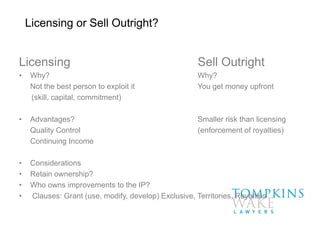
Licensing Sell Outright
• Why? Why?
Not the best person to exploit it You get money upfront
(skill, capital, commitment)
• Advantages? Smaller risk than licensing
Quality Control (enforcement of royalties)
Continuing Income
• Considerations
• Retain ownership?
• Who owns improvements to the IP?
• Clauses: Grant (use, modify, develop) Exclusive, Territories, Royalties
Licensing or Sell Outright?
END

Understanding Intellectual Property

  • 1.
  • 2.
    Purpose of thissession • To help you understand: - how to identify intellectual property; - how to protect intellectual property; - the commercial issues surrounding intellectual property; and - methods used to commercialise intellectual property.
  • 3.
  • 4.
    - Intangible Assetsare High Value - Attract and secure investment - Increase value of a business - Competitive edge $$$$$ • $US87.1 billion APPLE Trade Mark (alone) • $US100+ billion - Facebook networking technology • $US72 billion - Coca Cola secret recipe and brand • NZ$438 million – Air New Zealand • NZ$600 million - Telecom
  • 5.
    Identifying Your ValuableIntellectual Property Categorise into five main areas: – Brand (trade mark) – Look (design) – Copyright – Function (patent) – Knowledge (confidential information and trade secrets)
  • 6.
    Brands (Trade Marks) •Do you have a reputation?
  • 7.
    • Trade MarksAct 2002 - sets out rules for gaining registration • Words, logos, colours, shapes, sounds, smells (or any combination) Considerations: • Territorial • IPONZ and common law search • ® versus ™ • Business name / Domain Name / Trade Mark Nature of Protection
  • 8.
    Can you identifythis brand by its colour? Number 1
  • 9.
    Look – (Designs) •Do you have something that looks nice?
  • 10.
    Nature of Protection •Design Act – rules for gaining registration • External appearance (shape, pattern, ornamentation) • Exclusive right to make, import, sell and prevents others from imitating the design. Considerations: • Beware of the publicity trap! (not be published) • Consist of new or original features (not same as any other design already made public). • Territorial
  • 11.
  • 12.
    Copyright • Covers: – Literary(emails, training manuals, lyrics, computer programs) – Dramatic (dance, mime, film scenarios or script) – Musical (score and sheet music) – Artistic (paintings, drawings maps, photographs, sculptures) – Sounds recordings – Communications (radio and TV broadcasts, internet webcasts)
  • 13.
    Copyright (continued) Considerations: • Automatic– no registration required • Protects the expression, not the idea • Permission to use and attribute rightful owner (social media) • Copyright Notice • Ownership – Employee in normal course of employment, in which case the employer is the owner. – Contractor carrying out a “commissioned work”, in which case the “commissioner” is the owner. (Above positions can be varied by agreement).
  • 14.
    Can you identifythis brand by its colour? Number 2
  • 15.
    products processes ofmanufacturing Patents - Do you have something that functions well? chemical compounds and compositions electrical devices and circuits
  • 16.
    • Registration process •Protection for 20 years (subject to payment of renewal fees) • Exclusive right to use and license your invention Considerations: – Searching (to see whether a similar invention developed or published) – Territorial – Beware publicity trap – Confidentiality Agreement if decide not to patent and keep a secret (Coke) – Cost of Enforcement / Provisional Application (12 months) Nature of protection
  • 17.
    Can all inventionsbe patented? • No, it must: – be industrially applicable, (i.e. be able to be made or used in some kind of industry); – contain an inventive step that is, “non-obvious”. The invention cannot be already known, or be two or more products or processes put together with no new or improved effect ; – be new or novel (confidentiality essential prior to application)
  • 18.
    Knowledge • Common lawobligation of confidence Information must be – Confidential; and – Disclosed in manner indicating confidence. Considerations: - Must take active steps to keep it secret. - Contractual protection (Confidentiality and Non-Disclosure) - Provisions in Employment Agreements - Policies
  • 19.
    Commercial Issues • Beforestarting to market or sell a product or service seek professional advice regarding: – Search and be sure! – Novelty assessments. – Correct form of protection. – Protection before you publicise. • Get permission for source material. • Retain ownership records/proof of ownership. • Stop infringement happening to you (copyright notice).
  • 20.
    Can you identifythis brand by its colour? Number 3
  • 21.
    Commercialisation – IP •Start up, venture capital, angel investors... Studies have shown that inadequate protection of IP is an important reason for capital providers declining to invest. It is important that you have a business plan which includes a strong program for protecting IP.
  • 22.
    Business Plan • Prudent,focused strategy for the next 5 years. • An experienced, enthusiastic management team with specific objectives. • A good marketing plan. • Reliable market research indicating strong market opportunities and methods for realising business opportunities. • A focus on the domestic market with room for international expansion. • An IP portfolio able to protect those aspects of the business which determine the venture’s success and establish a competitive advantage. • Viability and revenue projections, pricing and gross margin strategies.
  • 23.
    Licensing Sell Outright •Why? Why? Not the best person to exploit it You get money upfront (skill, capital, commitment) • Advantages? Smaller risk than licensing Quality Control (enforcement of royalties) Continuing Income • Considerations • Retain ownership? • Who owns improvements to the IP? • Clauses: Grant (use, modify, develop) Exclusive, Territories, Royalties Licensing or Sell Outright?
  • 24.