November 2010
Getting the Registration Right
Judith Coghlan
BRYERS
November 2010
Broad IP spectrum
What is available?
Copyrights Designs
Patents Trademarks
November 2010
Which is best for you?
Protection which is
 free, but weak
 strong, but expensive
 economical, but useable
Will vary from product to product
Broad IP spectrum
November 2010
Broad IP spectrum
- IP is a commercial tool
- Does not authorise you to to use the IP, it
provides means for you to seek to stop others
- Primarily a deterrent - rarely worthwhile
instituting formal legal proceedings
- Usually possible to achieve a result by “sabre
rattling” and negotiation
November 2010
Unregistered Rights - Copyright
COPYRIGHT
• What does copyright protect?
• Protects literary, dramatic, artistic, musical works, etc
• e.g. books, plays, songs
• How does it arise?
• automatic, no registration system in UK, hence free
• recommended to mark with © symbol, but not compulsory
• How long does it last?
• life of the author + 70 years
• Who Owns it?
• the author or the employer of the author is the first owner
• a work created under commission or contract must still be
formally assigned
November 2010
Copyright
How is it infringed?
• infringed only by copying
• of a substantive part of the work - qualitative not
quantitative assessment
• copying may be assumed in some cases of similarity (plus
access)
Drawbacks
In order to enforce your right you must prove
- copyright exists
- you own the copyright
- that copying has occurred
November 2010
Designs
• Complicated!
• No less than 4 possible routes for protection
of a design
• UK Unregistered Design Right
• Community Unregistered Design Right
• UK Registered Design Right
• Community Registered Design Right
November 2010
Designs – unregistered
• UK unregistered design right (UK-UDR)
• Protection for the appearance of a design which is original
• Exists automatically for EU entities
• Duration up to 15 years (licence of right for last 5 years)
• Employer owns employee’s and commission’s UK-UDR
• European unregistered design right (C-UDR)
• Protection for the appearance of a design which is new and
has individual character
• Exists automatically from knowledge of design in EU
• Duration 3 years
• Employer owns employee’s C-UDR, but not contractor’s
C-UDR
November 2010
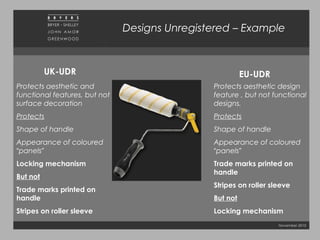
Designs Unregistered – Example
UK-UDR EU-UDR
Protects aesthetic and
functional features, but not
surface decoration
Protects
Shape of handle
Appearance of coloured
“panels”
Locking mechanism
But not
Trade marks printed on
handle
Stripes on roller sleeve
Protects aesthetic design
feature , but not functional
designs.
Protects
Shape of handle
Appearance of coloured
“panels”
Trade marks printed on
handle
Stripes on roller sleeve
But not
Locking mechanism
November 2010
Designs – unregistered
Infringement
Protects against copying, but not independent creation
Copying must be of the whole or a substantial part of the design
Drawbacks
In order to enforce your right you must prove that
- design right exists
- design qualifies for protection
- you own the right
- that copying has occurred
November 2010
Designs – registered
• Design Registration - UK & Europe
• Protection for the appearance of the whole or part of a
design of which is new and has individual character
• 1 year grace period
• Covers aesthetic designs, including surface decoration,
other than those dictated solely by function
• Protects against copying and independent creation
• Duration up to 25 years
November 2010
NEW
no identical design, or no design whose features differ
only in immaterial details, has previously been made
available to the public
Designs – registered
INDIVIDUAL CHARACTER
the overall impression produced by the design on the
informed user differs to that of any design disclosed
previously
November 2010
Designs - Registered
When Preparing a Registered Design Application - Things to Consider
• Protection determined by “representations” filed
• Colour, greyscale or black and white?
• Line drawing or rendered representations?
• Photographs?
• How many “representations”?
• Are you seeking to protect only a part of the appearance of a
product?
•Indication of Product - Locarno Classification
November 2010
Infringement
Protection against both copying and independent creation
Hence there would be infringement even if a second product has
been designed without reference to a first
Drawbacks
Cost associated with registration
Novelty requires decision to register to be made relatively early, but
don’t jump the gun!
Uncertainty, because applications are not examined as to
substance and therefore vulnerable to invalidation
Some dispute as to just who is the “informed user”
Designs - Registered
November 2010
Trademarks
• What is a trade mark?
• Any sign which can distinguish the goods and services of
one trader from those of another and is capable of being
represented graphically.
• What Form Can a Trade Mark Take?
• Words Logos Pictures Strap Lines
• Sounds Smells Colours Shapes
• What Does A Trade Mark Do
• Identifies your goods and/or services
• Ensures customers come back to you
• Adds value to your business
November 2010
Trademarks - Registered
When Registering a Trade Mark – Things to Consider
• Choosing a Trade Mark
• Distinctive
• Allusive to, but not descriptive of, your goods
• Is The Trade Mark Available?
• Pre-filing search - Risk assessment and advice
• Opposition and/or infringement
• Which goods/services? Set of “classes”
• Which Format? – word only, stylised word, logo, composite
November 2010
• Why Register Your Trade Mark?
• Protection against competition/copying
• Infringement/Passing Off
• Makes an intangible asset tangible
• Allows for easier transfer of the mark
• What if you are the wrong side of the line?
• Persuasion
• Evidence
Trademarks - Registered
November 2010
Patents
• Protect inventions
• For technology (in Europe at least)
• Not excluded, new and inventive
• Registered right
• Protects against independent creation
• Duration of up to 20 years
• Important to get inventorship & ownership correct
• Significant commercial importance
• But costly to acquire and maintain
November 2010
Patents – What is Protected?
How do you know what a patent protects?
• Typical patent document many pages long and includes a detailed
description and drawings which tell a skilled reader everything they need to
know to implement the invention
• Protection offered by patent not set by the detailed description, but a section
of the document referred to as “the claims”
What do “the claims” look like?
• List of related features which in combination are necessary to create the
invention
November 2010
Patents – Substantive Requirements
The UK-IPO must be sure that an application meets certain legal provisions
before they will grant a patent. A search and examination procedure exists to
determine whether an invention is:  
New, Inventive, Industrially Applicable, Not excluded
What is considered new?
In the UK, an invention is considered new if it has not been disclosed to the
public before an application for a patent was made. Anyone’s disclosures,
including your own count as a public disclosure.
In determining whether your patent application relates to something “new” the
UK-IPO will look at the list of essential features set out in your claims and
determine whether that combination of features was known at the time the
application was filed.
November 2010
Patents - Substantive Requirements
What is considered inventive?
Whether an invention is inventive is a matter of degree rather than a matter of
fact. Typically, the UK-IPO considers whether a person skilled in the particular area
of technology of the invention would consider that the invention set out in the
claims is obvious if having regard to all public disclosures known at the time the
application for a patent was made.
What if the UK-IPO raises objections?
- Persuasion
- Amendment (restricted to disclosure contained in application as originally filed)
November 2010
Patents
Things to Consider when Applying for a Patent
- have you described how to implement your invention sufficiently to allow a
person skilled in the art to implement it?
- do the claims relate to technical features and not the result to be achieved?
- have you used sufficiently broad (but functional) terms?
- careful wording
- remember that any amendments made during prosecution cannot “add
matter” to the application (very strict test)
- do you comply with formalities and law of UK?
- are you interested in protection overseas? Does your application take into
account differences in law and practice overseas?
November 2010
Role of IP Attorney
IP Attorneys
Trade Mark Attorneys (ITMA)
Patent Attorney (CIPA)
Qualified?
All take exams in fundamentals of Law – UK Fundamentals, Contract and Tort, EU
Competition Law, together with IP specific exams (copyright, design, trade marks,
patents)
Science/Engineering Degree
European and UK examination procedure – minimum 3 years
November 2010
Role of IP attorney
Your attorney:
- Knows the complexities and subtleties of IP law and practice
- Can offer range of IP options in relation to a product/method
BUT….
- Does not know your marketplace
- Does not know significance of your invention
- Does not know your competitors
Communicate!
November 2010
Infringement
Infringement of a Patent
Not a criminal offence
Law enforcement agencies do not monitor whether your patent is being
infringed nor can they take action against infringers on your behalf.
If you have discovered a potential infringement its up to you to pursue the
person infringing by initiating a civil action through the courts for damages and
an injunction.
Role of IP
Primarily a deterrent - rarely worthwhile instituting formal legal proceedings
Usually possible to achieve a result by “sabre rattling” and negotiation
Likely to be taken more seriously if patent has been drafted by an attorney
Likely to be taken more seriously if represented by an attorney
November 2010
What if You Can’t Register?
Not all forms of protection available for all products
- Unregistered Rights?
- Keep Confidential? “Trade Secret” or “Business Know-How”
- Be first to market?
- Develop brand/reputation/marketing
November 2010
GOOD LUCK
Any Questions?
Judith Coghlan
Bryers
7 Gay Street
Bath BA1 2PH
01225 428877
www.bryerlaw.com

Getting the registration right Judith Coghlan

  • 1.
    November 2010 Getting theRegistration Right Judith Coghlan BRYERS
  • 2.
    November 2010 Broad IPspectrum What is available? Copyrights Designs Patents Trademarks
  • 3.
    November 2010 Which isbest for you? Protection which is  free, but weak  strong, but expensive  economical, but useable Will vary from product to product Broad IP spectrum
  • 4.
    November 2010 Broad IPspectrum - IP is a commercial tool - Does not authorise you to to use the IP, it provides means for you to seek to stop others - Primarily a deterrent - rarely worthwhile instituting formal legal proceedings - Usually possible to achieve a result by “sabre rattling” and negotiation
  • 5.
    November 2010 Unregistered Rights- Copyright COPYRIGHT • What does copyright protect? • Protects literary, dramatic, artistic, musical works, etc • e.g. books, plays, songs • How does it arise? • automatic, no registration system in UK, hence free • recommended to mark with © symbol, but not compulsory • How long does it last? • life of the author + 70 years • Who Owns it? • the author or the employer of the author is the first owner • a work created under commission or contract must still be formally assigned
  • 6.
    November 2010 Copyright How isit infringed? • infringed only by copying • of a substantive part of the work - qualitative not quantitative assessment • copying may be assumed in some cases of similarity (plus access) Drawbacks In order to enforce your right you must prove - copyright exists - you own the copyright - that copying has occurred
  • 7.
    November 2010 Designs • Complicated! •No less than 4 possible routes for protection of a design • UK Unregistered Design Right • Community Unregistered Design Right • UK Registered Design Right • Community Registered Design Right
  • 8.
    November 2010 Designs –unregistered • UK unregistered design right (UK-UDR) • Protection for the appearance of a design which is original • Exists automatically for EU entities • Duration up to 15 years (licence of right for last 5 years) • Employer owns employee’s and commission’s UK-UDR • European unregistered design right (C-UDR) • Protection for the appearance of a design which is new and has individual character • Exists automatically from knowledge of design in EU • Duration 3 years • Employer owns employee’s C-UDR, but not contractor’s C-UDR
  • 9.
    November 2010 Designs Unregistered– Example UK-UDR EU-UDR Protects aesthetic and functional features, but not surface decoration Protects Shape of handle Appearance of coloured “panels” Locking mechanism But not Trade marks printed on handle Stripes on roller sleeve Protects aesthetic design feature , but not functional designs. Protects Shape of handle Appearance of coloured “panels” Trade marks printed on handle Stripes on roller sleeve But not Locking mechanism
  • 10.
    November 2010 Designs –unregistered Infringement Protects against copying, but not independent creation Copying must be of the whole or a substantial part of the design Drawbacks In order to enforce your right you must prove that - design right exists - design qualifies for protection - you own the right - that copying has occurred
  • 11.
    November 2010 Designs –registered • Design Registration - UK & Europe • Protection for the appearance of the whole or part of a design of which is new and has individual character • 1 year grace period • Covers aesthetic designs, including surface decoration, other than those dictated solely by function • Protects against copying and independent creation • Duration up to 25 years
  • 12.
    November 2010 NEW no identicaldesign, or no design whose features differ only in immaterial details, has previously been made available to the public Designs – registered INDIVIDUAL CHARACTER the overall impression produced by the design on the informed user differs to that of any design disclosed previously
  • 13.
    November 2010 Designs -Registered When Preparing a Registered Design Application - Things to Consider • Protection determined by “representations” filed • Colour, greyscale or black and white? • Line drawing or rendered representations? • Photographs? • How many “representations”? • Are you seeking to protect only a part of the appearance of a product? •Indication of Product - Locarno Classification
  • 14.
    November 2010 Infringement Protection againstboth copying and independent creation Hence there would be infringement even if a second product has been designed without reference to a first Drawbacks Cost associated with registration Novelty requires decision to register to be made relatively early, but don’t jump the gun! Uncertainty, because applications are not examined as to substance and therefore vulnerable to invalidation Some dispute as to just who is the “informed user” Designs - Registered
  • 15.
    November 2010 Trademarks • Whatis a trade mark? • Any sign which can distinguish the goods and services of one trader from those of another and is capable of being represented graphically. • What Form Can a Trade Mark Take? • Words Logos Pictures Strap Lines • Sounds Smells Colours Shapes • What Does A Trade Mark Do • Identifies your goods and/or services • Ensures customers come back to you • Adds value to your business
  • 16.
    November 2010 Trademarks -Registered When Registering a Trade Mark – Things to Consider • Choosing a Trade Mark • Distinctive • Allusive to, but not descriptive of, your goods • Is The Trade Mark Available? • Pre-filing search - Risk assessment and advice • Opposition and/or infringement • Which goods/services? Set of “classes” • Which Format? – word only, stylised word, logo, composite
  • 17.
    November 2010 • WhyRegister Your Trade Mark? • Protection against competition/copying • Infringement/Passing Off • Makes an intangible asset tangible • Allows for easier transfer of the mark • What if you are the wrong side of the line? • Persuasion • Evidence Trademarks - Registered
  • 18.
    November 2010 Patents • Protectinventions • For technology (in Europe at least) • Not excluded, new and inventive • Registered right • Protects against independent creation • Duration of up to 20 years • Important to get inventorship & ownership correct • Significant commercial importance • But costly to acquire and maintain
  • 19.
    November 2010 Patents –What is Protected? How do you know what a patent protects? • Typical patent document many pages long and includes a detailed description and drawings which tell a skilled reader everything they need to know to implement the invention • Protection offered by patent not set by the detailed description, but a section of the document referred to as “the claims” What do “the claims” look like? • List of related features which in combination are necessary to create the invention
  • 20.
    November 2010 Patents –Substantive Requirements The UK-IPO must be sure that an application meets certain legal provisions before they will grant a patent. A search and examination procedure exists to determine whether an invention is:   New, Inventive, Industrially Applicable, Not excluded What is considered new? In the UK, an invention is considered new if it has not been disclosed to the public before an application for a patent was made. Anyone’s disclosures, including your own count as a public disclosure. In determining whether your patent application relates to something “new” the UK-IPO will look at the list of essential features set out in your claims and determine whether that combination of features was known at the time the application was filed.
  • 21.
    November 2010 Patents -Substantive Requirements What is considered inventive? Whether an invention is inventive is a matter of degree rather than a matter of fact. Typically, the UK-IPO considers whether a person skilled in the particular area of technology of the invention would consider that the invention set out in the claims is obvious if having regard to all public disclosures known at the time the application for a patent was made. What if the UK-IPO raises objections? - Persuasion - Amendment (restricted to disclosure contained in application as originally filed)
  • 22.
    November 2010 Patents Things toConsider when Applying for a Patent - have you described how to implement your invention sufficiently to allow a person skilled in the art to implement it? - do the claims relate to technical features and not the result to be achieved? - have you used sufficiently broad (but functional) terms? - careful wording - remember that any amendments made during prosecution cannot “add matter” to the application (very strict test) - do you comply with formalities and law of UK? - are you interested in protection overseas? Does your application take into account differences in law and practice overseas?
  • 23.
    November 2010 Role ofIP Attorney IP Attorneys Trade Mark Attorneys (ITMA) Patent Attorney (CIPA) Qualified? All take exams in fundamentals of Law – UK Fundamentals, Contract and Tort, EU Competition Law, together with IP specific exams (copyright, design, trade marks, patents) Science/Engineering Degree European and UK examination procedure – minimum 3 years
  • 24.
    November 2010 Role ofIP attorney Your attorney: - Knows the complexities and subtleties of IP law and practice - Can offer range of IP options in relation to a product/method BUT…. - Does not know your marketplace - Does not know significance of your invention - Does not know your competitors Communicate!
  • 25.
    November 2010 Infringement Infringement ofa Patent Not a criminal offence Law enforcement agencies do not monitor whether your patent is being infringed nor can they take action against infringers on your behalf. If you have discovered a potential infringement its up to you to pursue the person infringing by initiating a civil action through the courts for damages and an injunction. Role of IP Primarily a deterrent - rarely worthwhile instituting formal legal proceedings Usually possible to achieve a result by “sabre rattling” and negotiation Likely to be taken more seriously if patent has been drafted by an attorney Likely to be taken more seriously if represented by an attorney
  • 26.
    November 2010 What ifYou Can’t Register? Not all forms of protection available for all products - Unregistered Rights? - Keep Confidential? “Trade Secret” or “Business Know-How” - Be first to market? - Develop brand/reputation/marketing
  • 27.
    November 2010 GOOD LUCK AnyQuestions? Judith Coghlan Bryers 7 Gay Street Bath BA1 2PH 01225 428877 www.bryerlaw.com