Explicit and Implicit Information
L.O. To understand the differences
between explicit and implicit information.
Key Words
Fact
Opinion
False fact
Implicit
Explicit
5
Discuss definitions
with your partner
Q1 and Q2
Assessment Objective
A01
Identify and interpret
explicit and implicit
information and ideas.
Select and synthesise
evidence from different
texts.
What is the difference between explicit
and implicit?
Explicit – clearly stated so there is
no room for confusion or questions.
Implicit – implied or suggested, but
not clearly stated.
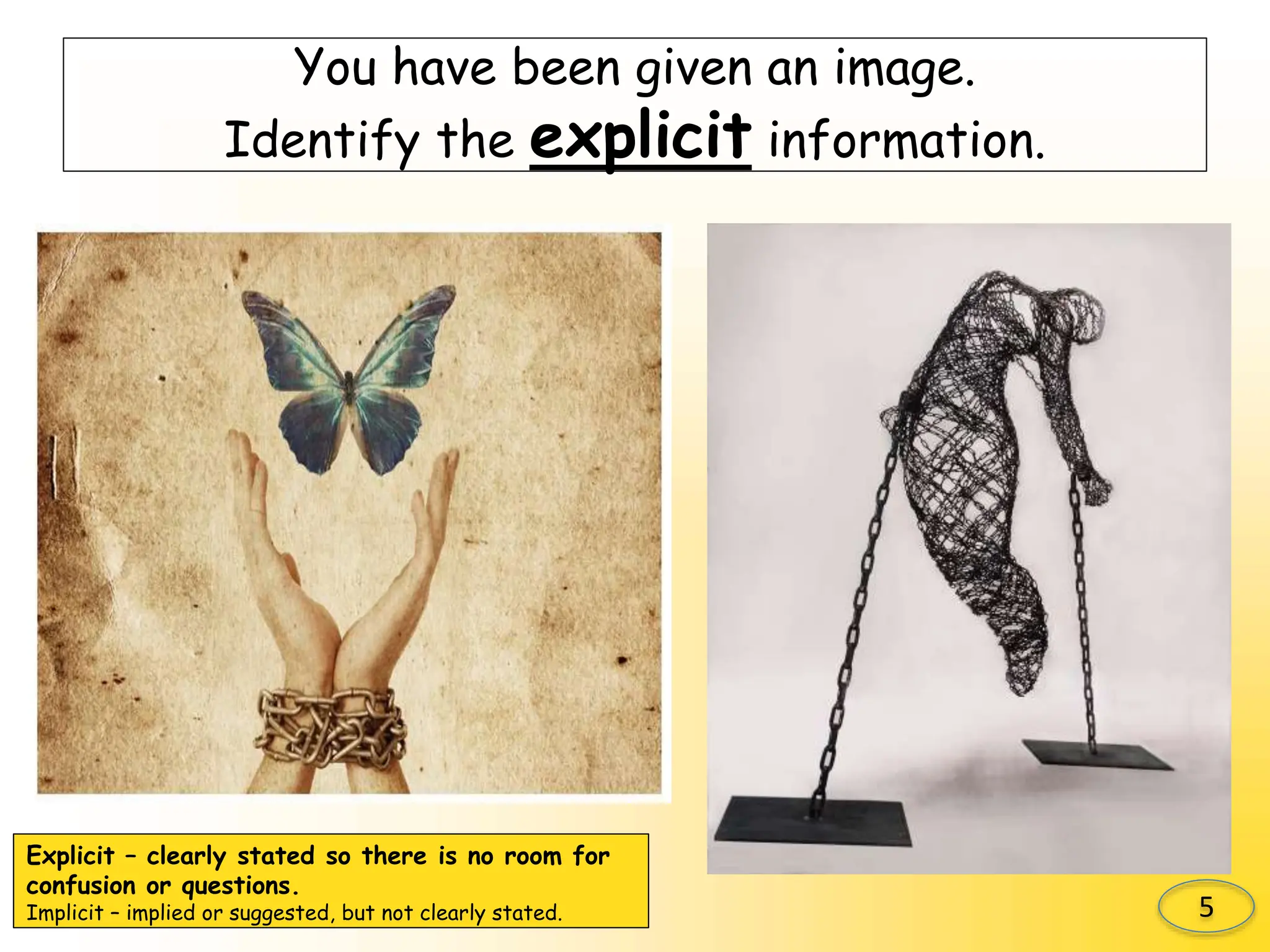
You have been given an image.
Identify the explicit information.
Explicit – clearly stated so there is no room for
confusion or questions.
Implicit – implied or suggested, but not clearly stated. 5
Did you pick out explicit information or implicit
information?
Explicit – clearly stated so there is no room for
confusion or questions.
Implicit – implied or suggested, but not clearly stated.
Explicit
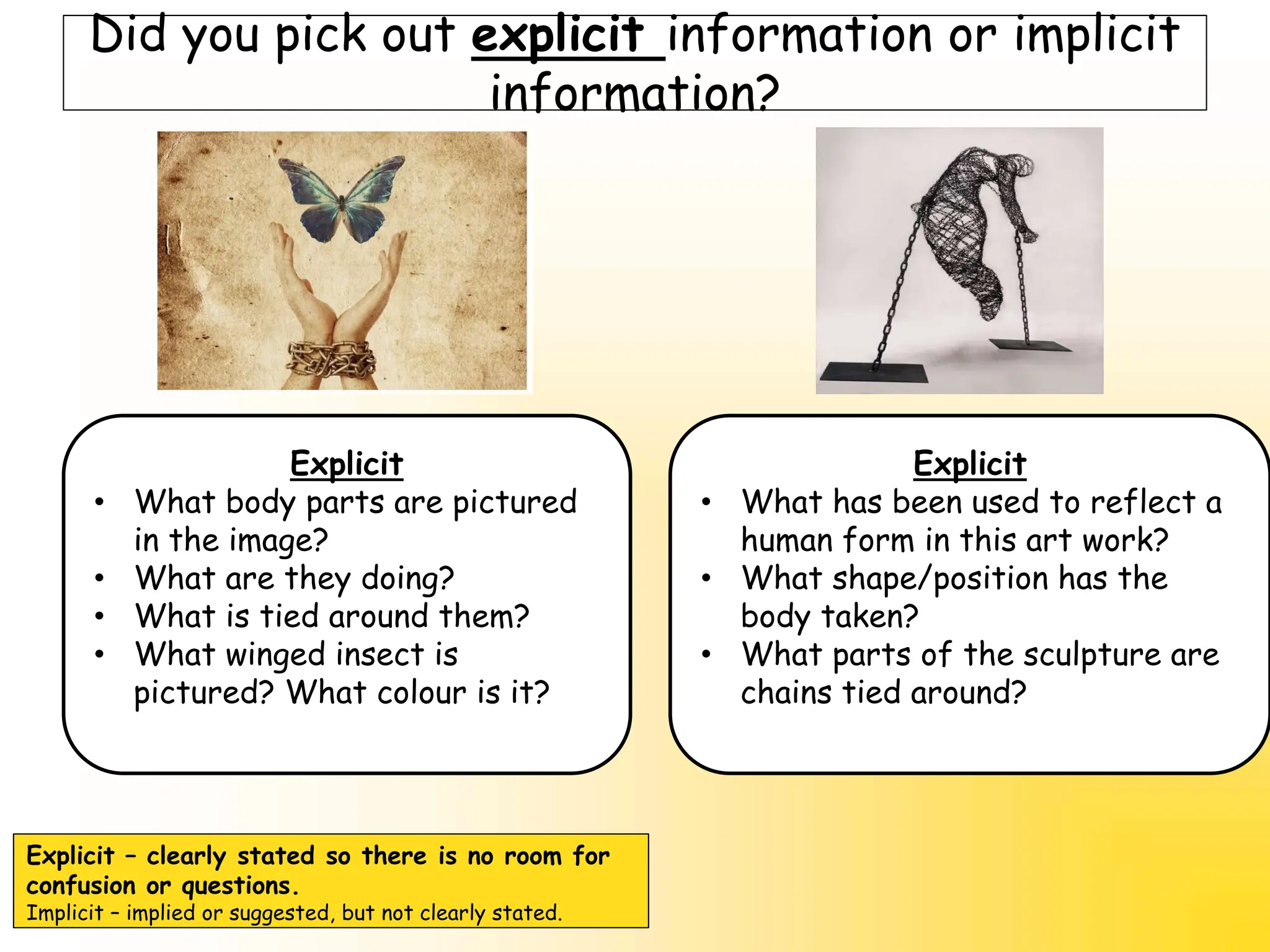
• What body parts are pictured
in the image?
• What are they doing?
• What is tied around them?
• What winged insect is
pictured? What colour is it?
Explicit
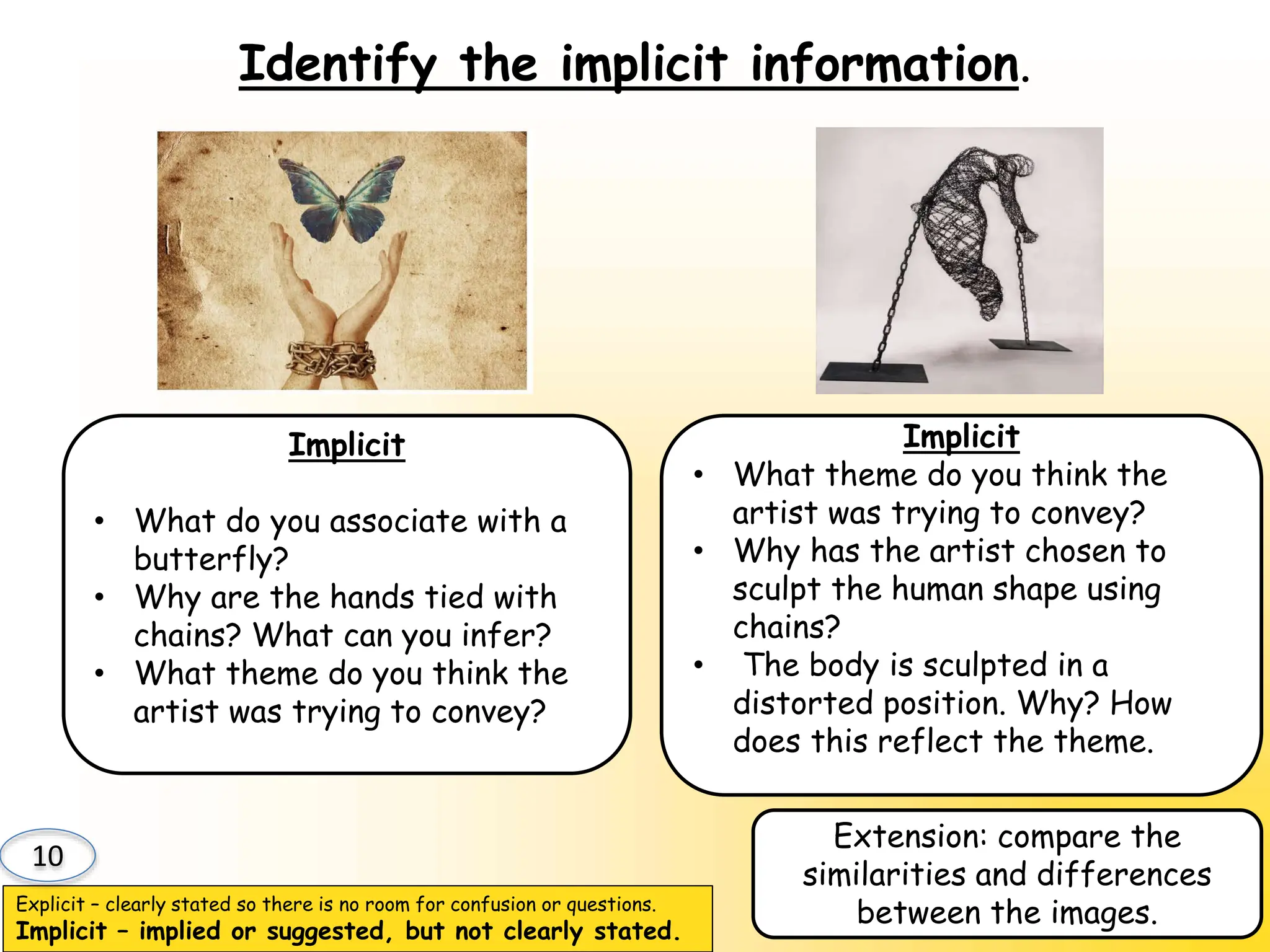
• What has been used to reflect a
human form in this art work?
• What shape/position has the
body taken?
• What parts of the sculpture are
chains tied around?
Identify the implicit information.
Explicit – clearly stated so there is no room for confusion or questions.
Implicit – implied or suggested, but not clearly stated.
Extension: compare the
similarities and differences
between the images.
Implicit
• What do you associate with a
butterfly?
• Why are the hands tied with
chains? What can you infer?
• What theme do you think the
artist was trying to convey?
Implicit
• What theme do you think the
artist was trying to convey?
• Why has the artist chosen to
sculpt the human shape using
chains?
• The body is sculpted in a
distorted position. Why? How
does this reflect the theme.
10
7
Fight for freedom – Source A (modern)
She is a Pakistani teenager who was protesting against the oppressive
regime in her country which meant that only boys were allowed to go to
school. Her public protests made her a target; in 2012, after she boarded
her school bus, she was shot three times by a gunman.
The assassination attempt sparked a national and international outpouring
of support for Yousafzai and, in 2014, Malala was announced as the co-
recipient of the Nobel Peace Prize.
What do you
know about
Malala?
Marks
awarded
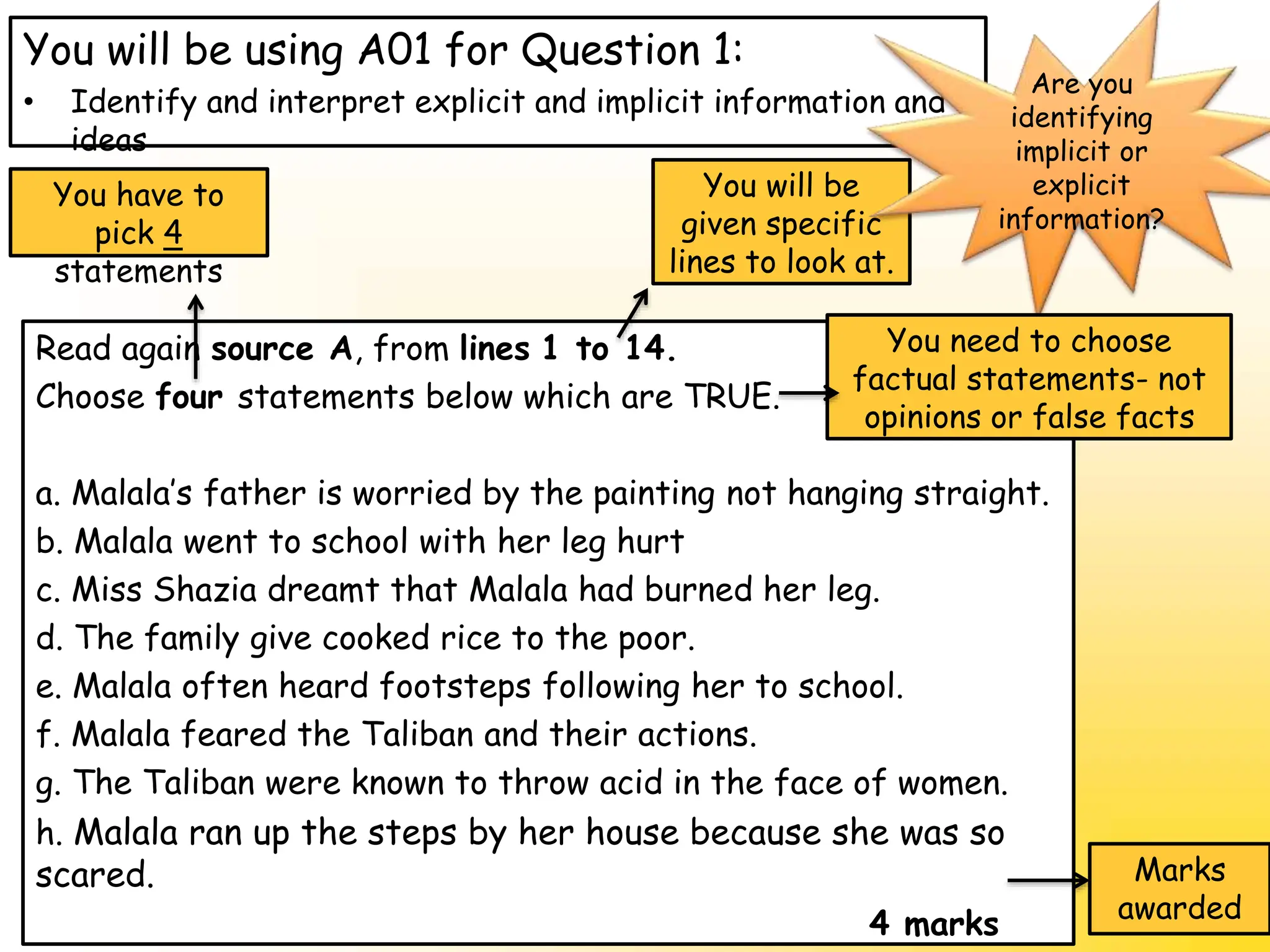
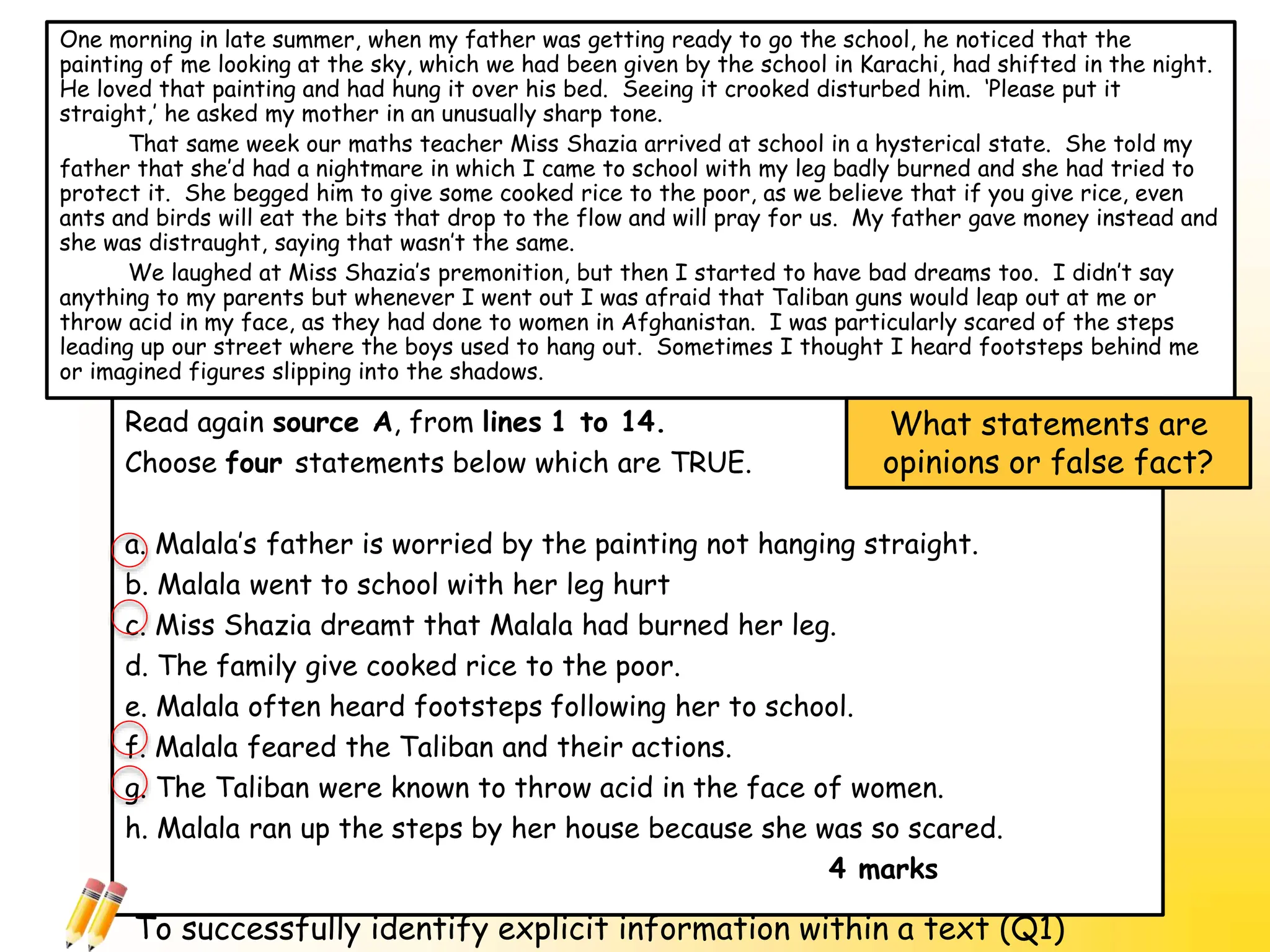
Read again source A, from lines 1 to 14.
Choose four statements below which are TRUE.
a. Malala’s father is worried by the painting not hanging straight.
b. Malala went to school with her leg hurt
c. Miss Shazia dreamt that Malala had burned her leg.
d. The family give cooked rice to the poor.
e. Malala often heard footsteps following her to school.
f. Malala feared the Taliban and their actions.
g. The Taliban were known to throw acid in the face of women.
h. Malala ran up the steps by her house because she was so
scared.
4 marks
You will be using A01 for Question 1:
• Identify and interpret explicit and implicit information and
ideas
You will be
given specific
lines to look at.
You have to
pick 4
statements
Are you
identifying
implicit or
explicit
information?
You need to choose
factual statements- not
opinions or false facts
Learning Checkpoint
1. What is explicit information?
2. What is a false fact?
3. What is an opinion?
4. What is implicit information?
Learning Checkpoint
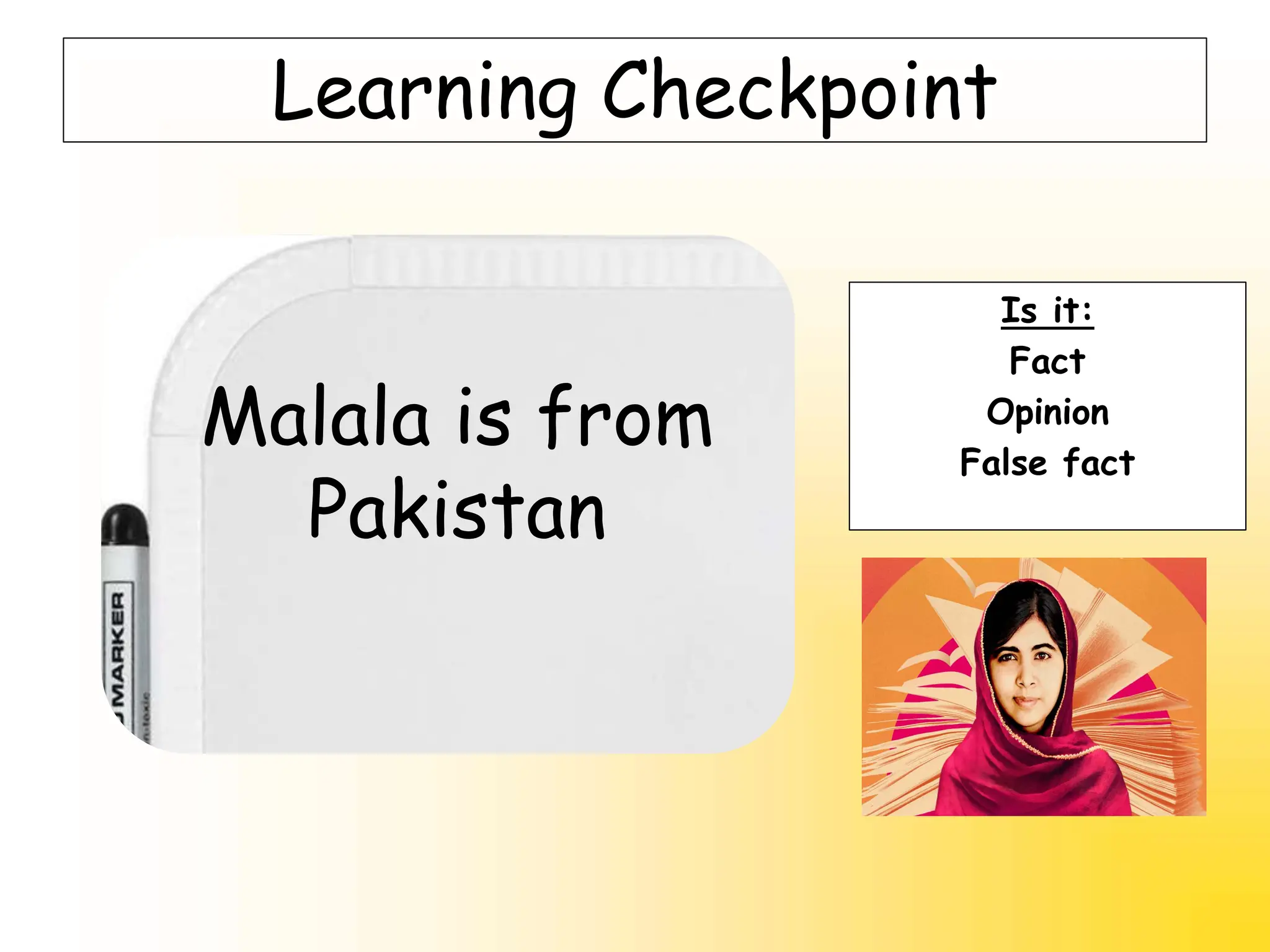
Malala is from
Pakistan
Is it:
Fact
Opinion
False fact
Learning Checkpoint
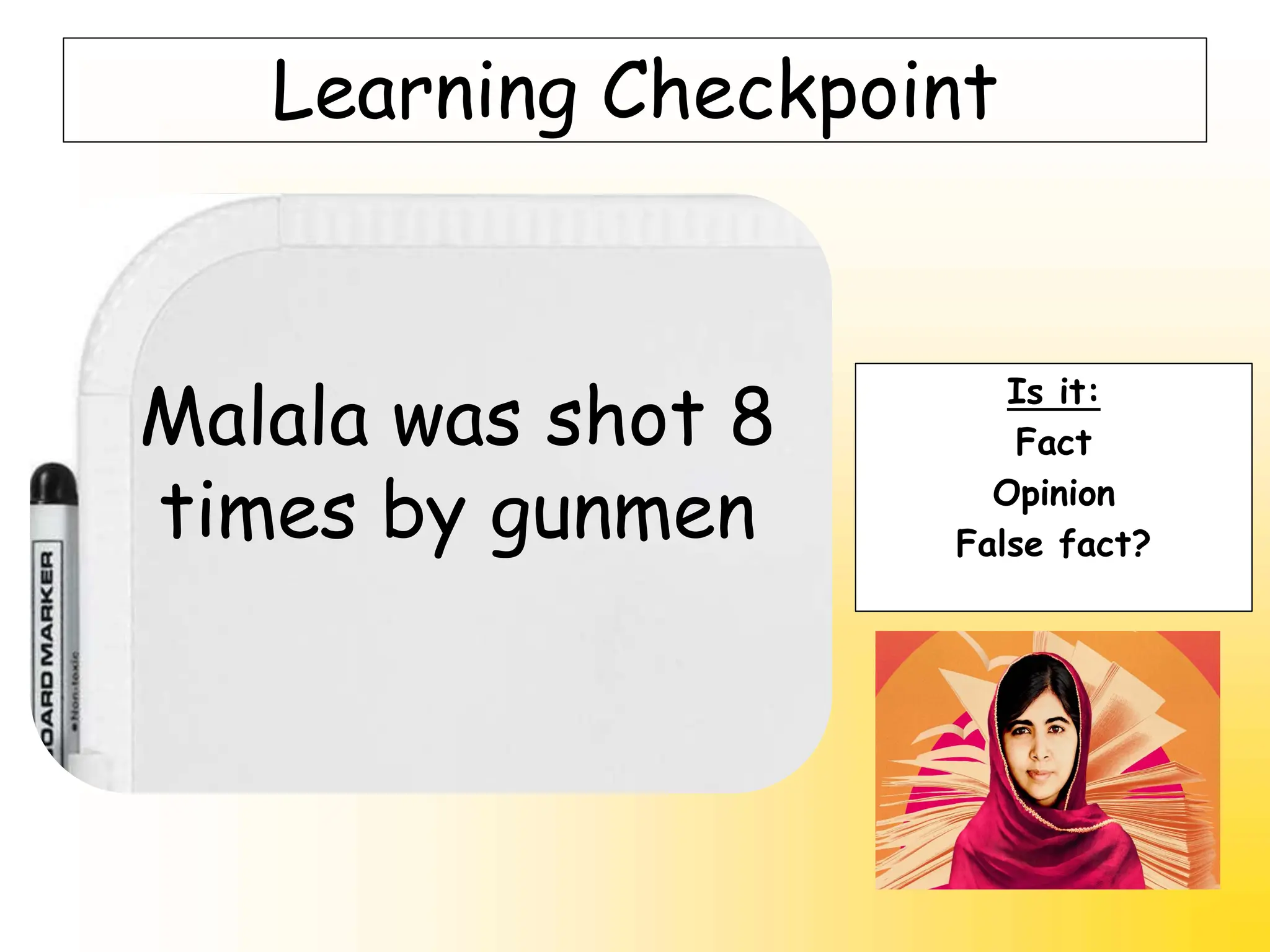
Malala was shot 8
times by gunmen
Is it:
Fact
Opinion
False fact?
Learning Checkpoint
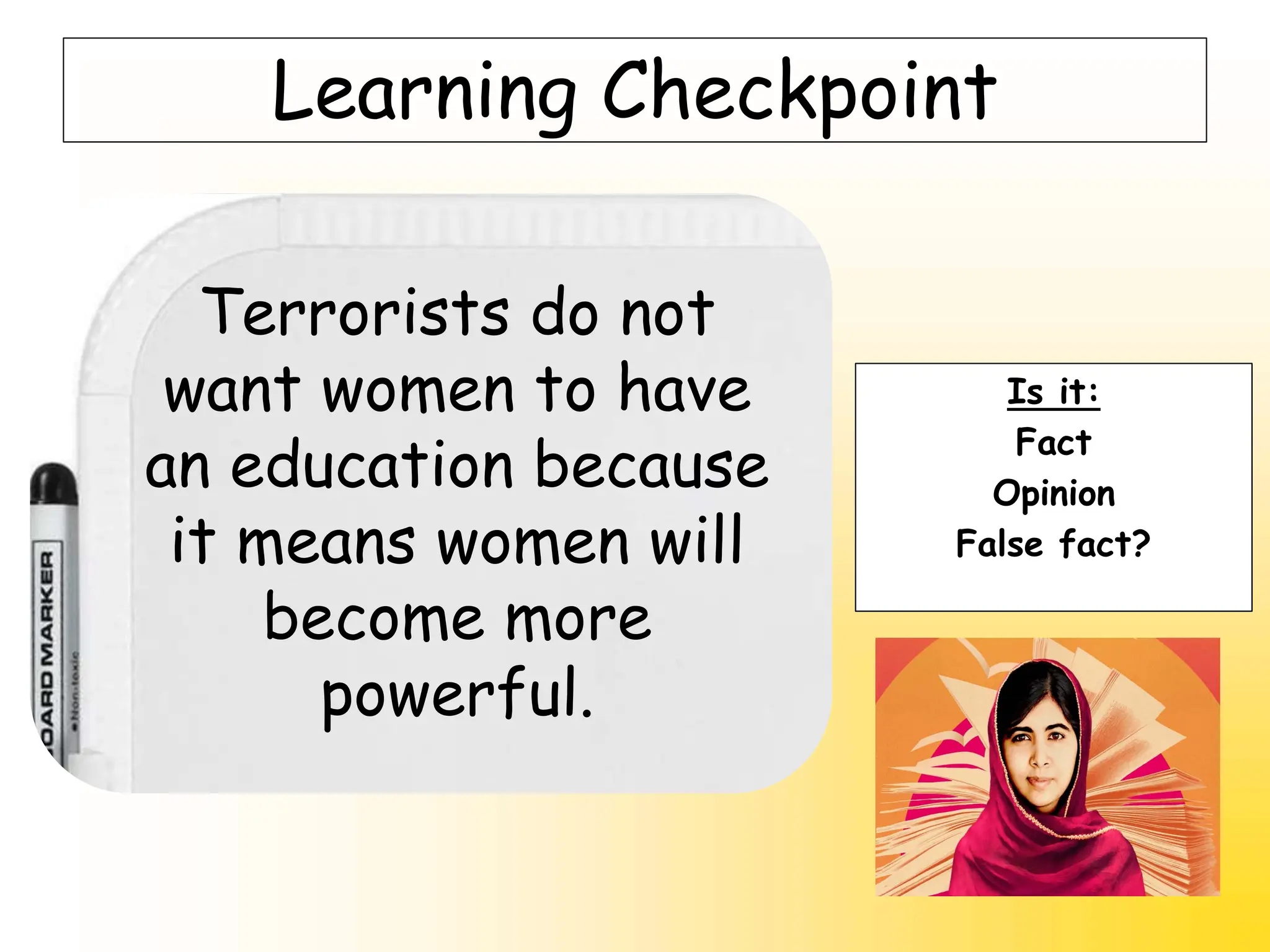
Terrorists do not
want women to have
an education because
it means women will
become more
powerful.
Is it:
Fact
Opinion
False fact?
Learning Checkpoint
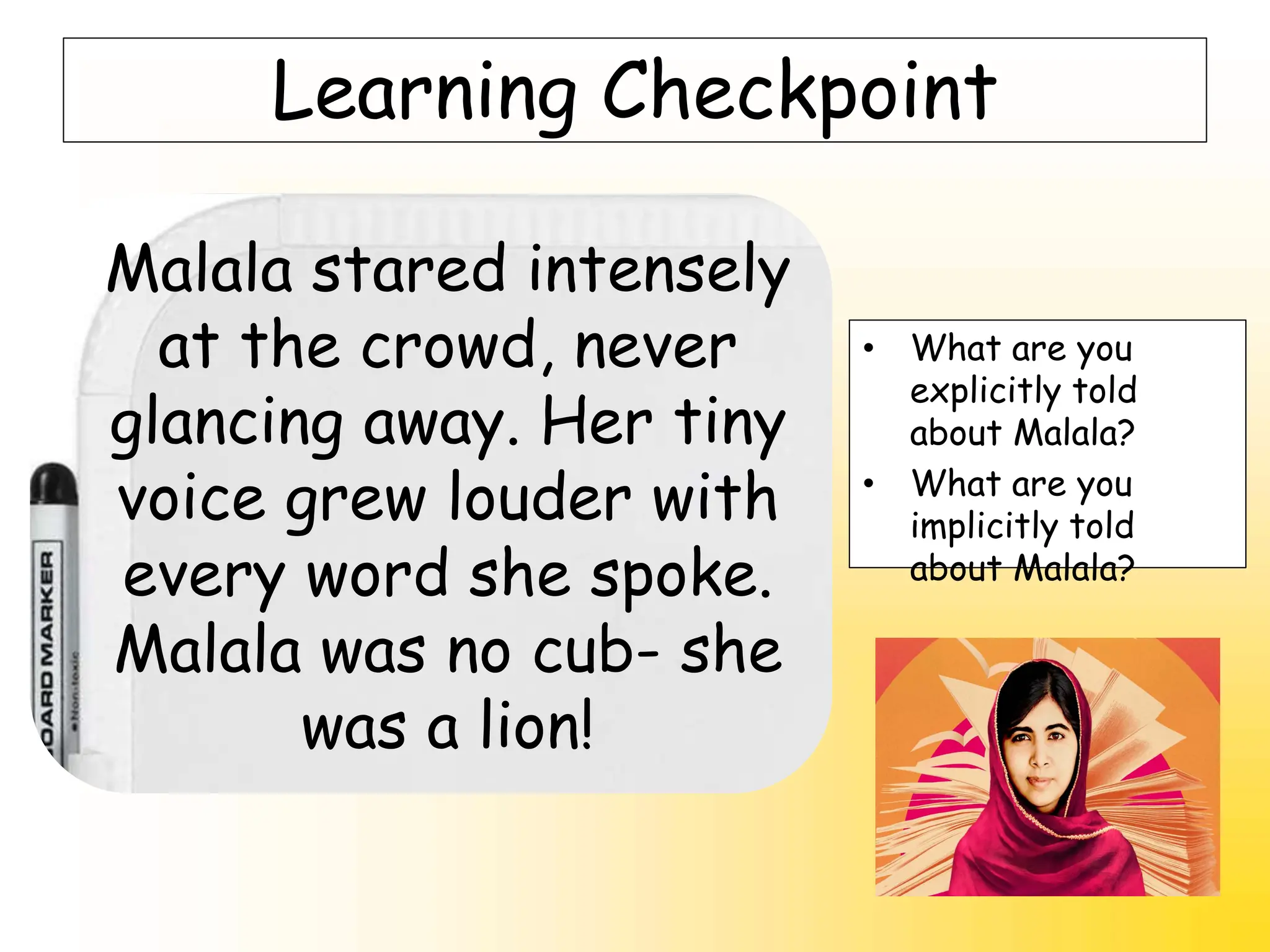
Malala stared intensely
at the crowd, never
glancing away. Her tiny
voice grew louder with
every word she spoke.
Malala was no cub- she
was a lion!
• What are you
explicitly told
about Malala?
• What are you
implicitly told
about Malala?
One morning in late summer, when my father was getting ready to go the school, he noticed that the
painting of me looking at the sky, which we had been given by the school in Karachi, had shifted in the night.
He loved that painting and had hung it over his bed. Seeing it crooked disturbed him. ‘Please put it
straight,’ he asked my mother in an unusually sharp tone.
That same week our maths teacher Miss Shazia arrived at school in a hysterical state. She told my
father that she’d had a nightmare in which I came to school with my leg badly burned and she had tried to
protect it. She begged him to give some cooked rice to the poor, as we believe that if you give rice, even
ants and birds will eat the bits that drop to the flow and will pray for us. My father gave money instead and
she was distraught, saying that wasn’t the same.
We laughed at Miss Shazia’s premonition, but then I started to have bad dreams too. I didn’t say
anything to my parents but whenever I went out I was afraid that Taliban guns would leap out at me or
throw acid in my face, as they had done to women in Afghanistan. I was particularly scared of the steps
leading up our street where the boys used to hang out. Sometimes I thought I heard footsteps behind me
or imagined figures slipping into the shadows.
Read again source A, from lines 1 to 14.
Choose four statements below which are TRUE.
a. Malala’s father is worried by the painting not hanging straight.
b. Malala went to school with her leg hurt
c. Miss Shazia dreamt that Malala had burned her leg.
d. The family give cooked rice to the poor.
e. Malala often heard footsteps following her to school.
f. Malala feared the Taliban and their actions.
g. The Taliban were known to throw acid in the face of women.
h. Malala ran up the steps by her house because she was so scared.
4 marks
To successfully identify explicit information within a text (Q1)
What statements are
opinions or false fact?
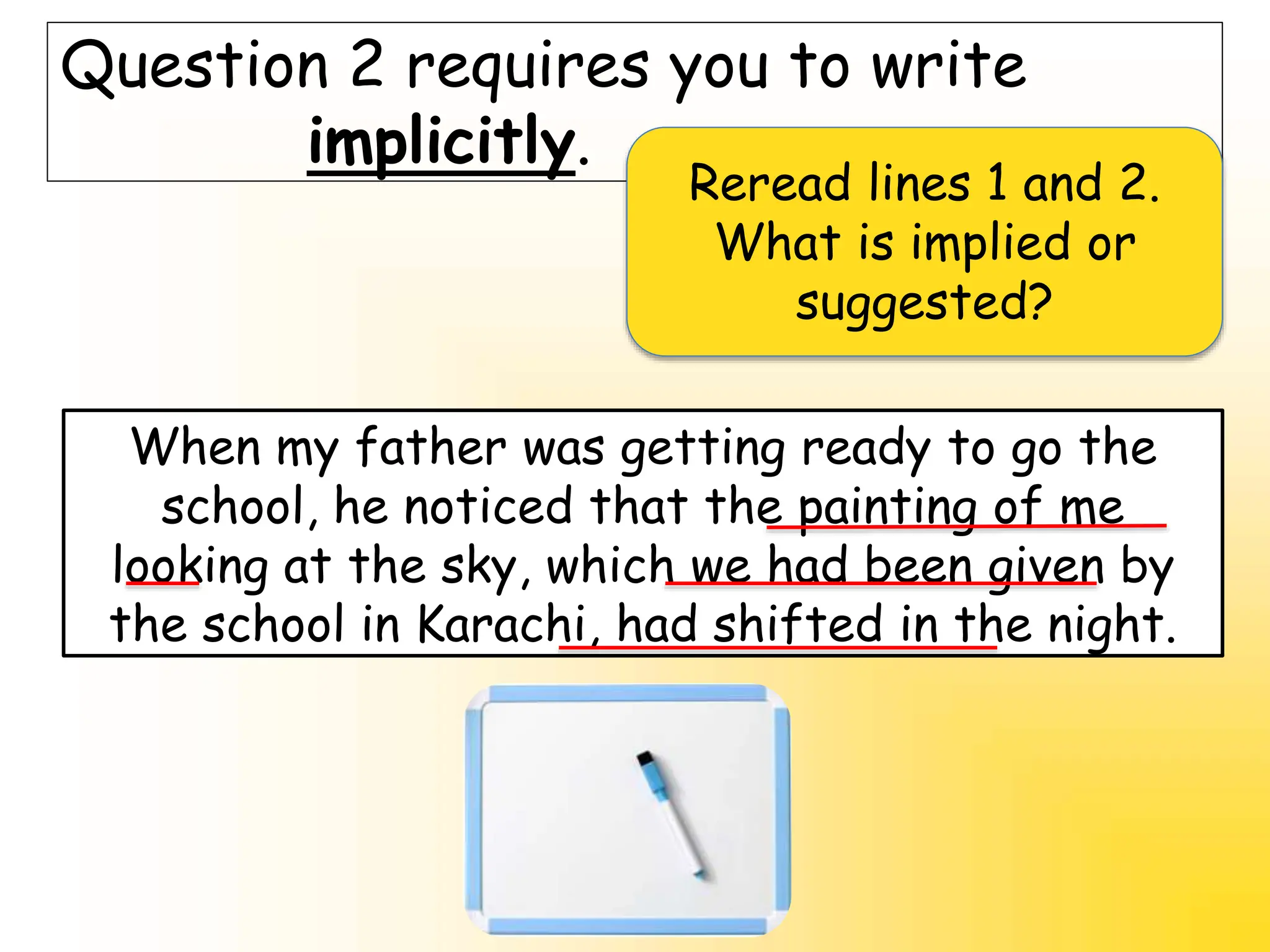
Question 2 requires you to write
implicitly.
When my father was getting ready to go the
school, he noticed that the painting of me
looking at the sky, which we had been given by
the school in Karachi, had shifted in the night.
Reread lines 1 and 2.
What is implied or
suggested?
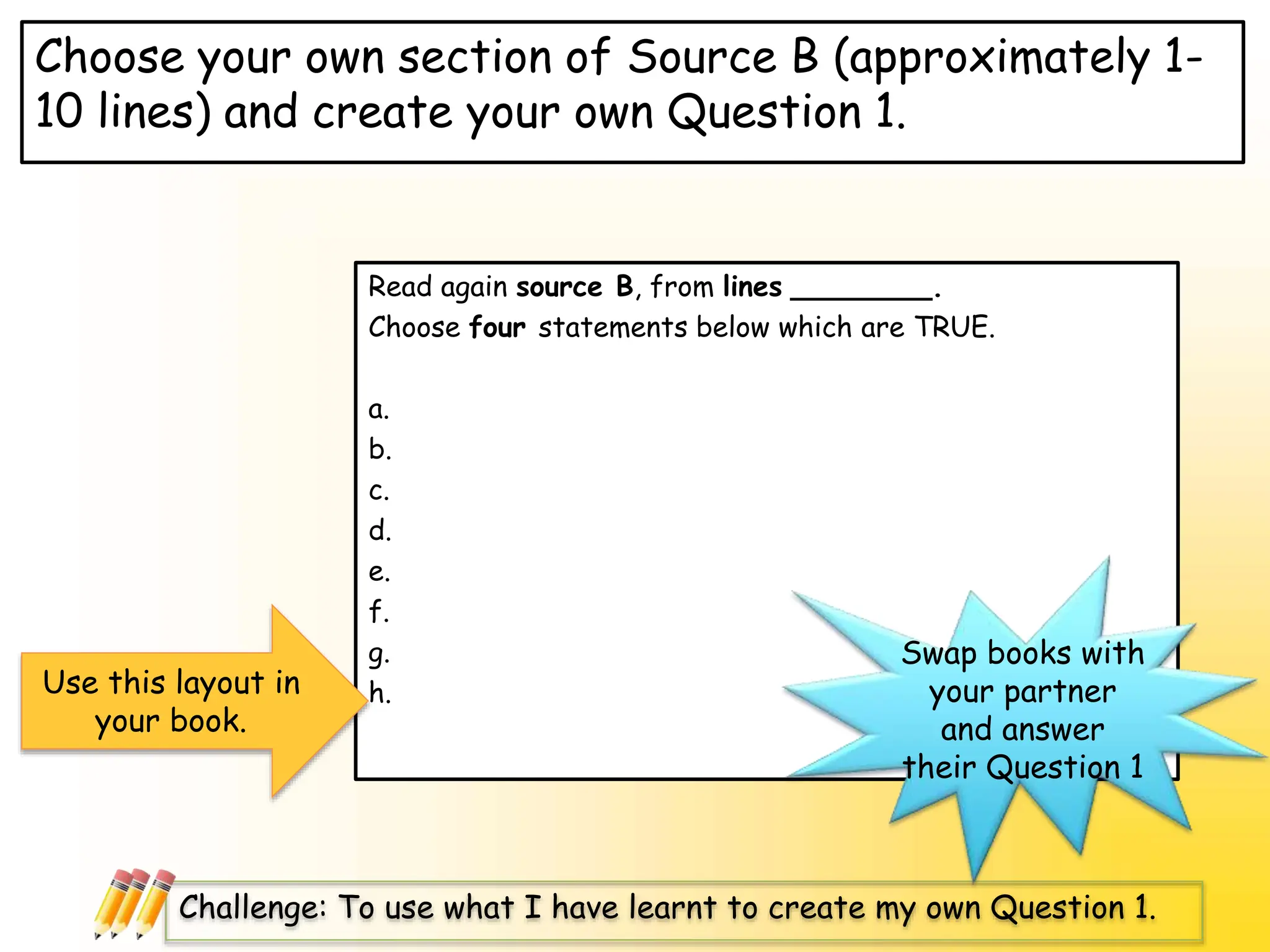
Choose your own section of Source B (approximately 1-
10 lines) and create your own Question 1.
Challenge: To use what I have learnt to create my own Question 1.
Read again source B, from lines ________.
Choose four statements below which are TRUE.
a.
b.
c.
d.
e.
f.
g.
h.
4
marks
Swap books with
your partner
and answer
their Question 1
Use this layout in
your book.
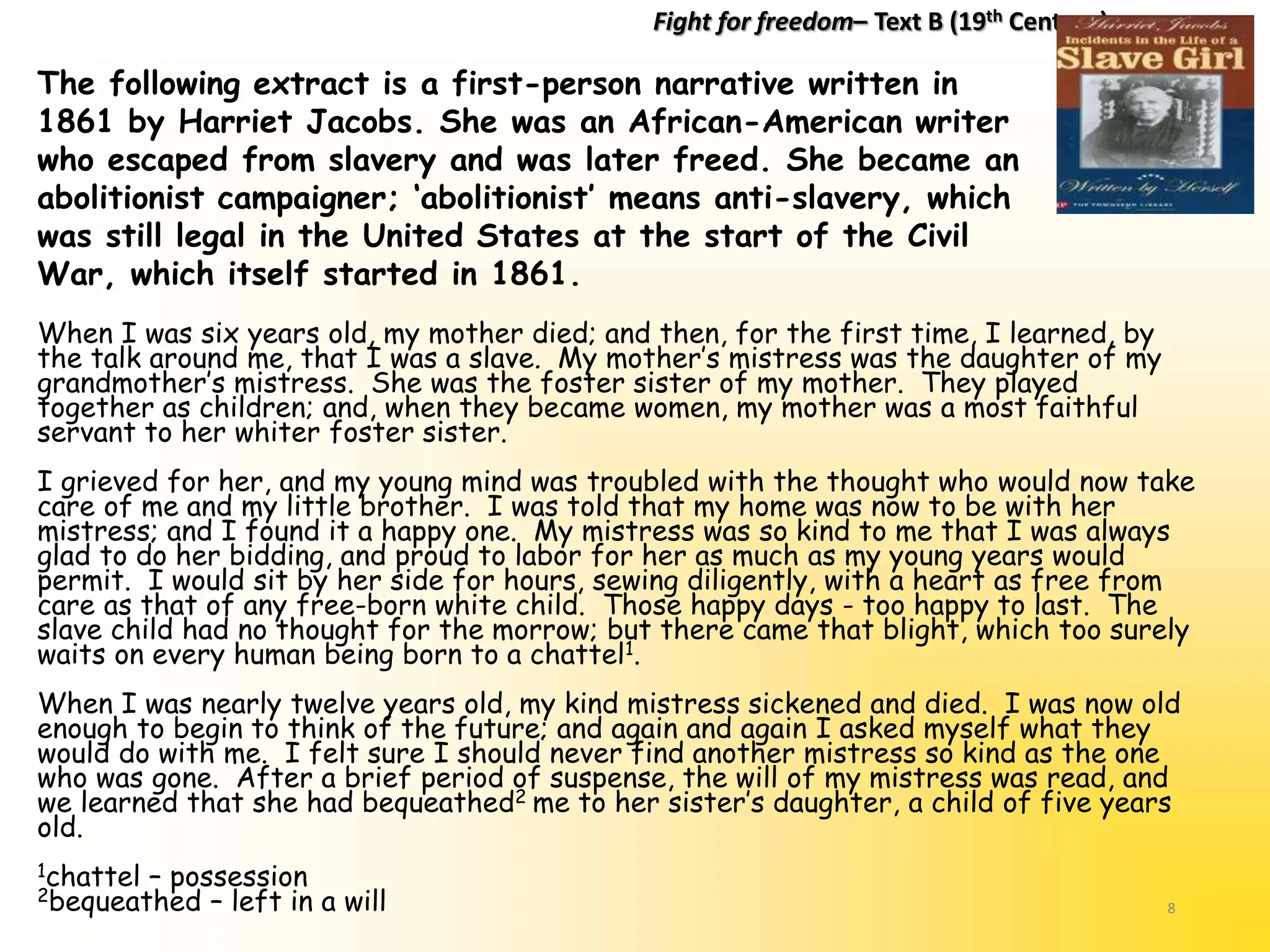
Fight for freedom– Text B (19th Century)
When I was six years old, my mother died; and then, for the first time, I learned, by
the talk around me, that I was a slave. My mother’s mistress was the daughter of my
grandmother’s mistress. She was the foster sister of my mother. They played
together as children; and, when they became women, my mother was a most faithful
servant to her whiter foster sister.
I grieved for her, and my young mind was troubled with the thought who would now take
care of me and my little brother. I was told that my home was now to be with her
mistress; and I found it a happy one. My mistress was so kind to me that I was always
glad to do her bidding, and proud to labor for her as much as my young years would
permit. I would sit by her side for hours, sewing diligently, with a heart as free from
care as that of any free-born white child. Those happy days - too happy to last. The
slave child had no thought for the morrow; but there came that blight, which too surely
waits on every human being born to a chattel1.
When I was nearly twelve years old, my kind mistress sickened and died. I was now old
enough to begin to think of the future; and again and again I asked myself what they
would do with me. I felt sure I should never find another mistress so kind as the one
who was gone. After a brief period of suspense, the will of my mistress was read, and
we learned that she had bequeathed2 me to her sister’s daughter, a child of five years
old.
1chattel – possession
2bequeathed – left in a will 8
The following extract is a first-person narrative written in
1861 by Harriet Jacobs. She was an African-American writer
who escaped from slavery and was later freed. She became an
abolitionist campaigner; ‘abolitionist’ means anti-slavery, which
was still legal in the United States at the start of the Civil
War, which itself started in 1861.
Join my community for revision videos,
support and advice to share with your

Understanding Explicit-and-Implicit-Information.pptx

  • 1.
    Explicit and ImplicitInformation L.O. To understand the differences between explicit and implicit information. Key Words Fact Opinion False fact Implicit Explicit 5 Discuss definitions with your partner
  • 2.
    Q1 and Q2 AssessmentObjective A01 Identify and interpret explicit and implicit information and ideas. Select and synthesise evidence from different texts.
  • 3.
    What is thedifference between explicit and implicit? Explicit – clearly stated so there is no room for confusion or questions. Implicit – implied or suggested, but not clearly stated.
  • 4.
    You have beengiven an image. Identify the explicit information. Explicit – clearly stated so there is no room for confusion or questions. Implicit – implied or suggested, but not clearly stated. 5
  • 5.
    Did you pickout explicit information or implicit information? Explicit – clearly stated so there is no room for confusion or questions. Implicit – implied or suggested, but not clearly stated. Explicit • What body parts are pictured in the image? • What are they doing? • What is tied around them? • What winged insect is pictured? What colour is it? Explicit • What has been used to reflect a human form in this art work? • What shape/position has the body taken? • What parts of the sculpture are chains tied around?
  • 6.
    Identify the implicitinformation. Explicit – clearly stated so there is no room for confusion or questions. Implicit – implied or suggested, but not clearly stated. Extension: compare the similarities and differences between the images. Implicit • What do you associate with a butterfly? • Why are the hands tied with chains? What can you infer? • What theme do you think the artist was trying to convey? Implicit • What theme do you think the artist was trying to convey? • Why has the artist chosen to sculpt the human shape using chains? • The body is sculpted in a distorted position. Why? How does this reflect the theme. 10
  • 7.
    7 Fight for freedom– Source A (modern) She is a Pakistani teenager who was protesting against the oppressive regime in her country which meant that only boys were allowed to go to school. Her public protests made her a target; in 2012, after she boarded her school bus, she was shot three times by a gunman. The assassination attempt sparked a national and international outpouring of support for Yousafzai and, in 2014, Malala was announced as the co- recipient of the Nobel Peace Prize. What do you know about Malala?
  • 8.
    Marks awarded Read again sourceA, from lines 1 to 14. Choose four statements below which are TRUE. a. Malala’s father is worried by the painting not hanging straight. b. Malala went to school with her leg hurt c. Miss Shazia dreamt that Malala had burned her leg. d. The family give cooked rice to the poor. e. Malala often heard footsteps following her to school. f. Malala feared the Taliban and their actions. g. The Taliban were known to throw acid in the face of women. h. Malala ran up the steps by her house because she was so scared. 4 marks You will be using A01 for Question 1: • Identify and interpret explicit and implicit information and ideas You will be given specific lines to look at. You have to pick 4 statements Are you identifying implicit or explicit information? You need to choose factual statements- not opinions or false facts
  • 9.
    Learning Checkpoint 1. Whatis explicit information? 2. What is a false fact? 3. What is an opinion? 4. What is implicit information?
  • 10.
    Learning Checkpoint Malala isfrom Pakistan Is it: Fact Opinion False fact
  • 11.
    Learning Checkpoint Malala wasshot 8 times by gunmen Is it: Fact Opinion False fact?
  • 12.
    Learning Checkpoint Terrorists donot want women to have an education because it means women will become more powerful. Is it: Fact Opinion False fact?
  • 13.
    Learning Checkpoint Malala staredintensely at the crowd, never glancing away. Her tiny voice grew louder with every word she spoke. Malala was no cub- she was a lion! • What are you explicitly told about Malala? • What are you implicitly told about Malala?
  • 14.
    One morning inlate summer, when my father was getting ready to go the school, he noticed that the painting of me looking at the sky, which we had been given by the school in Karachi, had shifted in the night. He loved that painting and had hung it over his bed. Seeing it crooked disturbed him. ‘Please put it straight,’ he asked my mother in an unusually sharp tone. That same week our maths teacher Miss Shazia arrived at school in a hysterical state. She told my father that she’d had a nightmare in which I came to school with my leg badly burned and she had tried to protect it. She begged him to give some cooked rice to the poor, as we believe that if you give rice, even ants and birds will eat the bits that drop to the flow and will pray for us. My father gave money instead and she was distraught, saying that wasn’t the same. We laughed at Miss Shazia’s premonition, but then I started to have bad dreams too. I didn’t say anything to my parents but whenever I went out I was afraid that Taliban guns would leap out at me or throw acid in my face, as they had done to women in Afghanistan. I was particularly scared of the steps leading up our street where the boys used to hang out. Sometimes I thought I heard footsteps behind me or imagined figures slipping into the shadows. Read again source A, from lines 1 to 14. Choose four statements below which are TRUE. a. Malala’s father is worried by the painting not hanging straight. b. Malala went to school with her leg hurt c. Miss Shazia dreamt that Malala had burned her leg. d. The family give cooked rice to the poor. e. Malala often heard footsteps following her to school. f. Malala feared the Taliban and their actions. g. The Taliban were known to throw acid in the face of women. h. Malala ran up the steps by her house because she was so scared. 4 marks To successfully identify explicit information within a text (Q1) What statements are opinions or false fact?
  • 15.
    Question 2 requiresyou to write implicitly. When my father was getting ready to go the school, he noticed that the painting of me looking at the sky, which we had been given by the school in Karachi, had shifted in the night. Reread lines 1 and 2. What is implied or suggested?
  • 16.
    Choose your ownsection of Source B (approximately 1- 10 lines) and create your own Question 1. Challenge: To use what I have learnt to create my own Question 1. Read again source B, from lines ________. Choose four statements below which are TRUE. a. b. c. d. e. f. g. h. 4 marks Swap books with your partner and answer their Question 1 Use this layout in your book.
  • 17.
    Fight for freedom–Text B (19th Century) When I was six years old, my mother died; and then, for the first time, I learned, by the talk around me, that I was a slave. My mother’s mistress was the daughter of my grandmother’s mistress. She was the foster sister of my mother. They played together as children; and, when they became women, my mother was a most faithful servant to her whiter foster sister. I grieved for her, and my young mind was troubled with the thought who would now take care of me and my little brother. I was told that my home was now to be with her mistress; and I found it a happy one. My mistress was so kind to me that I was always glad to do her bidding, and proud to labor for her as much as my young years would permit. I would sit by her side for hours, sewing diligently, with a heart as free from care as that of any free-born white child. Those happy days - too happy to last. The slave child had no thought for the morrow; but there came that blight, which too surely waits on every human being born to a chattel1. When I was nearly twelve years old, my kind mistress sickened and died. I was now old enough to begin to think of the future; and again and again I asked myself what they would do with me. I felt sure I should never find another mistress so kind as the one who was gone. After a brief period of suspense, the will of my mistress was read, and we learned that she had bequeathed2 me to her sister’s daughter, a child of five years old. 1chattel – possession 2bequeathed – left in a will 8 The following extract is a first-person narrative written in 1861 by Harriet Jacobs. She was an African-American writer who escaped from slavery and was later freed. She became an abolitionist campaigner; ‘abolitionist’ means anti-slavery, which was still legal in the United States at the start of the Civil War, which itself started in 1861.
  • 18.
    Join my communityfor revision videos, support and advice to share with your

Editor's Notes

  • #5 Students should work in pairs for this task. You may want to avoid giving them the questions (only lower ability who may need the help). See if they are picking out explicit information or steering towards implicit information. When they have finished identifying the explicit information, annotate answers around the whiteboard. Give higher ability the second image.
  • #6 Students should work in pairs for this task. You may want to avoid giving them the questions (only lower ability who may need the help). See if they are picking out explicit information or steering towards implicit information. When they have finished identifying the explicit information, annotate answers around the whiteboard. Give higher ability the second image.
  • #11 Fact
  • #12 False Facts- shot 3 times
  • #15 Or any other valid response that you are able to verify
  • #16 Help lower ability students by directing them to particular lines (red highlighted). Can be done independently or in pairs. Students write their answers on the whiteboards and then discuss ideas as a class.