Can you write about LANGUAGE?
Do you waffle in exams? (To be unable to make a decision; waver)
Do you write too little?
Do you write too much?
Do you just write the first thing that comes
into your head?
Do you know what the examiner wants?
How can you write sensibly about another
writer’s words?
2
gem
Think of three things to say about the
meaning of this word – e.g. what it looks
like, what it’s for, etc.
Now, think of
at least one
thing about
what the
word sounds
like (say it to
yourself).
What else does
this word make
you think of?
If you put all your ideas
together, you might come up
with something like this…
(perle)e
3
A gem is a precious stone – something
sparkling and attractive. It might also mean
something beautiful and pleasing to the eye.
gem
The word
‘gem’ is a
short
‘clipped’
word, that
makes me
think of a
small, neat
item.
This word makes
me think of
something really
worth having,
something valuable
and perhaps
hidden.
And if you
put all of
this in
one
paragraph
you get…
4
A gem is a precious stone – something
sparkling and attractive. It might also mean
something beautiful and pleasing to the eye.
The word ‘gem’ is a short ‘clipped’ word,
that makes me think of a small, neat item.
This word makes me think of something
really worth having, something valuable and
perhaps hidden.
5
Here it is again, this time in a sentence:
It is, there’s no doubt about it,
a gem of a bay, Lulworth Cove.
So what is the impact of the word in this
sentence? Try to find three things that the
writer gains by using the word ‘gem’.
6
This time, we have two words to analyse.
moving
relentlessly
Consider the meaning of the two words.
Think
about the
sound of
the words.
What else
do the
words
make you
think of?
Write down your
ideas and compare
them with the next
slide.
7
‘Moving relentlessly’ means moving without
stopping – continually on the move. The
word ‘relentlessly’ is a long word with a
repeated ‘l’ sound, which echoes the
repeated movements. The words make me
think of something determined and
unfeeling, like the sea or an army.
8
Look at the sentence that contains these words.
An almost unbroken line of people
is moving relentlessly up the
steep path.
So what is the impact of the words in this
sentence? Try to find three things that the
writer wants to make us think, by using the
words ‘moving relentlessly’.
9
You have looked at three ways to look at
language:
• looking at the full meaning
• listening to what words sound like
• thinking of what the words make you
think of
Let’s identify some other things to look out
for…
10
Is the writing is proper/correct
or more casual or friendly?
This can be a play on words or a
gentle joke with the reader.
Words which create pictures in
your mind, e.g. metaphors
Words which make you feel
something, e.g. anger, guilt
e.g. exaggeration, or rhetorical
questions
Words which relate to a
particular topic or specialism.
formal/informal
humour
imagery
emotive language
rhetorical devices
technical/specialist
See if you can match up each device and description.
11
For each of these extracts, decide which elements of
language you would comment on:
An almost space-age complex
Isn’t it all just a big green theme park?
The Eden Project has generated substantial
economic benefits for the area.
Something huge, strange and magical has
been growing in a giant crater in Cornwall.
12
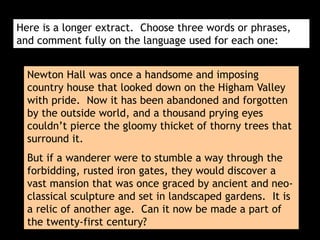
Here is a longer extract. Choose three words or phrases,
and comment fully on the language used for each one:
Newton Hall was once a handsome and imposing
country house that looked down on the Higham Valley
with pride. Now it has been abandoned and forgotten
by the outside world, and a thousand prying eyes
couldn’t pierce the gloomy thicket of thorny trees that
surround it.
But if a wanderer were to stumble a way through the
forbidding, rusted iron gates, they would discover a
vast mansion that was once graced by ancient and neo-
classical sculpture and set in landscaped gardens. It is
a relic of another age. Can it now be made a part of
the twenty-first century?

writers-use-of-language.ppt

  • 1.
    Can you writeabout LANGUAGE? Do you waffle in exams? (To be unable to make a decision; waver) Do you write too little? Do you write too much? Do you just write the first thing that comes into your head? Do you know what the examiner wants? How can you write sensibly about another writer’s words?
  • 2.
    2 gem Think of threethings to say about the meaning of this word – e.g. what it looks like, what it’s for, etc. Now, think of at least one thing about what the word sounds like (say it to yourself). What else does this word make you think of? If you put all your ideas together, you might come up with something like this… (perle)e
  • 3.
    3 A gem isa precious stone – something sparkling and attractive. It might also mean something beautiful and pleasing to the eye. gem The word ‘gem’ is a short ‘clipped’ word, that makes me think of a small, neat item. This word makes me think of something really worth having, something valuable and perhaps hidden. And if you put all of this in one paragraph you get…
  • 4.
    4 A gem isa precious stone – something sparkling and attractive. It might also mean something beautiful and pleasing to the eye. The word ‘gem’ is a short ‘clipped’ word, that makes me think of a small, neat item. This word makes me think of something really worth having, something valuable and perhaps hidden.
  • 5.
    5 Here it isagain, this time in a sentence: It is, there’s no doubt about it, a gem of a bay, Lulworth Cove. So what is the impact of the word in this sentence? Try to find three things that the writer gains by using the word ‘gem’.
  • 6.
    6 This time, wehave two words to analyse. moving relentlessly Consider the meaning of the two words. Think about the sound of the words. What else do the words make you think of? Write down your ideas and compare them with the next slide.
  • 7.
    7 ‘Moving relentlessly’ meansmoving without stopping – continually on the move. The word ‘relentlessly’ is a long word with a repeated ‘l’ sound, which echoes the repeated movements. The words make me think of something determined and unfeeling, like the sea or an army.
  • 8.
    8 Look at thesentence that contains these words. An almost unbroken line of people is moving relentlessly up the steep path. So what is the impact of the words in this sentence? Try to find three things that the writer wants to make us think, by using the words ‘moving relentlessly’.
  • 9.
    9 You have lookedat three ways to look at language: • looking at the full meaning • listening to what words sound like • thinking of what the words make you think of Let’s identify some other things to look out for…
  • 10.
    10 Is the writingis proper/correct or more casual or friendly? This can be a play on words or a gentle joke with the reader. Words which create pictures in your mind, e.g. metaphors Words which make you feel something, e.g. anger, guilt e.g. exaggeration, or rhetorical questions Words which relate to a particular topic or specialism. formal/informal humour imagery emotive language rhetorical devices technical/specialist See if you can match up each device and description.
  • 11.
    11 For each ofthese extracts, decide which elements of language you would comment on: An almost space-age complex Isn’t it all just a big green theme park? The Eden Project has generated substantial economic benefits for the area. Something huge, strange and magical has been growing in a giant crater in Cornwall.
  • 12.
    12 Here is alonger extract. Choose three words or phrases, and comment fully on the language used for each one: Newton Hall was once a handsome and imposing country house that looked down on the Higham Valley with pride. Now it has been abandoned and forgotten by the outside world, and a thousand prying eyes couldn’t pierce the gloomy thicket of thorny trees that surround it. But if a wanderer were to stumble a way through the forbidding, rusted iron gates, they would discover a vast mansion that was once graced by ancient and neo- classical sculpture and set in landscaped gardens. It is a relic of another age. Can it now be made a part of the twenty-first century?